•Fertilization accomplishes two things:
•Sex (combining genes from two genomes)
•Reproduction (initiates reactions in the egg cytoplasm that allow
development to proceed)
•
•Major Events:1. Contact and recognition between sperm and
eggs.-must be species-specific
•2. Regulation of sperm entry into egg.
•3. Fusion of genetic material of sperm and egg.
•4. Activation of egg metabolism to start development.
•Fertilization Overview
•Sperm formation and structure
•Egg structure and function
•Interactions between sperm and eggs
•Chemoattraction
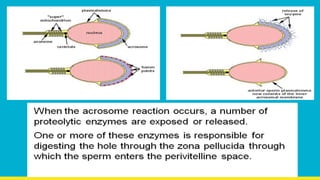
•Acrosome reaction
•Binding and fusion
•Prevention of polyspermy
•Egg activation
•Pronuclear fusion
•Mammalian fertilization
Mammalian Fertilization
•Many similarities with sea urchin; some differences:
•internal fertilization-heterogeneity of sperm population
•-translocation of gametes
•transport of both gametes to the oviduct
•--sperm motility
•-sperm capacitation-chemotaxis, thermotaxis, hyperactivation of motility
•-recognition at the zona pellucida(vitelline envelope in urchin eggs)
•-gamete adhesion
•-sperm-egg binding
•-acrosome reaction
•-prevention of polyspermy
•-fusion of genetic material
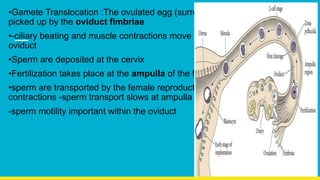
•Gamete Translocation :The ovulated egg (surrounded by cumulus cells) is
picked up by the oviduct fimbriae
•-ciliary beating and muscle contractions move oocyte-cumulus complex into
oviduct
•Sperm are deposited at the cervix
•Fertilization takes place at the ampulla of the fallopian tube
•sperm are transported by the female reproductive tract via uterine muscle
contractions -sperm transport slows at ampulla
-sperm motility important within the oviduct
•Sperm Capacitation (Mammals)
•Freshly ejaculated mammalian sperm cannot fertilize the egg
•-fresh sperm “held up” in the cumulus matrix
•Capacitation–a series of physiological maturation events that take
place in the vaginal tract, uterus, and oviduct.
Galactosyltransferase is a protein in the sperm plasmalemma
that MAY act as the receptor that binds to the zona pellucida and initiates
the acrosome reaction.
•Capacitation involves changes in: membrane lipid carbohydrates,
proteins, membrane potential (becomes more negative), protein
phosphorylation, internal pH, and enzyme activation.
•Hyperactivation, Thermotaxis, Chemotaxis
•Hyperactivation
•Motility patterns change in the oviduct in some species
-hyperactivated motility –higher velocity, greater force
-suited for viscous oviduct fluid
Thermotaxis
•Sperm may be able to sense a thermal gradient
•-ampullaof oviduct is 2°C warmer than isthmus
•-only capacitated sperm can respond thermotactically
Chemotaxis
•Oocytes and cumulus cells may secrete chemotactic agents
•-follicular fluid shows some chemotactic ability
•-only fertilizable follicles had chemotactic activity-only capacitated sperm
respond
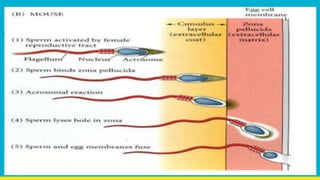
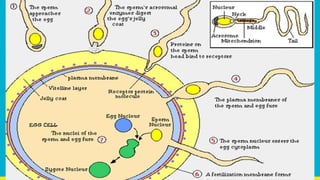
•Fusion of the egg and sperm plasma membranes
•Recognition of sperm by the vitelline envelope or zona pellucida
is followed by the lysis of that portion of the envelope or zona in the
region of the sperm head by the acrosomal enzymes . This lysis is
followed by the fusion of the sperm plasma membrane with the plasma
membrane of the egg. Sperm-egg binding appears to cause the extension
of several microvilli to form the fertilization cone
•In mammals, the fertilin proteins in the sperm plasma membrane are
essential for sperm membrane-egg membrane fusion.
•Mouse fertilin is localized to the posterior plasma membrane of the sperm
head. It adheres the sperm to the egg by binding to the integrin protein on the
egg plasma membrane.
•Moreover, like sea urchin bindin, fertilin has a hydrophobic region that could
potentially mediate the union of the two membranes .
Thus, fertilin appears to bind the sperm plasma membrane to the egg plasma
membrane and then to fuse the two of them together.
When the membranes are fused, the sperm nucleus, mitochondria,
centriole, and flagellum can enter the egg.
Blocks to polyspermy
1.Dilution
2.Fertilizin like secretions cause agglutination of
sperm in some invertebrate species (Does not
occur in mammals)
3. “Hardening” of vitelline membrane or zona
pellucida that results from cortical granule rupture - -
slow block to polyspermy, takes 1 - 5 min
•Thus, only
•1) dilution of the sperm and
•2) hardening of the zona pellucida due to the contents
of the cortical granules act to prevent polyspermy in
most mammals, including humans.
•Within 1to 3 seconds after the binding of the first sperm,
the membrane potential shifts to about +20 mV (Longo et
al. 1986).
•This change is caused by a small influx of sodium ions
into the egg.
Fusion of the sperm with the egg,
The male nucleus enters the egg cytoplasm and becomes the male pronucleus.
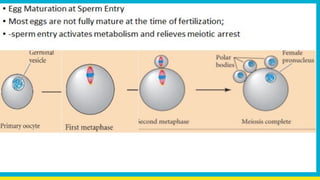
2. As a result of the sperm fusing with the egg plasmalemma, the oocyte
nucleus, which is at metaphase of the second meiotic division, completes that
division giving rise to another polar body.
3. Following the second meiotic division, what is now the nucleus of the ovum
becomes the female pronucleus.
4.The haploid male and female pronuclei move toward one and other, meet,
and fuse to form the diploid nucleus of the zygote.
5.The zygote will now proceed to undergo cleavage.
https://drive.google.com/open?id=1SuJi0B_cFXO7PWeK5ZIUkJxy7Cs_nO2K
•FAQs:
1.The correct sequence of events during fertilization in mammals is
a) capacitation,activation of egg, acrosomal reaction and entry of sperm in egg
b). capacitation, acrosomal reaction, activation of egg and entry of sperm in egg
c) acrosomal reaction, activation of egg, capacitation and entry of sperm in egg
d) activation of egg, acrosomal reaction, entry of sperm in egg and capacitation
2. The chemical substance found in the surface layer of cytoplasm of spermatozoa
is
a) fertilizin b) antifertilizin c) hyaluronidase d) Agglutinin
3. An enzyme which is secreted by mammalian sperms is
a) protein kinase b) hyaluronidase c) collagenase d) pepsin
THANK YOU

Fertilization

  • 3.
    •Fertilization accomplishes twothings: •Sex (combining genes from two genomes) •Reproduction (initiates reactions in the egg cytoplasm that allow development to proceed) • •Major Events:1. Contact and recognition between sperm and eggs.-must be species-specific •2. Regulation of sperm entry into egg. •3. Fusion of genetic material of sperm and egg. •4. Activation of egg metabolism to start development.
  • 4.
    •Fertilization Overview •Sperm formationand structure •Egg structure and function •Interactions between sperm and eggs •Chemoattraction •Acrosome reaction •Binding and fusion •Prevention of polyspermy •Egg activation •Pronuclear fusion •Mammalian fertilization
  • 6.
    Mammalian Fertilization •Many similaritieswith sea urchin; some differences: •internal fertilization-heterogeneity of sperm population •-translocation of gametes •transport of both gametes to the oviduct •--sperm motility •-sperm capacitation-chemotaxis, thermotaxis, hyperactivation of motility •-recognition at the zona pellucida(vitelline envelope in urchin eggs) •-gamete adhesion •-sperm-egg binding •-acrosome reaction •-prevention of polyspermy •-fusion of genetic material
  • 7.
    •Gamete Translocation :Theovulated egg (surrounded by cumulus cells) is picked up by the oviduct fimbriae •-ciliary beating and muscle contractions move oocyte-cumulus complex into oviduct •Sperm are deposited at the cervix •Fertilization takes place at the ampulla of the fallopian tube •sperm are transported by the female reproductive tract via uterine muscle contractions -sperm transport slows at ampulla -sperm motility important within the oviduct
  • 8.
    •Sperm Capacitation (Mammals) •Freshlyejaculated mammalian sperm cannot fertilize the egg •-fresh sperm “held up” in the cumulus matrix •Capacitation–a series of physiological maturation events that take place in the vaginal tract, uterus, and oviduct. Galactosyltransferase is a protein in the sperm plasmalemma that MAY act as the receptor that binds to the zona pellucida and initiates the acrosome reaction. •Capacitation involves changes in: membrane lipid carbohydrates, proteins, membrane potential (becomes more negative), protein phosphorylation, internal pH, and enzyme activation.
  • 9.
    •Hyperactivation, Thermotaxis, Chemotaxis •Hyperactivation •Motilitypatterns change in the oviduct in some species -hyperactivated motility –higher velocity, greater force -suited for viscous oviduct fluid Thermotaxis •Sperm may be able to sense a thermal gradient •-ampullaof oviduct is 2°C warmer than isthmus •-only capacitated sperm can respond thermotactically
  • 10.
    Chemotaxis •Oocytes and cumuluscells may secrete chemotactic agents •-follicular fluid shows some chemotactic ability •-only fertilizable follicles had chemotactic activity-only capacitated sperm respond
  • 12.
    •Fusion of theegg and sperm plasma membranes •Recognition of sperm by the vitelline envelope or zona pellucida is followed by the lysis of that portion of the envelope or zona in the region of the sperm head by the acrosomal enzymes . This lysis is followed by the fusion of the sperm plasma membrane with the plasma membrane of the egg. Sperm-egg binding appears to cause the extension of several microvilli to form the fertilization cone
  • 13.
    •In mammals, thefertilin proteins in the sperm plasma membrane are essential for sperm membrane-egg membrane fusion. •Mouse fertilin is localized to the posterior plasma membrane of the sperm head. It adheres the sperm to the egg by binding to the integrin protein on the egg plasma membrane. •Moreover, like sea urchin bindin, fertilin has a hydrophobic region that could potentially mediate the union of the two membranes . Thus, fertilin appears to bind the sperm plasma membrane to the egg plasma membrane and then to fuse the two of them together. When the membranes are fused, the sperm nucleus, mitochondria, centriole, and flagellum can enter the egg.
  • 15.
    Blocks to polyspermy 1.Dilution 2.Fertilizinlike secretions cause agglutination of sperm in some invertebrate species (Does not occur in mammals) 3. “Hardening” of vitelline membrane or zona pellucida that results from cortical granule rupture - - slow block to polyspermy, takes 1 - 5 min
  • 16.
    •Thus, only •1) dilutionof the sperm and •2) hardening of the zona pellucida due to the contents of the cortical granules act to prevent polyspermy in most mammals, including humans.
  • 17.
    •Within 1to 3seconds after the binding of the first sperm, the membrane potential shifts to about +20 mV (Longo et al. 1986). •This change is caused by a small influx of sodium ions into the egg.
  • 18.
    Fusion of thesperm with the egg, The male nucleus enters the egg cytoplasm and becomes the male pronucleus. 2. As a result of the sperm fusing with the egg plasmalemma, the oocyte nucleus, which is at metaphase of the second meiotic division, completes that division giving rise to another polar body. 3. Following the second meiotic division, what is now the nucleus of the ovum becomes the female pronucleus. 4.The haploid male and female pronuclei move toward one and other, meet, and fuse to form the diploid nucleus of the zygote. 5.The zygote will now proceed to undergo cleavage.
  • 20.
  • 21.
    •FAQs: 1.The correct sequenceof events during fertilization in mammals is a) capacitation,activation of egg, acrosomal reaction and entry of sperm in egg b). capacitation, acrosomal reaction, activation of egg and entry of sperm in egg c) acrosomal reaction, activation of egg, capacitation and entry of sperm in egg d) activation of egg, acrosomal reaction, entry of sperm in egg and capacitation 2. The chemical substance found in the surface layer of cytoplasm of spermatozoa is a) fertilizin b) antifertilizin c) hyaluronidase d) Agglutinin 3. An enzyme which is secreted by mammalian sperms is a) protein kinase b) hyaluronidase c) collagenase d) pepsin
  • 22.