OUTLINE:
 Ovarian cycle.
 Ovulation.
 Fertilization.
 Cleavage.
 Blastocyst formation.
 Implantation.
OVARIAN CYCLE:
• Series of events in the ovaries that occur during and after the
maturation of the oocyte (egg or ovum).
• Development and release of oocytes in the ovary and changes in the
follicles.
• Ouccurs within 28days and involves both oogenesis, the process of
formation and development of oocyte, and preparation of the uterus
to receive a fertilized ovum.
• The cycle consists of follicular phase and luteal phase.
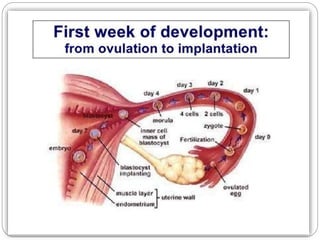
OVULATION:
 Ovulation is the release of eggs from the ovaries. In humans, this event occurs
when the follicles rupture and release the secondary oocyte ovarian
cells.[1] After ovulation, during the luteal phase, the egg will be available to
be fertilized by sperm. In addition, the uterinelining (endometrium) is thickened
to be able to receive a fertilized egg. If no conception occurs, the uterine lining
as well as blood will be shed during menstruation.[2]
 The process of ovulation is controlled by the hypothalamus of the brain and
through the release of hormones secreted in the anterior lobe of the pituitary
gland, luteinizing hormone (LH) and follicle-stimulating hormone (FSH).
 In humans, ovulation occurs about midway through the menstrual cycle, after
the follicular phase.
 The few days surrounding ovulation (from approximately days 10 to 18 of a 28-
day cycle), constitute the most fertile phase.
FERTILIZATION:
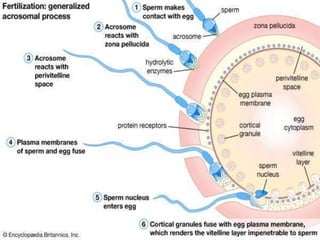
 After ovulation, the unfertilized egg is arrested in prophase of meiosis
II and contains one polar body left over from meiosis I. Fertilization is a
process of several events and typically takes place in the ampullated
portion of the uterine tube:
• Capacitation:
Changes take place in the glycoprotein coat of sperm as they travel up
the female reproductive tract. These changes are absolutely essential for
fertilization. Thus, to perform successful in vitro fertilization you must add
some tissue extracted from the female reproductive tract in addition to the
sperm and egg extracted from the parents.
• Approximation:
Only a tiny fraction of sperm actually reaches the ampulla of the uterine
tube to be near the egg.
• Penetration of Corona Radiata:
The sperm uses both chemical and physical means to penetrate the
egg’s corona radiata:
 The action of membrane-bound enzyme hyaluronidase on its coat,
 Swimming motion of its flagellum.
 Penetration of Zona Pellucida:
Once inside the corona radiata, the sperm binds to the species-specific
ZP3 receptor on the egg’s glycoprotein coat. This triggers
the acrosomal reaction, or the release of enzymes stored in the
sperm’s acrosome (e.g. acrosin). These enzymes help the sperm “drill
through” the zona pellucida.
 Once the sperm has penetrated the outer layers it fuses with the plasma
membrane of the egg and releases its contents inside. The head and
the tail of the sperm degrade, so that all mitochondria in the embryo
(and all mitochondrial DNA) come from the mother.
Cortical Reaction:
Entry of a sperm into the egg triggers changes that prevent polyspermy
(fertilization of an egg by more than one sperm). These changes are known
as the cortical reaction.
Phase Description
 Fast block
 Slow block
 Electrical depolarization of the egg’s surface (–
70Mv ® +10Mv) works for a short time to repel other
sperm electrostatically.
 A wave of Ca++ ions released from the point of sperm
entry spreads through the egg. This causes cortical
granules in the egg to release their
contents. Polysaccharides in the cortical granules
reach the outside of the egg and form a physical barrier
to sperm penetration. Enzymes in the granules break
down the ZP3 receptors in the zona pellucida and also
further harden the coat.
 Fusion of Pronuclei:
• DNA in the male pronucleus is packed very tightly with
protamines to make it compact enough to fit inside a sperm.
• These protamines are replaced by histones inside the egg,
unpacking the DNA.
• Afterwards the male and female pronuclei fuse and the egg
completes its second meiotic division, resulting in a
second polar body.
• The fertilized egg is now known as the zygote (“together”).
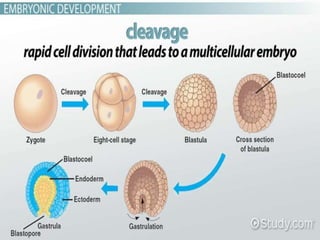
CLEAVAGE:
 The zygote undergoes a number of ordinary mitotic divisions that
increase the number of cells in the zygote but not its overall size.
 Each cycle of division takes about 24 hours.
 The individual cells are known as blastomeres.
 At the 32-cell stage the embryo is known as a morula (L.
“mulberry”), a solid ball consisting of an inner cell mass and
an outer cell mass. The inner cell mass will eventually become
the embryo and fetus, while the outer cell mass will eventually
become part of the placenta
BLASTOCYST FORMATION:
 Compaction:
The cells on the outside of the morula form tight intercellular
junctions and express ion channels to create an impermeable
barrier.
• Cavitation:
A fluid-filled cavity forms inside the morula. This cavity is known
as the blastocyst cavity or blastocoele, and the morula is now
called a blastula or blastocyst. The inner cell mass is now known
as the embryoblast and the outer cell mass becomes
the trophoblast.
IMPLANTATION:
 Hatching:
The blastula sheds its zona pellucida. This is required for implantation
to occur. One function of the zona pellucida is to prevent premature
implantation.
• Attachment and Invasion:
The embryo attaches to and invades into the maternal
endometrium. The trophoblast differentiates into
the cytotrophoblast and the syncytiotrophoblast. The embryo
typically implants in the posterior superior wall of the
uterus. The response of the maternal endrometrial cells to the
invading embryo is called the decidual reaction.
SUMMARY:
 Mammalian fertilization begins when the head of a sperm binds in a
species-specific mannerto the zona pellucido surrounding the egg.
 This induces the acrosome reaction in the sperm, which releases the
spermato digest its way through the zonato the egg plasma membrane
in order to fuse with it.
 The fusion of the sperm with the egg induces a Ca2+ signal, in the egg.
 The Ca2+ signal activates the egg to undergo the cortical reaction, in
which cortical granules release their contents, including enzymes that
alter the zona pellucida and thereby prevent the fusion of additional
sperm.
 The Ca2+ signal also triggers the development of the zygote, which
begins after sperm and egg haploidpronuclei have come together, and
their chromosomes have aligned on a single mitotic spindle , which
mediates the first division of the zygote.
REFERENCES:
 Embryology.med
 Langman’s medical embrology.
 Sciencedirect.com
Embryo  1st week

Embryo 1st week

  • 3.
    OUTLINE:  Ovarian cycle. Ovulation.  Fertilization.  Cleavage.  Blastocyst formation.  Implantation.
  • 4.
    OVARIAN CYCLE: • Seriesof events in the ovaries that occur during and after the maturation of the oocyte (egg or ovum). • Development and release of oocytes in the ovary and changes in the follicles. • Ouccurs within 28days and involves both oogenesis, the process of formation and development of oocyte, and preparation of the uterus to receive a fertilized ovum. • The cycle consists of follicular phase and luteal phase.
  • 6.
    OVULATION:  Ovulation isthe release of eggs from the ovaries. In humans, this event occurs when the follicles rupture and release the secondary oocyte ovarian cells.[1] After ovulation, during the luteal phase, the egg will be available to be fertilized by sperm. In addition, the uterinelining (endometrium) is thickened to be able to receive a fertilized egg. If no conception occurs, the uterine lining as well as blood will be shed during menstruation.[2]  The process of ovulation is controlled by the hypothalamus of the brain and through the release of hormones secreted in the anterior lobe of the pituitary gland, luteinizing hormone (LH) and follicle-stimulating hormone (FSH).  In humans, ovulation occurs about midway through the menstrual cycle, after the follicular phase.  The few days surrounding ovulation (from approximately days 10 to 18 of a 28- day cycle), constitute the most fertile phase.
  • 7.
    FERTILIZATION:  After ovulation,the unfertilized egg is arrested in prophase of meiosis II and contains one polar body left over from meiosis I. Fertilization is a process of several events and typically takes place in the ampullated portion of the uterine tube: • Capacitation: Changes take place in the glycoprotein coat of sperm as they travel up the female reproductive tract. These changes are absolutely essential for fertilization. Thus, to perform successful in vitro fertilization you must add some tissue extracted from the female reproductive tract in addition to the sperm and egg extracted from the parents.
  • 8.
    • Approximation: Only atiny fraction of sperm actually reaches the ampulla of the uterine tube to be near the egg. • Penetration of Corona Radiata: The sperm uses both chemical and physical means to penetrate the egg’s corona radiata:  The action of membrane-bound enzyme hyaluronidase on its coat,  Swimming motion of its flagellum.
  • 9.
     Penetration ofZona Pellucida: Once inside the corona radiata, the sperm binds to the species-specific ZP3 receptor on the egg’s glycoprotein coat. This triggers the acrosomal reaction, or the release of enzymes stored in the sperm’s acrosome (e.g. acrosin). These enzymes help the sperm “drill through” the zona pellucida.  Once the sperm has penetrated the outer layers it fuses with the plasma membrane of the egg and releases its contents inside. The head and the tail of the sperm degrade, so that all mitochondria in the embryo (and all mitochondrial DNA) come from the mother.
  • 10.
    Cortical Reaction: Entry ofa sperm into the egg triggers changes that prevent polyspermy (fertilization of an egg by more than one sperm). These changes are known as the cortical reaction. Phase Description  Fast block  Slow block  Electrical depolarization of the egg’s surface (– 70Mv ® +10Mv) works for a short time to repel other sperm electrostatically.  A wave of Ca++ ions released from the point of sperm entry spreads through the egg. This causes cortical granules in the egg to release their contents. Polysaccharides in the cortical granules reach the outside of the egg and form a physical barrier to sperm penetration. Enzymes in the granules break down the ZP3 receptors in the zona pellucida and also further harden the coat.
  • 11.
     Fusion ofPronuclei: • DNA in the male pronucleus is packed very tightly with protamines to make it compact enough to fit inside a sperm. • These protamines are replaced by histones inside the egg, unpacking the DNA. • Afterwards the male and female pronuclei fuse and the egg completes its second meiotic division, resulting in a second polar body. • The fertilized egg is now known as the zygote (“together”).
  • 13.
    CLEAVAGE:  The zygoteundergoes a number of ordinary mitotic divisions that increase the number of cells in the zygote but not its overall size.  Each cycle of division takes about 24 hours.  The individual cells are known as blastomeres.  At the 32-cell stage the embryo is known as a morula (L. “mulberry”), a solid ball consisting of an inner cell mass and an outer cell mass. The inner cell mass will eventually become the embryo and fetus, while the outer cell mass will eventually become part of the placenta
  • 15.
    BLASTOCYST FORMATION:  Compaction: Thecells on the outside of the morula form tight intercellular junctions and express ion channels to create an impermeable barrier. • Cavitation: A fluid-filled cavity forms inside the morula. This cavity is known as the blastocyst cavity or blastocoele, and the morula is now called a blastula or blastocyst. The inner cell mass is now known as the embryoblast and the outer cell mass becomes the trophoblast.
  • 17.
    IMPLANTATION:  Hatching: The blastulasheds its zona pellucida. This is required for implantation to occur. One function of the zona pellucida is to prevent premature implantation. • Attachment and Invasion: The embryo attaches to and invades into the maternal endometrium. The trophoblast differentiates into the cytotrophoblast and the syncytiotrophoblast. The embryo typically implants in the posterior superior wall of the uterus. The response of the maternal endrometrial cells to the invading embryo is called the decidual reaction.
  • 19.
    SUMMARY:  Mammalian fertilizationbegins when the head of a sperm binds in a species-specific mannerto the zona pellucido surrounding the egg.  This induces the acrosome reaction in the sperm, which releases the spermato digest its way through the zonato the egg plasma membrane in order to fuse with it.  The fusion of the sperm with the egg induces a Ca2+ signal, in the egg.  The Ca2+ signal activates the egg to undergo the cortical reaction, in which cortical granules release their contents, including enzymes that alter the zona pellucida and thereby prevent the fusion of additional sperm.  The Ca2+ signal also triggers the development of the zygote, which begins after sperm and egg haploidpronuclei have come together, and their chromosomes have aligned on a single mitotic spindle , which mediates the first division of the zygote.
  • 20.
    REFERENCES:  Embryology.med  Langman’smedical embrology.  Sciencedirect.com