SABAHAT BATOOL
KHUSHNUMA.
3RD BSC ā€˜CBZ’ , ’A’ SEC, VI SEM
REG NO: 17KFS85342
GWC, KOLAR.
DATED: 7/10/2019
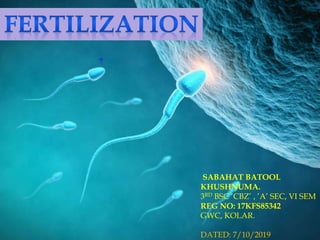
 Fertilization is the fusion of haploid gametes,
egg and sperm, to form the diploid zygote.
 fertilization process which occurs naturally
within the body or through reproductive
technologies outside the body, the overall
product in both cases is a diploid zygote
 It also activates the egg, triggers the beginning
of embryonic development.
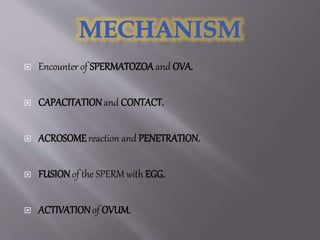
 Encounter of SPERMATOZOA and OVA.
 CAPACITATIONand CONTACT.
 ACROSOME reaction and PENETRATION.
 FUSIONof the SPERM with EGG.
 ACTIVATIONof OVUM.
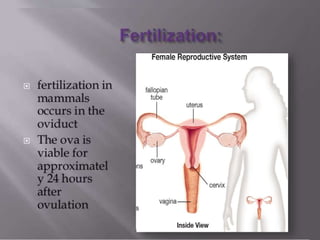
 During the fertilization phase, millions of sperms
travel from vagina to the uterus and into the
fallopian tube.
 CHEMOTAXIS – A chemical substance is found in
the cortex of egg.
 In general interaction is through special devices or
particular forms of behavior.
 The primary need is a fluid medium for the act of
fertilization and delivery of sperm to the egg.
 2 types of FERTILIZATION.
 EXTERNAL FERTILISATION.
• Occurs outside of the body of the female
• Increased number of eggs produced to insure the
survival of the species
Eg : Fish and Amphibians.
 INTERNAL FERTILIZATION.
• Occurs inside the body of the female.
• Fewer number of egg are produced.
• Increased parental care insure species survival
Eg : mammals, reptiles, birds.
 Several thousand sperms
reach the egg and
one will fertilize it.
 When the sperm fuses
with the egg it initiates
a series of chemical
changes that prevent
anyother sperm from entering.
 Sperm undergoes capaciation (further
maturation) within the female reproductive
tract
 Occurs in the female’s vagina.
 Vaginal secretions cause a molecular change
in the sperm plasma lemma (removal of
decapacitating factor – semen proteins ,
results in increased membrane fluidity).
 Takes 4-5 hours in humans.
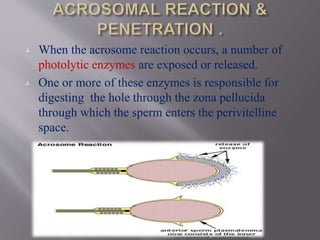
 When the acrosome reaction occurs, a number of
photolytic enzymes are exposed or released.
 One or more of these enzymes is responsible for
digesting the hole through the zona pellucida
through which the sperm enters the perivitelline
space.
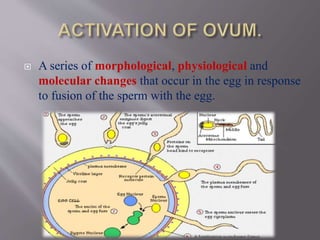
 The male nucleus enters the egg cytoplasm and becomes
the male pronucleus.
 As a result of the sperm fusing with the egg plasma
lemma, the oocyte nucleus, which is at metaphase of the
second meiotic division, completes that division giving
rise to another polar body.
 Following the second meiotic division, what is now the
nucleus of the ovum becomes the female pronucleus.
 The haploid male and female pronuclei move toward one
another, meet, and fuse to form the diploid nucleus of the
zygote.
 The zygote will now proceed to undergo cleavage.
 A series of morphological, physiological and
molecular changes that occur in the egg in response
to fusion of the sperm with the egg.
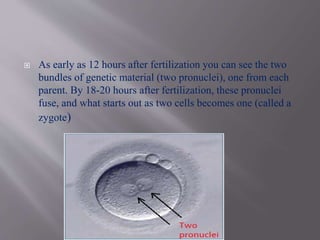
 As early as 12 hours after fertilization you can see the two
bundles of genetic material (two pronuclei), one from each
parent. By 18-20 hours after fertilization, these pronuclei
fuse, and what starts out as two cells becomes one (called a
zygote)
SABAHAT BATOOL KHUSHNUMA
REG `17KFS85342.

Fertilization

  • 1.
    SABAHAT BATOOL KHUSHNUMA. 3RD BSCā€˜CBZ’ , ’A’ SEC, VI SEM REG NO: 17KFS85342 GWC, KOLAR. DATED: 7/10/2019
  • 2.
     Fertilization isthe fusion of haploid gametes, egg and sperm, to form the diploid zygote.  fertilization process which occurs naturally within the body or through reproductive technologies outside the body, the overall product in both cases is a diploid zygote  It also activates the egg, triggers the beginning of embryonic development.
  • 4.
     Encounter ofSPERMATOZOA and OVA.  CAPACITATIONand CONTACT.  ACROSOME reaction and PENETRATION.  FUSIONof the SPERM with EGG.  ACTIVATIONof OVUM.
  • 6.
     During thefertilization phase, millions of sperms travel from vagina to the uterus and into the fallopian tube.  CHEMOTAXIS – A chemical substance is found in the cortex of egg.  In general interaction is through special devices or particular forms of behavior.  The primary need is a fluid medium for the act of fertilization and delivery of sperm to the egg.  2 types of FERTILIZATION.
  • 7.
     EXTERNAL FERTILISATION. •Occurs outside of the body of the female • Increased number of eggs produced to insure the survival of the species Eg : Fish and Amphibians.  INTERNAL FERTILIZATION. • Occurs inside the body of the female. • Fewer number of egg are produced. • Increased parental care insure species survival Eg : mammals, reptiles, birds.
  • 8.
     Several thousandsperms reach the egg and one will fertilize it.  When the sperm fuses with the egg it initiates a series of chemical changes that prevent anyother sperm from entering.
  • 9.
     Sperm undergoescapaciation (further maturation) within the female reproductive tract  Occurs in the female’s vagina.  Vaginal secretions cause a molecular change in the sperm plasma lemma (removal of decapacitating factor – semen proteins , results in increased membrane fluidity).  Takes 4-5 hours in humans.
  • 11.
     When theacrosome reaction occurs, a number of photolytic enzymes are exposed or released.  One or more of these enzymes is responsible for digesting the hole through the zona pellucida through which the sperm enters the perivitelline space.
  • 13.
     The malenucleus enters the egg cytoplasm and becomes the male pronucleus.  As a result of the sperm fusing with the egg plasma lemma, the oocyte nucleus, which is at metaphase of the second meiotic division, completes that division giving rise to another polar body.  Following the second meiotic division, what is now the nucleus of the ovum becomes the female pronucleus.  The haploid male and female pronuclei move toward one another, meet, and fuse to form the diploid nucleus of the zygote.  The zygote will now proceed to undergo cleavage.
  • 14.
     A seriesof morphological, physiological and molecular changes that occur in the egg in response to fusion of the sperm with the egg.
  • 15.
     As earlyas 12 hours after fertilization you can see the two bundles of genetic material (two pronuclei), one from each parent. By 18-20 hours after fertilization, these pronuclei fuse, and what starts out as two cells becomes one (called a zygote)
  • 17.