Definition
• Fertilization isthe union of a male gamete
(sperm) and a female gamete (ovum) to form
a zygote, marking the beginning of a new
organism.
3.
Site of Fertilization
•In mammals, fertilization occurs in the
fallopian tube, specifically in the ampulla
region. This area provides optimal
temperature, pH, and nutrients for gamete
interaction.
4.
Conditions Necessary for
Fertilization
•- Release of a mature ovum (ovulation)
• - Presence of viable sperm in the female tract
• - Sperm survival and motility
• - Proper timing and favorable environment in
the oviduct
5.
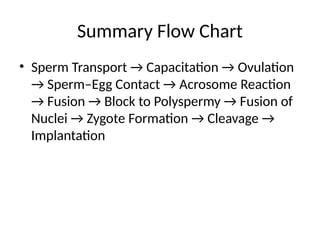
Step 1: SpermTransport
• Sperm are ejaculated into the vagina during
copulation.
• They travel through the cervix and uterus to
the fallopian tube with the help of flagellar
movement and uterine contractions. Only a
few reach the oviduct.
6.
Step 2: Capacitationof Sperm
• Sperm undergo biochemical changes in the
female tract (capacitation), making them
capable of fertilizing the egg.
• Their membranes become more permeable,
and motility increases.
7.
Step 3: Ovulationand Egg
Transport
• The mature ovum is released from the ovary
and swept into the fallopian tube by cilia.
• It is surrounded by the corona radiata and
zona pellucida.
8.
Step 4: Sperm–EggRecognition
• Sperm bind to receptors on the zona
pellucida.
• Only sperm of the same species can
successfully attach and proceed.
9.
Step 5: AcrosomeReaction
• The acrosome releases enzymes
(hyaluronidase, acrosin) that digest the egg
coverings, allowing sperm penetration.
10.
Step 6: Fusionof Sperm and Egg
Membranes
• Sperm head and midpiece enter the egg
cytoplasm; the tail remains outside.
• Chemical changes prevent entry of additional
sperm.
11.
Step 7: Blockto Polyspermy
• The cortical reaction releases enzymes that
harden the zona pellucida and destroy sperm
receptors, ensuring only one sperm fertilizes
the egg.
12.
Step 8: Activationof the Egg
• The sperm’s entry stimulates the egg to
complete meiosis II, forming a mature ovum
and second polar body.
13.
Step 9: Fusionof Pronuclei
• The male and female pronuclei fuse to form a
diploid zygote with complete genetic material.
14.
Step 10: Formationof the Zygote
• The zygote is the first cell of the new
organism. It begins to divide and develop into
an embryo.
15.
Events After Fertilization
•- Cleavage (cell division)
• - Blastocyst formation
• - Implantation in the uterine wall
• - Embryo and placenta development
16.
Importance of Fertilization
•- Restores diploid chromosome number
• - Determines genetic makeup and sex
• - Initiates embryo development
• - Ensures species continuity