Dr. Fakhar un Nisa
 At the end of lecture ,students will be able to
 Describe factors affecting the
spermatogenesis.
 Discuss the process of maturation of sperm.
 Explain the acrosome reaction.
 Explain the Capacitation.
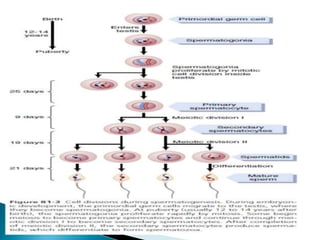
Hormonal Factors That Stimulate
Spermatogenesis
• H ormones play essential role in
spermatogenesis:
• Testosterone, secreted by the Leydig cells
located in the interstitium of the testis, is
essential for growth and division of
the
testicular germinal cells, which is the
first stage in forming sperm.
• Luteinizing hormone, secreted by the anterior
pituitary gland, stimulates the Leydig cells to
secrete testosterone.
• Follicle-stimulating hormone, also secreted
by the anterior pituitary gland, stimulates the
Sertoli cells; It causes the
conversion of the spermatids to sperm (the
process of spermiogenesis) will not occur.
• Estrogens, formed from testosterone by the Sertoli ce
lls
when they are stimulated by follicle-stimulating
hormone, are probably also essential for
spermiogenesis.
• Growth hormone (as well as most of the other body
hormones) is necessary for controlling background
metabolic functions of the testes.
• Growth hormone specifically promotes early division
of the spermatogonia themselves; in its absence, as in
pituitary dwarfs, spermatogenesis is severely deficient
or absent, thus causing infertility.
Maturation of Sperm in the Epididymis
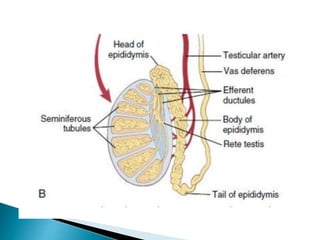
• After formation in the seminiferous tubules,
the sperm require several days to pass through
the 6-meter-long tubule of the epididymis.
• Sperm removed from the seminiferous tubules
and from the early portions of the epididymis
are nonmotile, and they cannot fertilize
an
ovum.
• After the sperm have been in the epididymis
for 18 to 24 hours, they develop the capability
of motility, even though several inhibitory
proteins in the epididymal fluid still prevent
final motility until after ejaculation.
Storage of Sperm in the Testes
• The two testes of the human adult form up to
120 million sperm each day.
• A small quantity of these can be stored in the
epididymis, but most are stored in the vas
deferens.
• They can remain stored, maintaining their
fertility, for at least a month.
• After ejaculation, the sperm become motile, and
they also become capable of fertilizing the ovum,
a process called maturation.
• The Sertoli cells and the epithelium of the
epididymis secrete a special nutrient fluid that is
ejaculated along with the sperm.
• This fluid contains hormones (including both
testosterone and estrogens), enzymes, and special
nutrients that are essential for sperm maturation.
Physiology of the Mature Sperm
• The normal motile, fertile sperm are capable of
flagellated movement through the fluid
medium at velocities of 1 to 4 mm/min.
• The activity of sperm is greatly enhanced in a
neutral and slightly alkaline medium, as exists
in the ejaculated semen, but it is greatly
depressed in a mildly acidic medium.
• A strong acidic medium can cause rapid death
of sperm. Flagella moves in quasi-
sinusoidal waves
• The activity of sperm increases markedly with
increasing temperature, but so does the rate of
metabolism, causing the life of the sperm to be
considerably shortened.
• Although sperm can live for many weeks in
the suppressed state in the genital ducts of the
testes, life expectancy of ejaculated sperm in
the female genital tract is only 1 to 2 days.
Medicolegal importance in rape cases.
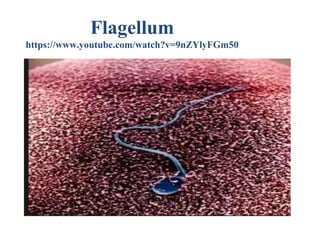
Flagellum
https://www.youtube.com/watch?v=9nZYlyFGm50
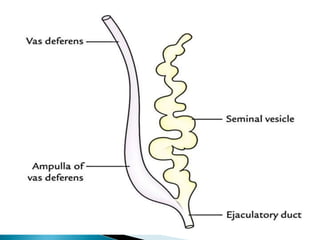
Function of the Seminal Vesicles
Each seminal vesicle is a tortuous, glands
lined with a secretory epithelium that
secretes a mucoid material containing an
abundance of
fructose, citric acid, prostaglandins and
fibrinogen.
 Prostaglandins are believed to aid fertilization
in two ways:
 (1) by reacting with the female cervical mucus
to make it more receptive to sperm
movement and
 (2) by possibly causing backward, reverse
peristaltic contractions in the uterus and
fallopian tubes to move the ejaculated sperm
toward the ovarie
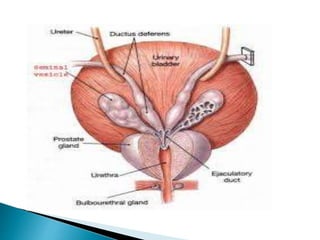
 The prostate gland secretes a thin, milky fluid that
contains calcium, citrate ion, phosphate ion, a
clotting enzyme, and a profibrinolysin.
 A slightly alkaline characteristic of the prostatic fluid
may be quite important for successful fertilization of
the ovum.
 Sperm do not become optimally motile until the pH
of the surrounding fluids rises to about 6.0 to 6.5.
 Although spermatozoa are said to be “mature” when
they leave the epididymis, their activity is held in
check by multiple inhibitory factors secreted by the
genital duct epithelia.
 Therefore, when they are first expelled in the semen,
they are unable to perform their duties in fertilizing
the ovum.
 However, on coming in contact with the fluids
of the female genital tract,
 multiple changes occur that activate the sperm
for the final processes of fertilization.
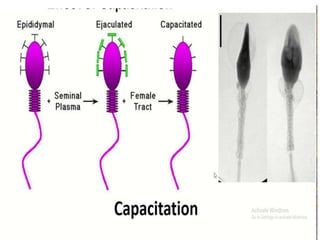
 These collective changes are called
capacitation of the spermatozoa.
 This normally requires from 1 to 10 hours
 Some changes that are believed to occur are
the following:
1. The uterine and fallopian tube fluids wash
away the various inhibitory factors that
suppress sperm activity in the male genital
ducts.
While the spermatozoa remain in the fluid of the male
genital ducts, they are continually exposed to many
floating vesicles from the seminiferous tubules
containing large amounts of cholesterol.
 This cholesterol is continually added to the cellular
membrane covering the sperm acrosome,
 toughening this membrane and preventing release
of its enzymes.
 After ejaculation,
 the sperm deposited in the vagina swim away from the
cholesterol vesicles upward into the uterine cavity, and they
gradually lose much of their other excess cholesterol over the
next few hours.
 In so doing, the membrane at the head of the sperm (the
acrosome) becomes much weaker
The membrane of the sperm also becomes much more
permeable to calcium ions,
so that calcium now enters the sperm in abundance
and changes the activity of the flagellum, giving it a
powerful whiplash motion in contrast to its
previously weak undulating motion.
 In addition, the calcium ions cause changes in the cellular
membrane that covers the leading edge of the acrosome,
making it possible for the acrosome to release its enzymes
rapidly and
 easily as the sperm penetrates the granulosa cell mass
surrounding the ovum,
 and even more so as it attempts to penetrate the zona pellucida
of the ovum itself.
 Stored in the acrosome of the sperm are large quantities
of hyaluronidase and proteolytic enzymes.
 Hyaluronidase depolymerizes the hyaluronic acid
polymers in the intercellular cement that holds the
ovarian granulosa cells together.
 The proteolytic enzymes digest proteins in the
structural elements of tissue cells that still adhere to the
ovum.
 When the ovum is expelled from the ovarian follicle
into the fallopian tube, it still carries with it multiple
layers of granulosa cells.
 Before a sperm can fertilize the ovum, it must dissolute
these granulosa cell layers, and then it must penetrate
though the thick covering of the ovum itself, the zona
pellucida
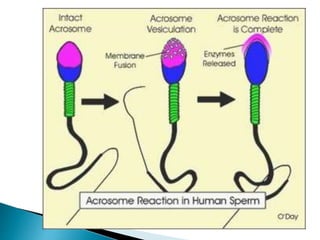
 To achieve this, the stored enzymes in the acrosome
begin to be released.
 It is believed that the hyaluronidase among these
enzymes is especially important in opening pathways
between the granulosa cells so that the sperm can reach
the ovum.
 When the sperm reaches the zona pellucida of the
ovum, the anterior membrane of the sperm binds
specifically with receptor proteins in the zona
pellucida.
 Next, the entire acrosome rapidly dissolves and all the
acrosomal enzymes are released
 Within minutes, these enzymes open a penetrating
pathway for passage of the sperm head through the
zona pellucida to the inside of the ovum.
 Within another 30 minutes, the cell membranes of the
sperm head and of the oocyte fuse with each other to
form a single cell.
 At the same time, the genetic material of the sperm and
the oocyte combine to form a completely new cell
genome, containing equal numbers of chromosomes
and genes from mother and father

capacitation ,Acrosome reaction.pptx

  • 1.
  • 2.
     At theend of lecture ,students will be able to  Describe factors affecting the spermatogenesis.  Discuss the process of maturation of sperm.  Explain the acrosome reaction.  Explain the Capacitation.
  • 5.
    Hormonal Factors ThatStimulate Spermatogenesis • H ormones play essential role in spermatogenesis: • Testosterone, secreted by the Leydig cells located in the interstitium of the testis, is essential for growth and division of the testicular germinal cells, which is the first stage in forming sperm.
  • 7.
    • Luteinizing hormone,secreted by the anterior pituitary gland, stimulates the Leydig cells to secrete testosterone. • Follicle-stimulating hormone, also secreted by the anterior pituitary gland, stimulates the Sertoli cells; It causes the conversion of the spermatids to sperm (the process of spermiogenesis) will not occur.
  • 8.
    • Estrogens, formedfrom testosterone by the Sertoli ce lls when they are stimulated by follicle-stimulating hormone, are probably also essential for spermiogenesis. • Growth hormone (as well as most of the other body hormones) is necessary for controlling background metabolic functions of the testes. • Growth hormone specifically promotes early division of the spermatogonia themselves; in its absence, as in pituitary dwarfs, spermatogenesis is severely deficient or absent, thus causing infertility.
  • 9.
    Maturation of Spermin the Epididymis • After formation in the seminiferous tubules, the sperm require several days to pass through the 6-meter-long tubule of the epididymis. • Sperm removed from the seminiferous tubules and from the early portions of the epididymis are nonmotile, and they cannot fertilize an ovum.
  • 10.
    • After thesperm have been in the epididymis for 18 to 24 hours, they develop the capability of motility, even though several inhibitory proteins in the epididymal fluid still prevent final motility until after ejaculation.
  • 11.
    Storage of Spermin the Testes • The two testes of the human adult form up to 120 million sperm each day. • A small quantity of these can be stored in the epididymis, but most are stored in the vas deferens. • They can remain stored, maintaining their fertility, for at least a month.
  • 12.
    • After ejaculation,the sperm become motile, and they also become capable of fertilizing the ovum, a process called maturation. • The Sertoli cells and the epithelium of the epididymis secrete a special nutrient fluid that is ejaculated along with the sperm. • This fluid contains hormones (including both testosterone and estrogens), enzymes, and special nutrients that are essential for sperm maturation.
  • 13.
    Physiology of theMature Sperm • The normal motile, fertile sperm are capable of flagellated movement through the fluid medium at velocities of 1 to 4 mm/min. • The activity of sperm is greatly enhanced in a neutral and slightly alkaline medium, as exists in the ejaculated semen, but it is greatly depressed in a mildly acidic medium. • A strong acidic medium can cause rapid death of sperm. Flagella moves in quasi- sinusoidal waves
  • 14.
    • The activityof sperm increases markedly with increasing temperature, but so does the rate of metabolism, causing the life of the sperm to be considerably shortened. • Although sperm can live for many weeks in the suppressed state in the genital ducts of the testes, life expectancy of ejaculated sperm in the female genital tract is only 1 to 2 days. Medicolegal importance in rape cases.
  • 15.
  • 16.
    Function of theSeminal Vesicles Each seminal vesicle is a tortuous, glands lined with a secretory epithelium that secretes a mucoid material containing an abundance of fructose, citric acid, prostaglandins and fibrinogen.
  • 18.
     Prostaglandins arebelieved to aid fertilization in two ways:  (1) by reacting with the female cervical mucus to make it more receptive to sperm movement and  (2) by possibly causing backward, reverse peristaltic contractions in the uterus and fallopian tubes to move the ejaculated sperm toward the ovarie
  • 19.
     The prostategland secretes a thin, milky fluid that contains calcium, citrate ion, phosphate ion, a clotting enzyme, and a profibrinolysin.  A slightly alkaline characteristic of the prostatic fluid may be quite important for successful fertilization of the ovum.  Sperm do not become optimally motile until the pH of the surrounding fluids rises to about 6.0 to 6.5.
  • 21.
     Although spermatozoaare said to be “mature” when they leave the epididymis, their activity is held in check by multiple inhibitory factors secreted by the genital duct epithelia.  Therefore, when they are first expelled in the semen, they are unable to perform their duties in fertilizing the ovum.
  • 22.
     However, oncoming in contact with the fluids of the female genital tract,  multiple changes occur that activate the sperm for the final processes of fertilization.  These collective changes are called capacitation of the spermatozoa.  This normally requires from 1 to 10 hours
  • 23.
     Some changesthat are believed to occur are the following: 1. The uterine and fallopian tube fluids wash away the various inhibitory factors that suppress sperm activity in the male genital ducts.
  • 25.
    While the spermatozoaremain in the fluid of the male genital ducts, they are continually exposed to many floating vesicles from the seminiferous tubules containing large amounts of cholesterol.  This cholesterol is continually added to the cellular membrane covering the sperm acrosome,  toughening this membrane and preventing release of its enzymes.
  • 26.
     After ejaculation, the sperm deposited in the vagina swim away from the cholesterol vesicles upward into the uterine cavity, and they gradually lose much of their other excess cholesterol over the next few hours.  In so doing, the membrane at the head of the sperm (the acrosome) becomes much weaker
  • 27.
    The membrane ofthe sperm also becomes much more permeable to calcium ions, so that calcium now enters the sperm in abundance and changes the activity of the flagellum, giving it a powerful whiplash motion in contrast to its previously weak undulating motion.
  • 28.
     In addition,the calcium ions cause changes in the cellular membrane that covers the leading edge of the acrosome, making it possible for the acrosome to release its enzymes rapidly and  easily as the sperm penetrates the granulosa cell mass surrounding the ovum,  and even more so as it attempts to penetrate the zona pellucida of the ovum itself.
  • 29.
     Stored inthe acrosome of the sperm are large quantities of hyaluronidase and proteolytic enzymes.  Hyaluronidase depolymerizes the hyaluronic acid polymers in the intercellular cement that holds the ovarian granulosa cells together.  The proteolytic enzymes digest proteins in the structural elements of tissue cells that still adhere to the ovum.
  • 30.
     When theovum is expelled from the ovarian follicle into the fallopian tube, it still carries with it multiple layers of granulosa cells.  Before a sperm can fertilize the ovum, it must dissolute these granulosa cell layers, and then it must penetrate though the thick covering of the ovum itself, the zona pellucida
  • 31.
     To achievethis, the stored enzymes in the acrosome begin to be released.  It is believed that the hyaluronidase among these enzymes is especially important in opening pathways between the granulosa cells so that the sperm can reach the ovum.
  • 33.
     When thesperm reaches the zona pellucida of the ovum, the anterior membrane of the sperm binds specifically with receptor proteins in the zona pellucida.  Next, the entire acrosome rapidly dissolves and all the acrosomal enzymes are released
  • 34.
     Within minutes,these enzymes open a penetrating pathway for passage of the sperm head through the zona pellucida to the inside of the ovum.  Within another 30 minutes, the cell membranes of the sperm head and of the oocyte fuse with each other to form a single cell.
  • 35.
     At thesame time, the genetic material of the sperm and the oocyte combine to form a completely new cell genome, containing equal numbers of chromosomes and genes from mother and father