PROF. DR. AISHA QAMAR
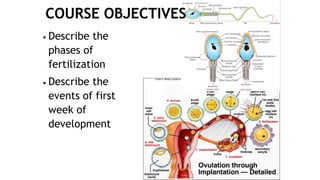
• Describe the
phases of
fertilization
• Describe the
events of first
week of
development
 At the end of this session, students should be
able to:
Describe the first week of human
development with reference to:
1. Fertilization process
2. Cleavage of the zygote
3. Blastogenesis
4. Initiation of implantation
• Q-1. A newborn baby girl showed upward
slanting eyes, depressed nasal bridge and
simian crease in hand, but her muscle tone
was normal. Karyotyping revealed that some
cells had an extra copy of chromosome 21,
while other cells were normal
• Q-2. A 35-year-old primigravida presented to the
emergency room with profuse bleeding per
vagina after 2 months of secondary amenorrhea.
The karyotyping of the aborted conceptus was
done which showed triploidy
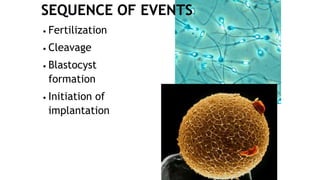
• Fertilization
• Cleavage
• Blastocyst
formation
• Initiation of
implantation
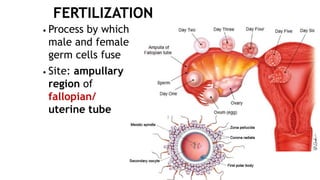
• Process by which
male and female
germ cells fuse
• Site: ampullary
region of
fallopian/
uterine tube
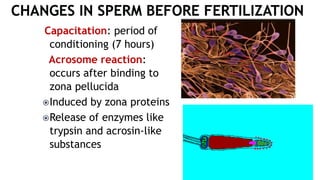
Capacitation: period of
conditioning (7 hours)
Acrosome reaction:
occurs after binding to
zona pellucida
Induced by zona proteins
Release of enzymes like
trypsin and acrosin-like
substances
• Phases
1. Penetration of
corona radiata
2. Penetration of
zona pellucida
3. Fusion of oocyte
and sperm cell
membranes
Takes
approximately 24
hours
Capacitated sperm
passes freely through
corona radiata
Results mainly from
action of enzyme
hyaluronidase released
from acrosome of
sperm
Tubal mucosal enzymes
Movement of sperm tail
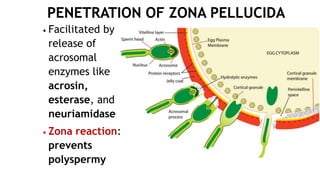
• Facilitated by
release of
acrosomal
enzymes like
acrosin,
esterase, and
neuriamidase
• Zona reaction:
prevents
polyspermy
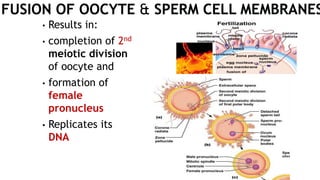
• Results in:
• completion of 2nd
meiotic division
of oocyte and
• formation of
female
pronucleus
• Replicates its
DNA
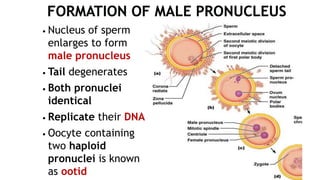
• Nucleus of sperm
enlarges to form
male pronucleus
• Tail degenerates
• Both pronuclei
identical
• Replicate their DNA
• Oocyte containing
two haploid
pronuclei is known
as ootid
• Pronuclei fuse
into a single
diploid
aggregation of
chromosomes,
ootid becomes
zygote
• Chromosomes
become arranged
on a cleavage
spindle
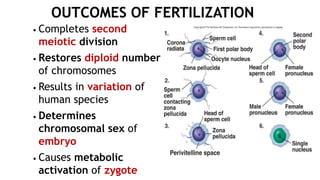
• Completes second
meiotic division
• Restores diploid number
of chromosomes
• Results in variation of
human species
• Determines
chromosomal sex of
embryo
• Causes metabolic
activation of zygote
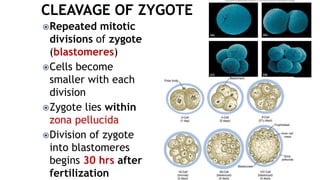
Repeated mitotic
divisions of zygote
(blastomeres)
Cells become
smaller with each
division
Zygote lies within
zona pellucida
Division of zygote
into blastomeres
begins 30 hrs after
fertilization
• Compaction: After
nine-cell stage,
blastomeres
tightly align
themselves to form
a compact ball of
cells
• 12 to 32-
blastomere stage is
called morula,
formed on 3rd day
after fertilization
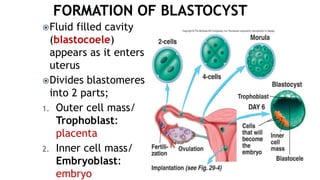
Fluid filled cavity
(blastocoele)
appears as it enters
uterus
Divides blastomeres
into 2 parts;
1. Outer cell mass/
Trophoblast:
placenta
2. Inner cell mass/
Embryoblast:
embryo
Early pregnancy
factor
(immunosupressant
protein) secreted by
trophoblast 24-48
hours after
fertilization
Forms basis of
pregnancy test
zona pellucida
degenerates
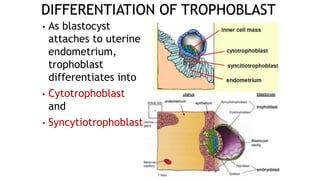
• As blastocyst
attaches to uterine
endometrium,
trophoblast
differentiates into
• Cytotrophoblast
and
• Syncytiotrophoblast
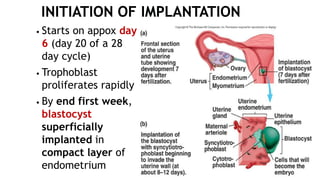
• Starts on appox day
6 (day 20 of a 28
day cycle)
• Trophoblast
proliferates rapidly
• By end first week,
blastocyst
superficially
implanted in
compact layer of
endometrium
• A layer of cells,
hypoblast, appears
at day 7 on surface
of embryoblast
facing blastocele
• Arises by
delamination of
blastomeres from
embryoblast
• Triploid conception
• Sex ratio
• IVF and embryo
transfer
• Mosaicism
• Early spontaneous
abortions
Q-1. A newborn baby girl showed upward slanting
eyes, depressed nasal bridge and simian crease in
hand, but her muscle tone was normal. Karyotyping
revealed that some cells of her body had an extra
copy of chromosome 21, while other cells were
normal
• a. Which condition was most likely present in this
neonate?
• b. Exlain the reasons for having two types of
chromosome constitution on karyotyping
Q-2. A 35-year-old primigravida presented to ER
with profuse bleeding per vagina after 2 months of
secondary amenorrhea. The karyotyping of the
aborted conceptus was done which showed triploidy.
• a. What is the reason for above condition?
• b. Which step in fertilization prevents above
mentioned condition?
• Langman’s Medical Embryology: Saddler
TW; 12th Edition, 2012
• The developing human. Moore et al.,
11th Edition; 2019

FIRST WEEK OF DEVELOPMENT.pptx

  • 1.
  • 2.
    • Describe the phasesof fertilization • Describe the events of first week of development
  • 3.
     At theend of this session, students should be able to: Describe the first week of human development with reference to: 1. Fertilization process 2. Cleavage of the zygote 3. Blastogenesis 4. Initiation of implantation
  • 4.
    • Q-1. Anewborn baby girl showed upward slanting eyes, depressed nasal bridge and simian crease in hand, but her muscle tone was normal. Karyotyping revealed that some cells had an extra copy of chromosome 21, while other cells were normal
  • 5.
    • Q-2. A35-year-old primigravida presented to the emergency room with profuse bleeding per vagina after 2 months of secondary amenorrhea. The karyotyping of the aborted conceptus was done which showed triploidy
  • 6.
    • Fertilization • Cleavage •Blastocyst formation • Initiation of implantation
  • 7.
    • Process bywhich male and female germ cells fuse • Site: ampullary region of fallopian/ uterine tube
  • 8.
    Capacitation: period of conditioning(7 hours) Acrosome reaction: occurs after binding to zona pellucida Induced by zona proteins Release of enzymes like trypsin and acrosin-like substances
  • 9.
    • Phases 1. Penetrationof corona radiata 2. Penetration of zona pellucida 3. Fusion of oocyte and sperm cell membranes Takes approximately 24 hours
  • 10.
    Capacitated sperm passes freelythrough corona radiata Results mainly from action of enzyme hyaluronidase released from acrosome of sperm Tubal mucosal enzymes Movement of sperm tail
  • 11.
    • Facilitated by releaseof acrosomal enzymes like acrosin, esterase, and neuriamidase • Zona reaction: prevents polyspermy
  • 12.
    • Results in: •completion of 2nd meiotic division of oocyte and • formation of female pronucleus • Replicates its DNA
  • 13.
    • Nucleus ofsperm enlarges to form male pronucleus • Tail degenerates • Both pronuclei identical • Replicate their DNA • Oocyte containing two haploid pronuclei is known as ootid
  • 14.
    • Pronuclei fuse intoa single diploid aggregation of chromosomes, ootid becomes zygote • Chromosomes become arranged on a cleavage spindle
  • 15.
    • Completes second meioticdivision • Restores diploid number of chromosomes • Results in variation of human species • Determines chromosomal sex of embryo • Causes metabolic activation of zygote
  • 16.
    Repeated mitotic divisions ofzygote (blastomeres) Cells become smaller with each division Zygote lies within zona pellucida Division of zygote into blastomeres begins 30 hrs after fertilization
  • 17.
    • Compaction: After nine-cellstage, blastomeres tightly align themselves to form a compact ball of cells • 12 to 32- blastomere stage is called morula, formed on 3rd day after fertilization
  • 18.
    Fluid filled cavity (blastocoele) appearsas it enters uterus Divides blastomeres into 2 parts; 1. Outer cell mass/ Trophoblast: placenta 2. Inner cell mass/ Embryoblast: embryo
  • 20.
    Early pregnancy factor (immunosupressant protein) secretedby trophoblast 24-48 hours after fertilization Forms basis of pregnancy test zona pellucida degenerates
  • 21.
    • As blastocyst attachesto uterine endometrium, trophoblast differentiates into • Cytotrophoblast and • Syncytiotrophoblast
  • 22.
    • Starts onappox day 6 (day 20 of a 28 day cycle) • Trophoblast proliferates rapidly • By end first week, blastocyst superficially implanted in compact layer of endometrium
  • 23.
    • A layerof cells, hypoblast, appears at day 7 on surface of embryoblast facing blastocele • Arises by delamination of blastomeres from embryoblast
  • 24.
    • Triploid conception •Sex ratio • IVF and embryo transfer • Mosaicism • Early spontaneous abortions
  • 26.
    Q-1. A newbornbaby girl showed upward slanting eyes, depressed nasal bridge and simian crease in hand, but her muscle tone was normal. Karyotyping revealed that some cells of her body had an extra copy of chromosome 21, while other cells were normal • a. Which condition was most likely present in this neonate? • b. Exlain the reasons for having two types of chromosome constitution on karyotyping
  • 27.
    Q-2. A 35-year-oldprimigravida presented to ER with profuse bleeding per vagina after 2 months of secondary amenorrhea. The karyotyping of the aborted conceptus was done which showed triploidy. • a. What is the reason for above condition? • b. Which step in fertilization prevents above mentioned condition?
  • 28.
    • Langman’s MedicalEmbryology: Saddler TW; 12th Edition, 2012 • The developing human. Moore et al., 11th Edition; 2019