‫الرح‬ ‫الرمحن‬ ‫هللا‬ ‫سم‬‫ب‬‫مي‬
ALLPPT.com _ Free PowerPoint Templates, Diagrams and Charts
Fertilization
Prof.: Ekbal M. Abo Hashem
Professor of Clinical Pathology
Mansoura University
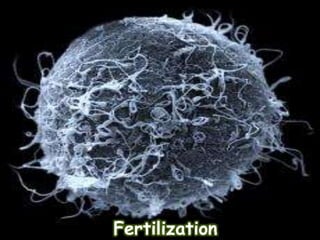
Fertilization
Fertilization
What are the factors that affect the sperm’s potential for
successfully fertilizing the egg?
SPERM TRANSPORT AND CAPACITATION
The process by which the sperm initiates and participates, with
the egg, in the development of the embryo
1. Capacitation - occurs in the female’s vagina. Vaginal
secretions cause a molecular change in the sperm
plasmalemma (removal of decapacitating factor - semen
proteins, results in increased membrane fluidity,). Takes
4-5 hr in humans .
Sperm Transport and
Capacitation
. Transport:
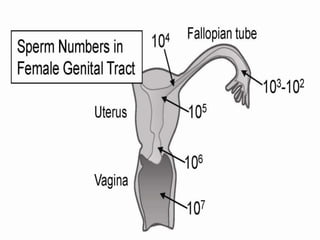
• Velocity = 1-4mm/min (300 x106  200 sperms reach
the oviduct).
• Flaggelar movement (to-and-fro) + ATP
The sperms are first deposited in the vagina:
• they then pass up this cavity and through the cervix into
the uterus ,
• up the uterus, through the junction between the uterus
and oviduct
• (Uterotubal Junction), and up the isthmus of the oviduct to
the usual
• area of fertilization in the oviduct: the ampullary –isthmic
junction.
1.Vaginal Sperm
•After about one minute of deposition in the Vagina the semen
becomes thicker and less liquid ( Coagulation).
•After about 20 minutes, the semen again liquefies, Stimulates
some sperm to swim more rapidly.
•The environment in the vagina is usually acidic ( about PH 4.2)
and this level of acidity inhibit semen motility.
•The presence of semen in the vagina, however, increases the
vaginal PH to a basic 7.2, which in turn increase sperm motility.
2. Cervical Sperm
•The cervical canal is lined by a complicated series of narrow fold
s and crypts and is blocked by a sticky mass of cervical mucus an
d tiny cervical fibers.
•Estrogen cause the mucus to become more liquid and makes gaps
wider.
•The cervical fibers vibrate in rhythm with the tail beat frequenc
y of normal sperm,
•this may allow the normal sperm to move through the cervix;
•where as sperm with abnormal or absent tail beats are detained.
•Other sperms enter cervical Crypts, where they may die or lost
or they remain as a reservoir of sperm that may enter the
uterus.
3. Uterine Sperm
•Upon leaving the cervix, the sperm travel up the uterus to the
uterotubal junction.
•The uterus fluid is watery but sparse
•The swimming rate of sperm (3mm/min) cannot account to climb
up uterine lumen.
•The muscle contraction and movement of cilia in the female
reproductive tract facilitate sperm transport.
•Uterotubal junction allows the gradual entrance of sperm in the
isthmus of the oviduct.
•About half of the sperm enter the wrong oviduct and only a few
hundred make its way to the general proximity of the waiting egg
.
Factors that affect the sperm’s
potential for successfully
fertilizing the egg?
3. Egg secretions - importance varies among species -
fertilizins - activating factors, agglutination, chemo-
attraction
2. Dilution - .Mammals - Dilution: 40 - 400 million spermatozoa
in vagina, only a few hundred to a thousand reach the upper
oviduct.
(cont.)
Factors that affect the sperm’s
potential for successfully
fertilizing the egg?
4. Structures surrounding the egg - barriers
• Follicle cells
• Zona pellucida .
• Oolemma (plasmalemma of egg)
(cont.)
After leaving the testis, mammalian spermatozoa are
morphologically differentiated but have acquired neither
progressive motility nor the ability to fertilize a metaphase II
arrested egg.
During epididymal transit, sperm acquire the ability to move
progressively; but they are still fertilization incompetent.
– Fertilization capacity is gained after residence in the
female tract for a finite time.
– Capacitation is also correlated with changes in sperm
motility patterns, designated as sperm hyperactivation.
– Capacitation causes head changes (acrosome reaction) and
tail changes (motility changes).
.Capacitation
•Sperms cannot fertilize oocytes when they are newly ejaculated.
Thus Capacitation is a process of sperm becoming fertile
•A process of essential changes in the spermatozoa that enables
them to fertilize the egg.
•Occurs during transport in female genital tract
•Capacitated sperm have the ability to fertilize the egg
•The process of capacitation takes 5-7 hours.
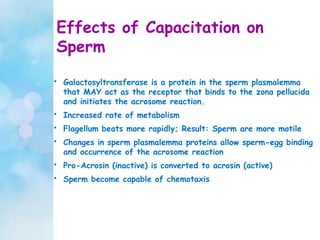
• Galactosyltransferase is a protein in the sperm plasmalemma
that MAY act as the receptor that binds to the zona pellucida
and initiates the acrosome reaction.
• Increased rate of metabolism
• Flagellum beats more rapidly; Result: Sperm are more motile
• Changes in sperm plasmalemma proteins allow sperm-egg binding
and occurrence of the acrosome reaction
• Pro-Acrosin (inactive) is converted to acrosin (active)
• Sperm become capable of chemotaxis
Effects of Capacitation on
Sperm
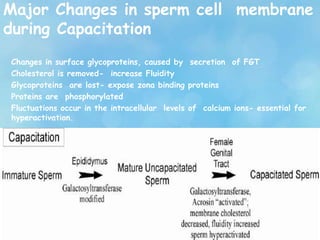
Major Changes in sperm cell membrane
during Capacitation
Changes in surface glycoproteins, caused by secretion of FGT
Cholesterol is removed- increase Fluidity
Glycoproteins are lost- expose zona binding proteins
Proteins are phosphorylated
Fluctuations occur in the intracellular levels of calcium ions- essential for
hyperactivation.
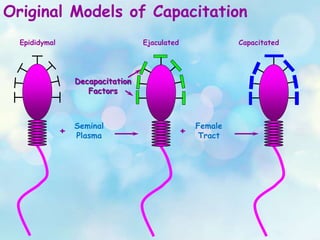
Original Models of Capacitation
Epididymal Capacitated
Female
Tract+
Ejaculated
Seminal
Plasma+
Decapacitation
Factors
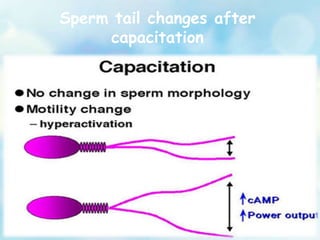
Sperm tail changes after
capacitation
Ejaculated spermatozoa
Contain decapacitated agent.
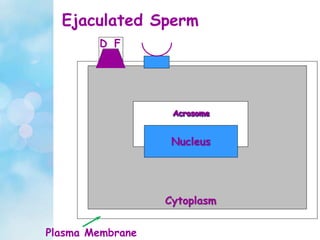
Ejaculated Sperm
D F
Plasma Membrane
Cytoplasm
Nucleus
How does the sperm get through
the barriers surrounding the
egg?
1. Used to be thought that the acrosome enzymes did it all.
2. More recent data
a. Sperm arrives at zona pellucida with the acrosome
still intact. So, how does it get through the follicle
cells that surround the egg?
b. Has to break down the intercellular cement that holds
the follicle cells together - hyaluronic acid
c. A protein found in the sperm plasmalemma (PH-20)
had hyaluronidase activity.
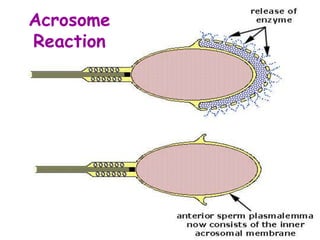
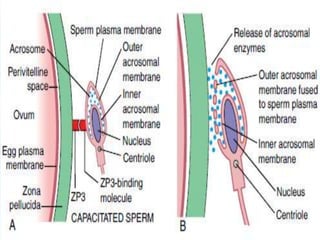
Acrosome
Reaction
Getting through the zona
pellucida
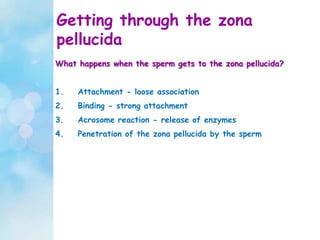
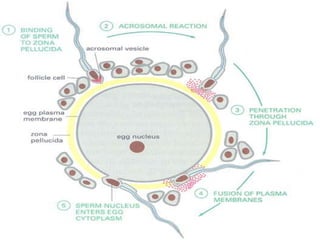
What happens when the sperm gets to the zona pellucida?
1. Attachment - loose association
2. Binding - strong attachment
3. Acrosome reaction - release of enzymes
4. Penetration of the zona pellucida by the sperm
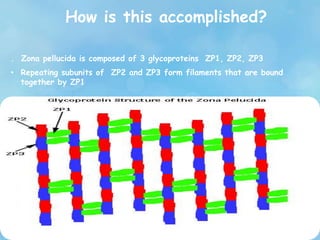
. Zona pellucida is composed of 3 glycoproteins ZP1, ZP2, ZP3
• Repeating subunits of ZP2 and ZP3 form filaments that are bound
together by ZP1
How is this accomplished?
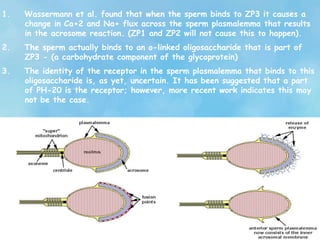
1. Wassermann et al. found that when the sperm binds to ZP3 it causes a
change in Ca+2 and Na+ flux across the sperm plasmalemma that results
in the acrosome reaction. (ZP1 and ZP2 will not cause this to happen).
2. The sperm actually binds to an o-linked oligosaccharide that is part of
ZP3 - (a carbohydrate component of the glycoprotein)
3. The identity of the receptor in the sperm plasmalemma that binds to this
oligosaccharide is, as yet, uncertain. It has been suggested that a part
of PH-20 is the receptor; however, more recent work indicates this may
not be the case.
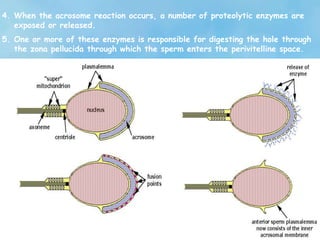
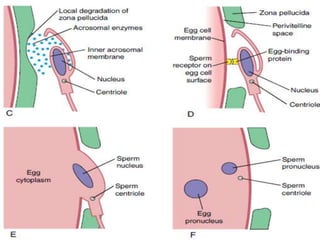
4. When the acrosome reaction occurs, a number of proteolytic enzymes are
exposed or released.
5. One or more of these enzymes is responsible for digesting the hole through
the zona pellucida through which the sperm enters the perivitelline space.
1. Release of Ca++ (calcium) stored in the egg endoplasmic
reticulum - appears to be the critical step in the process.
2. Cortical reaction - rupture of cortical granules that occurs
concurrently with the Ca++ release. Contents of granules are
released into perivitelline space and cause “hardening” of
the vitelline membrane or zona pellucida.
The major events that characterize egg activation following
fusion of the sperm with the egg:
1. The male nucleus enters the egg cytoplasm and becomes
the male pronucleus.
2. As a result of the sperm fusing with the egg
plasmalemma, the oocyte nucleus, which is at metaphase
of the second meiotic division, completes that division
giving rise to another polar body.
3. Following the second meiotic division, what is now the
nucleus of the ovum becomes the female pronucleus.
4. The haploid male and female pronuclei move toward one
and other, meet, and fuse to form the diploid nucleus of
the zygote.
5. The zygote will now proceed to undergo cleavage.
Following fusion of the sperm
with the egg
Egg Activation
A series of morphological, physiological and molecular changes that
occur in the egg in response to fusion of the sperm with the egg.
1. Frees egg from constraints that kept it from developing
prior to fertilization.
2. Prepares the egg for development.
Why “frees the egg” ? and not “frees the egg and sperm”?
1. Egg activation does not require the sperm nucleus.
2. In some species, just pricking the egg with a needle, shocking
it, or simply changing the pH of the solution it’s in will cause
activation.
What does egg activation accomplish?
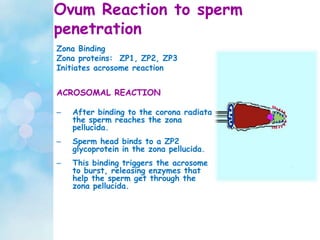
Ovum Reaction to sperm
penetration
Zona Binding
Zona proteins: ZP1, ZP2, ZP3
Initiates acrosome reaction
ACROSOMAL REACTION
– After binding to the corona radiata
the sperm reaches the zona
pellucida.
– Sperm head binds to a ZP2
glycoprotein in the zona pellucida.
– This binding triggers the acrosome
to burst, releasing enzymes that
help the sperm get through the
zona pellucida.
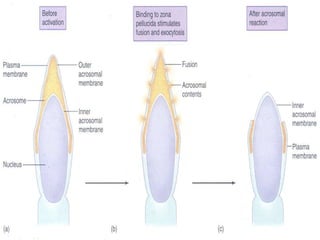
– The acrosome reaction is associated with the release of
acrosome enzymes that facilitate fertilization
– Acrosomal enzymes: esterases, acrosin,hyaluronidase ,and
neuraminidase cause lysis of the zona pellucida
On binding  sperm is induced to undergo the acrosomal reaction
(ZP3)

Influx of Ca2+ into the sperm cytosol

Contents of the acrosome are released (+ exocytosis)
i.Proteinases/acrosin) + hyaluronidase  penetration of ZP.
ii.Exposes other proteins on the sperm surface that bind to
ZP2  help the sperm maintain the binding to zona
iii.Exposes a protein in the sperm plasma membrane that mediates
the binding and fusion of this membrane with that of the egg.
Penetration thru ZP  15-25min.
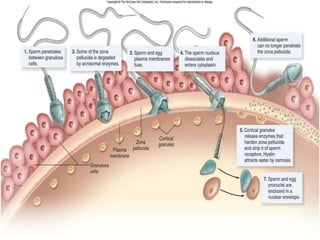
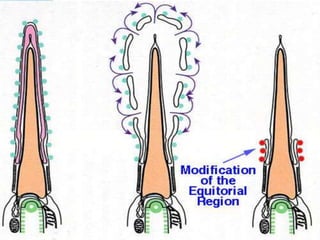
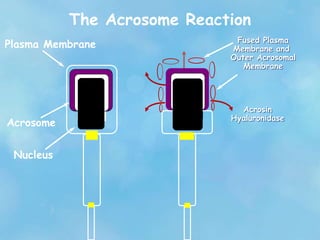
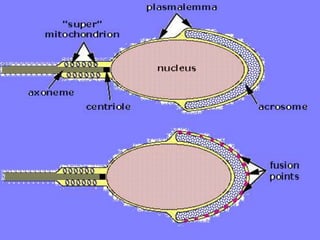
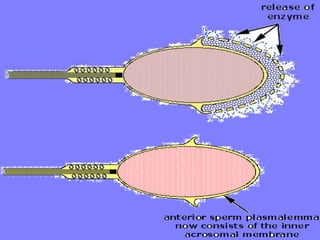
The Acrosome Reaction
Plasma Membrane
Acrosome
Fused Plasma
Membrane and
Outer Acrosomal
Membrane
Nucleus
Acrosin
Hyaluronidase
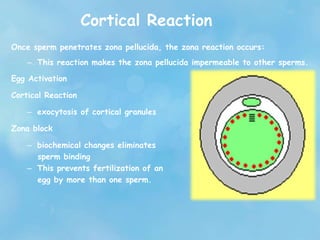
Cortical Reaction
Once sperm penetrates zona pellucida, the zona reaction occurs:
– This reaction makes the zona pellucida impermeable to other sperms.
Egg Activation
Cortical Reaction
– exocytosis of cortical granules
Zona block
– biochemical changes eliminates
sperm binding
– This prevents fertilization of an
egg by more than one sperm.
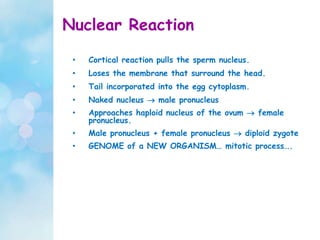
Nuclear Reaction
• Cortical reaction pulls the sperm nucleus.
• Loses the membrane that surround the head.
• Tail incorporated into the egg cytoplasm.
• Naked nucleus  male pronucleus
• Approaches haploid nucleus of the ovum  female
pronucleus.
• Male pronucleus + female pronucleus  diploid zygote
• GENOME of a NEW ORGANISM… mitotic process….
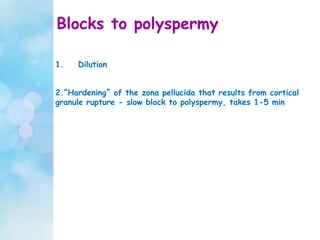
Blocks to polyspermy
1. Dilution
2.“Hardening” of the zona pellucida that results from cortical
granule rupture - slow block to polyspermy, takes 1-5 min
Mechanisms
i. Primary block to polyspermy
• Rapid depolarization of the egg plasma membrane prevents
further sperm from fusing and thereby acts as a fast primary
block to polyspermy.
• But the membrane potential returns to normal soon after
fertilization, so that a second mechanism is required to
ensure a longer-term, secondary block to polyspermy.
Two mechanisms can operate to ensure that only
one sperm fertilizes the egg.
ii. Secondary block to polyspermy
•A local increase in cytosolic Ca2+ (spreads in a wave).
•prolonged Ca2+ oscillations activate the egg to begin development
•The cortical granules release their contents by exocytosis Proteo
lytic cleavage of ZP2 and the hydrolysis of sugar groups on ZP3
•The zona becomes “hardened,” so that sperm no longer bind to it
In Vitro Sperm capacitation
The sperm cell is programmed to undergo capacitation when it is
incubated in the appropriate medium.
1- Role of media constituents
- Serum albumin.
- Calcium.
- Bicarbonate.
2- Effectors and intracellular messengers
- Cyclic AMP metabolism.
- Protein tyrosine phosphrylation.
- pH.
- Membrane potential.
- Free radicals.
- Heparin.
- Glucose.
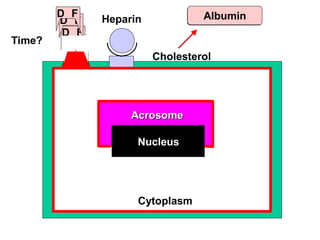
D F
Cytoplasm
Nucleus
AcrosomeAcrosome
GAG
Cholesterol
Chol-Acceptor
D F
D F
D F
D F
Heparin
Time?
Albumin
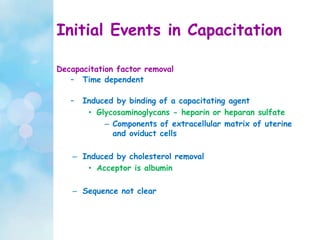
Initial Events in Capacitation
Decapacitation factor removal
– Time dependent
– Induced by binding of a capacitating agent
• Glycosaminoglycans - heparin or heparan sulfate
– Components of extracellular matrix of uterine
and oviduct cells
– Induced by cholesterol removal
• Acceptor is albumin
– Sequence not clear
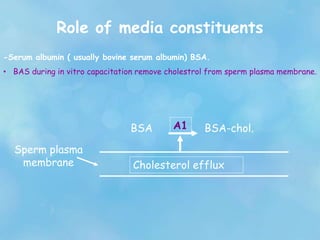
Role of media constituents
-Serum albumin ( usually bovine serum albumin) BSA.
• BAS during in vitro capacitation remove cholestrol from sperm plasma membrane.
BSA A1 BSA-chol.
Sperm plasma
membrane Cholesterol efflux
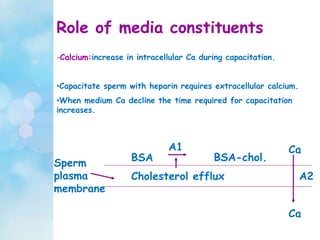
Role of media constituents
-Calcium:increase in intracellular Ca during capacitation.
•Capacitate sperm with heparin requires extracellular calcium.
•When medium Ca decline the time required for capacitation
increases.
Sperm
plasma
membrane
Cholesterol efflux
BSA BSA-chol.
Ca
Ca
A2
A1
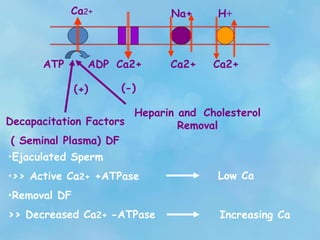
ATP ADP
(+)
Decapacitation Factors
( Seminal Plasma) DF
Ca2+
•Ejaculated Sperm
•>> Active Ca2+ +ATPase
•Removal DF
>> Decreased Ca2+ -ATPase
Low Ca
(-)
Heparin and Cholesterol
Removal
Ca2+ Ca2+
Na+
Ca2+
H+
Increasing Ca
Role of media constituents
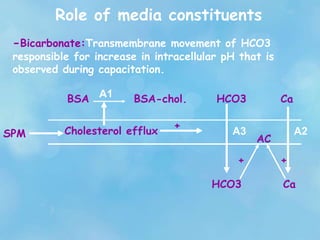
-Bicarbonate:Transmembrane movement of HCO3
responsible for increase in intracellular pH that is
observed during capacitation.
SPM Cholesterol efflux
BSA BSA-chol.A1 Ca
Ca
A2
+
HCO3
HCO3
A3
AC
+ +
Intracellular second messengers
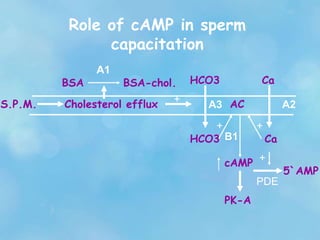
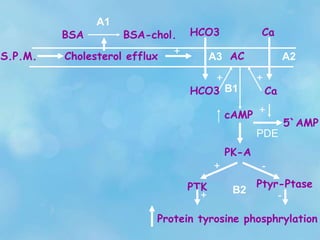
Cyclic AMP metabolism:The protein kinase A (PK-A)
activity increases during sperm capacitation as a result o
f elevation intracellular cAMP.
- The mode of regulation of cAMP metabolism during sper
m capacitation may be integrated with changes in Ca and
HCO3 movement.
S.P.M. Cholesterol efflux
BSA
A1
BSA-chol.
+
HCO3
HCO3
A3
Ca
A2
Ca
+ +
AC
cAMP
PDE
+
PK-A
5`AMP
Role of cAMP in sperm
capacitation
B1
Protein tyrosine phosphorylation
•Protein tyrosine phosphorylation mediates a variety of
cellular function .
•The increase in protein tyrosine phosphorylation is
dependent on the presence of BSA, Ca and NaHCO3 in the
medium.
•The role of protein tyrosine phosphorylation in sperm
capacitation is regulated through a PK-A.
S.P.M. Cholesterol efflux
BSA
A1
BSA-chol.
+
HCO3
HCO3
A3
Ca
A2
Ca
+ +
AC
cAMP
PDE
+
PK-A
5`AMP
B1
PTK
+
+
-
Ptyr-Ptase
-
Protein tyrosine phosphrylation
B2
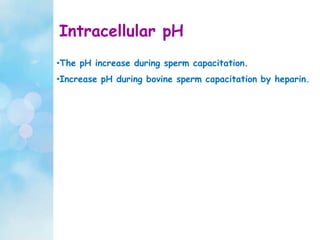
Intracellular pH
•The pH increase during sperm capacitation.
•Increase pH during bovine sperm capacitation by heparin.
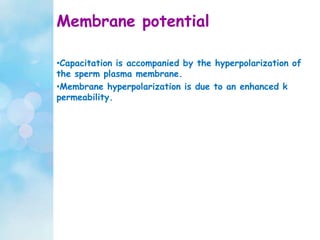
Membrane potential
•Capacitation is accompanied by the hyperpolarization of
the sperm plasma membrane.
•Membrane hyperpolarization is due to an enhanced k
permeability.
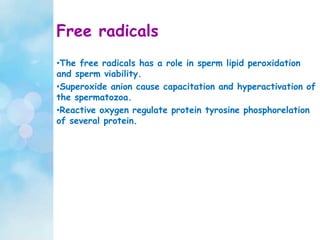
Free radicals
•The free radicals has a role in sperm lipid peroxidation
and sperm viability.
•Superoxide anion cause capacitation and hyperactivation of
the spermatozoa.
•Reactive oxygen regulate protein tyrosine phosphorelation
of several protein.
Heparin
•The active capacitating agent in the oviduct fluid is
thought to be a heparin-like glycosaminoglycan.
•The glycosaminoglycan may promote capacitation by binding
to and removing seminal plasma protein.
•Heparin increases cAMP synthesis,elevate pH and regulate
the capacitation-associated changes.
Thank you

Fertilization

  • 1.
  • 2.
    ALLPPT.com _ FreePowerPoint Templates, Diagrams and Charts Fertilization Prof.: Ekbal M. Abo Hashem Professor of Clinical Pathology Mansoura University
  • 3.
  • 4.
    Fertilization What are thefactors that affect the sperm’s potential for successfully fertilizing the egg? SPERM TRANSPORT AND CAPACITATION The process by which the sperm initiates and participates, with the egg, in the development of the embryo 1. Capacitation - occurs in the female’s vagina. Vaginal secretions cause a molecular change in the sperm plasmalemma (removal of decapacitating factor - semen proteins, results in increased membrane fluidity,). Takes 4-5 hr in humans .
  • 5.
    Sperm Transport and Capacitation .Transport: • Velocity = 1-4mm/min (300 x106  200 sperms reach the oviduct). • Flaggelar movement (to-and-fro) + ATP The sperms are first deposited in the vagina: • they then pass up this cavity and through the cervix into the uterus , • up the uterus, through the junction between the uterus and oviduct • (Uterotubal Junction), and up the isthmus of the oviduct to the usual • area of fertilization in the oviduct: the ampullary –isthmic junction.
  • 6.
    1.Vaginal Sperm •After aboutone minute of deposition in the Vagina the semen becomes thicker and less liquid ( Coagulation). •After about 20 minutes, the semen again liquefies, Stimulates some sperm to swim more rapidly. •The environment in the vagina is usually acidic ( about PH 4.2) and this level of acidity inhibit semen motility. •The presence of semen in the vagina, however, increases the vaginal PH to a basic 7.2, which in turn increase sperm motility.
  • 7.
    2. Cervical Sperm •Thecervical canal is lined by a complicated series of narrow fold s and crypts and is blocked by a sticky mass of cervical mucus an d tiny cervical fibers. •Estrogen cause the mucus to become more liquid and makes gaps wider. •The cervical fibers vibrate in rhythm with the tail beat frequenc y of normal sperm, •this may allow the normal sperm to move through the cervix; •where as sperm with abnormal or absent tail beats are detained. •Other sperms enter cervical Crypts, where they may die or lost or they remain as a reservoir of sperm that may enter the uterus.
  • 8.
    3. Uterine Sperm •Uponleaving the cervix, the sperm travel up the uterus to the uterotubal junction. •The uterus fluid is watery but sparse •The swimming rate of sperm (3mm/min) cannot account to climb up uterine lumen. •The muscle contraction and movement of cilia in the female reproductive tract facilitate sperm transport. •Uterotubal junction allows the gradual entrance of sperm in the isthmus of the oviduct. •About half of the sperm enter the wrong oviduct and only a few hundred make its way to the general proximity of the waiting egg .
  • 9.
    Factors that affectthe sperm’s potential for successfully fertilizing the egg? 3. Egg secretions - importance varies among species - fertilizins - activating factors, agglutination, chemo- attraction 2. Dilution - .Mammals - Dilution: 40 - 400 million spermatozoa in vagina, only a few hundred to a thousand reach the upper oviduct. (cont.)
  • 10.
    Factors that affectthe sperm’s potential for successfully fertilizing the egg? 4. Structures surrounding the egg - barriers • Follicle cells • Zona pellucida . • Oolemma (plasmalemma of egg) (cont.)
  • 12.
    After leaving thetestis, mammalian spermatozoa are morphologically differentiated but have acquired neither progressive motility nor the ability to fertilize a metaphase II arrested egg. During epididymal transit, sperm acquire the ability to move progressively; but they are still fertilization incompetent. – Fertilization capacity is gained after residence in the female tract for a finite time. – Capacitation is also correlated with changes in sperm motility patterns, designated as sperm hyperactivation. – Capacitation causes head changes (acrosome reaction) and tail changes (motility changes).
  • 13.
    .Capacitation •Sperms cannot fertilizeoocytes when they are newly ejaculated. Thus Capacitation is a process of sperm becoming fertile •A process of essential changes in the spermatozoa that enables them to fertilize the egg. •Occurs during transport in female genital tract •Capacitated sperm have the ability to fertilize the egg •The process of capacitation takes 5-7 hours.
  • 14.
    • Galactosyltransferase isa protein in the sperm plasmalemma that MAY act as the receptor that binds to the zona pellucida and initiates the acrosome reaction. • Increased rate of metabolism • Flagellum beats more rapidly; Result: Sperm are more motile • Changes in sperm plasmalemma proteins allow sperm-egg binding and occurrence of the acrosome reaction • Pro-Acrosin (inactive) is converted to acrosin (active) • Sperm become capable of chemotaxis Effects of Capacitation on Sperm
  • 15.
    Major Changes insperm cell membrane during Capacitation Changes in surface glycoproteins, caused by secretion of FGT Cholesterol is removed- increase Fluidity Glycoproteins are lost- expose zona binding proteins Proteins are phosphorylated Fluctuations occur in the intracellular levels of calcium ions- essential for hyperactivation.
  • 16.
    Original Models ofCapacitation Epididymal Capacitated Female Tract+ Ejaculated Seminal Plasma+ Decapacitation Factors
  • 17.
    Sperm tail changesafter capacitation
  • 18.
  • 19.
    Ejaculated Sperm D F PlasmaMembrane Cytoplasm Nucleus
  • 20.
    How does thesperm get through the barriers surrounding the egg? 1. Used to be thought that the acrosome enzymes did it all. 2. More recent data a. Sperm arrives at zona pellucida with the acrosome still intact. So, how does it get through the follicle cells that surround the egg? b. Has to break down the intercellular cement that holds the follicle cells together - hyaluronic acid c. A protein found in the sperm plasmalemma (PH-20) had hyaluronidase activity.
  • 21.
  • 23.
    Getting through thezona pellucida What happens when the sperm gets to the zona pellucida? 1. Attachment - loose association 2. Binding - strong attachment 3. Acrosome reaction - release of enzymes 4. Penetration of the zona pellucida by the sperm
  • 24.
    . Zona pellucidais composed of 3 glycoproteins ZP1, ZP2, ZP3 • Repeating subunits of ZP2 and ZP3 form filaments that are bound together by ZP1 How is this accomplished?
  • 25.
    1. Wassermann etal. found that when the sperm binds to ZP3 it causes a change in Ca+2 and Na+ flux across the sperm plasmalemma that results in the acrosome reaction. (ZP1 and ZP2 will not cause this to happen). 2. The sperm actually binds to an o-linked oligosaccharide that is part of ZP3 - (a carbohydrate component of the glycoprotein) 3. The identity of the receptor in the sperm plasmalemma that binds to this oligosaccharide is, as yet, uncertain. It has been suggested that a part of PH-20 is the receptor; however, more recent work indicates this may not be the case.
  • 26.
    4. When theacrosome reaction occurs, a number of proteolytic enzymes are exposed or released. 5. One or more of these enzymes is responsible for digesting the hole through the zona pellucida through which the sperm enters the perivitelline space.
  • 27.
    1. Release ofCa++ (calcium) stored in the egg endoplasmic reticulum - appears to be the critical step in the process. 2. Cortical reaction - rupture of cortical granules that occurs concurrently with the Ca++ release. Contents of granules are released into perivitelline space and cause “hardening” of the vitelline membrane or zona pellucida. The major events that characterize egg activation following fusion of the sperm with the egg:
  • 28.
    1. The malenucleus enters the egg cytoplasm and becomes the male pronucleus. 2. As a result of the sperm fusing with the egg plasmalemma, the oocyte nucleus, which is at metaphase of the second meiotic division, completes that division giving rise to another polar body. 3. Following the second meiotic division, what is now the nucleus of the ovum becomes the female pronucleus. 4. The haploid male and female pronuclei move toward one and other, meet, and fuse to form the diploid nucleus of the zygote. 5. The zygote will now proceed to undergo cleavage. Following fusion of the sperm with the egg
  • 29.
    Egg Activation A seriesof morphological, physiological and molecular changes that occur in the egg in response to fusion of the sperm with the egg. 1. Frees egg from constraints that kept it from developing prior to fertilization. 2. Prepares the egg for development. Why “frees the egg” ? and not “frees the egg and sperm”? 1. Egg activation does not require the sperm nucleus. 2. In some species, just pricking the egg with a needle, shocking it, or simply changing the pH of the solution it’s in will cause activation. What does egg activation accomplish?
  • 30.
    Ovum Reaction tosperm penetration Zona Binding Zona proteins: ZP1, ZP2, ZP3 Initiates acrosome reaction ACROSOMAL REACTION – After binding to the corona radiata the sperm reaches the zona pellucida. – Sperm head binds to a ZP2 glycoprotein in the zona pellucida. – This binding triggers the acrosome to burst, releasing enzymes that help the sperm get through the zona pellucida.
  • 31.
    – The acrosomereaction is associated with the release of acrosome enzymes that facilitate fertilization – Acrosomal enzymes: esterases, acrosin,hyaluronidase ,and neuraminidase cause lysis of the zona pellucida On binding  sperm is induced to undergo the acrosomal reaction (ZP3)  Influx of Ca2+ into the sperm cytosol  Contents of the acrosome are released (+ exocytosis) i.Proteinases/acrosin) + hyaluronidase  penetration of ZP. ii.Exposes other proteins on the sperm surface that bind to ZP2  help the sperm maintain the binding to zona iii.Exposes a protein in the sperm plasma membrane that mediates the binding and fusion of this membrane with that of the egg. Penetration thru ZP  15-25min.
  • 32.
    The Acrosome Reaction PlasmaMembrane Acrosome Fused Plasma Membrane and Outer Acrosomal Membrane Nucleus Acrosin Hyaluronidase
  • 37.
    Cortical Reaction Once spermpenetrates zona pellucida, the zona reaction occurs: – This reaction makes the zona pellucida impermeable to other sperms. Egg Activation Cortical Reaction – exocytosis of cortical granules Zona block – biochemical changes eliminates sperm binding – This prevents fertilization of an egg by more than one sperm.
  • 39.
    Nuclear Reaction • Corticalreaction pulls the sperm nucleus. • Loses the membrane that surround the head. • Tail incorporated into the egg cytoplasm. • Naked nucleus  male pronucleus • Approaches haploid nucleus of the ovum  female pronucleus. • Male pronucleus + female pronucleus  diploid zygote • GENOME of a NEW ORGANISM… mitotic process….
  • 42.
    Blocks to polyspermy 1.Dilution 2.“Hardening” of the zona pellucida that results from cortical granule rupture - slow block to polyspermy, takes 1-5 min
  • 43.
    Mechanisms i. Primary blockto polyspermy • Rapid depolarization of the egg plasma membrane prevents further sperm from fusing and thereby acts as a fast primary block to polyspermy. • But the membrane potential returns to normal soon after fertilization, so that a second mechanism is required to ensure a longer-term, secondary block to polyspermy. Two mechanisms can operate to ensure that only one sperm fertilizes the egg.
  • 44.
    ii. Secondary blockto polyspermy •A local increase in cytosolic Ca2+ (spreads in a wave). •prolonged Ca2+ oscillations activate the egg to begin development •The cortical granules release their contents by exocytosis Proteo lytic cleavage of ZP2 and the hydrolysis of sugar groups on ZP3 •The zona becomes “hardened,” so that sperm no longer bind to it
  • 45.
    In Vitro Spermcapacitation The sperm cell is programmed to undergo capacitation when it is incubated in the appropriate medium. 1- Role of media constituents - Serum albumin. - Calcium. - Bicarbonate. 2- Effectors and intracellular messengers - Cyclic AMP metabolism. - Protein tyrosine phosphrylation. - pH. - Membrane potential. - Free radicals. - Heparin. - Glucose.
  • 46.
  • 47.
    Initial Events inCapacitation Decapacitation factor removal – Time dependent – Induced by binding of a capacitating agent • Glycosaminoglycans - heparin or heparan sulfate – Components of extracellular matrix of uterine and oviduct cells – Induced by cholesterol removal • Acceptor is albumin – Sequence not clear
  • 48.
    Role of mediaconstituents -Serum albumin ( usually bovine serum albumin) BSA. • BAS during in vitro capacitation remove cholestrol from sperm plasma membrane. BSA A1 BSA-chol. Sperm plasma membrane Cholesterol efflux
  • 49.
    Role of mediaconstituents -Calcium:increase in intracellular Ca during capacitation. •Capacitate sperm with heparin requires extracellular calcium. •When medium Ca decline the time required for capacitation increases. Sperm plasma membrane Cholesterol efflux BSA BSA-chol. Ca Ca A2 A1
  • 50.
    ATP ADP (+) Decapacitation Factors (Seminal Plasma) DF Ca2+ •Ejaculated Sperm •>> Active Ca2+ +ATPase •Removal DF >> Decreased Ca2+ -ATPase Low Ca (-) Heparin and Cholesterol Removal Ca2+ Ca2+ Na+ Ca2+ H+ Increasing Ca
  • 51.
    Role of mediaconstituents -Bicarbonate:Transmembrane movement of HCO3 responsible for increase in intracellular pH that is observed during capacitation. SPM Cholesterol efflux BSA BSA-chol.A1 Ca Ca A2 + HCO3 HCO3 A3 AC + +
  • 52.
    Intracellular second messengers CyclicAMP metabolism:The protein kinase A (PK-A) activity increases during sperm capacitation as a result o f elevation intracellular cAMP. - The mode of regulation of cAMP metabolism during sper m capacitation may be integrated with changes in Ca and HCO3 movement.
  • 53.
    S.P.M. Cholesterol efflux BSA A1 BSA-chol. + HCO3 HCO3 A3 Ca A2 Ca ++ AC cAMP PDE + PK-A 5`AMP Role of cAMP in sperm capacitation B1
  • 54.
    Protein tyrosine phosphorylation •Proteintyrosine phosphorylation mediates a variety of cellular function . •The increase in protein tyrosine phosphorylation is dependent on the presence of BSA, Ca and NaHCO3 in the medium. •The role of protein tyrosine phosphorylation in sperm capacitation is regulated through a PK-A.
  • 55.
    S.P.M. Cholesterol efflux BSA A1 BSA-chol. + HCO3 HCO3 A3 Ca A2 Ca ++ AC cAMP PDE + PK-A 5`AMP B1 PTK + + - Ptyr-Ptase - Protein tyrosine phosphrylation B2
  • 56.
    Intracellular pH •The pHincrease during sperm capacitation. •Increase pH during bovine sperm capacitation by heparin.
  • 57.
    Membrane potential •Capacitation isaccompanied by the hyperpolarization of the sperm plasma membrane. •Membrane hyperpolarization is due to an enhanced k permeability.
  • 58.
    Free radicals •The freeradicals has a role in sperm lipid peroxidation and sperm viability. •Superoxide anion cause capacitation and hyperactivation of the spermatozoa. •Reactive oxygen regulate protein tyrosine phosphorelation of several protein.
  • 59.
    Heparin •The active capacitatingagent in the oviduct fluid is thought to be a heparin-like glycosaminoglycan. •The glycosaminoglycan may promote capacitation by binding to and removing seminal plasma protein. •Heparin increases cAMP synthesis,elevate pH and regulate the capacitation-associated changes.
  • 60.