Xulkifal yousaf [email_address] Fertilization
FERTILIZATION Recognition of Egg and Sperm:  5 steps, (1). Chemo attraction (2). Release of acrosomal enzymes (3). Binding of sperm to extra cellular envelopes (4). Passage through extra cellular envelopes (5). Fusion of sperm and egg nuclei (2 & 3 can be reversed). Fertilization May 21, 2010
FERTILIZATION Sperm attraction…..species specific in many invertebrates, chemo taxis, also timings in these animals. In sea urchin a peptide resact is such chemo tactic molecule. It is also sperm activating molecule. Egg jelly has other compounds as well, which bind with specific receptors on sperm, which inturn opens calcium ion channels, leading to exocytosis of acrosome.  Fertilization May 21, 2010
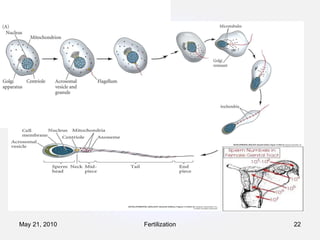
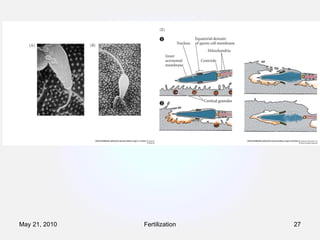
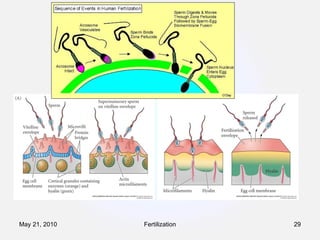
FERTILIZATION Acrosome reaction:   In marine invertebrates, fusion of acrosomal membrane with sperm membrane & the formation of acrosomal process. Release of proteolytic enzymes ->-> go through jelly coats ->->egg membrane. Transportation of sperm and its capacitation. Active, also passive through contraction, species specific recognition (as in sea urchin). Fertilization May 21, 2010
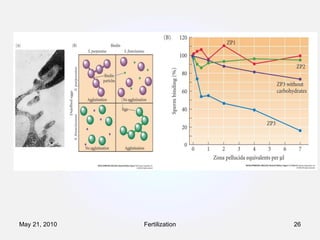
FERTILIZATION Acrosomal protein is Bindin….present on acrosomal process…which is species specific. Its specific receptors not all over the egg membrane……so limited sites of contact and penetration (first step towards block to polyspermy).   (In mammals, zona pellucida has many glycoproteins ….ZP-1, ZP-2, ZP-3….it is ZP-3 which affects binding & it also triggers acrosomal reaction. Fertilization May 21, 2010
FERTILIZATION ZP-3 of ZP of egg crosslinks with a sperm protein called galactosyltransferase-Ι(which binds with carbohydrate residue of ZP-3) Exocytosis of acrosome (its breakdown) releases many proteases----which make a hole in ZP; secondary binding of spermatozoa is through ZP-2). Fertilization May 21, 2010
FERTILIZATION Gamete Fusion and Prevention Of Polyspermy :  Fusion of sperm and egg membranes ->->polymerization of actin in egg->-> fertilization cone, as does the sperm actin which forms the acrosomal process.  These two projections meet so as to form a continuous bridge through which sperm nucleus & centiole pass. Fertilization May 21, 2010
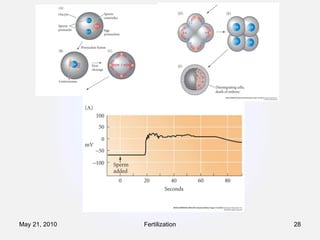
FERTILIZATION (In mammals sperms attach to egg membrane at a side of head (equatorial domain)….of head). Prevention of polyspermy:   In sea urchin …fast & slow processes……fast by changing of the electric potential of egg membrane, high  Na contents outside egg (in sea water), inside high K. Fertilization May 21, 2010
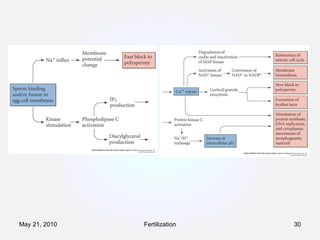
FERTILIZATION Resting membrane potential  -70 mv (inside of egg negatively charged)…within 1-3 sec. potential changes to positive, if experimentally this potential is changed polyspermy will be duly affected (i.e. by creating negative charge polyspermy can occur OR no fertilization by keeping the charge positive). Fertilization May 21, 2010
FERTILIZATION Slow block, sea urchin, cortical granule reaction, 15000 granules,1 µm in diameter, fuse with plasma membrane of egg and release contents into space between it & vitelline membrane, i.e.  exocytosis, several proteins released. First is cortical granule serine protease, it dissolves protein part that connect vitelline envelope protein to cell membrane, also clips off bindin receptors and any sperm attached to them. Fertilization May 21, 2010
FERTILIZATION Another mucopolysaccharide causes formation of fertilization envelope (by causing water get into the space between plasmalemma & vitelline membrane). A third protein released by cortical granules is peroxidase enzyme, which hardens fertilization envelope by cross linking tyrosine residues on adjacent proteins. This starts at sperm entry & spreads all over---- starts within 20 seconds and is finished by 60 seconds. Fertilization May 21, 2010
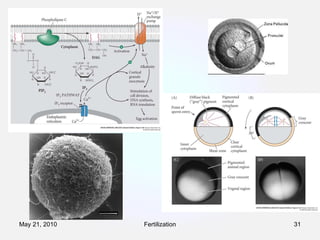
FERTILIZATION A 4th protein, hyalin, forms a coating around egg i.e. a hyalin layer, similar in mammalian egg but no fertilization membrane is formed, some other peculiar proteins in mouse i.e. ZP-3 & ZP-2 are knocked out. Calcium as initiator of cortical reaction :   Free calcium increases a lot. No influx but release from within egg i.e. intra cellular storage.  This can be monitored visually by ca-activated luminescent dye such as aequorin or fura-2. Fertilization May 21, 2010
FERTILIZATION These emit light when they bind with calcium.If injected with these dyes then fertilized, a wave of light starts from sperm entry point & go to other end ---completed within 30 sec. An ionophore A23187 (i.e. it transports calcium across membrane from outside), can cause cortical granules reaction & elevation of fertilization membrane if egg is immersed in this medium. Fertilization May 21, 2010
FERTILIZATION If no calcium in surrounding water even then this reaction occurs, so it must be activating ca++ already present.   Activation Of Egg Metabolism:   Early & late responses. Fertilization May 21, 2010
FERTILIZATION Early; Increase in calcium conc.->-> cell division, protein  synthesis (calcium increases from 0.1 to 1.0 µM).Several waves of calcium release…..  Several activities in egg related to these waves. If ca-chelating agent such as EGTA is injected ->->no cortical granule reaction, no change in membrane potential ->->no action potential. Fertilization May 21, 2010
FERTILIZATION Conversely injection of calcium ionophore (A23187) ->->all activities  i.e. elevation of fertilization membrane, rise in intra cellular pH, increase in O2 consumption, increase in the protein synthesis ,increase in DNA synthesis ,activation of enzyme NAD+ kinase which coverts NAD+ to NADP  which is important for construction of new cell membranes , needed at cleavage. Fertilization May 21, 2010
FERTILIZATION Late Responses;  DNA & protein synthesis, if pH increased artificially, DNA & protein synthesis ensues, nuclear envelope breakdown. Protein synthesis…. uses mRNA …..  already synthesized, especially encoding for histone, tubulin, actins, and morphogenetic proteins. The mRNA that was masked is now released (by maskin protein). Fertilization May 21, 2010
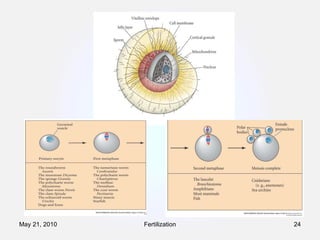
FERTILIZATION Fusion Of Genetic Material:  In sea urchin ----♀pronucleus already haploid, ♂ pronucleus decondenses, fuse to form zygote nuclei (diploid).  In mammals at fertilization ♀ nucleus at metaphase of 2nd meiotic division, calcium inactivates MAP kinase & DNA synthesis ensues. Two pronucei move towards each other: no envelope break down & chromosomes come on spindle (so true diploid nucleus is NOT formed in zygote but after first division) Fertilization May 21, 2010
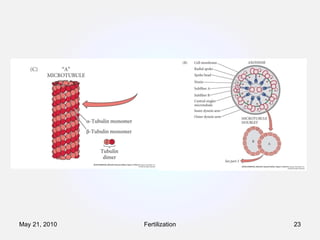
FERTILIZATION Rearrangement Of Egg Cytoplasm:  Fertilization leads to a lot of cytoplasmic movement, crucial for later cell differentiation. Rearrangement can be seen in tunicate ( Styla)….  various colors.  Also in amphibian cortex moves by about 30 degree towards sperm entry ->-> grey crescent exposed, this rotation is brought about by microtubules localized between cortex & inner cytoplasm.   Fertilization May 21, 2010
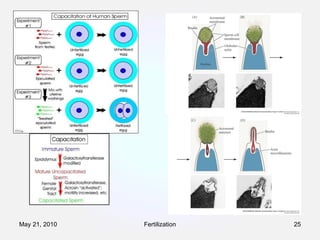
FERTILIZATION Sperm Capacitation:  Newly ejaculated sperms need to remain in ♀ reproductive tract to be able to undergo acrosomal reaction.   The set of physiological changes through which sperms become competent to fertilize an egg, is called capacitation. Fertilization May 21, 2010
FERTILIZATION Such changes involve (1). Removal of cholesterol from the sperm cell membrane. (2). Some particular proteins &/or carbohydrates are also lost during capacitation. (3). The membrane potential becomes more negative, as K ions leave the sperm. (4). Protein phosphorylation also takes place during capacitation. Capacitation can be achieved  in vitro , by incubating sperm in media containing calcium, bicarbonate and serum albumin.   Fertilization May 21, 2010
Fertilization May 21, 2010

fertilization

  • 1.
  • 2.
    FERTILIZATION Recognition ofEgg and Sperm: 5 steps, (1). Chemo attraction (2). Release of acrosomal enzymes (3). Binding of sperm to extra cellular envelopes (4). Passage through extra cellular envelopes (5). Fusion of sperm and egg nuclei (2 & 3 can be reversed). Fertilization May 21, 2010
  • 3.
    FERTILIZATION Sperm attraction…..speciesspecific in many invertebrates, chemo taxis, also timings in these animals. In sea urchin a peptide resact is such chemo tactic molecule. It is also sperm activating molecule. Egg jelly has other compounds as well, which bind with specific receptors on sperm, which inturn opens calcium ion channels, leading to exocytosis of acrosome. Fertilization May 21, 2010
  • 4.
    FERTILIZATION Acrosome reaction: In marine invertebrates, fusion of acrosomal membrane with sperm membrane & the formation of acrosomal process. Release of proteolytic enzymes ->-> go through jelly coats ->->egg membrane. Transportation of sperm and its capacitation. Active, also passive through contraction, species specific recognition (as in sea urchin). Fertilization May 21, 2010
  • 5.
    FERTILIZATION Acrosomal proteinis Bindin….present on acrosomal process…which is species specific. Its specific receptors not all over the egg membrane……so limited sites of contact and penetration (first step towards block to polyspermy). (In mammals, zona pellucida has many glycoproteins ….ZP-1, ZP-2, ZP-3….it is ZP-3 which affects binding & it also triggers acrosomal reaction. Fertilization May 21, 2010
  • 6.
    FERTILIZATION ZP-3 ofZP of egg crosslinks with a sperm protein called galactosyltransferase-Ι(which binds with carbohydrate residue of ZP-3) Exocytosis of acrosome (its breakdown) releases many proteases----which make a hole in ZP; secondary binding of spermatozoa is through ZP-2). Fertilization May 21, 2010
  • 7.
    FERTILIZATION Gamete Fusionand Prevention Of Polyspermy : Fusion of sperm and egg membranes ->->polymerization of actin in egg->-> fertilization cone, as does the sperm actin which forms the acrosomal process. These two projections meet so as to form a continuous bridge through which sperm nucleus & centiole pass. Fertilization May 21, 2010
  • 8.
    FERTILIZATION (In mammalssperms attach to egg membrane at a side of head (equatorial domain)….of head). Prevention of polyspermy: In sea urchin …fast & slow processes……fast by changing of the electric potential of egg membrane, high Na contents outside egg (in sea water), inside high K. Fertilization May 21, 2010
  • 9.
    FERTILIZATION Resting membranepotential -70 mv (inside of egg negatively charged)…within 1-3 sec. potential changes to positive, if experimentally this potential is changed polyspermy will be duly affected (i.e. by creating negative charge polyspermy can occur OR no fertilization by keeping the charge positive). Fertilization May 21, 2010
  • 10.
    FERTILIZATION Slow block,sea urchin, cortical granule reaction, 15000 granules,1 µm in diameter, fuse with plasma membrane of egg and release contents into space between it & vitelline membrane, i.e. exocytosis, several proteins released. First is cortical granule serine protease, it dissolves protein part that connect vitelline envelope protein to cell membrane, also clips off bindin receptors and any sperm attached to them. Fertilization May 21, 2010
  • 11.
    FERTILIZATION Another mucopolysaccharidecauses formation of fertilization envelope (by causing water get into the space between plasmalemma & vitelline membrane). A third protein released by cortical granules is peroxidase enzyme, which hardens fertilization envelope by cross linking tyrosine residues on adjacent proteins. This starts at sperm entry & spreads all over---- starts within 20 seconds and is finished by 60 seconds. Fertilization May 21, 2010
  • 12.
    FERTILIZATION A 4thprotein, hyalin, forms a coating around egg i.e. a hyalin layer, similar in mammalian egg but no fertilization membrane is formed, some other peculiar proteins in mouse i.e. ZP-3 & ZP-2 are knocked out. Calcium as initiator of cortical reaction : Free calcium increases a lot. No influx but release from within egg i.e. intra cellular storage. This can be monitored visually by ca-activated luminescent dye such as aequorin or fura-2. Fertilization May 21, 2010
  • 13.
    FERTILIZATION These emitlight when they bind with calcium.If injected with these dyes then fertilized, a wave of light starts from sperm entry point & go to other end ---completed within 30 sec. An ionophore A23187 (i.e. it transports calcium across membrane from outside), can cause cortical granules reaction & elevation of fertilization membrane if egg is immersed in this medium. Fertilization May 21, 2010
  • 14.
    FERTILIZATION If nocalcium in surrounding water even then this reaction occurs, so it must be activating ca++ already present. Activation Of Egg Metabolism: Early & late responses. Fertilization May 21, 2010
  • 15.
    FERTILIZATION Early; Increasein calcium conc.->-> cell division, protein synthesis (calcium increases from 0.1 to 1.0 µM).Several waves of calcium release….. Several activities in egg related to these waves. If ca-chelating agent such as EGTA is injected ->->no cortical granule reaction, no change in membrane potential ->->no action potential. Fertilization May 21, 2010
  • 16.
    FERTILIZATION Conversely injectionof calcium ionophore (A23187) ->->all activities i.e. elevation of fertilization membrane, rise in intra cellular pH, increase in O2 consumption, increase in the protein synthesis ,increase in DNA synthesis ,activation of enzyme NAD+ kinase which coverts NAD+ to NADP which is important for construction of new cell membranes , needed at cleavage. Fertilization May 21, 2010
  • 17.
    FERTILIZATION Late Responses; DNA & protein synthesis, if pH increased artificially, DNA & protein synthesis ensues, nuclear envelope breakdown. Protein synthesis…. uses mRNA ….. already synthesized, especially encoding for histone, tubulin, actins, and morphogenetic proteins. The mRNA that was masked is now released (by maskin protein). Fertilization May 21, 2010
  • 18.
    FERTILIZATION Fusion OfGenetic Material: In sea urchin ----♀pronucleus already haploid, ♂ pronucleus decondenses, fuse to form zygote nuclei (diploid). In mammals at fertilization ♀ nucleus at metaphase of 2nd meiotic division, calcium inactivates MAP kinase & DNA synthesis ensues. Two pronucei move towards each other: no envelope break down & chromosomes come on spindle (so true diploid nucleus is NOT formed in zygote but after first division) Fertilization May 21, 2010
  • 19.
    FERTILIZATION Rearrangement OfEgg Cytoplasm: Fertilization leads to a lot of cytoplasmic movement, crucial for later cell differentiation. Rearrangement can be seen in tunicate ( Styla)…. various colors. Also in amphibian cortex moves by about 30 degree towards sperm entry ->-> grey crescent exposed, this rotation is brought about by microtubules localized between cortex & inner cytoplasm. Fertilization May 21, 2010
  • 20.
    FERTILIZATION Sperm Capacitation: Newly ejaculated sperms need to remain in ♀ reproductive tract to be able to undergo acrosomal reaction. The set of physiological changes through which sperms become competent to fertilize an egg, is called capacitation. Fertilization May 21, 2010
  • 21.
    FERTILIZATION Such changesinvolve (1). Removal of cholesterol from the sperm cell membrane. (2). Some particular proteins &/or carbohydrates are also lost during capacitation. (3). The membrane potential becomes more negative, as K ions leave the sperm. (4). Protein phosphorylation also takes place during capacitation. Capacitation can be achieved in vitro , by incubating sperm in media containing calcium, bicarbonate and serum albumin. Fertilization May 21, 2010
  • 22.
  • 23.
  • 24.
  • 25.
  • 26.
  • 27.
  • 28.
  • 29.
  • 30.
  • 31.