Presented by
Priya Gupta
M.Sc. final
Fertilization is a complex sequence of
events that begins with contact between a
sperm and a secondary oocyte and ends
with the intermingling of the maternal and
paternal chromosomes at metaphase of 1st
cleavage of Zygote.
Site of fertilization
External fertilization- occur outside the body of
parent
e.g. In invertebrates and lower chordates
Internal fertilization- occur inside the body of
female
e.g. In terrestrial forms in which copulatory organs
are developed
Mechanism of fertilization
1. Approach of sperm to ova
2. Capacitation and contact
3. Acrosomal reaction and penetration
4. Activation of ovum
5. Amphimixis
Oocyte Transport
•At the time of ovulation,
the fimbriae move over the
ovary and sweep the
ovulatory mass containing
secondary oocyte, into the
infundibulum.
The ovulatory mass is then
guided into the ampulla
through the movements of
cilia, and by muscular
contraction of uterine tube
wall (Tubal Peristalsis).
•It has been estimated that
the ovulatory mass takes
about 25 minutes to reach
SPERM TRANSPORT
• Usually 200 to 500 million sperms are deposited.
• Sperms pass by movements of their tails through uterus &
tubes; assisted by muscular contraction.
• Prostaglandins present in the seminal plasma may
stimulate uterine motility at the time of intercourse.
• It is not known how long it takes sperms to reach the
fertilization site but the time of transport is short 5-
45minutes.
CONDITIONING OF THE
SPERMS
 The sperms in the female genital
tract, before fertilization undergo
1. Capacitation
2. Acrosome reaction
Capacitation
Starts in uterus& continues in to tubes.
Follicular fluid enhances the process.
It takes about 7 hours.
Glycoproteins are removed from plasma
membrane over acrosome.
Capacitated sperms show no morphological
change, but more active
Completion of capacitation permits acrosome
reaction to occur.
Fertilizin and antifertizin reaction
 Fertilizin is glycoprotein,produced by cells of
zona pellucida
• Makes sperm sticky adhere into clumps and
to egg surface
• Antifertizin secreted by surface membrane of
sperm it is acid protein
Acrosome reaction
•Occurs during passage of
sperm through corona
radiata.
•Outer membrane of the
acrosome fuses at many
places with overlying cell
membrane of sperm head.
fused membranes then
rupture, producing multiple
perforations through which
the enzymes
(Hyaluronidaze) in the
acrosome escape and
ooze out.
1. Hyaluronidase: needed to assist in
penetration of the corona radiata barrier;
2. Trypsin-like substances: needed for the
digestion of the zona pellucida;
3. Acrosin: also needed to help the sperm
cross the zona pellucida.
4. Progesterone (present in follicular fluid)
seems to stimulate the acrosome reaction.
ACROSOME REACTION
Penetration
• Passage of sperm through
corona radiata
– Hyaluronidase from acrosome
– Sperm tail
– Tubal mucosal enzymes
• Penetration of zona
pellucida facilitated by
– Acrosin
– Neurominidase
– Esterases
• Zona reaction
– Lysosomal enzymes of cortical
granules
contd.
Zona Pellucida
Wassermann and co-
workers (1980, 1985,
1987, 1988)
Found that zona pellucida
is composed of 3
glycoproteins
ZP1, ZP2, ZP3
Repeating subunits of
ZP2 and ZP3 form
filaments that are bound
together by ZP1
Wassermann et al. found that when the sperm binds to
ZP3 it causes a change in Ca+2 and Na+ flux across the
sperm plasmalemma that results in the acrosome
reaction. (ZP1 and ZP2 will not cause this to happen).
The sperm actually binds to an o-linked oligosaccharide
that is part of ZP3 - (a carbohydrate component of the
glycoprotein)
ZONA REACTION
As one sperm passes through zona pellucida, the
permeability of zona pellucida changes and zona
pellucida becomes impermeable to others sperms.
This is called zona reaction.
It is believed that granules released from the
secondary oocyte, which contain lysosomal
enzymes, produce this zona reaction.
Activation of ovum
Cytoplasmic fusion
Fertilization cone formation-at the region
of fusion cytoplasm of egg form projection
Cortical reaction - rupture of cortical
granules that occurs concurrently with the Ca++
release. Contents of granules are released into
perivitelline space and cause “hardening” of the zona
pellucida. Causes fertilization membrane to rise
away from surface of egg in some species.
Metabolic activation:-adenyl cyclase activity
increased
i. Change in permeability of plasma membrane
ii.NAD-kinase activated
iii.Ionic concentration of Na+,K+,Ca++ changed
iv.Rate of protein synthesis increased
Oocyte Cell Membrane
The secondary oocyte completes the second meiotic
division, forming a mature ovum and the second
polar body. The nucleus of the ovum is known as the
female pronucleus.
Once within the cytoplasm of the ovum the tail of
sperm degenerates & its head enlarges to form male
pronucleus.
Amphimixis & Zygote
formation
The male and female pronuclei come into contact
and loose their nuclear envelopes.
The maternal and paternal chromosomes
intermingle at equatorial plate of metaphase of the
first mitotic division of the zygote.
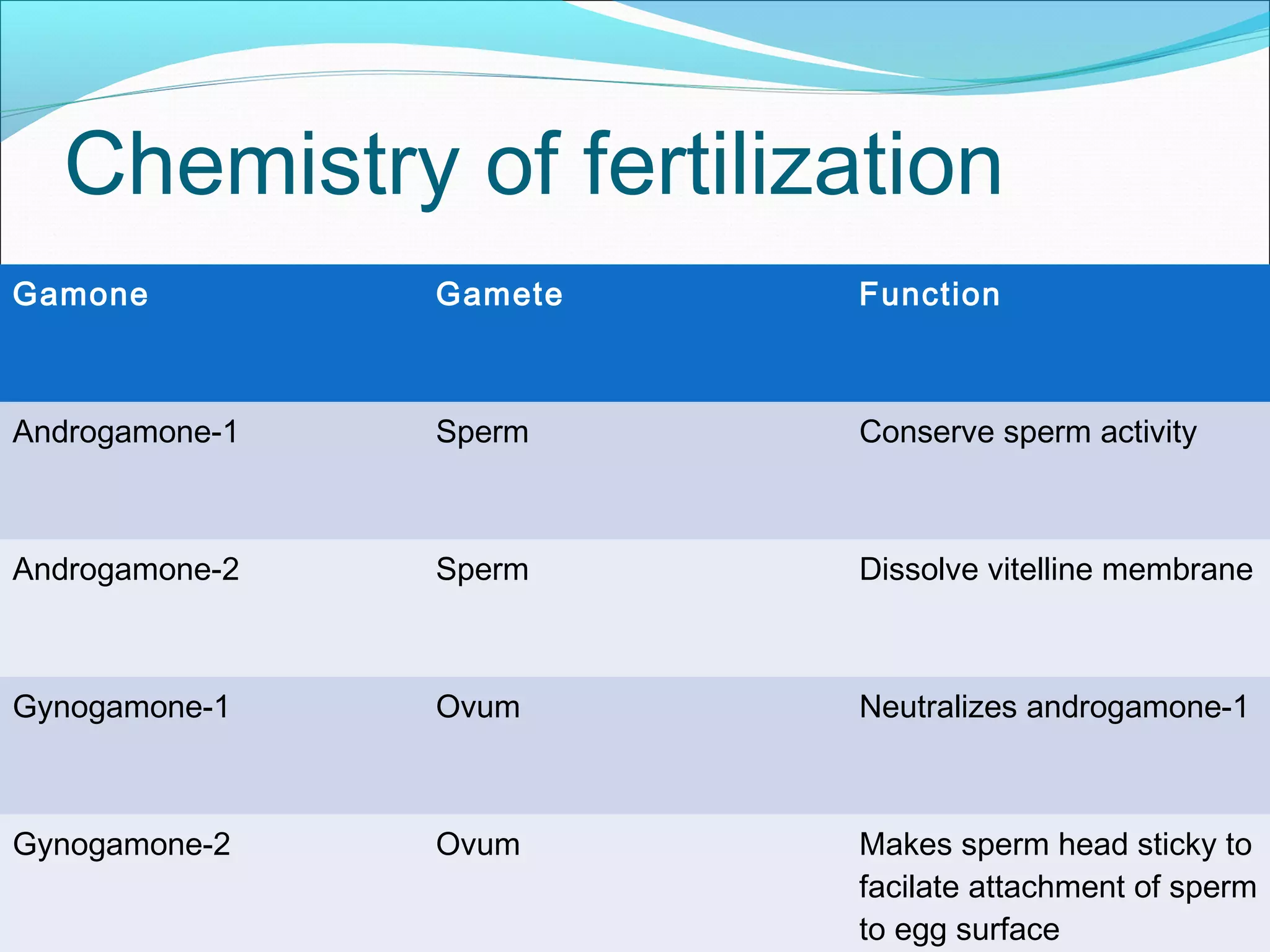
Chemistry of fertilization
Gamone Gamete Function
Androgamone-1 Sperm Conserve sperm activity
Androgamone-2 Sperm Dissolve vitelline membrane
Gynogamone-1 Ovum Neutralizes androgamone-1
Gynogamone-2 Ovum Makes sperm head sticky to
facilate attachment of sperm
to egg surface
 Restoration of diploid chromosomes
 Species variation
 Shuffling of genes.
 The zygote contains a new combination of
chromosomes, different from the parents.
 Bases of biparental inheritance and results in
variation of the human species.
Results of Fertilization
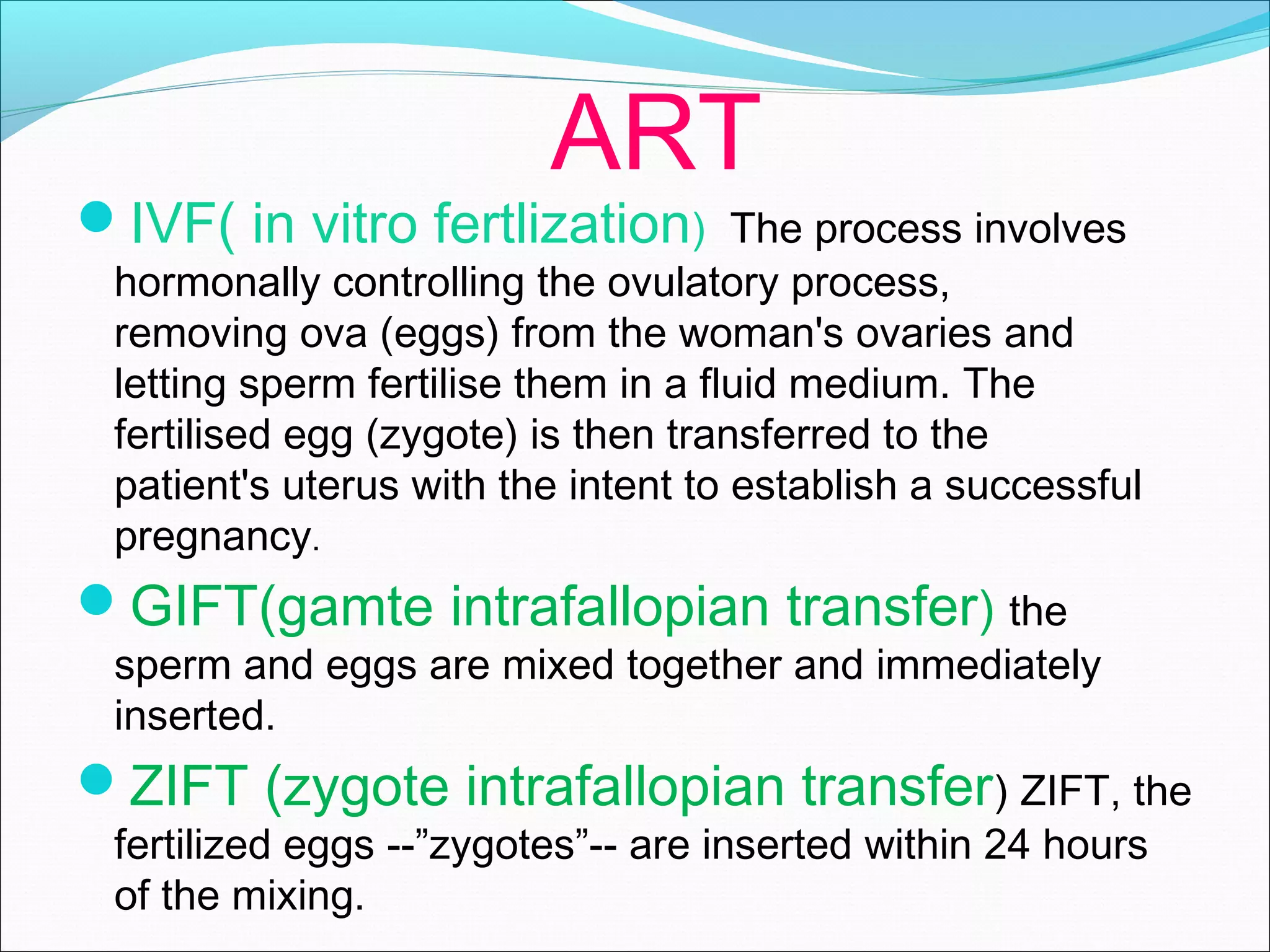
ART
IVF( in vitro fertlization)  The process involves
hormonally controlling the ovulatory process,
removing ova (eggs) from the woman's ovaries and
letting sperm fertilise them in a fluid medium. The
fertilised egg (zygote) is then transferred to the
patient's uterus with the intent to establish a successful
pregnancy. 
GIFT(gamte intrafallopian transfer) the
sperm and eggs are mixed together and immediately
inserted. 
ZIFT (zygote intrafallopian transfer) ZIFT, the
fertilized eggs --”zygotes”-- are inserted within 24 hours
of the mixing.
REFERANCES
Developmental Biology-Veer Bala Rastogi &
M.S.Jayaraj
Reproduction-Steve Parker
 Essential Reproduction-M. Johnson
Fertilization

Fertilization

  • 1.
  • 2.
    Fertilization is acomplex sequence of events that begins with contact between a sperm and a secondary oocyte and ends with the intermingling of the maternal and paternal chromosomes at metaphase of 1st cleavage of Zygote.
  • 3.
    Site of fertilization Externalfertilization- occur outside the body of parent e.g. In invertebrates and lower chordates Internal fertilization- occur inside the body of female e.g. In terrestrial forms in which copulatory organs are developed
  • 5.
    Mechanism of fertilization 1.Approach of sperm to ova 2. Capacitation and contact 3. Acrosomal reaction and penetration 4. Activation of ovum 5. Amphimixis
  • 6.
    Oocyte Transport •At thetime of ovulation, the fimbriae move over the ovary and sweep the ovulatory mass containing secondary oocyte, into the infundibulum. The ovulatory mass is then guided into the ampulla through the movements of cilia, and by muscular contraction of uterine tube wall (Tubal Peristalsis). •It has been estimated that the ovulatory mass takes about 25 minutes to reach
  • 7.
    SPERM TRANSPORT • Usually200 to 500 million sperms are deposited. • Sperms pass by movements of their tails through uterus & tubes; assisted by muscular contraction. • Prostaglandins present in the seminal plasma may stimulate uterine motility at the time of intercourse. • It is not known how long it takes sperms to reach the fertilization site but the time of transport is short 5- 45minutes.
  • 8.
    CONDITIONING OF THE SPERMS The sperms in the female genital tract, before fertilization undergo 1. Capacitation 2. Acrosome reaction
  • 9.
    Capacitation Starts in uterus&continues in to tubes. Follicular fluid enhances the process. It takes about 7 hours. Glycoproteins are removed from plasma membrane over acrosome. Capacitated sperms show no morphological change, but more active Completion of capacitation permits acrosome reaction to occur.
  • 10.
    Fertilizin and antifertizinreaction  Fertilizin is glycoprotein,produced by cells of zona pellucida • Makes sperm sticky adhere into clumps and to egg surface • Antifertizin secreted by surface membrane of sperm it is acid protein
  • 11.
    Acrosome reaction •Occurs duringpassage of sperm through corona radiata. •Outer membrane of the acrosome fuses at many places with overlying cell membrane of sperm head. fused membranes then rupture, producing multiple perforations through which the enzymes (Hyaluronidaze) in the acrosome escape and ooze out.
  • 12.
    1. Hyaluronidase: neededto assist in penetration of the corona radiata barrier; 2. Trypsin-like substances: needed for the digestion of the zona pellucida; 3. Acrosin: also needed to help the sperm cross the zona pellucida. 4. Progesterone (present in follicular fluid) seems to stimulate the acrosome reaction. ACROSOME REACTION
  • 13.
    Penetration • Passage ofsperm through corona radiata – Hyaluronidase from acrosome – Sperm tail – Tubal mucosal enzymes • Penetration of zona pellucida facilitated by – Acrosin – Neurominidase – Esterases • Zona reaction – Lysosomal enzymes of cortical granules contd.
  • 14.
    Zona Pellucida Wassermann andco- workers (1980, 1985, 1987, 1988) Found that zona pellucida is composed of 3 glycoproteins ZP1, ZP2, ZP3 Repeating subunits of ZP2 and ZP3 form filaments that are bound together by ZP1
  • 15.
    Wassermann et al.found that when the sperm binds to ZP3 it causes a change in Ca+2 and Na+ flux across the sperm plasmalemma that results in the acrosome reaction. (ZP1 and ZP2 will not cause this to happen). The sperm actually binds to an o-linked oligosaccharide that is part of ZP3 - (a carbohydrate component of the glycoprotein)
  • 16.
    ZONA REACTION As onesperm passes through zona pellucida, the permeability of zona pellucida changes and zona pellucida becomes impermeable to others sperms. This is called zona reaction. It is believed that granules released from the secondary oocyte, which contain lysosomal enzymes, produce this zona reaction.
  • 17.
    Activation of ovum Cytoplasmicfusion Fertilization cone formation-at the region of fusion cytoplasm of egg form projection Cortical reaction - rupture of cortical granules that occurs concurrently with the Ca++ release. Contents of granules are released into perivitelline space and cause “hardening” of the zona pellucida. Causes fertilization membrane to rise away from surface of egg in some species.
  • 19.
    Metabolic activation:-adenyl cyclaseactivity increased i. Change in permeability of plasma membrane ii.NAD-kinase activated iii.Ionic concentration of Na+,K+,Ca++ changed iv.Rate of protein synthesis increased
  • 20.
  • 21.
    The secondary oocytecompletes the second meiotic division, forming a mature ovum and the second polar body. The nucleus of the ovum is known as the female pronucleus. Once within the cytoplasm of the ovum the tail of sperm degenerates & its head enlarges to form male pronucleus.
  • 22.
    Amphimixis & Zygote formation Themale and female pronuclei come into contact and loose their nuclear envelopes. The maternal and paternal chromosomes intermingle at equatorial plate of metaphase of the first mitotic division of the zygote.
  • 24.
    Chemistry of fertilization GamoneGamete Function Androgamone-1 Sperm Conserve sperm activity Androgamone-2 Sperm Dissolve vitelline membrane Gynogamone-1 Ovum Neutralizes androgamone-1 Gynogamone-2 Ovum Makes sperm head sticky to facilate attachment of sperm to egg surface
  • 25.
     Restoration ofdiploid chromosomes  Species variation  Shuffling of genes.  The zygote contains a new combination of chromosomes, different from the parents.  Bases of biparental inheritance and results in variation of the human species. Results of Fertilization
  • 26.
    ART IVF( in vitrofertlization)  The process involves hormonally controlling the ovulatory process, removing ova (eggs) from the woman's ovaries and letting sperm fertilise them in a fluid medium. The fertilised egg (zygote) is then transferred to the patient's uterus with the intent to establish a successful pregnancy.  GIFT(gamte intrafallopian transfer) the sperm and eggs are mixed together and immediately inserted.  ZIFT (zygote intrafallopian transfer) ZIFT, the fertilized eggs --”zygotes”-- are inserted within 24 hours of the mixing.
  • 27.
    REFERANCES Developmental Biology-Veer BalaRastogi & M.S.Jayaraj Reproduction-Steve Parker  Essential Reproduction-M. Johnson