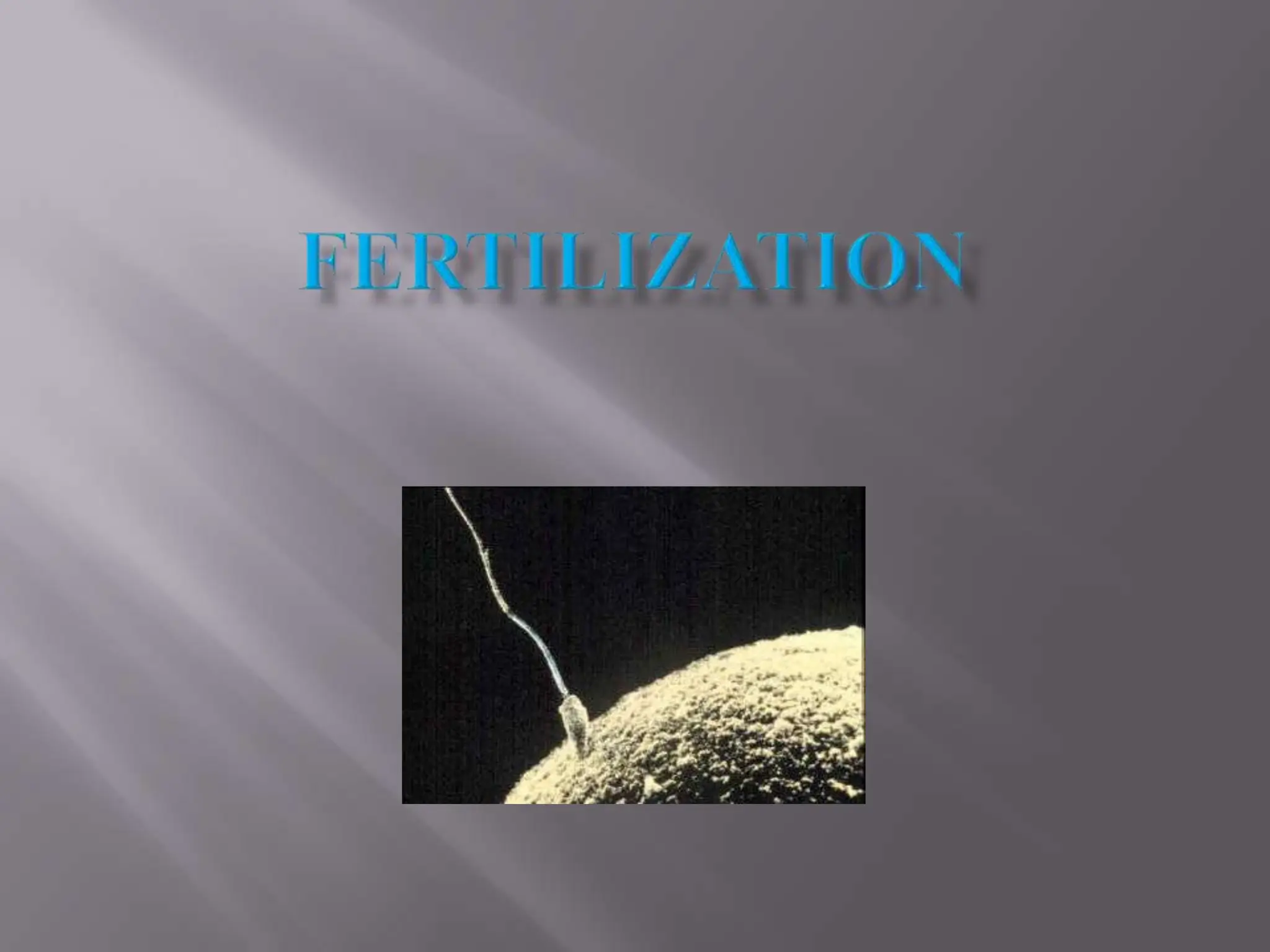
 the fusion of the sperm cell nucleus
with the egg cell nucleus to
produce a zygote (fertilized egg)
 Brings male and females gametes
together – produces diploid zygote
 It also activates the egg, triggering
the beginning of embryonic
development
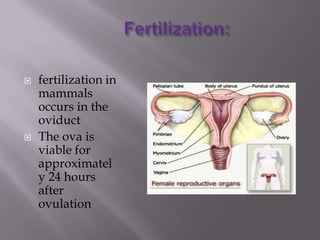
 fertilization in
mammals
occurs in the
oviduct
 The ova is
viable for
approximatel
y 24 hours
after
ovulation
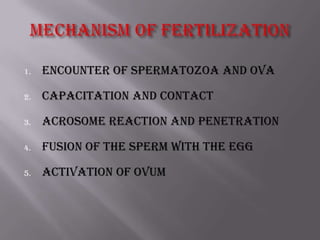
1. Encounter of spermatozoa and ova
2. Capacitation and contact
3. Acrosome reaction and penetration
4. Fusion of the sperm with the egg
5. Activation of ovum
 During the fertile phase, millions of sperm travel
from the vagina to the uterus and into the fallopian
tubes.
 Chemotaxis – A chemical substance is found in the
cortex of eggs.
 In general interaction is through special devices or
particular forms of behaviour.
 The primary need is a fluid medium for the act of
fertilization and delivery of sperm to the eggs at
the right time.
 2 types of fertilization
External
 Occurs outside of the body of the female
 Increased number of eggs produced to insure
the survival of the species
Eg: fish and amphibians
Internal
 Occurs inside the body of the female
 Fewer number of eggs are produced
 Increased parental care insures species survival
Eg: mammals, reptiles, birds
Several thousand sperm reach the egg
and one will fertilize it.
When the sperm fuses with the egg it
initiates a series of chemical changes
that prevent any other sperm from
entering.
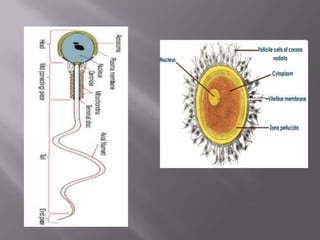
Capacitation
 Sperm undergo capacitation (further
maturation) within the female reproductive
tract.
 occurs in the female’s vagina.
 Vaginal secretions cause a molecular change
in the sperm plasmalemma (removal of
decapacitating factor - semen proteins, results
in increased membrane fluidity,).
 Takes 4-5 hr in humans
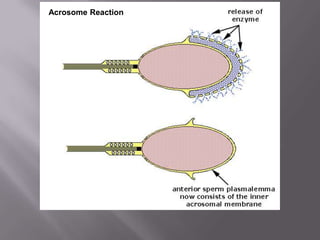
 When the acrosome reaction occurs, a number
of proteolytic enzymes are exposed or released.
 One or more of these enzymes is responsible
for digesting the hole through the zona pellucida
through which the sperm enters the perivitelline
space.
Acrosome Reaction
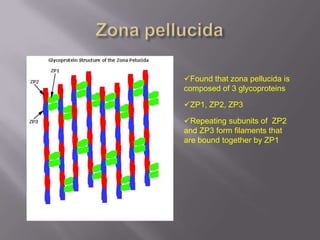
Found that zona pellucida is
composed of 3 glycoproteins
ZP1, ZP2, ZP3
Repeating subunits of ZP2
and ZP3 form filaments that
are bound together by ZP1
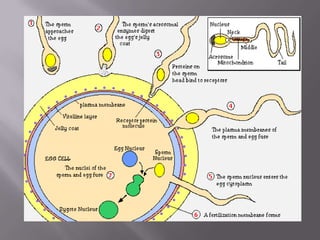
 The male nucleus enters the egg cytoplasm and
becomes the male pronucleus.
 As a result of the sperm fusing with the egg
plasmalemma, the oocyte nucleus, which is at
metaphase of the second meiotic division, completes
that division giving rise to another polar body.
 Following the second meiotic division, what is now the
nucleus of the ovum becomes the female pronucleus.
 The haploid male and female pronuclei move toward
one and other, meet, and fuse to form the diploid
nucleus of the zygote.
 The zygote will now proceed to undergo cleavage.
 A series of morphological, physiological
and molecular changes that occur in the
egg in response to fusion of the sperm with
the egg.
 1.Release of Ca++ (calcium) stored in the
egg endoplasmic reticulum - appears to be the
critical step in the process.
 2.Cortical reaction - rupture of cortical
granules that occurs concurrently with the
Ca++ release. Contents of granules are
released into perivitelline space and cause
“hardening” of the vitelline membrane or zona
pellucida. Causes vitelline/fertilization
membrane to rise away from surface of egg in
some species.
 3. In many species, an influx of Na+ (sodium)
into the egg cytoplasm that causes a change in
membrane potential - fast block to polyspermy.
 4. In many species a reorganization of the
egg cytoplasm.
 5. In most cases, completion of meiosis by
the egg.
 6. An efflux of H+ (hydrogen) ions causing an
increase in cytoplasmic pH - this activates
previously inhibited synthetic pathways.
 7. Increase in metabolism - zygote gears up
for development.
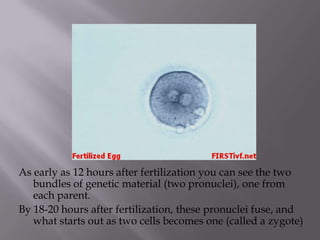
As early as 12 hours after fertilization you can see the two
bundles of genetic material (two pronuclei), one from
each parent.
By 18-20 hours after fertilization, these pronuclei fuse, and
what starts out as two cells becomes one (called a zygote)
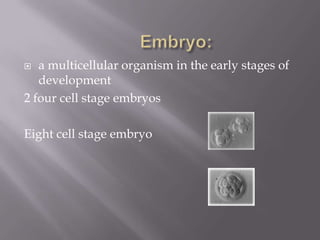
 a multicellular organism in the early stages of
development
2 four cell stage embryos
Eight cell stage embryo
The beginning developmental processes are
always the same in all animals:
1) cleavage
2) growth
3) differentiation
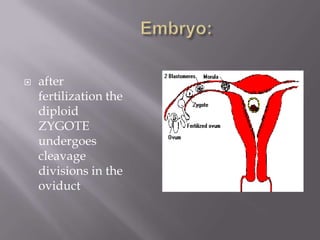
 after
fertilization the
diploid
ZYGOTE
undergoes
cleavage
divisions in the
oviduct
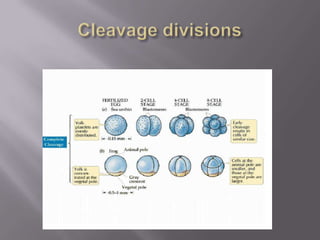
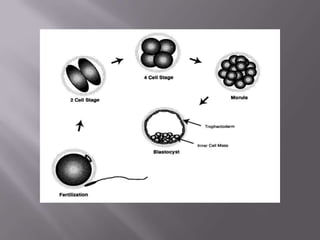
the first series of cell divisions by mitosis
after fertilization
Cell division is rapid, new cells do not take
time for the growth phase G1
cell growth does not occur so cells decrease
in size with each cleavage division
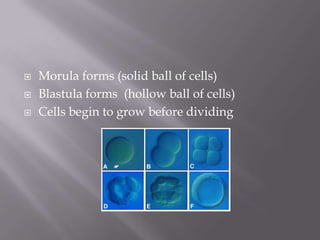
 Morula forms (solid ball of cells)
 Blastula forms (hollow ball of cells)
 Cells begin to grow before dividing
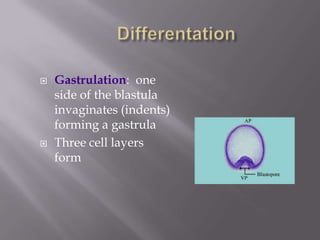
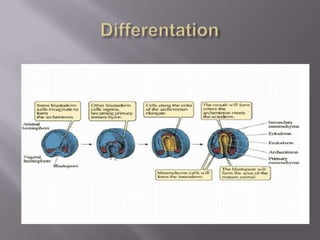
 Gastrulation: one
side of the blastula
invaginates (indents)
forming a gastrula
 Three cell layers
form
 The changing of unspecialized embryonic cells
into the specialized cells, tissues and organs of
a multicellular animal
 Ectoderm Outer layer
 Nervous system including brain, spinal
cord and nerves
 Lining of the mouth, nostrils, and anus
 Epidermis of skin, sweat glands, hair, nails
 Mesoderm Middle Layer
 Bones and muscles
 Blood and blood vessels
 Reproductive and excretory systems
 Inner layer (dermis) of skin
 Endoderm Inner Layer
 Lining of digestive tract
 Lining of trachea, bronchi, and lungs
 Liver, pancreas
 Thyroid, parathyroid, thymus, urinary bladder
fertilizationnotes-140122140506-phpapp02.pdf

fertilizationnotes-140122140506-phpapp02.pdf

  • 2.
     the fusionof the sperm cell nucleus with the egg cell nucleus to produce a zygote (fertilized egg)  Brings male and females gametes together – produces diploid zygote  It also activates the egg, triggering the beginning of embryonic development
  • 3.
     fertilization in mammals occursin the oviduct  The ova is viable for approximatel y 24 hours after ovulation
  • 4.
    1. Encounter ofspermatozoa and ova 2. Capacitation and contact 3. Acrosome reaction and penetration 4. Fusion of the sperm with the egg 5. Activation of ovum
  • 6.
     During thefertile phase, millions of sperm travel from the vagina to the uterus and into the fallopian tubes.  Chemotaxis – A chemical substance is found in the cortex of eggs.  In general interaction is through special devices or particular forms of behaviour.  The primary need is a fluid medium for the act of fertilization and delivery of sperm to the eggs at the right time.  2 types of fertilization
  • 7.
    External  Occurs outsideof the body of the female  Increased number of eggs produced to insure the survival of the species Eg: fish and amphibians
  • 8.
    Internal  Occurs insidethe body of the female  Fewer number of eggs are produced  Increased parental care insures species survival Eg: mammals, reptiles, birds
  • 9.
    Several thousand spermreach the egg and one will fertilize it. When the sperm fuses with the egg it initiates a series of chemical changes that prevent any other sperm from entering.
  • 10.
    Capacitation  Sperm undergocapacitation (further maturation) within the female reproductive tract.  occurs in the female’s vagina.  Vaginal secretions cause a molecular change in the sperm plasmalemma (removal of decapacitating factor - semen proteins, results in increased membrane fluidity,).  Takes 4-5 hr in humans
  • 11.
     When theacrosome reaction occurs, a number of proteolytic enzymes are exposed or released.  One or more of these enzymes is responsible for digesting the hole through the zona pellucida through which the sperm enters the perivitelline space.
  • 12.
  • 13.
    Found that zonapellucida is composed of 3 glycoproteins ZP1, ZP2, ZP3 Repeating subunits of ZP2 and ZP3 form filaments that are bound together by ZP1
  • 14.
     The malenucleus enters the egg cytoplasm and becomes the male pronucleus.  As a result of the sperm fusing with the egg plasmalemma, the oocyte nucleus, which is at metaphase of the second meiotic division, completes that division giving rise to another polar body.  Following the second meiotic division, what is now the nucleus of the ovum becomes the female pronucleus.  The haploid male and female pronuclei move toward one and other, meet, and fuse to form the diploid nucleus of the zygote.  The zygote will now proceed to undergo cleavage.
  • 15.
     A seriesof morphological, physiological and molecular changes that occur in the egg in response to fusion of the sperm with the egg.
  • 16.
     1.Release ofCa++ (calcium) stored in the egg endoplasmic reticulum - appears to be the critical step in the process.  2.Cortical reaction - rupture of cortical granules that occurs concurrently with the Ca++ release. Contents of granules are released into perivitelline space and cause “hardening” of the vitelline membrane or zona pellucida. Causes vitelline/fertilization membrane to rise away from surface of egg in some species.
  • 17.
     3. Inmany species, an influx of Na+ (sodium) into the egg cytoplasm that causes a change in membrane potential - fast block to polyspermy.  4. In many species a reorganization of the egg cytoplasm.  5. In most cases, completion of meiosis by the egg.  6. An efflux of H+ (hydrogen) ions causing an increase in cytoplasmic pH - this activates previously inhibited synthetic pathways.  7. Increase in metabolism - zygote gears up for development.
  • 19.
    As early as12 hours after fertilization you can see the two bundles of genetic material (two pronuclei), one from each parent. By 18-20 hours after fertilization, these pronuclei fuse, and what starts out as two cells becomes one (called a zygote)
  • 22.
     a multicellularorganism in the early stages of development 2 four cell stage embryos Eight cell stage embryo
  • 23.
    The beginning developmentalprocesses are always the same in all animals: 1) cleavage 2) growth 3) differentiation
  • 24.
  • 25.
    the first seriesof cell divisions by mitosis after fertilization Cell division is rapid, new cells do not take time for the growth phase G1 cell growth does not occur so cells decrease in size with each cleavage division
  • 27.
     Morula forms(solid ball of cells)  Blastula forms (hollow ball of cells)  Cells begin to grow before dividing
  • 29.
     Gastrulation: one sideof the blastula invaginates (indents) forming a gastrula  Three cell layers form
  • 31.
     The changingof unspecialized embryonic cells into the specialized cells, tissues and organs of a multicellular animal
  • 32.
     Ectoderm Outerlayer  Nervous system including brain, spinal cord and nerves  Lining of the mouth, nostrils, and anus  Epidermis of skin, sweat glands, hair, nails
  • 33.
     Mesoderm MiddleLayer  Bones and muscles  Blood and blood vessels  Reproductive and excretory systems  Inner layer (dermis) of skin
  • 34.
     Endoderm InnerLayer  Lining of digestive tract  Lining of trachea, bronchi, and lungs  Liver, pancreas  Thyroid, parathyroid, thymus, urinary bladder