The Fertilization Process
Objective:
-Explain the process of fertilization in
humans.
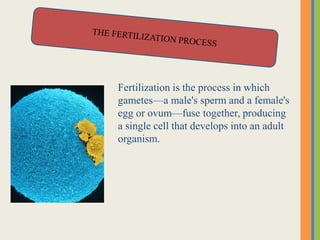
Fertilization is the process in which
gametes—a male's sperm and a female's
egg or ovum—fuse together, producing
a single cell that develops into an adult
organism.
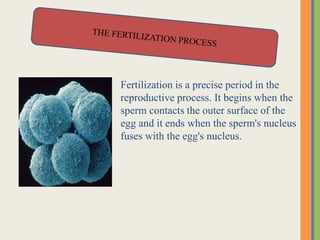
Fertilization is a precise period in the
reproductive process. It begins when the
sperm contacts the outer surface of the
egg and it ends when the sperm's nucleus
fuses with the egg's nucleus.
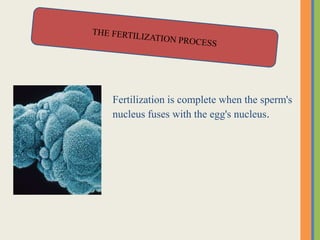
Fertilization is complete when the sperm's
nucleus fuses with the egg's nucleus.
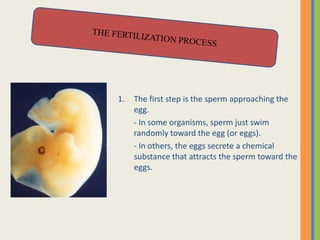
1. The first step is the sperm approaching the
egg.
- In some organisms, sperm just swim
randomly toward the egg (or eggs).
- In others, the eggs secrete a chemical
substance that attracts the sperm toward the
eggs.
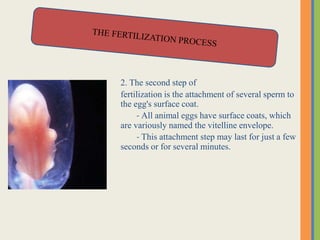
2. The second step of
fertilization is the attachment of several sperm to
the egg's surface coat.
- All animal eggs have surface coats, which
are variously named the vitelline envelope.
- This attachment step may last for just a few
seconds or for several minutes.
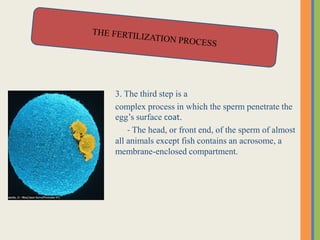
3. The third step is a
complex process in which the sperm penetrate the
egg’s surface coat.
- The head, or front end, of the sperm of almost
all animals except fish contains an acrosome, a
membrane-enclosed compartment.
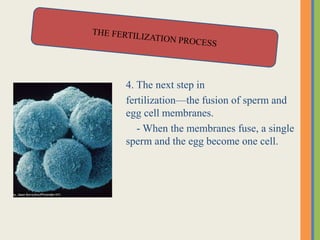
4. The next step in
fertilization—the fusion of sperm and
egg cell membranes.
- When the membranes fuse, a single
sperm and the egg become one cell.
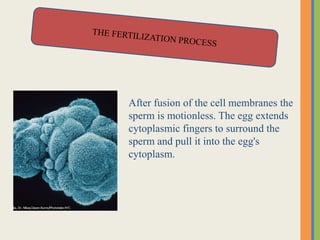
After fusion of the cell membranes the
sperm is motionless. The egg extends
cytoplasmic fingers to surround the
sperm and pull it into the egg's
cytoplasm.
Filaments called microtubules begin to
grow from the inner surface of the egg
cell's membrane inward toward the
cell's center, resembling spokes of a
bicycle wheel growing from the rim
inward toward the wheel's hub.
As the microtubules grow, the sperm and
egg nuclei are pushed toward the egg's
center.
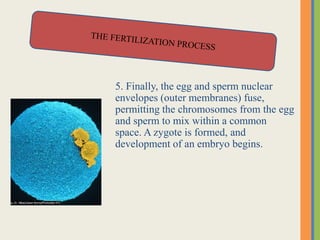
5. Finally, the egg and sperm nuclear
envelopes (outer membranes) fuse,
permitting the chromosomes from the egg
and sperm to mix within a common
space. A zygote is formed, and
development of an embryo begins.
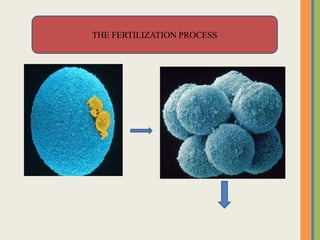
THE FERTILIZATION PROCESS
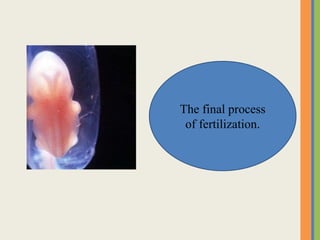
The final process
of fertilization.
References:
The world of Science 5
Into the Future; Science and Health 5
BEC Handbook in Science 5
Encarta 2009

Fertilization process

  • 1.
    The Fertilization Process Objective: -Explainthe process of fertilization in humans.
  • 2.
    Fertilization is theprocess in which gametes—a male's sperm and a female's egg or ovum—fuse together, producing a single cell that develops into an adult organism.
  • 3.
    Fertilization is aprecise period in the reproductive process. It begins when the sperm contacts the outer surface of the egg and it ends when the sperm's nucleus fuses with the egg's nucleus.
  • 4.
    Fertilization is completewhen the sperm's nucleus fuses with the egg's nucleus.
  • 5.
    1. The firststep is the sperm approaching the egg. - In some organisms, sperm just swim randomly toward the egg (or eggs). - In others, the eggs secrete a chemical substance that attracts the sperm toward the eggs.
  • 6.
    2. The secondstep of fertilization is the attachment of several sperm to the egg's surface coat. - All animal eggs have surface coats, which are variously named the vitelline envelope. - This attachment step may last for just a few seconds or for several minutes.
  • 7.
    3. The thirdstep is a complex process in which the sperm penetrate the egg’s surface coat. - The head, or front end, of the sperm of almost all animals except fish contains an acrosome, a membrane-enclosed compartment.
  • 8.
    4. The nextstep in fertilization—the fusion of sperm and egg cell membranes. - When the membranes fuse, a single sperm and the egg become one cell.
  • 9.
    After fusion ofthe cell membranes the sperm is motionless. The egg extends cytoplasmic fingers to surround the sperm and pull it into the egg's cytoplasm.
  • 10.
    Filaments called microtubulesbegin to grow from the inner surface of the egg cell's membrane inward toward the cell's center, resembling spokes of a bicycle wheel growing from the rim inward toward the wheel's hub.
  • 11.
    As the microtubulesgrow, the sperm and egg nuclei are pushed toward the egg's center.
  • 12.
    5. Finally, theegg and sperm nuclear envelopes (outer membranes) fuse, permitting the chromosomes from the egg and sperm to mix within a common space. A zygote is formed, and development of an embryo begins.
  • 13.
  • 15.
    The final process offertilization.
  • 16.
    References: The world ofScience 5 Into the Future; Science and Health 5 BEC Handbook in Science 5 Encarta 2009