ANTHOCEROS (Hornwort)
Division: Bryophyta, Class: Anthoceratopsida Order: Anthocerotales Family: Anthocerotaceae
                            Anthoceratopsida,                              Anthocerotaceae,
Genus: Anthoceros
Morphology of thallus:
•   Adult plant represents the gametophytic generation. It is thalloid, dorsiventrally flattened, green,
    irregularly lobed or radially dissected structure
                                            structure.
•   Definite midrib and dichotomous branching is absent.
•   Dorsal surface is smooth, velvety or rough.
•   On the ventral surface, many s smooth walled rhizoids are
    present which help in fixation. Scales and tuberculate rhizoids
    are absent. Some bluish mucilaginous spots are also seen
    which represent the colonies of blue
                                      blue-green alga (Nostoc or
    Anabaena).
•   At the end of the rainy season, elonga
                                      elongated horn- like sporophytes are seen on the gametophyte.

Anatomy of thallus:
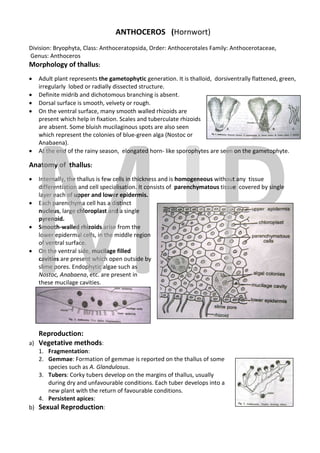
•   Internally, the thallus is few cells in thickness and is homogeneous without any tissue
    differentiation and cell specialisation. It consists of parenchymatous tissue covered by single
    layer each of upper and lower epidermis.
•   Each parenchyma cell has a distinct
    nucleus, large chloroplast and a single
    pyrenoid.
•   Smooth-walled rhizoids arise from the
    lower epidermal cells, in the middle region
    of ventral surface.
•   On the ventral side, mucilage filled
    cavities are present which open outside by
                                h
    slime pores. Endophytic algae such as
    Nostoc, Anabaena, etc. are present in
                                re
    these mucilage cavities.


   Reproduction:
a) Vegetative methods:
   1. Fragmentation:
   2. Gemmae: Formation of gemmae is reported on the thallus of some
               :
      species such as A. Glandulosus
                         Glandulosus.
   3. Tubers: Corky tubers develop on the margins of thallus, usually
             :
      during dry and unfavourable conditions. Each tuber develops into a
      new plant with the return of favour
                                   favourable conditions.
   4. Persistent apices:
b) Sexual Reproduction:
Sexual reproduction is oogamous type. Many species are monoecious while some are
dioecious. In monoecious species, antheridia develop much earlier to archegonia (Protandrous
condition). Sex organs develop inside the gametophytic
thallus.
Structure of Antheridia:
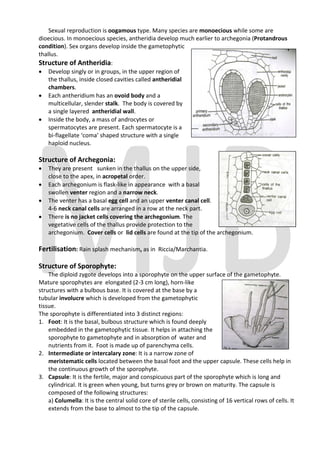
• Develop singly or in groups, in the upper region of
    the thallus, inside closed cavities called antheridial
    chambers.
• Each antheridium has an ovoid body and a
    multicellular, slender stalk. The body is covered by
    a single layered antheridial wall.
• Inside the body, a mass of androcytes or
    spermatocytes are present. Each spermatocyte is a
    bi-flagellate ‘coma’ shaped structure with a single
    haploid nucleus.

Structure of Archegonia:
•   They are present sunken in the thallus on the upper side,
    close to the apex, in acropetal order.
•   Each archegonium is flask-like in appearance with a basal
    swollen venter region and a narrow neck.
•   The venter has a basal egg cell and an upper venter canal cell.
    4-6 neck canal cells are arranged in a row at the neck part.
•   There is no jacket cells covering the archegonium. The
    vegetative cells of the thallus provide protection to the
    archegonium. Cover cells or lid cells are found at the tip of the archegonium.

Fertilisation: Rain splash mechanism, as in Riccia/Marchantia.

Structure of Sporophyte:
    The diploid zygote develops into a sporophyte on the upper surface of the gametophyte.
Mature sporophytes are elongated (2-3 cm long), horn-like
structures with a bulbous base. It is covered at the base by a
tubular involucre which is developed from the gametophytic
tissue.
The sporophyte is differentiated into 3 distinct regions:
1. Foot: It is the basal, bulbous structure which is found deeply
    embedded in the gametophytic tissue. It helps in attaching the
    sporophyte to gametophyte and in absorption of water and
    nutrients from it. Foot is made up of parenchyma cells.
2. Intermediate or intercalary zone: It is a narrow zone of
    meristematic cells located between the basal foot and the upper capsule. These cells help in
    the continuous growth of the sporophyte.
3. Capsule: It is the fertile, major and conspicuous part of the sporophyte which is long and
    cylindrical. It is green when young, but turns grey or brown on maturity. The capsule is
    composed of the following structures:
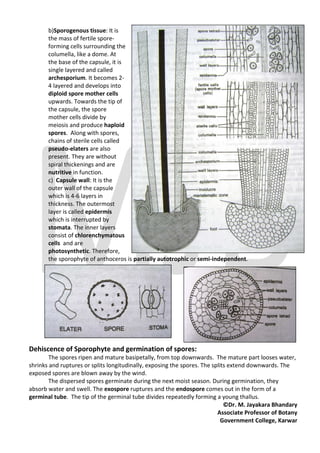
    a) Columella: It is the central solid core of sterile cells, consisting of 16 vertical rows of cells. It
    extends from the base to almost to the tip of the capsule.
b)Sporogenous tissue: It is
       the mass of fertile spore-
       forming cells surrounding the
       columella, like a dome. At
       the base of the capsule, it is
       single layered and called
       archesporium. It becomes 2-
       4 layered and develops into
       diploid spore mother cells
       upwards. Towards the tip of
       the capsule, the spore
       mother cells divide by
       meiosis and produce haploid
       spores. Along with spores,
       chains of sterile cells called
       pseudo-elaters are also
       present. They are without
       spiral thickenings and are
       nutritive in function.
       c) Capsule wall: It is the
       outer wall of the capsule
       which is 4-6 layers in
       thickness. The outermost
       layer is called epidermis
       which is interrupted by
       stomata. The inner layers
       consist of chlorenchymatous
       cells and are
       photosynthetic. Therefore,
       the sporophyte of anthoceros is partially autotrophic or semi-independent.


Dehiscence of Sporophyte and germination of spores:
        The spores ripen and mature basipetally, from top downwards. The mature part looses water,
shrinks and ruptures or splits longitudinally, exposing the spores. The splits extend downwards. The
exposed spores are blown away by the wind.
        The dispersed spores germinate during the next moist season. During germination, they
absorb water and swell. The exospore ruptures and the endospore comes out in the form of a
germinal tube. The tip of the germinal tube divides repeatedly forming a young thallus.
                                                                             ©Dr. M. Jayakara Bhandary
                                                                          Associate Professor of Botany
                                                                            Government College, Karwar

Anthoceros

  • 1.
    ANTHOCEROS (Hornwort) Division: Bryophyta,Class: Anthoceratopsida Order: Anthocerotales Family: Anthocerotaceae Anthoceratopsida, Anthocerotaceae, Genus: Anthoceros Morphology of thallus: • Adult plant represents the gametophytic generation. It is thalloid, dorsiventrally flattened, green, irregularly lobed or radially dissected structure structure. • Definite midrib and dichotomous branching is absent. • Dorsal surface is smooth, velvety or rough. • On the ventral surface, many s smooth walled rhizoids are present which help in fixation. Scales and tuberculate rhizoids are absent. Some bluish mucilaginous spots are also seen which represent the colonies of blue blue-green alga (Nostoc or Anabaena). • At the end of the rainy season, elonga elongated horn- like sporophytes are seen on the gametophyte. Anatomy of thallus: • Internally, the thallus is few cells in thickness and is homogeneous without any tissue differentiation and cell specialisation. It consists of parenchymatous tissue covered by single layer each of upper and lower epidermis. • Each parenchyma cell has a distinct nucleus, large chloroplast and a single pyrenoid. • Smooth-walled rhizoids arise from the lower epidermal cells, in the middle region of ventral surface. • On the ventral side, mucilage filled cavities are present which open outside by h slime pores. Endophytic algae such as Nostoc, Anabaena, etc. are present in re these mucilage cavities. Reproduction: a) Vegetative methods: 1. Fragmentation: 2. Gemmae: Formation of gemmae is reported on the thallus of some : species such as A. Glandulosus Glandulosus. 3. Tubers: Corky tubers develop on the margins of thallus, usually : during dry and unfavourable conditions. Each tuber develops into a new plant with the return of favour favourable conditions. 4. Persistent apices: b) Sexual Reproduction:
  • 2.
    Sexual reproduction isoogamous type. Many species are monoecious while some are dioecious. In monoecious species, antheridia develop much earlier to archegonia (Protandrous condition). Sex organs develop inside the gametophytic thallus. Structure of Antheridia: • Develop singly or in groups, in the upper region of the thallus, inside closed cavities called antheridial chambers. • Each antheridium has an ovoid body and a multicellular, slender stalk. The body is covered by a single layered antheridial wall. • Inside the body, a mass of androcytes or spermatocytes are present. Each spermatocyte is a bi-flagellate ‘coma’ shaped structure with a single haploid nucleus. Structure of Archegonia: • They are present sunken in the thallus on the upper side, close to the apex, in acropetal order. • Each archegonium is flask-like in appearance with a basal swollen venter region and a narrow neck. • The venter has a basal egg cell and an upper venter canal cell. 4-6 neck canal cells are arranged in a row at the neck part. • There is no jacket cells covering the archegonium. The vegetative cells of the thallus provide protection to the archegonium. Cover cells or lid cells are found at the tip of the archegonium. Fertilisation: Rain splash mechanism, as in Riccia/Marchantia. Structure of Sporophyte: The diploid zygote develops into a sporophyte on the upper surface of the gametophyte. Mature sporophytes are elongated (2-3 cm long), horn-like structures with a bulbous base. It is covered at the base by a tubular involucre which is developed from the gametophytic tissue. The sporophyte is differentiated into 3 distinct regions: 1. Foot: It is the basal, bulbous structure which is found deeply embedded in the gametophytic tissue. It helps in attaching the sporophyte to gametophyte and in absorption of water and nutrients from it. Foot is made up of parenchyma cells. 2. Intermediate or intercalary zone: It is a narrow zone of meristematic cells located between the basal foot and the upper capsule. These cells help in the continuous growth of the sporophyte. 3. Capsule: It is the fertile, major and conspicuous part of the sporophyte which is long and cylindrical. It is green when young, but turns grey or brown on maturity. The capsule is composed of the following structures: a) Columella: It is the central solid core of sterile cells, consisting of 16 vertical rows of cells. It extends from the base to almost to the tip of the capsule.
  • 3.
    b)Sporogenous tissue: Itis the mass of fertile spore- forming cells surrounding the columella, like a dome. At the base of the capsule, it is single layered and called archesporium. It becomes 2- 4 layered and develops into diploid spore mother cells upwards. Towards the tip of the capsule, the spore mother cells divide by meiosis and produce haploid spores. Along with spores, chains of sterile cells called pseudo-elaters are also present. They are without spiral thickenings and are nutritive in function. c) Capsule wall: It is the outer wall of the capsule which is 4-6 layers in thickness. The outermost layer is called epidermis which is interrupted by stomata. The inner layers consist of chlorenchymatous cells and are photosynthetic. Therefore, the sporophyte of anthoceros is partially autotrophic or semi-independent. Dehiscence of Sporophyte and germination of spores: The spores ripen and mature basipetally, from top downwards. The mature part looses water, shrinks and ruptures or splits longitudinally, exposing the spores. The splits extend downwards. The exposed spores are blown away by the wind. The dispersed spores germinate during the next moist season. During germination, they absorb water and swell. The exospore ruptures and the endospore comes out in the form of a germinal tube. The tip of the germinal tube divides repeatedly forming a young thallus. ©Dr. M. Jayakara Bhandary Associate Professor of Botany Government College, Karwar