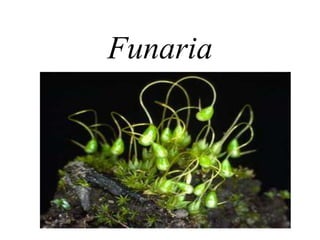
Funaria
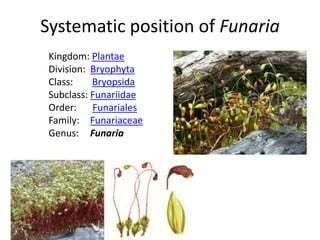
Systematic position of Funaria
Kingdom: Plantae
Division: Bryophyta
Class: Bryopsida
Subclass: Funariidae
Order: Funariales
Family: Funariaceae
Genus: Funaria
General characters
•Funaria is a genus of
approximately 210 species of
moss and 18 species reported
from India.
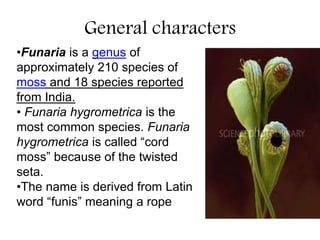
• Funaria hygrometrica is the
most common species. Funaria
hygrometrica is called “cord
moss” because of the twisted
seta.
•The name is derived from Latin
word “funis” meaning a rope
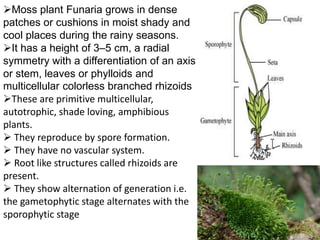
Moss plant Funaria grows in dense
patches or cushions in moist shady and
cool places during the rainy seasons.
It has a height of 3–5 cm, a radial
symmetry with a differentiation of an axis
or stem, leaves or phylloids and
multicellular colorless branched rhizoids
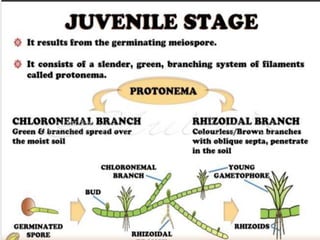
These are primitive multicellular,
autotrophic, shade loving, amphibious
plants.
 They reproduce by spore formation.
 They have no vascular system.
 Root like structures called rhizoids are
present.
 They show alternation of generation i.e.
the gametophytic stage alternates with the
sporophytic stage
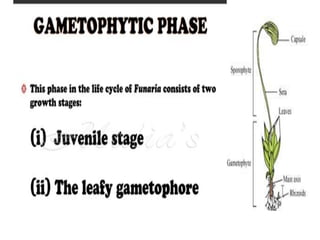
GAMETOPHORE STAGE
• Gametophore is the dominant stage in the
life cycle.
•It is erect, leafy structure that reaches
upto 3 cm height.
• It has slender, cylindrical upright central
axis known as cauloid on which the flat,
green, lateral expansions phylloids are
present.
• Cauloid and phylloids are structurally not
similar to stem and leaves because these are
without vascular tissues and gametophytic in
origin.
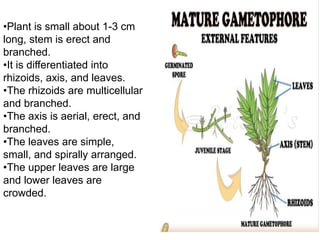
•Plant is small about 1-3 cm
long, stem is erect and
branched.
•It is differentiated into
rhizoids, axis, and leaves.
•The rhizoids are multicellular
and branched.
•The axis is aerial, erect, and
branched.
•The leaves are simple,
small, and spirally arranged.
•The upper leaves are large
and lower leaves are
crowded.
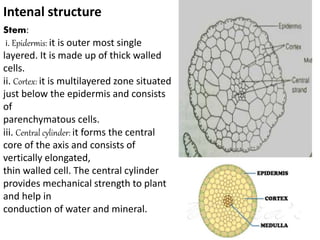
Intenal structure
Stem:
i. Epidermis: it is outer most single
layered. It is made up of thick walled
cells.
ii. Cortex: it is multilayered zone situated
just below the epidermis and consists
of
parenchymatous cells.
iii. Central cylinder: it forms the central
core of the axis and consists of
vertically elongated,
thin walled cell. The central cylinder
provides mechanical strength to plant
and help in
conduction of water and mineral.
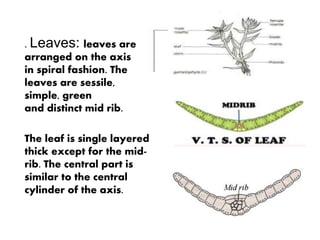
. Leaves: leaves are
arranged on the axis
in spiral fashion. The
leaves are sessile,
simple, green
and distinct mid rib.
The leaf is single layered
thick except for the mid-
rib. The central part is
similar to the central
cylinder of the axis.
Funaria
Funaria
Funaria
Funaria
Funaria
Funaria
Funaria
Funaria
Funaria
Funaria
Funaria
Funaria
Funaria
Funaria
Funaria

Funaria

  • 1.
  • 2.
    Systematic position ofFunaria Kingdom: Plantae Division: Bryophyta Class: Bryopsida Subclass: Funariidae Order: Funariales Family: Funariaceae Genus: Funaria
  • 3.
    General characters •Funaria isa genus of approximately 210 species of moss and 18 species reported from India. • Funaria hygrometrica is the most common species. Funaria hygrometrica is called “cord moss” because of the twisted seta. •The name is derived from Latin word “funis” meaning a rope
  • 4.
    Moss plant Funariagrows in dense patches or cushions in moist shady and cool places during the rainy seasons. It has a height of 3–5 cm, a radial symmetry with a differentiation of an axis or stem, leaves or phylloids and multicellular colorless branched rhizoids These are primitive multicellular, autotrophic, shade loving, amphibious plants.  They reproduce by spore formation.  They have no vascular system.  Root like structures called rhizoids are present.  They show alternation of generation i.e. the gametophytic stage alternates with the sporophytic stage
  • 7.
    GAMETOPHORE STAGE • Gametophoreis the dominant stage in the life cycle. •It is erect, leafy structure that reaches upto 3 cm height. • It has slender, cylindrical upright central axis known as cauloid on which the flat, green, lateral expansions phylloids are present. • Cauloid and phylloids are structurally not similar to stem and leaves because these are without vascular tissues and gametophytic in origin.
  • 8.
    •Plant is smallabout 1-3 cm long, stem is erect and branched. •It is differentiated into rhizoids, axis, and leaves. •The rhizoids are multicellular and branched. •The axis is aerial, erect, and branched. •The leaves are simple, small, and spirally arranged. •The upper leaves are large and lower leaves are crowded.
  • 9.
    Intenal structure Stem: i. Epidermis:it is outer most single layered. It is made up of thick walled cells. ii. Cortex: it is multilayered zone situated just below the epidermis and consists of parenchymatous cells. iii. Central cylinder: it forms the central core of the axis and consists of vertically elongated, thin walled cell. The central cylinder provides mechanical strength to plant and help in conduction of water and mineral.
  • 10.
    . Leaves: leavesare arranged on the axis in spiral fashion. The leaves are sessile, simple, green and distinct mid rib. The leaf is single layered thick except for the mid- rib. The central part is similar to the central cylinder of the axis.