Structure & Development of Embryos (Dicot & Monocot)
                                                              Dr. jayakara Bhandary M.
                                                            Associate Professor of Botany
                                                            Government College, Karwar
                                                                      jaikarb@gmail.com

        The zygote gives rise to an embryo by a predetermined series of cell divisions and cell
differentiations . This process is called embryogenesis. The
embryo then germinates and grows into an adult plant. In
seed plants, embryogenesis occurs within the embryo sac of
the ovule.

Structure and development of Dicot embryo:
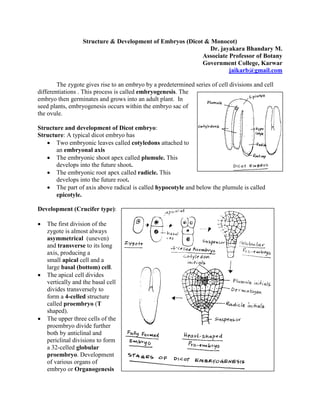
Structure: A typical dicot embryo has
   • Two embryonic leaves called cotyledons attached to
       an embryonal axis
   • The embryonic shoot apex called plumule. This
       develops into the future shoot.
   • The embryonic root apex called radicle. This
       develops into the future root.
   • The part of axis above radical is called hypocotyle and below the plumule is called
       epicotyle.

Development (Crucifer type):

•   The first division of the
    zygote is almost always
    asymmetrical (uneven)
    and transverse to its long
    axis, producing a
    small apical cell and a
    large basal (bottom) cell.
•   The apical cell divides
    vertically and the basal cell
    divides transversely to
    form a 4-celled structure
    called proembryo (T
    shaped).
•   The upper three cells of the
    proembryo divide further
    both by anticlinal and
    periclinal divisions to form
    a 32-celled globular
    proembryo. Development
    of various organs of
    embryo or Organogenesis
occurs in the 32 celled proembryo.
•   The outer most layer of cells of the globular proembryo develop into a distinct layer called
    dermatogen which forms the future epidermis.
•   The inner cells of the upper region develop into the cotyledons and plumule while the lower
    cells develop into the radicle.
•   The cotyledonary cells divide rapidly than the plumule cells. Therefore the embryo becomes
    heart shaped.
•   When the cotyledons are completely formed, they enclose the
    plumule at the base.
•   The lower most cell formed by the basal cell does not contribute
    to embryo structure. It may divide by a few transverse divisions
    to form a filamentous structure known as the suspensor, which
    anchors the embryo to the embryo sac wall and helps in nutrient
    absorption from the surrounding tissues.

Structure and development of Monocot embryo:
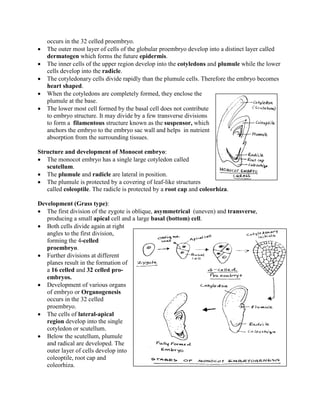
• The monocot embryo has a single large cotyledon called
   scutellum.
• The plumule and radicle are lateral in position.
• The plumule is protected by a covering of leaf-like structures
   called coleoptile. The radicle is protected by a root cap and coleorhiza.

Development (Grass type):
• The first division of the zygote is oblique, asymmetrical (uneven) and transverse,
   producing a small apical cell and a large basal (bottom) cell.
• Both cells divide again at right
   angles to the first division,
   forming the 4-celled
   proembryo.
• Further divisions at different
   planes result in the formation of
   a 16 celled and 32 celled pro-
   embryos.
• Development of various organs
   of embryo or Organogenesis
   occurs in the 32 celled
   proembryo.
• The cells of lateral-apical
   region develop into the single
   cotyledon or scutellum.
• Below the scutellum, plumule
   and radical are developed. The
   outer layer of cells develop into
   coleoptile, root cap and
   coleorhiza.
Embryogenesis

Embryogenesis

  • 1.
    Structure & Developmentof Embryos (Dicot & Monocot) Dr. jayakara Bhandary M. Associate Professor of Botany Government College, Karwar jaikarb@gmail.com The zygote gives rise to an embryo by a predetermined series of cell divisions and cell differentiations . This process is called embryogenesis. The embryo then germinates and grows into an adult plant. In seed plants, embryogenesis occurs within the embryo sac of the ovule. Structure and development of Dicot embryo: Structure: A typical dicot embryo has • Two embryonic leaves called cotyledons attached to an embryonal axis • The embryonic shoot apex called plumule. This develops into the future shoot. • The embryonic root apex called radicle. This develops into the future root. • The part of axis above radical is called hypocotyle and below the plumule is called epicotyle. Development (Crucifer type): • The first division of the zygote is almost always asymmetrical (uneven) and transverse to its long axis, producing a small apical cell and a large basal (bottom) cell. • The apical cell divides vertically and the basal cell divides transversely to form a 4-celled structure called proembryo (T shaped). • The upper three cells of the proembryo divide further both by anticlinal and periclinal divisions to form a 32-celled globular proembryo. Development of various organs of embryo or Organogenesis
  • 2.
    occurs in the32 celled proembryo. • The outer most layer of cells of the globular proembryo develop into a distinct layer called dermatogen which forms the future epidermis. • The inner cells of the upper region develop into the cotyledons and plumule while the lower cells develop into the radicle. • The cotyledonary cells divide rapidly than the plumule cells. Therefore the embryo becomes heart shaped. • When the cotyledons are completely formed, they enclose the plumule at the base. • The lower most cell formed by the basal cell does not contribute to embryo structure. It may divide by a few transverse divisions to form a filamentous structure known as the suspensor, which anchors the embryo to the embryo sac wall and helps in nutrient absorption from the surrounding tissues. Structure and development of Monocot embryo: • The monocot embryo has a single large cotyledon called scutellum. • The plumule and radicle are lateral in position. • The plumule is protected by a covering of leaf-like structures called coleoptile. The radicle is protected by a root cap and coleorhiza. Development (Grass type): • The first division of the zygote is oblique, asymmetrical (uneven) and transverse, producing a small apical cell and a large basal (bottom) cell. • Both cells divide again at right angles to the first division, forming the 4-celled proembryo. • Further divisions at different planes result in the formation of a 16 celled and 32 celled pro- embryos. • Development of various organs of embryo or Organogenesis occurs in the 32 celled proembryo. • The cells of lateral-apical region develop into the single cotyledon or scutellum. • Below the scutellum, plumule and radical are developed. The outer layer of cells develop into coleoptile, root cap and coleorhiza.