Dr. Lina Shbeeb
Horizontal alignment
Transportation Engineering
Dr. Lina Shbeeb
Geometric design
• Consists of the following:
• Horizontal Design of roadways (Horizontal
design)
• Vertical Design of roadways (Vertical design)
• Cross-sectional Design (pavement design, no of
lane, etc)
• Terminal Facilities (Parking Lots, Garages, etc)
• Intersections & Interchanges.
Dr. Lina Shbeeb
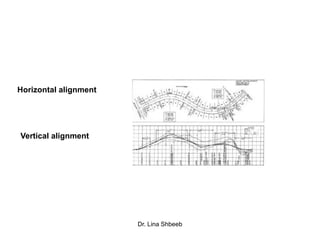
Horizontal alignment
Vertical alignment
Dr. Lina Shbeeb
Horizontal Alignment (HA)
• Definition: Straight segments of roadways
(tangents) connected by suitable curves
(horizontal curves) there might be a need to
provide transitions.
• Curves require superelevation to provide
banking of curve, retard sliding, allow more
uniform speed.
• The length of the facility is measured along the
horizontal of control line like the center line and
is usually expressed in terms of 100-ft stations
from a reference point (i.e. sta 14 is located at
1400 ft from a reference point.
Dr. Lina Shbeeb
Types of curves in horizontal
alignment
• simple curves: it will be discussed in the
following section.
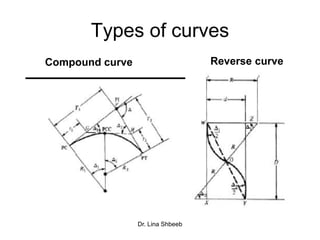
• Compound Curves consist of 2 or more curves
in succession turning in the same direction with
a common tangent point
• Reverse Curves consist of two simple curves
with equal radii turning opposite directions with a
common tangent
• Transition or Spiral curves are placed between
tangents and circular curves or between two
adjacent circular curves with substantially
different radii.
Dr. Lina Shbeeb
Types of curves
Compound curve Reverse curve
Dr. Lina Shbeeb
2
sin2:
100:
2
tantan:
)
2
cos1(tan:
)1
2
(sectan:
:











RcordLongLC
D
curveofLengthL
RgentofLengthT
RcedisordinateMiddleM
RcedisExternalE
curveofDegreeD
2
cos
1
2
sec



 /2  /2
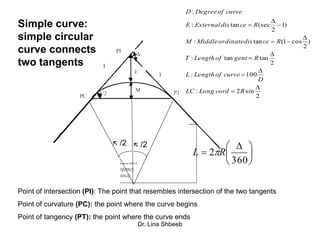
Simple curve:
simple circular
curve connects
two tangents
Point of intersection (PI): The point that resembles intersection of the two tangents
Point of curvature (PC): the point where the curve begins
Point of tangency (PT): the point where the curve ends





 

360
2 RL 
Dr. Lina Shbeeb
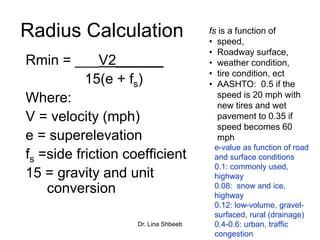
Radius Calculation
Rmin = ___V2______
15(e + fs)
Where:
V = velocity (mph)
e = superelevation
fs =side friction coefficient
15 = gravity and unit
conversion
fs is a function of
• speed,
• Roadway surface,
• weather condition,
• tire condition, ect
• AASHTO: 0.5 if the
speed is 20 mph with
new tires and wet
pavement to 0.35 if
speed becomes 60
mph
e-value as function of road
and surface conditions
0.1: commonly used,
highway
0.08: snow and ice,
highway
0.12: low-volume, gravel-
surfaced, rural (drainage)
0.4-0.6: urban, traffic
congestion
Dr. Lina Shbeeb
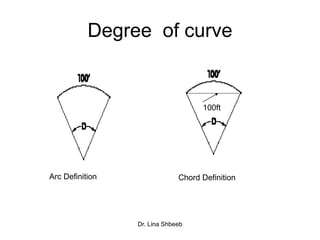
Degree of curve
• As two tangents intersect they can be connected with infinite
number of curves that differ by D: Degree of curve they
have two definitions one for highway and one for railway
– The arc definition (highway) is equal to the central angle in degree
subtended by an arc of 100 ft; the relation between D and R is
estimated by
– The Chord definition (Railway) is equal to the central angle in degree
subtended by a cord of 100 ft; the relation between D and R is
estimated by








R
D
D
R
58.5729
3602
100

R
D 50
2
sin 





Dr. Lina Shbeeb
Degree of curve
100ft
Arc Definition Chord Definition
Dr. Lina Shbeeb
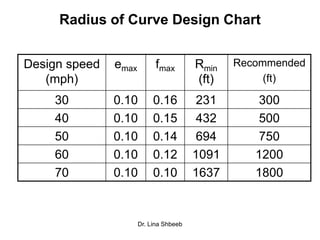
Radius of Curve Design Chart
Design speed
(mph)
emax fmax Rmin
(ft)
Recommended
(ft)
30 0.10 0.16 231 300
40 0.10 0.15 432 500
50 0.10 0.14 694 750
60 0.10 0.12 1091 1200
70 0.10 0.10 1637 1800
Dr. Lina Shbeeb
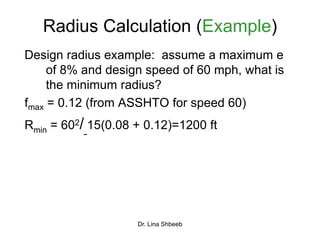
Radius Calculation (Example)
Design radius example: assume a maximum e
of 8% and design speed of 60 mph, what is
the minimum radius?
fmax = 0.12 (from ASSHTO for speed 60)
Rmin = 602/ 15(0.08 + 0.12)=1200 ft
Dr. Lina Shbeeb
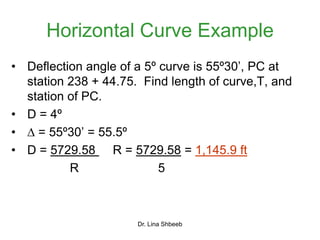
Horizontal Curve Example
• Deflection angle of a 5º curve is 55º30’, PC at
station 238 + 44.75. Find length of curve,T, and
station of PC.
• D = 4º
•  = 55º30’ = 55.5º
• D = 5729.58 R = 5729.58 = 1,145.9 ft
R 5
Dr. Lina Shbeeb
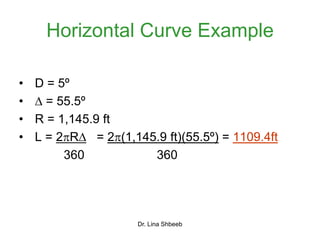
Horizontal Curve Example
• D = 5º
•  = 55.5º
• R = 1,145.9 ft
• L = 2R = 2(1,145.9 ft)(55.5º) = 1109.4ft
360 360
Dr. Lina Shbeeb
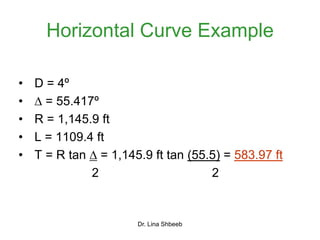
Horizontal Curve Example
• D = 4º
•  = 55.417º
• R = 1,145.9 ft
• L = 1109.4 ft
• T = R tan  = 1,145.9 ft tan (55.5) = 583.97 ft
2 2
Dr. Lina Shbeeb
Sight Distance for Horizontal
Curves
• Location of object along
chord length that blocks
line of sight around the
curve
• m = R(1 – cos [28.65 S])
R
Where:
m = line of sight
S = stopping sight distance
R = radius
Dr. Lina Shbeeb
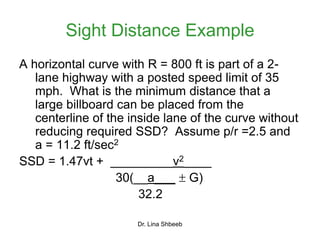
Sight Distance Example
A horizontal curve with R = 800 ft is part of a 2-
lane highway with a posted speed limit of 35
mph. What is the minimum distance that a
large billboard can be placed from the
centerline of the inside lane of the curve without
reducing required SSD? Assume p/r =2.5 and
a = 11.2 ft/sec2
SSD = 1.47vt + _________v2____
30(__a___  G)
32.2
Dr. Lina Shbeeb
Sight Distance Example
SSD = 1.47(35 mph)(2.5 sec) +
_____(35 mph)2____ = 246 feet
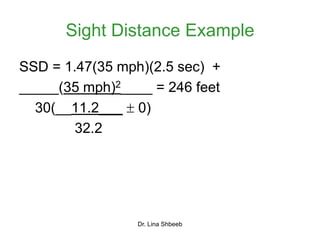
30(__11.2___  0)
32.2
Dr. Lina Shbeeb
Sight Distance Example
m = R(1 – cos [28.65 S])
R
m = 800 (1 – cos [28.65 {246}]) = 9.43 feet
800
Dr. Lina Shbeeb
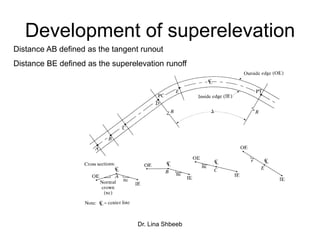
Development of superelevation
Distance AB defined as the tangent runout
Distance BE defined as the superelevation runoff
Dr. Lina Shbeeb
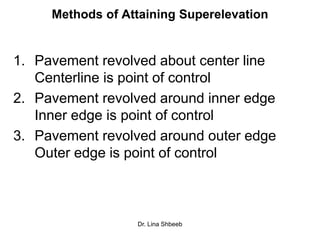
Methods of Attaining Superelevation
1. Pavement revolved about center line
Centerline is point of control
2. Pavement revolved around inner edge
Inner edge is point of control
3. Pavement revolved around outer edge
Outer edge is point of control

Lec 05 Horizontal Alignment (Transportation Engineering Dr.Lina Shbeeb)

  • 1.
    Dr. Lina Shbeeb Horizontalalignment Transportation Engineering
  • 2.
    Dr. Lina Shbeeb Geometricdesign • Consists of the following: • Horizontal Design of roadways (Horizontal design) • Vertical Design of roadways (Vertical design) • Cross-sectional Design (pavement design, no of lane, etc) • Terminal Facilities (Parking Lots, Garages, etc) • Intersections & Interchanges.
  • 3.
    Dr. Lina Shbeeb Horizontalalignment Vertical alignment
  • 4.
    Dr. Lina Shbeeb HorizontalAlignment (HA) • Definition: Straight segments of roadways (tangents) connected by suitable curves (horizontal curves) there might be a need to provide transitions. • Curves require superelevation to provide banking of curve, retard sliding, allow more uniform speed. • The length of the facility is measured along the horizontal of control line like the center line and is usually expressed in terms of 100-ft stations from a reference point (i.e. sta 14 is located at 1400 ft from a reference point.
  • 5.
    Dr. Lina Shbeeb Typesof curves in horizontal alignment • simple curves: it will be discussed in the following section. • Compound Curves consist of 2 or more curves in succession turning in the same direction with a common tangent point • Reverse Curves consist of two simple curves with equal radii turning opposite directions with a common tangent • Transition or Spiral curves are placed between tangents and circular curves or between two adjacent circular curves with substantially different radii.
  • 6.
    Dr. Lina Shbeeb Typesof curves Compound curve Reverse curve
  • 7.
    Dr. Lina Shbeeb 2 sin2: 100: 2 tantan: ) 2 cos1(tan: )1 2 (sectan: :            RcordLongLC D curveofLengthL RgentofLengthT RcedisordinateMiddleM RcedisExternalE curveofDegreeD 2 cos 1 2 sec    /2  /2 Simple curve: simple circular curve connects two tangents Point of intersection (PI): The point that resembles intersection of the two tangents Point of curvature (PC): the point where the curve begins Point of tangency (PT): the point where the curve ends         360 2 RL 
  • 8.
    Dr. Lina Shbeeb RadiusCalculation Rmin = ___V2______ 15(e + fs) Where: V = velocity (mph) e = superelevation fs =side friction coefficient 15 = gravity and unit conversion fs is a function of • speed, • Roadway surface, • weather condition, • tire condition, ect • AASHTO: 0.5 if the speed is 20 mph with new tires and wet pavement to 0.35 if speed becomes 60 mph e-value as function of road and surface conditions 0.1: commonly used, highway 0.08: snow and ice, highway 0.12: low-volume, gravel- surfaced, rural (drainage) 0.4-0.6: urban, traffic congestion
  • 9.
    Dr. Lina Shbeeb Degreeof curve • As two tangents intersect they can be connected with infinite number of curves that differ by D: Degree of curve they have two definitions one for highway and one for railway – The arc definition (highway) is equal to the central angle in degree subtended by an arc of 100 ft; the relation between D and R is estimated by – The Chord definition (Railway) is equal to the central angle in degree subtended by a cord of 100 ft; the relation between D and R is estimated by         R D D R 58.5729 3602 100  R D 50 2 sin      
  • 10.
    Dr. Lina Shbeeb Degreeof curve 100ft Arc Definition Chord Definition
  • 11.
    Dr. Lina Shbeeb Radiusof Curve Design Chart Design speed (mph) emax fmax Rmin (ft) Recommended (ft) 30 0.10 0.16 231 300 40 0.10 0.15 432 500 50 0.10 0.14 694 750 60 0.10 0.12 1091 1200 70 0.10 0.10 1637 1800
  • 12.
    Dr. Lina Shbeeb RadiusCalculation (Example) Design radius example: assume a maximum e of 8% and design speed of 60 mph, what is the minimum radius? fmax = 0.12 (from ASSHTO for speed 60) Rmin = 602/ 15(0.08 + 0.12)=1200 ft
  • 13.
    Dr. Lina Shbeeb HorizontalCurve Example • Deflection angle of a 5º curve is 55º30’, PC at station 238 + 44.75. Find length of curve,T, and station of PC. • D = 4º •  = 55º30’ = 55.5º • D = 5729.58 R = 5729.58 = 1,145.9 ft R 5
  • 14.
    Dr. Lina Shbeeb HorizontalCurve Example • D = 5º •  = 55.5º • R = 1,145.9 ft • L = 2R = 2(1,145.9 ft)(55.5º) = 1109.4ft 360 360
  • 15.
    Dr. Lina Shbeeb HorizontalCurve Example • D = 4º •  = 55.417º • R = 1,145.9 ft • L = 1109.4 ft • T = R tan  = 1,145.9 ft tan (55.5) = 583.97 ft 2 2
  • 16.
    Dr. Lina Shbeeb SightDistance for Horizontal Curves • Location of object along chord length that blocks line of sight around the curve • m = R(1 – cos [28.65 S]) R Where: m = line of sight S = stopping sight distance R = radius
  • 17.
    Dr. Lina Shbeeb SightDistance Example A horizontal curve with R = 800 ft is part of a 2- lane highway with a posted speed limit of 35 mph. What is the minimum distance that a large billboard can be placed from the centerline of the inside lane of the curve without reducing required SSD? Assume p/r =2.5 and a = 11.2 ft/sec2 SSD = 1.47vt + _________v2____ 30(__a___  G) 32.2
  • 18.
    Dr. Lina Shbeeb SightDistance Example SSD = 1.47(35 mph)(2.5 sec) + _____(35 mph)2____ = 246 feet 30(__11.2___  0) 32.2
  • 19.
    Dr. Lina Shbeeb SightDistance Example m = R(1 – cos [28.65 S]) R m = 800 (1 – cos [28.65 {246}]) = 9.43 feet 800
  • 20.
    Dr. Lina Shbeeb Developmentof superelevation Distance AB defined as the tangent runout Distance BE defined as the superelevation runoff
  • 21.
    Dr. Lina Shbeeb Methodsof Attaining Superelevation 1. Pavement revolved about center line Centerline is point of control 2. Pavement revolved around inner edge Inner edge is point of control 3. Pavement revolved around outer edge Outer edge is point of control