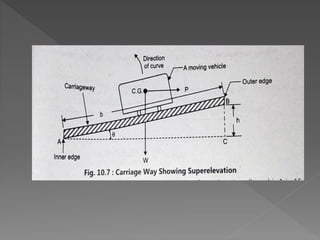
 The inward transverse inclination provided to the
cross-section of the carriage way at horizontal
curved portion of a road is called
superelevation,cant or banking .
 It is expressed as the ratio of elevation of outer
edge above the inner edge to the horizontal
width of the carraige way or as the tangent of
the angle of slope of the road surface. It is
generally denoted by the ‘e’.
1. To counteract the effect of centrifugal force acting on the moving
vehicle to pull the same outward on a horizontal curve.
2. To help a fastmoving vehicle to negotiate a curved path without
overturning and skidding.
3. To ensure safety of the fastmoving vehicle.
4. To prevent damaging effect on the road surface due to improper
distribution of load.
1. It permits running of vehicle at high speed on a curved path or a
straight path without anydanger of overturning and thus results into
increased volume of traffic.
2. It also helps to keep the vehicle to their proper side on the pavement
and thus prevents collision of vehicles moving in opposite direction
on a curved portion of the road.
3. It provides drainage of the whole width of the road towards the inner
side. Thus, there is no necessity of providing side drain on the
outerside of the road.
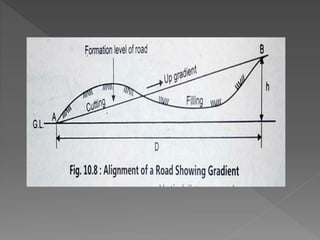
The rateor fallprovided tothe formationof a roadalong its
alignmentis calledas gardeor garadient.
It isthe longitudinalslopeprovided to the formationofa road
along itsalignment.
1. To make the earth work of the road project
economical, since a perfectly level road
involves more cutting and filling.
2. To connect the terminal stations situated at
different levels.
3. To provide effective drainage of rain water
falling over the road surface, particularly when
the pavement is provided with kerbs.
4. To reduce the maintenance coast of the road
surface.
The following are the various factors which
govern the selection of gradient in the alignment
of a road.
1. Nature of ground
2. Nature of traffic
3. Drainage required.
4. The type of road surface.
5. The total height to be curved.
6. Road and railway intersections and bridge
approaches.
7. Safety required.
1. Ruling Gradient:
The gradient usually adopted while making the
alignment of a road is called as ruling Gradient.
2. Limiting Gradient:
The gradient steeper then the ruling which may be
used in restricted road lengths where the later is not
feasible is called maximum or Limiting Gradient
3. Exceptional Gradient:
The gradient steeper than the limiting which may be
used in short lengths of the road only in extra ordinary
situationa is called as Exceptional Gradient.
4. Average Gradient:
The total rise or fall between any two points along the
alignment of a road divided by the horizontal distance
between them is called Average Gradient.
5. Floating Gradient:
The gradient on which a motor vehicle moving with a
constant speed, continues to descend with the same
speed without any application of power or brakes is
called Floating Gradient.
6. Minimum Gradient:
The minimum desirable slope essential for effective
drainage of rain water from the road surface is called
Minimum Gradient.
The distance along the centre line of a road at
which a driver has visibility of a object,stationary
or moving,at a specified height above the
carriage way is known as sight distance.
1. Speed of the vehicle.
2. Efficiency of brakes of the vehicle.
3. The frictional resistance of the road surface.
4. Height of the driver’s eye.
5. Slope of the road surface.
6. Eye sight of the driver.
7. Efficiency of the screen wipers during rain.
8. Weathering conditions.
 1. Stopping or non-passing sight distance:
The clear distance ahead needed by a driver to bring his
vehicle to a stop before meeting a stationary object on
the road is called stopping or non-passing sight distance.
 2. Overtaking or passing sight distance:
The minimum sight distance needed by a driver on a two
way road to enable him to overtake another vehicle
ahead with safety against the traffic from opposite
direction is called as overtaking sight distance.
 3. Intermediate sight distance:
The distance which affords reasonable opportunities to
drivers to overtake the vehicle ahead with caution is
known as intermediate sight distance.
4. Lateral sight distance:
The sight distance needed by the driver who
sees another vehicle approaching the
intersection, reacts and applies brakes to bring
his vehicle to dead stop at the intersection
without any collision or accident is called safe
distance for entering into an intersection or
lateral sight distance.
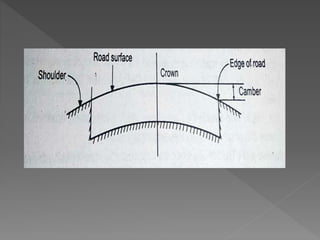
The convexity provided to the surface of
carriage way or the rise given to the center
of the carriage way above its edges on
straight portion of a road is called Camber or
Cross fall.
Camber is provided on the straight reaches
of a road by raising the centre of its carriage
way with respect to the edges forming a
crown at the given centre.
 1. To drain-off water quickly from the surface
of the carriage way towards the sides of a
road.
 2. To regulate the vehicles to their proper
lines.
 3. To improve the architectural appearance
of the roadway.
 1. Composite Camber: It consists of two
straight slopes from the edges with a
parabolic or circular crown in the centre of
carriage way. This type of Camber can be
easily constructed and maintained.
 2. Sloped or straight camber: It consists of
two straight slopes from the edges joining at
the centre of carriage way.
3. Two straight line camber: It consists of two
straight lines steeper near the edges and
flatter near the crown of carriage way.
This type of camber is considered to be the
best for Indian roads because it provides
more contact area of the tyres with the road
surface than in other types of camber.
Thus,it provides less damage to the road
surface.
4. Barrel camber: It consists of continuous
curve either elliptical or parabolic.It provides
a flat road surface at the middle and steeper
towards the edges.
This camber is therefore,preferred by fast
moving vehicles and is suggested for urban
roads. This type of camber is difficult to
construct and maintain.
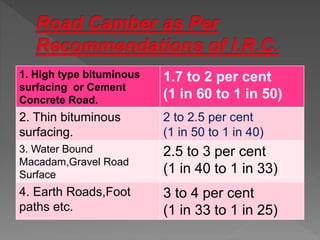
1. High type bituminous
surfacing or Cement
Concrete Road.
1.7 to 2 per cent
(1 in 60 to 1 in 50)
2. Thin bituminous
surfacing.
2 to 2.5 per cent
(1 in 50 to 1 in 40)
3. Water Bound
Macadam,Gravel Road
Surface
2.5 to 3 per cent
(1 in 40 to 1 in 33)
4. Earth Roads,Foot
paths etc.
3 to 4 per cent
(1 in 33 to 1 in 25)
Superelevation

Superelevation

  • 2.
     The inwardtransverse inclination provided to the cross-section of the carriage way at horizontal curved portion of a road is called superelevation,cant or banking .  It is expressed as the ratio of elevation of outer edge above the inner edge to the horizontal width of the carraige way or as the tangent of the angle of slope of the road surface. It is generally denoted by the ‘e’.
  • 4.
    1. To counteractthe effect of centrifugal force acting on the moving vehicle to pull the same outward on a horizontal curve. 2. To help a fastmoving vehicle to negotiate a curved path without overturning and skidding. 3. To ensure safety of the fastmoving vehicle. 4. To prevent damaging effect on the road surface due to improper distribution of load.
  • 5.
    1. It permitsrunning of vehicle at high speed on a curved path or a straight path without anydanger of overturning and thus results into increased volume of traffic. 2. It also helps to keep the vehicle to their proper side on the pavement and thus prevents collision of vehicles moving in opposite direction on a curved portion of the road. 3. It provides drainage of the whole width of the road towards the inner side. Thus, there is no necessity of providing side drain on the outerside of the road.
  • 6.
    The rateor fallprovidedtothe formationof a roadalong its alignmentis calledas gardeor garadient. It isthe longitudinalslopeprovided to the formationofa road along itsalignment.
  • 7.
    1. To makethe earth work of the road project economical, since a perfectly level road involves more cutting and filling. 2. To connect the terminal stations situated at different levels. 3. To provide effective drainage of rain water falling over the road surface, particularly when the pavement is provided with kerbs. 4. To reduce the maintenance coast of the road surface.
  • 8.
    The following arethe various factors which govern the selection of gradient in the alignment of a road. 1. Nature of ground 2. Nature of traffic 3. Drainage required. 4. The type of road surface. 5. The total height to be curved. 6. Road and railway intersections and bridge approaches. 7. Safety required.
  • 9.
    1. Ruling Gradient: Thegradient usually adopted while making the alignment of a road is called as ruling Gradient. 2. Limiting Gradient: The gradient steeper then the ruling which may be used in restricted road lengths where the later is not feasible is called maximum or Limiting Gradient 3. Exceptional Gradient: The gradient steeper than the limiting which may be used in short lengths of the road only in extra ordinary situationa is called as Exceptional Gradient.
  • 11.
    4. Average Gradient: Thetotal rise or fall between any two points along the alignment of a road divided by the horizontal distance between them is called Average Gradient. 5. Floating Gradient: The gradient on which a motor vehicle moving with a constant speed, continues to descend with the same speed without any application of power or brakes is called Floating Gradient. 6. Minimum Gradient: The minimum desirable slope essential for effective drainage of rain water from the road surface is called Minimum Gradient.
  • 12.
    The distance alongthe centre line of a road at which a driver has visibility of a object,stationary or moving,at a specified height above the carriage way is known as sight distance.
  • 13.
    1. Speed ofthe vehicle. 2. Efficiency of brakes of the vehicle. 3. The frictional resistance of the road surface. 4. Height of the driver’s eye. 5. Slope of the road surface. 6. Eye sight of the driver. 7. Efficiency of the screen wipers during rain. 8. Weathering conditions.
  • 14.
     1. Stoppingor non-passing sight distance: The clear distance ahead needed by a driver to bring his vehicle to a stop before meeting a stationary object on the road is called stopping or non-passing sight distance.  2. Overtaking or passing sight distance: The minimum sight distance needed by a driver on a two way road to enable him to overtake another vehicle ahead with safety against the traffic from opposite direction is called as overtaking sight distance.  3. Intermediate sight distance: The distance which affords reasonable opportunities to drivers to overtake the vehicle ahead with caution is known as intermediate sight distance.
  • 15.
    4. Lateral sightdistance: The sight distance needed by the driver who sees another vehicle approaching the intersection, reacts and applies brakes to bring his vehicle to dead stop at the intersection without any collision or accident is called safe distance for entering into an intersection or lateral sight distance.
  • 16.
    The convexity providedto the surface of carriage way or the rise given to the center of the carriage way above its edges on straight portion of a road is called Camber or Cross fall. Camber is provided on the straight reaches of a road by raising the centre of its carriage way with respect to the edges forming a crown at the given centre.
  • 18.
     1. Todrain-off water quickly from the surface of the carriage way towards the sides of a road.  2. To regulate the vehicles to their proper lines.  3. To improve the architectural appearance of the roadway.
  • 19.
     1. CompositeCamber: It consists of two straight slopes from the edges with a parabolic or circular crown in the centre of carriage way. This type of Camber can be easily constructed and maintained.  2. Sloped or straight camber: It consists of two straight slopes from the edges joining at the centre of carriage way.
  • 20.
    3. Two straightline camber: It consists of two straight lines steeper near the edges and flatter near the crown of carriage way. This type of camber is considered to be the best for Indian roads because it provides more contact area of the tyres with the road surface than in other types of camber. Thus,it provides less damage to the road surface.
  • 21.
    4. Barrel camber:It consists of continuous curve either elliptical or parabolic.It provides a flat road surface at the middle and steeper towards the edges. This camber is therefore,preferred by fast moving vehicles and is suggested for urban roads. This type of camber is difficult to construct and maintain.
  • 22.
    1. High typebituminous surfacing or Cement Concrete Road. 1.7 to 2 per cent (1 in 60 to 1 in 50) 2. Thin bituminous surfacing. 2 to 2.5 per cent (1 in 50 to 1 in 40) 3. Water Bound Macadam,Gravel Road Surface 2.5 to 3 per cent (1 in 40 to 1 in 33) 4. Earth Roads,Foot paths etc. 3 to 4 per cent (1 in 33 to 1 in 25)