TRAFFIC ENGINEERING COURSE
(PWE 8322)
ROUNDABOUTS
Instructor: Usama Elrawy Shahdah, PhDLecture # 05
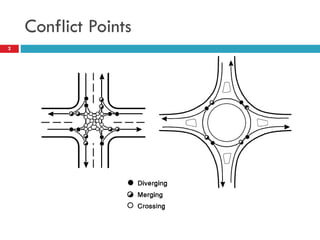
Conflict Points
2
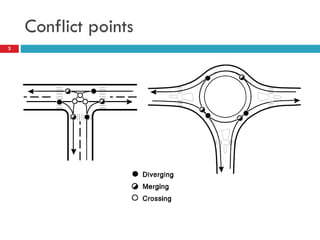
Conflict points
3
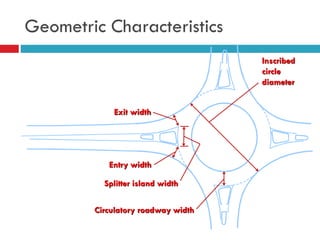
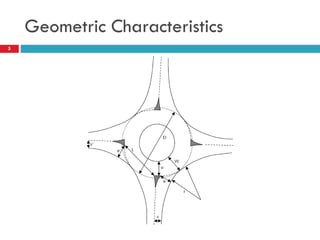
Geometric Characteristics
Entry width
Inscribed
circle
diameter
Exit width
Splitter island width
Circulatory roadway width
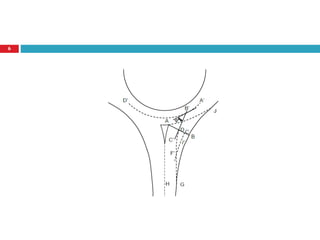
Geometric Characteristics
5
6
7
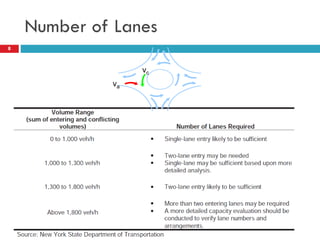
Number of Lanes
8
vc
va
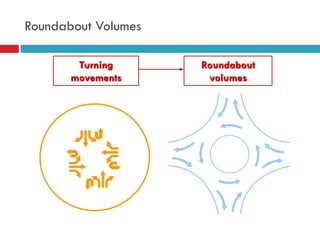
Roundabout Volumes
Turning
movements
Roundabout
volumes
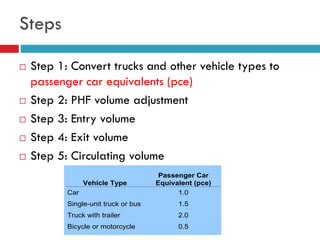
Steps
Vehicle Type
Passenger Car
Equivalent (pce)
Car 1.0
Single-unit truck or bus 1.5
Truck with trailer 2.0
Bicycle or motorcycle 0.5
 Step 1: Convert trucks and other vehicle types to
passenger car equivalents (pce)
 Step 2: PHF volume adjustment
 Step 3: Entry volume
 Step 4: Exit volume
 Step 5: Circulating volume
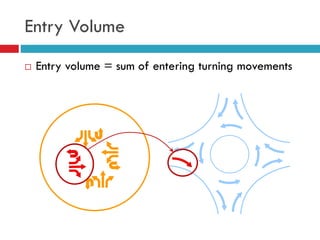
Entry Volume
 Entry volume = sum of entering turning movements
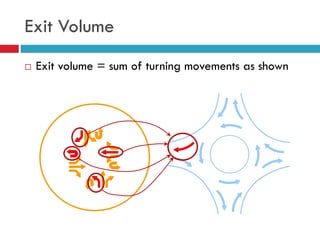
Exit Volume
 Exit volume = sum of turning movements as shown
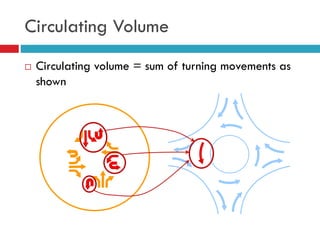
Circulating Volume
 Circulating volume = sum of turning movements as
shown
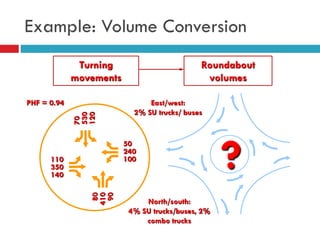
Example: Volume Conversion
Turning
movements
Roundabout
volumes
110
350
140
50
240
100
North/south:
4% SU trucks/buses, 2%
combo trucks
East/west:
2% SU trucks/ buses
?
PHF = 0.94
Example Step 1: PCE Calculation
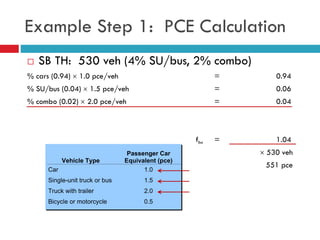
 SB TH: 530 veh (4% SU/bus, 2% combo)
% cars (0.94)  1.0 pce/veh = 0.94
% SU/bus (0.04)  1.5 pce/veh = 0.06
% combo (0.02)  2.0 pce/veh = 0.04
fhv = 1.04
 530 veh
551 pce
Vehicle Type
Passenger Car
Equivalent (pce)
Car 1.0
Single-unit truck or bus 1.5
Truck with trailer 2.0
Bicycle or motorcycle 0.5
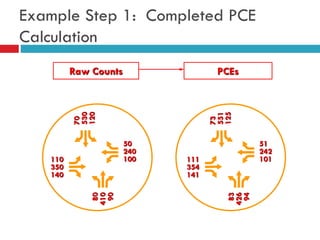
Example Step 1: Completed PCE
Calculation
Raw Counts PCEs
110
350
140
50
240
100 111
354
141
51
242
101
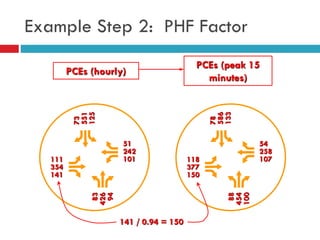
Example Step 2: PHF Factor
PCEs (hourly)
PCEs (peak 15
minutes)
118
377
150
54
258
107111
354
141
51
242
101
141 / 0.94 = 150
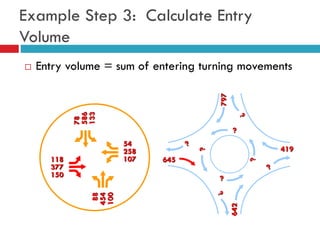
Example Step 3: Calculate Entry
Volume
 Entry volume = sum of entering turning movements
118
377
150
54
258
107 645
?
?
419
?
642
797
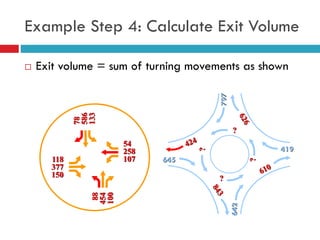
Example Step 4: Calculate Exit Volume
 Exit volume = sum of turning movements as shown
645
?
?
419
?
642
797
118
377
150
54
258
107
Example Step 5: Calculate Circulating
Volume
 Circulating volume = sum of turning movements as
shown
645
628
826
419
453
642
797
118
377
150
54
258
107
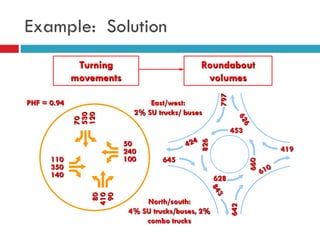
Example: Solution
Turning
movements
Roundabout
volumes
110
350
140
50
240
100
North/south:
4% SU trucks/buses, 2%
combo trucks
East/west:
2% SU trucks/ buses
645
628
826
419
453
642
797
PHF = 0.94
22
Capacity Determination
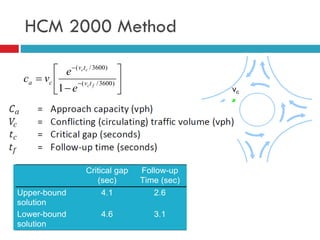
HCM 2000 Method
CCCrrriiitttiiicccaaalll gggaaappp
(((ssseeeccc)))
FFFooollllllooowww---uuuppp
TTTiiimmmeee (((ssseeeccc)))
UUUppppppeeerrr---bbbooouuunnnddd
sssooollluuutttiiiooonnn
444...111 222...666
LLLooowwweeerrr---bbbooouuunnnddd
sssooollluuutttiiiooonnn
444...666 333...111







 

)3600/(
)3600/(
1 fc
cc
tv
tv
ca
e
e
vc
vc
va
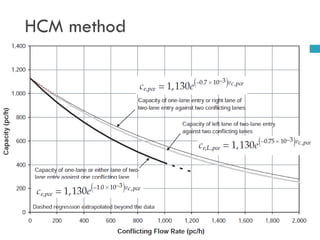
HCM method
24
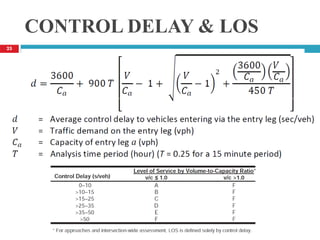
CONTROL DELAY & LOS
25
Kimber Method
26
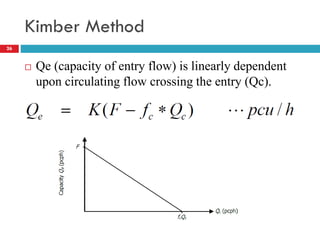
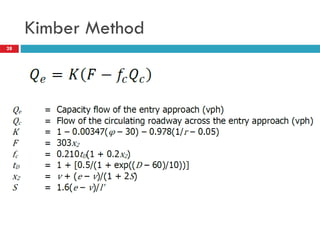
 Qe (capacity of entry flow) is linearly dependent
upon circulating flow crossing the entry (Qc).
Kimber Method
27
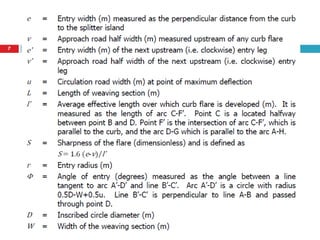
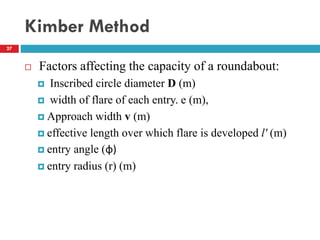
 Factors affecting the capacity of a roundabout:
 Inscribed circle diameter D (m)
 width of flare of each entry. e (m),
 Approach width v (m)
 effective length over which flare is developed l' (m)
 entry angle (φ)
 entry radius (r) (m)
Kimber Method
28
Kimber Method
29
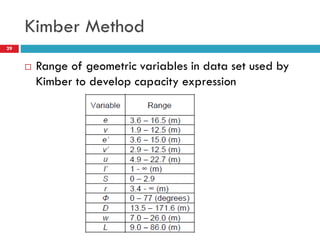
 Range of geometric variables in data set used by
Kimber to develop capacity expression
Kimber Method (simplified method)
30
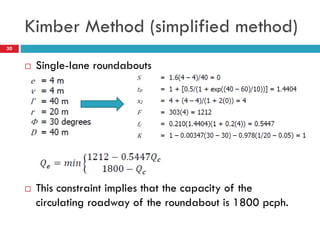
 Single-lane roundabouts
 This constraint implies that the capacity of the
circulating roadway of the roundabout is 1800 pcph.
Kimber Method (simplified method)
31
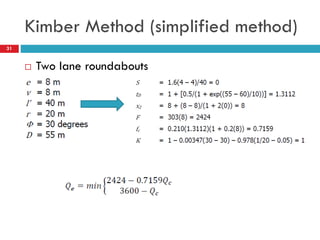
 Two lane roundabouts
Example
32
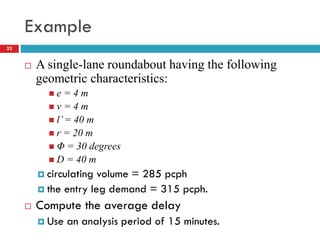
 A single-lane roundabout having the following
geometric characteristics:
 e = 4 m
 v = 4 m
 l’= 40 m
 r = 20 m
 Φ = 30 degrees
 D = 40 m
 circulating volume = 285 pcph
 the entry leg demand = 315 pcph.
 Compute the average delay
 Use an analysis period of 15 minutes.
Solution
33
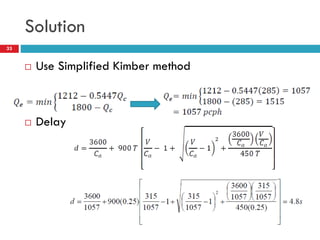
 Use Simplified Kimber method
 Delay
Trafficware Synchro
34
 Demonstrated in Class
Home Reading
35
 Synchro Studio 9 User Guide
 NCHRPREPORT 672 “Design Roundabouts: An
Informational Guide”, Second Edition
36
Thanks for your time

Lecture 05 Roundabout (Traffic Engineering هندسة المرور & Dr. Usama Shahdah)