TRAFFIC ENGINEERING COURSE
(PWE 8322)
CAPACITY FOR TWSC
Instructor: Usama Elrawy Shahdah, PhDLecture # 04
Gap Acceptance Theory
 Gap acceptance theory attempts to provide an analytical framework for
modelling the process that drivers implement when they are engaged in
making a manoeuvre from a stop controlled minor street across, or onto, an
uncontrolled major street.
 Vehicle “A” is on the minor street is attempting to cross the major street.
 The degree of difficulty that the driver of vehicle “A” faces in completing
this manoeuvre successfully depends on 3 factors:
1) The size of the time headway required to complete the manoeuvre,
2) The number and size of time headways that are available in the traffic
stream, and
3) The relative priority of the movement the driver is attempting to make
relative to all other traffic movements.
2
Required Gap Size
 Drivers attempting to cross or enter the
major traffic stream must use time gaps that
are sufficiently large as to allow the
manoeuvre to be completed and to allow for
a safety buffer between the lead vehicle and
the vehicle making the manoeuvre and
between the vehicle making the manoeuvre
and its following vehicle.
 Vehicle “C” is waiting on the minor street
approach to make a left-hand turn onto the
major street.
 At time T, the driver of vehicle C decides that
the time headway between vehicle A and B is
sufficient to permit the left turn movement
and initiates the manoeuvre.
3
Required Gap Size (cont.)
The size of the time gap required to complete a manoeuvre is a function
of many parameters, including:
1) The physical length of vehicle C.
 Consider the same time headway between vehicles A and B, but in this case
vehicle C is a tractor-trailer.
 Even though the truck accelerates at the same rate as vehicle C in previous slide,
the length of the truck occupies a greater portion of the roadway and
 if vehicle B does not decelerate, there will be a collision.
2) Acceleration capabilities of vehicle C.
 A vehicle that accelerates quickly is able to clear the roadway in less time and
therefore can safely use a smaller gap than a vehicle that accelerates slowly.
3) Characteristics of the driver of vehicle C.
 A cautious driver generally requires a longer gap than a more aggressive driver.
 Some drivers are not capable of accurately estimating the gap size, and therefore
compensate by requiring longer gaps.
4) Width of the major roadway.
 The number of lanes that need to be crossed by vehicle C impacts the size of gap
required,
 as the gap must be long enough to permit the vehicle to safely clear the conflict
zone.
5) The type of manoeuvre being executed.
 left turn movement from a minor street requires a longer time gap than does a
through movement.
 For the left turn movement, vehicle C is merging with a traffic stream and must
not "cut off" the following vehicle (vehicle B ) such that a rear-end collision
results.
4
Usefulness of gaps
 The usefulness of gaps depends on:
 whether or not drivers from the minor street will make
use of an available gap, and
 if they do, how many drivers will complete their
manoeuvre in the same gap.
 Need to be able to answer two questions:
1) Will drivers be able to use a gap of a specific
duration (e.g. 10 seconds)?
2) If drivers are able to use the gap, How many drivers
will depart in this gap?
5
Capacity
 The maximum number of vehicles that can
complete one or more specific manoeuvres (e.g.
left turn) from the minor street approach during 1
hour
Note: Estimates of delay and queue length can be made on the
basis of capacity and the number of vehicles attempting to
make the manoeuvre.
6
Critical gap and follow-up time
 Critical gap (tc) (Critical time headway) : The minimum gap size in the
major steert that drivers in the minor street will accept.
 Follow-up time (tf):
 if the gap is long enough, then more than one vehicle will complete
their intended manoeuvre in the gap.
 The time required for each non-first vehicle to initiate its manoeuvre
and clear the stop line is referred to as the “follow-up time”
 Minimum headway between two consecutive vehicles in the minor stream
 Critical gap and follow-up time:
 varies from driver to driver and
 varies for a single driver from situation to situation.
 there exist distributions of values for tc and tf
 Using distributions complicates the determination of capacity of the minor street
approach.
7
Critical gap and follow-up time
 Assumptions to remove these distributions:
1) Drivers are consistent in that a driver behaves the same way each time
she is faced with the same traffic conditions (i.e. drivers do not change
behaviour with time).
2) The driver population is homogeneous in that all drivers behave in the
same way and have the same gap size requirements (i.e. there is no
distribution of driver types).
 The errors incurred by these unrealistic assumptions counteract
each other and that the resulting total error is small
 Assume that tc and tf are constants instead of distributions.
 Different constant values of tc and tf are used for :
 different minor street movements (e.g. left turn versus a through
movement).
 different vehicle types (e.g. trucks versus passenger cars)
8
Estimating tc and tf (using filed data)
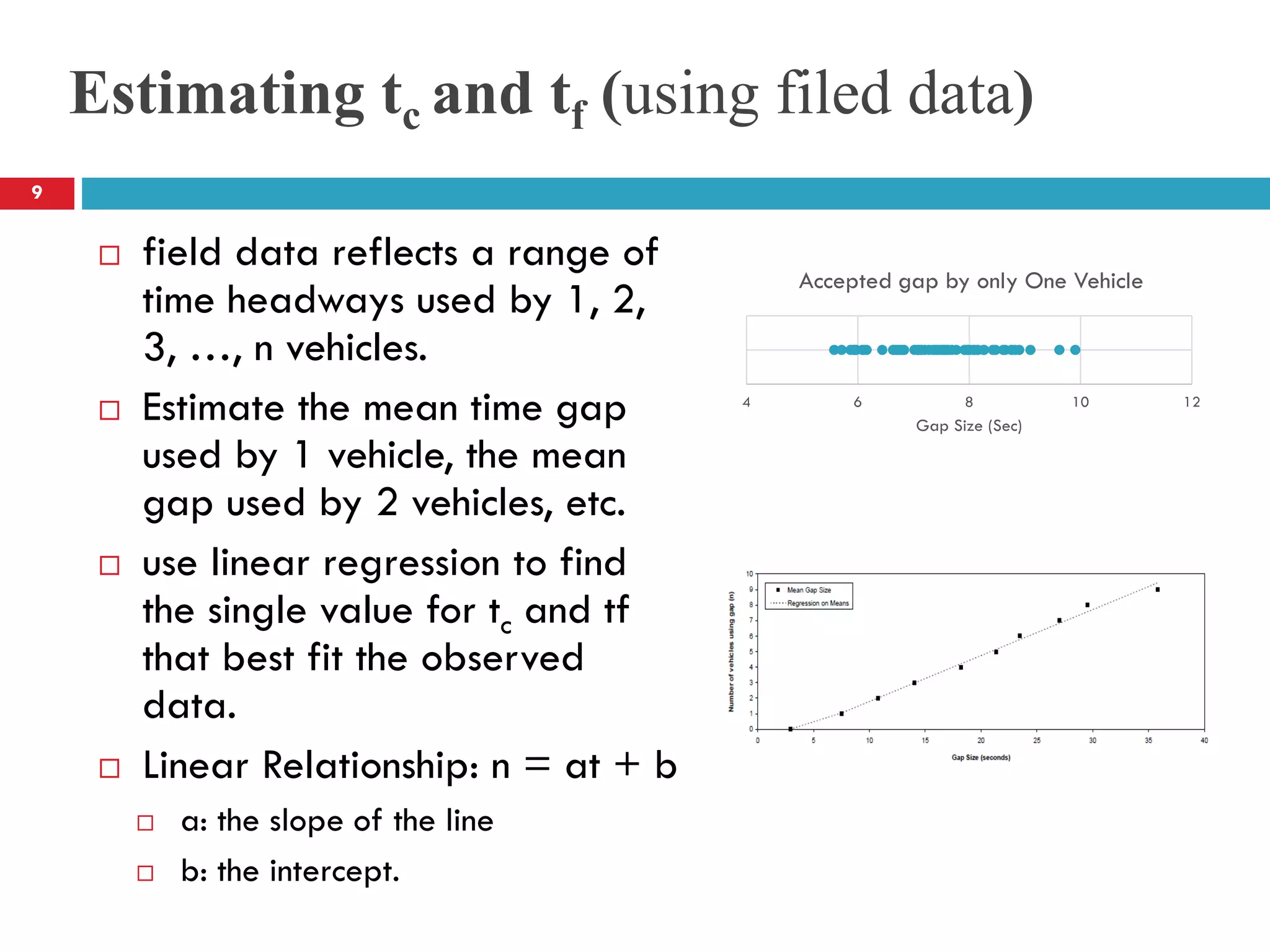
 field data reflects a range of
time headways used by 1, 2,
3, …, n vehicles.
 Estimate the mean time gap
used by 1 vehicle, the mean
gap used by 2 vehicles, etc.
 use linear regression to find
the single value for tc and tf
that best fit the observed
data.
 Linear Relationship: n = at + b
 a: the slope of the line
 b: the intercept.
4 6 8 10 12
Gap Size (Sec)
Accepted gap by only One Vehicle
9
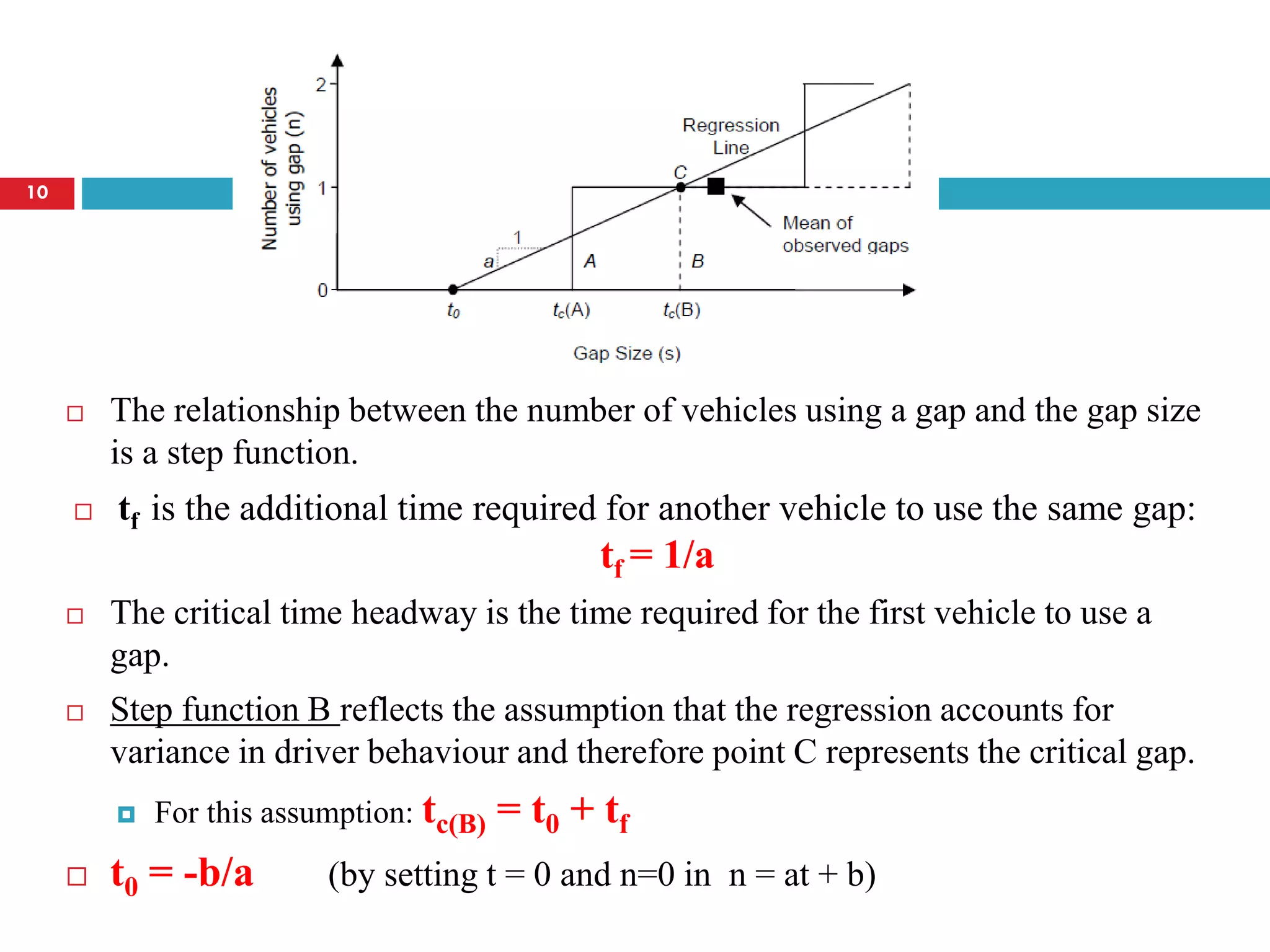
 The relationship between the number of vehicles using a gap and the gap size
is a step function.
 tf is the additional time required for another vehicle to use the same gap:
tf = 1/a
 The critical time headway is the time required for the first vehicle to use a
gap.
 Step function B reflects the assumption that the regression accounts for
variance in driver behaviour and therefore point C represents the critical gap.
 For this assumption: tc(B) = t0 + tf
 t0 = -b/a (by setting t = 0 and n=0 in n = at + b)
10
Critical Gap (tc)
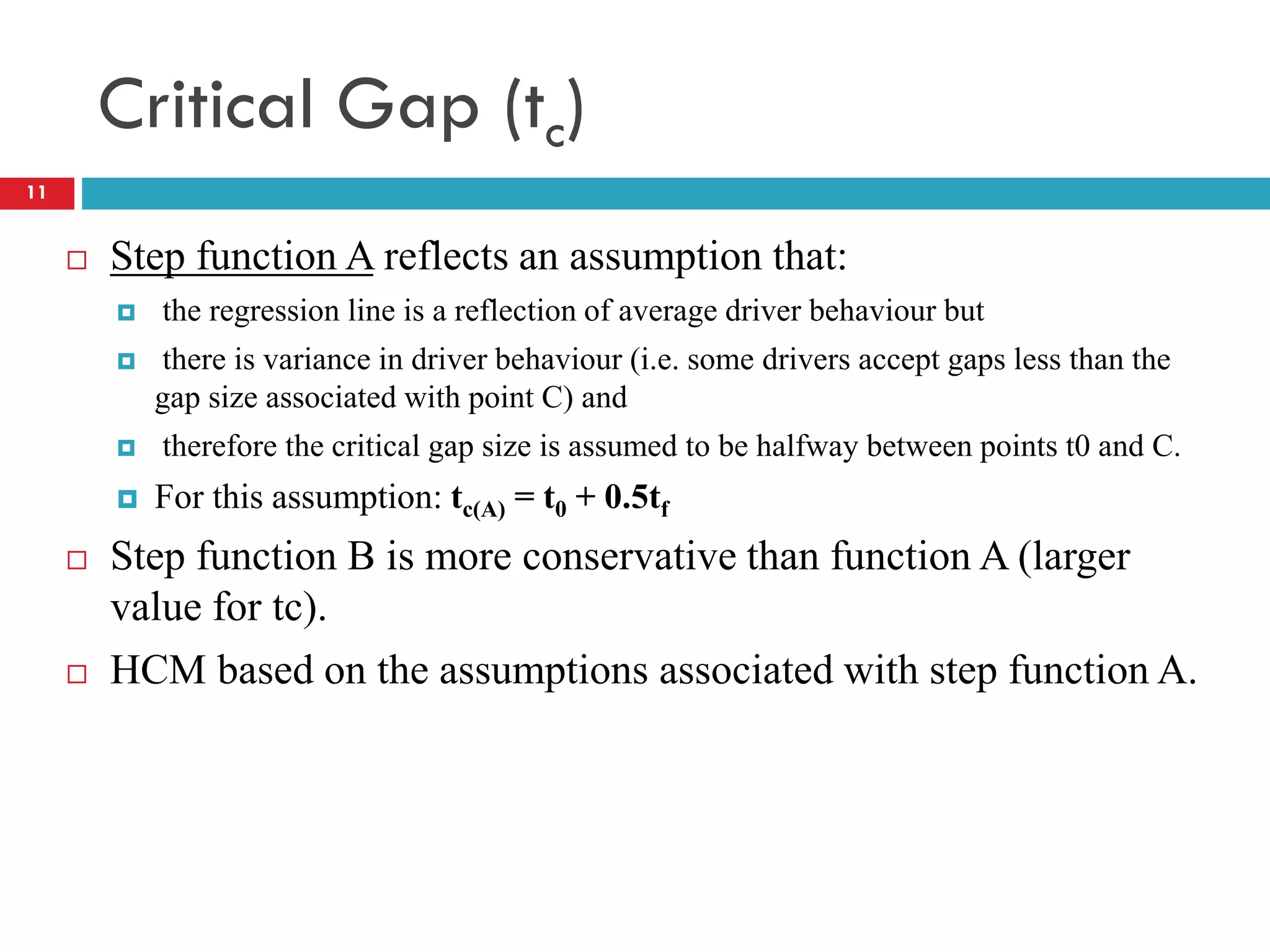
 Step function A reflects an assumption that:
 the regression line is a reflection of average driver behaviour but
 there is variance in driver behaviour (i.e. some drivers accept gaps less than the
gap size associated with point C) and
 therefore the critical gap size is assumed to be halfway between points t0 and C.
 For this assumption: tc(A) = t0 + 0.5tf
 Step function B is more conservative than function A (larger
value for tc).
 HCM based on the assumptions associated with step function A.
11
12
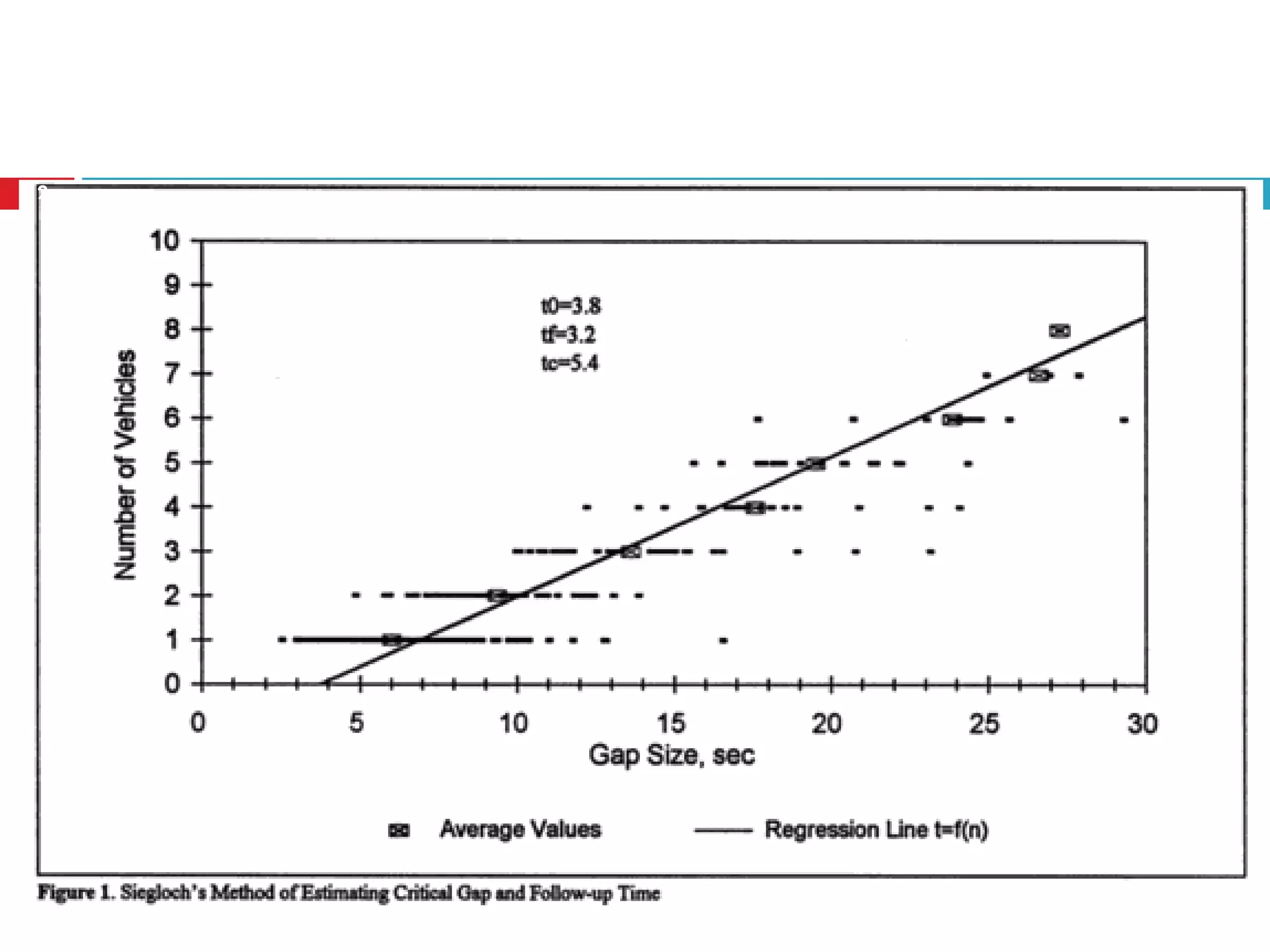
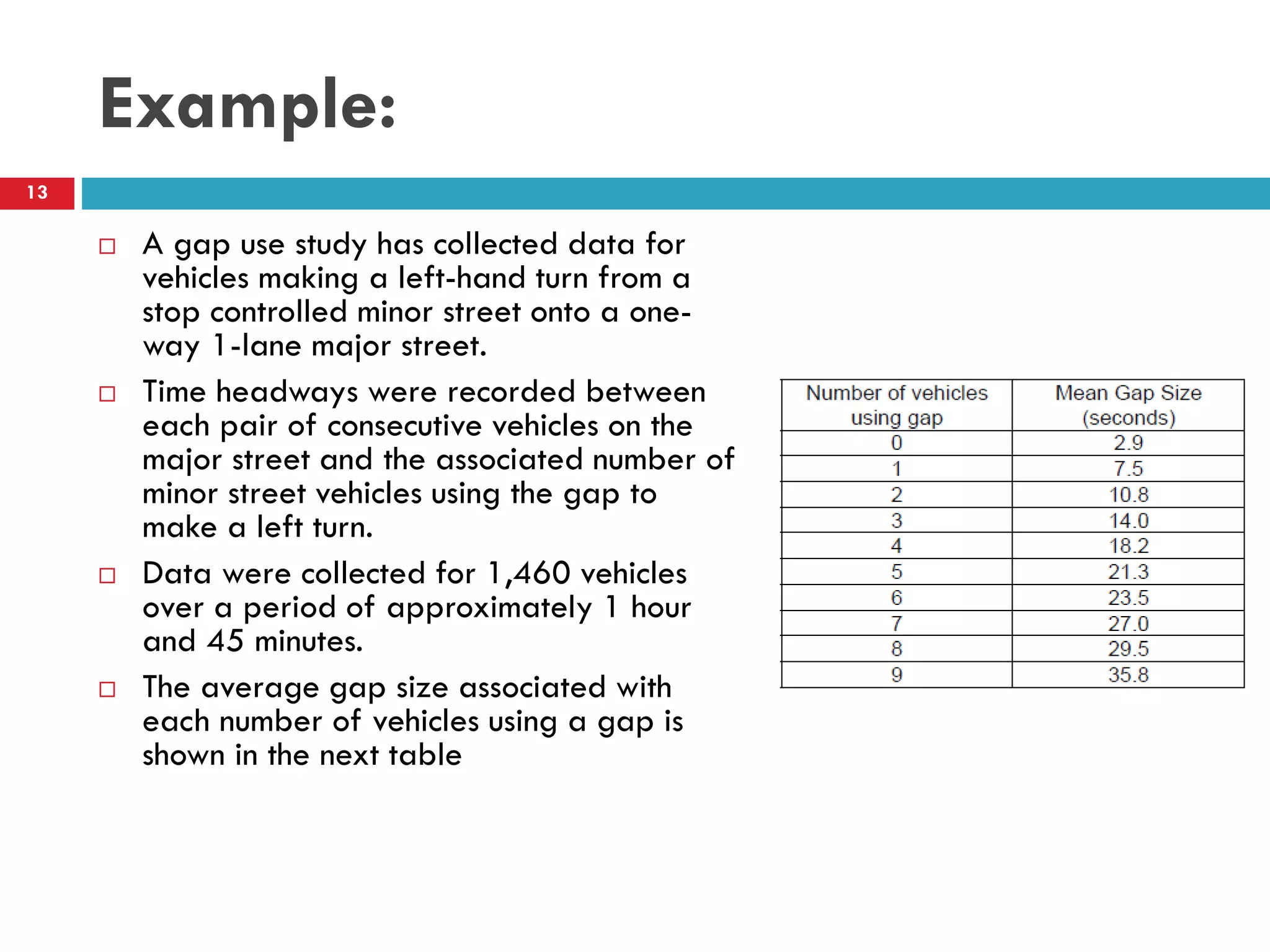
Example:
 A gap use study has collected data for
vehicles making a left-hand turn from a
stop controlled minor street onto a one-
way 1-lane major street.
 Time headways were recorded between
each pair of consecutive vehicles on the
major street and the associated number of
minor street vehicles using the gap to
make a left turn.
 Data were collected for 1,460 vehicles
over a period of approximately 1 hour
and 45 minutes.
 The average gap size associated with
each number of vehicles using a gap is
shown in the next table
13
Solution
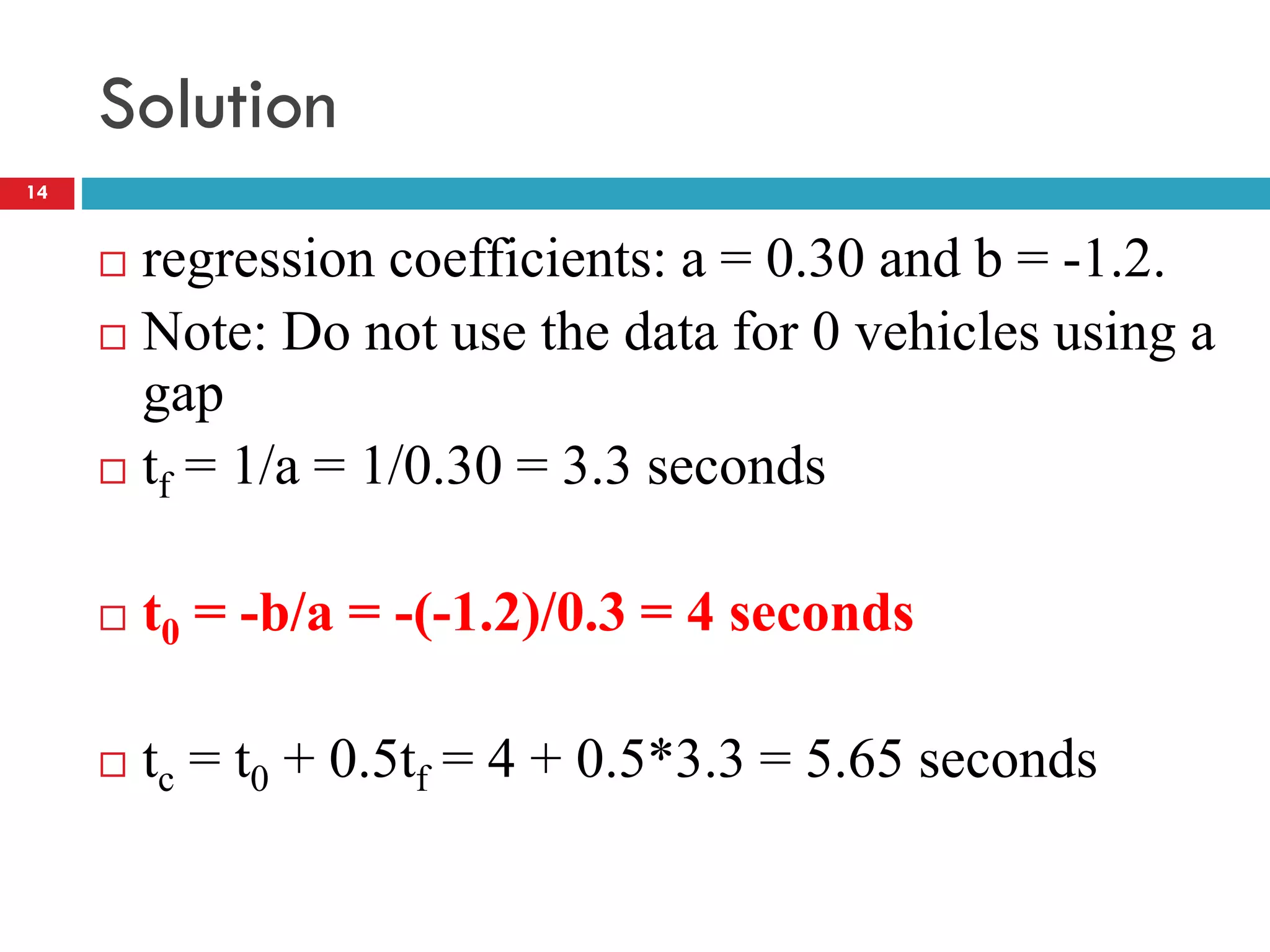
 regression coefficients: a = 0.30 and b = -1.2.
 Note: Do not use the data for 0 vehicles using a
gap
 tf = 1/a = 1/0.30 = 3.3 seconds
 t0 = -b/a = -(-1.2)/0.3 = 4 seconds
 tc = t0 + 0.5tf = 4 + 0.5*3.3 = 5.65 seconds
14
Important Note
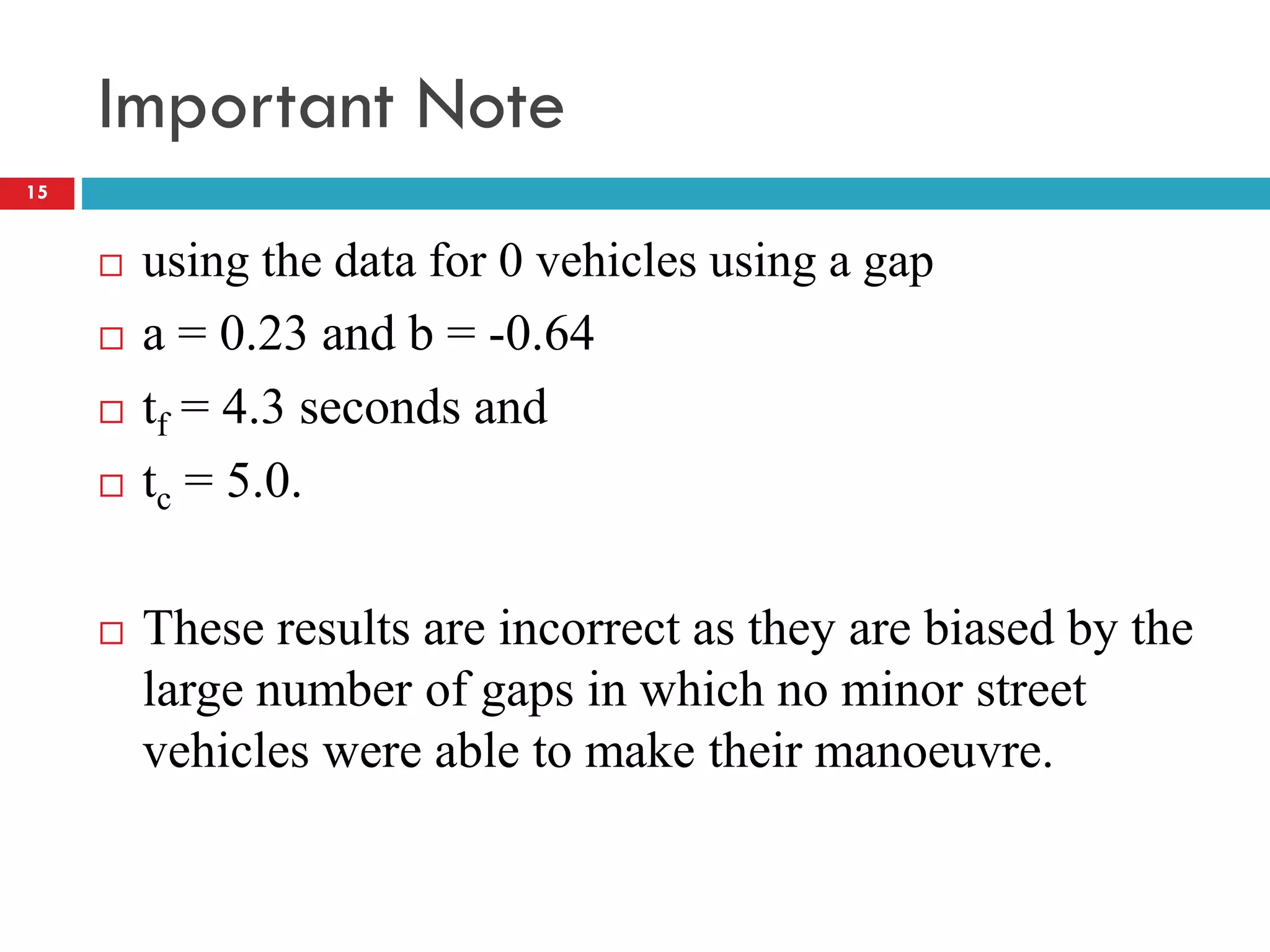
 using the data for 0 vehicles using a gap
 a = 0.23 and b = -0.64
 tf = 4.3 seconds and
 tc = 5.0.
 These results are incorrect as they are biased by the
large number of gaps in which no minor street
vehicles were able to make their manoeuvre.
15
Distribution of Gap Sizes
 Please review lecture # 02
 Vehicle Arrival Patterns (Poisson Distribution)
 Exponential Distribution of Gaps
 Shifted Exponential Distribution of Gaps
16
Capacity Analysis for TWSC
intersections
 Capacity of a minor street movement is
governed by:
1) The number of gaps in the opposing stream.
2) Size of gaps.
3) Characteristics of drivers use of gaps (i.e. tc and tf)
4) Priority to use suitable gaps.
17
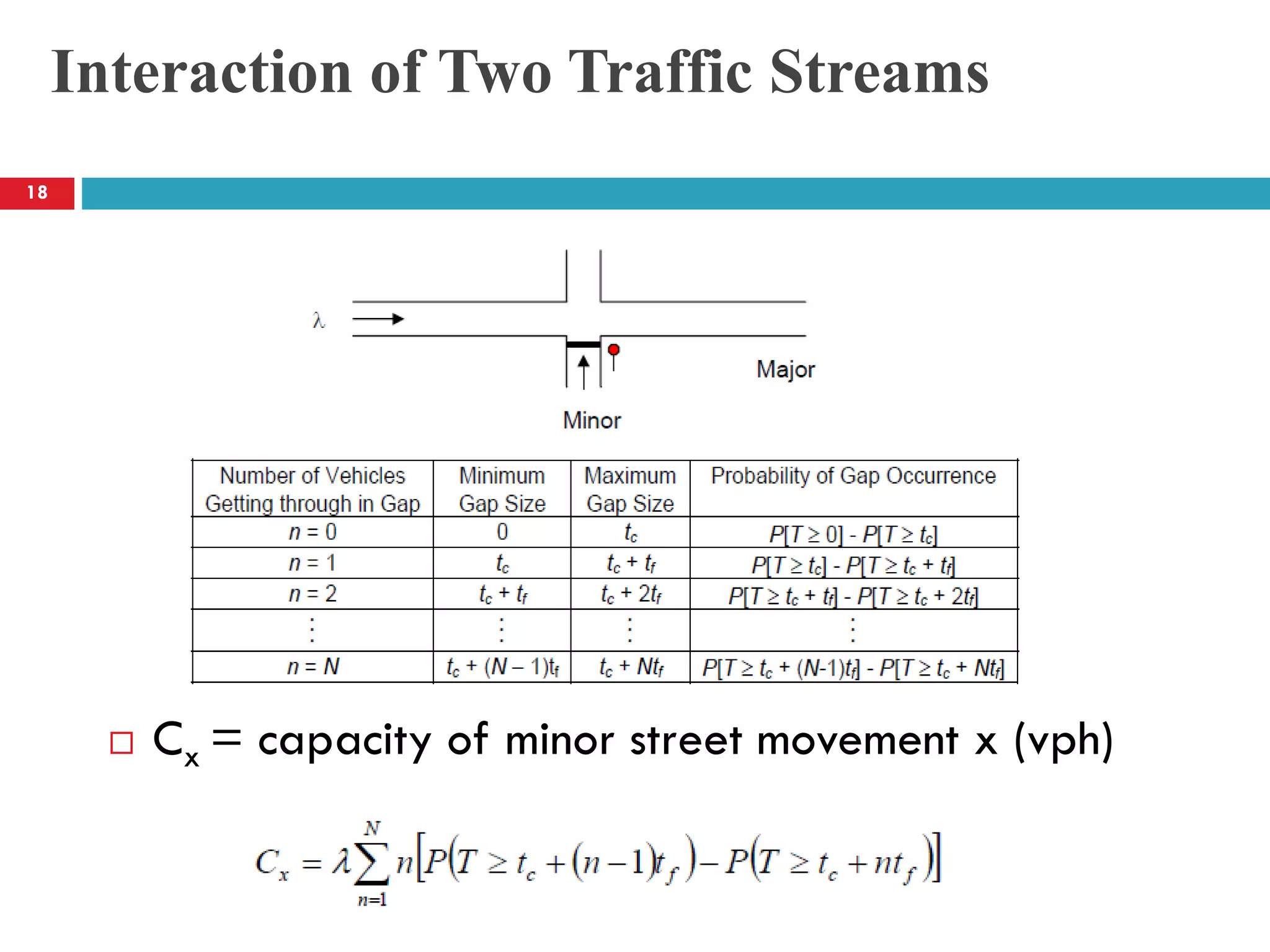
Interaction of Two Traffic Streams
 Cx = capacity of minor street movement x (vph)
18
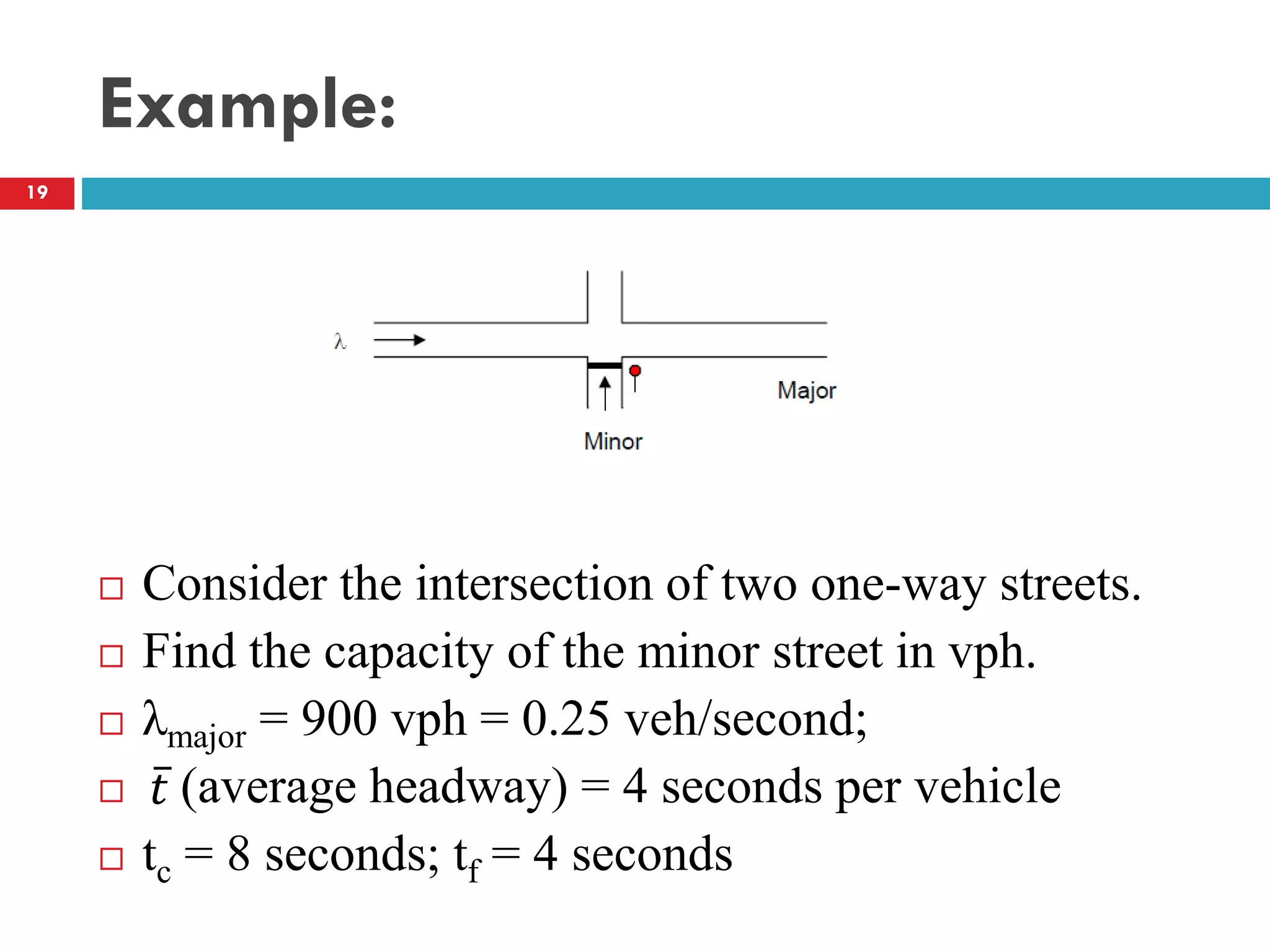
Example:
 Consider the intersection of two one-way streets.
 Find the capacity of the minor street in vph.
 λmajor = 900 vph = 0.25 veh/second;
 (average headway) = 4 seconds per vehicle
 tc = 8 seconds; tf = 4 seconds
̅𝑡𝑡
19
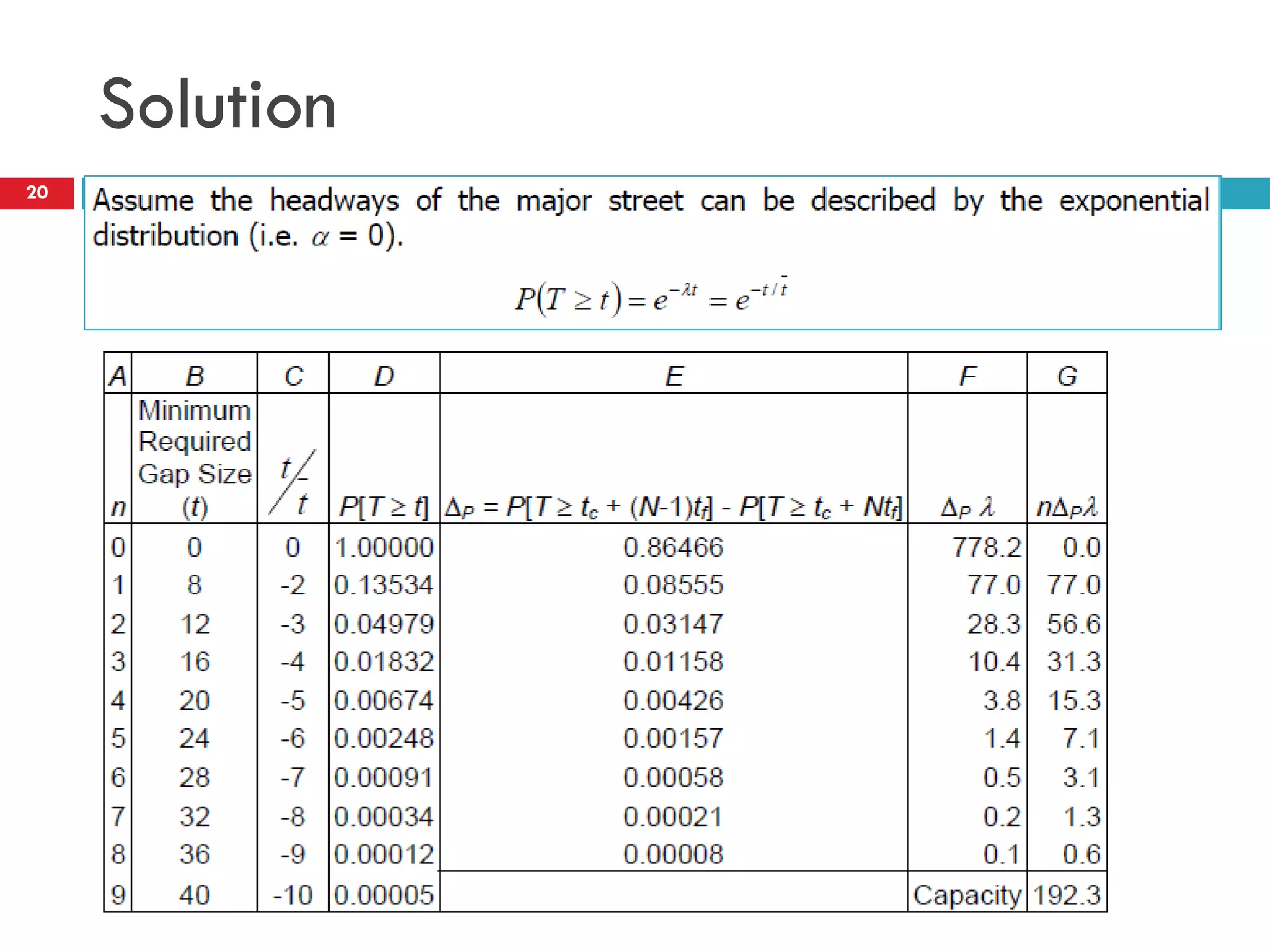
Solution
20
Solution
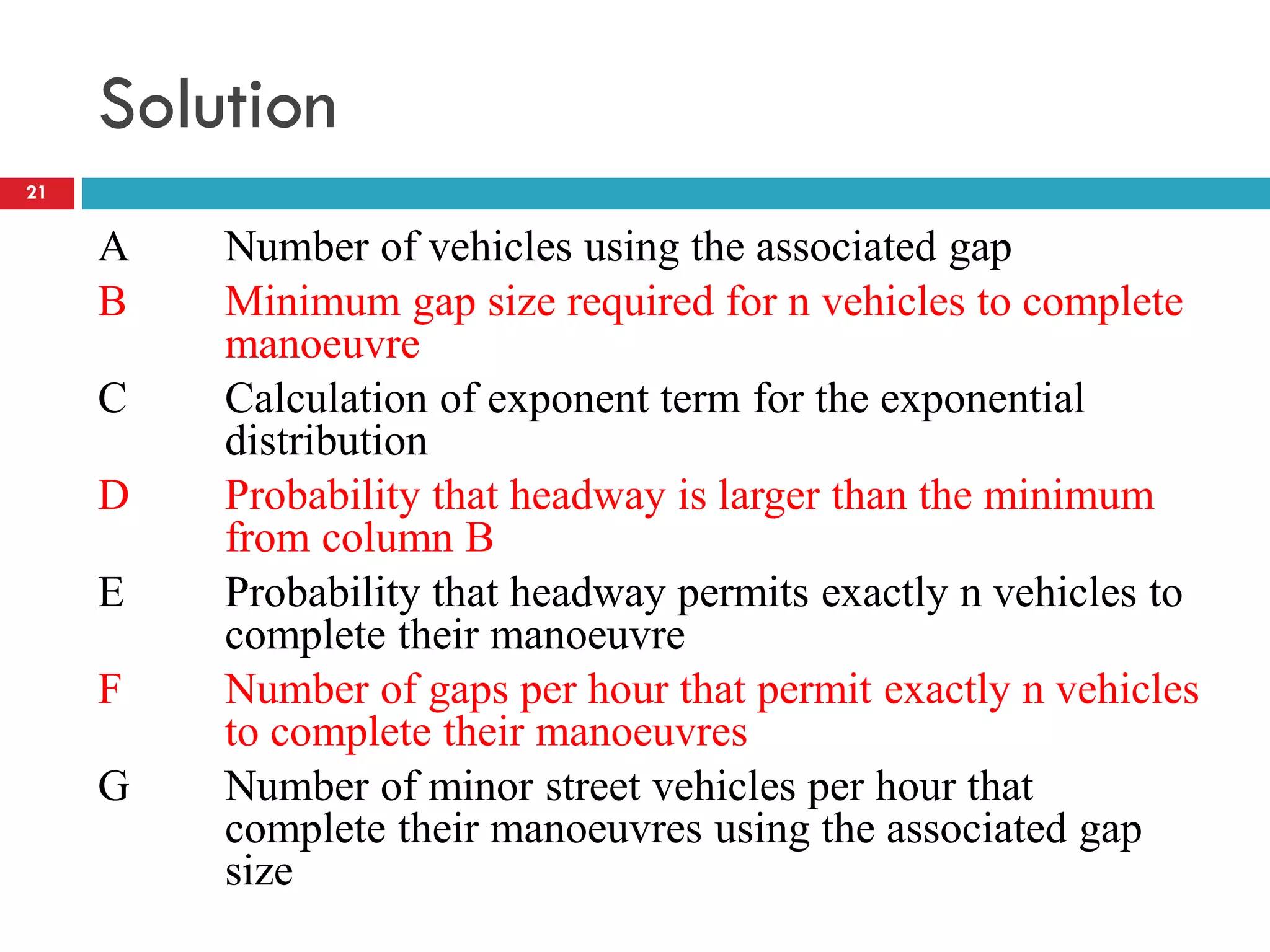
A Number of vehicles using the associated gap
B Minimum gap size required for n vehicles to complete
manoeuvre
C Calculation of exponent term for the exponential
distribution
D Probability that headway is larger than the minimum
from column B
E Probability that headway permits exactly n vehicles to
complete their manoeuvre
F Number of gaps per hour that permit exactly n vehicles
to complete their manoeuvres
G Number of minor street vehicles per hour that
complete their manoeuvres using the associated gap
size
21
Interaction of More Than Two streams
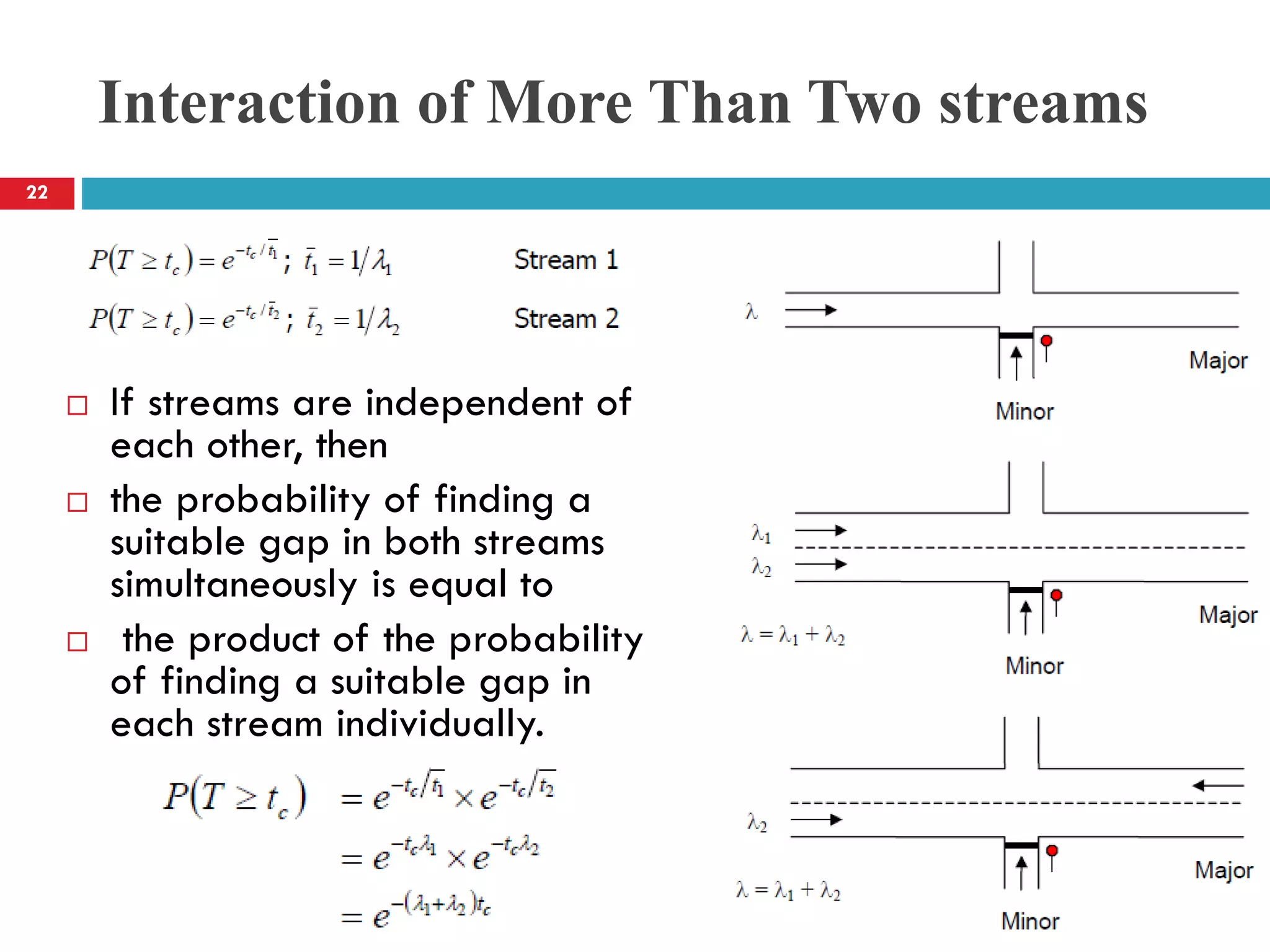
 If streams are independent of
each other, then
 the probability of finding a
suitable gap in both streams
simultaneously is equal to
 the product of the probability
of finding a suitable gap in
each stream individually.
22
Priority of traffic streams
 When calculating the capacity of movements
for an intersection with more than two traffic
streams, one must consider the rank/priority of
that movement
 For North America the HCM is the standard
commonly used for TWSC analysis
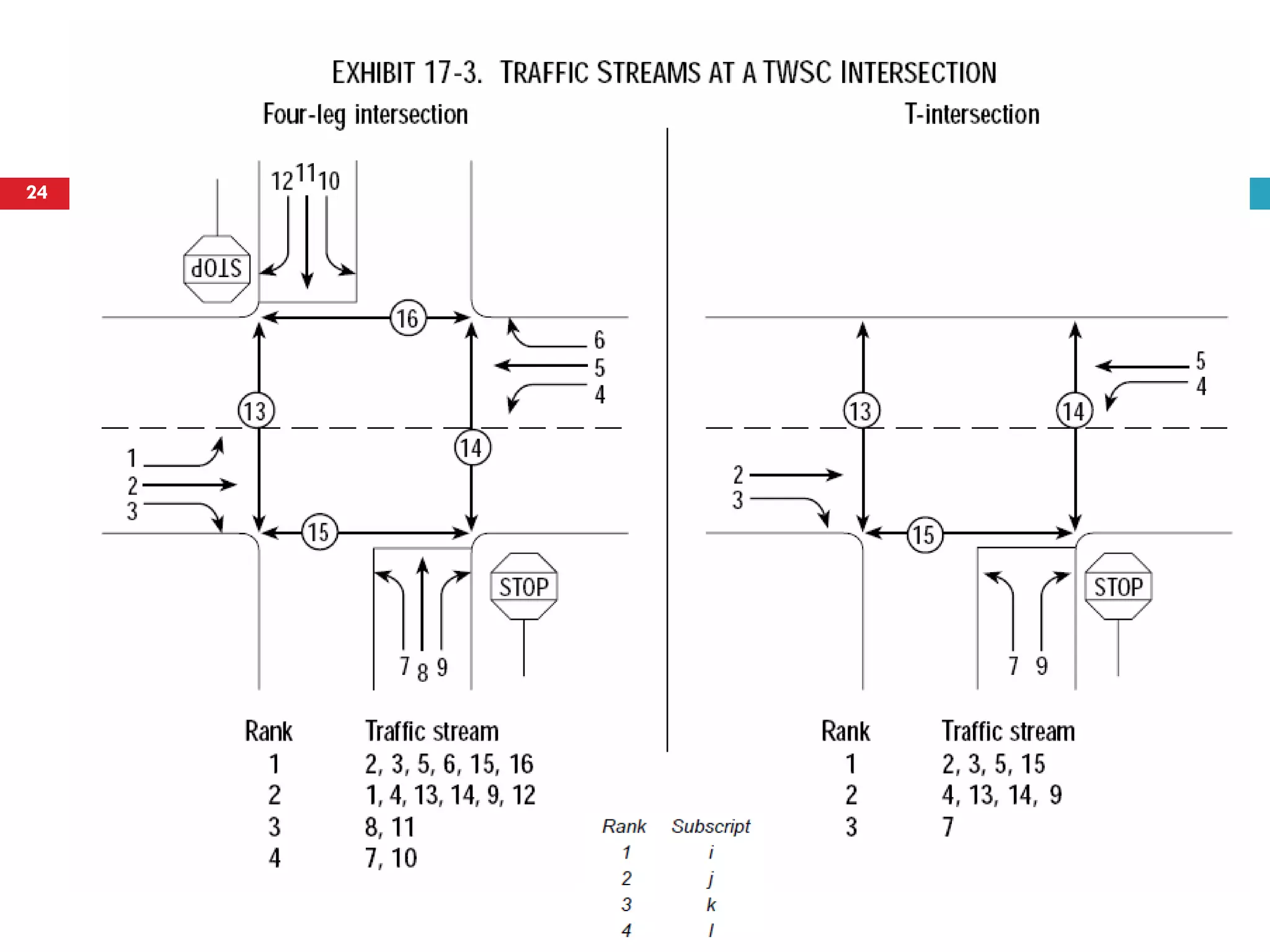
 Exhibit 17-3 illustrates the ranks of the
different possible intersection movements
23
24
25
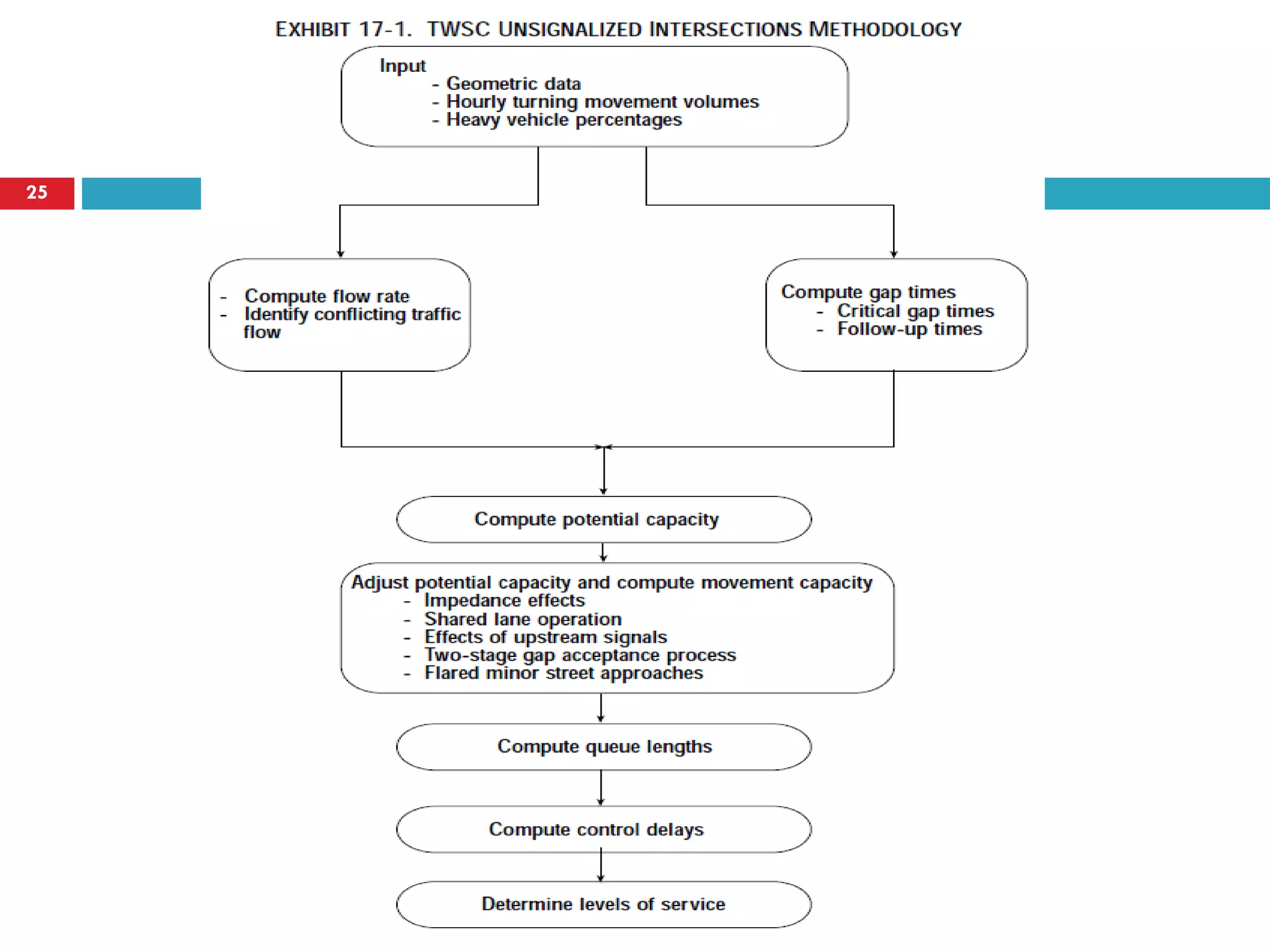
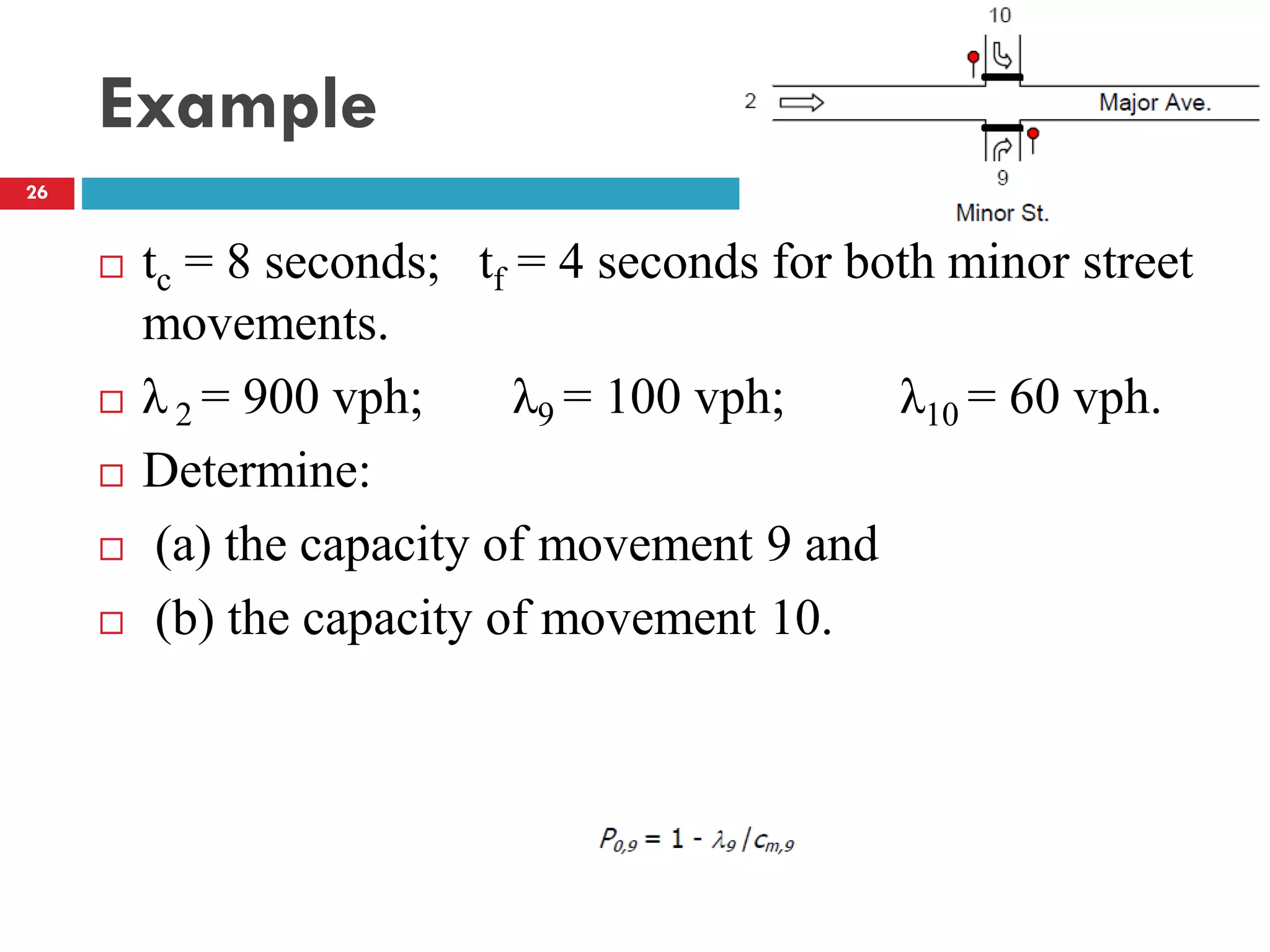
Example
 tc = 8 seconds; tf = 4 seconds for both minor street
movements.
 λ 2 = 900 vph; λ9 = 100 vph; λ10 = 60 vph.
 Determine:
 (a) the capacity of movement 9 and
 (b) the capacity of movement 10.
26
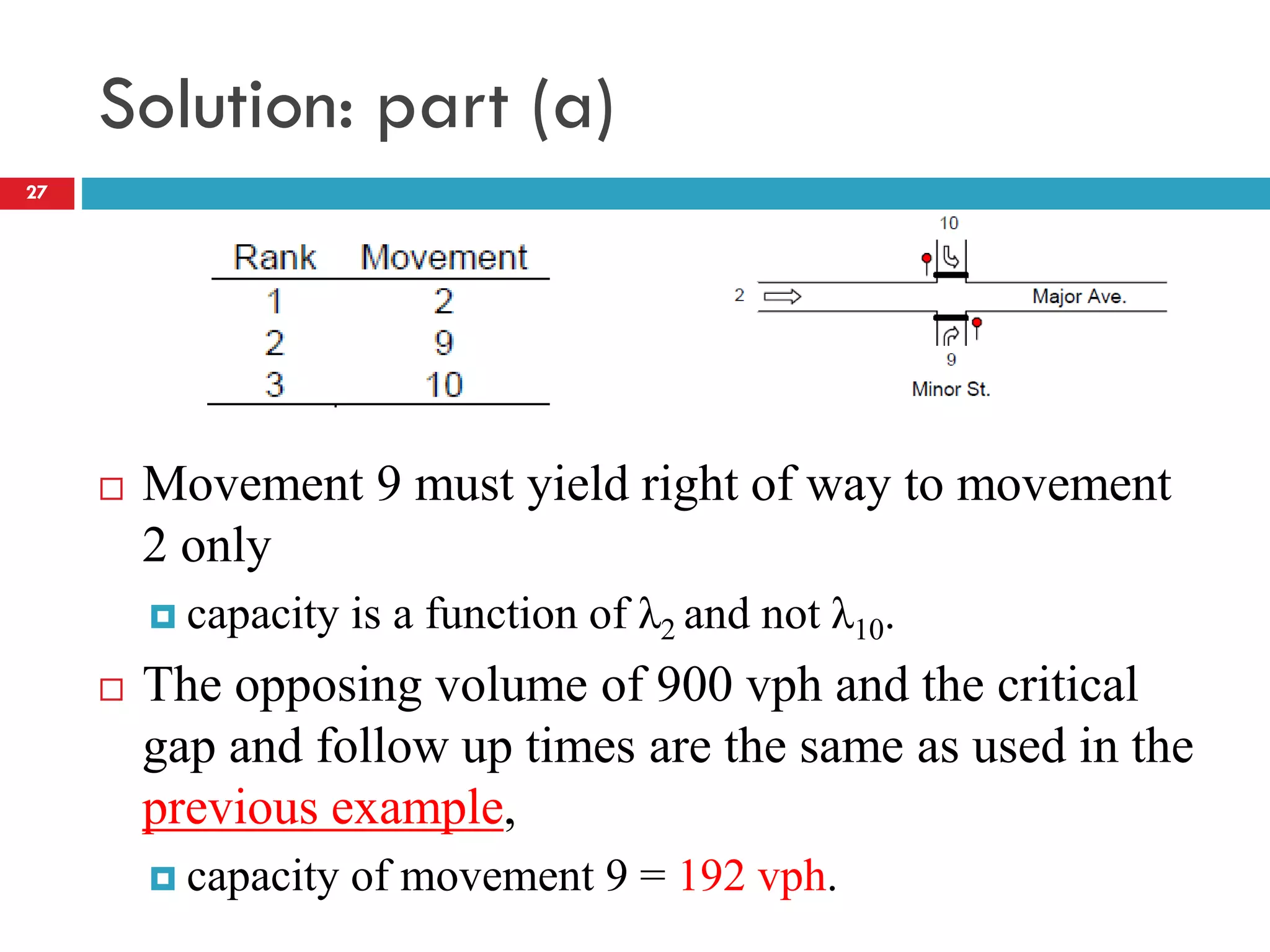
Solution: part (a)
 Movement 9 must yield right of way to movement
2 only
 capacity is a function of λ2 and not λ10.
 The opposing volume of 900 vph and the critical
gap and follow up times are the same as used in the
previous example,
 capacity of movement 9 = 192 vph.
27
Solution: part (b)
 The capacity of movement 10 ≠ 192 vph because
 movement 9 uses some of the available gaps making them
unavailable for movement 10.
 We call this effect “impedance”.
 The magnitude of this effect depends on the arrival rate and
capacity of higher ranked movements.
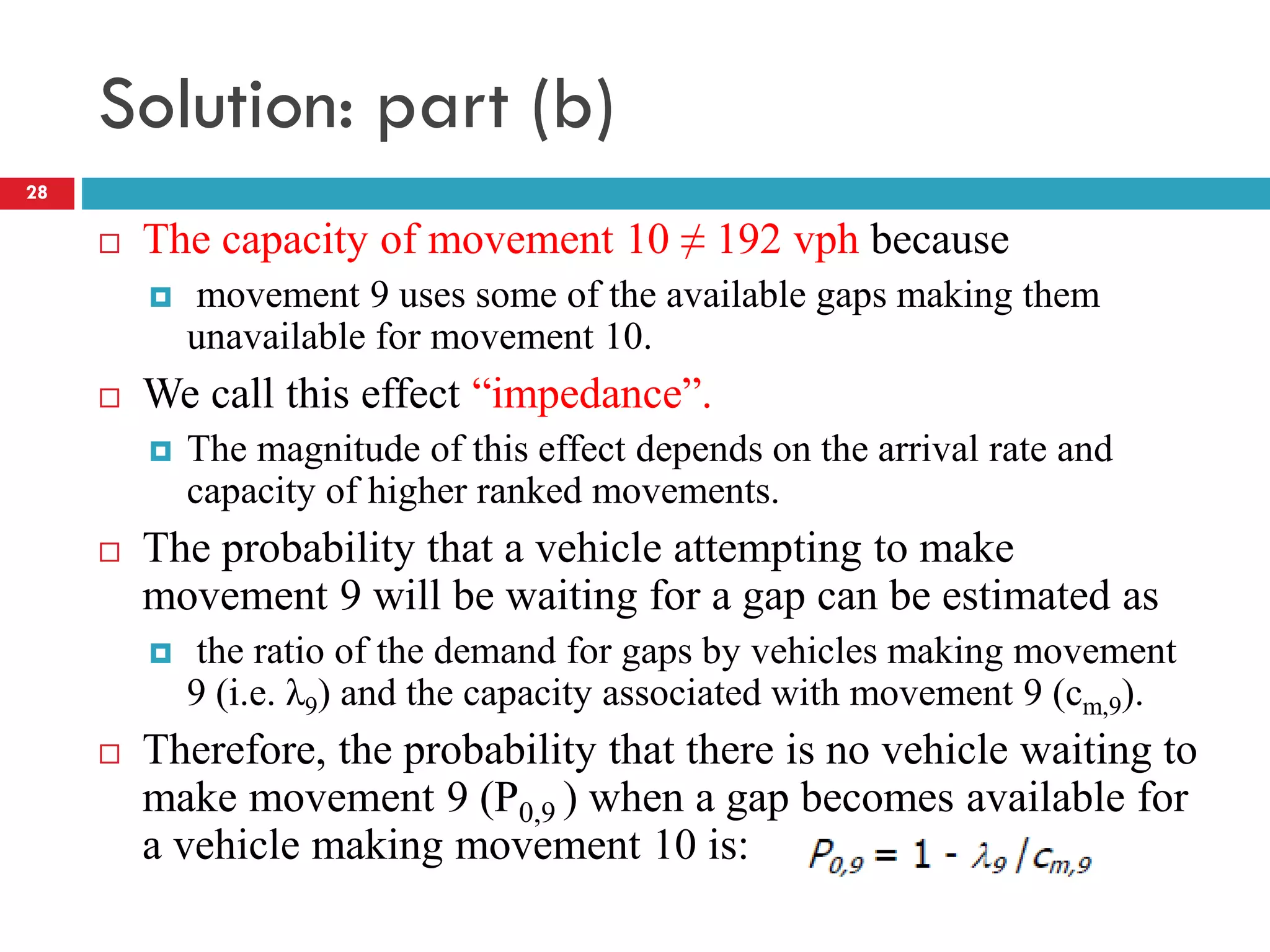
 The probability that a vehicle attempting to make
movement 9 will be waiting for a gap can be estimated as
 the ratio of the demand for gaps by vehicles making movement
9 (i.e. λ9) and the capacity associated with movement 9 (cm,9).
 Therefore, the probability that there is no vehicle waiting to
make movement 9 (P0,9 ) when a gap becomes available for
a vehicle making movement 10 is:
28
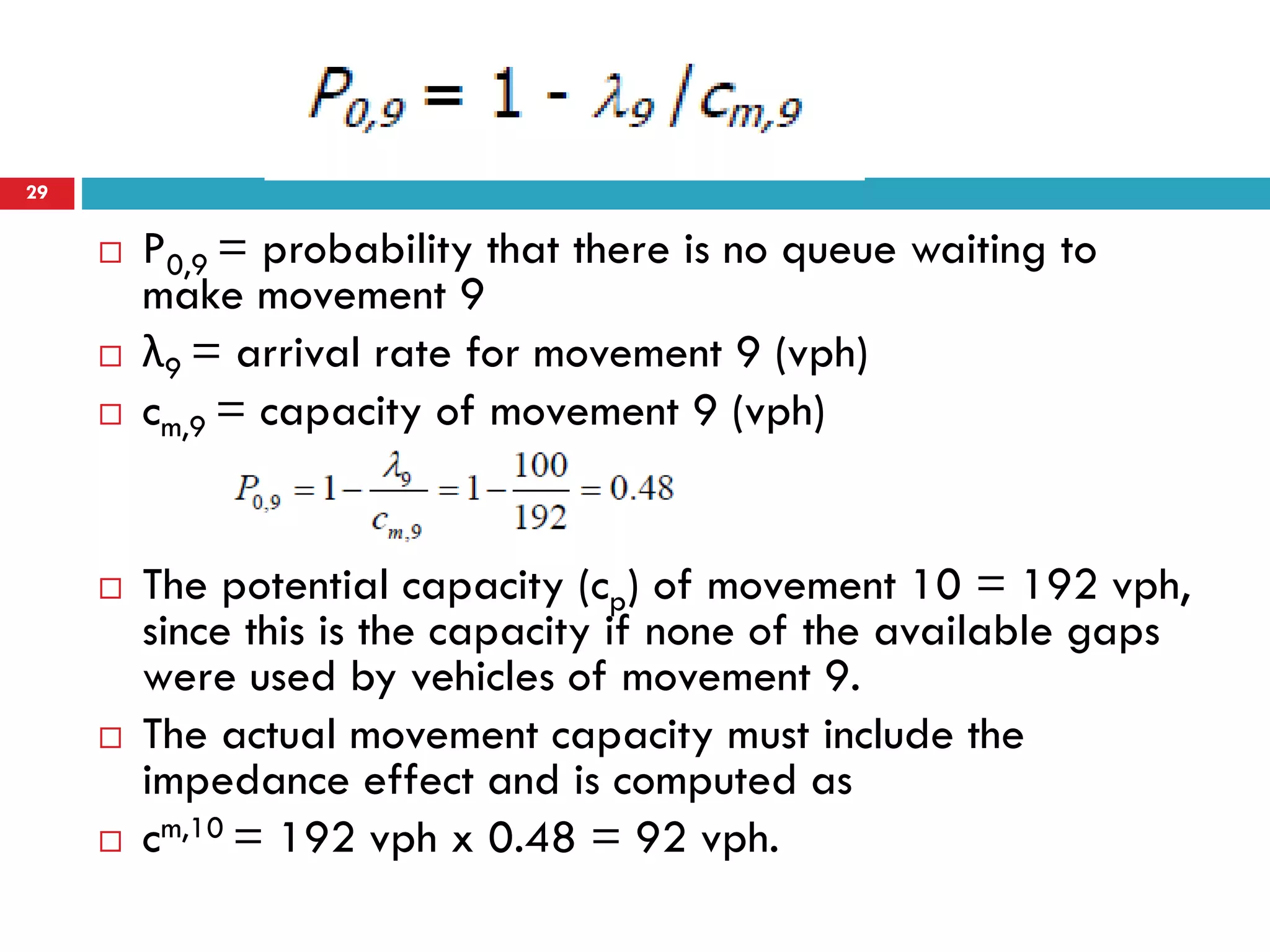
 P0,9 = probability that there is no queue waiting to
make movement 9
 λ9 = arrival rate for movement 9 (vph)
 cm,9 = capacity of movement 9 (vph)
 The potential capacity (cp) of movement 10 = 192 vph,
since this is the capacity if none of the available gaps
were used by vehicles of movement 9.
 The actual movement capacity must include the
impedance effect and is computed as
 cm,10 = 192 vph x 0.48 = 92 vph.
29
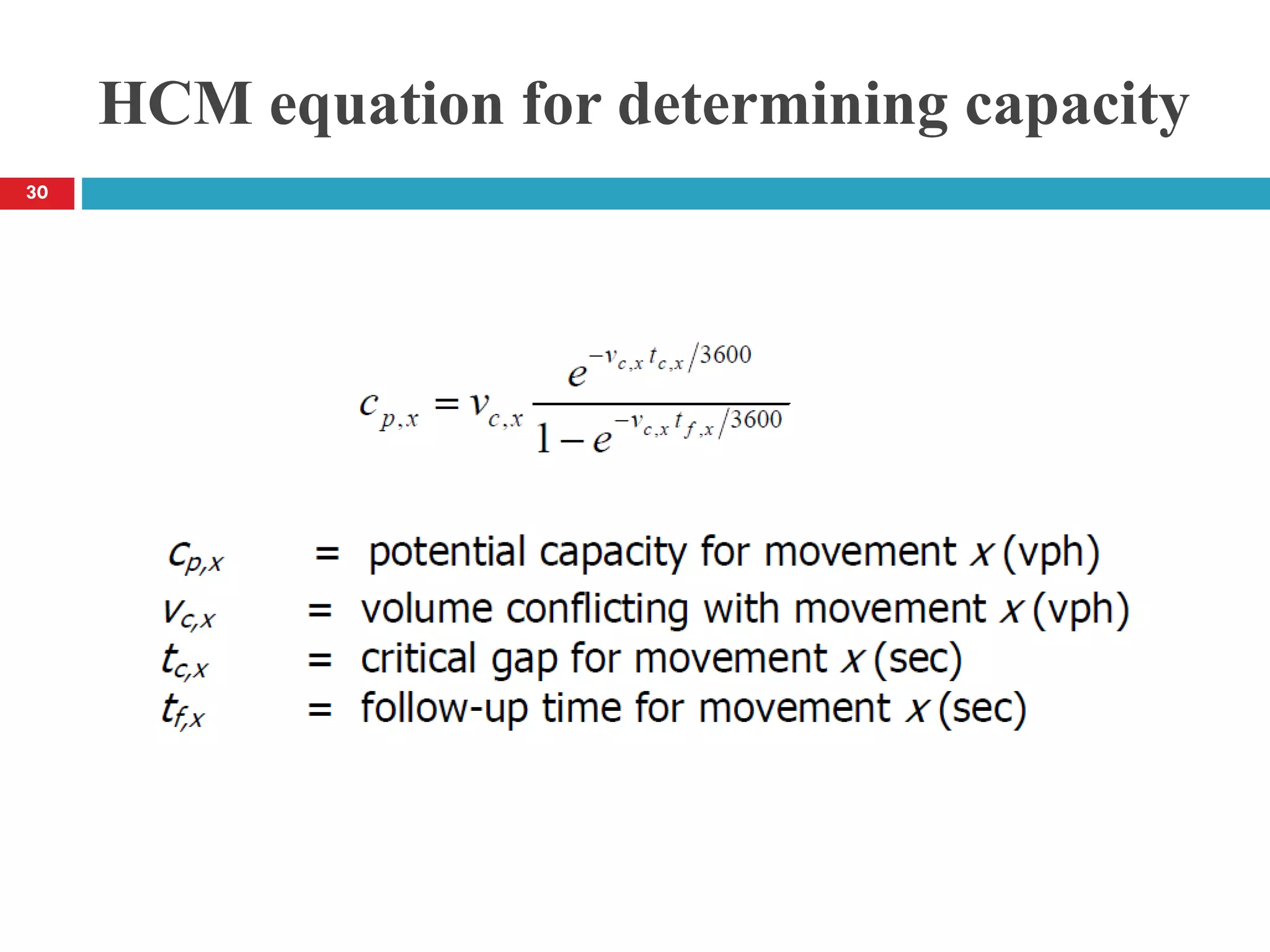
HCM equation for determining capacity
30
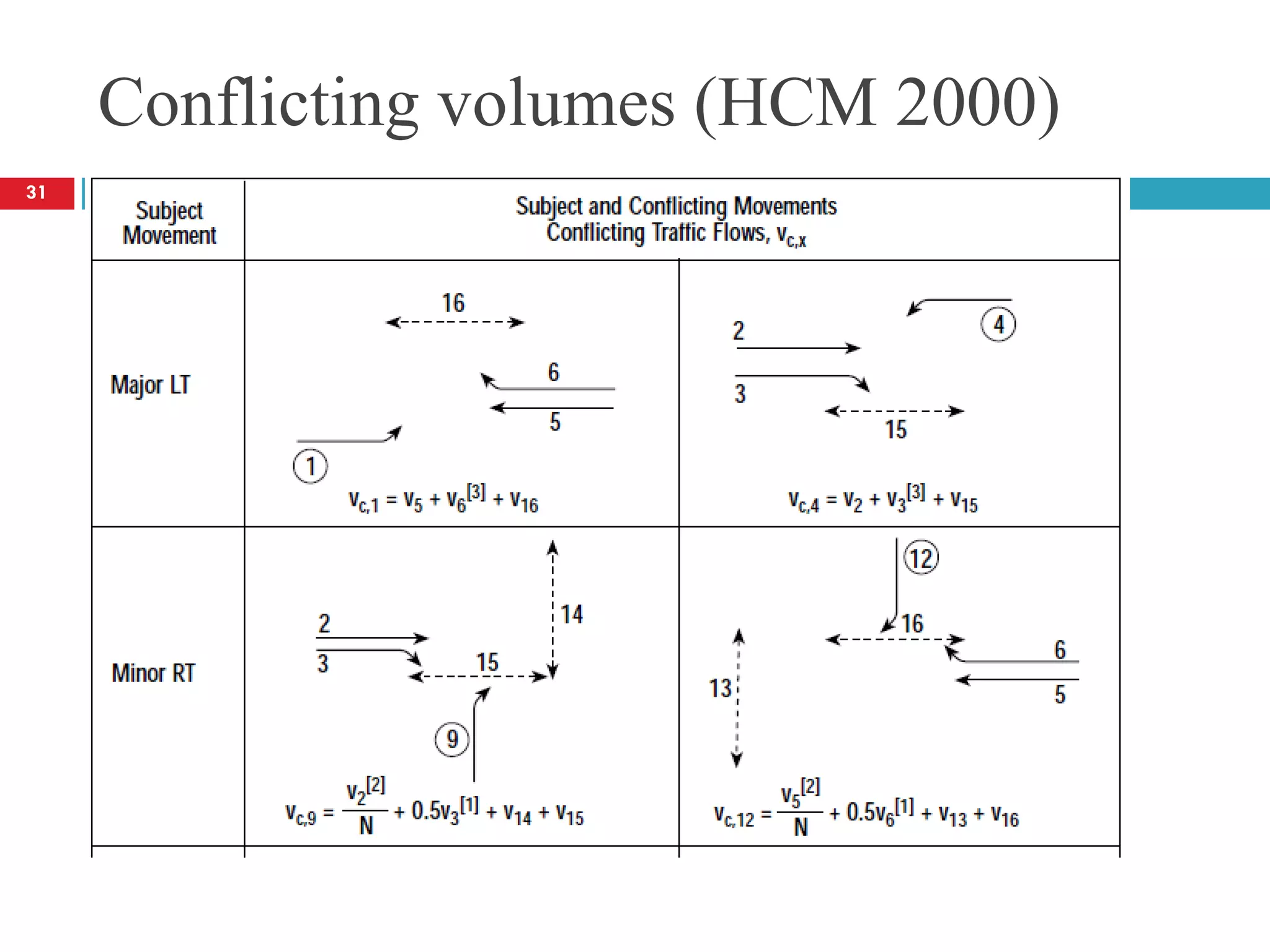
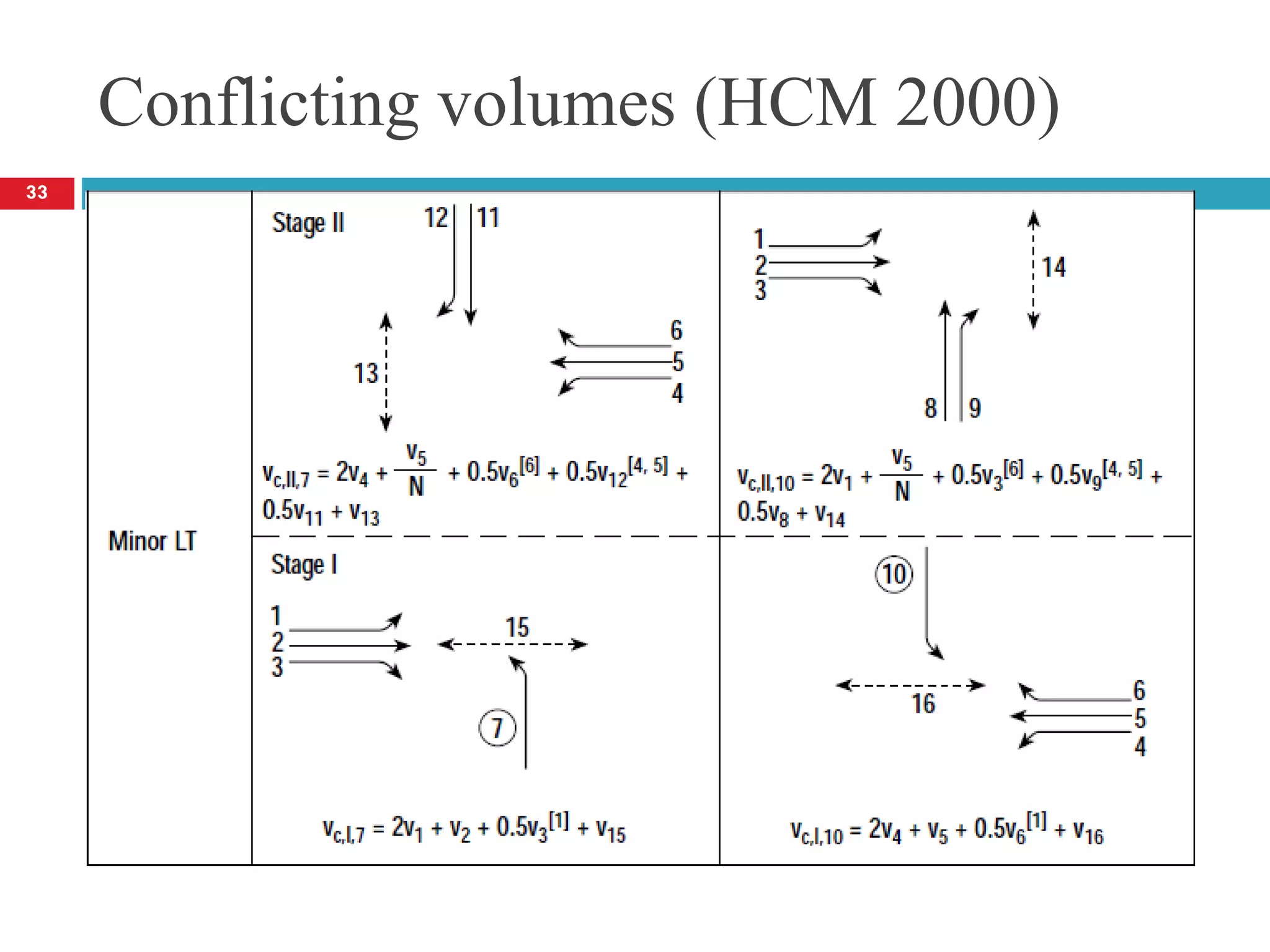
Conflicting volumes (HCM 2000)
31
Conflicting volumes (HCM 2000)
32
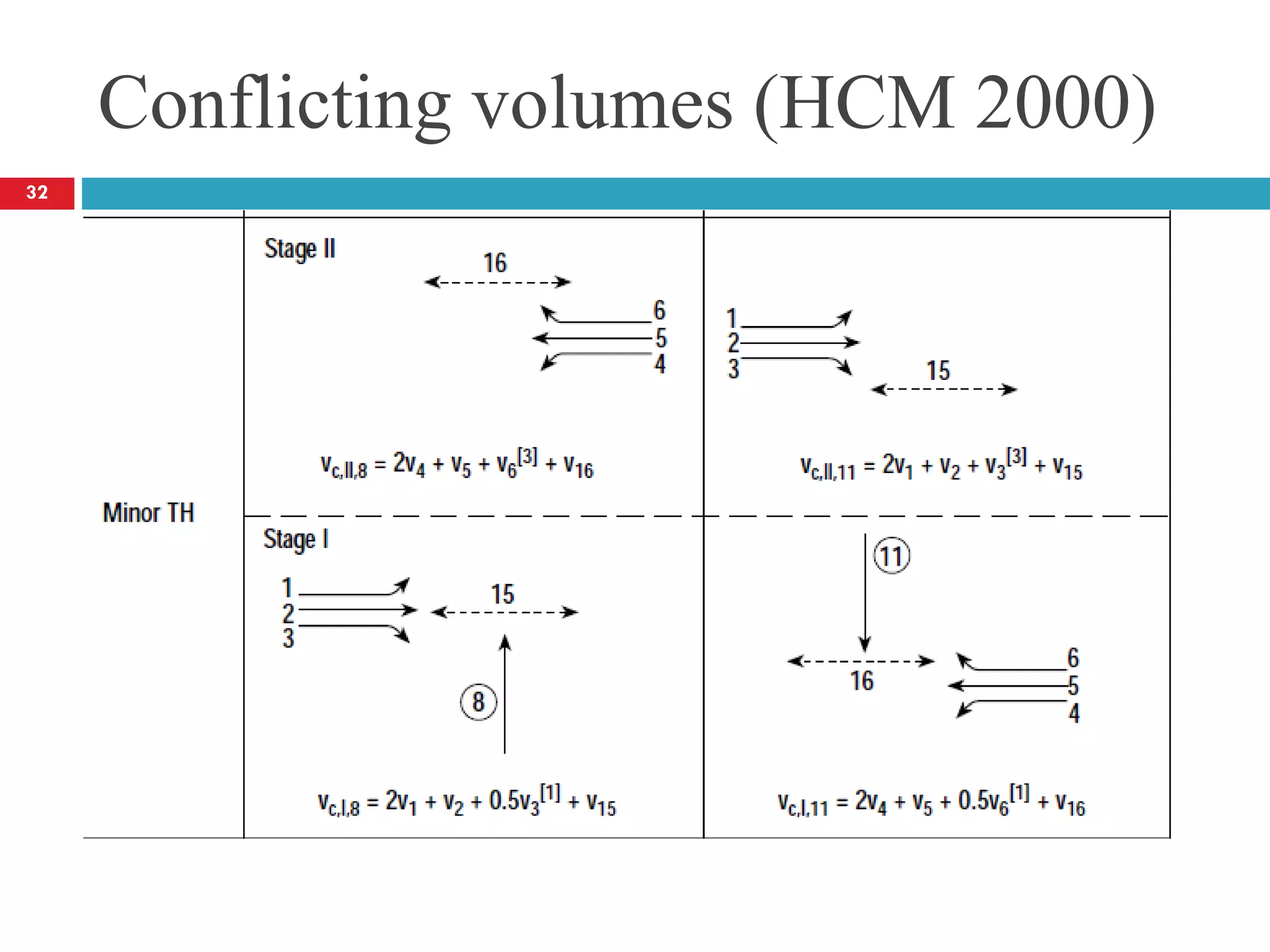
Conflicting volumes (HCM 2000)
33
Conflicting volumes (HCM 2000)
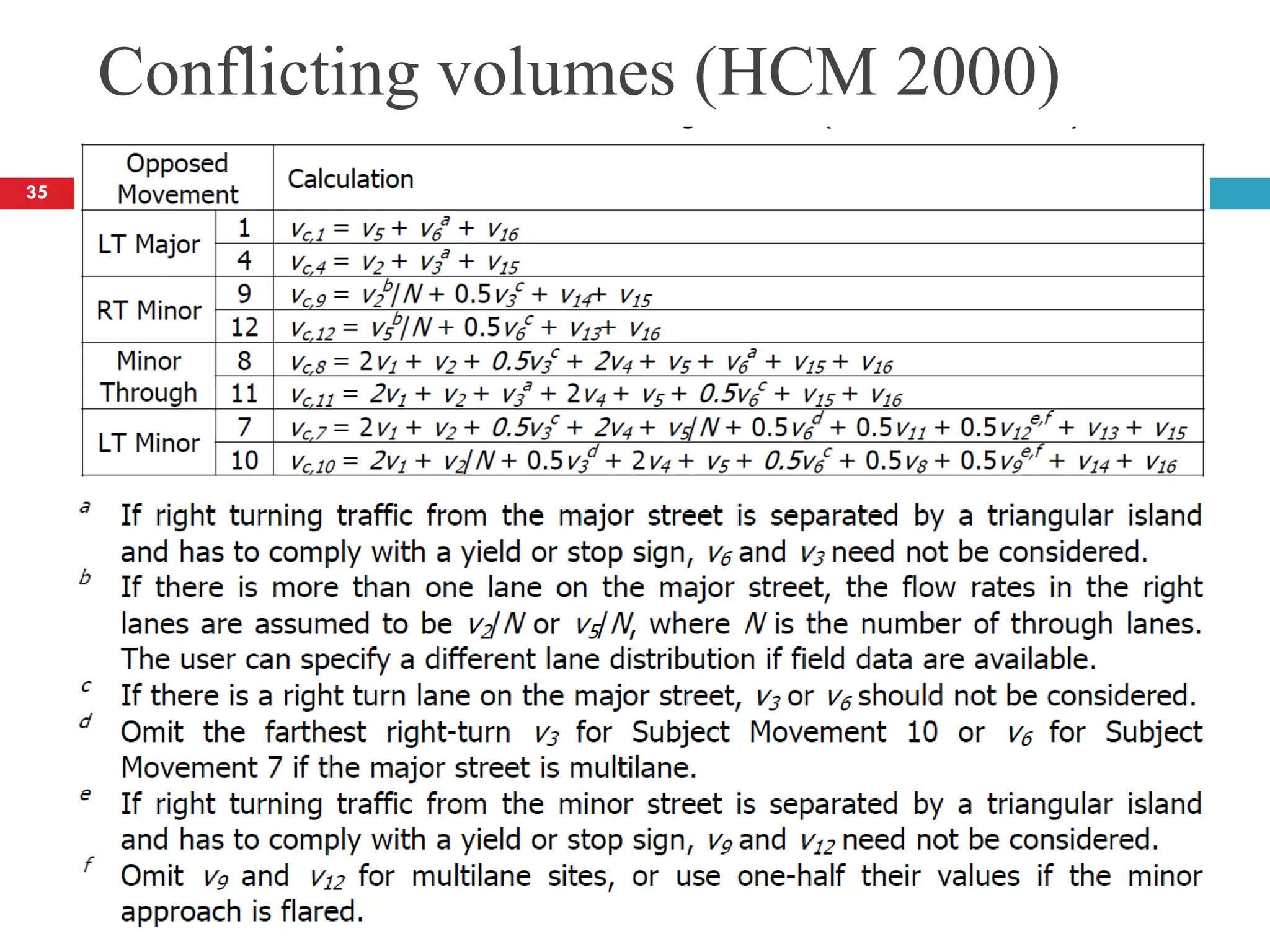
 [1] If there is a right-turn lane on the major street, v3 or v6 should not be
considered.
 [2] If there is more than one lane on the major street, the flow rates in the
right lane are assumed to be v2/N or v5/N, where N is the number of through
lanes. The user can specify a different lane distribution if field data are
available.
 [3] If right-turning traffic from the major road is separated by a triangular
island and has to comply with a yield or stop sign, v6 and v3 need not be
considered.
 [4] If right-turning traffic from the minor road is separated by a triangular
island and has to comply with a yield or stop sign, v9 and v12 need not be
considered.
 [5] Omit v9 and v12 for multilane sites, or use one-half their values if the
minor approach is flared.
 [6] Omit the farthest right-turn v3 for subject movement 10 or v6 for subject
movement 7 if the major street is multilane.
34
Conflicting volumes (HCM 2000)
35
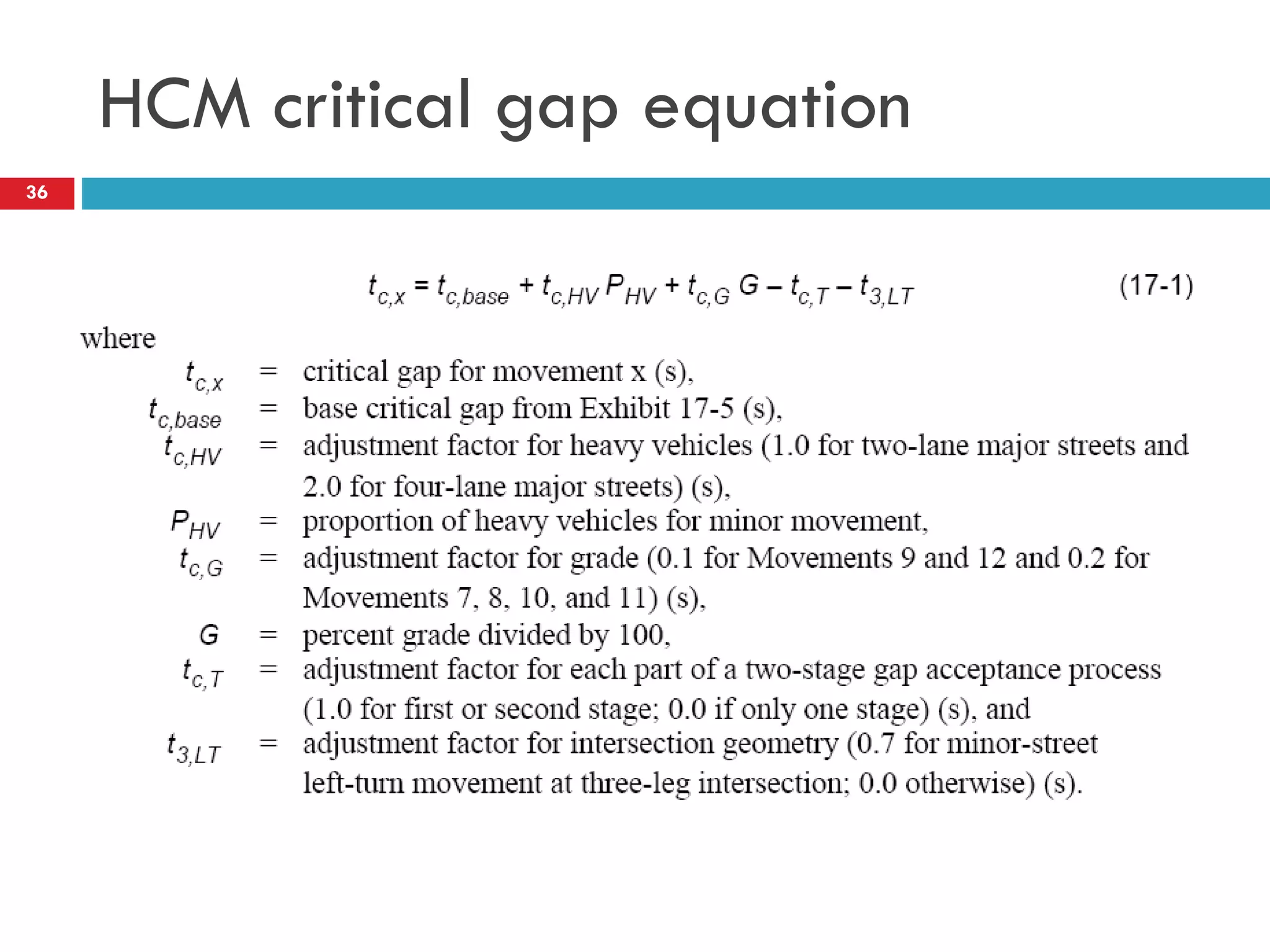
HCM critical gap equation
36
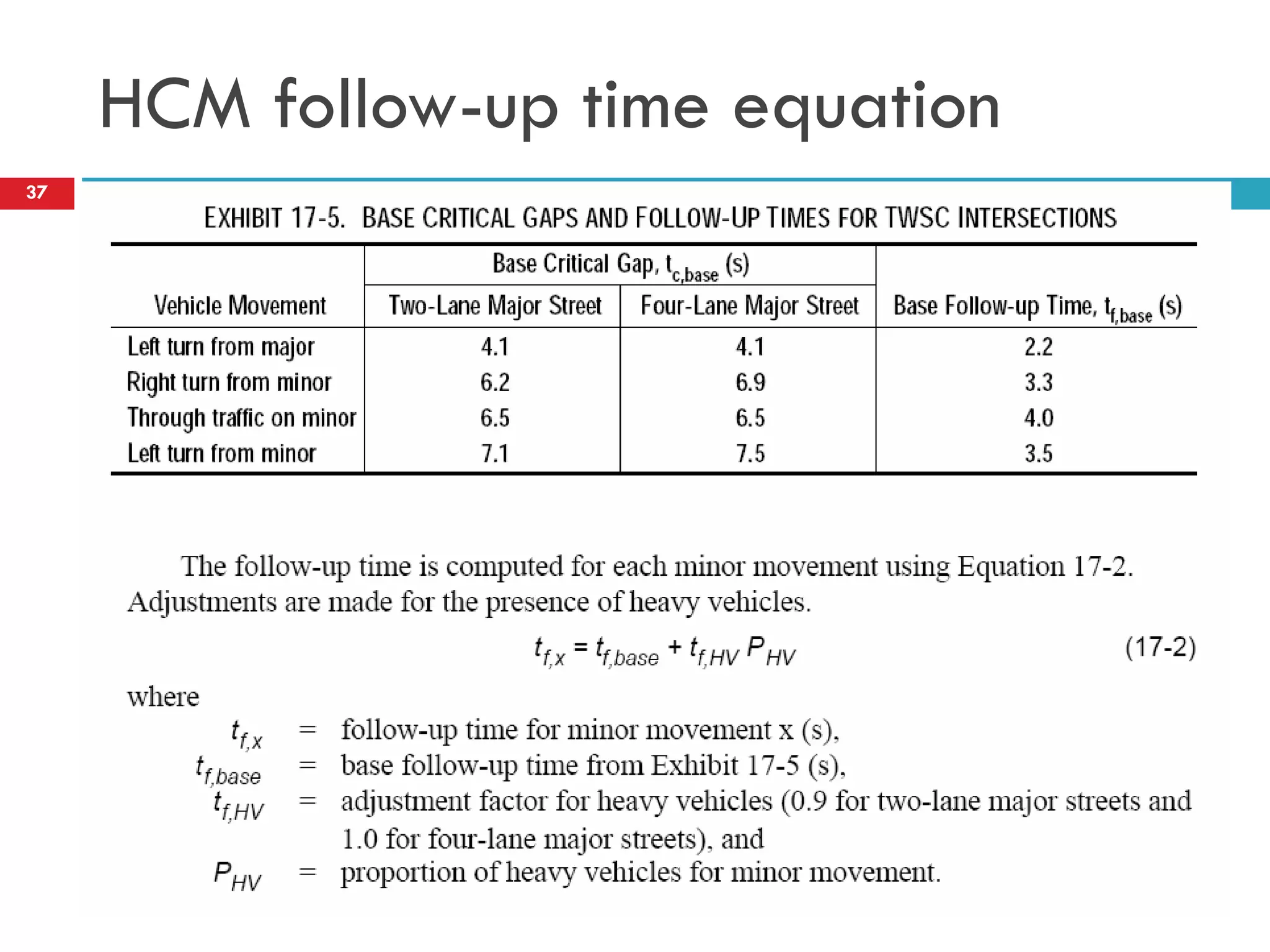
HCM follow-up time equation
37
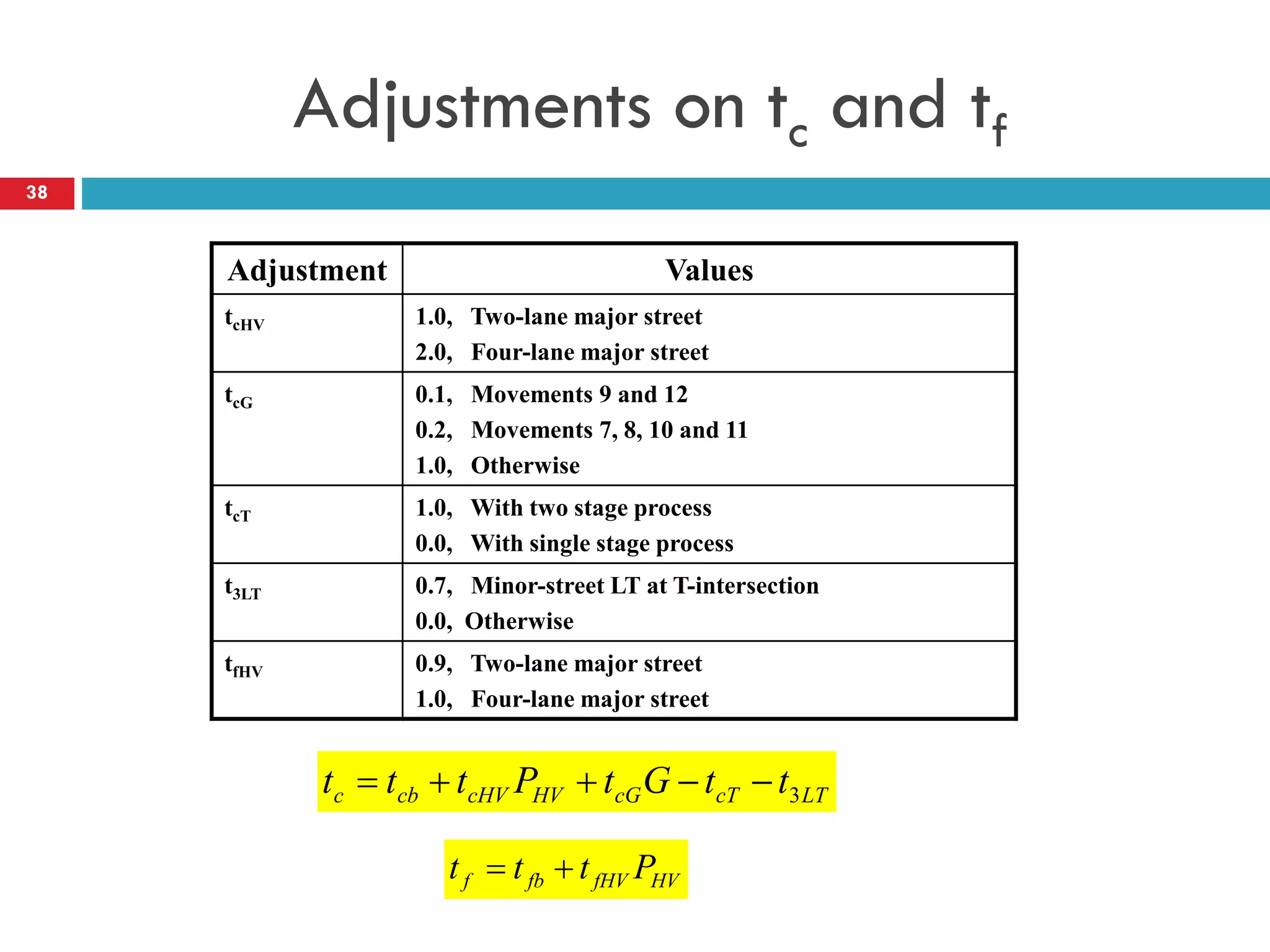
Adjustments on tc and tf
Adjustment Values
tcHV 1.0, Two-lane major street
2.0, Four-lane major street
tcG 0.1, Movements 9 and 12
0.2, Movements 7, 8, 10 and 11
1.0, Otherwise
tcT 1.0, With two stage process
0.0, With single stage process
t3LT 0.7, Minor-street LT at T-intersection
0.0, Otherwise
tfHV 0.9, Two-lane major street
1.0, Four-lane major street
LTcTcGHVcHVcbc ttGtPttt 3−−++=
HVfHVfbf Pttt +=
38
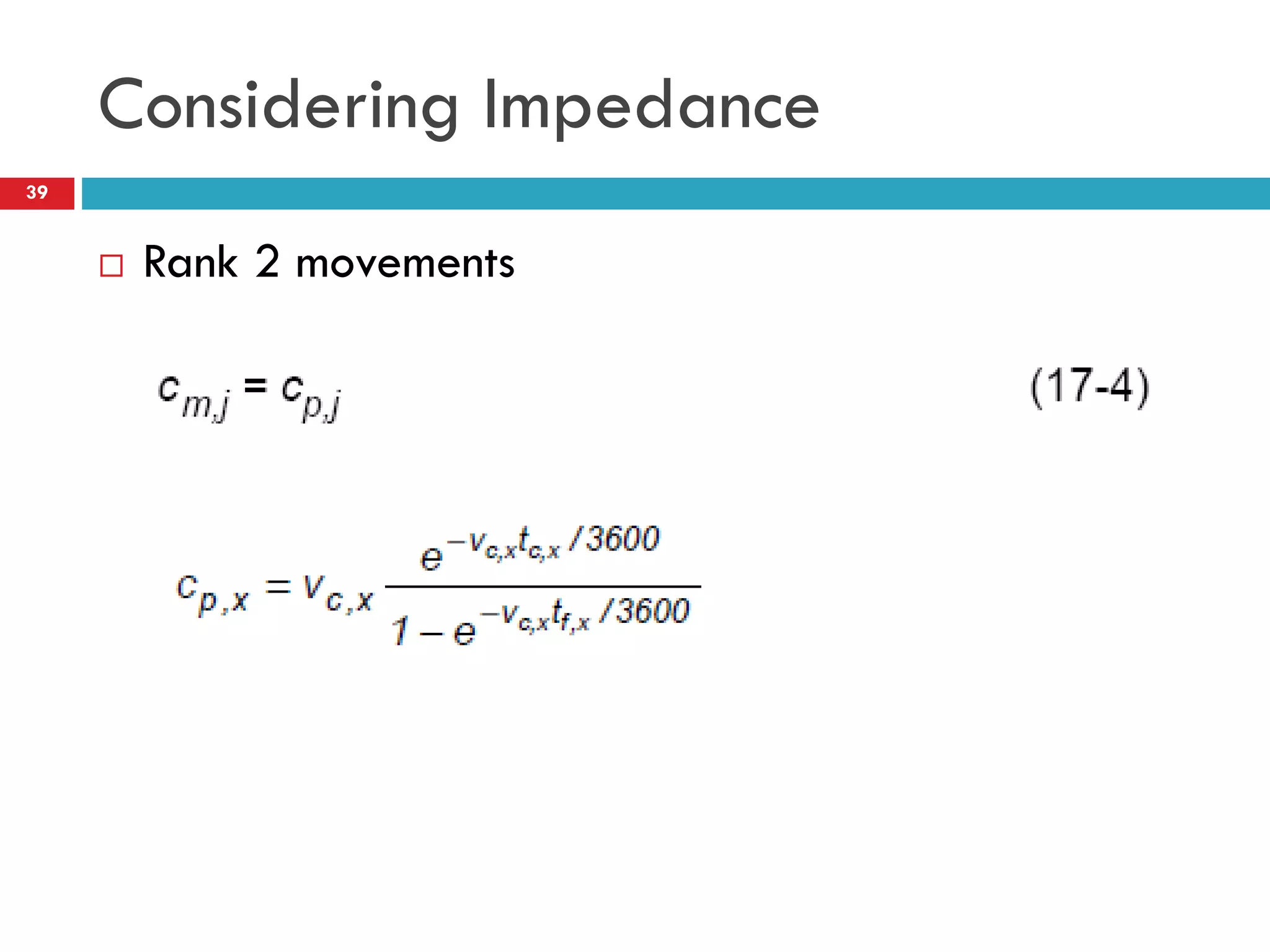
Considering Impedance
 Rank 2 movements
39
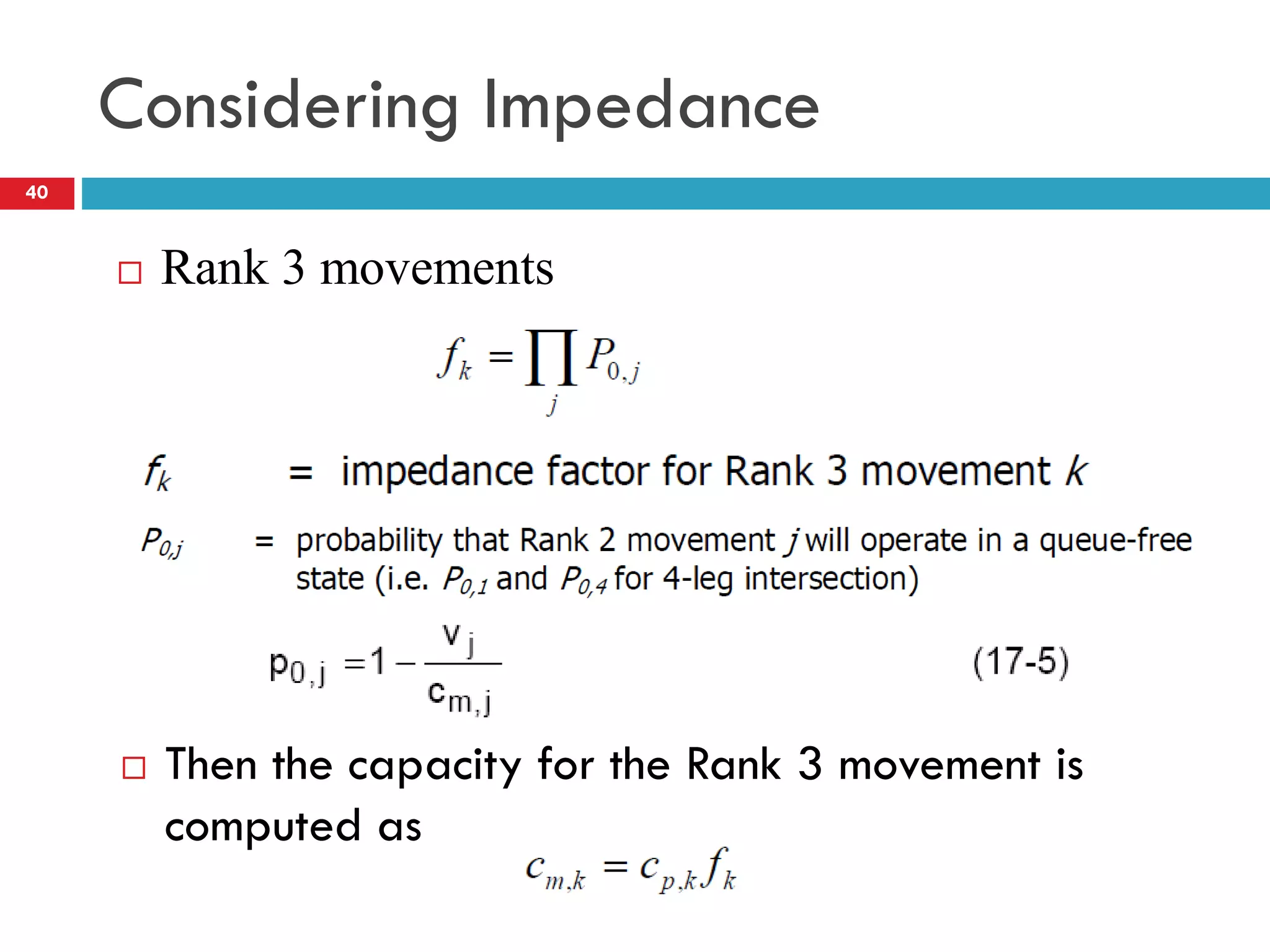
Considering Impedance
 Then the capacity for the Rank 3 movement is
computed as
 Rank 3 movements
40
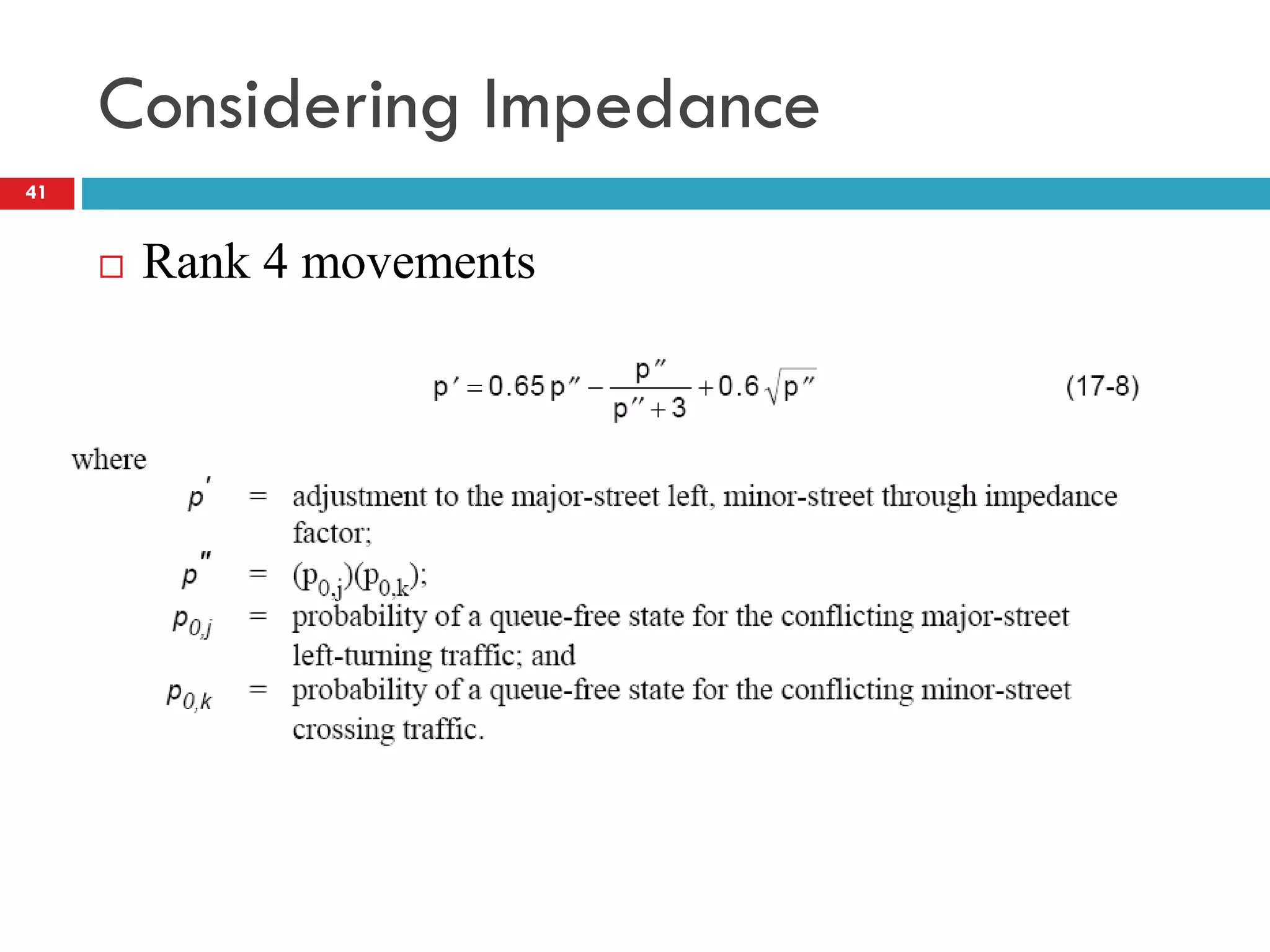
Considering Impedance
 Rank 4 movements
41
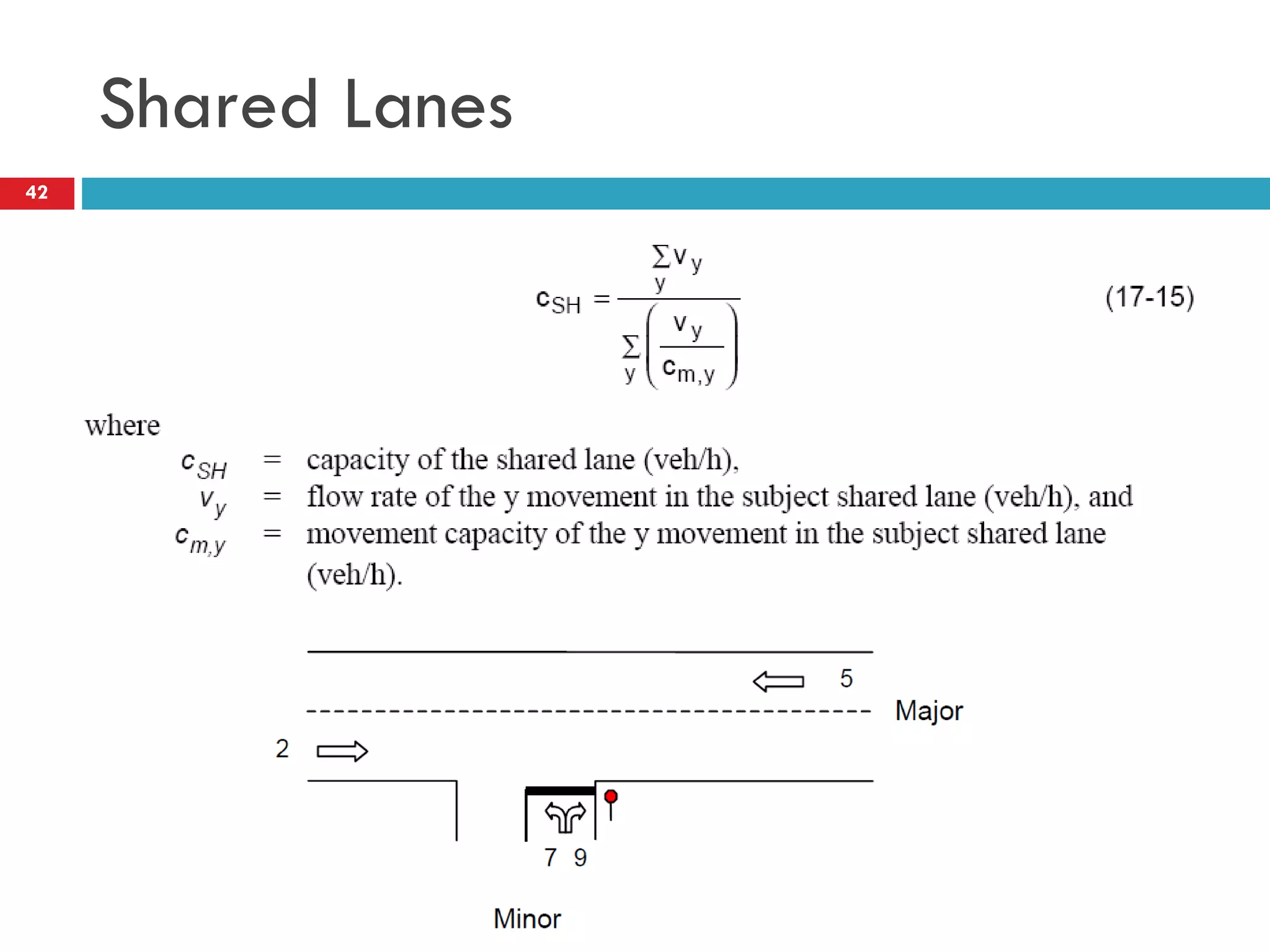
Shared Lanes
42
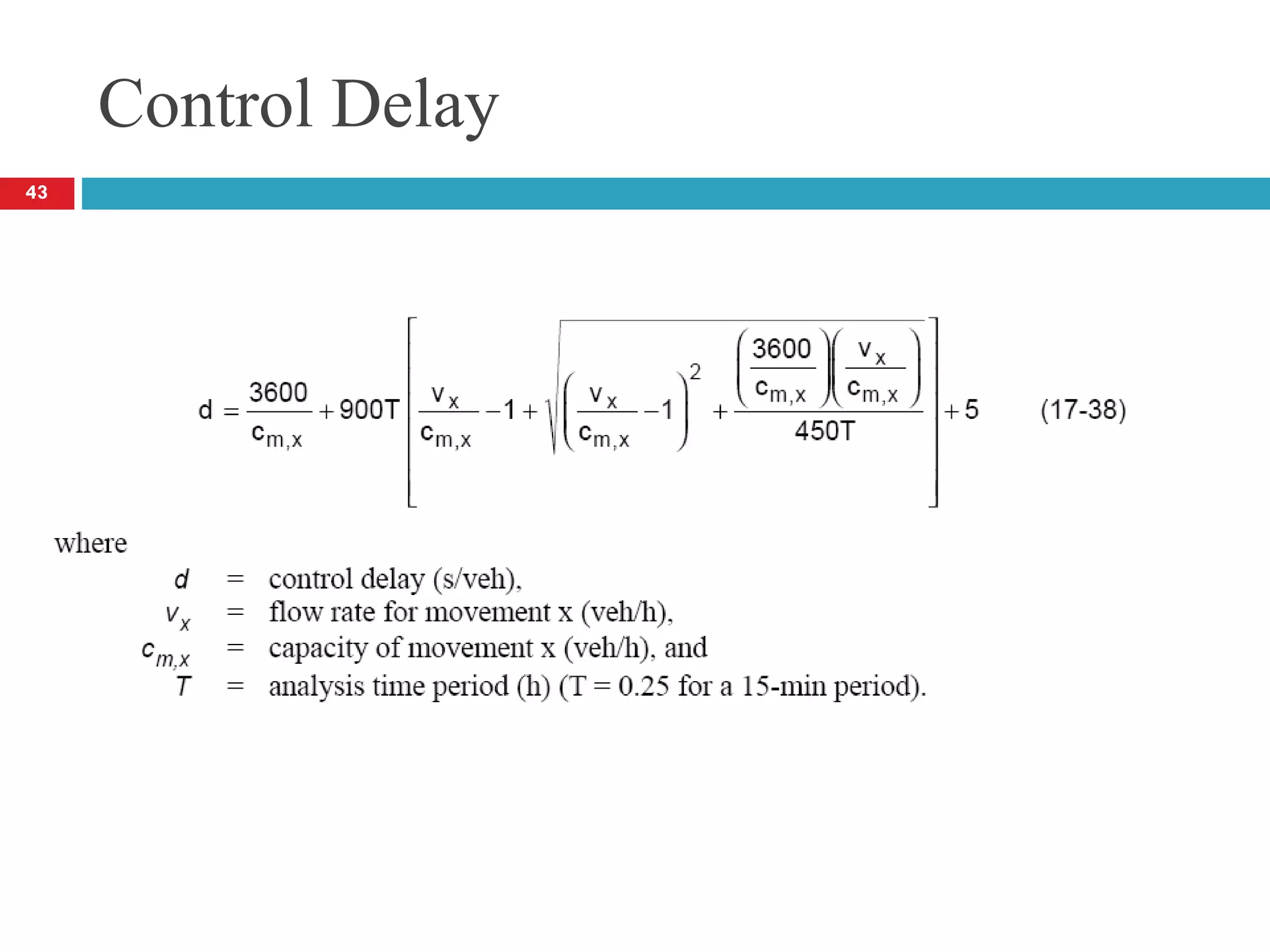
Control Delay
43
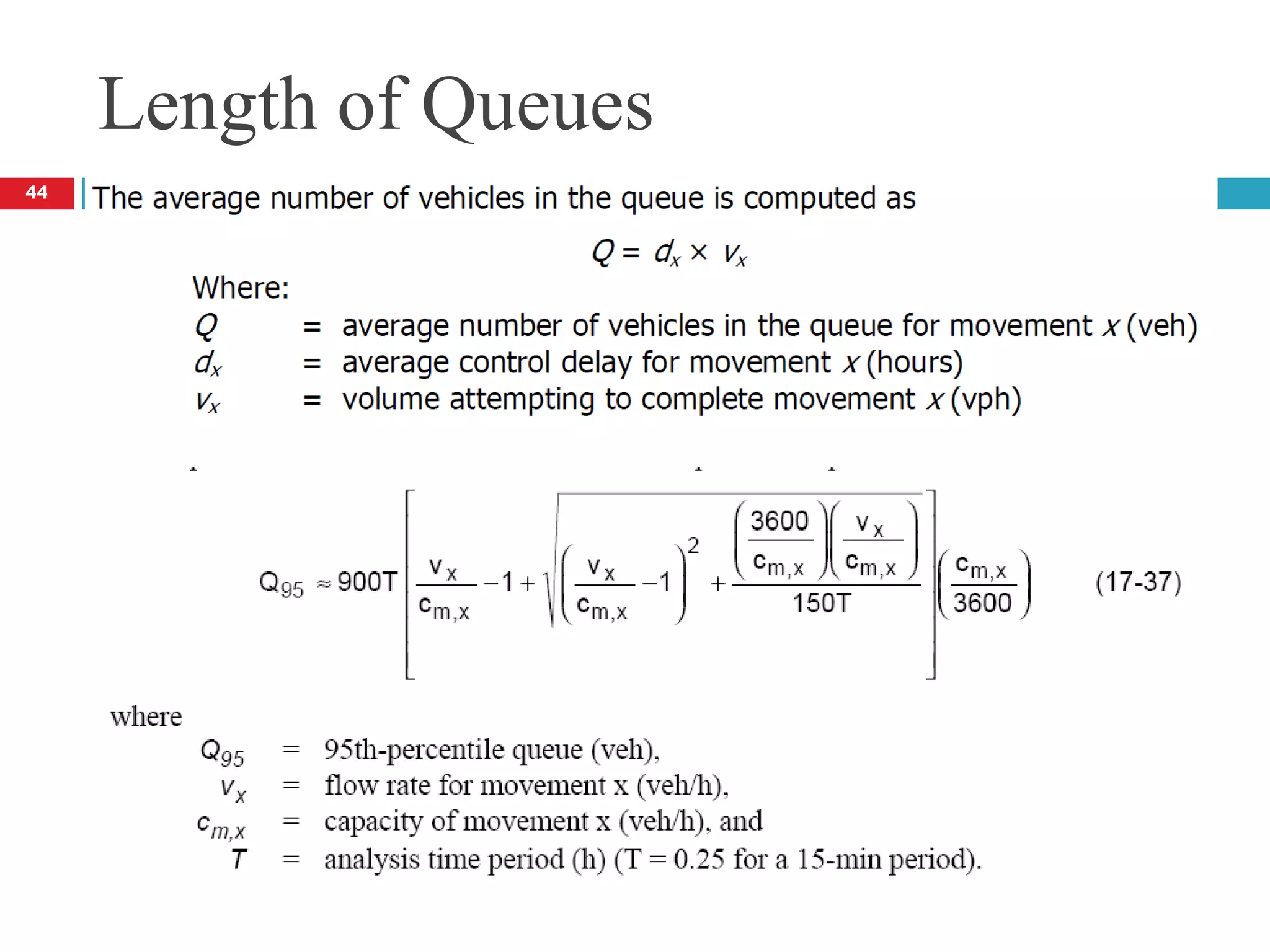
Length of Queues
44
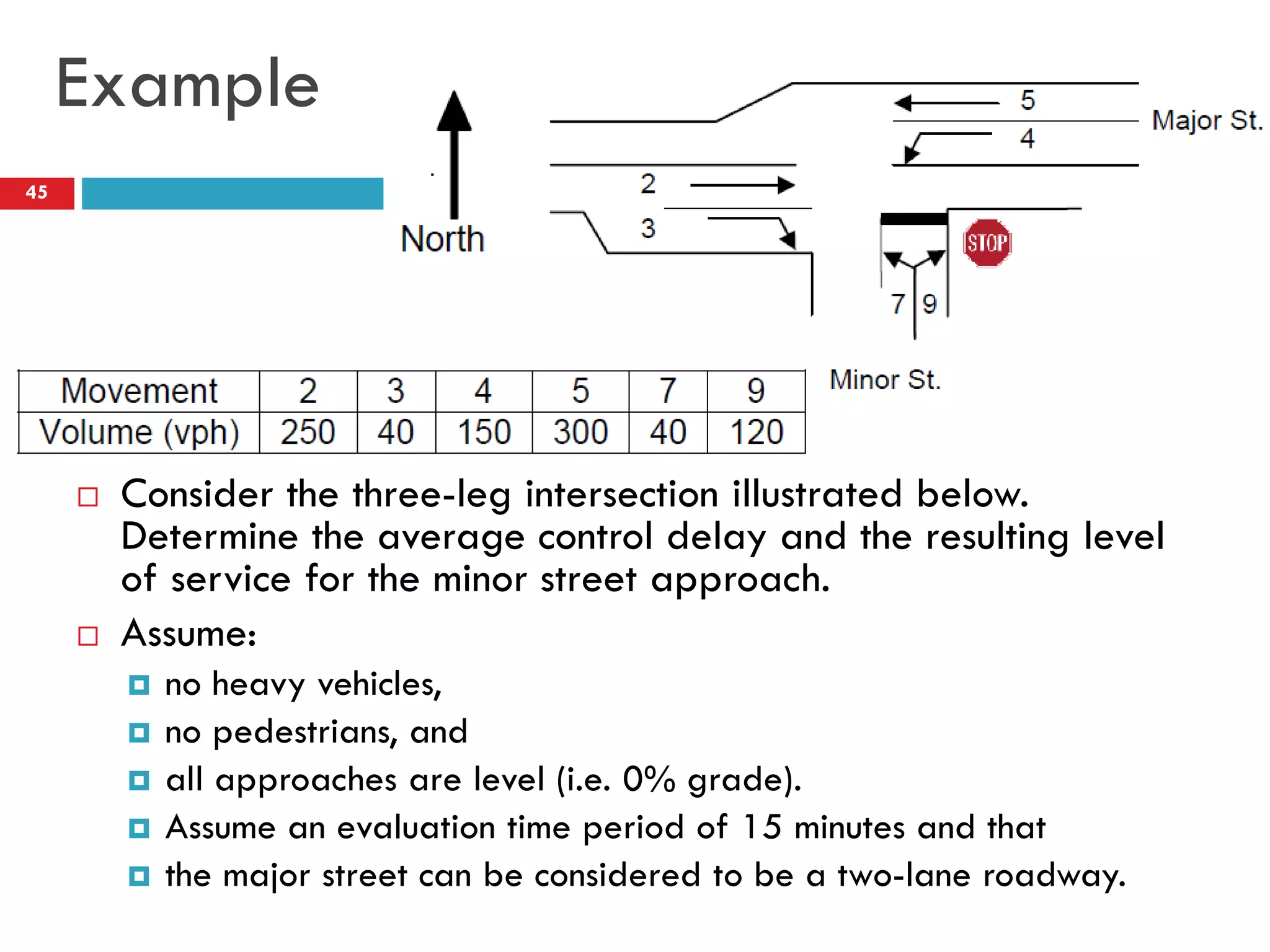
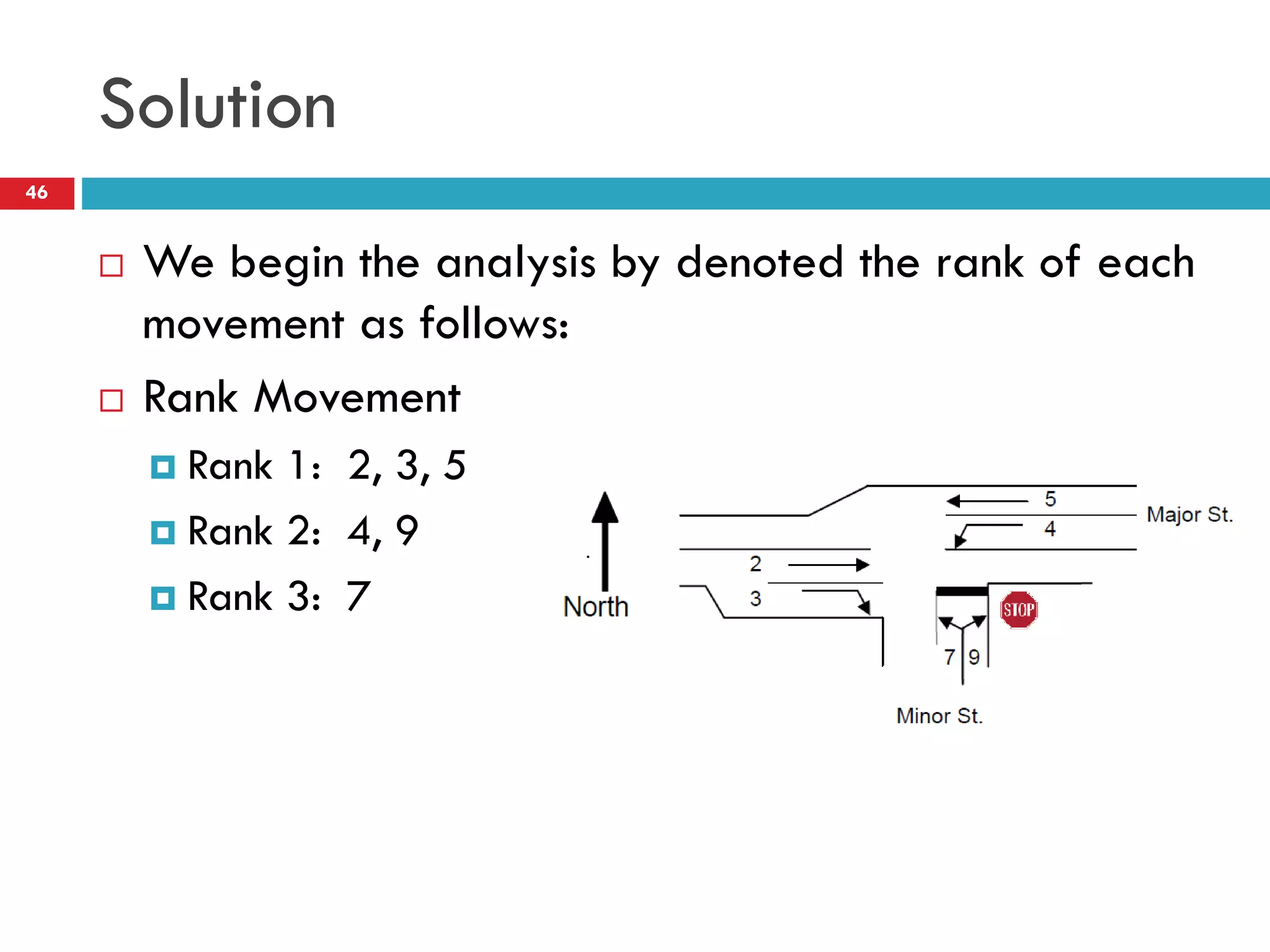
Example
 Consider the three-leg intersection illustrated below.
Determine the average control delay and the resulting level
of service for the minor street approach.
 Assume:
 no heavy vehicles,
 no pedestrians, and
 all approaches are level (i.e. 0% grade).
 Assume an evaluation time period of 15 minutes and that
 the major street can be considered to be a two-lane roadway.
45
Solution
 We begin the analysis by denoted the rank of each
movement as follows:
 Rank Movement
 Rank 1: 2, 3, 5
 Rank 2: 4, 9
 Rank 3: 7
46
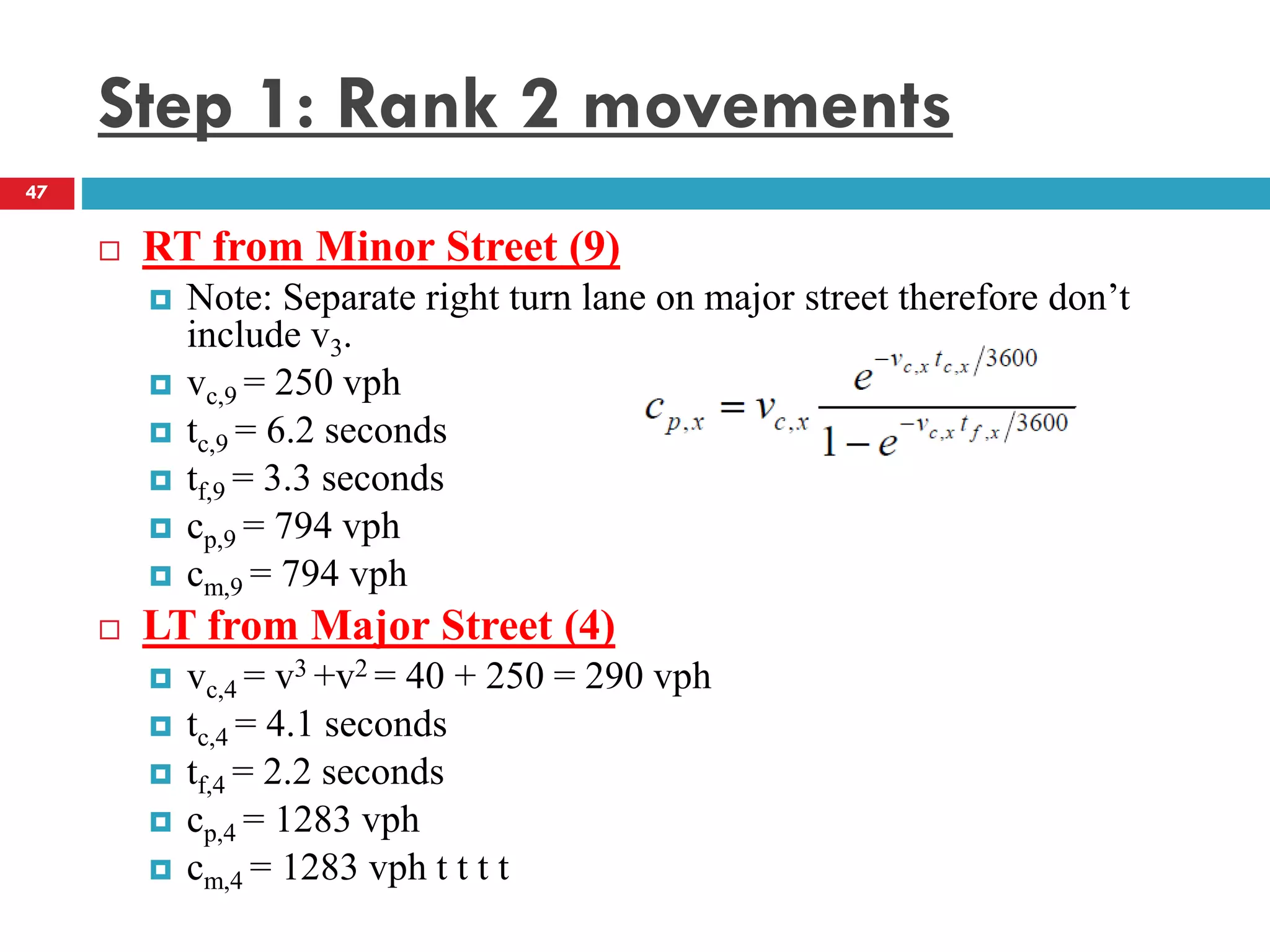
Step 1: Rank 2 movements
 RT from Minor Street (9)
 Note: Separate right turn lane on major street therefore don’t
include v3.
 vc,9 = 250 vph
 tc,9 = 6.2 seconds
 tf,9 = 3.3 seconds
 cp,9 = 794 vph
 cm,9 = 794 vph
 LT from Major Street (4)
 vc,4 = v3 +v2 = 40 + 250 = 290 vph
 tc,4 = 4.1 seconds
 tf,4 = 2.2 seconds
 cp,4 = 1283 vph
 cm,4 = 1283 vph t t t t
47
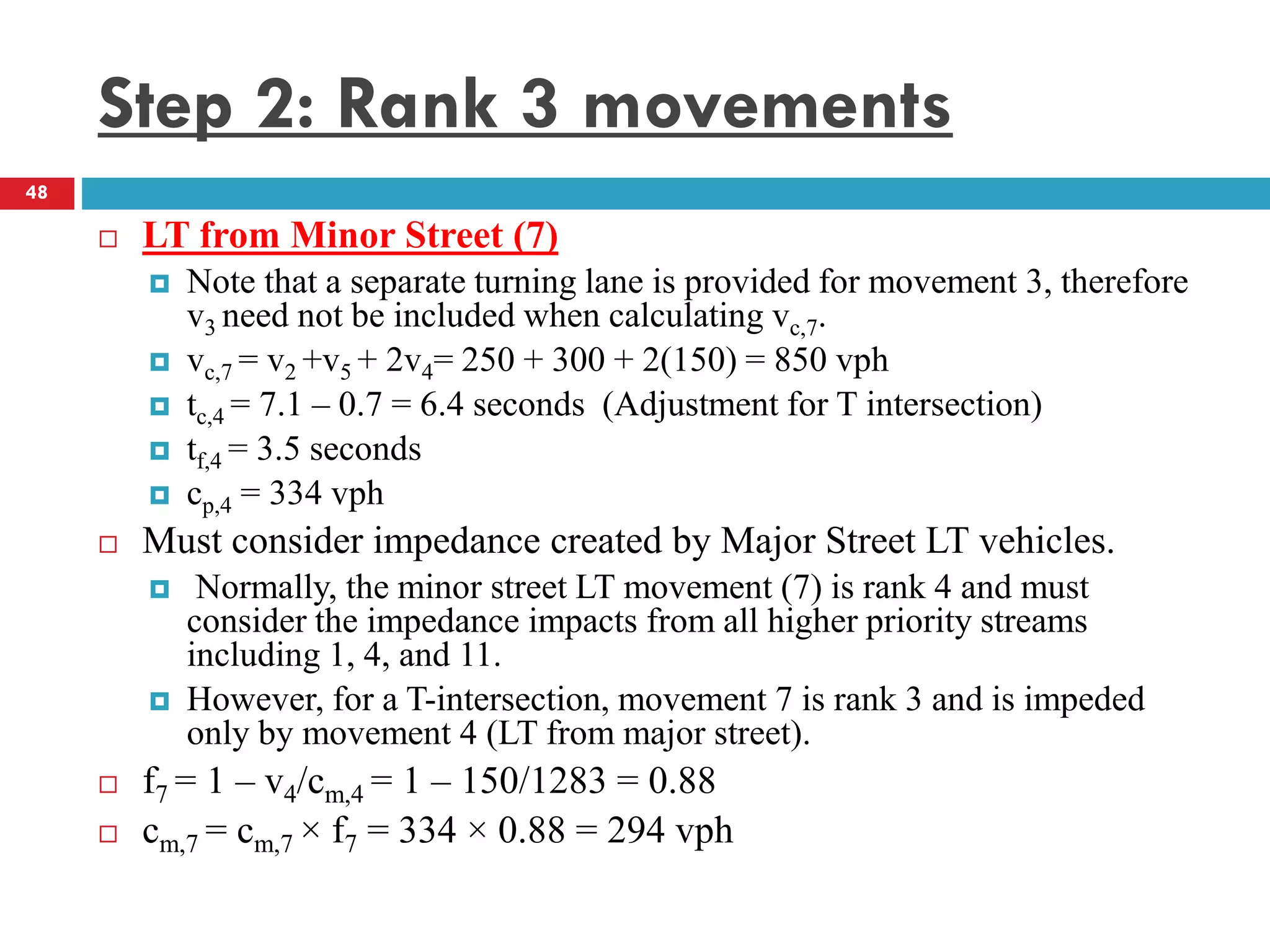
Step 2: Rank 3 movements
 LT from Minor Street (7)
 Note that a separate turning lane is provided for movement 3, therefore
v3 need not be included when calculating vc,7.
 vc,7 = v2 +v5 + 2v4= 250 + 300 + 2(150) = 850 vph
 tc,4 = 7.1 – 0.7 = 6.4 seconds (Adjustment for T intersection)
 tf,4 = 3.5 seconds
 cp,4 = 334 vph
 Must consider impedance created by Major Street LT vehicles.
 Normally, the minor street LT movement (7) is rank 4 and must
consider the impedance impacts from all higher priority streams
including 1, 4, and 11.
 However, for a T-intersection, movement 7 is rank 3 and is impeded
only by movement 4 (LT from major street).
 f7 = 1 – v4/cm,4 = 1 – 150/1283 = 0.88
 cm,7 = cm,7 × f7 = 334 × 0.88 = 294 vph
48
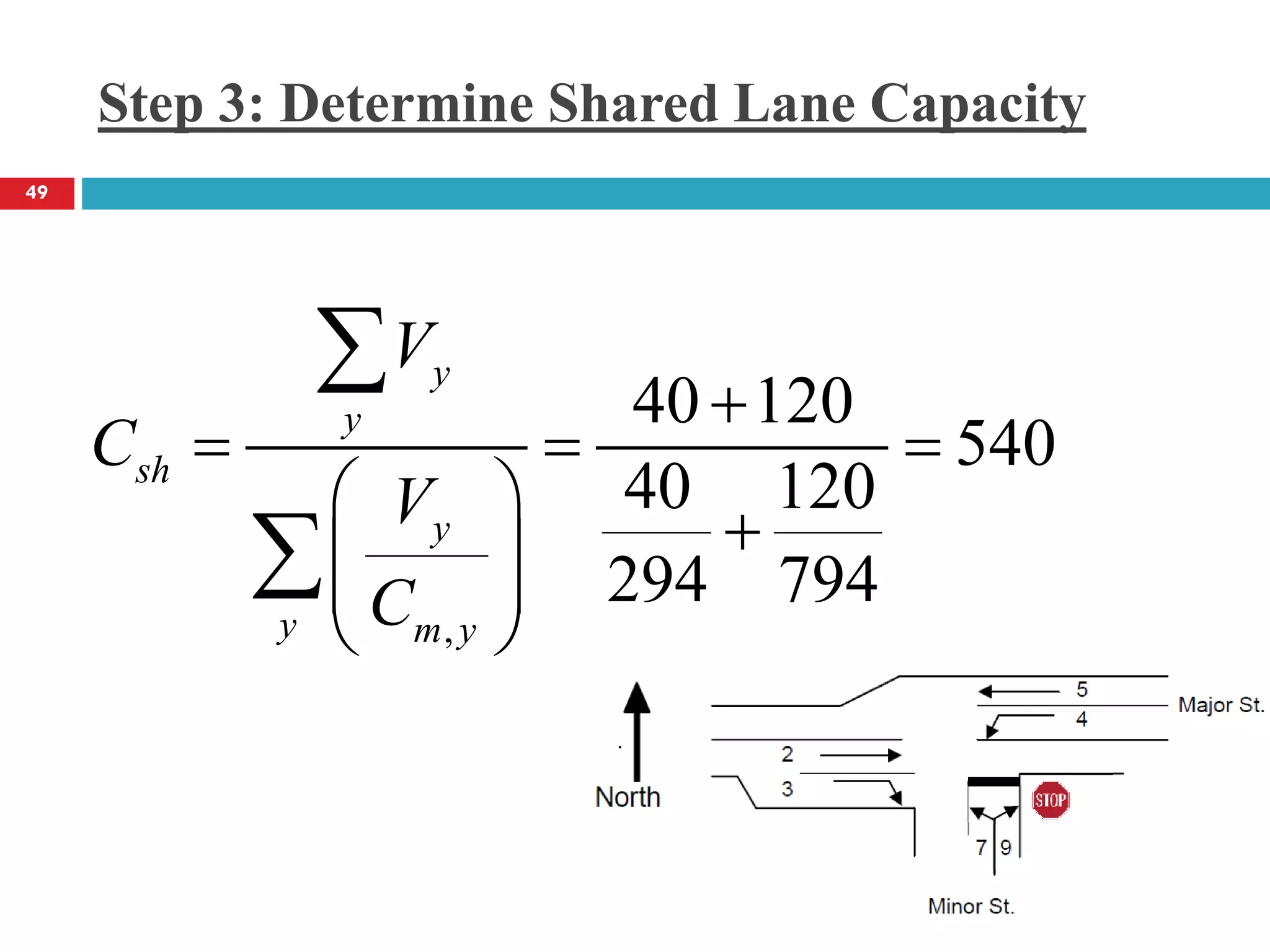
Step 3: Determine Shared Lane Capacity
,
40 120
540
40 120
294 794
y
y
sh
y
y m y
V
C
V
C
+
= =
  +  
 
∑
∑
49
Step 4: Determine Delay
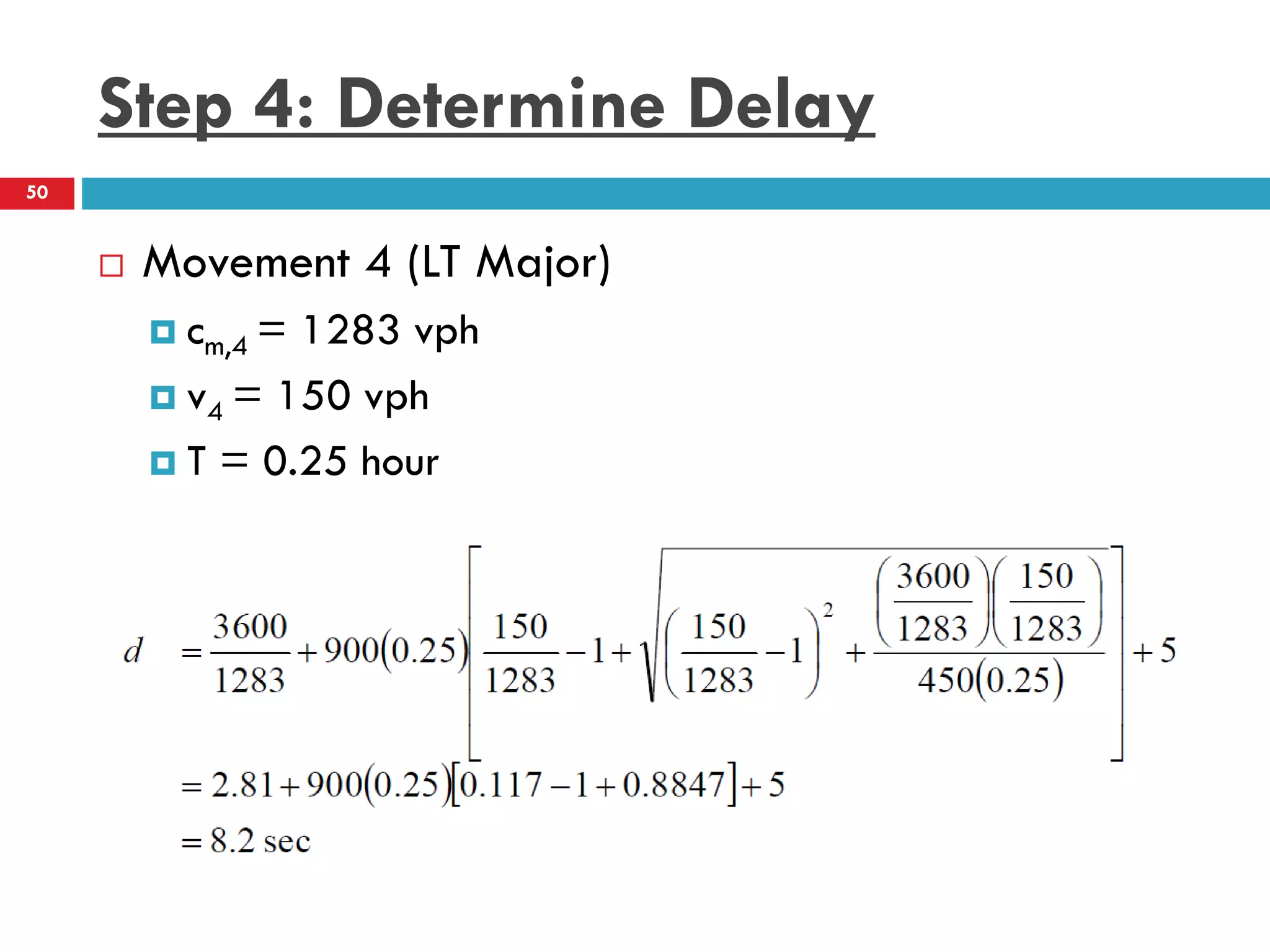
 Movement 4 (LT Major)
 cm,4 = 1283 vph
 v4 = 150 vph
 T = 0.25 hour
50
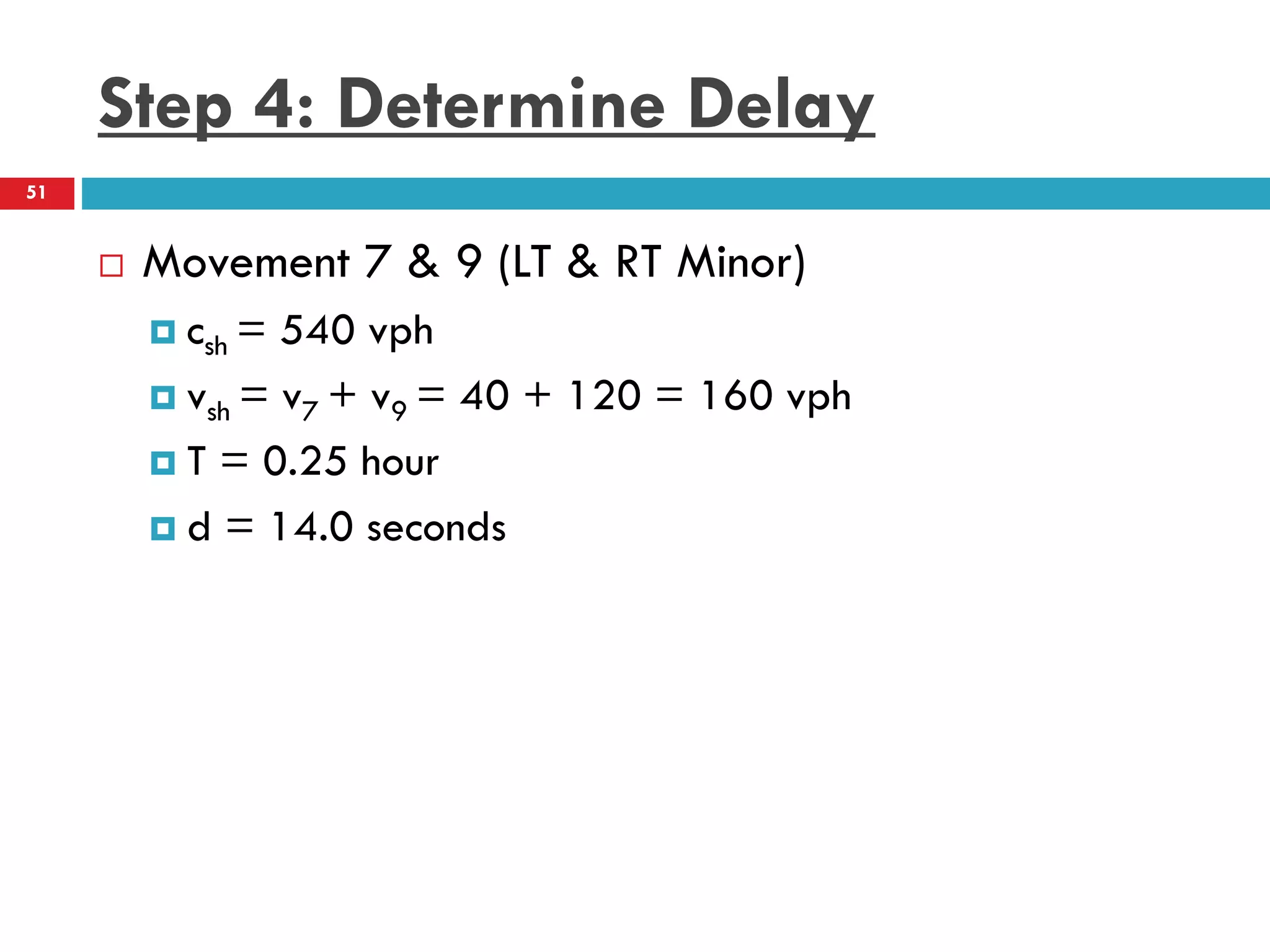
Step 4: Determine Delay
 Movement 7 & 9 (LT & RT Minor)
 csh = 540 vph
 vsh = v7 + v9 = 40 + 120 = 160 vph
 T = 0.25 hour
 d = 14.0 seconds
51
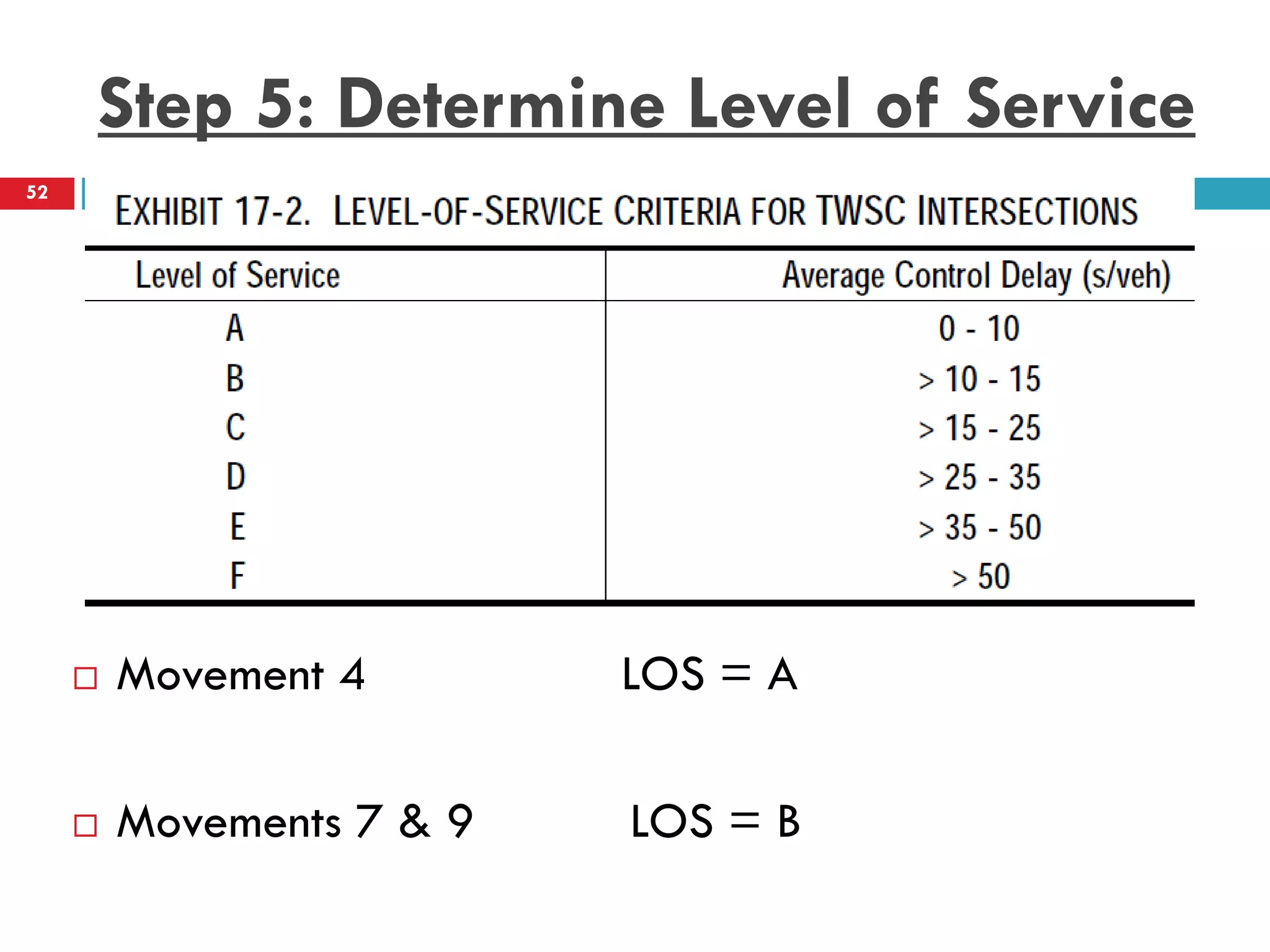
Step 5: Determine Level of Service
 Movement 4 LOS = A
 Movements 7 & 9 LOS = B
52
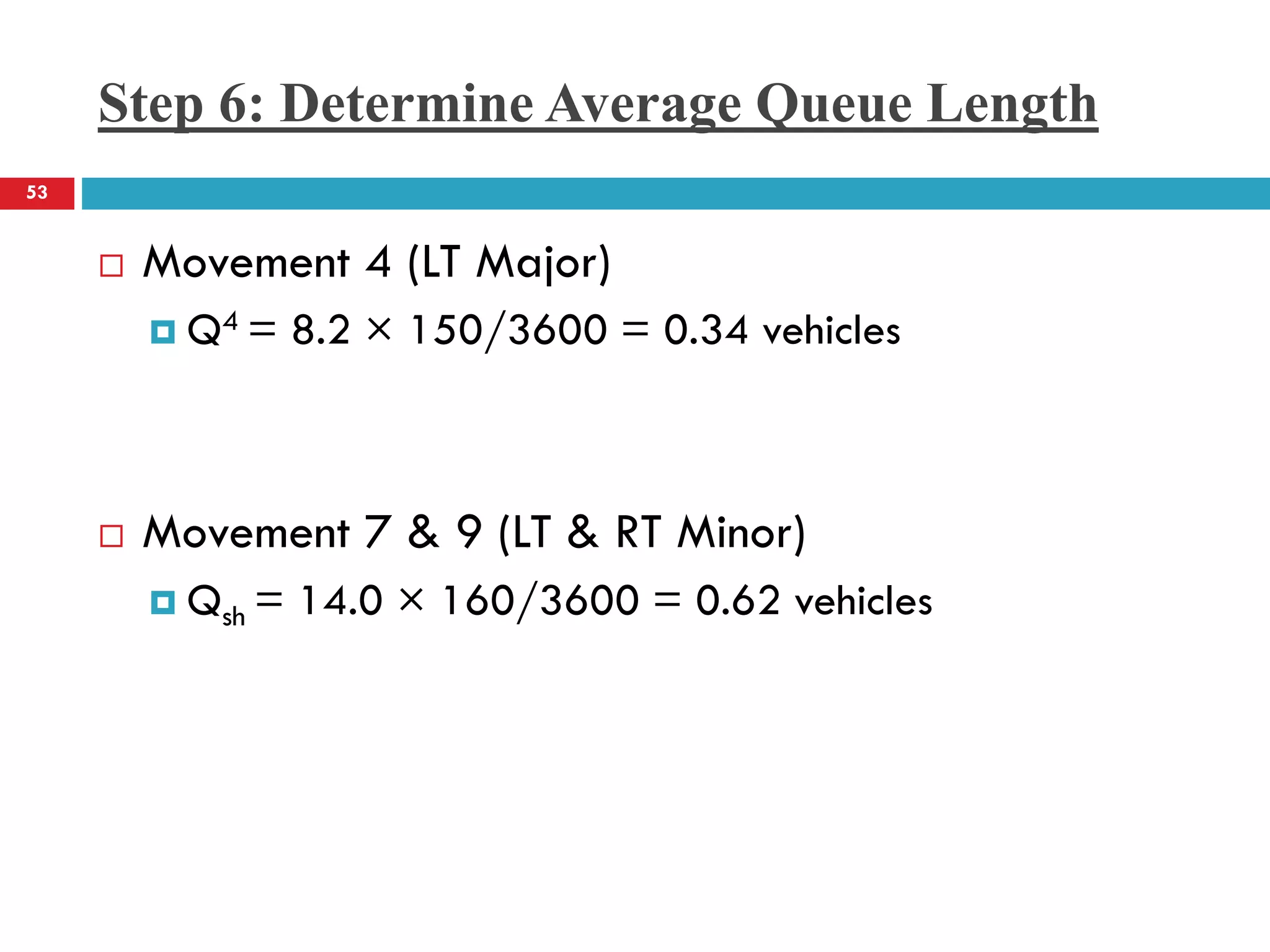
Step 6: Determine Average Queue Length
 Movement 4 (LT Major)
 Q4 = 8.2 × 150/3600 = 0.34 vehicles
 Movement 7 & 9 (LT & RT Minor)
 Qsh = 14.0 × 160/3600 = 0.62 vehicles
53
Home Reading
 Chapter # 17 in HCM 2000
54
Thanks for your time
55

Lecture 04 Capacity for TWSC (Traffic Engineering هندسة المرور & Dr. Usama Shahdah)

  • 1.
    TRAFFIC ENGINEERING COURSE (PWE8322) CAPACITY FOR TWSC Instructor: Usama Elrawy Shahdah, PhDLecture # 04
  • 2.
    Gap Acceptance Theory Gap acceptance theory attempts to provide an analytical framework for modelling the process that drivers implement when they are engaged in making a manoeuvre from a stop controlled minor street across, or onto, an uncontrolled major street.  Vehicle “A” is on the minor street is attempting to cross the major street.  The degree of difficulty that the driver of vehicle “A” faces in completing this manoeuvre successfully depends on 3 factors: 1) The size of the time headway required to complete the manoeuvre, 2) The number and size of time headways that are available in the traffic stream, and 3) The relative priority of the movement the driver is attempting to make relative to all other traffic movements. 2
  • 3.
    Required Gap Size Drivers attempting to cross or enter the major traffic stream must use time gaps that are sufficiently large as to allow the manoeuvre to be completed and to allow for a safety buffer between the lead vehicle and the vehicle making the manoeuvre and between the vehicle making the manoeuvre and its following vehicle.  Vehicle “C” is waiting on the minor street approach to make a left-hand turn onto the major street.  At time T, the driver of vehicle C decides that the time headway between vehicle A and B is sufficient to permit the left turn movement and initiates the manoeuvre. 3
  • 4.
    Required Gap Size(cont.) The size of the time gap required to complete a manoeuvre is a function of many parameters, including: 1) The physical length of vehicle C.  Consider the same time headway between vehicles A and B, but in this case vehicle C is a tractor-trailer.  Even though the truck accelerates at the same rate as vehicle C in previous slide, the length of the truck occupies a greater portion of the roadway and  if vehicle B does not decelerate, there will be a collision. 2) Acceleration capabilities of vehicle C.  A vehicle that accelerates quickly is able to clear the roadway in less time and therefore can safely use a smaller gap than a vehicle that accelerates slowly. 3) Characteristics of the driver of vehicle C.  A cautious driver generally requires a longer gap than a more aggressive driver.  Some drivers are not capable of accurately estimating the gap size, and therefore compensate by requiring longer gaps. 4) Width of the major roadway.  The number of lanes that need to be crossed by vehicle C impacts the size of gap required,  as the gap must be long enough to permit the vehicle to safely clear the conflict zone. 5) The type of manoeuvre being executed.  left turn movement from a minor street requires a longer time gap than does a through movement.  For the left turn movement, vehicle C is merging with a traffic stream and must not "cut off" the following vehicle (vehicle B ) such that a rear-end collision results. 4
  • 5.
    Usefulness of gaps The usefulness of gaps depends on:  whether or not drivers from the minor street will make use of an available gap, and  if they do, how many drivers will complete their manoeuvre in the same gap.  Need to be able to answer two questions: 1) Will drivers be able to use a gap of a specific duration (e.g. 10 seconds)? 2) If drivers are able to use the gap, How many drivers will depart in this gap? 5
  • 6.
    Capacity  The maximumnumber of vehicles that can complete one or more specific manoeuvres (e.g. left turn) from the minor street approach during 1 hour Note: Estimates of delay and queue length can be made on the basis of capacity and the number of vehicles attempting to make the manoeuvre. 6
  • 7.
    Critical gap andfollow-up time  Critical gap (tc) (Critical time headway) : The minimum gap size in the major steert that drivers in the minor street will accept.  Follow-up time (tf):  if the gap is long enough, then more than one vehicle will complete their intended manoeuvre in the gap.  The time required for each non-first vehicle to initiate its manoeuvre and clear the stop line is referred to as the “follow-up time”  Minimum headway between two consecutive vehicles in the minor stream  Critical gap and follow-up time:  varies from driver to driver and  varies for a single driver from situation to situation.  there exist distributions of values for tc and tf  Using distributions complicates the determination of capacity of the minor street approach. 7
  • 8.
    Critical gap andfollow-up time  Assumptions to remove these distributions: 1) Drivers are consistent in that a driver behaves the same way each time she is faced with the same traffic conditions (i.e. drivers do not change behaviour with time). 2) The driver population is homogeneous in that all drivers behave in the same way and have the same gap size requirements (i.e. there is no distribution of driver types).  The errors incurred by these unrealistic assumptions counteract each other and that the resulting total error is small  Assume that tc and tf are constants instead of distributions.  Different constant values of tc and tf are used for :  different minor street movements (e.g. left turn versus a through movement).  different vehicle types (e.g. trucks versus passenger cars) 8
  • 9.
    Estimating tc andtf (using filed data)  field data reflects a range of time headways used by 1, 2, 3, …, n vehicles.  Estimate the mean time gap used by 1 vehicle, the mean gap used by 2 vehicles, etc.  use linear regression to find the single value for tc and tf that best fit the observed data.  Linear Relationship: n = at + b  a: the slope of the line  b: the intercept. 4 6 8 10 12 Gap Size (Sec) Accepted gap by only One Vehicle 9
  • 10.
     The relationshipbetween the number of vehicles using a gap and the gap size is a step function.  tf is the additional time required for another vehicle to use the same gap: tf = 1/a  The critical time headway is the time required for the first vehicle to use a gap.  Step function B reflects the assumption that the regression accounts for variance in driver behaviour and therefore point C represents the critical gap.  For this assumption: tc(B) = t0 + tf  t0 = -b/a (by setting t = 0 and n=0 in n = at + b) 10
  • 11.
    Critical Gap (tc) Step function A reflects an assumption that:  the regression line is a reflection of average driver behaviour but  there is variance in driver behaviour (i.e. some drivers accept gaps less than the gap size associated with point C) and  therefore the critical gap size is assumed to be halfway between points t0 and C.  For this assumption: tc(A) = t0 + 0.5tf  Step function B is more conservative than function A (larger value for tc).  HCM based on the assumptions associated with step function A. 11
  • 12.
  • 13.
    Example:  A gapuse study has collected data for vehicles making a left-hand turn from a stop controlled minor street onto a one- way 1-lane major street.  Time headways were recorded between each pair of consecutive vehicles on the major street and the associated number of minor street vehicles using the gap to make a left turn.  Data were collected for 1,460 vehicles over a period of approximately 1 hour and 45 minutes.  The average gap size associated with each number of vehicles using a gap is shown in the next table 13
  • 14.
    Solution  regression coefficients:a = 0.30 and b = -1.2.  Note: Do not use the data for 0 vehicles using a gap  tf = 1/a = 1/0.30 = 3.3 seconds  t0 = -b/a = -(-1.2)/0.3 = 4 seconds  tc = t0 + 0.5tf = 4 + 0.5*3.3 = 5.65 seconds 14
  • 15.
    Important Note  usingthe data for 0 vehicles using a gap  a = 0.23 and b = -0.64  tf = 4.3 seconds and  tc = 5.0.  These results are incorrect as they are biased by the large number of gaps in which no minor street vehicles were able to make their manoeuvre. 15
  • 16.
    Distribution of GapSizes  Please review lecture # 02  Vehicle Arrival Patterns (Poisson Distribution)  Exponential Distribution of Gaps  Shifted Exponential Distribution of Gaps 16
  • 17.
    Capacity Analysis forTWSC intersections  Capacity of a minor street movement is governed by: 1) The number of gaps in the opposing stream. 2) Size of gaps. 3) Characteristics of drivers use of gaps (i.e. tc and tf) 4) Priority to use suitable gaps. 17
  • 18.
    Interaction of TwoTraffic Streams  Cx = capacity of minor street movement x (vph) 18
  • 19.
    Example:  Consider theintersection of two one-way streets.  Find the capacity of the minor street in vph.  λmajor = 900 vph = 0.25 veh/second;  (average headway) = 4 seconds per vehicle  tc = 8 seconds; tf = 4 seconds ̅𝑡𝑡 19
  • 20.
  • 21.
    Solution A Number ofvehicles using the associated gap B Minimum gap size required for n vehicles to complete manoeuvre C Calculation of exponent term for the exponential distribution D Probability that headway is larger than the minimum from column B E Probability that headway permits exactly n vehicles to complete their manoeuvre F Number of gaps per hour that permit exactly n vehicles to complete their manoeuvres G Number of minor street vehicles per hour that complete their manoeuvres using the associated gap size 21
  • 22.
    Interaction of MoreThan Two streams  If streams are independent of each other, then  the probability of finding a suitable gap in both streams simultaneously is equal to  the product of the probability of finding a suitable gap in each stream individually. 22
  • 23.
    Priority of trafficstreams  When calculating the capacity of movements for an intersection with more than two traffic streams, one must consider the rank/priority of that movement  For North America the HCM is the standard commonly used for TWSC analysis  Exhibit 17-3 illustrates the ranks of the different possible intersection movements 23
  • 24.
  • 25.
  • 26.
    Example  tc =8 seconds; tf = 4 seconds for both minor street movements.  λ 2 = 900 vph; λ9 = 100 vph; λ10 = 60 vph.  Determine:  (a) the capacity of movement 9 and  (b) the capacity of movement 10. 26
  • 27.
    Solution: part (a) Movement 9 must yield right of way to movement 2 only  capacity is a function of λ2 and not λ10.  The opposing volume of 900 vph and the critical gap and follow up times are the same as used in the previous example,  capacity of movement 9 = 192 vph. 27
  • 28.
    Solution: part (b) The capacity of movement 10 ≠ 192 vph because  movement 9 uses some of the available gaps making them unavailable for movement 10.  We call this effect “impedance”.  The magnitude of this effect depends on the arrival rate and capacity of higher ranked movements.  The probability that a vehicle attempting to make movement 9 will be waiting for a gap can be estimated as  the ratio of the demand for gaps by vehicles making movement 9 (i.e. λ9) and the capacity associated with movement 9 (cm,9).  Therefore, the probability that there is no vehicle waiting to make movement 9 (P0,9 ) when a gap becomes available for a vehicle making movement 10 is: 28
  • 29.
     P0,9 =probability that there is no queue waiting to make movement 9  λ9 = arrival rate for movement 9 (vph)  cm,9 = capacity of movement 9 (vph)  The potential capacity (cp) of movement 10 = 192 vph, since this is the capacity if none of the available gaps were used by vehicles of movement 9.  The actual movement capacity must include the impedance effect and is computed as  cm,10 = 192 vph x 0.48 = 92 vph. 29
  • 30.
    HCM equation fordetermining capacity 30
  • 31.
  • 32.
  • 33.
  • 34.
    Conflicting volumes (HCM2000)  [1] If there is a right-turn lane on the major street, v3 or v6 should not be considered.  [2] If there is more than one lane on the major street, the flow rates in the right lane are assumed to be v2/N or v5/N, where N is the number of through lanes. The user can specify a different lane distribution if field data are available.  [3] If right-turning traffic from the major road is separated by a triangular island and has to comply with a yield or stop sign, v6 and v3 need not be considered.  [4] If right-turning traffic from the minor road is separated by a triangular island and has to comply with a yield or stop sign, v9 and v12 need not be considered.  [5] Omit v9 and v12 for multilane sites, or use one-half their values if the minor approach is flared.  [6] Omit the farthest right-turn v3 for subject movement 10 or v6 for subject movement 7 if the major street is multilane. 34
  • 35.
  • 36.
    HCM critical gapequation 36
  • 37.
    HCM follow-up timeequation 37
  • 38.
    Adjustments on tcand tf Adjustment Values tcHV 1.0, Two-lane major street 2.0, Four-lane major street tcG 0.1, Movements 9 and 12 0.2, Movements 7, 8, 10 and 11 1.0, Otherwise tcT 1.0, With two stage process 0.0, With single stage process t3LT 0.7, Minor-street LT at T-intersection 0.0, Otherwise tfHV 0.9, Two-lane major street 1.0, Four-lane major street LTcTcGHVcHVcbc ttGtPttt 3−−++= HVfHVfbf Pttt += 38
  • 39.
  • 40.
    Considering Impedance  Thenthe capacity for the Rank 3 movement is computed as  Rank 3 movements 40
  • 41.
  • 42.
  • 43.
  • 44.
  • 45.
    Example  Consider thethree-leg intersection illustrated below. Determine the average control delay and the resulting level of service for the minor street approach.  Assume:  no heavy vehicles,  no pedestrians, and  all approaches are level (i.e. 0% grade).  Assume an evaluation time period of 15 minutes and that  the major street can be considered to be a two-lane roadway. 45
  • 46.
    Solution  We beginthe analysis by denoted the rank of each movement as follows:  Rank Movement  Rank 1: 2, 3, 5  Rank 2: 4, 9  Rank 3: 7 46
  • 47.
    Step 1: Rank2 movements  RT from Minor Street (9)  Note: Separate right turn lane on major street therefore don’t include v3.  vc,9 = 250 vph  tc,9 = 6.2 seconds  tf,9 = 3.3 seconds  cp,9 = 794 vph  cm,9 = 794 vph  LT from Major Street (4)  vc,4 = v3 +v2 = 40 + 250 = 290 vph  tc,4 = 4.1 seconds  tf,4 = 2.2 seconds  cp,4 = 1283 vph  cm,4 = 1283 vph t t t t 47
  • 48.
    Step 2: Rank3 movements  LT from Minor Street (7)  Note that a separate turning lane is provided for movement 3, therefore v3 need not be included when calculating vc,7.  vc,7 = v2 +v5 + 2v4= 250 + 300 + 2(150) = 850 vph  tc,4 = 7.1 – 0.7 = 6.4 seconds (Adjustment for T intersection)  tf,4 = 3.5 seconds  cp,4 = 334 vph  Must consider impedance created by Major Street LT vehicles.  Normally, the minor street LT movement (7) is rank 4 and must consider the impedance impacts from all higher priority streams including 1, 4, and 11.  However, for a T-intersection, movement 7 is rank 3 and is impeded only by movement 4 (LT from major street).  f7 = 1 – v4/cm,4 = 1 – 150/1283 = 0.88  cm,7 = cm,7 × f7 = 334 × 0.88 = 294 vph 48
  • 49.
    Step 3: DetermineShared Lane Capacity , 40 120 540 40 120 294 794 y y sh y y m y V C V C + = =   +     ∑ ∑ 49
  • 50.
    Step 4: DetermineDelay  Movement 4 (LT Major)  cm,4 = 1283 vph  v4 = 150 vph  T = 0.25 hour 50
  • 51.
    Step 4: DetermineDelay  Movement 7 & 9 (LT & RT Minor)  csh = 540 vph  vsh = v7 + v9 = 40 + 120 = 160 vph  T = 0.25 hour  d = 14.0 seconds 51
  • 52.
    Step 5: DetermineLevel of Service  Movement 4 LOS = A  Movements 7 & 9 LOS = B 52
  • 53.
    Step 6: DetermineAverage Queue Length  Movement 4 (LT Major)  Q4 = 8.2 × 150/3600 = 0.34 vehicles  Movement 7 & 9 (LT & RT Minor)  Qsh = 14.0 × 160/3600 = 0.62 vehicles 53
  • 54.
    Home Reading  Chapter# 17 in HCM 2000 54
  • 55.