
Aman Bathla
(A.P.)
Review of Syllabus
Unit – II
Part - I
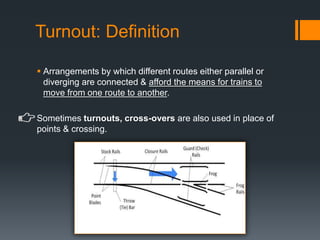
Turnout: Definition
 Arrangements by which different routes either parallel or
diverging are connected & afford the means for trains to
move from one route to another.
Sometimes turnouts, cross-overs are also used in place of
points & crossing.
Turnout: Necessity
 The direction of movement & the diversion of the vehicles to
the another track are controlled automatically by wheel
flanges rather than the driver as in case of roads.
 Provide flexibility of movement y connecting one line to
another.
 Impose restrictions over turnouts to retard the movement.
Turnout: Types
 The simplest combination of points & crossings which
enables one track to take off from another track.
Depending upon the direction of movements of trains from
main track; turnout are classified as
Left hand turnout
Right hand turnout
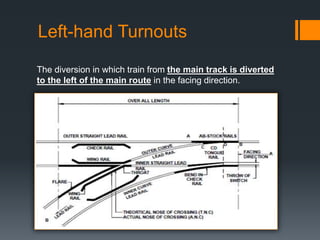
Left-hand Turnouts
The diversion in which train from the main track is diverted
to the left of the main route in the facing direction.
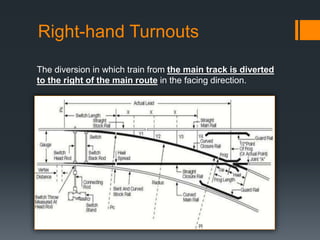
Right-hand Turnouts
The diversion in which train from the main track is diverted
to the right of the main route in the facing direction.
Turnout: Working Principle
 Turnout works with the combination of Points & crossings.
This consist of mainly a pair of points or switches, Four Lead
Rails, two check Rails & crossing.
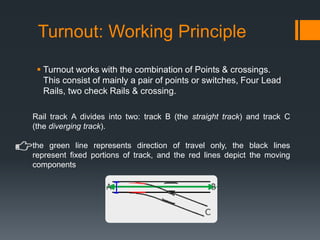
Rail track A divides into two: track B (the straight track) and track C
(the diverging track).
the green line represents direction of travel only, the black lines
represent fixed portions of track, and the red lines depict the moving
components
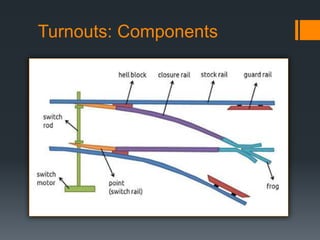
Turnouts: Components
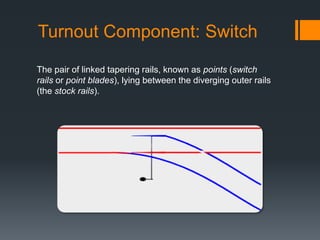
Turnout Component: Switch
The pair of linked tapering rails, known as points (switch
rails or point blades), lying between the diverging outer rails
(the stock rails).
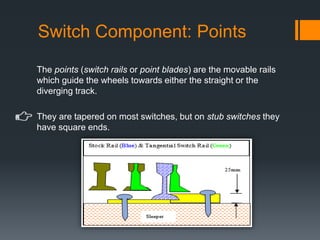
Switch Component: Points
The points (switch rails or point blades) are the movable rails
which guide the wheels towards either the straight or the
diverging track.
They are tapered on most switches, but on stub switches they
have square ends.
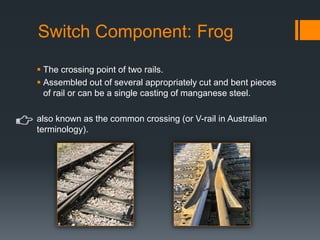
Switch Component: Frog
 The crossing point of two rails.
 Assembled out of several appropriately cut and bent pieces
of rail or can be a single casting of manganese steel.
also known as the common crossing (or V-rail in Australian
terminology).
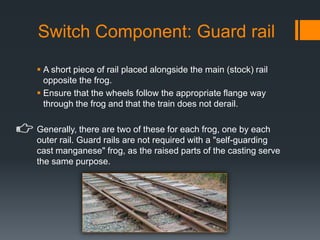
Switch Component: Guard rail
 A short piece of rail placed alongside the main (stock) rail
opposite the frog.
 Ensure that the wheels follow the appropriate flange way
through the frog and that the train does not derail.
Generally, there are two of these for each frog, one by each
outer rail. Guard rails are not required with a "self-guarding
cast manganese" frog, as the raised parts of the casting serve
the same purpose.
Other Switch Components
 Stock Rails (The main rails of the track)
 Tongue Rails (lie between two stock rails & are tapered to a
point)
 Heel Blocks (blocks inserted between the heel of the
tongue rail & stock rail)
 Distance Block (block to provide distance between running
rail & check rail)
 Stretcher Bar (bar through which the tongue rails are
connected together)
Important terms in Switches
 Heel Clearance/ Divergence
Distance between the running faces of stock rail & tongue rail
 Switch Angle
Angle between running faces of the stock rail & tongue rail
 Throw of Switch
Distance through which the toe of the tongue rail moves
sideway
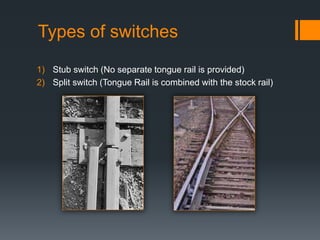
Types of switches
1) Stub switch (No separate tongue rail is provided)
2) Split switch (Tongue Rail is combined with the stock rail)
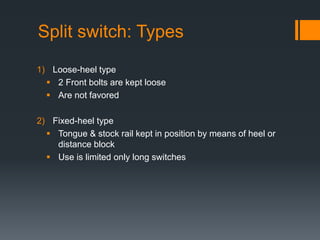
Split switch: Types
1) Loose-heel type
 2 Front bolts are kept loose
 Are not favored
2) Fixed-heel type
 Tongue & stock rail kept in position by means of heel or
distance block
 Use is limited only long switches
Crossing & its requirements
Device to permit vehicles moving along one track to cross the
another track.
Requirements
 A side plate should be provided for connecting the point &
splice rails. ( Turned bolts should be used for this
connection)
 The foot-flanges of the wing rail should be riveted to the
plate.
 Alloy steel for light traffic & high manganese steel should be
used on crossing
 Crossing should be rigid.
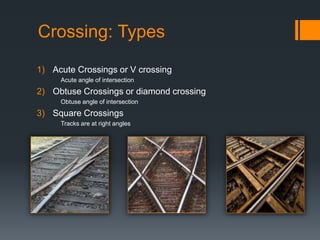
Crossing: Types
1) Acute Crossings or V crossing
Acute angle of intersection
2) Obtuse Crossings or diamond crossing
Obtuse angle of intersection
3) Square Crossings
Tracks are at right angles
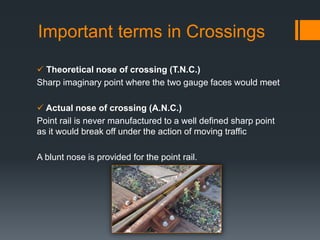
Important terms in Crossings
 Theoretical nose of crossing (T.N.C.)
Sharp imaginary point where the two gauge faces would meet
 Actual nose of crossing (A.N.C.)
Point rail is never manufactured to a well defined sharp point
as it would break off under the action of moving traffic
A blunt nose is provided for the point rail.
Track Junction
Combinations of points and crossings, with curves &
straights to transfer trains from one track to another
Important track junctions
 Three throw switch
 Diamond crossing
 Cross over
 Single & double slip
 Triangle
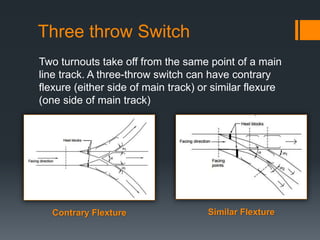
Three throw Switch
Two turnouts take off from the same point of a main
line track. A three-throw switch can have contrary
flexure (either side of main track) or similar flexure
(one side of main track)
Contrary Flexture Similar Flexture
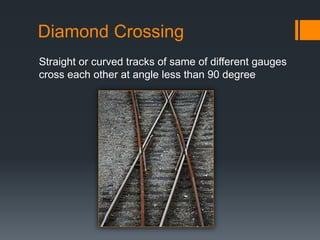
Diamond Crossing
Straight or curved tracks of same of different gauges
cross each other at angle less than 90 degree
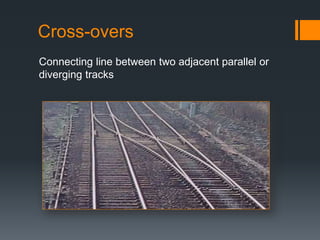
Cross-overs
Connecting line between two adjacent parallel or
diverging tracks
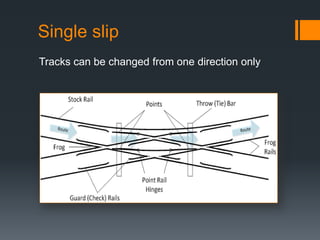
Single slip
Tracks can be changed from one direction only
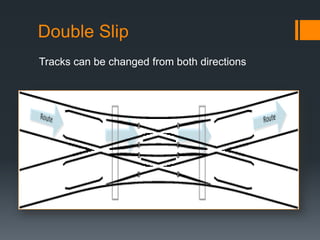
Double Slip
Tracks can be changed from both directions
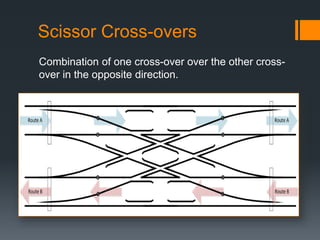
Scissor Cross-overs
Combination of one cross-over over the other cross-
over in the opposite direction.
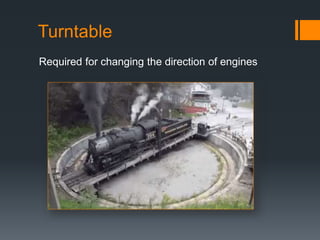
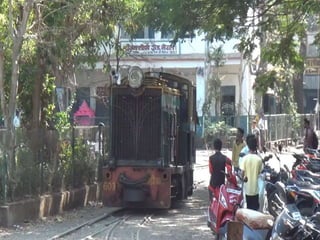
Turntable
Required for changing the direction of engines
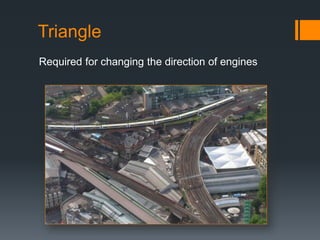
Triangle
Required for changing the direction of engines
Do you have Any Question?

Railway Engineering: Points and crossings

  • 1.
  • 2.
    Review of Syllabus Unit– II Part - I
  • 3.
    Turnout: Definition  Arrangementsby which different routes either parallel or diverging are connected & afford the means for trains to move from one route to another. Sometimes turnouts, cross-overs are also used in place of points & crossing.
  • 4.
    Turnout: Necessity  Thedirection of movement & the diversion of the vehicles to the another track are controlled automatically by wheel flanges rather than the driver as in case of roads.  Provide flexibility of movement y connecting one line to another.  Impose restrictions over turnouts to retard the movement.
  • 5.
    Turnout: Types  Thesimplest combination of points & crossings which enables one track to take off from another track. Depending upon the direction of movements of trains from main track; turnout are classified as Left hand turnout Right hand turnout
  • 6.
    Left-hand Turnouts The diversionin which train from the main track is diverted to the left of the main route in the facing direction.
  • 7.
    Right-hand Turnouts The diversionin which train from the main track is diverted to the right of the main route in the facing direction.
  • 8.
    Turnout: Working Principle Turnout works with the combination of Points & crossings. This consist of mainly a pair of points or switches, Four Lead Rails, two check Rails & crossing. Rail track A divides into two: track B (the straight track) and track C (the diverging track). the green line represents direction of travel only, the black lines represent fixed portions of track, and the red lines depict the moving components
  • 9.
  • 10.
    Turnout Component: Switch Thepair of linked tapering rails, known as points (switch rails or point blades), lying between the diverging outer rails (the stock rails).
  • 11.
    Switch Component: Points Thepoints (switch rails or point blades) are the movable rails which guide the wheels towards either the straight or the diverging track. They are tapered on most switches, but on stub switches they have square ends.
  • 12.
    Switch Component: Frog The crossing point of two rails.  Assembled out of several appropriately cut and bent pieces of rail or can be a single casting of manganese steel. also known as the common crossing (or V-rail in Australian terminology).
  • 13.
    Switch Component: Guardrail  A short piece of rail placed alongside the main (stock) rail opposite the frog.  Ensure that the wheels follow the appropriate flange way through the frog and that the train does not derail. Generally, there are two of these for each frog, one by each outer rail. Guard rails are not required with a "self-guarding cast manganese" frog, as the raised parts of the casting serve the same purpose.
  • 14.
    Other Switch Components Stock Rails (The main rails of the track)  Tongue Rails (lie between two stock rails & are tapered to a point)  Heel Blocks (blocks inserted between the heel of the tongue rail & stock rail)  Distance Block (block to provide distance between running rail & check rail)  Stretcher Bar (bar through which the tongue rails are connected together)
  • 15.
    Important terms inSwitches  Heel Clearance/ Divergence Distance between the running faces of stock rail & tongue rail  Switch Angle Angle between running faces of the stock rail & tongue rail  Throw of Switch Distance through which the toe of the tongue rail moves sideway
  • 16.
    Types of switches 1)Stub switch (No separate tongue rail is provided) 2) Split switch (Tongue Rail is combined with the stock rail)
  • 17.
    Split switch: Types 1)Loose-heel type  2 Front bolts are kept loose  Are not favored 2) Fixed-heel type  Tongue & stock rail kept in position by means of heel or distance block  Use is limited only long switches
  • 18.
    Crossing & itsrequirements Device to permit vehicles moving along one track to cross the another track. Requirements  A side plate should be provided for connecting the point & splice rails. ( Turned bolts should be used for this connection)  The foot-flanges of the wing rail should be riveted to the plate.  Alloy steel for light traffic & high manganese steel should be used on crossing  Crossing should be rigid.
  • 19.
    Crossing: Types 1) AcuteCrossings or V crossing Acute angle of intersection 2) Obtuse Crossings or diamond crossing Obtuse angle of intersection 3) Square Crossings Tracks are at right angles
  • 20.
    Important terms inCrossings  Theoretical nose of crossing (T.N.C.) Sharp imaginary point where the two gauge faces would meet  Actual nose of crossing (A.N.C.) Point rail is never manufactured to a well defined sharp point as it would break off under the action of moving traffic A blunt nose is provided for the point rail.
  • 21.
    Track Junction Combinations ofpoints and crossings, with curves & straights to transfer trains from one track to another Important track junctions  Three throw switch  Diamond crossing  Cross over  Single & double slip  Triangle
  • 22.
    Three throw Switch Twoturnouts take off from the same point of a main line track. A three-throw switch can have contrary flexure (either side of main track) or similar flexure (one side of main track) Contrary Flexture Similar Flexture
  • 23.
    Diamond Crossing Straight orcurved tracks of same of different gauges cross each other at angle less than 90 degree
  • 24.
    Cross-overs Connecting line betweentwo adjacent parallel or diverging tracks
  • 25.
    Single slip Tracks canbe changed from one direction only
  • 26.
    Double Slip Tracks canbe changed from both directions
  • 27.
    Scissor Cross-overs Combination ofone cross-over over the other cross- over in the opposite direction.
  • 28.
    Turntable Required for changingthe direction of engines
  • 29.
    Triangle Required for changingthe direction of engines
  • 31.
    Do you haveAny Question?