Topic curves
BUET-K/Uthal Campus
Topic will be covers
Introduction of curves
Types of curves
Applications of curve
Design and layout of curves
Curves
are defined as arcs, with some finite radius, provided
between intersecting straights to gradually negotiate a
change in direction. This change in direction of the
straights may be in a horizontal or vertical plane,
resulting in the provision of a horizontal or vertical curve
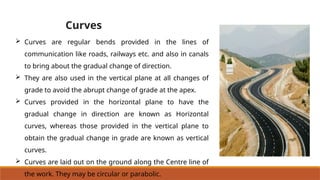
 Curves are regular bends provided in the lines of
communication like roads, railways etc. and also in canals
to bring about the gradual change of direction.
 They are also used in the vertical plane at all changes of
grade to avoid the abrupt change of grade at the apex.
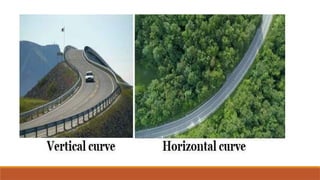
 Curves provided in the horizontal plane to have the
gradual change in direction are known as Horizontal
curves, whereas those provided in the vertical plane to
obtain the gradual change in grade are known as vertical
curves.
 Curves are laid out on the ground along the Centre line of
the work. They may be circular or parabolic.
Curves
Mainly curves are two types
1. Horizontal curve
2. Vertical curve
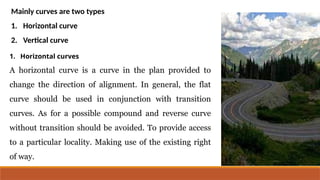
1. Horizontal curves
A horizontal curve is a curve in the plan provided to
change the direction of alignment. In general, the flat
curve should be used in conjunction with transition
curves. As for a possible compound and reverse curve
without transition should be avoided. To provide access
to a particular locality. Making use of the existing right
of way.
Types of Horizontal curves
•Simple curve
•Compound curve.
•Reverse curve.
•Transition curve.
•Lemniscate curve
•Spiral curve
•Cubic parabolic curve
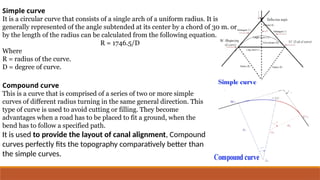
Simple curve
It is a circular curve that consists of a single arch of a uniform radius. It is
generally represented of the angle subtended at its center by a chord of 30 m. or
by the length of the radius can be calculated from the following equation.
R = 1746.5/D
Where
R = radius of the curve.
D = degree of curve.
Compound curve
This is a curve that is comprised of a series of two or more simple
curves of different radius turning in the same general direction. This
type of curve is used to avoid cutting or filling. They become
advantages when a road has to be placed to fit a ground, when the
bend has to follow a specified path.
It is used to provide the layout of canal alignment, Compound
curves perfectly fits the topography comparatively better than
the simple curves.
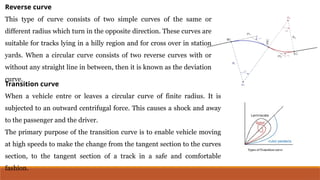
Reverse curve
This type of curve consists of two simple curves of the same or
different radius which turn in the opposite direction. These curves are
suitable for tracks lying in a hilly region and for cross over in station
yards. When a circular curve consists of two reverse curves with or
without any straight line in between, then it is known as the deviation
curve.
Transition curve
When a vehicle entre or leaves a circular curve of finite radius. It is
subjected to an outward centrifugal force. This causes a shock and away
to the passenger and the driver.
The primary purpose of the transition curve is to enable vehicle moving
at high speeds to make the change from the tangent section to the curves
section, to the tangent section of a track in a safe and comfortable
fashion.
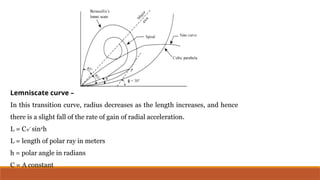
Lemniscate curve –
In this transition curve, radius decreases as the length increases, and hence
there is a slight fall of the rate of gain of radial acceleration.
L = C sin
✓ 2
h
L = length of polar ray in meters
h = polar angle in radians
C = A constant
Spiral curve –
This an ideal transition curve. The radius of this curve is inversely
proportional to length traversed. Hence the rate of change of acceleration in
this curve is uniform throughout its length.
Cubic parabolic curve –
In this case of curve the rate of decrease curvature is much low for deflection
angles 4° to 9° but beyond 9° there is a rapid increase in the radius of
curvature.
Y = X3
/(6RL)
Y = coordinate of any point
R = radius
L= length of curve
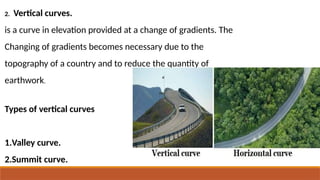
2. Vertical curves.
is a curve in elevation provided at a change of gradients. The
Changing of gradients becomes necessary due to the
topography of a country and to reduce the quantity of
earthwork.
Types of vertical curves
1.Valley curve.
2.Summit curve.
Summit curve
1. A positive grade meets a negative grade,
2. A positive grade meets another milder positive graded,
3. A positive grade meets a level straight,
4. A negative grade meets a Steeper negative grade.
The centrifugal force generated by the movement of a vehicle along a
summit curve acts in a direction opposite to the direction in which it’s
weight acts.
Valley curve
1.A negative grade meets a positive grades,
2.A negative grade meets a milder negative grade,
3.A negative grade meets a level stretch,
4.A negative grade meets a Steeper positive grade.
The centrifugal force generated by the vehicle moving on a
valley curve acts in the same direction as the weight of vehicle.
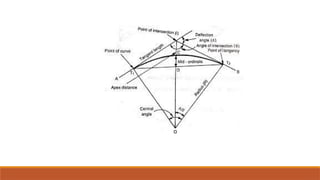
ELEMENTS OF A SIMPLE CURVE
Point of Intersection (PI)
The point of intersection marks the point
where the back and forward tangents
intersect. The surveyor indicates it as one of
the stations on the preliminary traverse.
Intersecting Angle (I)
The intersecting angle is the deflection
angle at the PI. The surveyor either
computes its value from the preliminary
traverse station angles or measures it in the
field.
Radius (R)
The radius is the curvature of circle,
Which is the curve of an arc.
Point of Curvature (PC)
The point of curvature is the point where the circular curve
begins. The back tangent is tangent to the curve at this point.
Point of Tangency (PT)
The point of tangency is the end of the curve. The forward
tangent is tangent to the curve at this point.
Length of Curve (L)
The length of curve is the distance from the PC to the PT
measured along the curve.
Tangent Distance (T)
The tangent distance is the distance along the tangents from the
PI to the PC or PT. These distances are equal on a simple curve.
Central Angle (Δ)
The central angle is the angle formed by two radii drawn from
the center of the circle (0) to the PC and PT. The central angle is
equal in value to the I angle.
.
Long Chord (LC)
The long chord is the chord from the PC to the PT.
External Distance (E)
The external distance is the distance from the PI to the midpoint of the curve.
The external distance bisects the interior angle at the PI.
Middle Ordinate (M)
The middle ordinate is the distance from the midpoint of the curve to the
midpoint of the long chord. The extension of the middle ordinate bisects the
central angle.
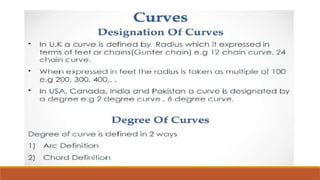
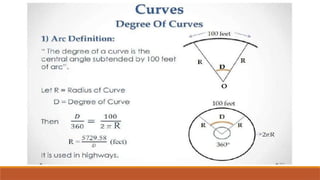
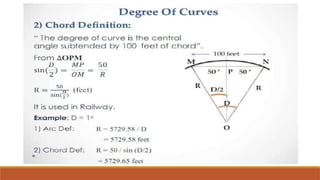
Degree of Curve (D)
The degree of curve defines the “sharpness” or “flatness” of the curve. There
are two definitions commonly in use for degree of curve, the arc definition and
the chord definition.
CURVES.pptx surveying engineerings based on survey

CURVES.pptx surveying engineerings based on survey

  • 1.
  • 2.
    Topic will becovers Introduction of curves Types of curves Applications of curve Design and layout of curves
  • 3.
    Curves are defined asarcs, with some finite radius, provided between intersecting straights to gradually negotiate a change in direction. This change in direction of the straights may be in a horizontal or vertical plane, resulting in the provision of a horizontal or vertical curve
  • 4.
     Curves areregular bends provided in the lines of communication like roads, railways etc. and also in canals to bring about the gradual change of direction.  They are also used in the vertical plane at all changes of grade to avoid the abrupt change of grade at the apex.  Curves provided in the horizontal plane to have the gradual change in direction are known as Horizontal curves, whereas those provided in the vertical plane to obtain the gradual change in grade are known as vertical curves.  Curves are laid out on the ground along the Centre line of the work. They may be circular or parabolic. Curves
  • 6.
    Mainly curves aretwo types 1. Horizontal curve 2. Vertical curve 1. Horizontal curves A horizontal curve is a curve in the plan provided to change the direction of alignment. In general, the flat curve should be used in conjunction with transition curves. As for a possible compound and reverse curve without transition should be avoided. To provide access to a particular locality. Making use of the existing right of way.
  • 7.
    Types of Horizontalcurves •Simple curve •Compound curve. •Reverse curve. •Transition curve. •Lemniscate curve •Spiral curve •Cubic parabolic curve
  • 8.
    Simple curve It isa circular curve that consists of a single arch of a uniform radius. It is generally represented of the angle subtended at its center by a chord of 30 m. or by the length of the radius can be calculated from the following equation. R = 1746.5/D Where R = radius of the curve. D = degree of curve. Compound curve This is a curve that is comprised of a series of two or more simple curves of different radius turning in the same general direction. This type of curve is used to avoid cutting or filling. They become advantages when a road has to be placed to fit a ground, when the bend has to follow a specified path. It is used to provide the layout of canal alignment, Compound curves perfectly fits the topography comparatively better than the simple curves.
  • 9.
    Reverse curve This typeof curve consists of two simple curves of the same or different radius which turn in the opposite direction. These curves are suitable for tracks lying in a hilly region and for cross over in station yards. When a circular curve consists of two reverse curves with or without any straight line in between, then it is known as the deviation curve. Transition curve When a vehicle entre or leaves a circular curve of finite radius. It is subjected to an outward centrifugal force. This causes a shock and away to the passenger and the driver. The primary purpose of the transition curve is to enable vehicle moving at high speeds to make the change from the tangent section to the curves section, to the tangent section of a track in a safe and comfortable fashion.
  • 10.
    Lemniscate curve – Inthis transition curve, radius decreases as the length increases, and hence there is a slight fall of the rate of gain of radial acceleration. L = C sin ✓ 2 h L = length of polar ray in meters h = polar angle in radians C = A constant
  • 11.
    Spiral curve – Thisan ideal transition curve. The radius of this curve is inversely proportional to length traversed. Hence the rate of change of acceleration in this curve is uniform throughout its length. Cubic parabolic curve – In this case of curve the rate of decrease curvature is much low for deflection angles 4° to 9° but beyond 9° there is a rapid increase in the radius of curvature. Y = X3 /(6RL) Y = coordinate of any point R = radius L= length of curve
  • 12.
    2. Vertical curves. isa curve in elevation provided at a change of gradients. The Changing of gradients becomes necessary due to the topography of a country and to reduce the quantity of earthwork. Types of vertical curves 1.Valley curve. 2.Summit curve.
  • 13.
    Summit curve 1. Apositive grade meets a negative grade, 2. A positive grade meets another milder positive graded, 3. A positive grade meets a level straight, 4. A negative grade meets a Steeper negative grade. The centrifugal force generated by the movement of a vehicle along a summit curve acts in a direction opposite to the direction in which it’s weight acts.
  • 14.
    Valley curve 1.A negativegrade meets a positive grades, 2.A negative grade meets a milder negative grade, 3.A negative grade meets a level stretch, 4.A negative grade meets a Steeper positive grade. The centrifugal force generated by the vehicle moving on a valley curve acts in the same direction as the weight of vehicle.
  • 15.
    ELEMENTS OF ASIMPLE CURVE Point of Intersection (PI) The point of intersection marks the point where the back and forward tangents intersect. The surveyor indicates it as one of the stations on the preliminary traverse. Intersecting Angle (I) The intersecting angle is the deflection angle at the PI. The surveyor either computes its value from the preliminary traverse station angles or measures it in the field. Radius (R) The radius is the curvature of circle, Which is the curve of an arc.
  • 16.
    Point of Curvature(PC) The point of curvature is the point where the circular curve begins. The back tangent is tangent to the curve at this point. Point of Tangency (PT) The point of tangency is the end of the curve. The forward tangent is tangent to the curve at this point. Length of Curve (L) The length of curve is the distance from the PC to the PT measured along the curve. Tangent Distance (T) The tangent distance is the distance along the tangents from the PI to the PC or PT. These distances are equal on a simple curve. Central Angle (Δ) The central angle is the angle formed by two radii drawn from the center of the circle (0) to the PC and PT. The central angle is equal in value to the I angle.
  • 17.
    . Long Chord (LC) Thelong chord is the chord from the PC to the PT. External Distance (E) The external distance is the distance from the PI to the midpoint of the curve. The external distance bisects the interior angle at the PI. Middle Ordinate (M) The middle ordinate is the distance from the midpoint of the curve to the midpoint of the long chord. The extension of the middle ordinate bisects the central angle. Degree of Curve (D) The degree of curve defines the “sharpness” or “flatness” of the curve. There are two definitions commonly in use for degree of curve, the arc definition and the chord definition.