Anatomical Position
Introduction to Anatomy
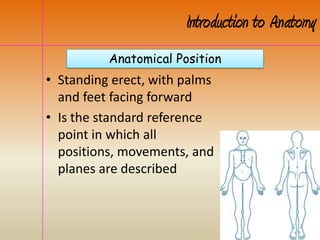
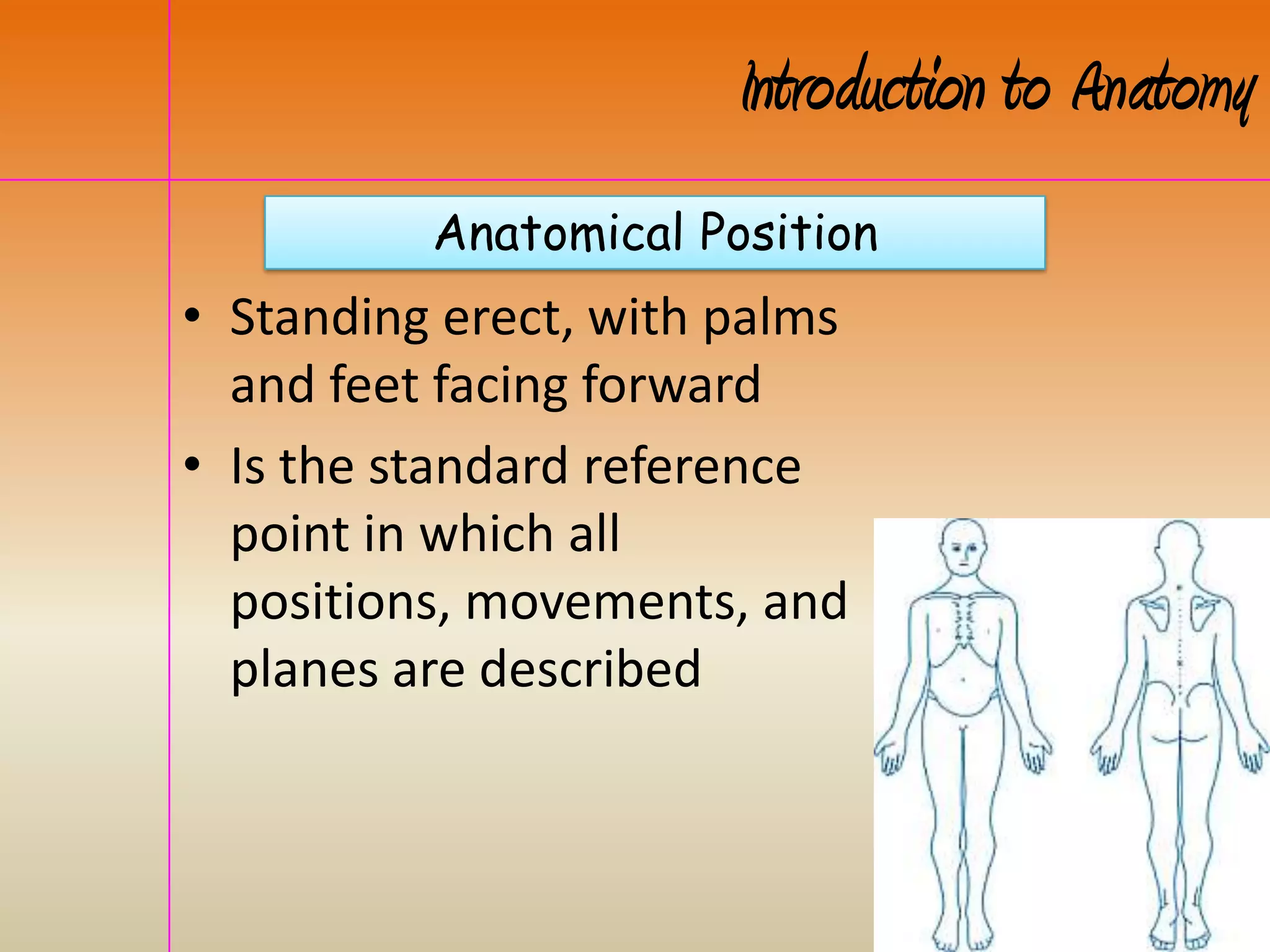
• Standing erect, with palms
and feet facing forward
• Is the standard reference
point in which all
positions, movements, and
planes are described
Anatomical Terms Worksheet
Introduction to Anatomy
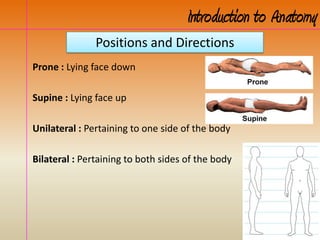
Prone : Lying face down
Supine : Lying face up
Unilateral : Pertaining to one side of the body
Bilateral : Pertaining to both sides of the body
Positions and Directions
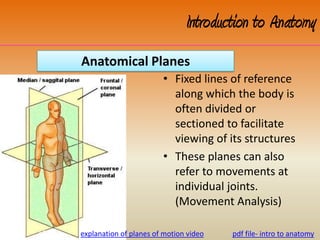
• Fixed lines of reference
along which the body is
often divided or
sectioned to facilitate
viewing of its structures
• These planes can also
refer to movements at
individual joints.
(Movement Analysis)
Introduction to Anatomy
Anatomical Planes
pdf file- intro to anatomyexplanation of planes of motion video
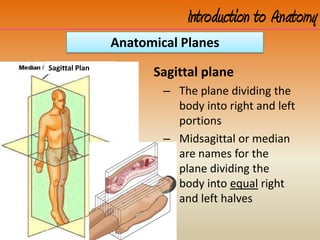
Sagittal plane
– The plane dividing the
body into right and left
portions
– Midsagittal or median
are names for the
plane dividing the
body into equal right
and left halves
Introduction to Anatomy
Anatomical Planes
Sagittal Plan
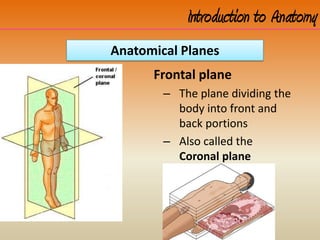
Frontal plane
– The plane dividing the
body into front and
back portions
– Also called the
Coronal plane
Introduction to Anatomy
Anatomical Planes
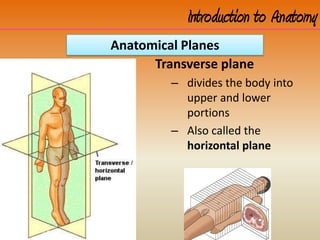
Transverse plane
– divides the body into
upper and lower
portions
– Also called the
horizontal plane
Anatomical Planes
Introduction to Anatomy
Anatomical Axes
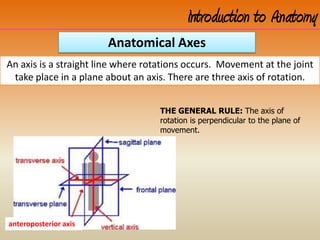
An axis is a straight line where rotations occurs. Movement at the joint
take place in a plane about an axis. There are three axis of rotation.
THE GENERAL RULE: The axis of
rotation is perpendicular to the plane of
movement.
anteroposterior axis
Introduction to Anatomy
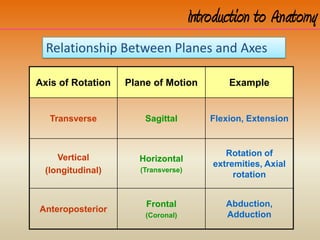
Relationship Between Planes and Axes
Axis of Rotation Plane of Motion Example
Transverse Sagittal Flexion, Extension
Vertical
(longitudinal)
Horizontal
(Transverse)
Rotation of
extremities, Axial
rotation
Anteroposterior
Frontal
(Coronal)
Abduction,
Adduction
Introduction to Anatomy
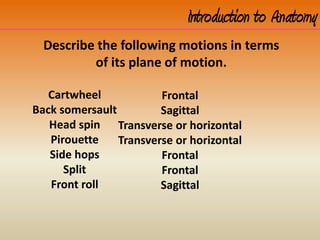
Describe the following motions in terms
of its plane of motion.
Cartwheel
Back somersault
Head spin
Pirouette
Side hops
Split
Front roll
Frontal
Sagittal
Transverse or horizontal
Frontal
Frontal
Sagittal
Introduction to Anatomy
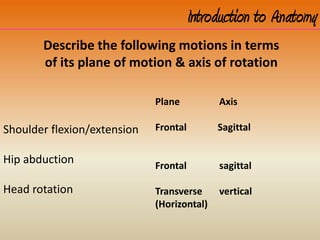
Describe the following motions in terms
of its plane of motion & axis of rotation
Shoulder flexion/extension
Hip abduction
Head rotation
Plane Axis
Frontal Sagittal
Frontal sagittal
Transverse vertical
(Horizontal)
Introduction to Anatomy
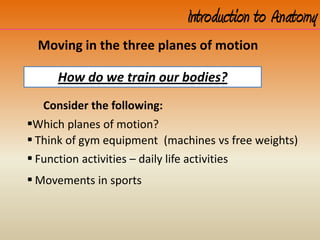
Moving in the three planes of motion
How do we train our bodies?
• Think of gym equipment (machines vs free weights)
•Which planes of motion?
• Function activities – daily life activities
Consider the following:
• Movements in sports
Introduction to Anatomy
Moving in the 3 planes of motion clips
Moving in the three planes of motion
Our bodies generally move in more than
one plane at a time.
Which plane of movement is usually neglected in training?
Answer: Transverse (horizontal) Plane
Introduction to Anatomy
Assignment:
For each plane of motion list and describe 3 exercises/
warm-ups.
Your description should include what plane(s) it is moving
in and which axis (axes) is/are involved.
If you choose a multi-joint exercise you only need to
describe one joint during the exercise. (Name that joint
in your description)
You can include pictures in your description.
 Superior (cranial) is a term used to describe
a place that is toward the upper part of the
body. For example the skull is superior to
the shoulders. Superior can also be used to
mean above.
 When the lower part of the body (or below
is referred to, the term inferior (caudal) is
used. For example, the knees are inferior to
the shoulders.
Terms of Position & Direction
Introduction to Anatomy
 Lateral means towards the side of the
body or away from the middle imaginary
body line (the midline). For
example, the humerus is lateral to the
sternum
 Medial is used to describe the position
of a part of the body located towards
the midline. For example, coccyx is
medial to the carpals.
Introduction to Anatomy
Terms of Position & Direction
 Anterior (ventral) is used to describe
the front or towards the front of the
body. For example, the sternum is
anterior to the vertebrae.
 Posterior (dorsal) is used to describe
the back of the body. For example, the
vertebral column is posterior to the
sternum.
Introduction to Anatomy
Terms of Position & Direction
 Proximal means closer to the center of
the body. For example, the shoulder is
proximal in relation to the hand.
 Distal means away from the center of
the body. For example, the hand is
distal in relation to the head.
Introduction to Anatomy
Terms of Position & Direction
These are only used when discussing limbs
Introduction to Anatomy
Terms of Position & Direction
External refers on the surface or near the
surface.
Internal refers to internal or further away
from the surface.
A structure closer to the surface of the body
is superficial, while a structure further away
from the surface is deep.
Activity:
Give an example of the use of the following
terms in relation to body parts, bones or
muscles:
e.g. “the patella is _________ to the
scapula.”
 Inferior/Superior : Caudal/Cranial
 Proximal/Distal
 Medial/Lateral
 Posterior/Anterior : Dorsal/Ventral
 Superficial/Deep
 Ipsilateral/Contralateral
Introduction to Anatomy
Terms of Position & Direction
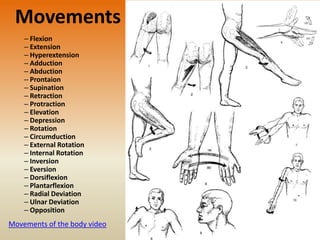
Movements
– Flexion
– Extension
– Hyperextension
– Adduction
– Abduction
– Prontaion
– Supination
– Retraction
– Protraction
– Elevation
– Depression
– Rotation
– Circumduction
– External Rotation
– Internal Rotation
– Inversion
– Eversion
– Dorsiflexion
– Plantarflexion
– Radial Deviation
– Ulnar Deviation
– Opposition
Movements of the body video
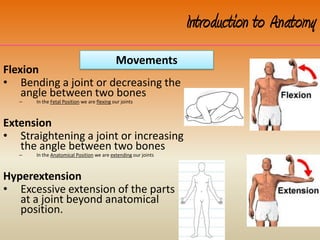
Flexion
• Bending a joint or decreasing the
angle between two bones
– In the Fetal Position we are flexing our joints
Extension
• Straightening a joint or increasing
the angle between two bones
– In the Anatomical Position we are extending our joints
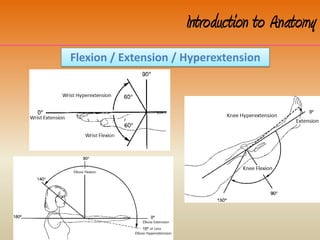
Hyperextension
• Excessive extension of the parts
at a joint beyond anatomical
position.
Introduction to Anatomy
Movements
Introduction to Anatomy
Flexion / Extension / Hyperextension
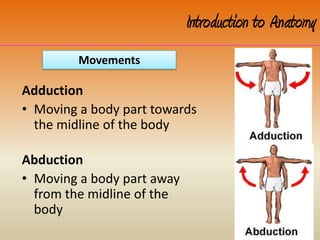
Adduction
• Moving a body part towards
the midline of the body
Abduction
• Moving a body part away
from the midline of the
body
Movements
Introduction to Anatomy
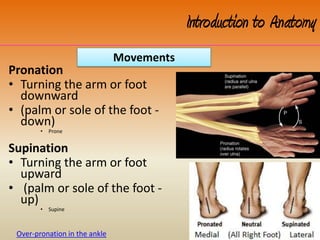
Pronation
• Turning the arm or foot
downward
• (palm or sole of the foot -
down)
• Prone
Supination
• Turning the arm or foot
upward
• (palm or sole of the foot -
up)
• Supine
Movements
Introduction to Anatomy
Over-pronation in the ankle
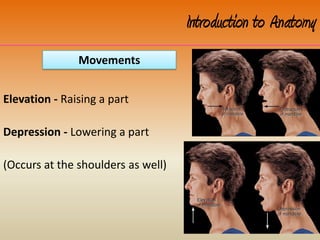
Elevation - Raising a part
Depression - Lowering a part
(Occurs at the shoulders as well)
Introduction to Anatomy
Movements
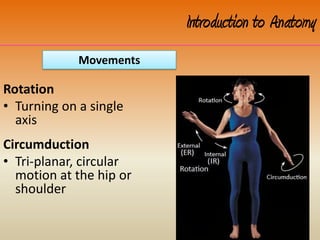
Rotation
• Turning on a single
axis
Circumduction
• Tri-planar, circular
motion at the hip or
shoulder
Movements
Introduction to Anatomy
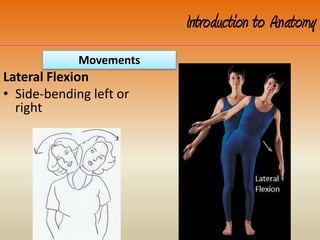
Lateral Flexion
• Side-bending left or
right
Movements
Introduction to Anatomy
Inversion
• Turning the sole of the foot
inward
Eversion
• Turning the sole of the foot
outward
Dorsiflexion
• Ankle movement bringing the
foot towards the shin
Plantarflexion
• Ankle movement pointing the
foot downward
Movements of the foot
Introduction to Anatomy
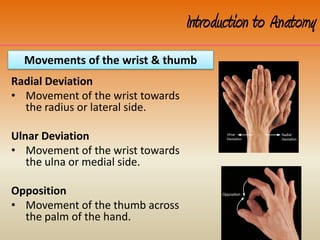
Radial Deviation
• Movement of the wrist towards
the radius or lateral side.
Ulnar Deviation
• Movement of the wrist towards
the ulna or medial side.
Opposition
• Movement of the thumb across
the palm of the hand.
Movements of the wrist & thumb
Introduction to Anatomy
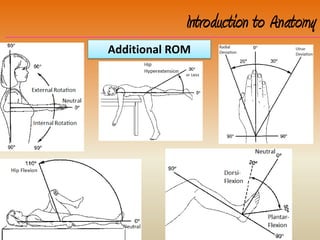
Additional ROM
Introduction to Anatomy

Intro to anatomy

  • 1.
    Anatomical Position Introduction toAnatomy • Standing erect, with palms and feet facing forward • Is the standard reference point in which all positions, movements, and planes are described
  • 2.
  • 3.
    Introduction to Anatomy Prone: Lying face down Supine : Lying face up Unilateral : Pertaining to one side of the body Bilateral : Pertaining to both sides of the body Positions and Directions
  • 4.
    • Fixed linesof reference along which the body is often divided or sectioned to facilitate viewing of its structures • These planes can also refer to movements at individual joints. (Movement Analysis) Introduction to Anatomy Anatomical Planes pdf file- intro to anatomyexplanation of planes of motion video
  • 5.
    Sagittal plane – Theplane dividing the body into right and left portions – Midsagittal or median are names for the plane dividing the body into equal right and left halves Introduction to Anatomy Anatomical Planes Sagittal Plan
  • 6.
    Frontal plane – Theplane dividing the body into front and back portions – Also called the Coronal plane Introduction to Anatomy Anatomical Planes
  • 7.
    Transverse plane – dividesthe body into upper and lower portions – Also called the horizontal plane Anatomical Planes Introduction to Anatomy
  • 8.
    Introduction to Anatomy AnatomicalAxes An axis is a straight line where rotations occurs. Movement at the joint take place in a plane about an axis. There are three axis of rotation. THE GENERAL RULE: The axis of rotation is perpendicular to the plane of movement. anteroposterior axis
  • 9.
    Introduction to Anatomy RelationshipBetween Planes and Axes Axis of Rotation Plane of Motion Example Transverse Sagittal Flexion, Extension Vertical (longitudinal) Horizontal (Transverse) Rotation of extremities, Axial rotation Anteroposterior Frontal (Coronal) Abduction, Adduction
  • 10.
    Introduction to Anatomy Describethe following motions in terms of its plane of motion. Cartwheel Back somersault Head spin Pirouette Side hops Split Front roll Frontal Sagittal Transverse or horizontal Transverse or horizontal Frontal Frontal Sagittal
  • 11.
    Introduction to Anatomy Describethe following motions in terms of its plane of motion & axis of rotation Shoulder flexion/extension Hip abduction Head rotation Plane Axis Frontal Sagittal Frontal sagittal Transverse vertical (Horizontal)
  • 12.
    Introduction to Anatomy Movingin the three planes of motion How do we train our bodies? • Think of gym equipment (machines vs free weights) •Which planes of motion? • Function activities – daily life activities Consider the following: • Movements in sports
  • 13.
    Introduction to Anatomy Movingin the 3 planes of motion clips Moving in the three planes of motion Our bodies generally move in more than one plane at a time. Which plane of movement is usually neglected in training? Answer: Transverse (horizontal) Plane
  • 14.
    Introduction to Anatomy Assignment: Foreach plane of motion list and describe 3 exercises/ warm-ups. Your description should include what plane(s) it is moving in and which axis (axes) is/are involved. If you choose a multi-joint exercise you only need to describe one joint during the exercise. (Name that joint in your description) You can include pictures in your description.
  • 15.
     Superior (cranial)is a term used to describe a place that is toward the upper part of the body. For example the skull is superior to the shoulders. Superior can also be used to mean above.  When the lower part of the body (or below is referred to, the term inferior (caudal) is used. For example, the knees are inferior to the shoulders. Terms of Position & Direction Introduction to Anatomy
  • 16.
     Lateral meanstowards the side of the body or away from the middle imaginary body line (the midline). For example, the humerus is lateral to the sternum  Medial is used to describe the position of a part of the body located towards the midline. For example, coccyx is medial to the carpals. Introduction to Anatomy Terms of Position & Direction
  • 17.
     Anterior (ventral)is used to describe the front or towards the front of the body. For example, the sternum is anterior to the vertebrae.  Posterior (dorsal) is used to describe the back of the body. For example, the vertebral column is posterior to the sternum. Introduction to Anatomy Terms of Position & Direction
  • 18.
     Proximal meanscloser to the center of the body. For example, the shoulder is proximal in relation to the hand.  Distal means away from the center of the body. For example, the hand is distal in relation to the head. Introduction to Anatomy Terms of Position & Direction These are only used when discussing limbs
  • 19.
    Introduction to Anatomy Termsof Position & Direction External refers on the surface or near the surface. Internal refers to internal or further away from the surface. A structure closer to the surface of the body is superficial, while a structure further away from the surface is deep.
  • 20.
    Activity: Give an exampleof the use of the following terms in relation to body parts, bones or muscles: e.g. “the patella is _________ to the scapula.”  Inferior/Superior : Caudal/Cranial  Proximal/Distal  Medial/Lateral  Posterior/Anterior : Dorsal/Ventral  Superficial/Deep  Ipsilateral/Contralateral Introduction to Anatomy Terms of Position & Direction
  • 21.
    Movements – Flexion – Extension –Hyperextension – Adduction – Abduction – Prontaion – Supination – Retraction – Protraction – Elevation – Depression – Rotation – Circumduction – External Rotation – Internal Rotation – Inversion – Eversion – Dorsiflexion – Plantarflexion – Radial Deviation – Ulnar Deviation – Opposition Movements of the body video
  • 22.
    Flexion • Bending ajoint or decreasing the angle between two bones – In the Fetal Position we are flexing our joints Extension • Straightening a joint or increasing the angle between two bones – In the Anatomical Position we are extending our joints Hyperextension • Excessive extension of the parts at a joint beyond anatomical position. Introduction to Anatomy Movements
  • 23.
    Introduction to Anatomy Flexion/ Extension / Hyperextension
  • 24.
    Adduction • Moving abody part towards the midline of the body Abduction • Moving a body part away from the midline of the body Movements Introduction to Anatomy
  • 25.
    Pronation • Turning thearm or foot downward • (palm or sole of the foot - down) • Prone Supination • Turning the arm or foot upward • (palm or sole of the foot - up) • Supine Movements Introduction to Anatomy Over-pronation in the ankle
  • 26.
    Elevation - Raisinga part Depression - Lowering a part (Occurs at the shoulders as well) Introduction to Anatomy Movements
  • 27.
    Rotation • Turning ona single axis Circumduction • Tri-planar, circular motion at the hip or shoulder Movements Introduction to Anatomy
  • 28.
    Lateral Flexion • Side-bendingleft or right Movements Introduction to Anatomy
  • 29.
    Inversion • Turning thesole of the foot inward Eversion • Turning the sole of the foot outward Dorsiflexion • Ankle movement bringing the foot towards the shin Plantarflexion • Ankle movement pointing the foot downward Movements of the foot Introduction to Anatomy
  • 30.
    Radial Deviation • Movementof the wrist towards the radius or lateral side. Ulnar Deviation • Movement of the wrist towards the ulna or medial side. Opposition • Movement of the thumb across the palm of the hand. Movements of the wrist & thumb Introduction to Anatomy
  • 31.