Intel Microprocessors

   Dileep Bhandarkar
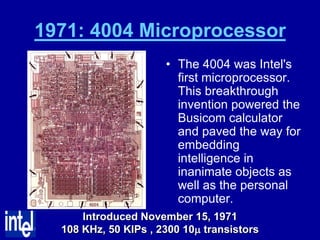
1971: 4004 Microprocessor
                      • The 4004 was Intel's
                        first microprocessor.
                        This breakthrough
                        invention powered the
                        Busicom calculator
                        and paved the way for
                        embedding
                        intelligence in
                        inanimate objects as
                        well as the personal
                        computer.
      Introduced November 15, 1971
  108 KHz, 50 KIPs , 2300 10m transistors
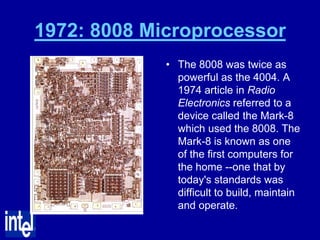
1972: 8008 Microprocessor
             • The 8008 was twice as
               powerful as the 4004. A
               1974 article in Radio
               Electronics referred to a
               device called the Mark-8
               which used the 8008. The
               Mark-8 is known as one
               of the first computers for
               the home --one that by
               today's standards was
               difficult to build, maintain
               and operate.
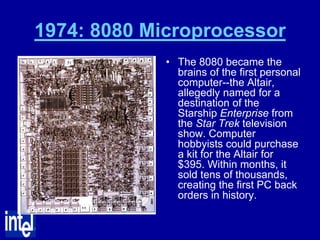
1974: 8080 Microprocessor
             • The 8080 became the
               brains of the first personal
               computer--the Altair,
               allegedly named for a
               destination of the
               Starship Enterprise from
               the Star Trek television
               show. Computer
               hobbyists could purchase
               a kit for the Altair for
               $395. Within months, it
               sold tens of thousands,
               creating the first PC back
               orders in history.
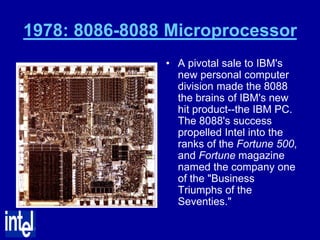
1978: 8086-8088 Microprocessor
               • A pivotal sale to IBM's
                 new personal computer
                 division made the 8088
                 the brains of IBM's new
                 hit product--the IBM PC.
                 The 8088's success
                 propelled Intel into the
                 ranks of the Fortune 500,
                 and Fortune magazine
                 named the company one
                 of the "Business
                 Triumphs of the
                 Seventies."
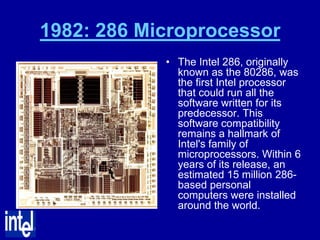
1982: 286 Microprocessor
            • The Intel 286, originally
              known as the 80286, was
              the first Intel processor
              that could run all the
              software written for its
              predecessor. This
              software compatibility
              remains a hallmark of
              Intel's family of
              microprocessors. Within 6
              years of its release, an
              estimated 15 million 286-
              based personal
              computers were installed
              around the world.
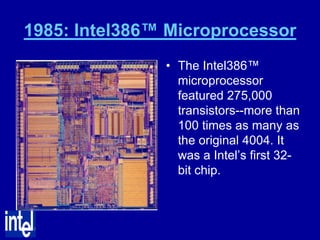
1985: Intel386™ Microprocessor
               • The Intel386™
                 microprocessor
                 featured 275,000
                 transistors--more than
                 100 times as many as
                 the original 4004. It
                 was a Intel’s first 32-
                 bit chip.
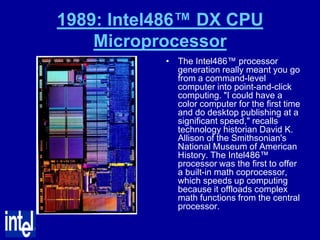
1989: Intel486™ DX CPU
    Microprocessor
           • The Intel486™ processor
             generation really meant you go
             from a command-level
             computer into point-and-click
             computing. "I could have a
             color computer for the first time
             and do desktop publishing at a
             significant speed," recalls
             technology historian David K.
             Allison of the Smithsonian's
             National Museum of American
             History. The Intel486™
             processor was the first to offer
             a built-in math coprocessor,
             which speeds up computing
             because it offloads complex
             math functions from the central
             processor.
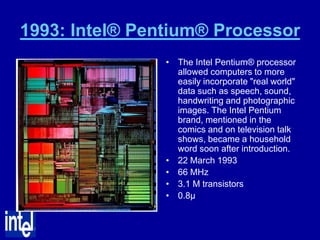
1993: Intel® Pentium® Processor
                • The Intel Pentium® processor
                  allowed computers to more
                  easily incorporate "real world"
                  data such as speech, sound,
                  handwriting and photographic
                  images. The Intel Pentium
                  brand, mentioned in the
                  comics and on television talk
                  shows, became a household
                  word soon after introduction.
                • 22 March 1993
                • 66 MHz
                • 3.1 M transistors
                • 0.8µ
P6

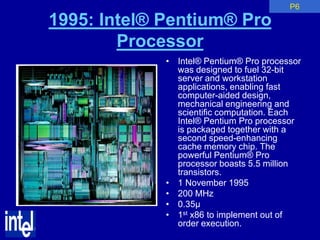
1995: Intel® Pentium® Pro
        Processor
             • Intel® Pentium® Pro processor
               was designed to fuel 32-bit
               server and workstation
               applications, enabling fast
               computer-aided design,
               mechanical engineering and
               scientific computation. Each
               Intel® Pentium Pro processor
               is packaged together with a
               second speed-enhancing
               cache memory chip. The
               powerful Pentium® Pro
               processor boasts 5.5 million
               transistors.
             • 1 November 1995
             • 200 MHz
             • 0.35µ
             • 1st x86 to implement out of
               order execution.
P55C

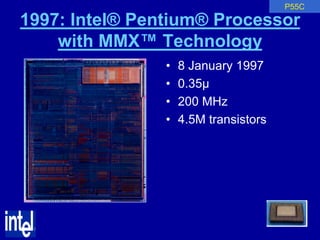
1997: Intel® Pentium® Processor
    with MMX™ Technology
                •   8 January 1997
                •   0.35µ
                •   200 MHz
                •   4.5M transistors
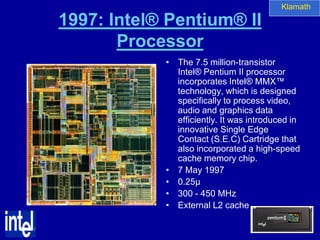
Klamath

1997: Intel® Pentium® II
       Processor
            • The 7.5 million-transistor
              Intel® Pentium II processor
              incorporates Intel® MMX™
              technology, which is designed
              specifically to process video,
              audio and graphics data
              efficiently. It was introduced in
              innovative Single Edge
              Contact (S.E.C) Cartridge that
              also incorporated a high-speed
              cache memory chip.
            • 7 May 1997
            • 0.25µ
            • 300 - 450 MHz
            • External L2 cache
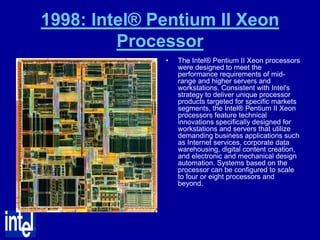
1998: Intel® Pentium II Xeon
         Processor
              •   The Intel® Pentium II Xeon processors
                  were designed to meet the
                  performance requirements of mid-
                  range and higher servers and
                  workstations. Consistent with Intel's
                  strategy to deliver unique processor
                  products targeted for specific markets
                  segments, the Intel® Pentium II Xeon
                  processors feature technical
                  innovations specifically designed for
                  workstations and servers that utilize
                  demanding business applications such
                  as Internet services, corporate data
                  warehousing, digital content creation,
                  and electronic and mechanical design
                  automation. Systems based on the
                  processor can be configured to scale
                  to four or eight processors and
                  beyond.
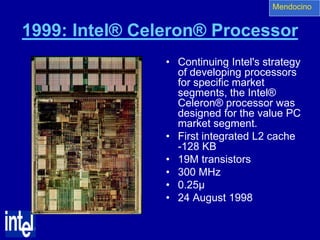
Mendocino


1999: Intel® Celeron® Processor
                • Continuing Intel's strategy
                  of developing processors
                  for specific market
                  segments, the Intel®
                  Celeron® processor was
                  designed for the value PC
                  market segment.
                • First integrated L2 cache
                  -128 KB
                • 19M transistors
                • 300 MHz
                • 0.25µ
                • 24 August 1998
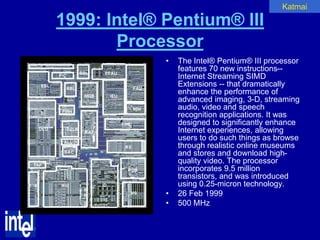
Katmai

1999: Intel® Pentium® III
       Processor
             •   The Intel® Pentium® III processor
                 features 70 new instructions--
                 Internet Streaming SIMD
                 Extensions -- that dramatically
                 enhance the performance of
                 advanced imaging, 3-D, streaming
                 audio, video and speech
                 recognition applications. It was
                 designed to significantly enhance
                 Internet experiences, allowing
                 users to do such things as browse
                 through realistic online museums
                 and stores and download high-
                 quality video. The processor
                 incorporates 9.5 million
                 transistors, and was introduced
                 using 0.25-micron technology.
             •   26 Feb 1999
             •   500 MHz
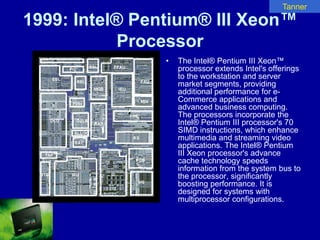
Tanner

1999: Intel® Pentium® III Xeon™
            Processor
                •   The Intel® Pentium III Xeon™
                    processor extends Intel's offerings
                    to the workstation and server
                    market segments, providing
                    additional performance for e-
                    Commerce applications and
                    advanced business computing.
                    The processors incorporate the
                    Intel® Pentium III processor's 70
                    SIMD instructions, which enhance
                    multimedia and streaming video
                    applications. The Intel® Pentium
                    III Xeon processor's advance
                    cache technology speeds
                    information from the system bus to
                    the processor, significantly
                    boosting performance. It is
                    designed for systems with
                    multiprocessor configurations.
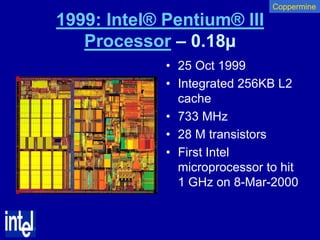
Coppermine

1999: Intel® Pentium® III
   Processor – 0.18µ
             • 25 Oct 1999
             • Integrated 256KB L2
               cache
             • 733 MHz
             • 28 M transistors
             • First Intel
               microprocessor to hit
               1 GHz on 8-Mar-2000
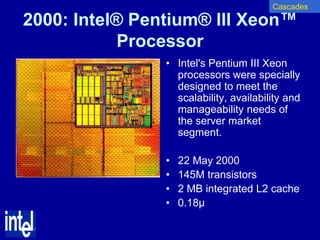
Cascades

2000: Intel® Pentium® III Xeon™
            Processor
                • Intel's Pentium III Xeon
                  processors were specially
                  designed to meet the
                  scalability, availability and
                  manageability needs of
                  the server market
                  segment.

                •   22 May 2000
                •   145M transistors
                •   2 MB integrated L2 cache
                •   0.18µ
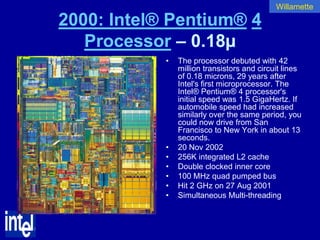
Willamette

2000: Intel® Pentium® 4
   Processor – 0.18µ
            •   The processor debuted with 42
                million transistors and circuit lines
                of 0.18 microns, 29 years after
                Intel's first microprocessor. The
                Intel® Pentium® 4 processor's
                initial speed was 1.5 GigaHertz. If
                automobile speed had increased
                similarly over the same period, you
                could now drive from San
                Francisco to New York in about 13
                seconds.
            •   20 Nov 2002
            •   256K integrated L2 cache
            •   Double clocked inner core
            •   100 MHz quad pumped bus
            •   Hit 2 GHz on 27 Aug 2001
            •   Simultaneous Multi-threading
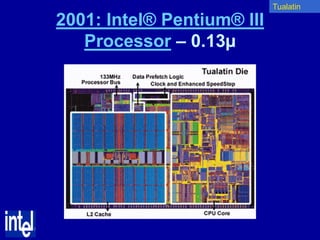
Tualatin

2001: Intel® Pentium® III
   Processor – 0.13µ
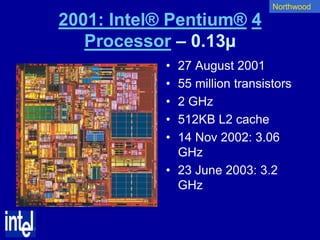
Northwood

2001: Intel® Pentium® 4
   Processor – 0.13µ
            • 27 August 2001
            • 55 million transistors
            • 2 GHz
            • 512KB L2 cache
            • 14 Nov 2002: 3.06
              GHz
            • 23 June 2003: 3.2
              GHz
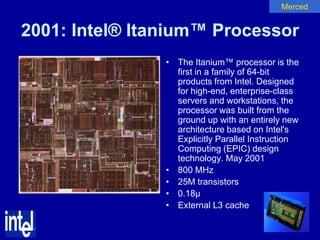
Merced


2001: Intel® Itanium™ Processor
                • The Itanium™ processor is the
                  first in a family of 64-bit
                  products from Intel. Designed
                  for high-end, enterprise-class
                  servers and workstations, the
                  processor was built from the
                  ground up with an entirely new
                  architecture based on Intel's
                  Explicitly Parallel Instruction
                  Computing (EPIC) design
                  technology. May 2001
                • 800 MHz
                • 25M transistors
                • 0.18µ
                • External L3 cache
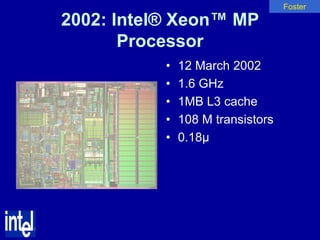
Foster

2002: Intel® Xeon™ MP
       Processor
           •   12 March 2002
           •   1.6 GHz
           •   1MB L3 cache
           •   108 M transistors
           •   0.18µ
McKinley

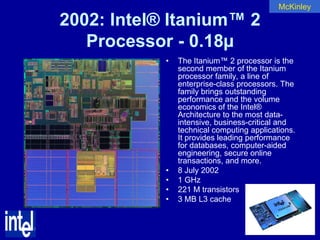
2002: Intel® Itanium™ 2
   Processor - 0.18µ
            •   The Itanium™ 2 processor is the
                second member of the Itanium
                processor family, a line of
                enterprise-class processors. The
                family brings outstanding
                performance and the volume
                economics of the Intel®
                Architecture to the most data-
                intensive, business-critical and
                technical computing applications.
                It provides leading performance
                for databases, computer-aided
                engineering, secure online
                transactions, and more.
            •   8 July 2002
            •   1 GHz
            •   221 M transistors
            •   3 MB L3 cache
Madison

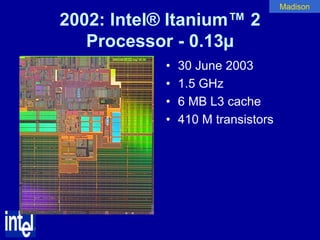
2002: Intel® Itanium™ 2
   Processor - 0.13µ
            •   30 June 2003
            •   1.5 GHz
            •   6 MB L3 cache
            •   410 M transistors
Banias

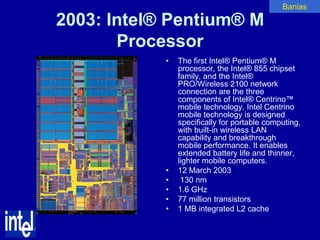
2003: Intel® Pentium® M
       Processor
            •   The first Intel® Pentium® M
                processor, the Intel® 855 chipset
                family, and the Intel®
                PRO/Wireless 2100 network
                connection are the three
                components of Intel® Centrino™
                mobile technology. Intel Centrino
                mobile technology is designed
                specifically for portable computing,
                with built-in wireless LAN
                capability and breakthrough
                mobile performance. It enables
                extended battery life and thinner,
                lighter mobile computers.
            •   12 March 2003
            •    130 nm
            •   1.6 GHz
            •   77 million transistors
            •   1 MB integrated L2 cache
Prescott

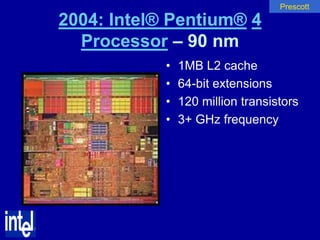
2004: Intel® Pentium® 4
  Processor – 90 nm
            •   1MB L2 cache
            •   64-bit extensions
            •   120 million transistors
            •   3+ GHz frequency
Dothan

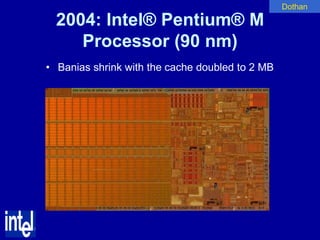
  2004: Intel® Pentium® M
     Processor (90 nm)
• Banias shrink with the cache doubled to 2 MB
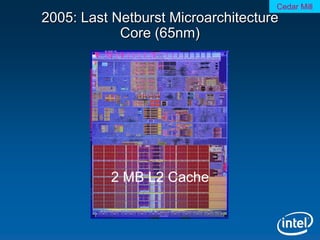
Cedar Mill
2005: Last Netburst Microarchitecture
            Core (65nm)


          2 MB L2 Cache
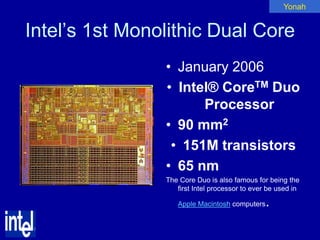
Yonah


Intel’s 1st Monolithic Dual Core
                • January 2006
                • Intel® CoreTM Duo
                      Processor
                • 90 mm2
                 • 151M transistors
                • 65 nm
                The Core Duo is also famous for being the
                   first Intel processor to ever be used in

                   Apple Macintosh computers    .
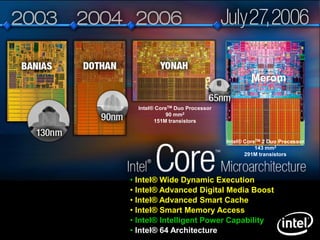
Merom

  Intel® CoreTM Duo Processor
             90 mm2
        151M transistors


                                Intel® CoreTM 2 Duo Processor
                                           143 mm2
                                       291M transistors


• Intel® Wide Dynamic Execution
• Intel® Advanced Digital Media Boost
• Intel® Advanced Smart Cache
• Intel® Smart Memory Access
• Intel® Intelligent Power Capability
• Intel® 64 Architecture
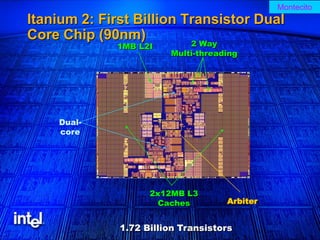
Montecito
Itanium 2: First Billion Transistor Dual
Core Chip (90nm)
             1MB L2I        2 Way
                        Multi-threading


    Dual-
    core


                    2x12MB L3
                      Caches        Arbiter


              1.72 Billion Transistors
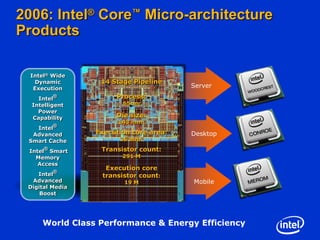
2006: Intel® Core™ Micro-architecture
Products

  Intel® Wide
   Dynamic        14 Stage Pipeline
   Execution                            Server

     Intel®           Process:
  Intelligent           65nm
    Power
  Capability          Die size:
                       143 mm2
    Intel®
  Advanced       Execution core area:   Desktop
 Smart Cache           36 mm2

 Intel® Smart     Transistor count:
   Memory               291 M
   Access
                   Execution core
    Intel®        transistor count:
  Advanced              19 M            Mobile
 Digital Media
     Boost


     World Class Performance & Energy Efficiency
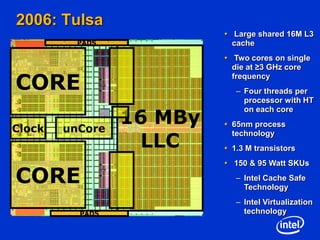
2006: Tulsa
                           Large shared 16M L3
          PADS              cache
                           Two cores on single
                            die at ≥3 GHz core

CORE
                            frequency
                             – Four threads per
                               processor with HT

                 16 MBy
                               on each core
                           65nm process
Clock   unCore
                  LLC
                            technology
                           1.3 M transistors
                           150 & 95 Watt SKUs

CORE                         – Intel Cache Safe
                               Technology
                             – Intel Virtualization
          PADS                 technology
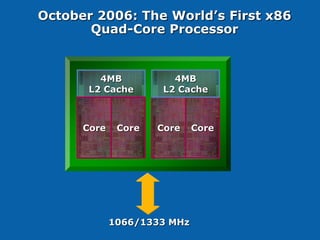
October 2006: The World’s First x86
       Quad-Core Processor


         4MB            4MB
       L2 Cache       L2 Cache


      Core    Core   Core    Core


             1066/1333 MHz
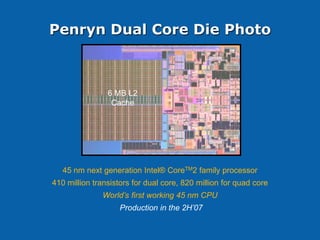
Penryn Dual Core Die Photo


                6 MB L2
                 Cache


   45 nm next generation Intel® CoreTM2 family processor
410 million transistors for dual core, 820 million for quad core
              World’s first working 45 nm CPU
                    Production in the 2H’07
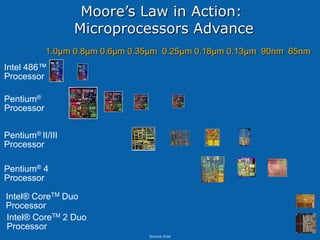
Moore’s Law in Action:
                  Microprocessors Advance
            1.0µm 0.8µm 0.6µm 0.35µm 0.25µm 0.18µm 0.13µm 90nm 65nm
Intel 486™
Processor

Pentium®
Processor


Pentium® II/III
Processor

Pentium® 4
Processor

Intel® CoreTM Duo
Processor
Intel® CoreTM 2 Duo
Processor
                                 Source: Intel

Intel microprocessors

  • 1.
    Intel Microprocessors Dileep Bhandarkar
  • 2.
    1971: 4004 Microprocessor • The 4004 was Intel's first microprocessor. This breakthrough invention powered the Busicom calculator and paved the way for embedding intelligence in inanimate objects as well as the personal computer. Introduced November 15, 1971 108 KHz, 50 KIPs , 2300 10m transistors
  • 3.
    1972: 8008 Microprocessor • The 8008 was twice as powerful as the 4004. A 1974 article in Radio Electronics referred to a device called the Mark-8 which used the 8008. The Mark-8 is known as one of the first computers for the home --one that by today's standards was difficult to build, maintain and operate.
  • 4.
    1974: 8080 Microprocessor • The 8080 became the brains of the first personal computer--the Altair, allegedly named for a destination of the Starship Enterprise from the Star Trek television show. Computer hobbyists could purchase a kit for the Altair for $395. Within months, it sold tens of thousands, creating the first PC back orders in history.
  • 5.
    1978: 8086-8088 Microprocessor • A pivotal sale to IBM's new personal computer division made the 8088 the brains of IBM's new hit product--the IBM PC. The 8088's success propelled Intel into the ranks of the Fortune 500, and Fortune magazine named the company one of the "Business Triumphs of the Seventies."
  • 6.
    1982: 286 Microprocessor • The Intel 286, originally known as the 80286, was the first Intel processor that could run all the software written for its predecessor. This software compatibility remains a hallmark of Intel's family of microprocessors. Within 6 years of its release, an estimated 15 million 286- based personal computers were installed around the world.
  • 7.
    1985: Intel386™ Microprocessor • The Intel386™ microprocessor featured 275,000 transistors--more than 100 times as many as the original 4004. It was a Intel’s first 32- bit chip.
  • 8.
    1989: Intel486™ DXCPU Microprocessor • The Intel486™ processor generation really meant you go from a command-level computer into point-and-click computing. "I could have a color computer for the first time and do desktop publishing at a significant speed," recalls technology historian David K. Allison of the Smithsonian's National Museum of American History. The Intel486™ processor was the first to offer a built-in math coprocessor, which speeds up computing because it offloads complex math functions from the central processor.
  • 9.
    1993: Intel® Pentium®Processor • The Intel Pentium® processor allowed computers to more easily incorporate "real world" data such as speech, sound, handwriting and photographic images. The Intel Pentium brand, mentioned in the comics and on television talk shows, became a household word soon after introduction. • 22 March 1993 • 66 MHz • 3.1 M transistors • 0.8µ
  • 10.
    P6 1995: Intel® Pentium®Pro Processor • Intel® Pentium® Pro processor was designed to fuel 32-bit server and workstation applications, enabling fast computer-aided design, mechanical engineering and scientific computation. Each Intel® Pentium Pro processor is packaged together with a second speed-enhancing cache memory chip. The powerful Pentium® Pro processor boasts 5.5 million transistors. • 1 November 1995 • 200 MHz • 0.35µ • 1st x86 to implement out of order execution.
  • 11.
    P55C 1997: Intel® Pentium®Processor with MMX™ Technology • 8 January 1997 • 0.35µ • 200 MHz • 4.5M transistors
  • 12.
    Klamath 1997: Intel® Pentium®II Processor • The 7.5 million-transistor Intel® Pentium II processor incorporates Intel® MMX™ technology, which is designed specifically to process video, audio and graphics data efficiently. It was introduced in innovative Single Edge Contact (S.E.C) Cartridge that also incorporated a high-speed cache memory chip. • 7 May 1997 • 0.25µ • 300 - 450 MHz • External L2 cache
  • 13.
    1998: Intel® PentiumII Xeon Processor • The Intel® Pentium II Xeon processors were designed to meet the performance requirements of mid- range and higher servers and workstations. Consistent with Intel's strategy to deliver unique processor products targeted for specific markets segments, the Intel® Pentium II Xeon processors feature technical innovations specifically designed for workstations and servers that utilize demanding business applications such as Internet services, corporate data warehousing, digital content creation, and electronic and mechanical design automation. Systems based on the processor can be configured to scale to four or eight processors and beyond.
  • 14.
    Mendocino 1999: Intel® Celeron®Processor • Continuing Intel's strategy of developing processors for specific market segments, the Intel® Celeron® processor was designed for the value PC market segment. • First integrated L2 cache -128 KB • 19M transistors • 300 MHz • 0.25µ • 24 August 1998
  • 15.
    Katmai 1999: Intel® Pentium®III Processor • The Intel® Pentium® III processor features 70 new instructions-- Internet Streaming SIMD Extensions -- that dramatically enhance the performance of advanced imaging, 3-D, streaming audio, video and speech recognition applications. It was designed to significantly enhance Internet experiences, allowing users to do such things as browse through realistic online museums and stores and download high- quality video. The processor incorporates 9.5 million transistors, and was introduced using 0.25-micron technology. • 26 Feb 1999 • 500 MHz
  • 16.
    Tanner 1999: Intel® Pentium®III Xeon™ Processor • The Intel® Pentium III Xeon™ processor extends Intel's offerings to the workstation and server market segments, providing additional performance for e- Commerce applications and advanced business computing. The processors incorporate the Intel® Pentium III processor's 70 SIMD instructions, which enhance multimedia and streaming video applications. The Intel® Pentium III Xeon processor's advance cache technology speeds information from the system bus to the processor, significantly boosting performance. It is designed for systems with multiprocessor configurations.
  • 17.
    Coppermine 1999: Intel® Pentium®III Processor – 0.18µ • 25 Oct 1999 • Integrated 256KB L2 cache • 733 MHz • 28 M transistors • First Intel microprocessor to hit 1 GHz on 8-Mar-2000
  • 18.
    Cascades 2000: Intel® Pentium®III Xeon™ Processor • Intel's Pentium III Xeon processors were specially designed to meet the scalability, availability and manageability needs of the server market segment. • 22 May 2000 • 145M transistors • 2 MB integrated L2 cache • 0.18µ
  • 19.
    Willamette 2000: Intel® Pentium®4 Processor – 0.18µ • The processor debuted with 42 million transistors and circuit lines of 0.18 microns, 29 years after Intel's first microprocessor. The Intel® Pentium® 4 processor's initial speed was 1.5 GigaHertz. If automobile speed had increased similarly over the same period, you could now drive from San Francisco to New York in about 13 seconds. • 20 Nov 2002 • 256K integrated L2 cache • Double clocked inner core • 100 MHz quad pumped bus • Hit 2 GHz on 27 Aug 2001 • Simultaneous Multi-threading
  • 20.
    Tualatin 2001: Intel® Pentium®III Processor – 0.13µ
  • 21.
    Northwood 2001: Intel® Pentium®4 Processor – 0.13µ • 27 August 2001 • 55 million transistors • 2 GHz • 512KB L2 cache • 14 Nov 2002: 3.06 GHz • 23 June 2003: 3.2 GHz
  • 22.
    Merced 2001: Intel® Itanium™Processor • The Itanium™ processor is the first in a family of 64-bit products from Intel. Designed for high-end, enterprise-class servers and workstations, the processor was built from the ground up with an entirely new architecture based on Intel's Explicitly Parallel Instruction Computing (EPIC) design technology. May 2001 • 800 MHz • 25M transistors • 0.18µ • External L3 cache
  • 23.
    Foster 2002: Intel® Xeon™MP Processor • 12 March 2002 • 1.6 GHz • 1MB L3 cache • 108 M transistors • 0.18µ
  • 24.
    McKinley 2002: Intel® Itanium™2 Processor - 0.18µ • The Itanium™ 2 processor is the second member of the Itanium processor family, a line of enterprise-class processors. The family brings outstanding performance and the volume economics of the Intel® Architecture to the most data- intensive, business-critical and technical computing applications. It provides leading performance for databases, computer-aided engineering, secure online transactions, and more. • 8 July 2002 • 1 GHz • 221 M transistors • 3 MB L3 cache
  • 25.
    Madison 2002: Intel® Itanium™2 Processor - 0.13µ • 30 June 2003 • 1.5 GHz • 6 MB L3 cache • 410 M transistors
  • 26.
    Banias 2003: Intel® Pentium®M Processor • The first Intel® Pentium® M processor, the Intel® 855 chipset family, and the Intel® PRO/Wireless 2100 network connection are the three components of Intel® Centrino™ mobile technology. Intel Centrino mobile technology is designed specifically for portable computing, with built-in wireless LAN capability and breakthrough mobile performance. It enables extended battery life and thinner, lighter mobile computers. • 12 March 2003 • 130 nm • 1.6 GHz • 77 million transistors • 1 MB integrated L2 cache
  • 27.
    Prescott 2004: Intel® Pentium®4 Processor – 90 nm • 1MB L2 cache • 64-bit extensions • 120 million transistors • 3+ GHz frequency
  • 28.
    Dothan 2004:Intel® Pentium® M Processor (90 nm) • Banias shrink with the cache doubled to 2 MB
  • 29.
    Cedar Mill 2005: LastNetburst Microarchitecture Core (65nm) 2 MB L2 Cache
  • 30.
    Yonah Intel’s 1st MonolithicDual Core • January 2006 • Intel® CoreTM Duo Processor • 90 mm2 • 151M transistors • 65 nm The Core Duo is also famous for being the first Intel processor to ever be used in Apple Macintosh computers .
  • 31.
    Merom Intel®CoreTM Duo Processor 90 mm2 151M transistors Intel® CoreTM 2 Duo Processor 143 mm2 291M transistors • Intel® Wide Dynamic Execution • Intel® Advanced Digital Media Boost • Intel® Advanced Smart Cache • Intel® Smart Memory Access • Intel® Intelligent Power Capability • Intel® 64 Architecture
  • 32.
    Montecito Itanium 2: FirstBillion Transistor Dual Core Chip (90nm) 1MB L2I 2 Way Multi-threading Dual- core 2x12MB L3 Caches Arbiter 1.72 Billion Transistors
  • 33.
    2006: Intel® Core™Micro-architecture Products Intel® Wide Dynamic 14 Stage Pipeline Execution Server Intel® Process: Intelligent 65nm Power Capability Die size: 143 mm2 Intel® Advanced Execution core area: Desktop Smart Cache 36 mm2 Intel® Smart Transistor count: Memory 291 M Access Execution core Intel® transistor count: Advanced 19 M Mobile Digital Media Boost World Class Performance & Energy Efficiency
  • 34.
    2006: Tulsa  Large shared 16M L3 PADS cache  Two cores on single die at ≥3 GHz core CORE frequency – Four threads per processor with HT 16 MBy on each core  65nm process Clock unCore LLC technology  1.3 M transistors  150 & 95 Watt SKUs CORE – Intel Cache Safe Technology – Intel Virtualization PADS technology
  • 35.
    October 2006: TheWorld’s First x86 Quad-Core Processor 4MB 4MB L2 Cache L2 Cache Core Core Core Core 1066/1333 MHz
  • 36.
    Penryn Dual CoreDie Photo 6 MB L2 Cache 45 nm next generation Intel® CoreTM2 family processor 410 million transistors for dual core, 820 million for quad core World’s first working 45 nm CPU Production in the 2H’07
  • 37.
    Moore’s Law inAction: Microprocessors Advance 1.0µm 0.8µm 0.6µm 0.35µm 0.25µm 0.18µm 0.13µm 90nm 65nm Intel 486™ Processor Pentium® Processor Pentium® II/III Processor Pentium® 4 Processor Intel® CoreTM Duo Processor Intel® CoreTM 2 Duo Processor Source: Intel