


MEL432
Microprocessor Applications In
Manufacturing
Control Systems in Automobiles
Submitted By:
Rohit Gothwal(2010ME20796)
Himanshu Kumar(2010ME20775)
Anil Kumar (2010ME20764)
Dileep Kr. Meena(2010ME20773)
ECU:The Brain of your vehicle
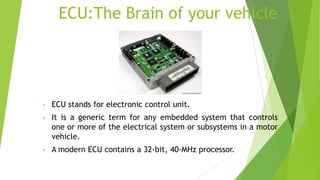
• ECU stands for electronic control unit.
• It is a generic term for any embedded system that controls
one or more of the electrical system or subsystems in a motor
vehicle.
• A modern ECU contains a 32-bit, 40-MHz processor.
• It collect data from different sensors, it knows everything from
the coolant temperature to the amount of oxygen in the exhaust.
• With this data, it performs many calculations and decides the
best spark timing and determining how long the fuel injector is
open.
• The code in an average ECU takes up less than 1MB of memory.
• It uses closed-loop control, a control scheme that monitors
outputs of a system to control the inputs to a system, managing
the emissions and fuel economy of the engine.
ECU COMPONENTS
Th-e processor is packaged in a module with hundreds of
components on a multi-layer circuit board. Some of the
components in the ECU that support the processor are:
 Analog-to-digital converters - These devices read the
outputs of the sensors in the car, such as the oxygen sensor.
The output of an oxygen sensor is an analog voltage. The
processor only understands digital numbers, so the analog-
to-digital converter changes this voltage into a 10-bit digital
number.
 High-level digital outputs - On many modern cars, the ECU
fires the spark plugs, opens and closes the fuel injectors and
turns the cooling fan on and off. All of these tasks require
digital outputs. A digital output is either on or off, there is
no in-between.
• Digital-to-analog converters - Sometimes the ECU has to provide an
analog voltage output to drive some engine components. Since the
processor on the ECU is a digital device, it needs a component that
can convert the digital number into an analog voltage.
• Signal conditioners - A signal conditioner is a circuit that adjusts the
level of the signals coming in or out. For instance, if we applied a
signal conditioner that multiplied the voltage coming from the oxygen
sensor (0V to 1.1V) by 4, we'd get a 0V to 4.4V signal.
• Communication chips - These chips implement the various
communications standards that are used on cars. This communication
standard allows for communication speeds of up to 500 kilobits per
second (Kbps).This speed is becoming necessary because some
modules communicate data onto the bus hundreds of times per
second.
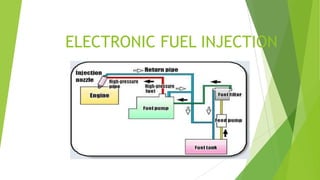
ELECTRONIC FUEL INJECTION
.
OBJECTIVES
 Power output
 Fuel efficiency
 Emissions performance
 Engine tuning
 Driveability and smooth operation
 Strict emission standards require precise fuel delivery.
 Computers used to calculate fuel needs.
 EFIS is very precise, reliable & cost effective.
 EFI provide correct A/F ratio for all loads, speeds, & temperature ranges.
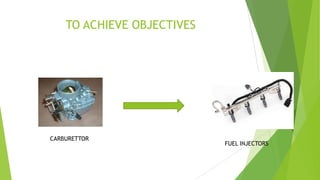
TO ACHIEVE OBJECTIVES
CARBURETTOR
FUEL INJECTORS
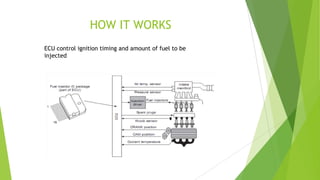
HOW IT WORKS
ECU control ignition timing and amount of fuel to be
injected
SENSORS
 MAP(Manifold air pressure) Sensor
 Throttle Positioning Sensor
 CAM sensor
 Crank Sensor
 Oxygen Sensor
 RPM Sensor
 Knocking Sensors
.
Knock Sensor
.
Overview
 What is Knock Sensor
 Micro Controller application in Knock Sensor
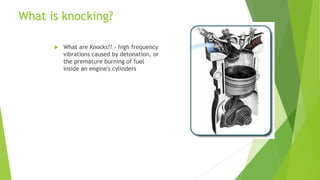
What is knocking?
 What are Knocks?? - high frequency
vibrations caused by detonation, or
the premature burning of fuel
inside an engine's cylinders
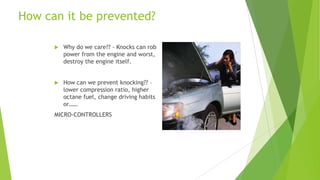
How can it be prevented?
 Why do we care?? - Knocks can rob
power from the engine and worst,
destroy the engine itself.
 How can we prevent knocking?? –
lower compression ratio, higher
octane fuel, change driving habits
or……
MICRO-CONTROLLERS
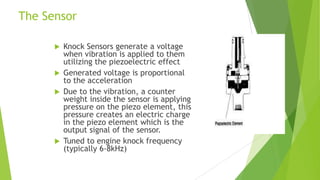
The Sensor
 Knock Sensors generate a voltage
when vibration is applied to them
utilizing the piezoelectric effect
 Generated voltage is proportional
to the acceleration
 Due to the vibration, a counter
weight inside the sensor is applying
pressure on the piezo element, this
pressure creates an electric charge
in the piezo element which is the
output signal of the sensor.
 Tuned to engine knock frequency
(typically 6-8kHz)
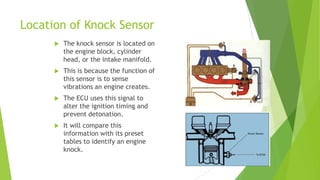
Location of Knock Sensor
 The knock sensor is located on
the engine block, cylinder
head, or the intake manifold.
 This is because the function of
this sensor is to sense
vibrations an engine creates.
 The ECU uses this signal to
alter the ignition timing and
prevent detonation.
 It will compare this
information with its preset
tables to identify an engine
knock.
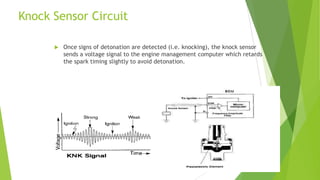
Knock Sensor Circuit
 Once signs of detonation are detected (i.e. knocking), the knock sensor
sends a voltage signal to the engine management computer which retards
the spark timing slightly to avoid detonation.
Benefits
 Vehicle engines work more efficiently and produce more power when
operating near the detonation limit.
 Although simple, knock sensors allow optimum engine performance and
protect the engine from potential damage caused by detonation.
Other applications
 Rain sensors
 Anti collision system
 ABS- Anti lock Braking System
REFERENCES
 http://www.embedded.com/electronics-blogs/significant-
bits/4024611/Motoring-with-microprocessors
 http://www.carsdirect.com/used-car-buying/how-a-fuel-injection-ecu-
system-works-engine-control-unit
 http://www.topspeed.com/cars/automotive-glossary/ecuthe-heart-of-a-car-
ar14214.html
 http://www.essortment.com/computer-questions-car-computers-work-
28983.html
Microprocessor applications

Microprocessor applications

  • 1.
    MEL432 Microprocessor Applications In Manufacturing ControlSystems in Automobiles Submitted By: Rohit Gothwal(2010ME20796) Himanshu Kumar(2010ME20775) Anil Kumar (2010ME20764) Dileep Kr. Meena(2010ME20773)
  • 2.
    ECU:The Brain ofyour vehicle • ECU stands for electronic control unit. • It is a generic term for any embedded system that controls one or more of the electrical system or subsystems in a motor vehicle. • A modern ECU contains a 32-bit, 40-MHz processor.
  • 3.
    • It collectdata from different sensors, it knows everything from the coolant temperature to the amount of oxygen in the exhaust. • With this data, it performs many calculations and decides the best spark timing and determining how long the fuel injector is open. • The code in an average ECU takes up less than 1MB of memory. • It uses closed-loop control, a control scheme that monitors outputs of a system to control the inputs to a system, managing the emissions and fuel economy of the engine.
  • 4.
    ECU COMPONENTS Th-e processoris packaged in a module with hundreds of components on a multi-layer circuit board. Some of the components in the ECU that support the processor are:  Analog-to-digital converters - These devices read the outputs of the sensors in the car, such as the oxygen sensor. The output of an oxygen sensor is an analog voltage. The processor only understands digital numbers, so the analog- to-digital converter changes this voltage into a 10-bit digital number.  High-level digital outputs - On many modern cars, the ECU fires the spark plugs, opens and closes the fuel injectors and turns the cooling fan on and off. All of these tasks require digital outputs. A digital output is either on or off, there is no in-between.
  • 5.
    • Digital-to-analog converters- Sometimes the ECU has to provide an analog voltage output to drive some engine components. Since the processor on the ECU is a digital device, it needs a component that can convert the digital number into an analog voltage. • Signal conditioners - A signal conditioner is a circuit that adjusts the level of the signals coming in or out. For instance, if we applied a signal conditioner that multiplied the voltage coming from the oxygen sensor (0V to 1.1V) by 4, we'd get a 0V to 4.4V signal. • Communication chips - These chips implement the various communications standards that are used on cars. This communication standard allows for communication speeds of up to 500 kilobits per second (Kbps).This speed is becoming necessary because some modules communicate data onto the bus hundreds of times per second.
  • 6.
  • 7.
    OBJECTIVES  Power output Fuel efficiency  Emissions performance  Engine tuning  Driveability and smooth operation
  • 8.
     Strict emissionstandards require precise fuel delivery.  Computers used to calculate fuel needs.  EFIS is very precise, reliable & cost effective.  EFI provide correct A/F ratio for all loads, speeds, & temperature ranges.
  • 9.
  • 10.
    HOW IT WORKS ECUcontrol ignition timing and amount of fuel to be injected
  • 11.
    SENSORS  MAP(Manifold airpressure) Sensor  Throttle Positioning Sensor  CAM sensor  Crank Sensor  Oxygen Sensor  RPM Sensor  Knocking Sensors
  • 12.
  • 13.
  • 14.
    Overview  What isKnock Sensor  Micro Controller application in Knock Sensor
  • 15.
    What is knocking? What are Knocks?? - high frequency vibrations caused by detonation, or the premature burning of fuel inside an engine's cylinders
  • 16.
    How can itbe prevented?  Why do we care?? - Knocks can rob power from the engine and worst, destroy the engine itself.  How can we prevent knocking?? – lower compression ratio, higher octane fuel, change driving habits or…… MICRO-CONTROLLERS
  • 17.
    The Sensor  KnockSensors generate a voltage when vibration is applied to them utilizing the piezoelectric effect  Generated voltage is proportional to the acceleration  Due to the vibration, a counter weight inside the sensor is applying pressure on the piezo element, this pressure creates an electric charge in the piezo element which is the output signal of the sensor.  Tuned to engine knock frequency (typically 6-8kHz)
  • 18.
    Location of KnockSensor  The knock sensor is located on the engine block, cylinder head, or the intake manifold.  This is because the function of this sensor is to sense vibrations an engine creates.  The ECU uses this signal to alter the ignition timing and prevent detonation.  It will compare this information with its preset tables to identify an engine knock.
  • 19.
    Knock Sensor Circuit Once signs of detonation are detected (i.e. knocking), the knock sensor sends a voltage signal to the engine management computer which retards the spark timing slightly to avoid detonation.
  • 20.
    Benefits  Vehicle engineswork more efficiently and produce more power when operating near the detonation limit.  Although simple, knock sensors allow optimum engine performance and protect the engine from potential damage caused by detonation.
  • 21.
    Other applications  Rainsensors  Anti collision system  ABS- Anti lock Braking System
  • 22.
    REFERENCES  http://www.embedded.com/electronics-blogs/significant- bits/4024611/Motoring-with-microprocessors  http://www.carsdirect.com/used-car-buying/how-a-fuel-injection-ecu- system-works-engine-control-unit http://www.topspeed.com/cars/automotive-glossary/ecuthe-heart-of-a-car- ar14214.html  http://www.essortment.com/computer-questions-car-computers-work- 28983.html