Name: Emrah

Surname: Aptoula

Students number: 20090024

Course: Eng102

Subject: History Of Microprocessors
Contents

 Introduction

 4-Bit   Microprocessors
 8-Bit   Microprocessors
 16-Bit   Microprocessors
 32-Bit   Microprocessors
 64-Bit   Microprocessors
Introductıon
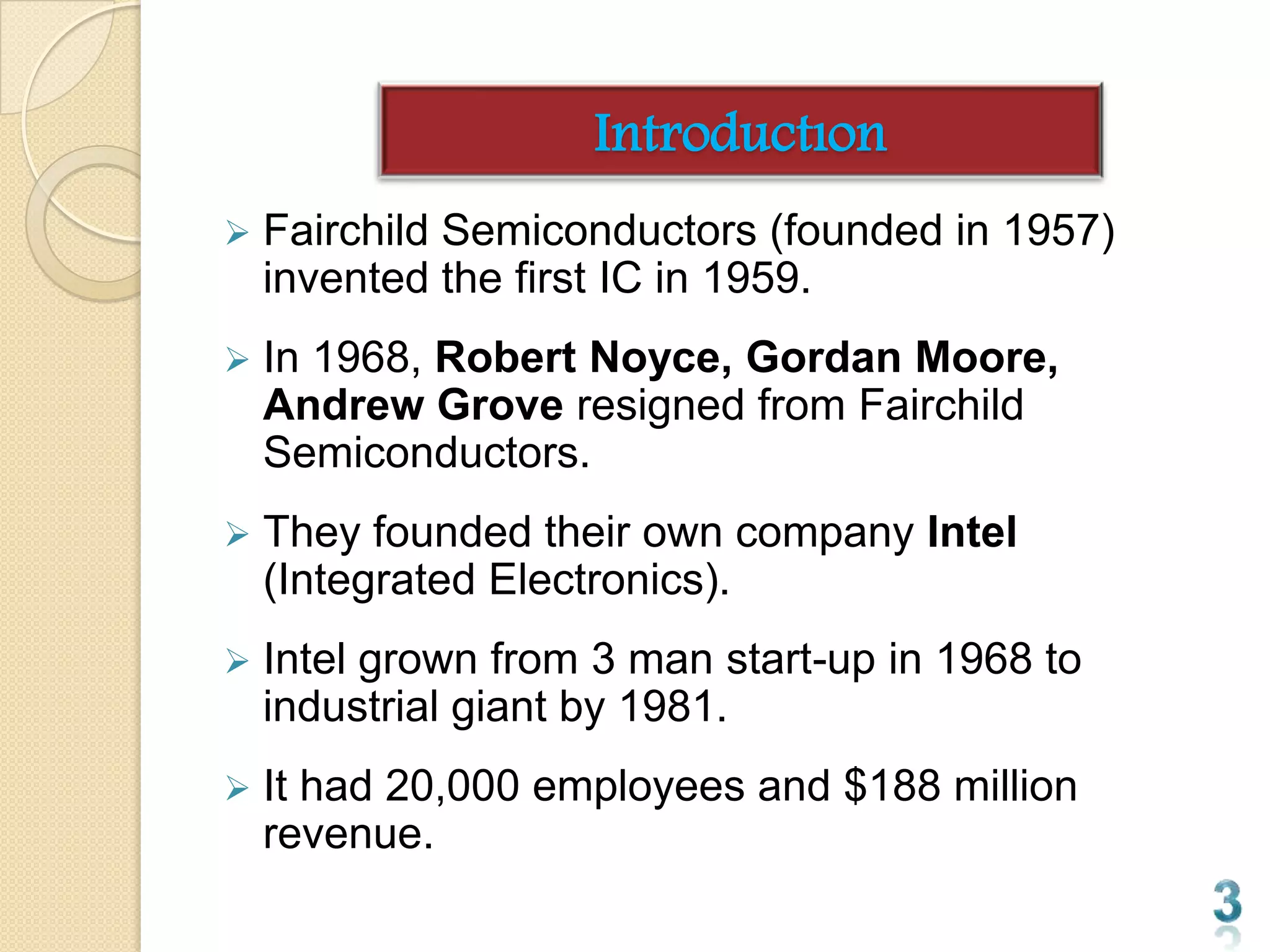
   Fairchild Semiconductors (founded in 1957)
    invented the first IC in 1959.
   In 1968, Robert Noyce, Gordan Moore,
    Andrew Grove resigned from Fairchild
    Semiconductors.
   They founded their own company Intel
    (Integrated Electronics).
   Intel grown from 3 man start-up in 1968 to
    industrial giant by 1981.
   It had 20,000 employees and $188 million
    revenue.
4-bıt Mıcroprocessors
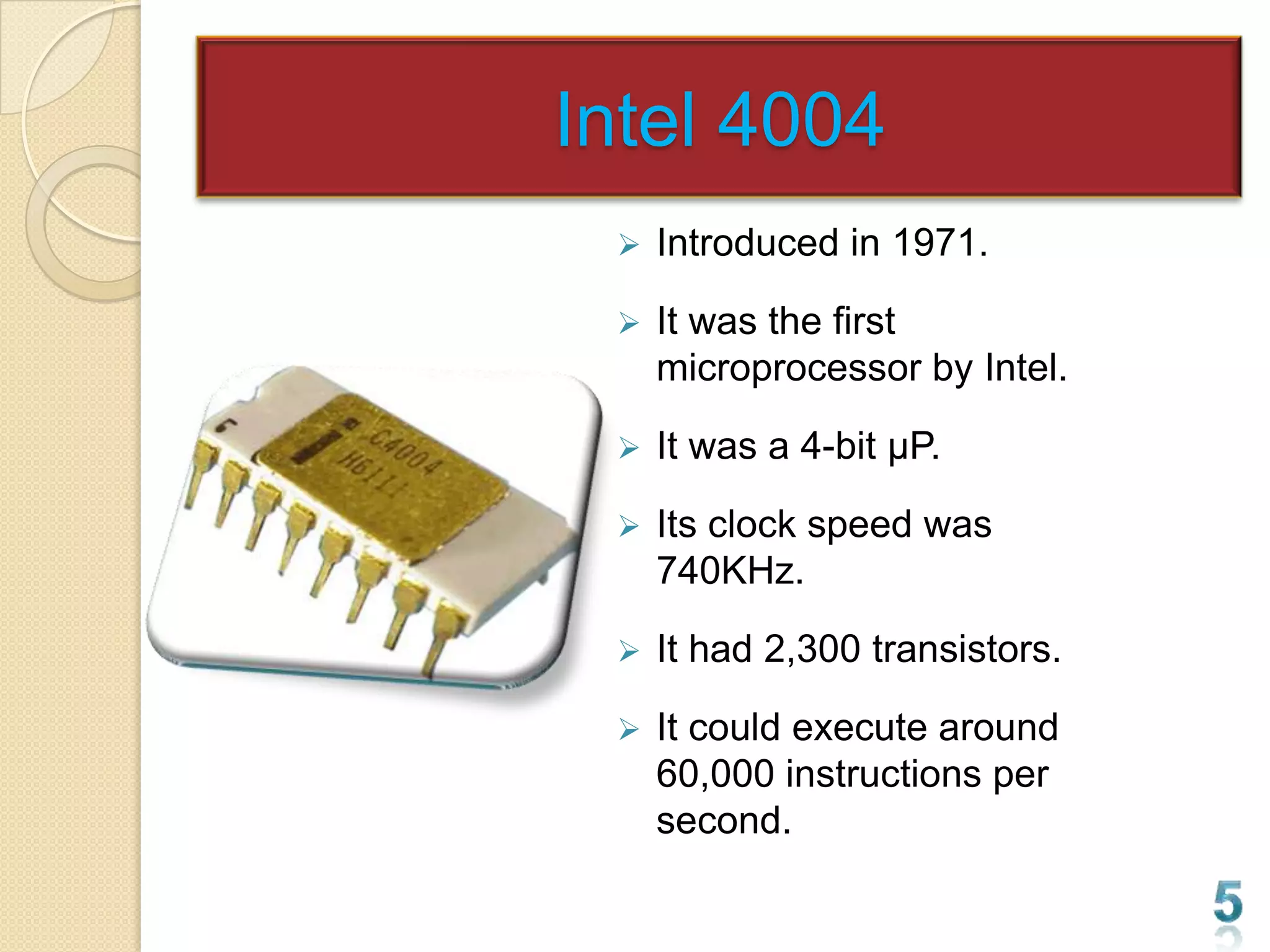
Intel 4004
    Introduced in 1971.

    It was the first
     microprocessor by Intel.

    It was a 4-bit µP.

    Its clock speed was
     740KHz.

    It had 2,300 transistors.

    It could execute around
     60,000 instructions per
     second.
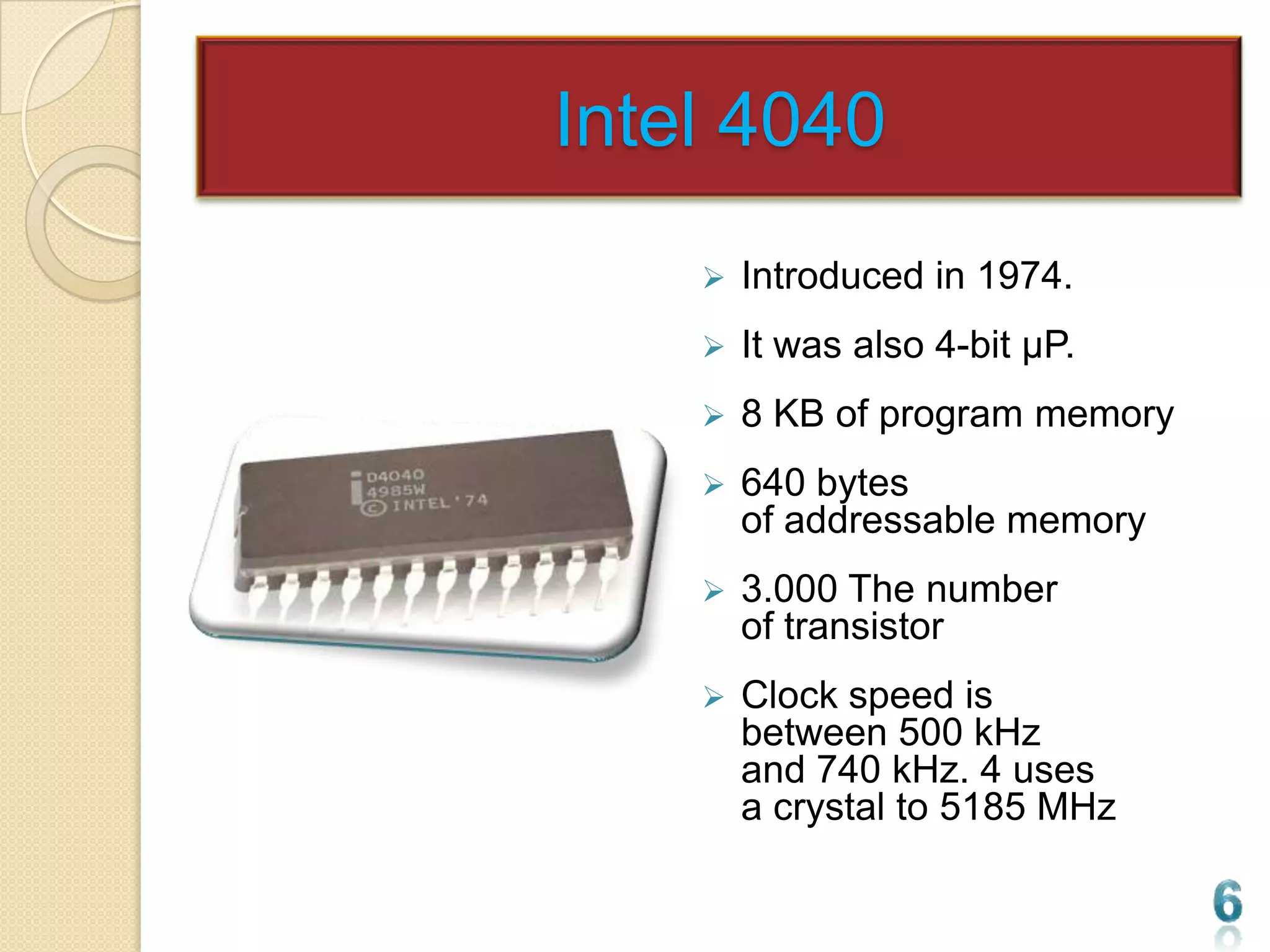
Intel 4040
       Introduced in 1974.
       It was also 4-bit µP.
       8 KB of program memory
       640 bytes
        of addressable memory
       3.000 The number
        of transistor
       Clock speed is
        between 500 kHz
        and 740 kHz. 4 uses
        a crystal to 5185 MHz
8-bıt Mıcroprocessors
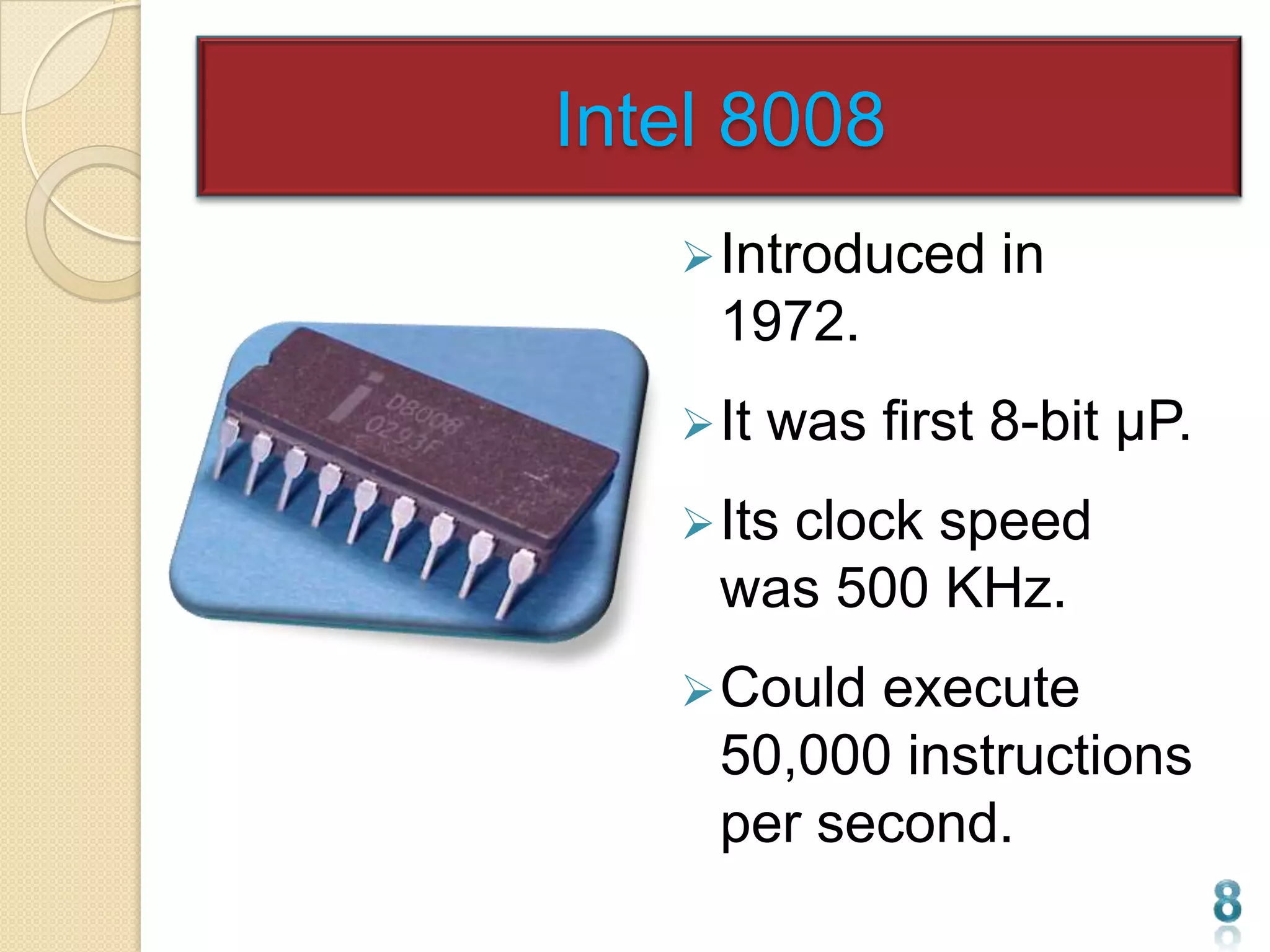
Intel 8008
    Introduced     in
     1972.
    It   was first 8-bit µP.
    Its
       clock speed
     was 500 KHz.
    Could execute
     50,000 instructions
     per second.
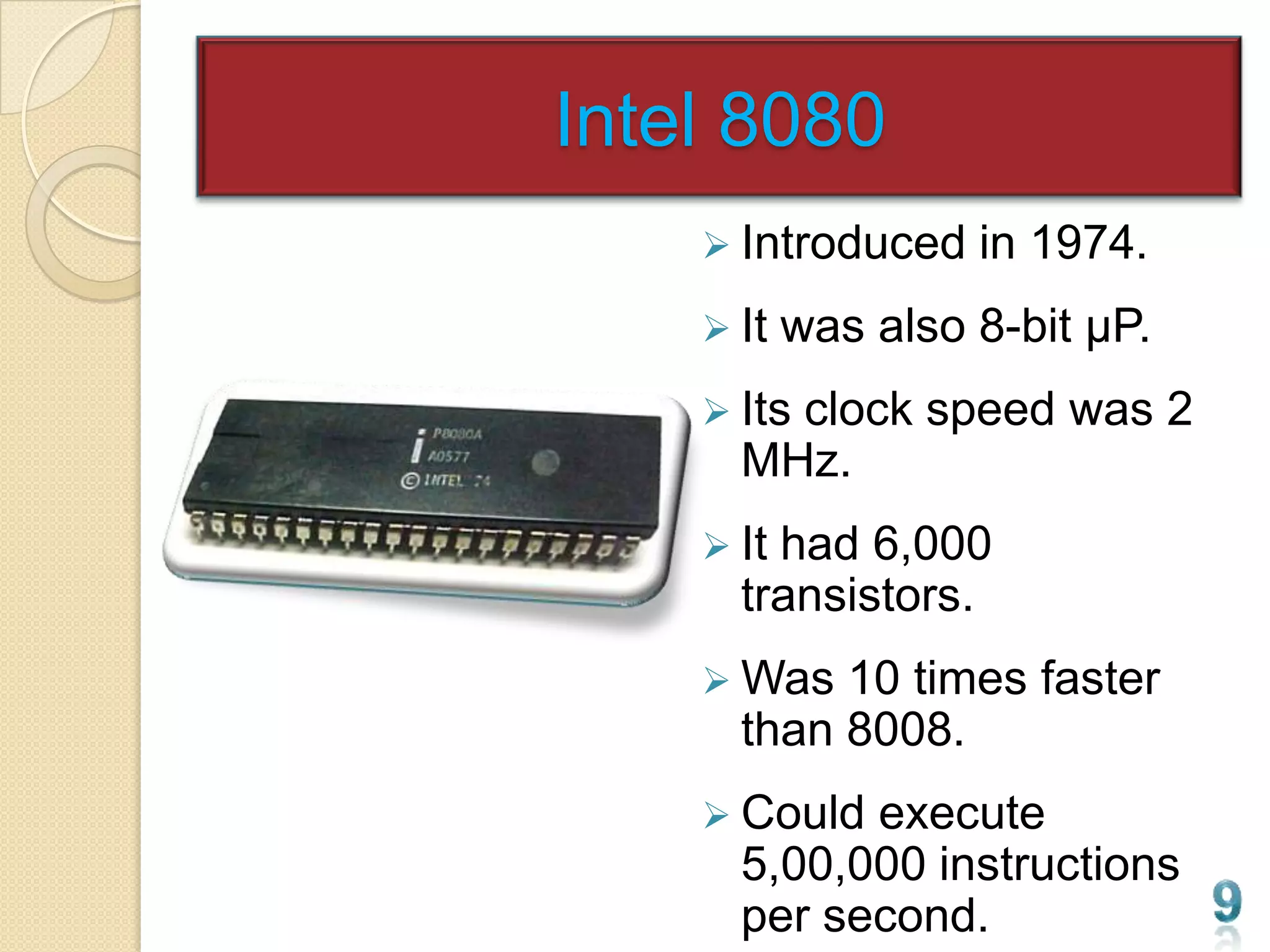
Intel 8080
     Introduced    in 1974.
     It   was also 8-bit µP.
     Its
        clock speed was 2
      MHz.
     Ithad 6,000
      transistors.
     Was  10 times faster
      than 8008.
     Could execute
      5,00,000 instructions
      per second.
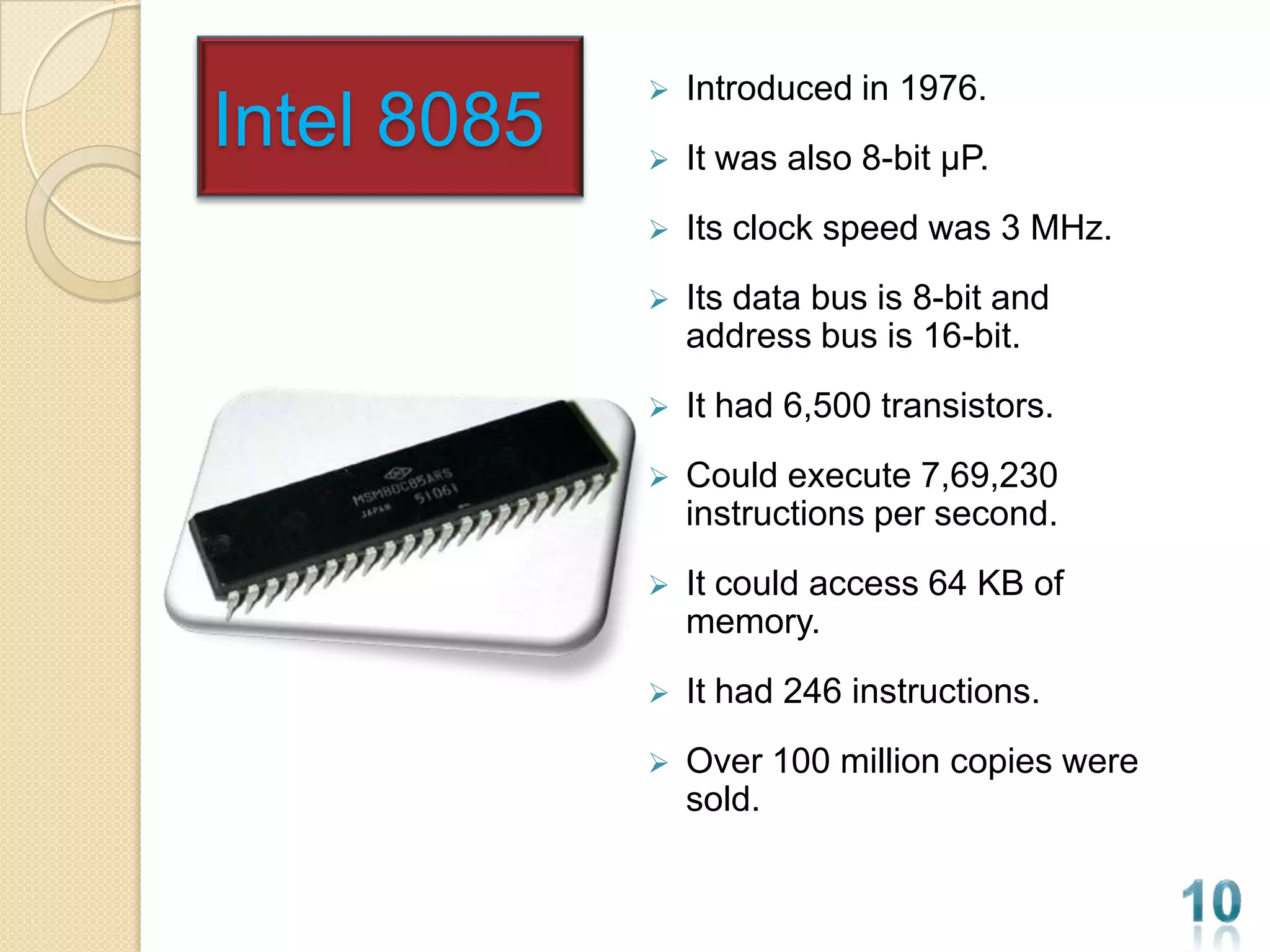
   Introduced in 1976.
Intel 8085      It was also 8-bit µP.
                Its clock speed was 3 MHz.
                Its data bus is 8-bit and
                 address bus is 16-bit.
                It had 6,500 transistors.
                Could execute 7,69,230
                 instructions per second.
                It could access 64 KB of
                 memory.
                It had 246 instructions.
                Over 100 million copies were
                 sold.
16-bıt Mıcroprocessors
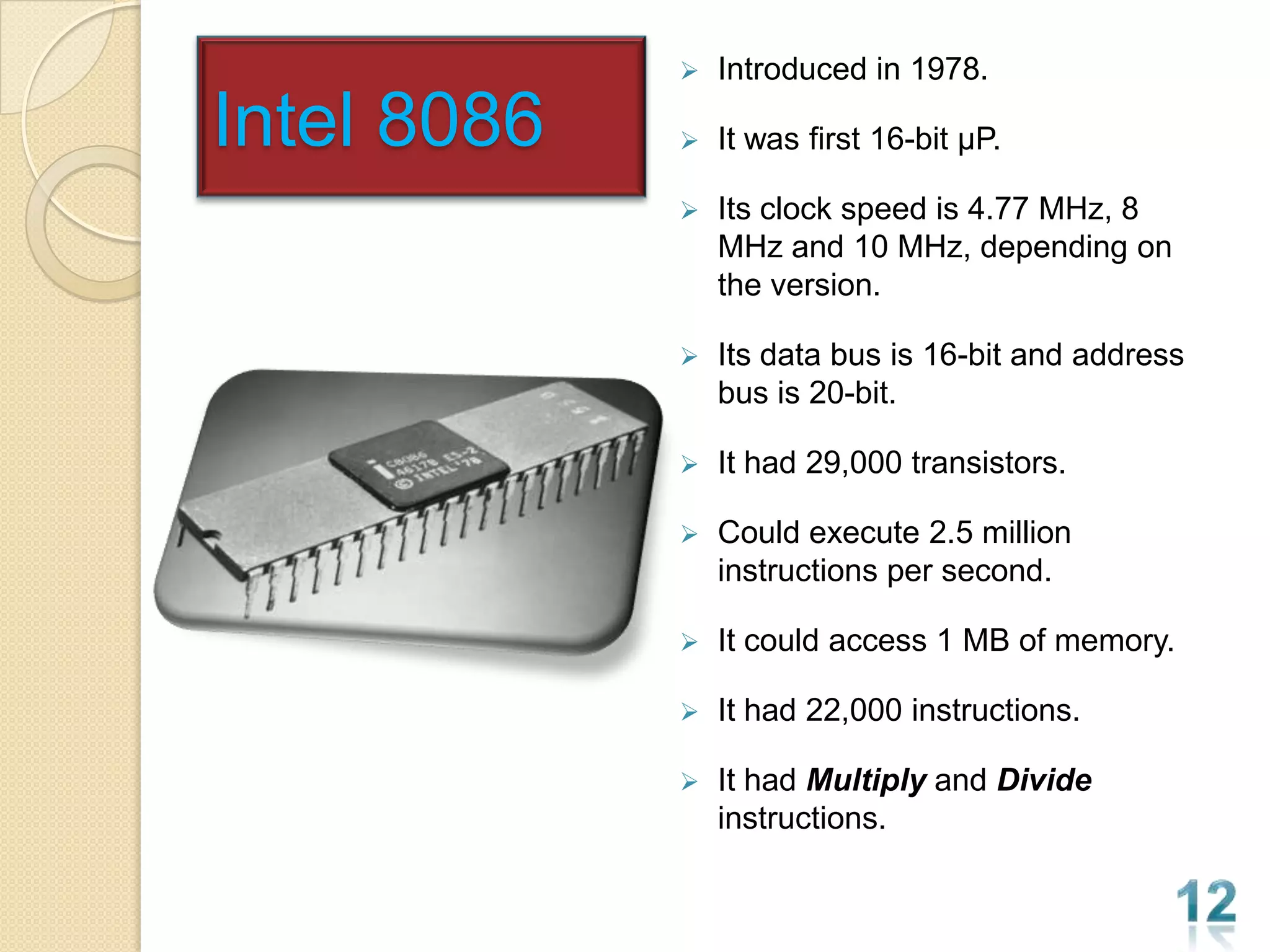
   Introduced in 1978.

Intel 8086      It was first 16-bit µP.

                Its clock speed is 4.77 MHz, 8
                 MHz and 10 MHz, depending on
                 the version.

                Its data bus is 16-bit and address
                 bus is 20-bit.

                It had 29,000 transistors.

                Could execute 2.5 million
                 instructions per second.

                It could access 1 MB of memory.

                It had 22,000 instructions.

                It had Multiply and Divide
                 instructions.
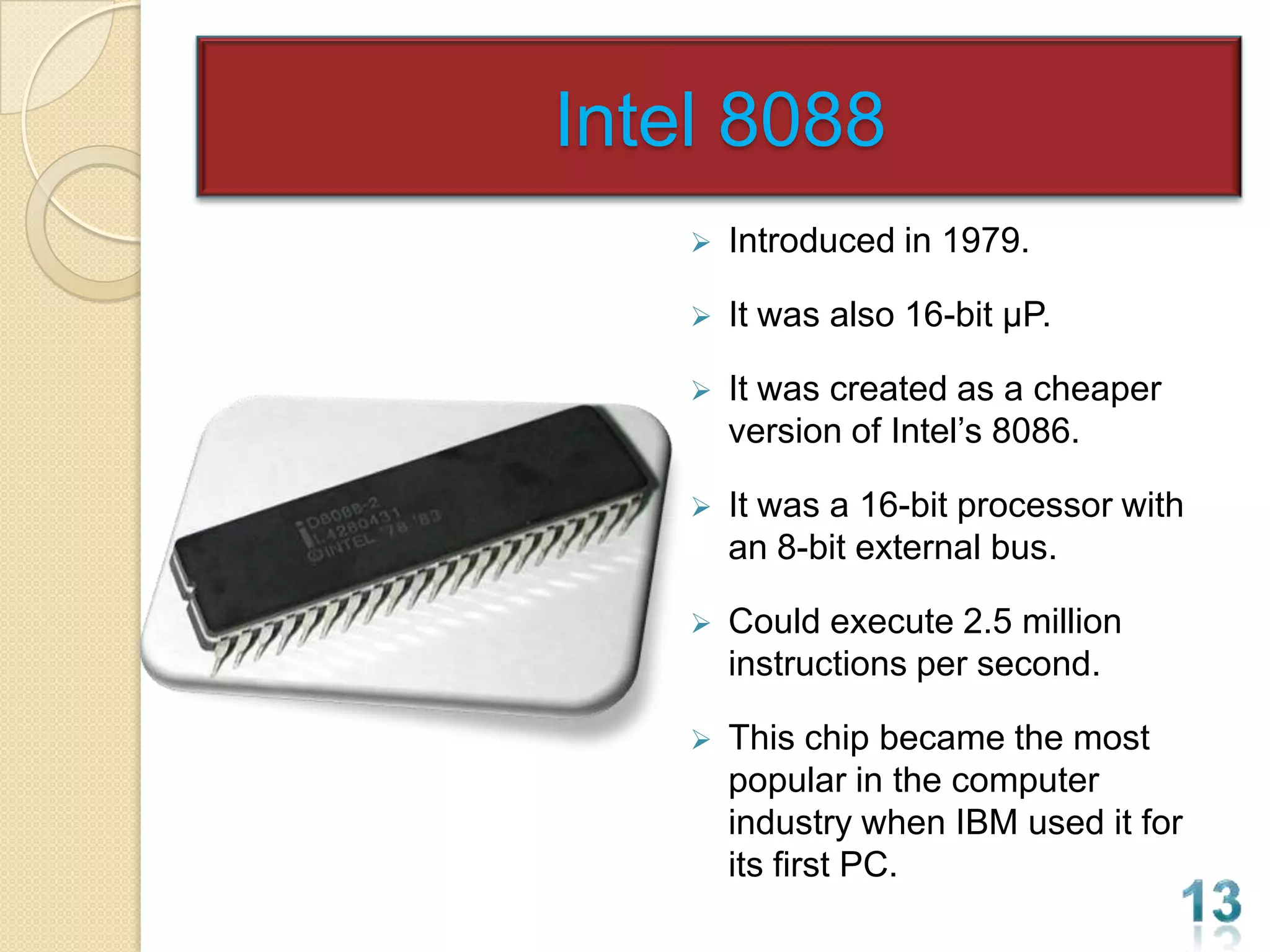
Intel 8088
       Introduced in 1979.

       It was also 16-bit µP.

       It was created as a cheaper
        version of Intel’s 8086.

       It was a 16-bit processor with
        an 8-bit external bus.

       Could execute 2.5 million
        instructions per second.

       This chip became the most
        popular in the computer
        industry when IBM used it for
        its first PC.
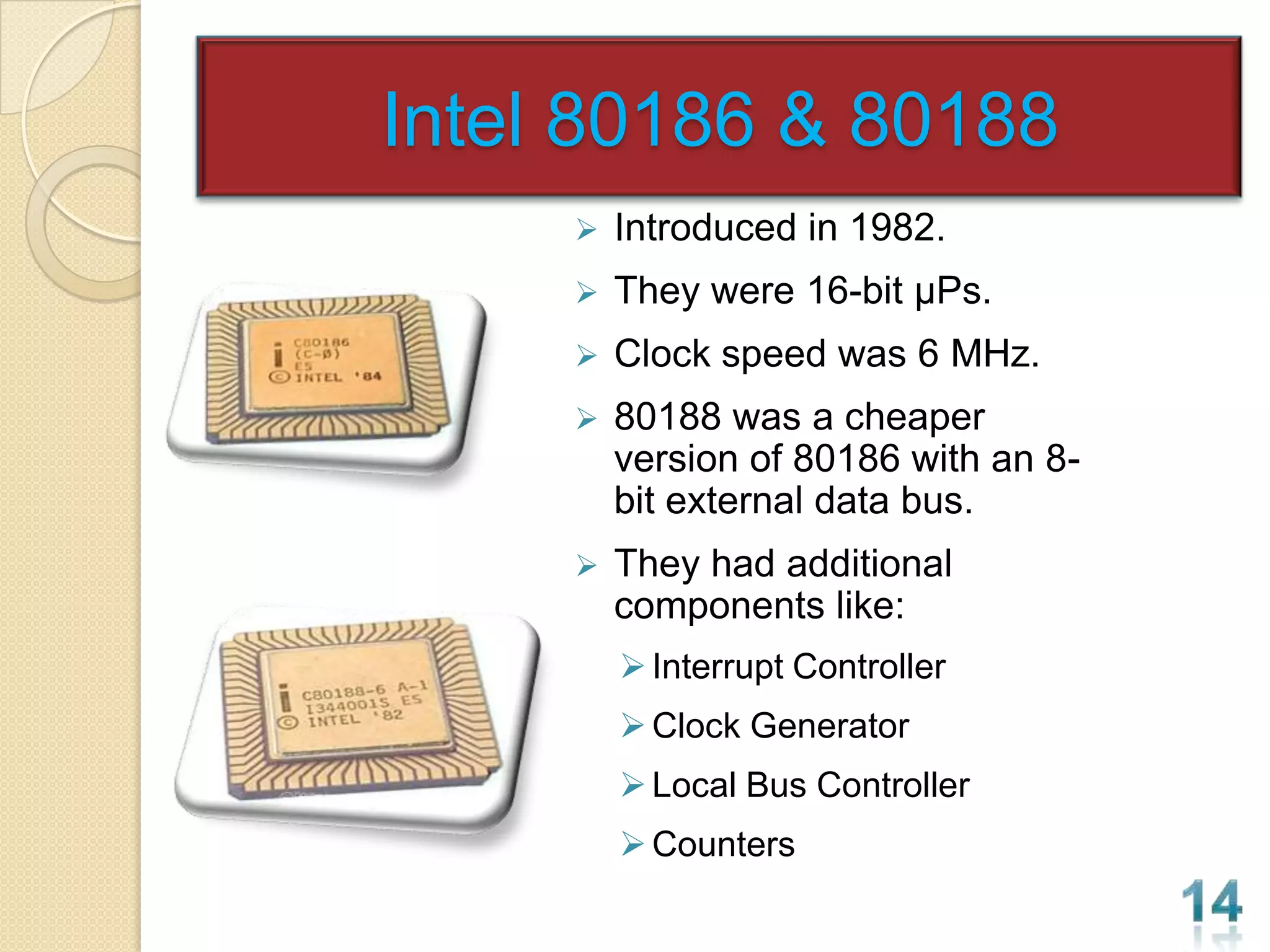
Intel 80186 & 80188
        Introduced in 1982.
        They were 16-bit µPs.
        Clock speed was 6 MHz.
        80188 was a cheaper
         version of 80186 with an 8-
         bit external data bus.
        They had additional
         components like:
          Interrupt Controller
          Clock Generator
          Local Bus Controller
          Counters
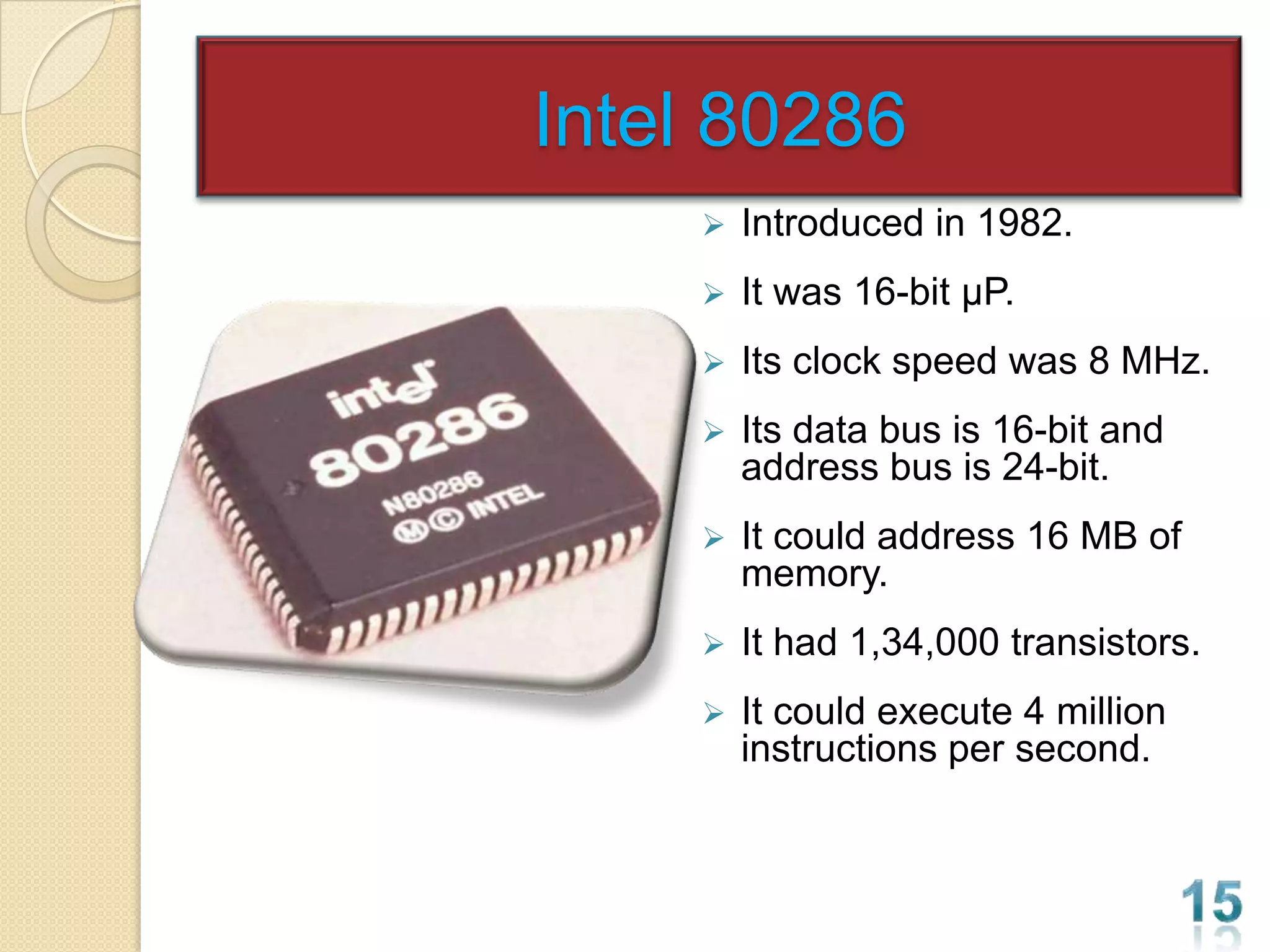
Intel 80286
       Introduced in 1982.
       It was 16-bit µP.
       Its clock speed was 8 MHz.
       Its data bus is 16-bit and
        address bus is 24-bit.
       It could address 16 MB of
        memory.
       It had 1,34,000 transistors.
       It could execute 4 million
        instructions per second.
32-bıt Mıcroprocessors
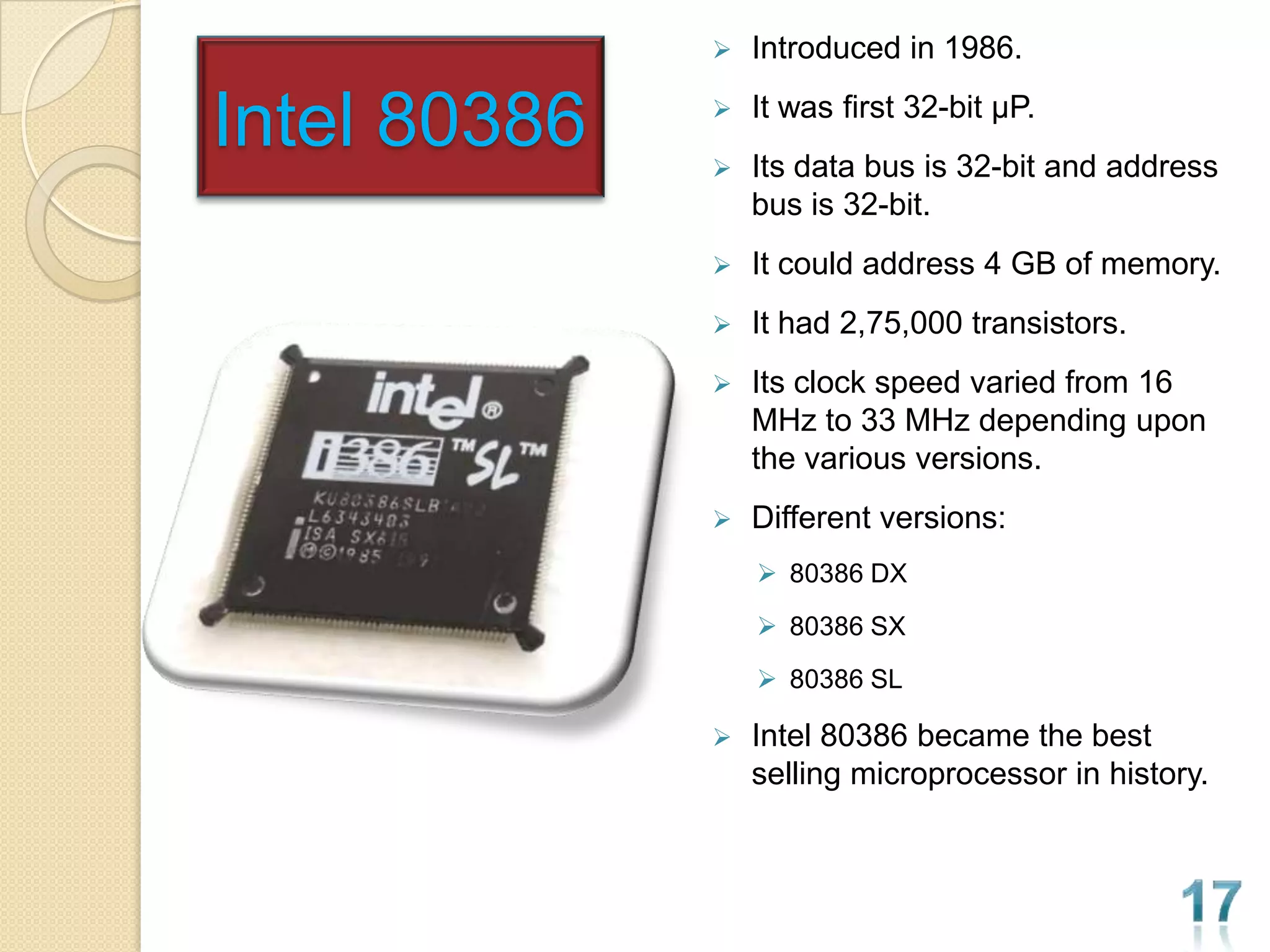
   Introduced in 1986.

Intel 80386   

              
                  It was first 32-bit µP.
                  Its data bus is 32-bit and address
                  bus is 32-bit.
                 It could address 4 GB of memory.
                 It had 2,75,000 transistors.
                 Its clock speed varied from 16
                  MHz to 33 MHz depending upon
                  the various versions.
                 Different versions:
                   80386 DX

                   80386 SX

                   80386 SL

                 Intel 80386 became the best
                  selling microprocessor in history.
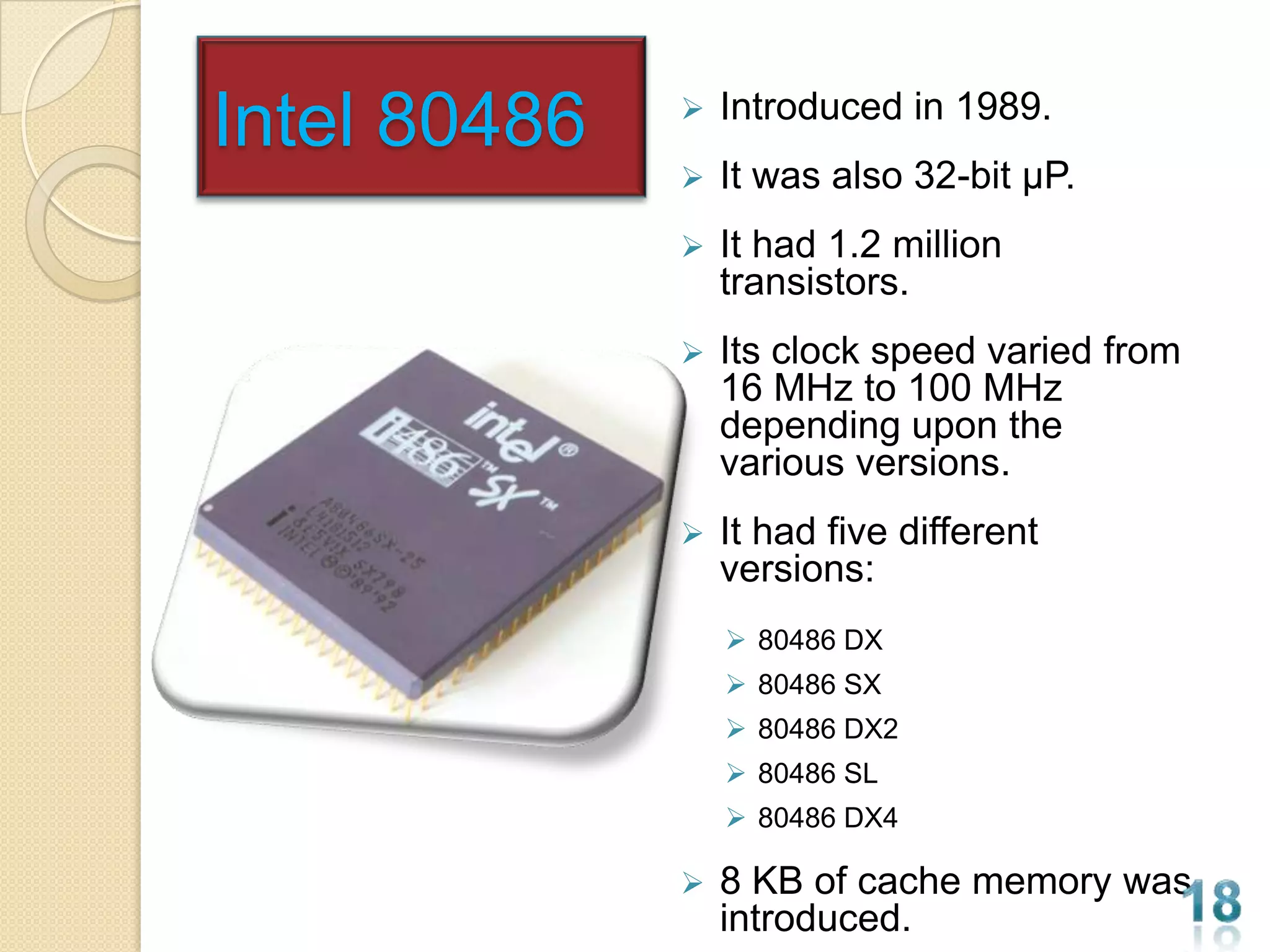
Intel 80486      Introduced in 1989.
                 It was also 32-bit µP.
                 It had 1.2 million
                  transistors.
                 Its clock speed varied from
                  16 MHz to 100 MHz
                  depending upon the
                  various versions.
                 It had five different
                  versions:
                   80486 DX
                   80486 SX
                   80486 DX2
                   80486 SL
                   80486 DX4

                 8 KB of cache memory was
                  introduced.
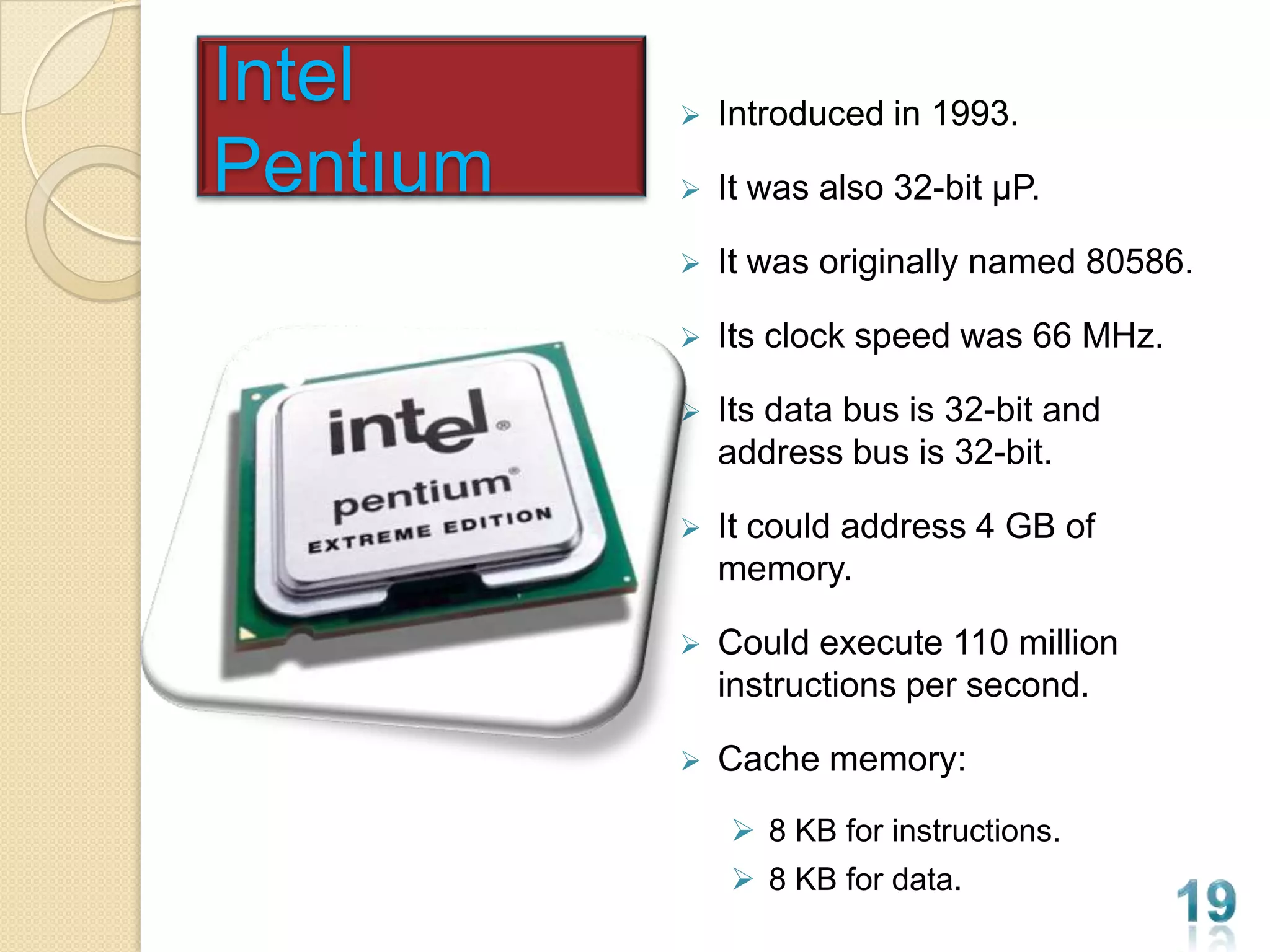
Intel        Introduced in 1993.
Pentıum      It was also 32-bit µP.

             It was originally named 80586.

             Its clock speed was 66 MHz.

             Its data bus is 32-bit and
              address bus is 32-bit.

             It could address 4 GB of
              memory.

             Could execute 110 million
              instructions per second.

             Cache memory:
               8 KB for instructions.
               8 KB for data.
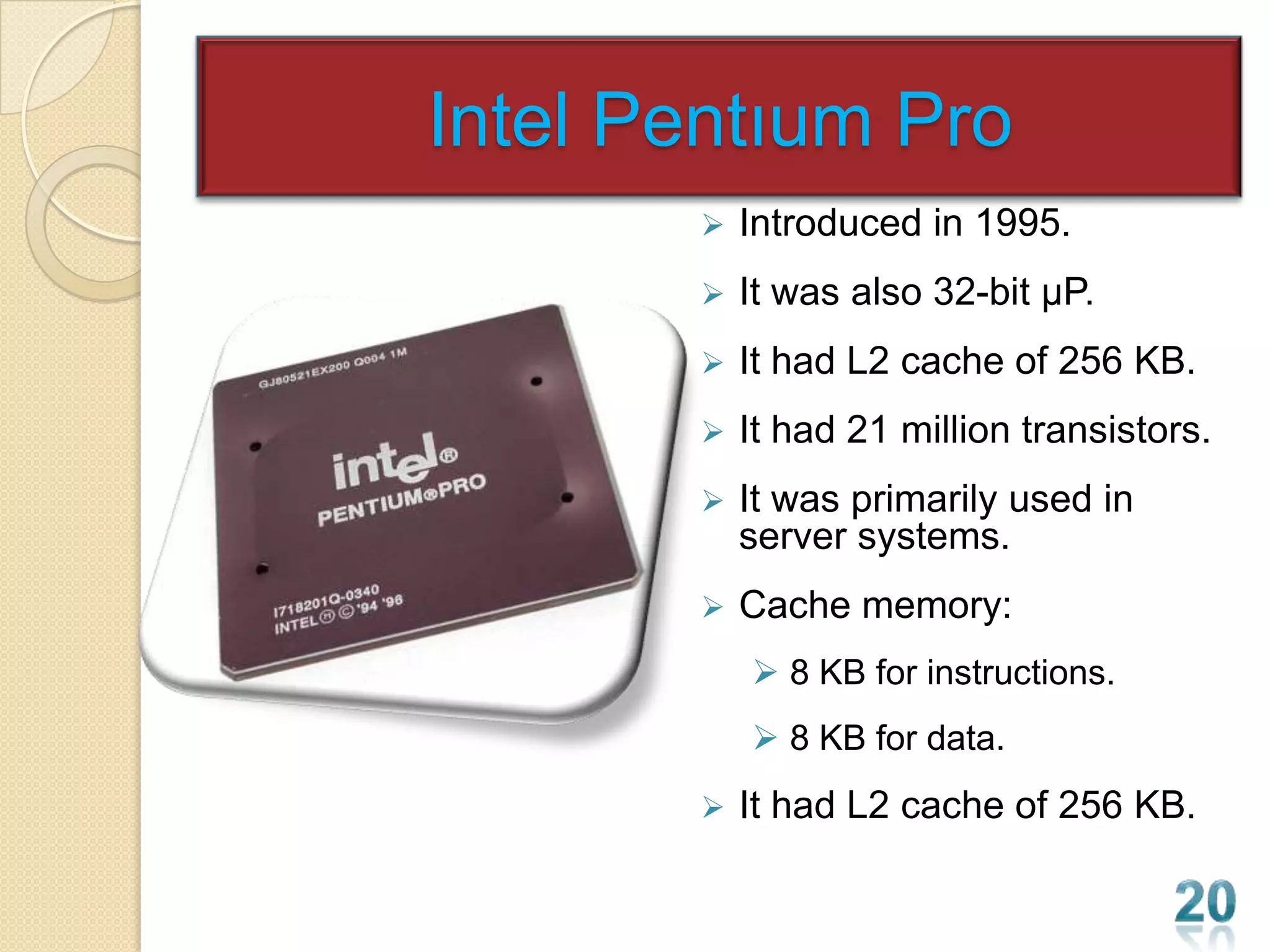
Intel Pentıum Pro
          Introduced in 1995.
          It was also 32-bit µP.
          It had L2 cache of 256 KB.
          It had 21 million transistors.
          It was primarily used in
           server systems.
          Cache memory:
            8 KB for instructions.
            8 KB for data.
          It had L2 cache of 256 KB.
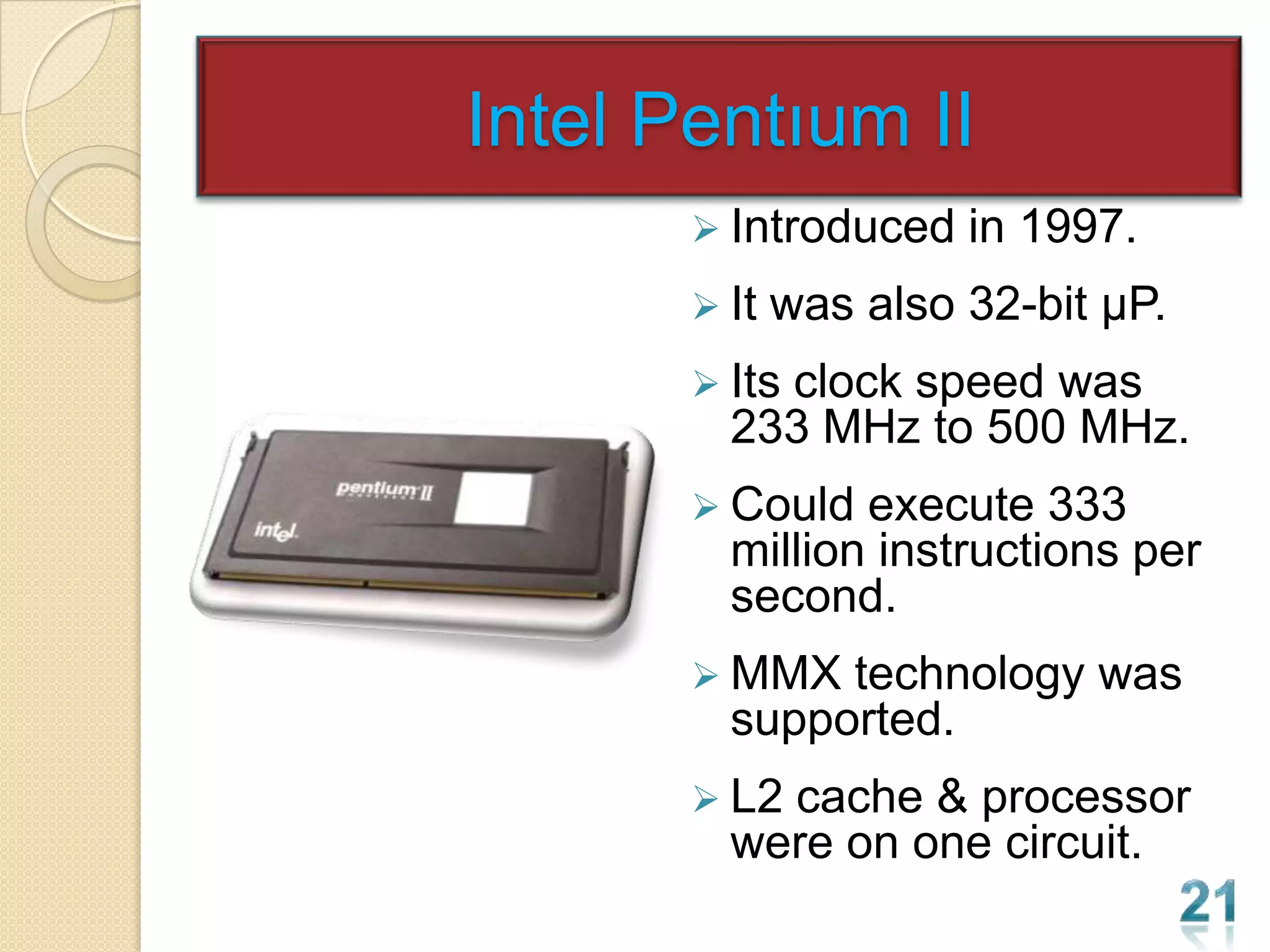
Intel Pentıum II
        Introduced    in 1997.
        It   was also 32-bit µP.
        Its
           clock speed was
         233 MHz to 500 MHz.
        Could  execute 333
         million instructions per
         second.
        MMX  technology was
         supported.
        L2cache & processor
         were on one circuit.
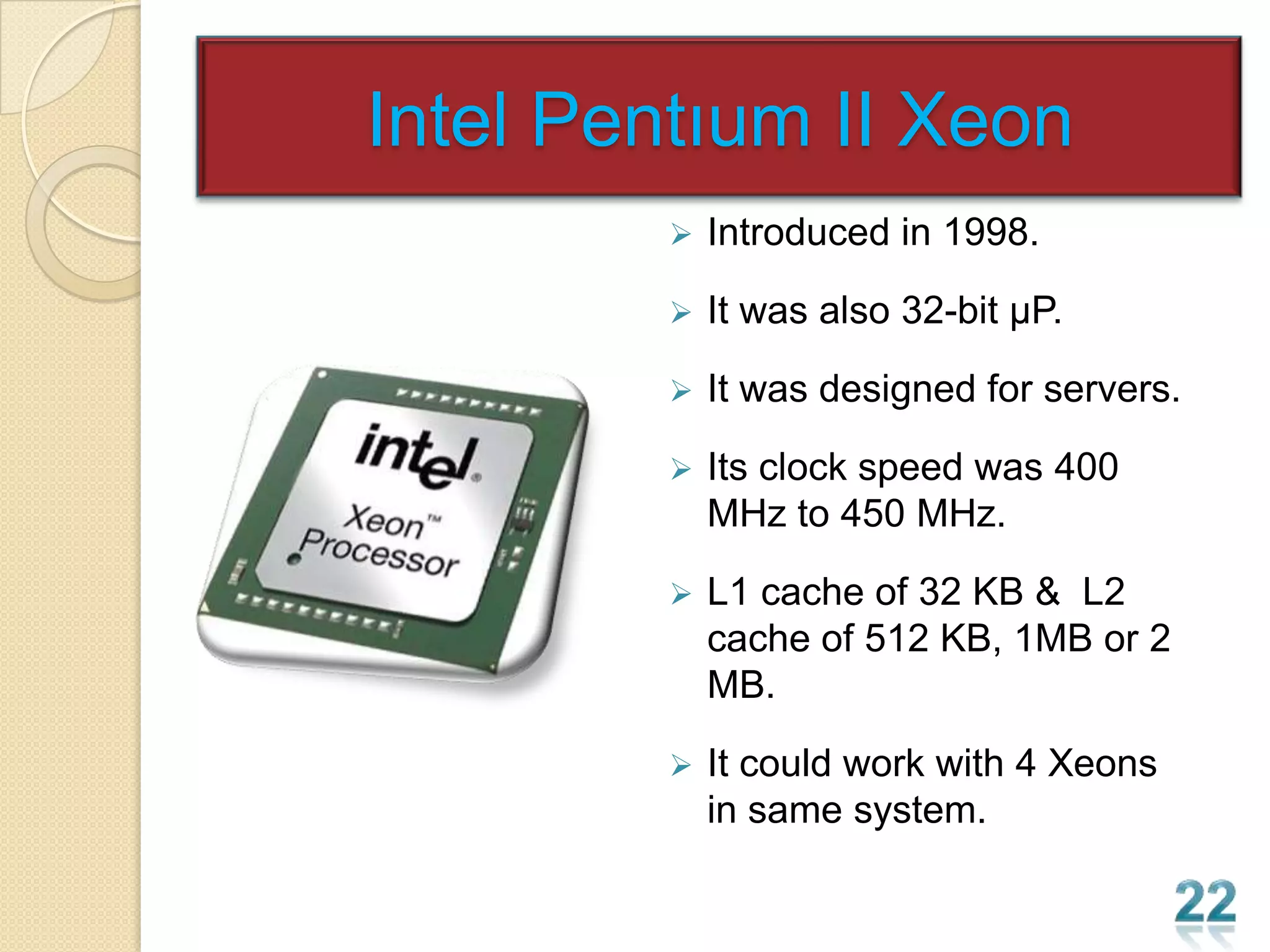
Intel Pentıum II Xeon
           Introduced in 1998.

           It was also 32-bit µP.

           It was designed for servers.

           Its clock speed was 400
            MHz to 450 MHz.

           L1 cache of 32 KB & L2
            cache of 512 KB, 1MB or 2
            MB.

           It could work with 4 Xeons
            in same system.
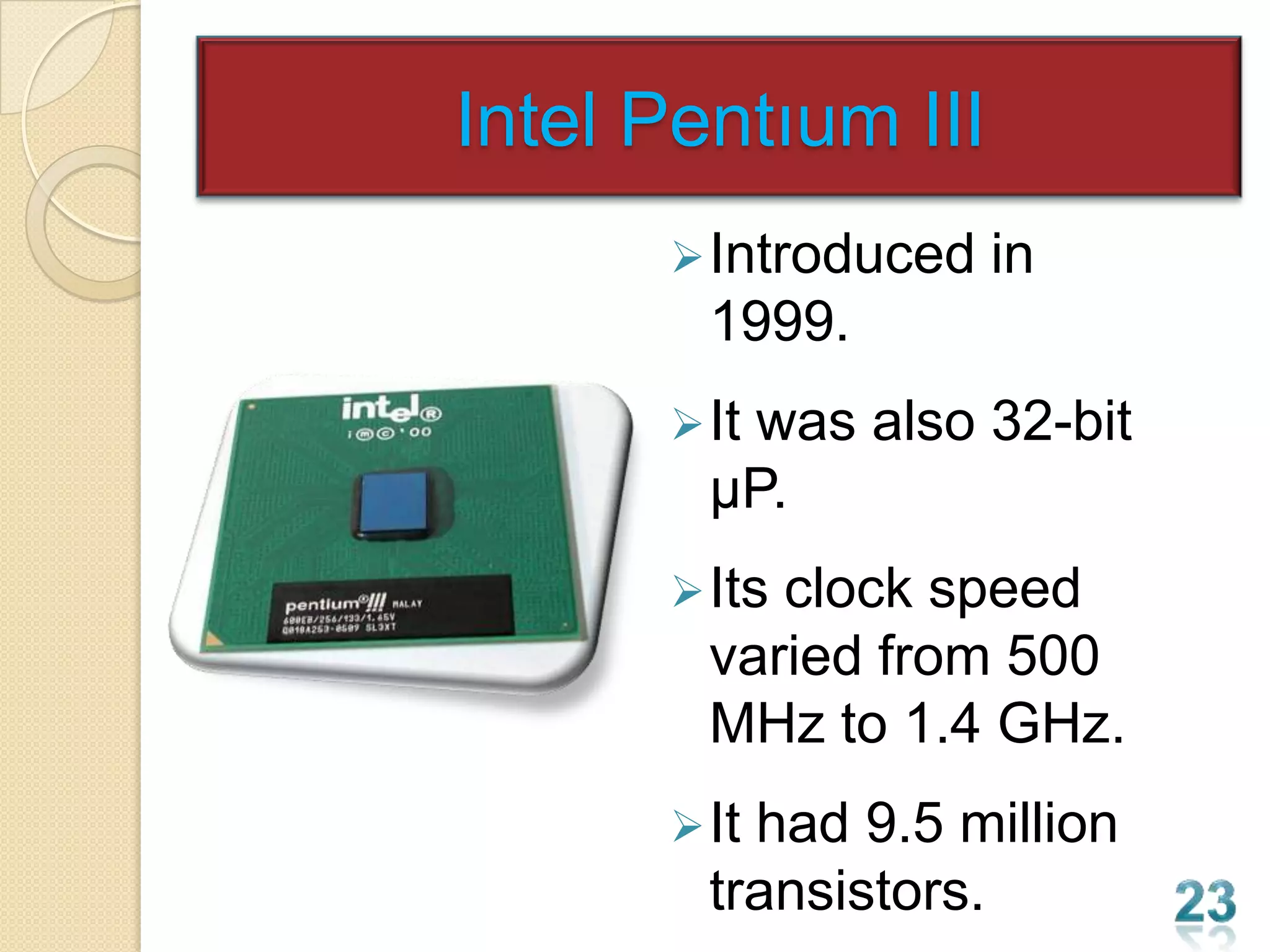
Intel Pentıum III
       Introduced   in
        1999.
       It
         was also 32-bit
        µP.
       Itsclock speed
        varied from 500
        MHz to 1.4 GHz.
       Ithad 9.5 million
        transistors.
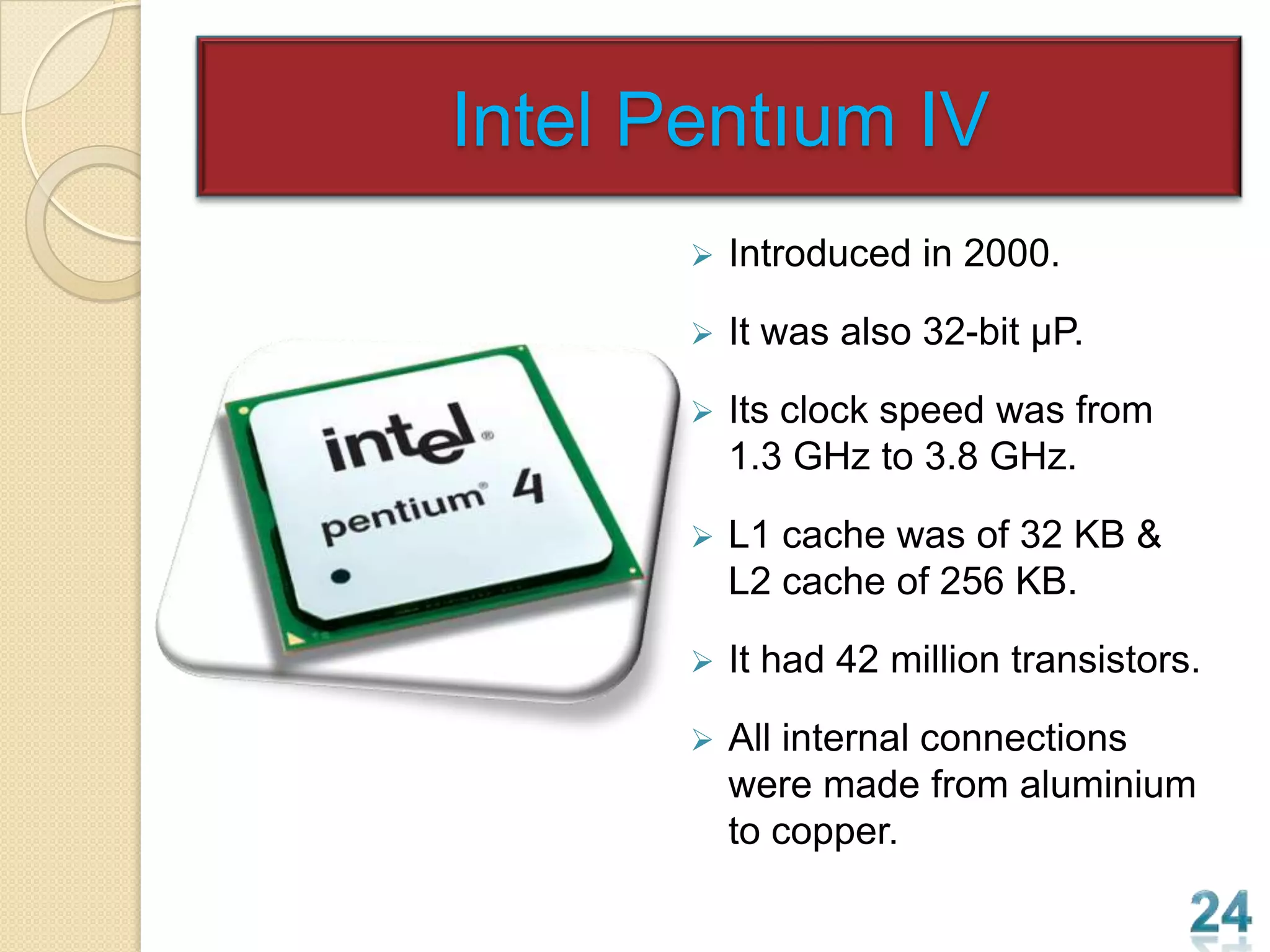
Intel Pentıum IV
          Introduced in 2000.

          It was also 32-bit µP.

          Its clock speed was from
           1.3 GHz to 3.8 GHz.

          L1 cache was of 32 KB &
           L2 cache of 256 KB.

          It had 42 million transistors.

          All internal connections
           were made from aluminium
           to copper.
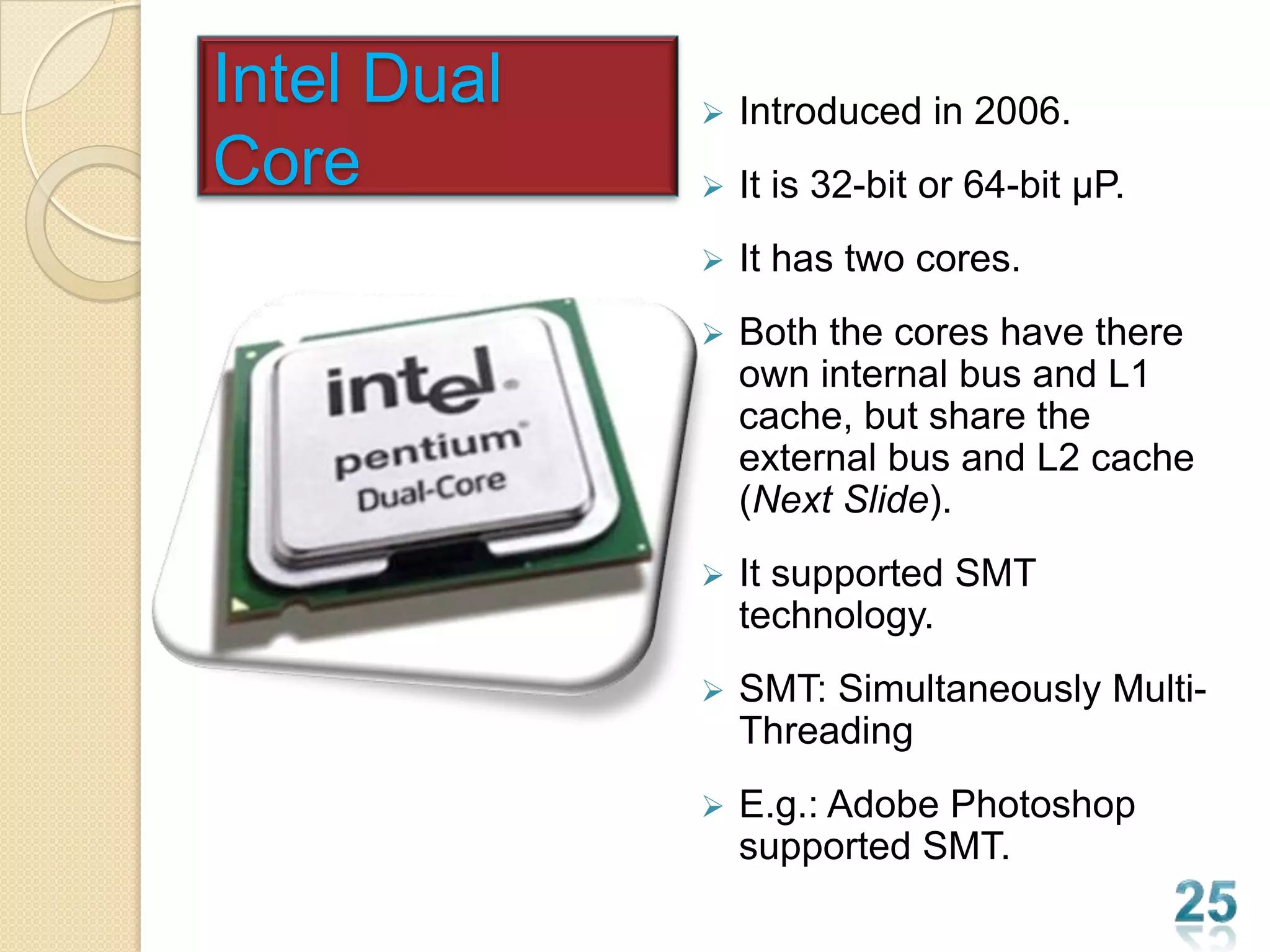
Intel Dual      Introduced in 2006.
Core            It is 32-bit or 64-bit µP.
                It has two cores.
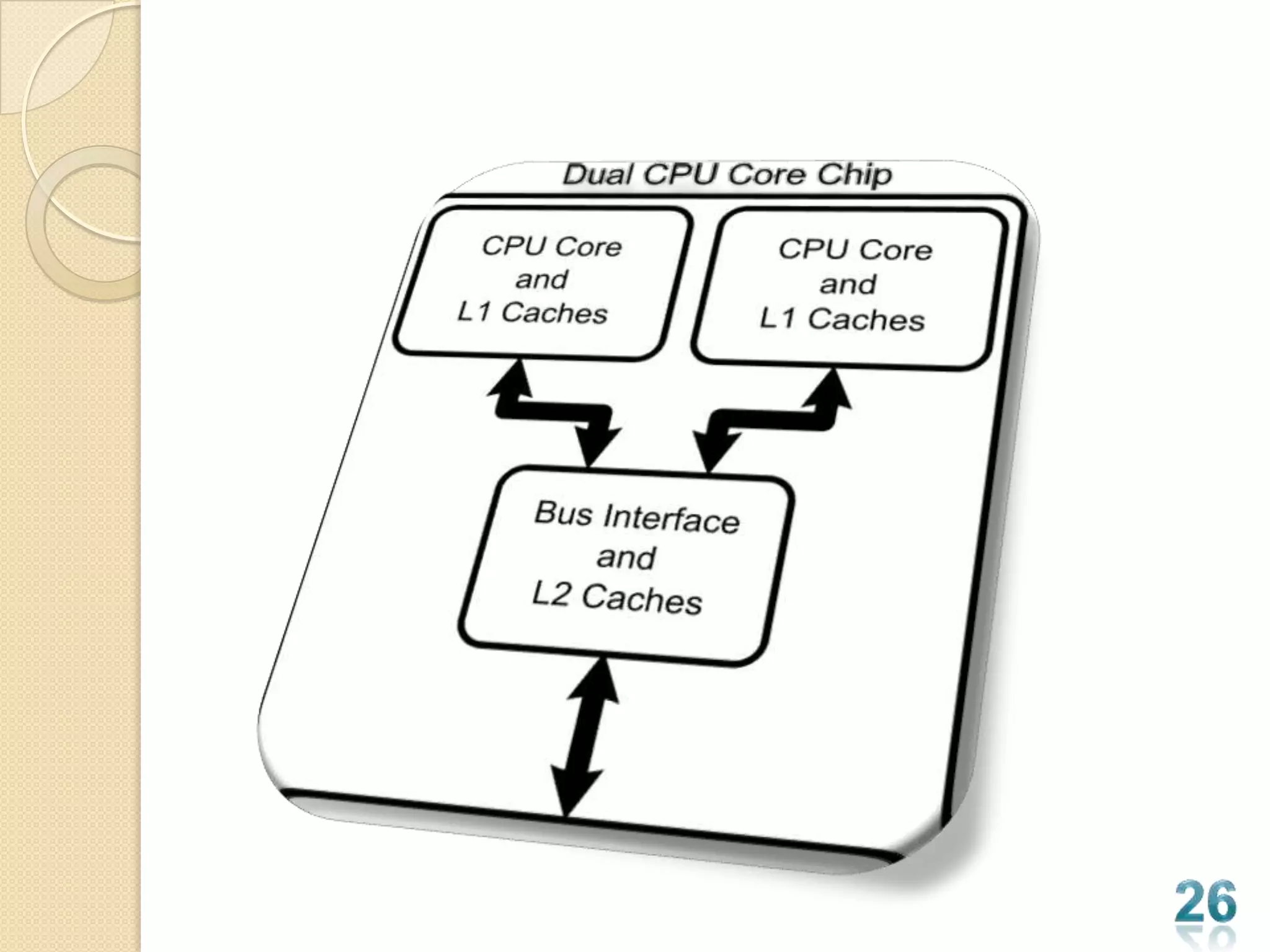
                Both the cores have there
                 own internal bus and L1
                 cache, but share the
                 external bus and L2 cache
                 (Next Slide).
                It supported SMT
                 technology.
                SMT: Simultaneously Multi-
                 Threading
                E.g.: Adobe Photoshop
                 supported SMT.
64-bıt Mıcroprocessors
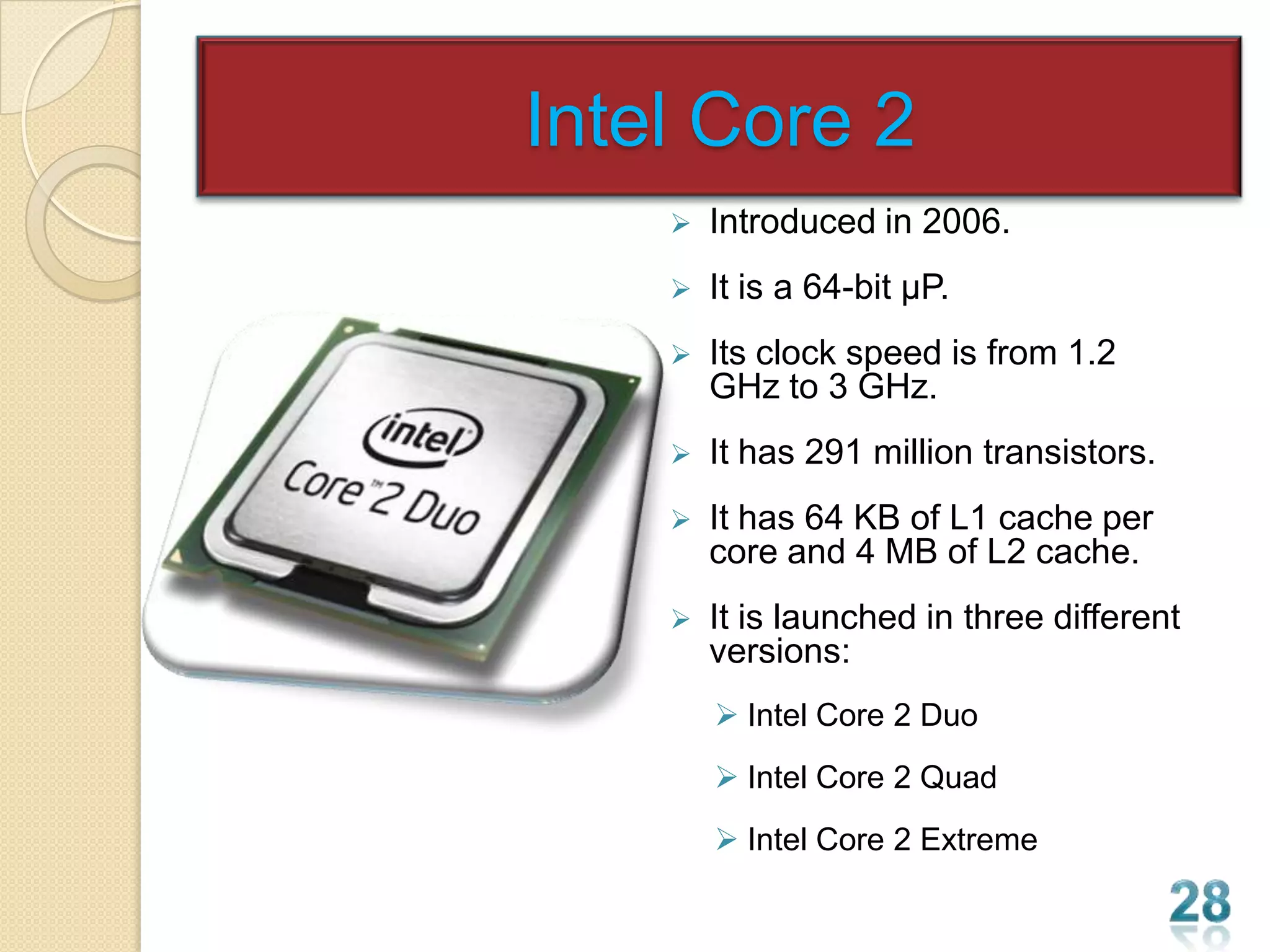
Intel Core 2
       Introduced in 2006.
       It is a 64-bit µP.
       Its clock speed is from 1.2
        GHz to 3 GHz.
       It has 291 million transistors.
       It has 64 KB of L1 cache per
        core and 4 MB of L2 cache.
       It is launched in three different
        versions:
         Intel Core 2 Duo
         Intel Core 2 Quad
         Intel Core 2 Extreme
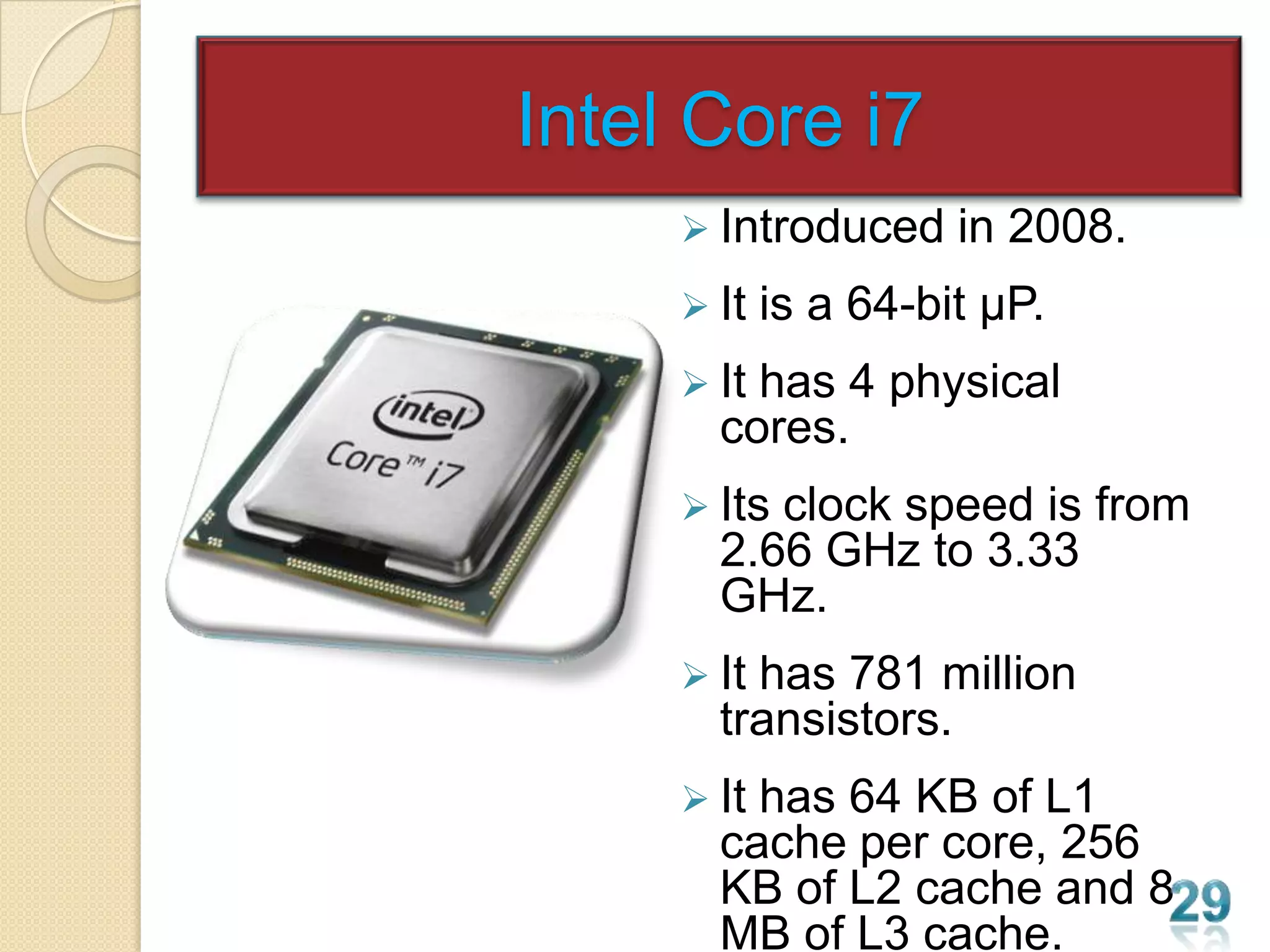
Intel Core i7
      Introduced     in 2008.
      It   is a 64-bit µP.
      Ithas 4 physical
       cores.
      Itsclock speed is from
       2.66 GHz to 3.33
       GHz.
      Ithas 781 million
       transistors.
      Ithas 64 KB of L1
       cache per core, 256
       KB of L2 cache and 8
       MB of L3 cache.
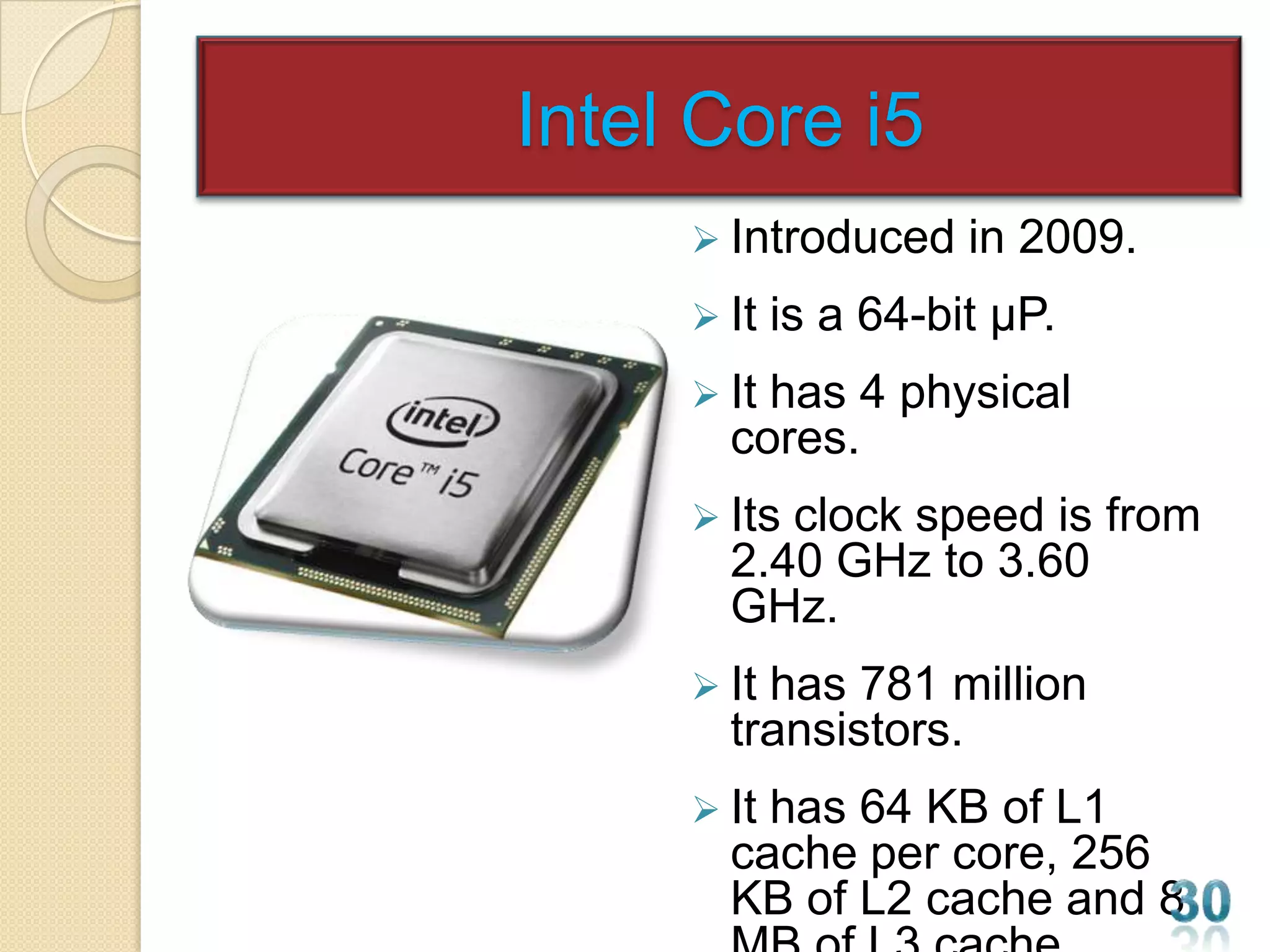
Intel Core i5
      Introduced     in 2009.
      It   is a 64-bit µP.
      Ithas 4 physical
       cores.
      Itsclock speed is from
       2.40 GHz to 3.60
       GHz.
      Ithas 781 million
       transistors.
      Ithas 64 KB of L1
       cache per core, 256
       KB of L2 cache and 8
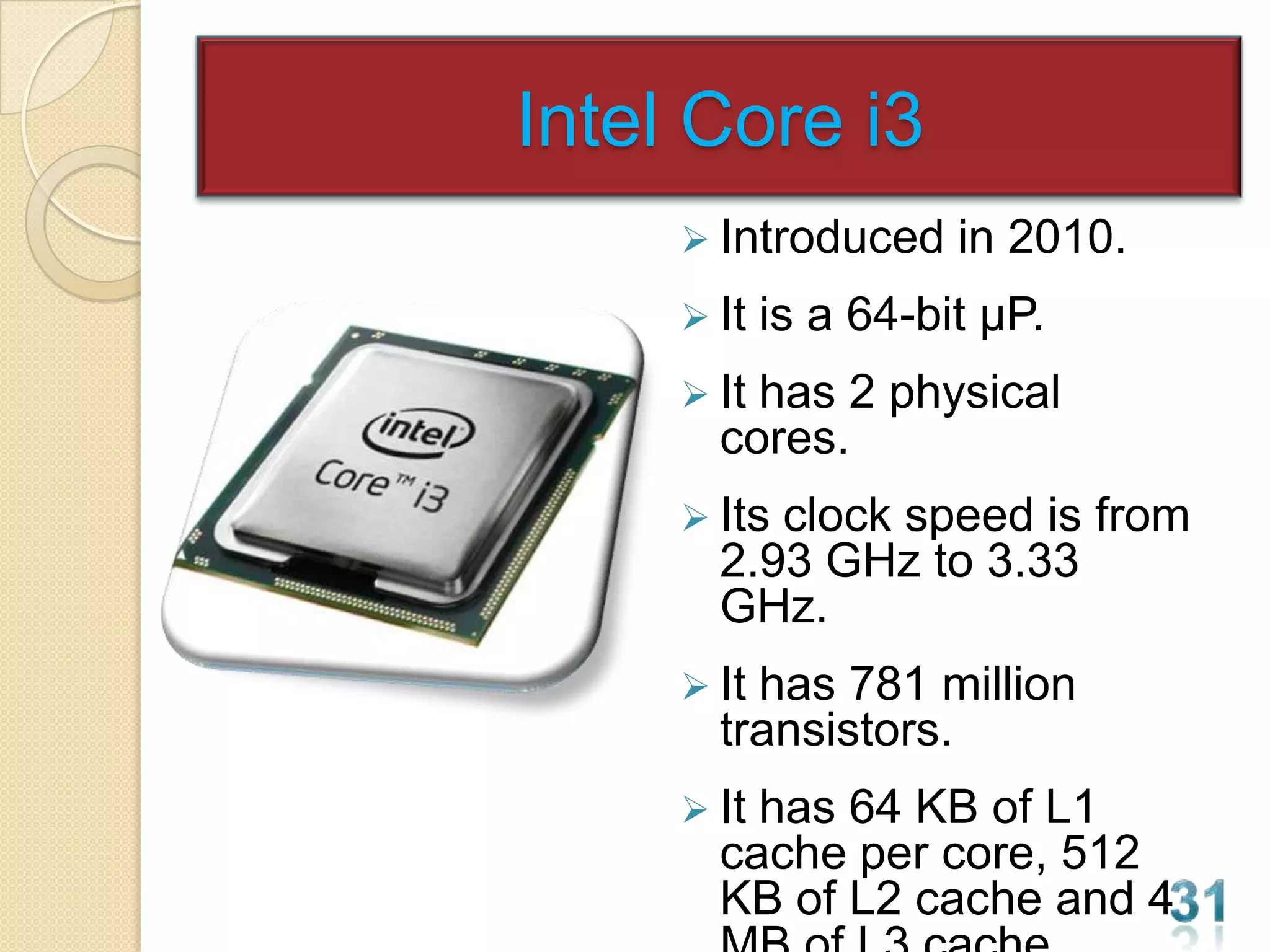
Intel Core i3
      Introduced     in 2010.
      It   is a 64-bit µP.
      Ithas 2 physical
       cores.
      Itsclock speed is from
       2.93 GHz to 3.33
       GHz.
      Ithas 781 million
       transistors.
      Ithas 64 KB of L1
       cache per core, 512
       KB of L2 cache and 4
REFERENCE

 http://en.wikipedia.org/wiki/Microproce
  ssor
 http://www-
  scm.tees.ac.uk/users/a.clements/Histo
  ry/History.htm
 http://www.buzzle.com/articles/history-
  of-microprocessor.html

History of microprocessors

  • 1.
    Name: Emrah Surname: Aptoula Studentsnumber: 20090024 Course: Eng102 Subject: History Of Microprocessors
  • 2.
    Contents  Introduction  4-Bit Microprocessors  8-Bit Microprocessors  16-Bit Microprocessors  32-Bit Microprocessors  64-Bit Microprocessors
  • 3.
    Introductıon  Fairchild Semiconductors (founded in 1957) invented the first IC in 1959.  In 1968, Robert Noyce, Gordan Moore, Andrew Grove resigned from Fairchild Semiconductors.  They founded their own company Intel (Integrated Electronics).  Intel grown from 3 man start-up in 1968 to industrial giant by 1981.  It had 20,000 employees and $188 million revenue.
  • 4.
  • 5.
    Intel 4004  Introduced in 1971.  It was the first microprocessor by Intel.  It was a 4-bit µP.  Its clock speed was 740KHz.  It had 2,300 transistors.  It could execute around 60,000 instructions per second.
  • 6.
    Intel 4040  Introduced in 1974.  It was also 4-bit µP.  8 KB of program memory  640 bytes of addressable memory  3.000 The number of transistor  Clock speed is between 500 kHz and 740 kHz. 4 uses a crystal to 5185 MHz
  • 7.
  • 8.
    Intel 8008  Introduced in 1972.  It was first 8-bit µP.  Its clock speed was 500 KHz.  Could execute 50,000 instructions per second.
  • 9.
    Intel 8080  Introduced in 1974.  It was also 8-bit µP.  Its clock speed was 2 MHz.  Ithad 6,000 transistors.  Was 10 times faster than 8008.  Could execute 5,00,000 instructions per second.
  • 10.
    Introduced in 1976. Intel 8085  It was also 8-bit µP.  Its clock speed was 3 MHz.  Its data bus is 8-bit and address bus is 16-bit.  It had 6,500 transistors.  Could execute 7,69,230 instructions per second.  It could access 64 KB of memory.  It had 246 instructions.  Over 100 million copies were sold.
  • 11.
  • 12.
    Introduced in 1978. Intel 8086  It was first 16-bit µP.  Its clock speed is 4.77 MHz, 8 MHz and 10 MHz, depending on the version.  Its data bus is 16-bit and address bus is 20-bit.  It had 29,000 transistors.  Could execute 2.5 million instructions per second.  It could access 1 MB of memory.  It had 22,000 instructions.  It had Multiply and Divide instructions.
  • 13.
    Intel 8088  Introduced in 1979.  It was also 16-bit µP.  It was created as a cheaper version of Intel’s 8086.  It was a 16-bit processor with an 8-bit external bus.  Could execute 2.5 million instructions per second.  This chip became the most popular in the computer industry when IBM used it for its first PC.
  • 14.
    Intel 80186 &80188  Introduced in 1982.  They were 16-bit µPs.  Clock speed was 6 MHz.  80188 was a cheaper version of 80186 with an 8- bit external data bus.  They had additional components like:  Interrupt Controller  Clock Generator  Local Bus Controller  Counters
  • 15.
    Intel 80286  Introduced in 1982.  It was 16-bit µP.  Its clock speed was 8 MHz.  Its data bus is 16-bit and address bus is 24-bit.  It could address 16 MB of memory.  It had 1,34,000 transistors.  It could execute 4 million instructions per second.
  • 16.
  • 17.
    Introduced in 1986. Intel 80386   It was first 32-bit µP. Its data bus is 32-bit and address bus is 32-bit.  It could address 4 GB of memory.  It had 2,75,000 transistors.  Its clock speed varied from 16 MHz to 33 MHz depending upon the various versions.  Different versions:  80386 DX  80386 SX  80386 SL  Intel 80386 became the best selling microprocessor in history.
  • 18.
    Intel 80486  Introduced in 1989.  It was also 32-bit µP.  It had 1.2 million transistors.  Its clock speed varied from 16 MHz to 100 MHz depending upon the various versions.  It had five different versions:  80486 DX  80486 SX  80486 DX2  80486 SL  80486 DX4  8 KB of cache memory was introduced.
  • 19.
    Intel  Introduced in 1993. Pentıum  It was also 32-bit µP.  It was originally named 80586.  Its clock speed was 66 MHz.  Its data bus is 32-bit and address bus is 32-bit.  It could address 4 GB of memory.  Could execute 110 million instructions per second.  Cache memory:  8 KB for instructions.  8 KB for data.
  • 20.
    Intel Pentıum Pro  Introduced in 1995.  It was also 32-bit µP.  It had L2 cache of 256 KB.  It had 21 million transistors.  It was primarily used in server systems.  Cache memory:  8 KB for instructions.  8 KB for data.  It had L2 cache of 256 KB.
  • 21.
    Intel Pentıum II  Introduced in 1997.  It was also 32-bit µP.  Its clock speed was 233 MHz to 500 MHz.  Could execute 333 million instructions per second.  MMX technology was supported.  L2cache & processor were on one circuit.
  • 22.
    Intel Pentıum IIXeon  Introduced in 1998.  It was also 32-bit µP.  It was designed for servers.  Its clock speed was 400 MHz to 450 MHz.  L1 cache of 32 KB & L2 cache of 512 KB, 1MB or 2 MB.  It could work with 4 Xeons in same system.
  • 23.
    Intel Pentıum III  Introduced in 1999.  It was also 32-bit µP.  Itsclock speed varied from 500 MHz to 1.4 GHz.  Ithad 9.5 million transistors.
  • 24.
    Intel Pentıum IV  Introduced in 2000.  It was also 32-bit µP.  Its clock speed was from 1.3 GHz to 3.8 GHz.  L1 cache was of 32 KB & L2 cache of 256 KB.  It had 42 million transistors.  All internal connections were made from aluminium to copper.
  • 25.
    Intel Dual  Introduced in 2006. Core  It is 32-bit or 64-bit µP.  It has two cores.  Both the cores have there own internal bus and L1 cache, but share the external bus and L2 cache (Next Slide).  It supported SMT technology.  SMT: Simultaneously Multi- Threading  E.g.: Adobe Photoshop supported SMT.
  • 27.
  • 28.
    Intel Core 2  Introduced in 2006.  It is a 64-bit µP.  Its clock speed is from 1.2 GHz to 3 GHz.  It has 291 million transistors.  It has 64 KB of L1 cache per core and 4 MB of L2 cache.  It is launched in three different versions:  Intel Core 2 Duo  Intel Core 2 Quad  Intel Core 2 Extreme
  • 29.
    Intel Core i7  Introduced in 2008.  It is a 64-bit µP.  Ithas 4 physical cores.  Itsclock speed is from 2.66 GHz to 3.33 GHz.  Ithas 781 million transistors.  Ithas 64 KB of L1 cache per core, 256 KB of L2 cache and 8 MB of L3 cache.
  • 30.
    Intel Core i5  Introduced in 2009.  It is a 64-bit µP.  Ithas 4 physical cores.  Itsclock speed is from 2.40 GHz to 3.60 GHz.  Ithas 781 million transistors.  Ithas 64 KB of L1 cache per core, 256 KB of L2 cache and 8
  • 31.
    Intel Core i3  Introduced in 2010.  It is a 64-bit µP.  Ithas 2 physical cores.  Itsclock speed is from 2.93 GHz to 3.33 GHz.  Ithas 781 million transistors.  Ithas 64 KB of L1 cache per core, 512 KB of L2 cache and 4
  • 32.
    REFERENCE  http://en.wikipedia.org/wiki/Microproce ssor  http://www- scm.tees.ac.uk/users/a.clements/Histo ry/History.htm  http://www.buzzle.com/articles/history- of-microprocessor.html