Architecture of 80386
Processor
Architecture
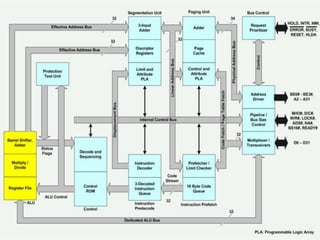
The Internal Architecture of 80386 is divided into 3
sections.
1. Central processing unit(CPU)
2. Memory management unit(MMU)
3. Bus interface unit(BIU)
• Central processing unit is further divided into
Execution unit(EU) and Instruction unit(IU)
• Execution unit has 8 General purpose and 8
Special purpose registers which are either used
for handling data or calculating offset addresses.
• The Instruction unit decodes the opcode bytes
received from the 16-byte instruction code queue
and arranges them in a 3- instruction decoded
instruction queue.
• After decoding them pass it to the control section
for deriving the necessary control signals. The
barrel shifter increases the speed of all shift and
rotate operations.
• The multiply / divide logic implements the bit-shift-
rotate algorithms to complete the operations in
minimum time.
• Even 32- bit multiplications can be executed within
one microsecond by the multiply / divide logic.
• The Memory management unit consists of
 Segmentation unit and
 Paging unit.
• Segmentation unit allows the use of two address
components, viz. segment and offset for relocability and
sharing of code and data.
• Segmentation unit allows segments of size 4Gbytes at
max.
• The Paging unit organizes the physical memory in terms
of pages of 4kbytes size each.
• Paging unit works under the control of the segmentation
unit, i.e. each segment is further divided into pages. The
virtual memory is also organizes in terms of segments
and pages by the memory management unit.
• The Segmentation unit provides a 4 level protection mechanism
for protecting and isolating the system code and data from those
of the application program.
• Paging unit converts linear addresses into physical addresses.
• The control and attribute PLA checks the privileges at the page
level. Each of the pages maintains the paging information of the
task. The limit and attribute PLA checks segment limits and
attributes at segment level to avoid invalid accesses to code and
data in the memory segments.
• The Bus control unit has a prioritizer to resolve the priority of the
various bus requests. This controls the access of the bus. The
address driver drives the bus enable and address signal A0 – A31.
The pipeline and dynamic bus sizing unit handle the related
control signals.
• The data buffers interface the internal data bus with the system
bus.
Register Organization:
• The 80386 has eight 32 - bit general purpose
registers which may be used as either 8 bit or 16
bit registers.
• A 32 - bit register known as an extended register,
is represented by the register name with prefix E.
• Example : A 32 bit register corresponding to AX is
EAX, similarly BX is EBX etc.
• The 16 bit registers BP, SP, SI and DI in 8086 are
now available with their extended size of 32 bit
and are names as EBP,ESP,ESI and EDI.
• AX represents the lower 16 bit of the 32 bit
register EAX.
• Thank you

80386 Architecture

  • 1.
  • 2.
    Architecture The Internal Architectureof 80386 is divided into 3 sections. 1. Central processing unit(CPU) 2. Memory management unit(MMU) 3. Bus interface unit(BIU) • Central processing unit is further divided into Execution unit(EU) and Instruction unit(IU) • Execution unit has 8 General purpose and 8 Special purpose registers which are either used for handling data or calculating offset addresses.
  • 4.
    • The Instructionunit decodes the opcode bytes received from the 16-byte instruction code queue and arranges them in a 3- instruction decoded instruction queue. • After decoding them pass it to the control section for deriving the necessary control signals. The barrel shifter increases the speed of all shift and rotate operations. • The multiply / divide logic implements the bit-shift- rotate algorithms to complete the operations in minimum time. • Even 32- bit multiplications can be executed within one microsecond by the multiply / divide logic.
  • 5.
    • The Memorymanagement unit consists of  Segmentation unit and  Paging unit. • Segmentation unit allows the use of two address components, viz. segment and offset for relocability and sharing of code and data. • Segmentation unit allows segments of size 4Gbytes at max. • The Paging unit organizes the physical memory in terms of pages of 4kbytes size each. • Paging unit works under the control of the segmentation unit, i.e. each segment is further divided into pages. The virtual memory is also organizes in terms of segments and pages by the memory management unit.
  • 6.
    • The Segmentationunit provides a 4 level protection mechanism for protecting and isolating the system code and data from those of the application program. • Paging unit converts linear addresses into physical addresses. • The control and attribute PLA checks the privileges at the page level. Each of the pages maintains the paging information of the task. The limit and attribute PLA checks segment limits and attributes at segment level to avoid invalid accesses to code and data in the memory segments. • The Bus control unit has a prioritizer to resolve the priority of the various bus requests. This controls the access of the bus. The address driver drives the bus enable and address signal A0 – A31. The pipeline and dynamic bus sizing unit handle the related control signals. • The data buffers interface the internal data bus with the system bus.
  • 7.
    Register Organization: • The80386 has eight 32 - bit general purpose registers which may be used as either 8 bit or 16 bit registers. • A 32 - bit register known as an extended register, is represented by the register name with prefix E. • Example : A 32 bit register corresponding to AX is EAX, similarly BX is EBX etc. • The 16 bit registers BP, SP, SI and DI in 8086 are now available with their extended size of 32 bit and are names as EBP,ESP,ESI and EDI. • AX represents the lower 16 bit of the 32 bit register EAX.
  • 8.