History of Intel
Microprocessor
Prepared by:
Felix I. Mendoza
Raeneir B. Buates
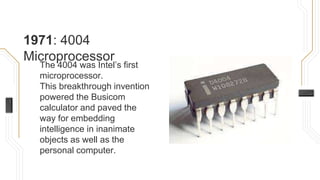
1971: 4004
Microprocessor
The 4004 was Intel’s first
microprocessor.
This breakthrough invention
powered the Busicom
calculator and paved the
way for embedding
intelligence in inanimate
objects as well as the
personal computer.
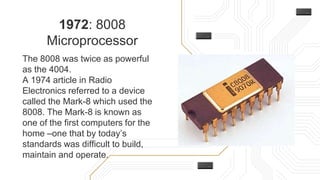
1972: 8008
Microprocessor
The 8008 was twice as powerful
as the 4004.
A 1974 article in Radio
Electronics referred to a device
called the Mark-8 which used the
8008. The Mark-8 is known as
one of the first computers for the
home –one that by today’s
standards was difficult to build,
maintain and operate.
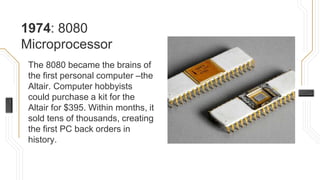
1974: 8080
Microprocessor
The 8080 became the brains of
the first personal computer –the
Altair. Computer hobbyists
could purchase a kit for the
Altair for $395. Within months, it
sold tens of thousands, creating
the first PC back orders in
history.
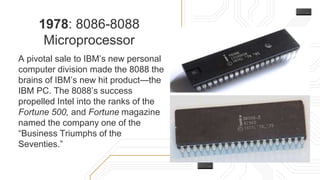
1978: 8086-8088
Microprocessor
A pivotal sale to IBM’s new personal
computer division made the 8088 the
brains of IBM’s new hit product—the
IBM PC. The 8088’s success
propelled Intel into the ranks of the
Fortune 500, and Fortune magazine
named the company one of the
“Business Triumphs of the
Seventies.”
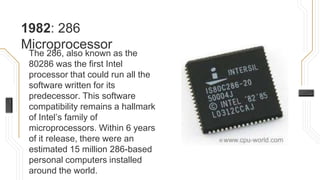
1982: 286
Microprocessor
The 286, also known as the
80286 was the first Intel
processor that could run all the
software written for its
predecessor. This software
compatibility remains a hallmark
of Intel’s family of
microprocessors. Within 6 years
of it release, there were an
estimated 15 million 286-based
personal computers installed
around the world.
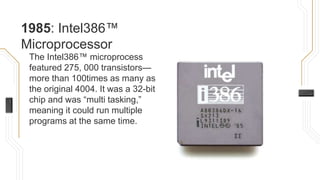
1985: Intel386™
Microprocessor
The Intel386™ microprocess
featured 275, 000 transistors—
more than 100times as many as
the original 4004. It was a 32-bit
chip and was “multi tasking,”
meaning it could run multiple
programs at the same time.
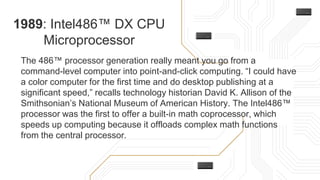
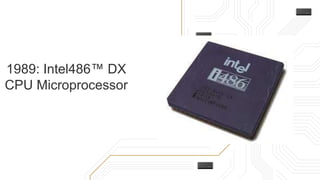
1989: Intel486™ DX CPU
Microprocessor
The 486™ processor generation really meant you go from a
command-level computer into point-and-click computing. “I could have
a color computer for the first time and do desktop publishing at a
significant speed,” recalls technology historian David K. Allison of the
Smithsonian’s National Museum of American History. The Intel486™
processor was the first to offer a built-in math coprocessor, which
speeds up computing because it offloads complex math functions
from the central processor.
1989: Intel486™ DX
CPU Microprocessor
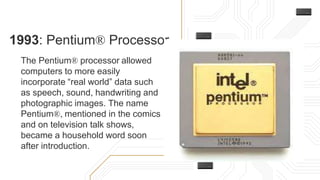
1993: Pentium® Processor
The Pentium® processor allowed
computers to more easily
incorporate “real world” data such
as speech, sound, handwriting and
photographic images. The name
Pentium®, mentioned in the comics
and on television talk shows,
became a household word soon
after introduction.
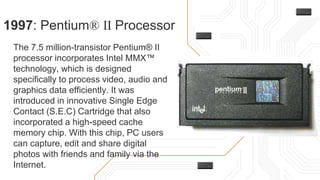
1997: Pentium® Ⅱ Processor
The 7.5 million-transistor Pentium® II
processor incorporates Intel MMX™
technology, which is designed
specifically to process video, audio and
graphics data efficiently. It was
introduced in innovative Single Edge
Contact (S.E.C) Cartridge that also
incorporated a high-speed cache
memory chip. With this chip, PC users
can capture, edit and share digital
photos with friends and family via the
Internet.
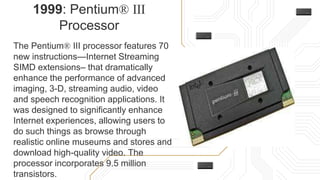
1999: Pentium® Ⅲ
Processor
The Pentium® III processor features 70
new instructions—Internet Streaming
SIMD extensions– that dramatically
enhance the performance of advanced
imaging, 3-D, streaming audio, video
and speech recognition applications. It
was designed to significantly enhance
Internet experiences, allowing users to
do such things as browse through
realistic online museums and stores and
download high-quality video. The
processor incorporates 9.5 million
transistors.
2000: Pentium® 4 Processor
Users of Pentium® 4 processor-based
PCs can create professional-quality
movies; deliver TV-like video via the
Internet; communicate with real-time
video and voice; render 3D graphics in
real time; quickly encode music for MP3
players; and simultaneously run several
multimedia applications while connected
to the Internet. The processor debuted
with 42 million transistors and circuit
lines of 0.18 microns. The Pentium® 4
processor’s initial speed of 1.5 gigahertz
(1.5 billion hertz).
History-of-Intel-Microprocessor.ppt           tx

History-of-Intel-Microprocessor.ppt tx

  • 1.
    History of Intel Microprocessor Preparedby: Felix I. Mendoza Raeneir B. Buates
  • 2.
    1971: 4004 Microprocessor The 4004was Intel’s first microprocessor. This breakthrough invention powered the Busicom calculator and paved the way for embedding intelligence in inanimate objects as well as the personal computer.
  • 3.
    1972: 8008 Microprocessor The 8008was twice as powerful as the 4004. A 1974 article in Radio Electronics referred to a device called the Mark-8 which used the 8008. The Mark-8 is known as one of the first computers for the home –one that by today’s standards was difficult to build, maintain and operate.
  • 4.
    1974: 8080 Microprocessor The 8080became the brains of the first personal computer –the Altair. Computer hobbyists could purchase a kit for the Altair for $395. Within months, it sold tens of thousands, creating the first PC back orders in history.
  • 5.
    1978: 8086-8088 Microprocessor A pivotalsale to IBM’s new personal computer division made the 8088 the brains of IBM’s new hit product—the IBM PC. The 8088’s success propelled Intel into the ranks of the Fortune 500, and Fortune magazine named the company one of the “Business Triumphs of the Seventies.”
  • 6.
    1982: 286 Microprocessor The 286,also known as the 80286 was the first Intel processor that could run all the software written for its predecessor. This software compatibility remains a hallmark of Intel’s family of microprocessors. Within 6 years of it release, there were an estimated 15 million 286-based personal computers installed around the world.
  • 7.
    1985: Intel386™ Microprocessor The Intel386™microprocess featured 275, 000 transistors— more than 100times as many as the original 4004. It was a 32-bit chip and was “multi tasking,” meaning it could run multiple programs at the same time.
  • 8.
    1989: Intel486™ DXCPU Microprocessor The 486™ processor generation really meant you go from a command-level computer into point-and-click computing. “I could have a color computer for the first time and do desktop publishing at a significant speed,” recalls technology historian David K. Allison of the Smithsonian’s National Museum of American History. The Intel486™ processor was the first to offer a built-in math coprocessor, which speeds up computing because it offloads complex math functions from the central processor.
  • 9.
  • 10.
    1993: Pentium® Processor ThePentium® processor allowed computers to more easily incorporate “real world” data such as speech, sound, handwriting and photographic images. The name Pentium®, mentioned in the comics and on television talk shows, became a household word soon after introduction.
  • 11.
    1997: Pentium® ⅡProcessor The 7.5 million-transistor Pentium® II processor incorporates Intel MMX™ technology, which is designed specifically to process video, audio and graphics data efficiently. It was introduced in innovative Single Edge Contact (S.E.C) Cartridge that also incorporated a high-speed cache memory chip. With this chip, PC users can capture, edit and share digital photos with friends and family via the Internet.
  • 12.
    1999: Pentium® Ⅲ Processor ThePentium® III processor features 70 new instructions—Internet Streaming SIMD extensions– that dramatically enhance the performance of advanced imaging, 3-D, streaming audio, video and speech recognition applications. It was designed to significantly enhance Internet experiences, allowing users to do such things as browse through realistic online museums and stores and download high-quality video. The processor incorporates 9.5 million transistors.
  • 13.
    2000: Pentium® 4Processor Users of Pentium® 4 processor-based PCs can create professional-quality movies; deliver TV-like video via the Internet; communicate with real-time video and voice; render 3D graphics in real time; quickly encode music for MP3 players; and simultaneously run several multimedia applications while connected to the Internet. The processor debuted with 42 million transistors and circuit lines of 0.18 microns. The Pentium® 4 processor’s initial speed of 1.5 gigahertz (1.5 billion hertz).