Plant Tissue Systems:
VASCULAR TISSUE
Vascular Tissue
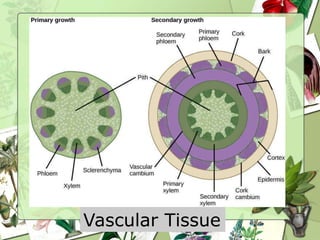
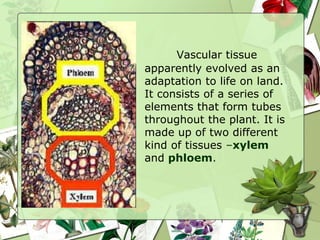
Vascular tissue
apparently evolved as an
adaptation to life on land.
It consists of a series of
elements that form tubes
throughout the plant. It is
made up of two different
kind of tissues –xylem
and phloem.
Xylem
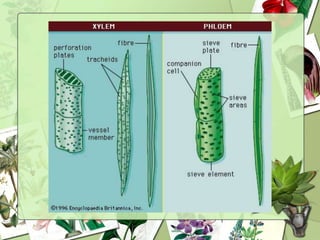
Xylem consists of two types
of cells known as tracheids
and vessel elements.
Tracheids and vessel
elements form tube-shaped
structures that provide
pathways for water and
minerals to travel from the
roots to the leaves. While
tracheids are found in all
vascular plants, vessels are
found only in angiosperms.
Phloem
Phloem is composed mostly of
cells called sieve-tube cells
and companion cells. These
cells assist in the transport of
sugar and nutrients produced
during photosynthesis from
the leaves to other parts of
the plant. While tracheid cells
are nonliving, sieve-tube and
companion cells of the phloem
are living. Companion cells
possess a nucleus and
actively transport
sugar into and out
of sieve-tubes.
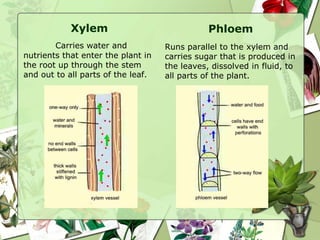
Xylem
Carries water and
nutrients that enter the plant in
the root up through the stem
and out to all parts of the leaf.
Phloem
Runs parallel to the xylem and
carries sugar that is produced in
the leaves, dissolved in fluid, to
all parts of the plant.
• Phloem is the living tissue that carries organic
nutrients to all parts of the plant where needed.
• Xylem transports water, but it also transports some
nutrients.
• Vascular cambium is a type of meristem - a tissue
consisting of embryonic (not specialized) cells which can
produce other (and more differentiated) plant tissues
originate.
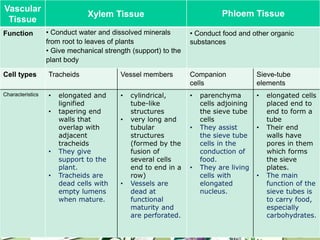
Vascular
Tissue
Xylem Tissue Phloem Tissue
Function • Conduct water and dissolved minerals
from root to leaves of plants
• Give mechanical strength (support) to the
plant body
• Conduct food and other organic
substances
Cell types Tracheids Vessel members Companion
cells
Sieve-tube
elements
Characteristics • elongated and
lignified
• tapering end
walls that
overlap with
adjacent
tracheids
• They give
support to the
plant.
• Tracheids are
dead cells with
empty lumens
when mature.
• cylindrical,
tube-like
structures
• very long and
tubular
structures
(formed by the
fusion of
several cells
end to end in a
row)
• Vessels are
dead at
functional
maturity and
are perforated.
• parenchyma
cells adjoining
the sieve tube
cells
• They assist
the sieve tube
cells in the
conduction of
food.
• They are living
cells with
elongated
nucleus.
• elongated cells
placed end to
end to form a
tube
• Their end
walls have
pores in them
which forms
the sieve
plates.
• The main
function of the
sieve tubes is
to carry food,
especially
carbohydrates.
Sources:
o http://biology.about.com/od/plantbiology/ss/plant-tissue-systems_2.htm
o http://www.phschool.com/science/biology_place/biocoach/plants/vascular.html
o http://www.ehow.com/list_7153104_functions-vascular-tissue-plants_.html
o http://www.phschool.com/science/biology_place/biocoach/plants/support.html
o http://www.phschool.com/science/biology_place/biocoach/plants/parenchyma.h
tml
o http://tantebazar.com/gardening_histology_of_plant_part_2.php

Vascular Tissue

  • 1.
  • 2.
  • 3.
    Vascular tissue apparently evolvedas an adaptation to life on land. It consists of a series of elements that form tubes throughout the plant. It is made up of two different kind of tissues –xylem and phloem.
  • 4.
    Xylem Xylem consists oftwo types of cells known as tracheids and vessel elements. Tracheids and vessel elements form tube-shaped structures that provide pathways for water and minerals to travel from the roots to the leaves. While tracheids are found in all vascular plants, vessels are found only in angiosperms. Phloem Phloem is composed mostly of cells called sieve-tube cells and companion cells. These cells assist in the transport of sugar and nutrients produced during photosynthesis from the leaves to other parts of the plant. While tracheid cells are nonliving, sieve-tube and companion cells of the phloem are living. Companion cells possess a nucleus and actively transport sugar into and out of sieve-tubes.
  • 5.
    Xylem Carries water and nutrientsthat enter the plant in the root up through the stem and out to all parts of the leaf. Phloem Runs parallel to the xylem and carries sugar that is produced in the leaves, dissolved in fluid, to all parts of the plant.
  • 6.
    • Phloem isthe living tissue that carries organic nutrients to all parts of the plant where needed. • Xylem transports water, but it also transports some nutrients. • Vascular cambium is a type of meristem - a tissue consisting of embryonic (not specialized) cells which can produce other (and more differentiated) plant tissues originate.
  • 8.
    Vascular Tissue Xylem Tissue PhloemTissue Function • Conduct water and dissolved minerals from root to leaves of plants • Give mechanical strength (support) to the plant body • Conduct food and other organic substances Cell types Tracheids Vessel members Companion cells Sieve-tube elements Characteristics • elongated and lignified • tapering end walls that overlap with adjacent tracheids • They give support to the plant. • Tracheids are dead cells with empty lumens when mature. • cylindrical, tube-like structures • very long and tubular structures (formed by the fusion of several cells end to end in a row) • Vessels are dead at functional maturity and are perforated. • parenchyma cells adjoining the sieve tube cells • They assist the sieve tube cells in the conduction of food. • They are living cells with elongated nucleus. • elongated cells placed end to end to form a tube • Their end walls have pores in them which forms the sieve plates. • The main function of the sieve tubes is to carry food, especially carbohydrates.
  • 9.
    Sources: o http://biology.about.com/od/plantbiology/ss/plant-tissue-systems_2.htm o http://www.phschool.com/science/biology_place/biocoach/plants/vascular.html ohttp://www.ehow.com/list_7153104_functions-vascular-tissue-plants_.html o http://www.phschool.com/science/biology_place/biocoach/plants/support.html o http://www.phschool.com/science/biology_place/biocoach/plants/parenchyma.h tml o http://tantebazar.com/gardening_histology_of_plant_part_2.php