Topic – Complex tissue
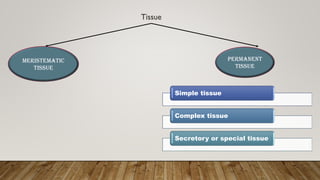
Tissue
Meristematic
tissue
Permanent
tissue
Simple tissue
Complex tissue
Secretory or special tissue
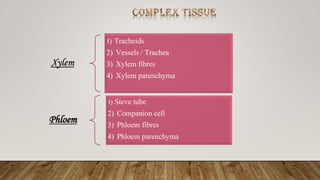
Xylem
1) Tracheids
2) Vessels / Trachea
3) Xylem fibres
4) Xylem parenchyma
Phloem
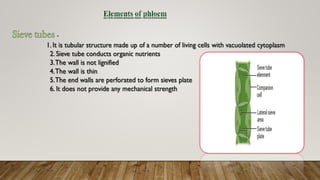
1) Sieve tube
2) Companion cell
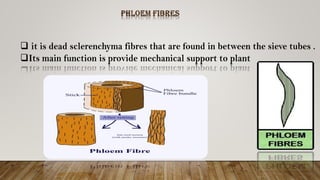
3) Phloem fibres
4) Phloem parenchyma
Xylem Phloem
Function Vascular tissue that transport water
and dissolved nutrients from root to
the aerial parts of plants
Vascular tissue that transports prepared
food from the leaves and shoots to the
roots
Type Dead cell Living cell
Location Centre of vascular bundle The periphery of the vascular bundle
Cellular
Composition
Lignin , Cellulose Phloem sap
Structural
Composition
Tracheids ,Trachea , Xylem fibres ,
Xylem parenchyma
Sieve tube , companion cell , phloem fibres ,
phloem parenchyma
Movement
direction
Unidirectionally Bidirectionally
Support Forms the bulk of plants and provide
mechanical support
Forms a smaller parts pf plants and does
not provide any mechanical support
Differences between xylem and phloem
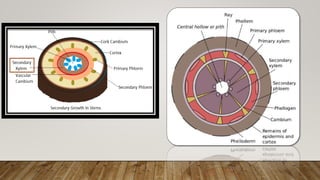
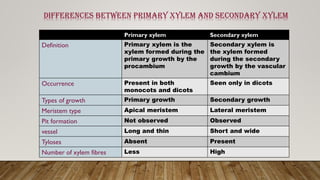
Differences between primary xylem and secondary xylem
Primary xylem Secondary xylem
Definition Primary xylem is the
xylem formed during the
primary growth by the
procambium
Secondary xylem is
the xylem formed
during the secondary
growth by the vascular
cambium
Occurrence Present in both
monocots and dicots
Seen only in dicots
Types of growth Primary growth Secondary growth
Meristem type Apical meristem Lateral meristem
Pit formation Not observed Observed
vessel Long and thin Short and wide
Tyloses Absent Present
Number of xylem fibres Less High
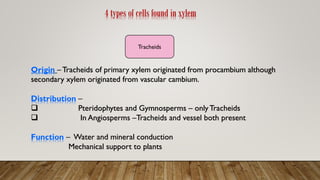
4 types of cells found in xylem
Tracheids
Origin – Tracheids of primary xylem originated from procambium although
secondary xylem originated from vascular cambium.
Distribution –
❑ Pteridophytes and Gymnosperms – only Tracheids
❑ In Angiosperms –Tracheids and vessel both present
Function – Water and mineral conduction
Mechanical support to plants
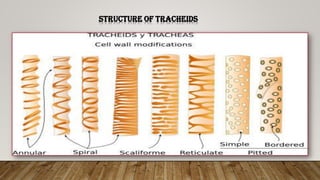
Structure of tracheids
Vessels / Trachea
Origin and Development - vessels of primary xylem originated from procambium besides in
secondary xylem originated from cambium
Distribution - Pteridophytes and Gymnosperm – absent
Angiosperm – present ( exception – Amborella , Bubbia , Chlorenthus , Drimys etc.
Function – 1. Helps in conduction of water and minerals from the root to different parts of the
plants.
2. Mechanical support to the plants.
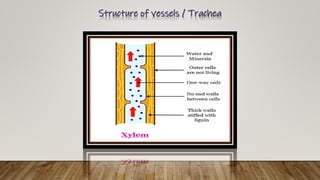
Structure of vessels / Trachea
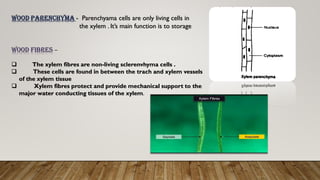
Wood parenchyma - Parenchyama cells are only living cells in
the xylem . It’s main function is to storage
Wood fibres –
❑ The xylem fibres are non-living sclerenvhyma cells .
❑ These cells are found in between the trach and xylem vessels
of the xylem tissue
❑ Xylem fibres protect and provide mechanical support to the
major water conducting tissues of the xylem.
Phloem
Differences between primary phloem and secondary phloem
Primary phloem Secondary phloem
Develops from Procambium From vascular cambium
Bast fibres Absent Present
Types of growth Primary growth Secondary growth
Sclereids Absent Present
Occurrence Towards the periphery It is formed inner to the primary
phloem
Radial system Absent It is traversed by radial system of
phloem rays
Number of phloem
fibres
Less More
Number of sieve tube Less More
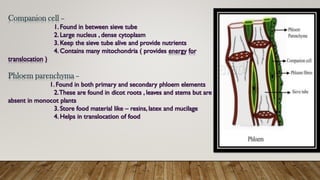
Companion cell –
1. Found in between sieve tube
2. Large nucleus , dense cytoplasm
3. Keep the sieve tube alive and provide nutrients
4. Contains many mitochondria ( provides energy for
translocation )
Phloem parenchyma –
1. Found in both primary and secondary phloem elements
2.These are found in dicot roots , leaves and stems but are
absent in monocot plants
3. Store food material like – resins, latex and mucilage
4. Helps in translocation of food
Complex tissue 1
Complex tissue 1

Complex tissue 1

  • 1.
  • 2.
  • 3.
    Xylem 1) Tracheids 2) Vessels/ Trachea 3) Xylem fibres 4) Xylem parenchyma Phloem 1) Sieve tube 2) Companion cell 3) Phloem fibres 4) Phloem parenchyma
  • 5.
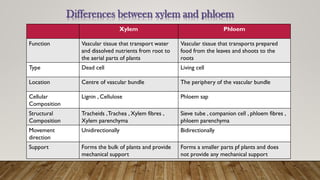
    Xylem Phloem Function Vasculartissue that transport water and dissolved nutrients from root to the aerial parts of plants Vascular tissue that transports prepared food from the leaves and shoots to the roots Type Dead cell Living cell Location Centre of vascular bundle The periphery of the vascular bundle Cellular Composition Lignin , Cellulose Phloem sap Structural Composition Tracheids ,Trachea , Xylem fibres , Xylem parenchyma Sieve tube , companion cell , phloem fibres , phloem parenchyma Movement direction Unidirectionally Bidirectionally Support Forms the bulk of plants and provide mechanical support Forms a smaller parts pf plants and does not provide any mechanical support Differences between xylem and phloem
  • 7.
    Differences between primaryxylem and secondary xylem Primary xylem Secondary xylem Definition Primary xylem is the xylem formed during the primary growth by the procambium Secondary xylem is the xylem formed during the secondary growth by the vascular cambium Occurrence Present in both monocots and dicots Seen only in dicots Types of growth Primary growth Secondary growth Meristem type Apical meristem Lateral meristem Pit formation Not observed Observed vessel Long and thin Short and wide Tyloses Absent Present Number of xylem fibres Less High
  • 8.
    4 types ofcells found in xylem Tracheids Origin – Tracheids of primary xylem originated from procambium although secondary xylem originated from vascular cambium. Distribution – ❑ Pteridophytes and Gymnosperms – only Tracheids ❑ In Angiosperms –Tracheids and vessel both present Function – Water and mineral conduction Mechanical support to plants
  • 9.
  • 10.
    Vessels / Trachea Originand Development - vessels of primary xylem originated from procambium besides in secondary xylem originated from cambium Distribution - Pteridophytes and Gymnosperm – absent Angiosperm – present ( exception – Amborella , Bubbia , Chlorenthus , Drimys etc. Function – 1. Helps in conduction of water and minerals from the root to different parts of the plants. 2. Mechanical support to the plants.
  • 11.
  • 12.
    Wood parenchyma -Parenchyama cells are only living cells in the xylem . It’s main function is to storage Wood fibres – ❑ The xylem fibres are non-living sclerenvhyma cells . ❑ These cells are found in between the trach and xylem vessels of the xylem tissue ❑ Xylem fibres protect and provide mechanical support to the major water conducting tissues of the xylem.
  • 13.
    Phloem Differences between primaryphloem and secondary phloem Primary phloem Secondary phloem Develops from Procambium From vascular cambium Bast fibres Absent Present Types of growth Primary growth Secondary growth Sclereids Absent Present Occurrence Towards the periphery It is formed inner to the primary phloem Radial system Absent It is traversed by radial system of phloem rays Number of phloem fibres Less More Number of sieve tube Less More
  • 15.
    Companion cell – 1.Found in between sieve tube 2. Large nucleus , dense cytoplasm 3. Keep the sieve tube alive and provide nutrients 4. Contains many mitochondria ( provides energy for translocation ) Phloem parenchyma – 1. Found in both primary and secondary phloem elements 2.These are found in dicot roots , leaves and stems but are absent in monocot plants 3. Store food material like – resins, latex and mucilage 4. Helps in translocation of food