
xylem and phloemBiology presentation9-fDone by : Rohan & jimit
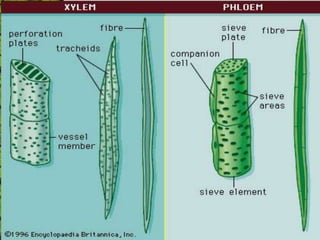
Nature  of  XylemIt has Xylem parenchyma as only living part. Others are tracheids, vessels, xylem fibres which all are dead.
Nature  of  Xylema. Tracheids: Elongated cells with sloping walls enclosing a large empty cavity. The walls of trachieds are thickened by a complex chemical compound called lignin.
Nature  of  Xylemb. Vessels: Cylindrical tube-like structures formed by a row of cells placed end to end. The transverse wall between the cells partly or almost completely dissolve to form a continuous channel or water pipe. These also have lignified walls.Trachieds and vessels are Named according to the Manner in which lignin has been deposited. E.g.  annular, Spiral, scalariform
Nature  of   PhloemIt consists of sieve tubes,Companion cells, phloemparenchyma and which all are living parts. Bast fibres alone are composed of dead cells.
Nature  of   PhloemSieve tubes: Thin-walled elongated cells placed end toend forming a slender tubular structure. Cytoplasm of one sieve element is continuous with other because of pores present at transverse end walls of cells. Nuclei is absent.
Nature  of   Phloemb. Companion cells: Theseare small in size, have dense cytoplasm and a large elongated nucleus and are associated with sieve tubes.It remains connected with companion cells by pores.These are absent in ferns and gymnosperms(fir, cycas, pine)c. Bast fibers: Sclerenchyma  cells in phloem are Bast fibers. These alone are composed of dead cells.d. Phloem Parenchyma: It is ordinary parenchyma. It is absent in monocot stems.
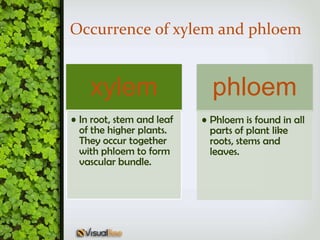
Occurrence of xylem and phloem
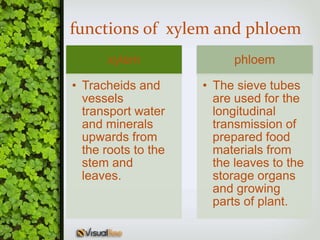
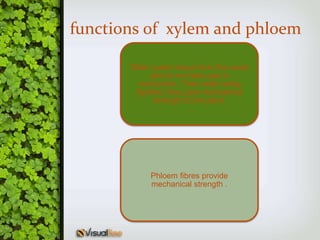
functions of  xylem and phloem
xylem and phloem