 In plants different parts absorb water and
send it to all parts of the plant.
 The tissue that is involved in the
transportation of materials is vascular tissue.
 The main components of vascular tissue are
Xylem and Phloem.
 Xylem mainly consists of dead elements
where as Phloem consists of living elements .
 In some plants they carry water to great
heights in the plant body i.e. up to nearly
330ft.
 It gives mechanical support to the plant.
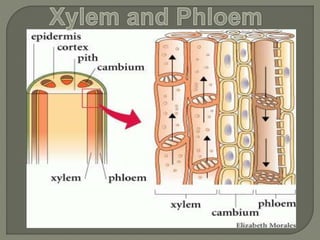
 Xylem is one of the two types of transport tissue in
vascular plants.
 This word XYLEM derived from the Greek word
Xylon (ξύλοv) which means “wood”.
 The best known Xylem tissue is wood, that is found
through out the plant.
 It’s basic function is to transport water, but it also
transfers some nutrients through the plant.
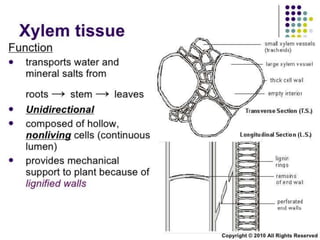
 Vessels and trachieds are responsible for the
conduction of water and minerals.
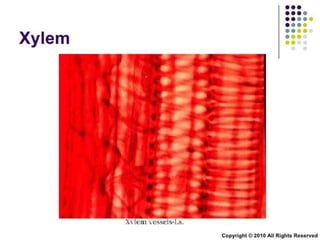
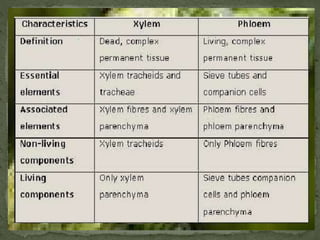
 It has Xylem parenchyma as only living part. Others
are tracheids, vessels, xylem fibres which all are dead.
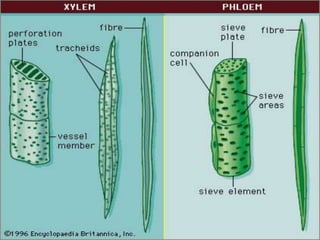
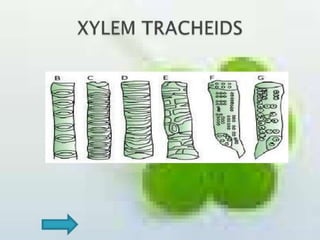
 a. Tracheids: Elongated cells with sloping walls enclosing
a large empty cavity. The walls of trachieds are thickened
by a complex chemical compound called lignin.
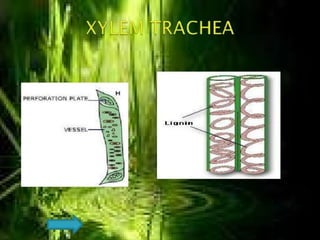
 b. Vessels: Cylindrical tube-like structures formed by a
row of cells placed end to end. The transverse wall
between the cells partly or almost completely dissolve to
form a continuous channel or water pipe. These also have
lignified walls.
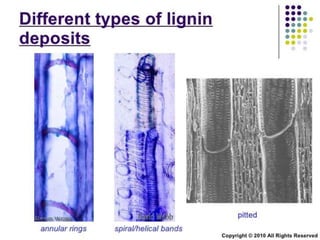
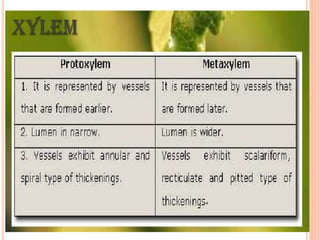
 Trachieds and vessels are Named according to the Manner
in which lignin has been deposited. E.g. annular, Spiral,
scalariform
 Its main function is to transport water
and soluble minerals from the roots
through the plant.
 It is also used to replace water loss
during transpiration and photosynthesis.
 Xylem sap consists mainly of inorganic
ions and water, although it consists of
many organic chemicals.
 The transport is passive, not powered by
energy.
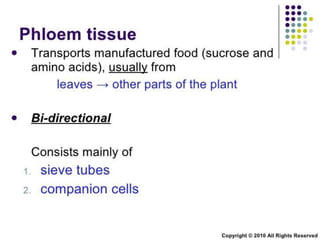
 Pholem is the vascular tissue which carries organic
nutrients like photosynthane.
 As the Pholem is the inner most layer of the bark its
name is derived from reek word philos.
 It mostly transports soluble organic material made
during photosynthesis. This is called translocation.
 Phloem Sieve tubes are responsible for the
conduction of organic minerals to all parts of the
body.
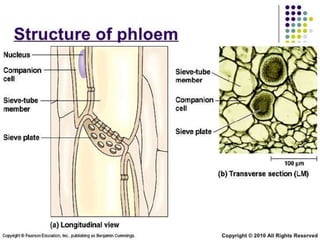
• It consists of sieve tubes, Companion cells, phloem
parenchyma and which all are living parts.
• Bast fibres alone are composed of dead cells.
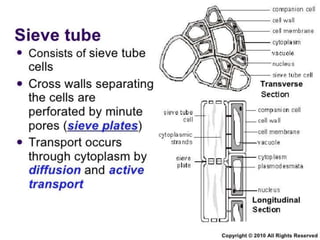
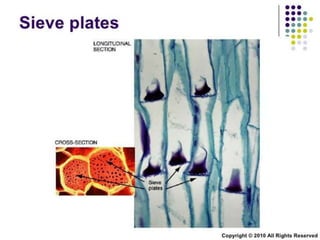
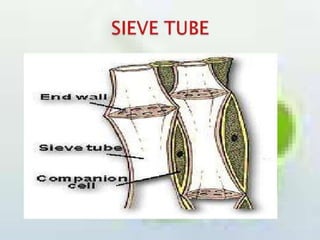
1. Sieve tubes: Thin-walled elongated cells placed end toend
forming a slender tubular structure. Cytoplasm of one sieve
element is continuous with other because of pores present at
transverse end walls of cells. Nuclei is absent.
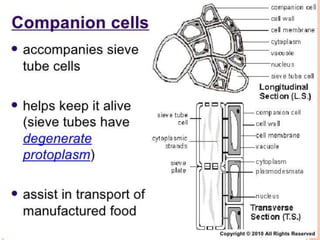
b. Companion cells: These are small in size, have dense
cytoplasm and a large elongated nucleus and are associated
with sieve tubes.
It remains connected with companion cells by pores.
These are absent in ferns and gymnosperms(fir, cycas, pine)
c. Bast fibers: Sclerenchyma cells in phloem are Bast fibers.
These alone are composed of dead cells.
d. Phloem Parenchyma: It is ordinary parenchyma. It is absent
in monocot stems.
 Unlike xylem, the phloem is composed of
still living cells that transport sap.
 The sap is water based solution, but rich
in sugars.
 These sugars are transported to non-
photosynthetic areas like rots, or into
storage structures.
 A hypothesis was proposed by Ernst
Munch in 1930 called Pressure flow
hypothesis that explains the mechanism
of phloem translocation.
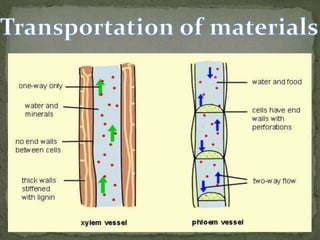
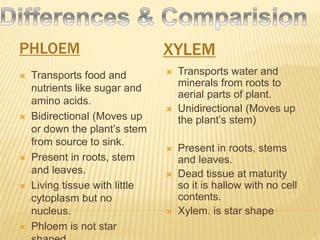
PHLOEM XYLEM
 Transports food and
nutrients like sugar and
amino acids.
 Bidirectional (Moves up
or down the plant’s stem
from source to sink.
 Present in roots, stem
and leaves.
 Living tissue with little
cytoplasm but no
nucleus.
 Phloem is not star
 Transports water and
minerals from roots to
aerial parts of plant.
 Unidirectional (Moves up
the plant’s stem)
 Present in roots, stems
and leaves.
 Dead tissue at maturity
so it is hallow with no cell
contents.
 Xylem. is star shape
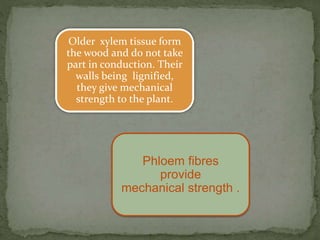
Older xylem tissue form
the wood and do not take
part in conduction. Their
walls being lignified,
they give mechanical
strength to the plant.
Phloem fibres
provide
mechanical strength .
Xylemphloem by pooja

Xylemphloem by pooja

  • 2.
     In plantsdifferent parts absorb water and send it to all parts of the plant.  The tissue that is involved in the transportation of materials is vascular tissue.  The main components of vascular tissue are Xylem and Phloem.  Xylem mainly consists of dead elements where as Phloem consists of living elements .  In some plants they carry water to great heights in the plant body i.e. up to nearly 330ft.  It gives mechanical support to the plant.
  • 5.
     Xylem isone of the two types of transport tissue in vascular plants.  This word XYLEM derived from the Greek word Xylon (ξύλοv) which means “wood”.  The best known Xylem tissue is wood, that is found through out the plant.  It’s basic function is to transport water, but it also transfers some nutrients through the plant.  Vessels and trachieds are responsible for the conduction of water and minerals.  It has Xylem parenchyma as only living part. Others are tracheids, vessels, xylem fibres which all are dead.
  • 6.
     a. Tracheids:Elongated cells with sloping walls enclosing a large empty cavity. The walls of trachieds are thickened by a complex chemical compound called lignin.  b. Vessels: Cylindrical tube-like structures formed by a row of cells placed end to end. The transverse wall between the cells partly or almost completely dissolve to form a continuous channel or water pipe. These also have lignified walls.  Trachieds and vessels are Named according to the Manner in which lignin has been deposited. E.g. annular, Spiral, scalariform
  • 16.
     Its mainfunction is to transport water and soluble minerals from the roots through the plant.  It is also used to replace water loss during transpiration and photosynthesis.  Xylem sap consists mainly of inorganic ions and water, although it consists of many organic chemicals.  The transport is passive, not powered by energy.
  • 17.
     Pholem isthe vascular tissue which carries organic nutrients like photosynthane.  As the Pholem is the inner most layer of the bark its name is derived from reek word philos.  It mostly transports soluble organic material made during photosynthesis. This is called translocation.  Phloem Sieve tubes are responsible for the conduction of organic minerals to all parts of the body.
  • 18.
    • It consistsof sieve tubes, Companion cells, phloem parenchyma and which all are living parts. • Bast fibres alone are composed of dead cells. 1. Sieve tubes: Thin-walled elongated cells placed end toend forming a slender tubular structure. Cytoplasm of one sieve element is continuous with other because of pores present at transverse end walls of cells. Nuclei is absent. b. Companion cells: These are small in size, have dense cytoplasm and a large elongated nucleus and are associated with sieve tubes. It remains connected with companion cells by pores. These are absent in ferns and gymnosperms(fir, cycas, pine) c. Bast fibers: Sclerenchyma cells in phloem are Bast fibers. These alone are composed of dead cells. d. Phloem Parenchyma: It is ordinary parenchyma. It is absent in monocot stems.
  • 25.
     Unlike xylem,the phloem is composed of still living cells that transport sap.  The sap is water based solution, but rich in sugars.  These sugars are transported to non- photosynthetic areas like rots, or into storage structures.  A hypothesis was proposed by Ernst Munch in 1930 called Pressure flow hypothesis that explains the mechanism of phloem translocation.
  • 27.
    PHLOEM XYLEM  Transportsfood and nutrients like sugar and amino acids.  Bidirectional (Moves up or down the plant’s stem from source to sink.  Present in roots, stem and leaves.  Living tissue with little cytoplasm but no nucleus.  Phloem is not star  Transports water and minerals from roots to aerial parts of plant.  Unidirectional (Moves up the plant’s stem)  Present in roots, stems and leaves.  Dead tissue at maturity so it is hallow with no cell contents.  Xylem. is star shape
  • 30.
    Older xylem tissueform the wood and do not take part in conduction. Their walls being lignified, they give mechanical strength to the plant. Phloem fibres provide mechanical strength .