INTRODUCTION
In plants differentparts absorb water and send it to all parts of
the plant.
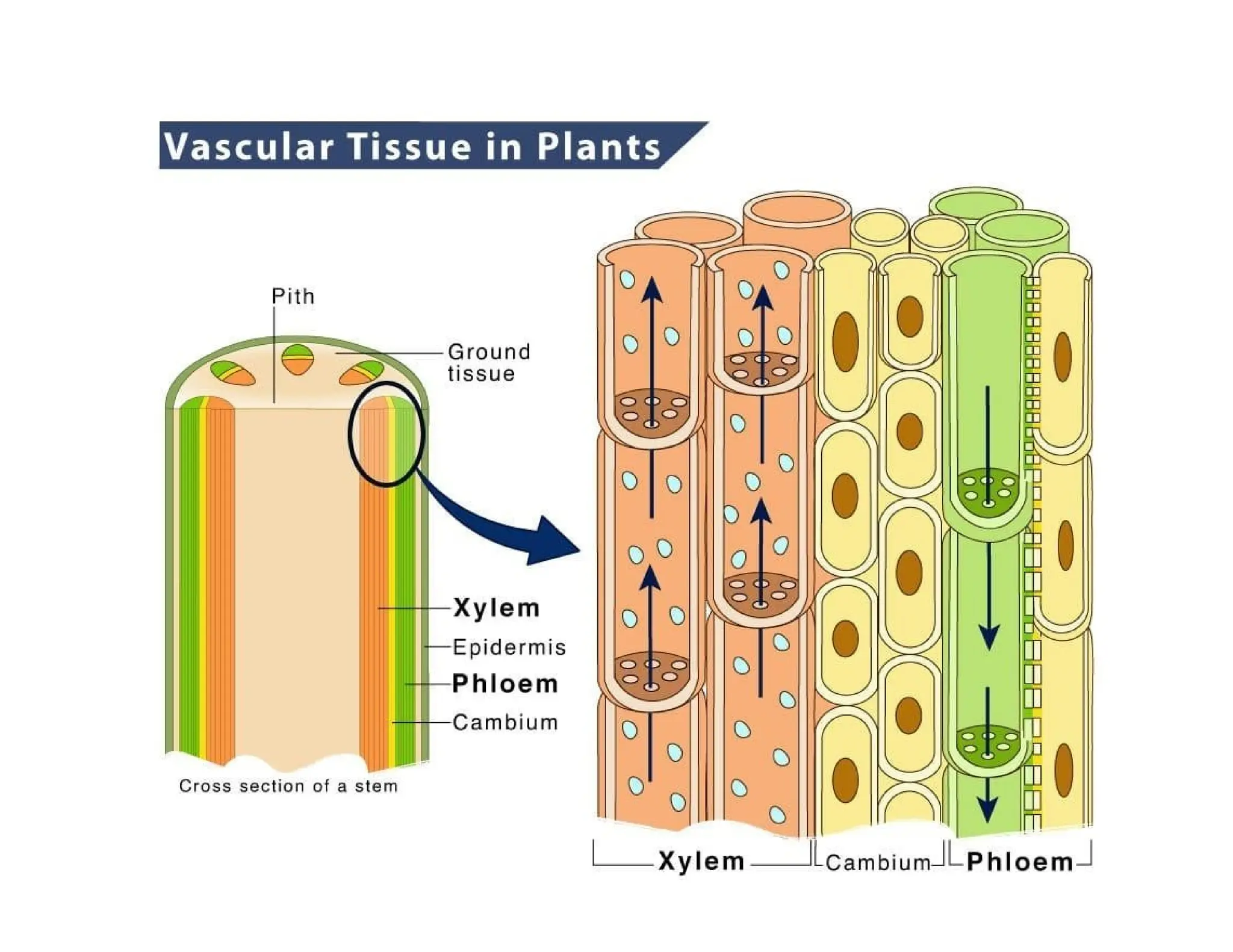
• The tissue that is involved in the transportation of
materials is vascular tissue.
• The main components of vascular tissue are Xylem and
Phloem.
• Xylem mainly consists of dead elements where as
Phloem consists of living elements.
• In some plants they carry water to great heights in the
plant body i.e. up to nearly 330ft.
• It gives mechanical support to the plant.
3.
Vascular Tissue
• Vasculartissue is a complex conducting tissue formed of
more than one cell type.
• Found in vascular plants.
• The primary components of vascular tissue are :-
1. Xylem
2. Phloem
5.
Xylem
• Xylem cellsare elongated cells.
• Has lignified secondary thickening of the cells walls.
• Xylem cells are specialized for conduction of water.
• The possession of xylem defines the vascular plants or
Tracheophytes.
• Xylem tracheids are pointed, elongated xylem cells, the
simplest of which have continuous primary cell walls
and lignified secondary wall thickenings in the form of
rings, hoops or reticulate networks.
7.
Component of xylem
Theyare:-
• Xylem tracheids
• Xylem tracheae
• Xylem vessel
• Xylem fibers and
• Xylem parenchyma
8.
Xylem Tracheids
• Theyare found abundantly in pteridophytes,
gymnosperms and primitive angiosperms.
• In these groups of plants, the tracheids represent the
most active water conducting elements.
• In advanced angiosperms, the tracheids are found
restricted to leaf margin and leaf tip.
• The tracheids are elongated, dead cells, with tapering
ends.
9.
• They arecharacterized by the presence of a thick cell
wall consisting of primary wall and a secondary
wall.
10.
• The primarywall is composed of cellulose where as the
secondary wall is made up of lignin.
• There is a spacious lumen that extends throughout the
length of the tracheid.
• In some cases due to the deposition of lignin, the
primary wall develops numerous concave depressions
called pits.
• When pits are present, the tracheid is described as
pitted
and when pits are absent, it is described as simple.
• The pits are often surrounded by a halo and are then
Xylem Tracheae
• Theyare commonly known as xylem vessels.
• They are the most active water conducting elements in
all higher angiosperms.
• The tracheae are found arranged parallel to each other,
extending from one end of the plant body to another.
• The tracheae are long cylindrical dead cells. They are
characterized by a thick cell wall consisting of a primary
wall and a secondary wall.
13.
• The primarywall is made up of cellulose where as the
secondary wall is made up of lignin.
• There is a spacious lumen that extends throughout the
length of the trachea.
• The deposition of lignin in the secondary wall is not
always uniform.
• As a result, the xylem vessels exhibit different types of
secondary thickenings.
15.
On this basis,xylem vessels can be distinguished into five
types.
• Annular vessels in which the secondary thickening is in
the form of rings placed more or less as equal distance
from each other.
• Spiral vessels in which the secondary thickenings are
present in the form of a helix or coil.
• Scalariform vessels in which the secondary thickenings
appear in the form of cross bands resembling the steps of
a ladder.
16.
• Reticulate vesselsin which the secondary thickenings
are irregular and appear in the form of a network.
• Pitted vessels in which the secondary thickenings result
in the formation of depressions on the primary wall
called pits.
17.
Where A- Annular
B-Spiral
C- Scalariform
D- Reticulate
E- Pitted
Xylem Fibres
• They are represented by the dead sclerenchyma fibres
that are found in between the vessels and the tracheids.
• They are meant for providing mechanical support to the
essential elements.
• It isrepresented by groups of parenchyma cells that are
found in between the vessels and the fibres.
• They are meant for storage of reserve food.
20.
Types of xylem
Xylemcan be distinguished into two types namely
1. Primary xylem
• Primary xylem is the xylem that is formed during
normal growth. It is a derivative of primary meristem.
• It occurs in both monocots and dicots.
• In the primary xylem, two types of xylem vessels can be
distinguished, namely protoxylem and metaxylem.
21.
2. Secondary xylem
•Secondary xylem is the xylem that is formed during
secondary growth.
• It is derivative of secondary meristem.
22.
• It isa characteristic feature of only dicots.
• Secondary xylem is commonly known as wood.
• It is of commercial importance since it is extensively
used in the manufacturing of doors, windows and
furniture.
Phloem
• Phloem is specialized tissue for food conduction in
higher plants.
• Phloem consists of two cell types, the sieve types and the
intimately associated companion cells.
24.
• The sievetube elements lack nuclei and ribosomes, and
their metabolism and functions are regulated by the
adjacent nucleate companion cells.
• Sieve tubes are joined end to end with perforate end-
plates between known as sieve plates, which allow
transport of photosynthetic between the sieve elements.
• The companion cells, connected to the sieve tubes via
plasmodesmata, are responsible for loading the phloem
with sugars.
25.
• The bryophyteslack phloem, but moss sporophytes have
a simpler tissue with analogous function known as the
leptome.
• Phloem is a complex permanent tissue, which is
specialized for the conduction of food and other organic
substances.
• Phloem is also a heterogeneous tissue, made up of 4
different type of cellular elements are :-
a) Sieve tubes
b) Companion cells
26.
c) Phloem parenchymaand
d) Phloem fibres
e) Sieve Tubes-
• They represent the most active food conducting element
in the phloem tissue.
• The sieve tubes are found arranged parallel to one
another from one end of the plant body to
another.
27.
• Each sievetube is formed by a series of hollow,
cylindrical cells called sieve tube cells arranged one
above the other.
• The sieve cells are separated from each other by
horizontal perforated plates called sieve plates.
• The sieve cells communicate with each other through the
sieve plates.
• Each sieve cell has a thin cell wall, which is composed
of only cellulose. The cell has a central mass of dense
cytoplasm.
28.
• The granularcytoplasm forms a number of projections
called cytoplasmic strands extending towards the
sieve plate.
• The nucleus is absent.
29.
b) Companion cells
•They are more or less spindle shaped cells associated
with the sieve tube cells.
• Each companion cell is found attached to any one lateral
surface of a sieve cell.
• The companion cell and the neighboring sieve cell
together represent a pair of sister cells.
• The companion cell has a granular cytoplasm,
prominent
nucleus and one or two small vacuoles.
30.
• The nucleusof the companion cell is said to be capable
of exerting its influence on the adjacent sieve cells.
c) Phloem Parenchyma
• Phloem parenchyma is represented by a group of living
parenchyma cells that are found in between the sieve
tubes.
• They are meant only for storage of organic food.
32.
d) Phloem fibres
•Phloem fibres are represented by the dead sclerenchyma
fibres that are found in between the sieve tubes.
• They are meant only for providing mechanical support.
33.
Types of Phloem
Phloemcan be distinguished into two types:-
a) Primary phloem
b) Secondary phloem
c) Primary phloem
• Primary phloem is the phloem that is formed during
normal growth in the plant body.
• It is a derivative of primary meristem.
• It is found in both monocots and dicots.
34.
• The primaryphloem is further composed of
protophloem and metaphloem .
• The sieve tubes and the companion cells which appear
earlier during normal growth, represent protophloem,
while metaphloem is represented by the sieve tubes and
the companion cells that appear later.
• However, there is no significant morphological
difference between protophloem and metaphloem.
35.
b) Secondary phloem
•Secondary Phloem is the phloem that is formed
during secondary growth.
• It is a derivative of secondary meristem.
• Secondary Phloem is characteristic feature of only
dicots.
• It is also known as bast.
• It is also of summerical importance since it yields bast
fibres.
Functions of Phloem
Unlikexylem, the phloem is composed of still living cells
that transport sap.
The sap is water based solution, but rich in sugars.
These sugars are transported to non- photosynthetic
areas like rots, or into storage structures.
A hypothesis was proposed by Ernst Munch in
1930 called Pressure flow hypothesis that explains
the mechanism of phloem translocation.
39.
Functions of Xylem
Itsmain function is to transport water and soluble
minerals from the roots through the plant.
It is also used to replace water loss during transpiration
and photosynthesis.
Xylem sap consists mainly of inorganic ions and water,
although it consists of many organic chemicals.
The transport is passive, not powered by energy.
41.
Secondary growth
Theincrease in stem thickness that results from
secondary growth is due to the activity of the lateral
meristems, which are lacking in herbaceous plants.
Lateral meristems include the vascular cambium and, in
woody plants, the cork cambium.
The vascular cambium is located just outside the
primary xylem and to the interior of the primary phloem.
42.
The cells ofthe vascular cambium divide and form
secondary xylem (tracheids and vessel elements) to the
inside and secondary phloem (sieve elements and
companion cells) to the outside.
43.
The thickening ofthe stem that occurs in secondary
growth is due to the formation of secondary phloem
and secondary xylem by the vascular cambium, plus
the action of cork cambium, which forms the tough
outermost layer of the stem. The cells of the secondary
44.
xylem contain lignin,which provides hardiness and
strength.
In woody plants, cork cambium is the outermost lateral
meristem. It produces cork cells (bark) containing a
waxy substance known as suberin that can repel water.
The bark protects the plant against physical damage and
helps reduce water loss.
45.
The cork cambiumalso produces a layer of cells
known as phelloderm, which grows inward from the
cambium. The cork cambium, cork cells, and
phelloderm are collectively termed the periderm.
The periderm substitutes for the epidermis in mature
palnts. In some plants, the periderm has many openings,
known as lenticels, which allow the interior cells to
exchange gases with the outside atmosphere. This
supplies oxygen to the living and metabolically active
cells of the cortex, xylem and phloem.
46.
After a longperiod of secondary growth, two types of
woods appear in the stem such as, sapwood, heartwood.
Sapwood is recently formed wood and heartwood is
earlier formed wood.
47.
In woody stemsthe stomata are blocked by the
presence of cork cells.
The epidermis of woody stems breaks up to form tiny
pores called lenticels which allow gaseous exchange.
48.
Annual rings
The activityof the vascular cambium gives rise to
annual growth rings. During the spring growing season,
cells of the secondary xylem have a large internal
diameter; their primary cell walls are not extensively
thickened.
This is known as early wood, or spring wood.
49.
During the fallseason, the secondary xylem
develops thickened cell walls, forming late wood, or
autumn wood, which is denser than early wood.
50.
This alternation ofearly and late wood is due largely to
a seasonal decrease in the number of vessel elements
and a seasonal increase in the number of tracheids. It
results in the formation of an annual ring, which can be
seen as a circular ring in the cross section of the stem.
An examination of the number of annual rings and
their nature (such as their size and cell wall thickness)
can reveal the age of the tree and the prevailing
climatic conditions during each season.