

Functional Speaking
Functional Speaking
Functional Speaking is a communication tool to get messages
across and to carry out activities that many people consider
necessary to function in society.
 To speak loud enough to be heard
 To speak distinctly where everyone can understand
Tips
 Know your material.
 Practice. Practice. Practice
 Know the room.
 Relax.
 Visualize yourself giving your speech
 Concentrate on the message
 Gain experience
Tips
 In order to ensure you get your point across, reduce what you say to the bare
minimum.
-When it comes down to the words you choose, you must clarify; Simplify; Economize;
Emphasize
 Show, don’t tell
-In dealing with what you say, you can show your point through body language with
greater efficacy than merely telling your point.
 Watch your "ums" and "uhs“
-This kind of mumbling happens most often when you’re nervous and unprepared, so
keep in mind: The more prepared you are, the less nervous you’ll be.
Say it loud and say it proud!
Beforehand Preparations
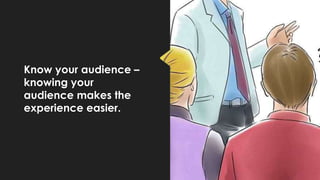
Know your audience –
knowing your
audience makes the
experience easier.
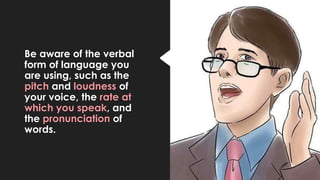
Be aware of the verbal
form of language you
are using, such as the
pitch and loudness of
your voice, the rate at
which you speak, and
the pronunciation of
words.
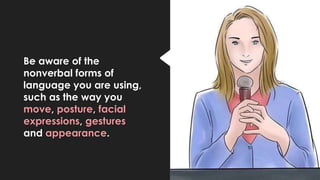
Be aware of the
nonverbal forms of
language you are using,
such as the way you
move, posture, facial
expressions, gestures
and appearance.
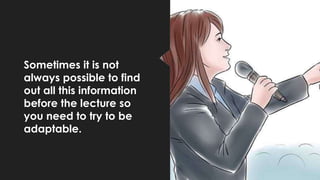
Sometimes it is not
always possible to find
out all this information
before the lecture so
you need to try to be
adaptable.
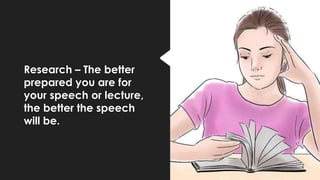
Research – The better
prepared you are for
your speech or lecture,
the better the speech
will be.
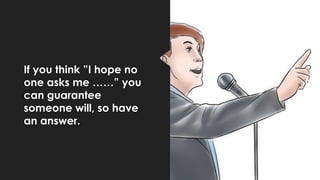
If you think ”I hope no
one asks me ……” you
can guarantee
someone will, so have
an answer.
Delivery
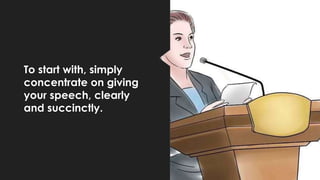
To start with, simply
concentrate on giving
your speech, clearly
and succinctly.
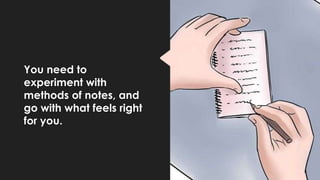
You need to
experiment with
methods of notes, and
go with what feels right
for you.
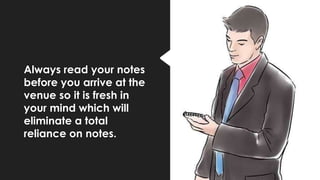
Always read your notes
before you arrive at the
venue so it is fresh in
your mind which will
eliminate a total
reliance on notes.
Resources
 http://www.toastmasters.org/mainmenucategories/freeresources/needhelpgivingaspeec
h/tipstechniques/10tipsforpublicspeaking.aspx
 http://www.askmen.com/money/successful_150/169c_success.html
 http://www.wikihow.com/Be-an-Effective-Public-Speaker
 Prentice Hall Grammar and Composition 4
 Microsoft ® Encarta ® 2008. © 1993-2007 Microsoft Corporation. All rights reserved.
 Google images

Functional Speaking

  • 1.
  • 2.
    Functional Speaking Functional Speakingis a communication tool to get messages across and to carry out activities that many people consider necessary to function in society.  To speak loud enough to be heard  To speak distinctly where everyone can understand
  • 3.
    Tips  Know yourmaterial.  Practice. Practice. Practice  Know the room.  Relax.  Visualize yourself giving your speech  Concentrate on the message  Gain experience
  • 4.
    Tips  In orderto ensure you get your point across, reduce what you say to the bare minimum. -When it comes down to the words you choose, you must clarify; Simplify; Economize; Emphasize  Show, don’t tell -In dealing with what you say, you can show your point through body language with greater efficacy than merely telling your point.  Watch your "ums" and "uhs“ -This kind of mumbling happens most often when you’re nervous and unprepared, so keep in mind: The more prepared you are, the less nervous you’ll be. Say it loud and say it proud!
  • 5.
  • 6.
    Know your audience– knowing your audience makes the experience easier.
  • 7.
    Be aware ofthe verbal form of language you are using, such as the pitch and loudness of your voice, the rate at which you speak, and the pronunciation of words.
  • 8.
    Be aware ofthe nonverbal forms of language you are using, such as the way you move, posture, facial expressions, gestures and appearance.
  • 9.
    Sometimes it isnot always possible to find out all this information before the lecture so you need to try to be adaptable.
  • 10.
    Research – Thebetter prepared you are for your speech or lecture, the better the speech will be.
  • 11.
    If you think”I hope no one asks me ……” you can guarantee someone will, so have an answer.
  • 12.
  • 13.
    To start with,simply concentrate on giving your speech, clearly and succinctly.
  • 14.
    You need to experimentwith methods of notes, and go with what feels right for you.
  • 15.
    Always read yournotes before you arrive at the venue so it is fresh in your mind which will eliminate a total reliance on notes.
  • 16.
    Resources  http://www.toastmasters.org/mainmenucategories/freeresources/needhelpgivingaspeec h/tipstechniques/10tipsforpublicspeaking.aspx  http://www.askmen.com/money/successful_150/169c_success.html http://www.wikihow.com/Be-an-Effective-Public-Speaker  Prentice Hall Grammar and Composition 4  Microsoft ® Encarta ® 2008. © 1993-2007 Microsoft Corporation. All rights reserved.  Google images