Government Engineering College,
Bhavnagar.
Civil Engineering Department
Strength Of Materials
Topic:-
Torsion
By,
Bhavik Shah – 130210106049
Contents
 Introduction
 Torsion Formula
 Assumptions
 Power Transmitted by shaft
 Torsional Rigidity
Introduction
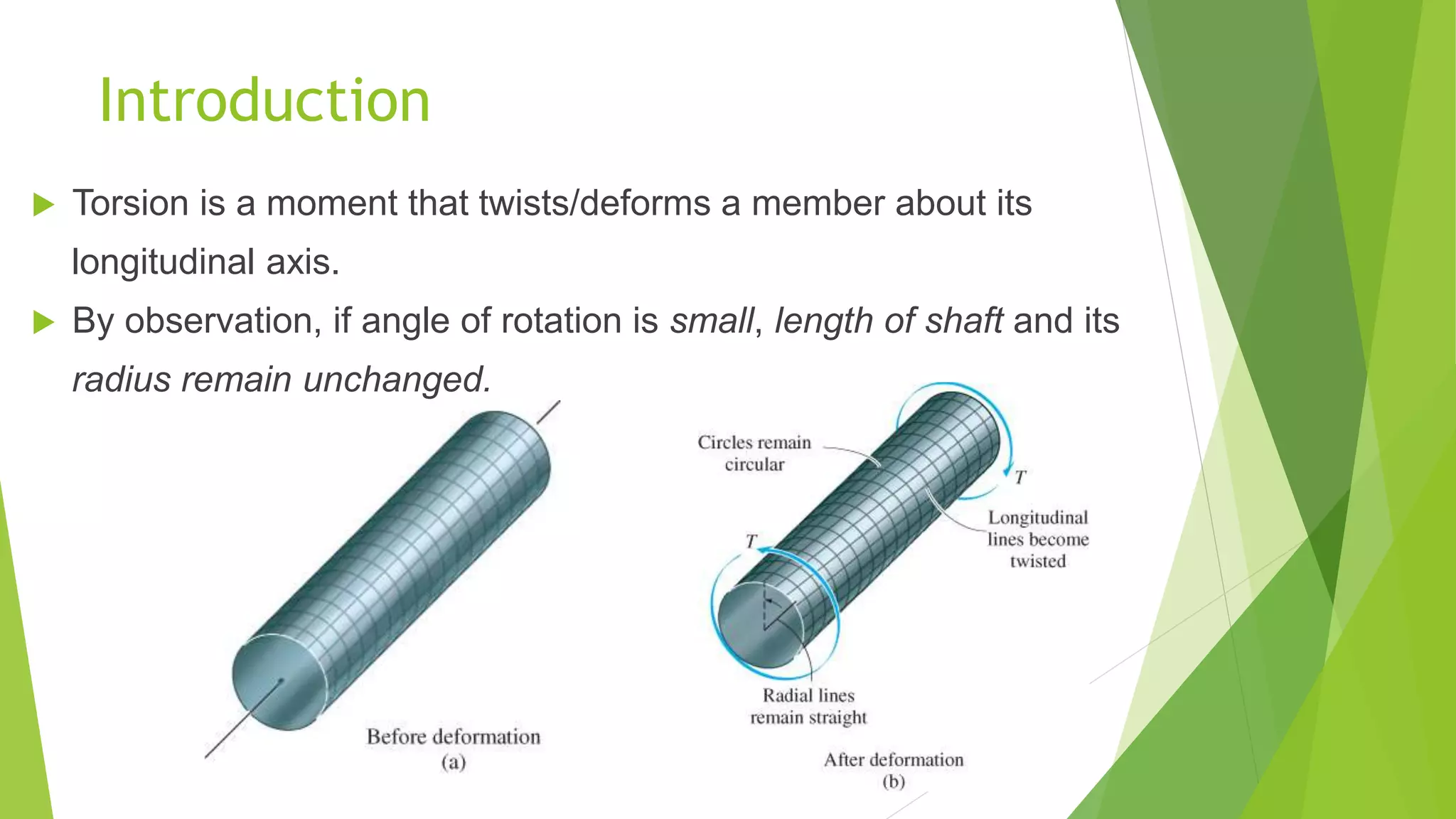
 Torsion is a moment that twists/deforms a member about its
longitudinal axis.
 By observation, if angle of rotation is small, length of shaft and its
radius remain unchanged.
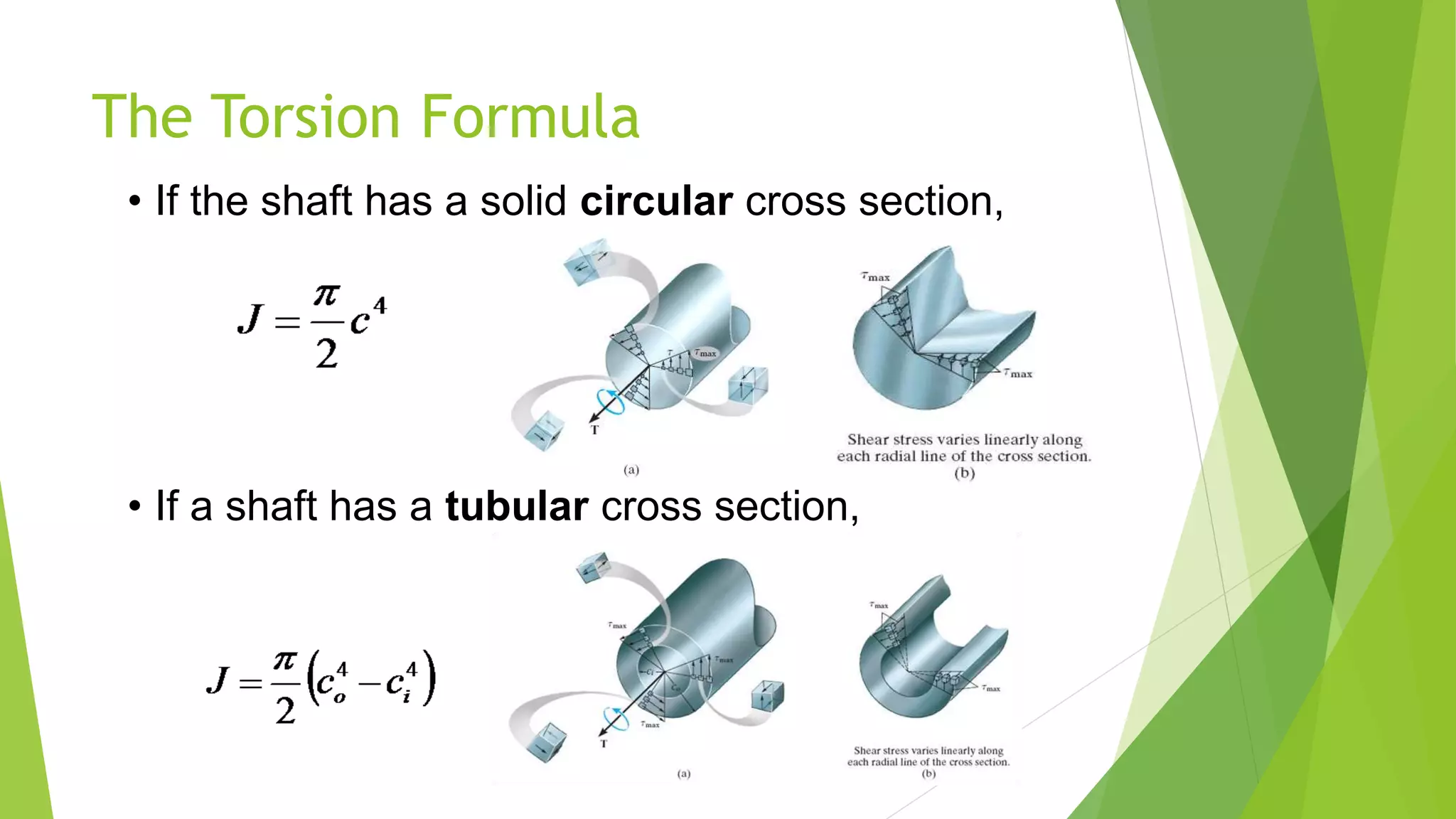
The Torsion Formula
 When material is linear-elastic, Hooke’s law applies.
 A linear variation in shear strain leads to a corresponding linear variation in
shear stress along any radial line on the cross section.
The Torsion Formula
• If the shaft has a solid circular cross section,
• If a shaft has a tubular cross section,
Example
• The shaft is supported by two bearings and is subjected to three torques.
Determine the shear stress developed at points A and B, located at section
a–a of the shaft.
Solution
From the free-body diagram of the left segment,
The polar moment of inertia for the shaft is
Since point A is at ρ = c = 75 mm,
Likewise for point B, at ρ =15 mm, we have
Assumptions
 The material is homogeneous, i.e. of uniform elastic
properties throughout.
 The material is elastic, following Hooke's law with shear
stress proportional to shear
strain.
 The stress does not exceed the elastic limit or limit of
proportionality.
 Circular sections remain circular.
Assumptions
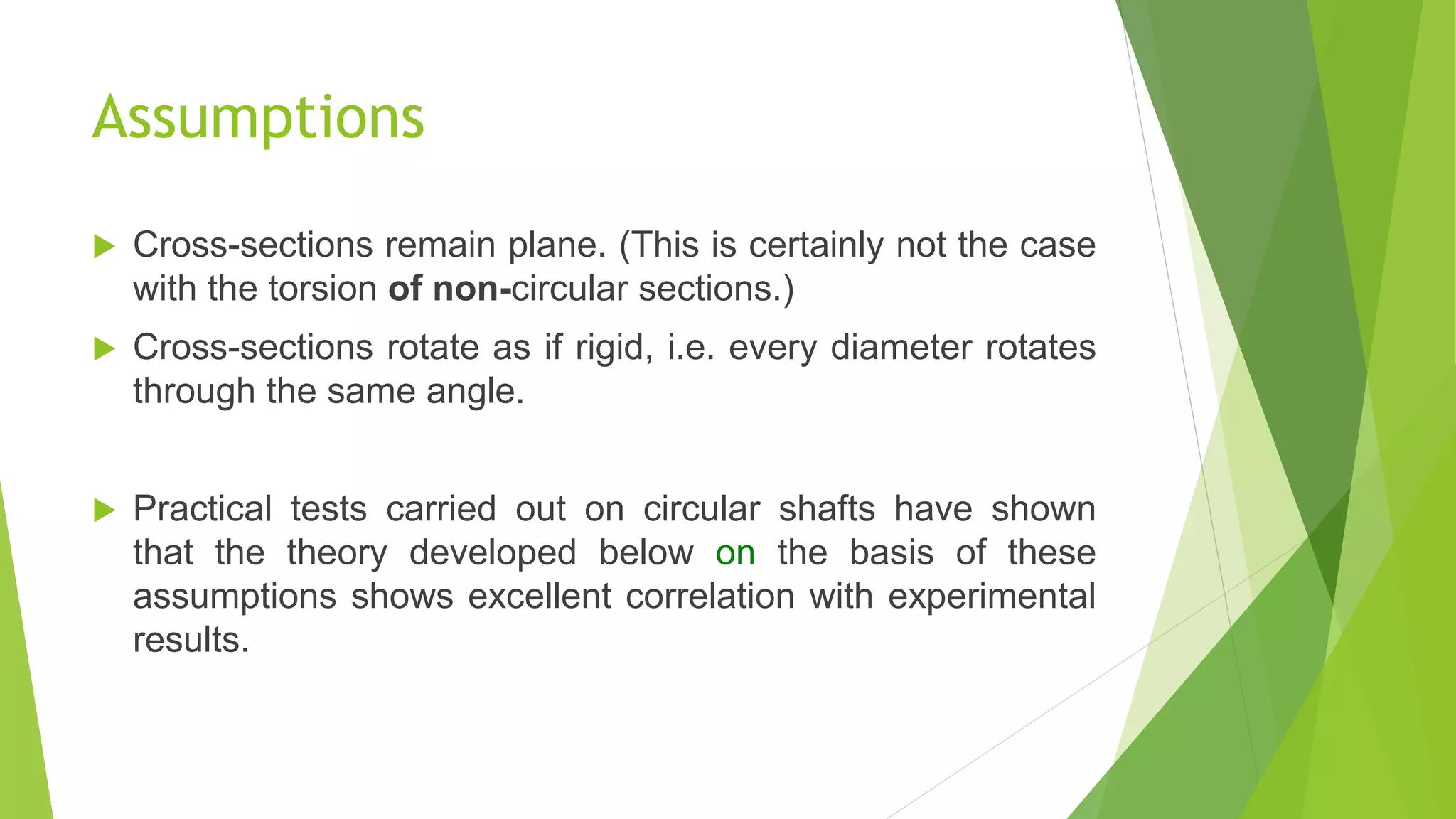
 Cross-sections remain plane. (This is certainly not the case
with the torsion of non-circular sections.)
 Cross-sections rotate as if rigid, i.e. every diameter rotates
through the same angle.
 Practical tests carried out on circular shafts have shown
that the theory developed below on the basis of these
assumptions shows excellent correlation with experimental
results.
Power Transmission
 Power is defined as work performed per unit of time
 Instantaneous power is
 Since shaft’s angular velocity  = d/dt, we can also
express power as
 Frequency f of a shaft’s rotation is often reported. It
measures the number of cycles per second and since 1
cycle = 2 radians, and  = 2f T, then power
P = T (d/dt)
P = T
P = 2f T
Power Transmission
Shaft Design
 If power transmitted by shaft and its frequency of rotation is known,
torque is determined from Eqn 5-11
 Knowing T and allowable shear stress for material, allow and applying
torsion formula,
 For solid shaft, substitute J = (/2)c4 to determine c
 For tubular shaft, substitute J = (/2)(co
2  ci
2) to determine co and ci
Example
Solid steel shaft shown used to transmit 3750 W from
attached motor M. Shaft rotates at  = 175 rpm and
the steel allow = 100 MPa.
Determine required diameter of shaft to nearest mm.
Solution
Torque on shaft determined from P = T,
Thus, P = 3750 N·m/s
Thus, P = T,T = 204.6 N·m
Since 2c = 21.84 mm, select shaft with diameter of d = 22 mm
Torsional Rigidity
The angle of twist per unit length of shafts is given by the torsion theory as:

L
T
G J

The quantity G J is called the torsional rigidity of the shaft and is thus given as:
G J
T
L

 / (12)
i.e. the torsional rigidity is the torque divided by the angle of twist (in radians) per unit
length.
Thank You For Bearing

Torsion

  • 1.
  • 2.
  • 3.
    Contents  Introduction  TorsionFormula  Assumptions  Power Transmitted by shaft  Torsional Rigidity
  • 4.
    Introduction  Torsion isa moment that twists/deforms a member about its longitudinal axis.  By observation, if angle of rotation is small, length of shaft and its radius remain unchanged.
  • 5.
    The Torsion Formula When material is linear-elastic, Hooke’s law applies.  A linear variation in shear strain leads to a corresponding linear variation in shear stress along any radial line on the cross section.
  • 6.
    The Torsion Formula •If the shaft has a solid circular cross section, • If a shaft has a tubular cross section,
  • 7.
    Example • The shaftis supported by two bearings and is subjected to three torques. Determine the shear stress developed at points A and B, located at section a–a of the shaft.
  • 8.
    Solution From the free-bodydiagram of the left segment, The polar moment of inertia for the shaft is Since point A is at ρ = c = 75 mm, Likewise for point B, at ρ =15 mm, we have
  • 9.
    Assumptions  The materialis homogeneous, i.e. of uniform elastic properties throughout.  The material is elastic, following Hooke's law with shear stress proportional to shear strain.  The stress does not exceed the elastic limit or limit of proportionality.  Circular sections remain circular.
  • 10.
    Assumptions  Cross-sections remainplane. (This is certainly not the case with the torsion of non-circular sections.)  Cross-sections rotate as if rigid, i.e. every diameter rotates through the same angle.  Practical tests carried out on circular shafts have shown that the theory developed below on the basis of these assumptions shows excellent correlation with experimental results.
  • 11.
    Power Transmission  Poweris defined as work performed per unit of time  Instantaneous power is  Since shaft’s angular velocity  = d/dt, we can also express power as  Frequency f of a shaft’s rotation is often reported. It measures the number of cycles per second and since 1 cycle = 2 radians, and  = 2f T, then power P = T (d/dt) P = T P = 2f T
  • 12.
    Power Transmission Shaft Design If power transmitted by shaft and its frequency of rotation is known, torque is determined from Eqn 5-11  Knowing T and allowable shear stress for material, allow and applying torsion formula,  For solid shaft, substitute J = (/2)c4 to determine c  For tubular shaft, substitute J = (/2)(co 2  ci 2) to determine co and ci
  • 13.
    Example Solid steel shaftshown used to transmit 3750 W from attached motor M. Shaft rotates at  = 175 rpm and the steel allow = 100 MPa. Determine required diameter of shaft to nearest mm.
  • 14.
    Solution Torque on shaftdetermined from P = T, Thus, P = 3750 N·m/s Thus, P = T,T = 204.6 N·m Since 2c = 21.84 mm, select shaft with diameter of d = 22 mm
  • 15.
    Torsional Rigidity The angleof twist per unit length of shafts is given by the torsion theory as:  L T G J  The quantity G J is called the torsional rigidity of the shaft and is thus given as: G J T L   / (12) i.e. the torsional rigidity is the torque divided by the angle of twist (in radians) per unit length.
  • 16.