Government Engineering College,
Bhavnagar.
Civil Engineering Department
Topic:-
Hardened Concrete
Contents
 Overview of Concrete
 Hardened Concrete
 Strength of Concrete
 Standard Test methods
 Stress Strain Behaviour of concrete
 Creep and Shrinkage
Overview of Concrete
 Concrete is one of the most commonly used building materials.
 Concrete is a composite material made from several readily available
constituents (aggregates, sand, cement, water).
 Concrete is a versatile material that can easily be mixed to meet a
variety of special needs and formed to virtually any shape.
 Constituents:-
 Cement
 Water
 Fine Aggregates.
 Coarse Aggregates.
 Admixtures
Concrete
Advantages Disadvantages
 Ability to be cast
 Economical
 Durable
 Fire resistant
 Energy efficient
 On-site fabrication
 Low tensile strength
 Low ductility
 Volume instability
 Low strength to weight ratio
PROPERTIES OF
HARDENED CONCRETE
 The principal properties of hardened concrete which are
of practical importance can be listed as:
1. Strength
2. Shrinkage & creep deformations
3. Permeability & durability
4. Response to temperature variations
Of these compressive strength is the most important
property of concrete.
PROPERTIES OF
HARDENED CONCRETE
 Of the above mentioned hardened properties compressive
strength is one of the most important property that is often
required, simply because;
Concrete is used for compressive loads
Compressive strength is easily obtained
It is a good measure of all the other
properties.
What Affects Concrete Strength?
STRENGTH OF CONCRETE
 The strength of a concrete specimen prepared, cured and tested
under specified conditions at a given age depends on:
1. w/c ratio
2. Degree of compaction
COMPRESSIVE STRENGTH
 Compressive Strength is determined by loading properly prepared
and cured cubic, cylindrical or prismatic specimens under
compression.
COMPRESSIVE STRENGTH
Cylinder : ASTM C470
 Cubes : British standard 150x150x150 mm3
 Other sizes:
Cylinder: 100 × 200 or 150 × 300 mm
Cubes: 100 × 100 × 100 mm3 or
A
P
C

•For 150 mm cubes fill in 3 layers compact
each layer 35 times.
•For 100 mm cubes fill in 3 layers compact
each layer 25 times.
•No need for capping.
•For 150 x 300 mm cylinder, fill in 3 layers compact
each layer 25 times.
•Capping to obtain a plane and smooth surface (thin
layer ≈ 3mm), using:
Stiff Portland cement paste on freshly cast concrete,
or mixture of sulphur and granular material, or
high-strength gypsum plaster on hardened concrete.
TENSILE STRENGTH
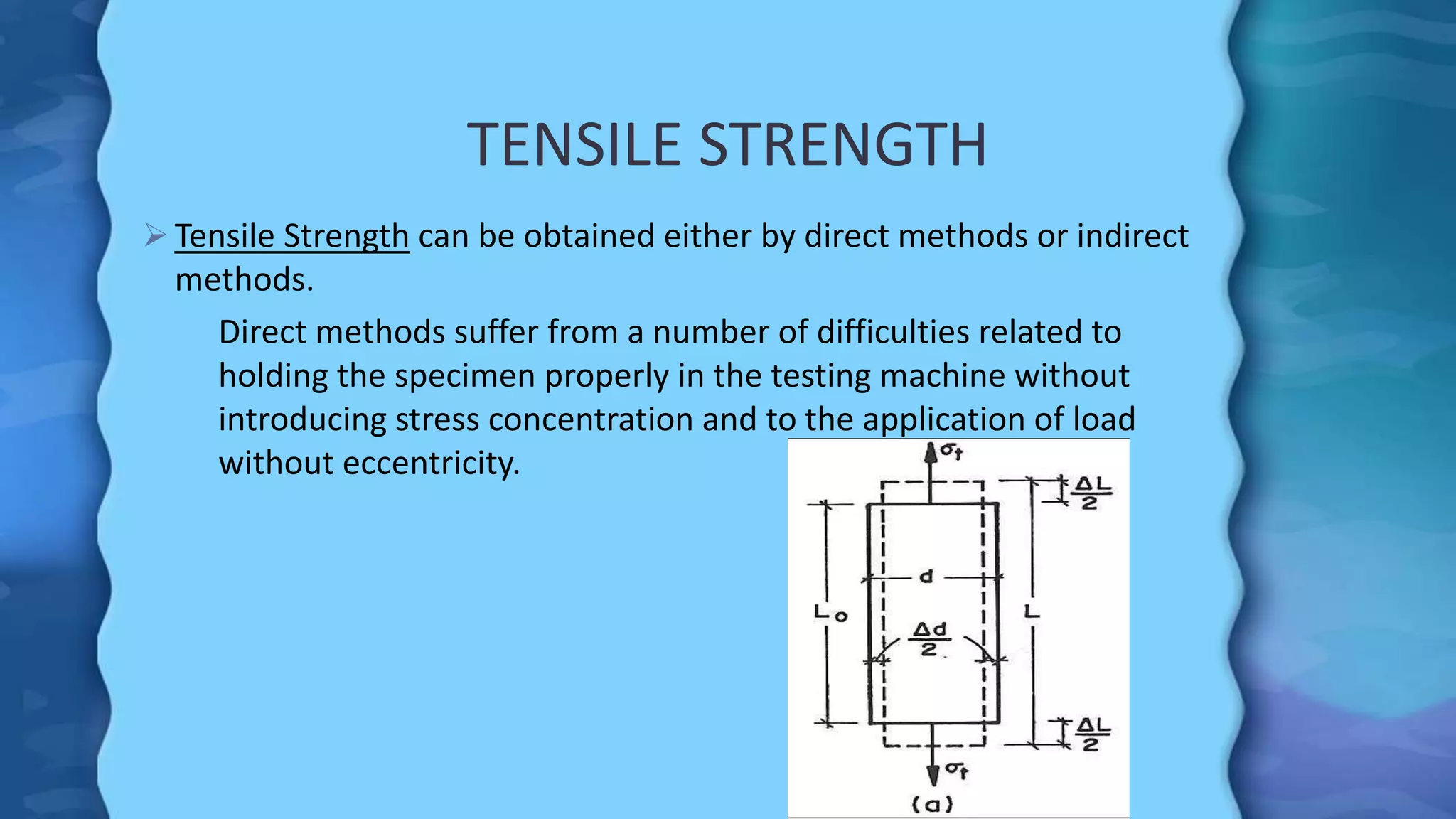
 Tensile Strength can be obtained either by direct methods or indirect
methods.
Direct methods suffer from a number of difficulties related to
holding the specimen properly in the testing machine without
introducing stress concentration and to the application of load
without eccentricity.
SPLIT TENSILE STRENGTH
 Due to applied compression load a fairly uniform tensile stress is
induced over nearly 2/3 of the diameter of the cylinder perpendicular
to the direction of load application.
• The advantage of the splitting test over the direct
tensile test is the same molds are used for
compressive & tensile strength determination.
• The test is simple to perform and gives uniform
results than other tension tests.
σst =
2P
πDl
P: applied compressive load
D: diameter of specimen
l: length of specimen
Splitting Tensile
Strength
Factors Affecting the Strength of Concrete
Factors depended on the test
type:
Factors independent of test type:
 Size of specimen
 Size of specimen in relation
with size of aggregates
 Support condition of
specimen
 Moisture condition of
specimen
 Type of loading adopted
 Rate of loading
 Type of test machine
 Type of cement
 Type of aggregates
 Degree of compaction
 Mix proportions
 Type of curing
 Type of stress situation
 W/C ratio
 Admixtures
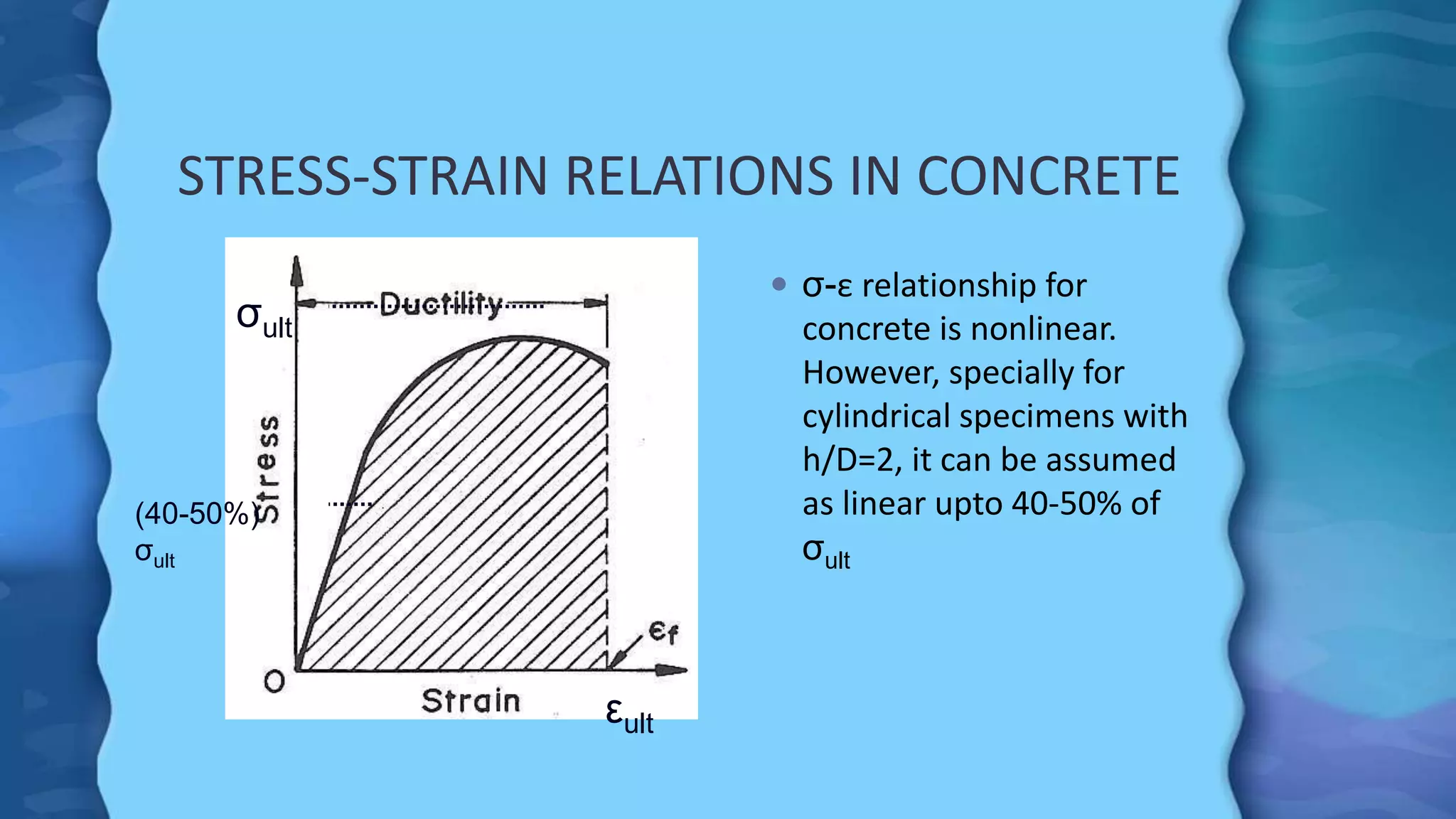
STRESS-STRAIN RELATIONS IN CONCRETE
 σ-ε relationship for
concrete is nonlinear.
However, specially for
cylindrical specimens with
h/D=2, it can be assumed
as linear upto 40-50% of
σult
σult
(40-50%)
σult
εult
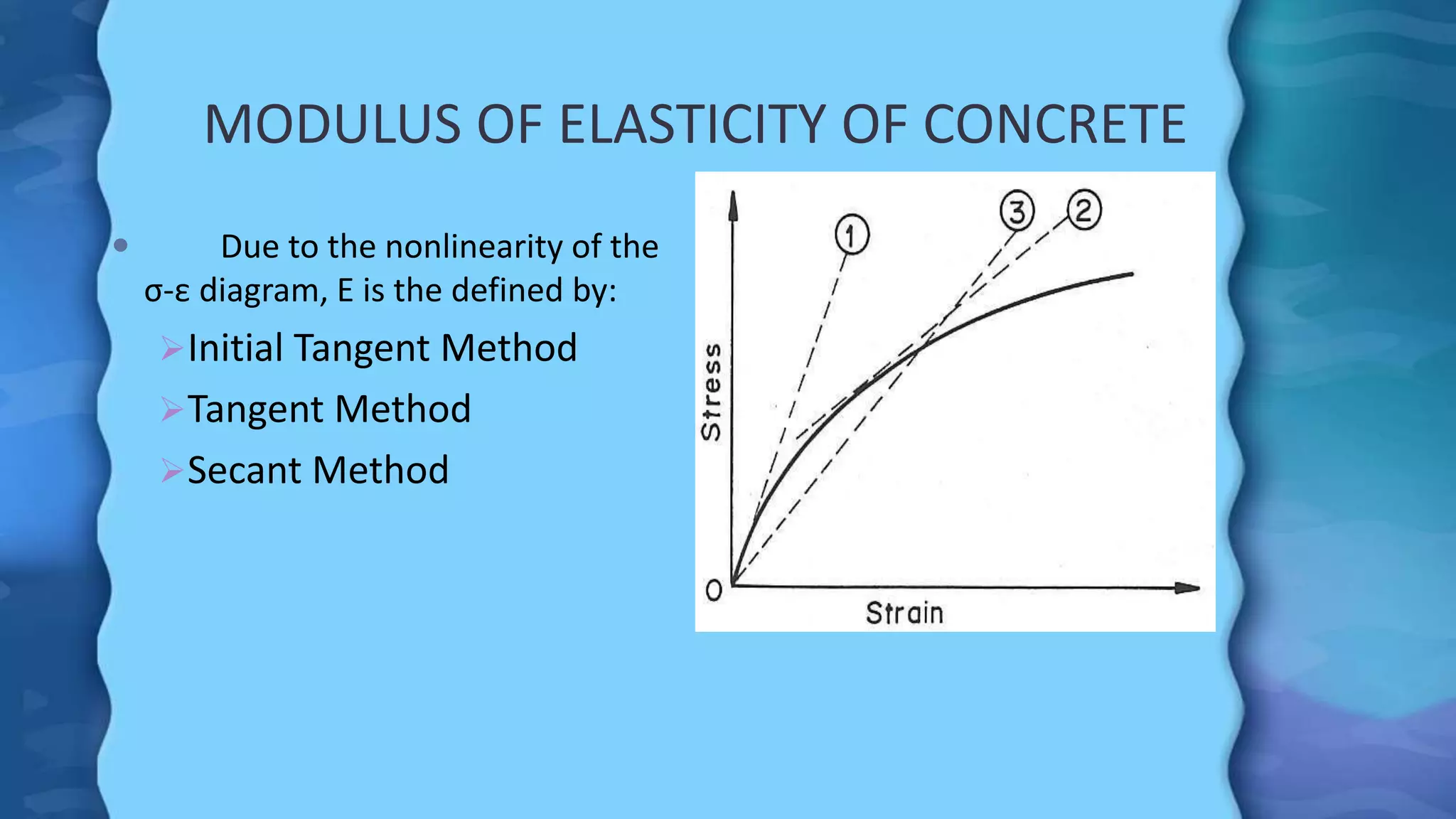
MODULUS OF ELASTICITY OF CONCRETE
 Due to the nonlinearity of the
σ-ε diagram, E is the defined by:
Initial Tangent Method
Tangent Method
Secant Method
Creep in Concrete
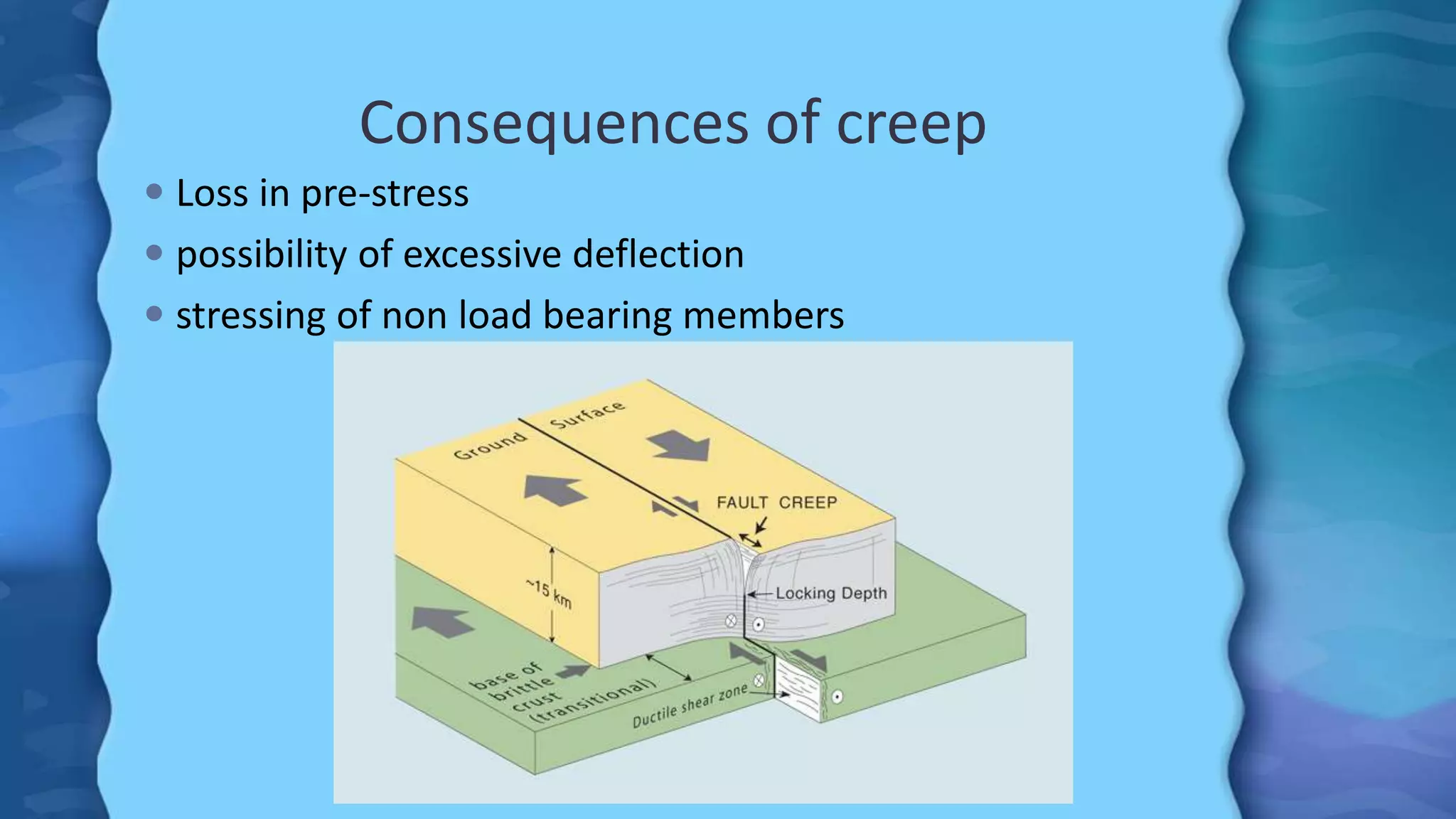
Consequences of creep
 Loss in pre-stress
 possibility of excessive deflection
 stressing of non load bearing members
Shrinkage
 Concrete shrinkage is the contracting of the concrete due to the
water evaporating from the mixture. This evaporation will cause the
concrete to weaken. This can lead to cracks, internal warping and
external deflection.
Types of Concrete Shrinkage
 There are numerous types of concrete shrinkage including plastic
shrinkage, drying shrinkage, Autogenous shrinkage, and carbonation
shrinkage.
 Plastic shrinkage happens soon after the concrete is poured in the
forms. The water evaporates and results in a reduction of volume,
this causes the concrete on the surface to collapse. It can be reduced
by covering the surface with polyethylene sheeting immediately after
it is poured.
 Plastic Shrinkage in Concrete
Types of Concrete Shrinkage
 Drying shrinkage is the ever lasting process for concrete within
drying conditions. The loss of water within the gel pores of the
concrete is what causes the concrete to shrink. The finer the
gel within the pores, the more shrinkage there is.
 Autogenous shrinkage is most prevalent within the concrete in the
interior of a dam. When the temperature is constant shrinkage may
occur, especially when there is no moisture movement.
 Carbonation shrinkage is where carbon dioxide penetrates beyond
the surface of the concrete. This also depends on the moisture
content and the humidity levels. Carbonation shrinkage is caused by
the disbanding of calcium hydroxide crystals and the evidence of
calcium carbonate.
Where Concrete Shrinkage Occurs
 Concrete shrinkage can occur in any poured concrete.
 It is most common in slabs, beams, bearing walls, foundations and
columns.
 It can also be found in pre-stressed members as well as tanks.
 Shrinkage is a problem for any poured concrete, but when it happens
in bearing walls and foundations the entire stability and integrity of
the structure is in jeopardy.
By,
Bhavik Shah – 130210106049,
Kartik Hingol – 130210106030,
Digvijay Solanki – 130210106055,
Nitin Charel – 130210106011.

Hardened concrete

  • 1.
  • 2.
  • 3.
    Contents  Overview ofConcrete  Hardened Concrete  Strength of Concrete  Standard Test methods  Stress Strain Behaviour of concrete  Creep and Shrinkage
  • 4.
    Overview of Concrete Concrete is one of the most commonly used building materials.  Concrete is a composite material made from several readily available constituents (aggregates, sand, cement, water).  Concrete is a versatile material that can easily be mixed to meet a variety of special needs and formed to virtually any shape.  Constituents:-  Cement  Water  Fine Aggregates.  Coarse Aggregates.  Admixtures
  • 5.
    Concrete Advantages Disadvantages  Abilityto be cast  Economical  Durable  Fire resistant  Energy efficient  On-site fabrication  Low tensile strength  Low ductility  Volume instability  Low strength to weight ratio
  • 6.
    PROPERTIES OF HARDENED CONCRETE The principal properties of hardened concrete which are of practical importance can be listed as: 1. Strength 2. Shrinkage & creep deformations 3. Permeability & durability 4. Response to temperature variations Of these compressive strength is the most important property of concrete.
  • 7.
    PROPERTIES OF HARDENED CONCRETE Of the above mentioned hardened properties compressive strength is one of the most important property that is often required, simply because; Concrete is used for compressive loads Compressive strength is easily obtained It is a good measure of all the other properties.
  • 8.
  • 9.
    STRENGTH OF CONCRETE The strength of a concrete specimen prepared, cured and tested under specified conditions at a given age depends on: 1. w/c ratio 2. Degree of compaction
  • 10.
    COMPRESSIVE STRENGTH  CompressiveStrength is determined by loading properly prepared and cured cubic, cylindrical or prismatic specimens under compression.
  • 11.
    COMPRESSIVE STRENGTH Cylinder :ASTM C470  Cubes : British standard 150x150x150 mm3  Other sizes: Cylinder: 100 × 200 or 150 × 300 mm Cubes: 100 × 100 × 100 mm3 or A P C 
  • 12.
    •For 150 mmcubes fill in 3 layers compact each layer 35 times. •For 100 mm cubes fill in 3 layers compact each layer 25 times. •No need for capping.
  • 13.
    •For 150 x300 mm cylinder, fill in 3 layers compact each layer 25 times. •Capping to obtain a plane and smooth surface (thin layer ≈ 3mm), using: Stiff Portland cement paste on freshly cast concrete, or mixture of sulphur and granular material, or high-strength gypsum plaster on hardened concrete.
  • 15.
    TENSILE STRENGTH  TensileStrength can be obtained either by direct methods or indirect methods. Direct methods suffer from a number of difficulties related to holding the specimen properly in the testing machine without introducing stress concentration and to the application of load without eccentricity.
  • 16.
    SPLIT TENSILE STRENGTH Due to applied compression load a fairly uniform tensile stress is induced over nearly 2/3 of the diameter of the cylinder perpendicular to the direction of load application.
  • 17.
    • The advantageof the splitting test over the direct tensile test is the same molds are used for compressive & tensile strength determination. • The test is simple to perform and gives uniform results than other tension tests. σst = 2P πDl P: applied compressive load D: diameter of specimen l: length of specimen Splitting Tensile Strength
  • 18.
    Factors Affecting theStrength of Concrete Factors depended on the test type: Factors independent of test type:  Size of specimen  Size of specimen in relation with size of aggregates  Support condition of specimen  Moisture condition of specimen  Type of loading adopted  Rate of loading  Type of test machine  Type of cement  Type of aggregates  Degree of compaction  Mix proportions  Type of curing  Type of stress situation  W/C ratio  Admixtures
  • 19.
    STRESS-STRAIN RELATIONS INCONCRETE  σ-ε relationship for concrete is nonlinear. However, specially for cylindrical specimens with h/D=2, it can be assumed as linear upto 40-50% of σult σult (40-50%) σult εult
  • 20.
    MODULUS OF ELASTICITYOF CONCRETE  Due to the nonlinearity of the σ-ε diagram, E is the defined by: Initial Tangent Method Tangent Method Secant Method
  • 21.
  • 22.
    Consequences of creep Loss in pre-stress  possibility of excessive deflection  stressing of non load bearing members
  • 23.
    Shrinkage  Concrete shrinkageis the contracting of the concrete due to the water evaporating from the mixture. This evaporation will cause the concrete to weaken. This can lead to cracks, internal warping and external deflection.
  • 24.
    Types of ConcreteShrinkage  There are numerous types of concrete shrinkage including plastic shrinkage, drying shrinkage, Autogenous shrinkage, and carbonation shrinkage.  Plastic shrinkage happens soon after the concrete is poured in the forms. The water evaporates and results in a reduction of volume, this causes the concrete on the surface to collapse. It can be reduced by covering the surface with polyethylene sheeting immediately after it is poured.  Plastic Shrinkage in Concrete
  • 25.
    Types of ConcreteShrinkage  Drying shrinkage is the ever lasting process for concrete within drying conditions. The loss of water within the gel pores of the concrete is what causes the concrete to shrink. The finer the gel within the pores, the more shrinkage there is.  Autogenous shrinkage is most prevalent within the concrete in the interior of a dam. When the temperature is constant shrinkage may occur, especially when there is no moisture movement.  Carbonation shrinkage is where carbon dioxide penetrates beyond the surface of the concrete. This also depends on the moisture content and the humidity levels. Carbonation shrinkage is caused by the disbanding of calcium hydroxide crystals and the evidence of calcium carbonate.
  • 26.
    Where Concrete ShrinkageOccurs  Concrete shrinkage can occur in any poured concrete.  It is most common in slabs, beams, bearing walls, foundations and columns.  It can also be found in pre-stressed members as well as tanks.  Shrinkage is a problem for any poured concrete, but when it happens in bearing walls and foundations the entire stability and integrity of the structure is in jeopardy.
  • 27.
    By, Bhavik Shah –130210106049, Kartik Hingol – 130210106030, Digvijay Solanki – 130210106055, Nitin Charel – 130210106011.