2005 Pearson Education South Asia Pte Ltd
5. Torsion
1
CHAPTER OBJECTIVES
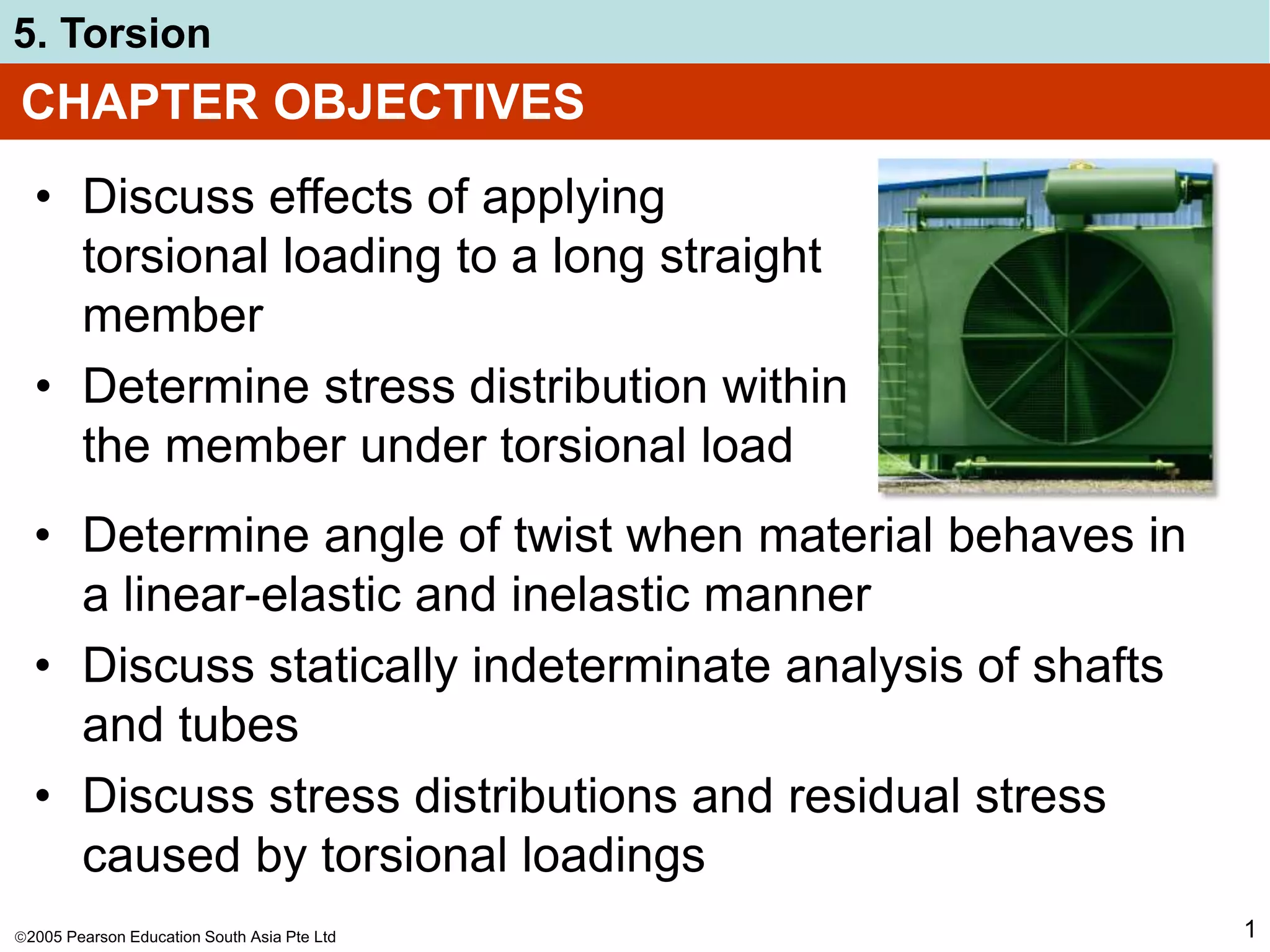
• Discuss effects of applying
torsional loading to a long straight
member
• Determine stress distribution within
the member under torsional load
• Determine angle of twist when material behaves in
a linear-elastic and inelastic manner
• Discuss statically indeterminate analysis of shafts
and tubes
• Discuss stress distributions and residual stress
caused by torsional loadings
2005 Pearson Education South Asia Pte Ltd
5. Torsion
2
CHAPTER OUTLINE
1. Torsional Deformation of a Circular Shaft
2. The Torsion Formula
3. Power Transmission
4. Angle of Twist
5. Statically Indeterminate Torque-Loaded Members
6. *Solid Noncircular Shafts
7. *Thin-Walled Tubes Having Closed Cross
Sections
8. Stress Concentration
9. *Inelastic Torsion
10. *Residual Stress
2005 Pearson Education South Asia Pte Ltd
5. Torsion
3
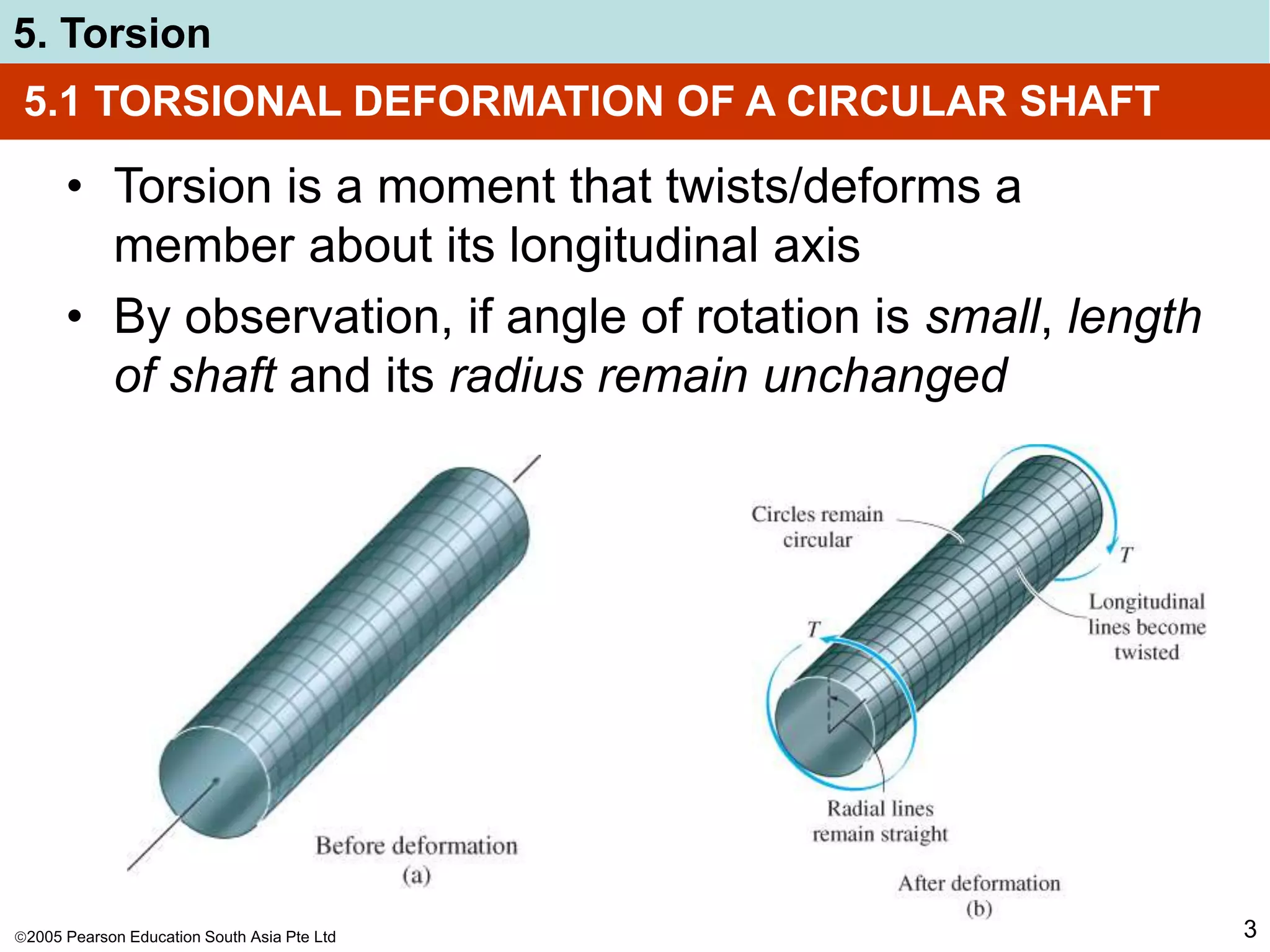
• Torsion is a moment that twists/deforms a
member about its longitudinal axis
• By observation, if angle of rotation is small, length
of shaft and its radius remain unchanged
5.1 TORSIONAL DEFORMATION OF A CIRCULAR SHAFT
2005 Pearson Education South Asia Pte Ltd
5. Torsion
4
5.1 TORSIONAL DEFORMATION OF A CIRCULAR SHAFT
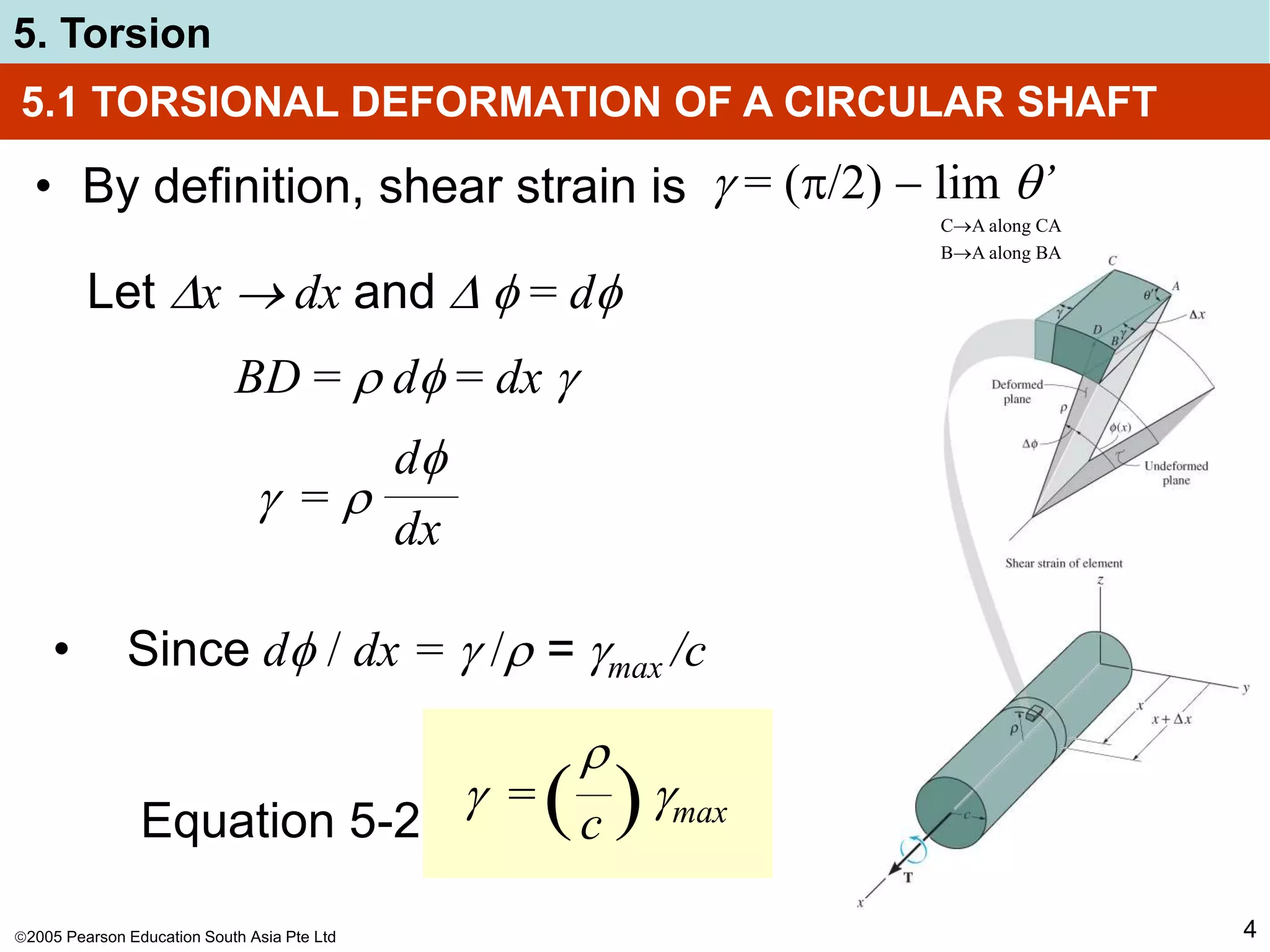
• By definition, shear strain is
Let x  dx and   = d
BD =  d = dx 
 = (/2)  lim ’
CA along CA
BA along BA
 = 
d
dx
• Since d / dx =  / = max /c
 = max

c
( )
Equation 5-2
2005 Pearson Education South Asia Pte Ltd
5. Torsion
5
5.2 THE TORSION FORMULA
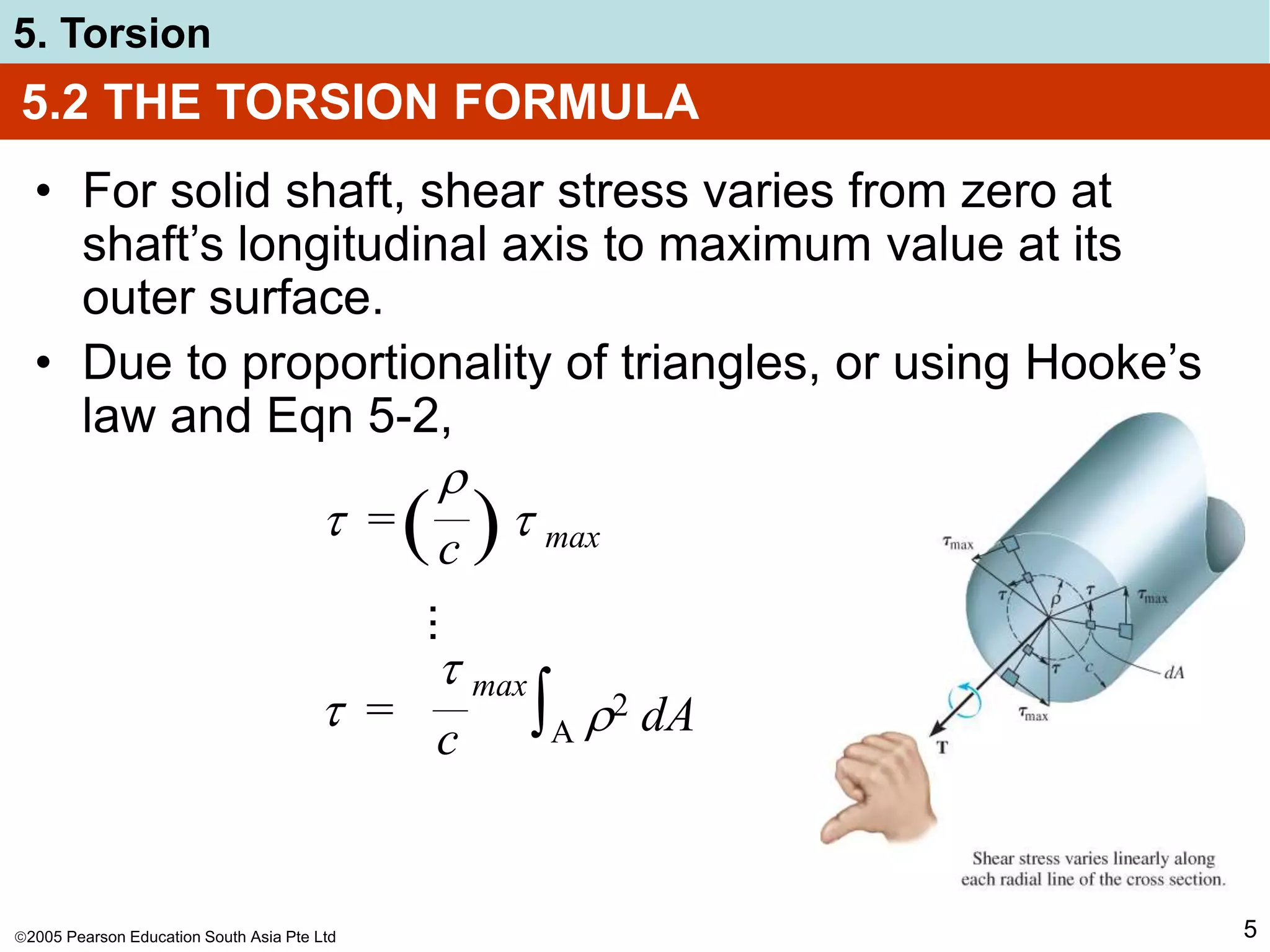
• For solid shaft, shear stress varies from zero at
shaft’s longitudinal axis to maximum value at its
outer surface.
• Due to proportionality of triangles, or using Hooke’s
law and Eqn 5-2,
 =  max

c
( )
...
 =
 max
c ∫A 2 dA
2005 Pearson Education South Asia Pte Ltd
5. Torsion
6
5.2 THE TORSION FORMULA
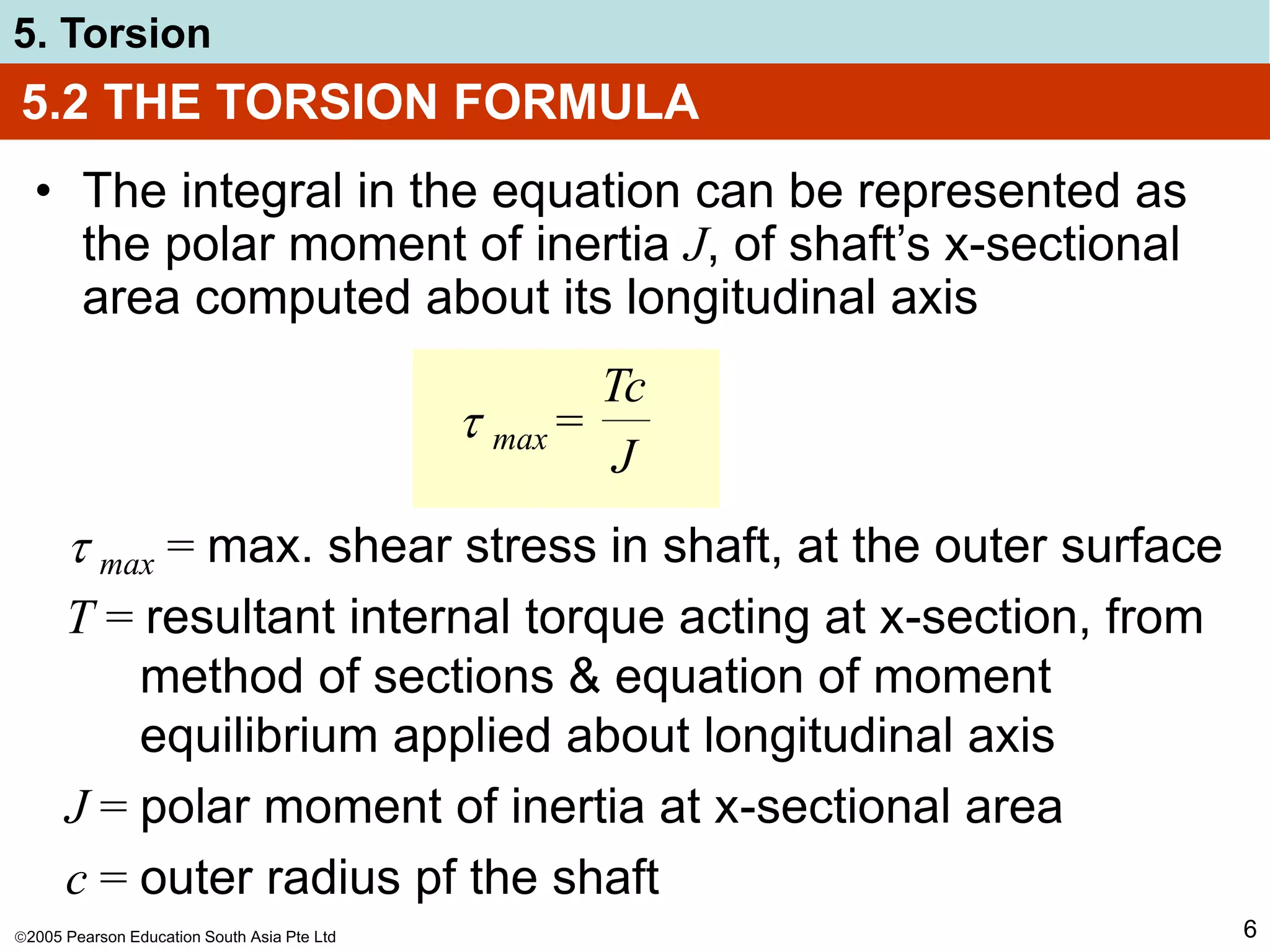
• The integral in the equation can be represented as
the polar moment of inertia J, of shaft’s x-sectional
area computed about its longitudinal axis
 max =
Tc
J
 max = max. shear stress in shaft, at the outer surface
T = resultant internal torque acting at x-section, from
method of sections & equation of moment
equilibrium applied about longitudinal axis
J = polar moment of inertia at x-sectional area
c = outer radius pf the shaft
2005 Pearson Education South Asia Pte Ltd
5. Torsion
7
5.2 THE TORSION FORMULA
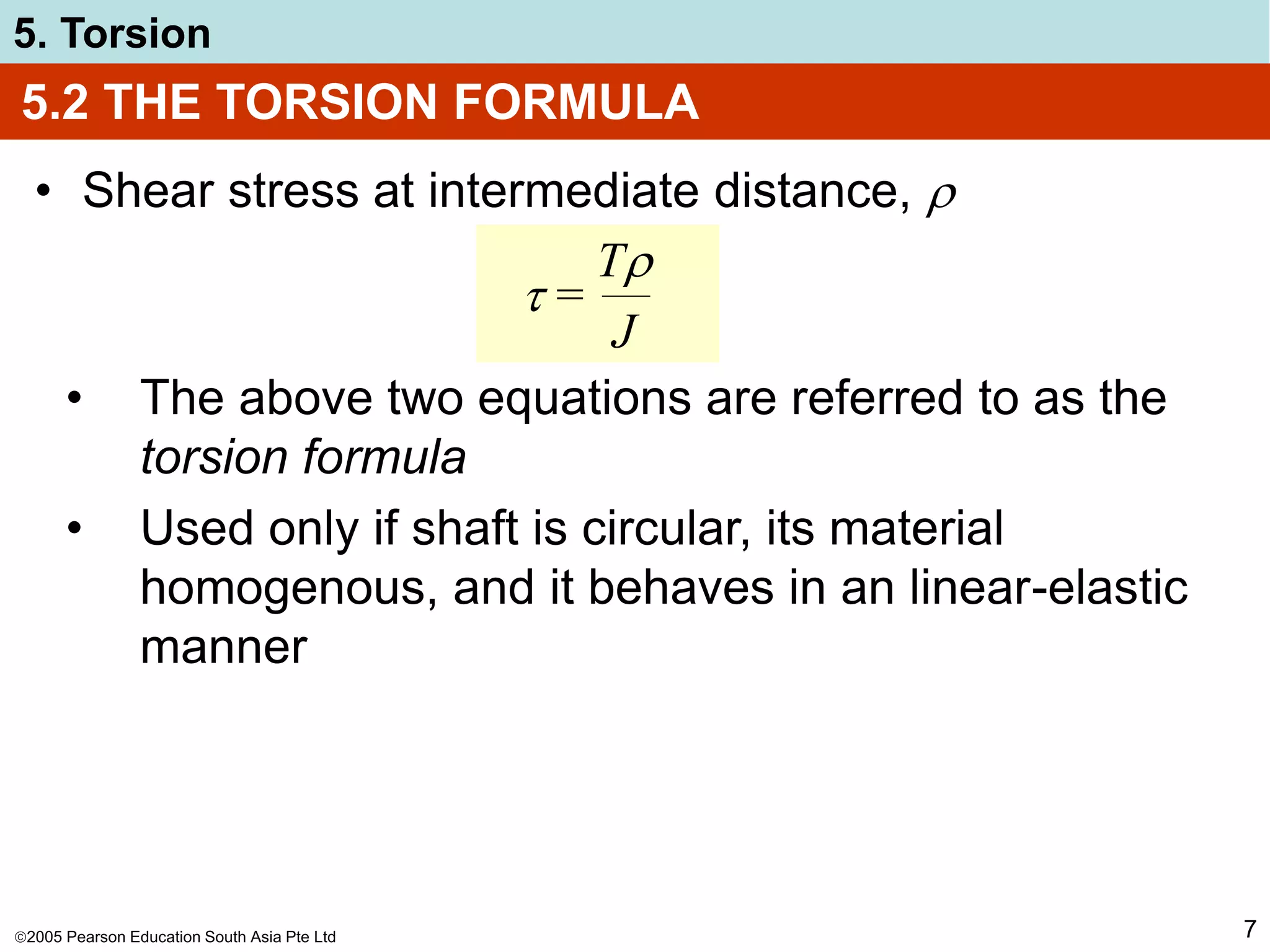
• Shear stress at intermediate distance, 
 =
T
J
• The above two equations are referred to as the
torsion formula
• Used only if shaft is circular, its material
homogenous, and it behaves in an linear-elastic
manner
2005 Pearson Education South Asia Pte Ltd
5. Torsion
8
5.2 THE TORSION FORMULA
Solid shaft
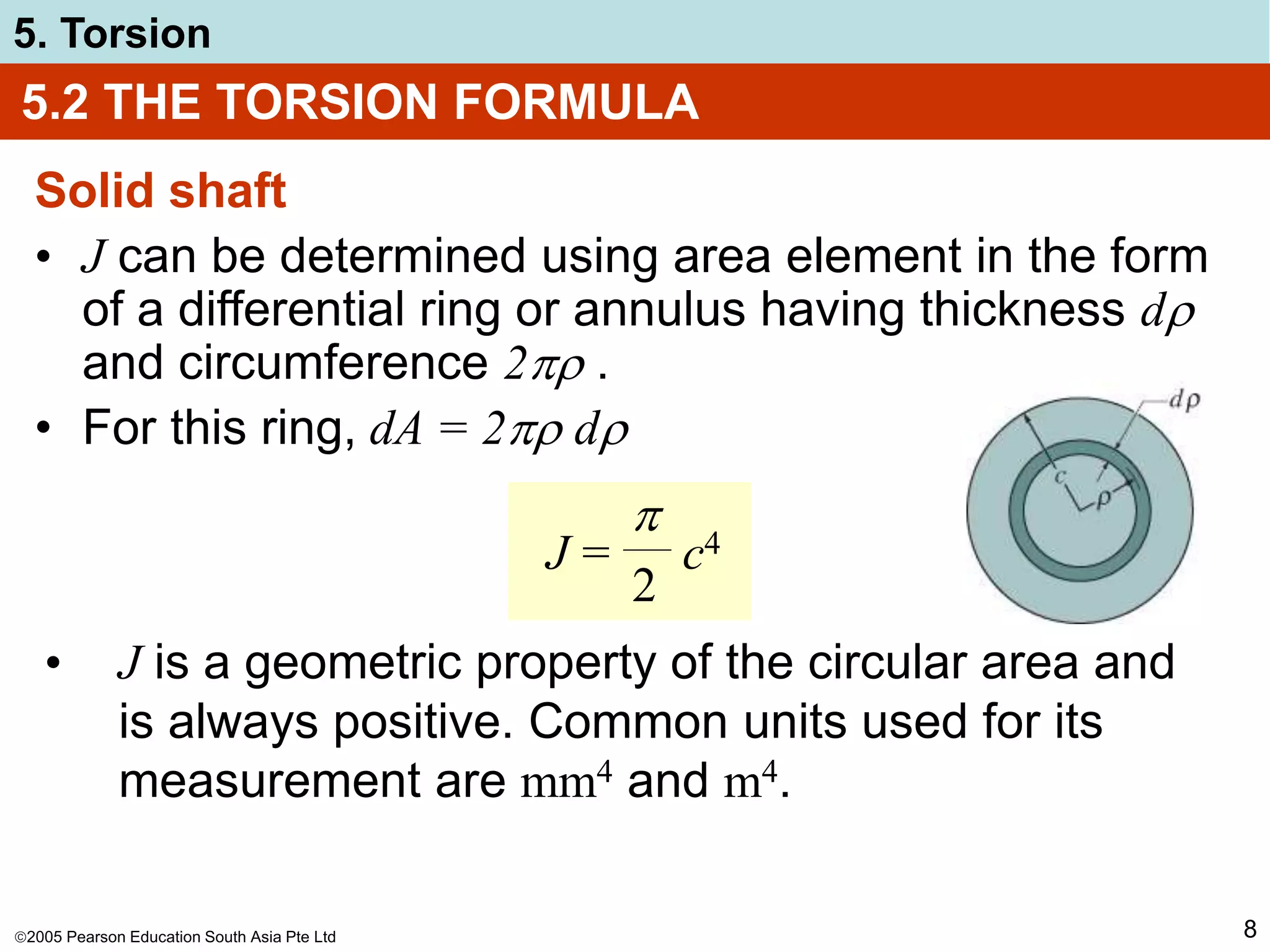
• J can be determined using area element in the form
of a differential ring or annulus having thickness d
and circumference 2 .
• For this ring, dA = 2 d
J = c4

2
• J is a geometric property of the circular area and
is always positive. Common units used for its
measurement are mm4 and m4.
2005 Pearson Education South Asia Pte Ltd
5. Torsion
9
5.2 THE TORSION FORMULA
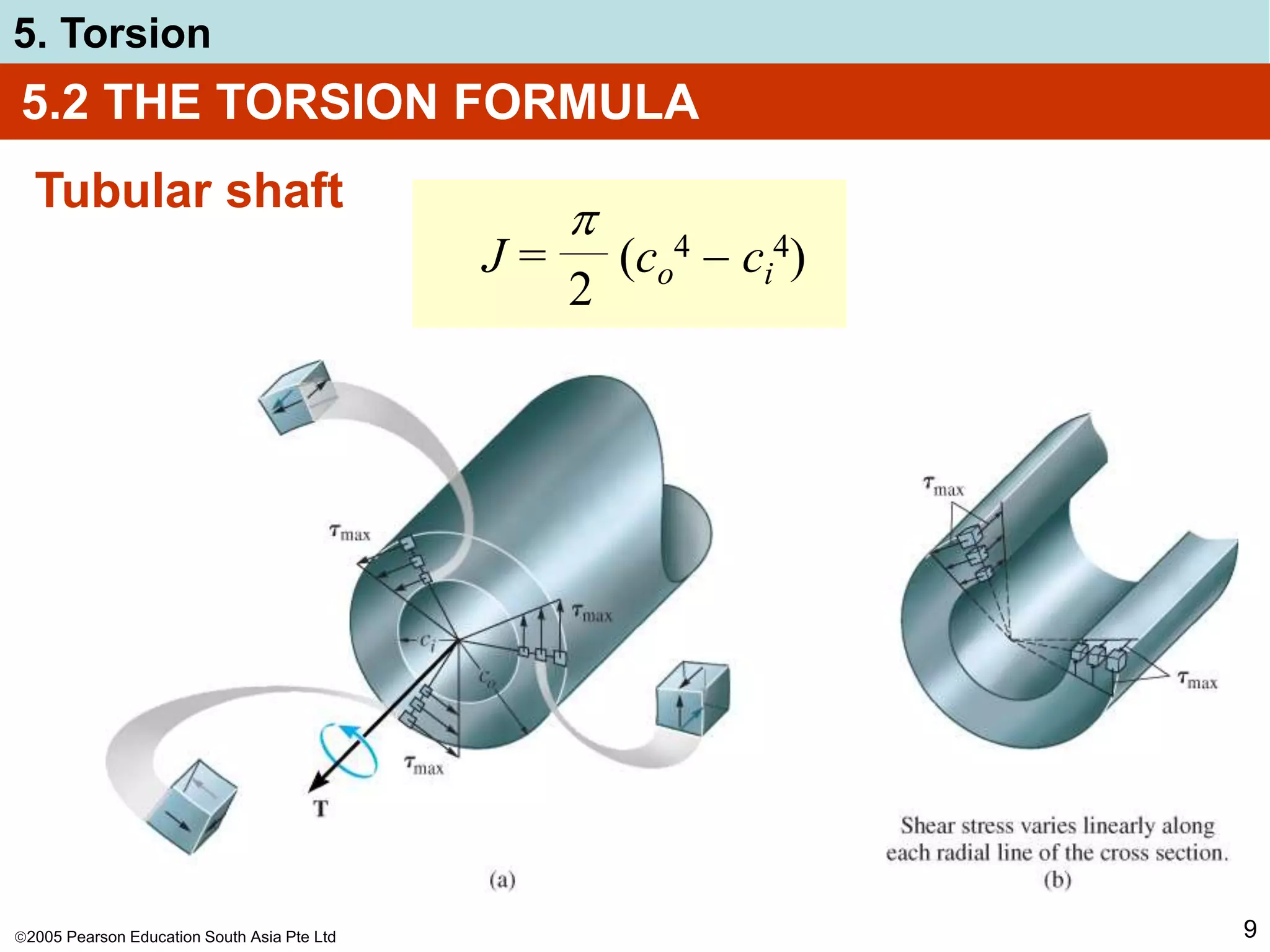
Tubular shaft
J = (co
4  ci
4)

2
2005 Pearson Education South Asia Pte Ltd
5. Torsion
10
5.2 THE TORSION FORMULA
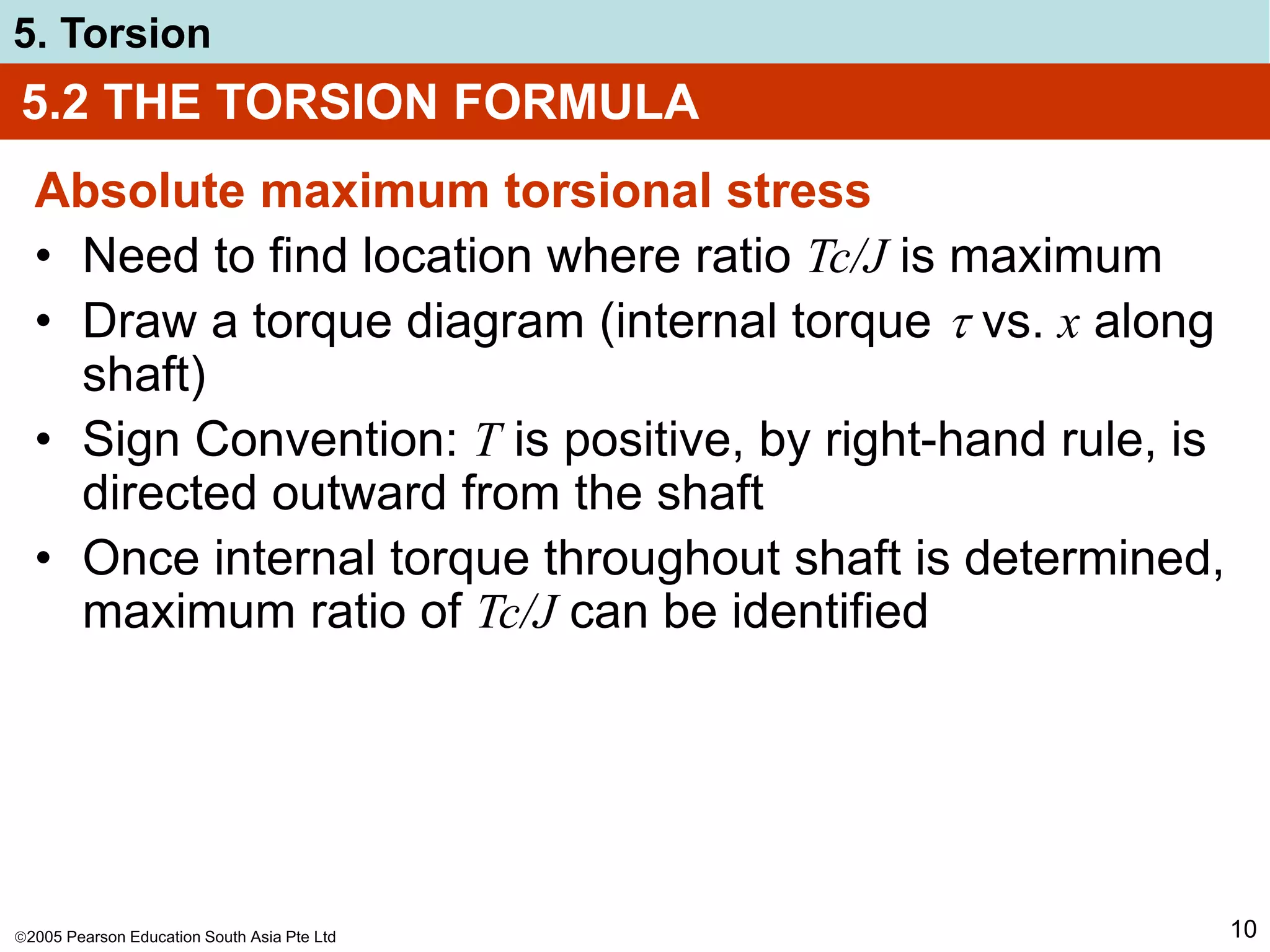
Absolute maximum torsional stress
• Need to find location where ratio Tc/J is maximum
• Draw a torque diagram (internal torque  vs. x along
shaft)
• Sign Convention: T is positive, by right-hand rule, is
directed outward from the shaft
• Once internal torque throughout shaft is determined,
maximum ratio of Tc/J can be identified
2005 Pearson Education South Asia Pte Ltd
5. Torsion
11
5.2 THE TORSION FORMULA
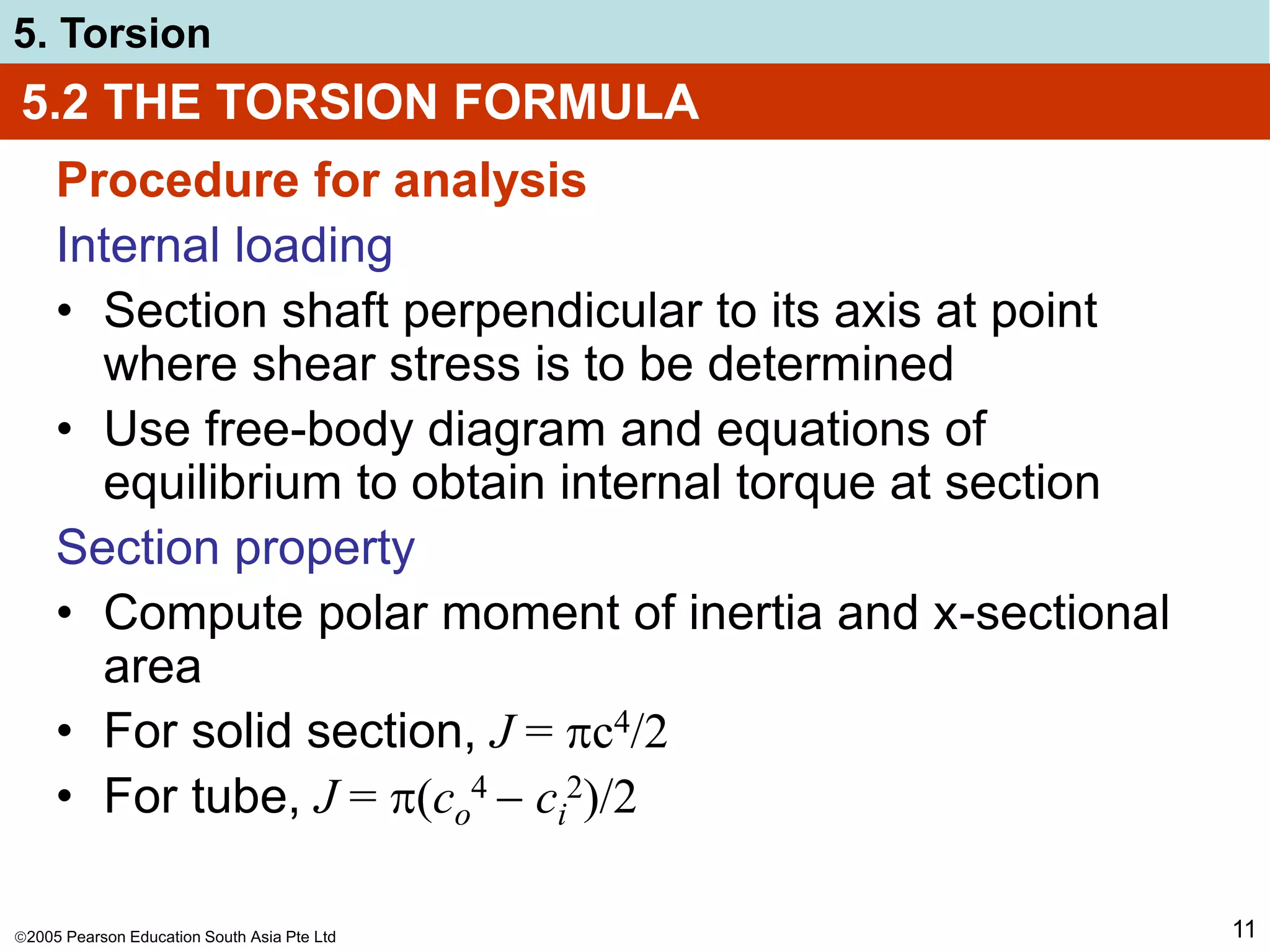
Procedure for analysis
Internal loading
• Section shaft perpendicular to its axis at point
where shear stress is to be determined
• Use free-body diagram and equations of
equilibrium to obtain internal torque at section
Section property
• Compute polar moment of inertia and x-sectional
area
• For solid section, J = c4/2
• For tube, J = (co
4  ci
2)/2
2005 Pearson Education South Asia Pte Ltd
5. Torsion
12
5.2 THE TORSION FORMULA
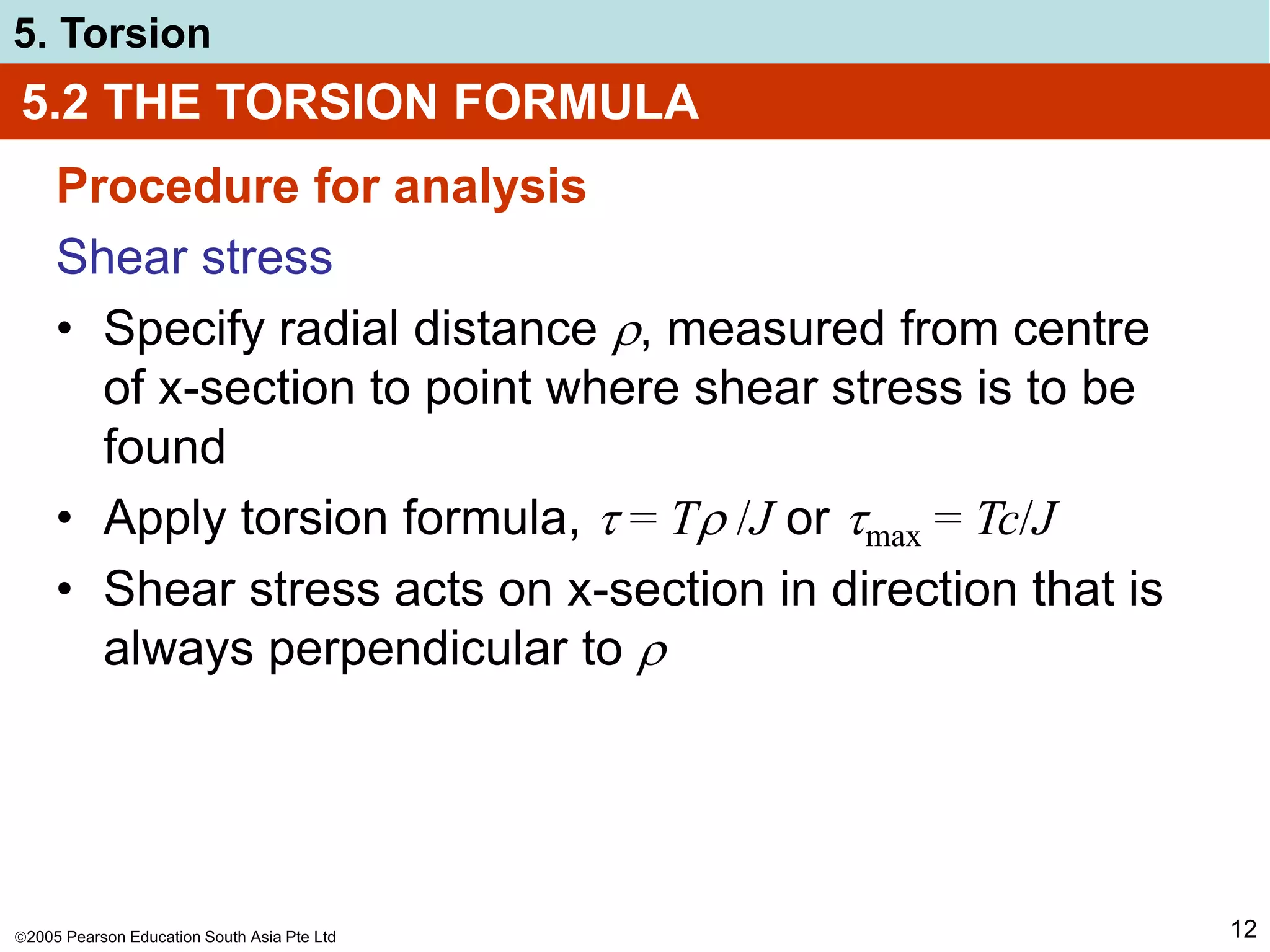
Procedure for analysis
Shear stress
• Specify radial distance , measured from centre
of x-section to point where shear stress is to be
found
• Apply torsion formula,  = T /J or max = Tc/J
• Shear stress acts on x-section in direction that is
always perpendicular to 
2005 Pearson Education South Asia Pte Ltd
5. Torsion
13
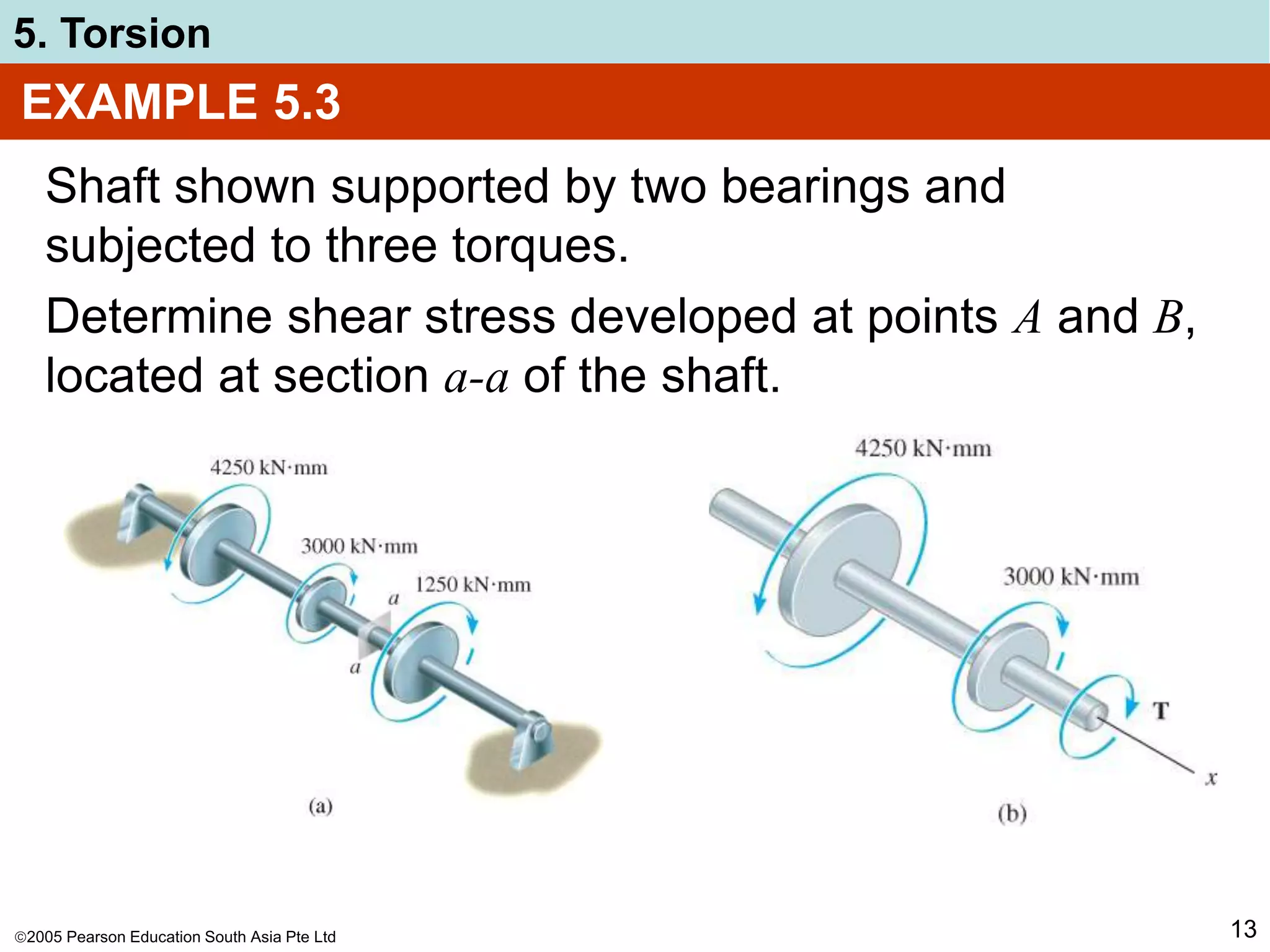
EXAMPLE 5.3
Shaft shown supported by two bearings and
subjected to three torques.
Determine shear stress developed at points A and B,
located at section a-a of the shaft.
2005 Pearson Education South Asia Pte Ltd
5. Torsion
14
EXAMPLE 5.3 (SOLN)
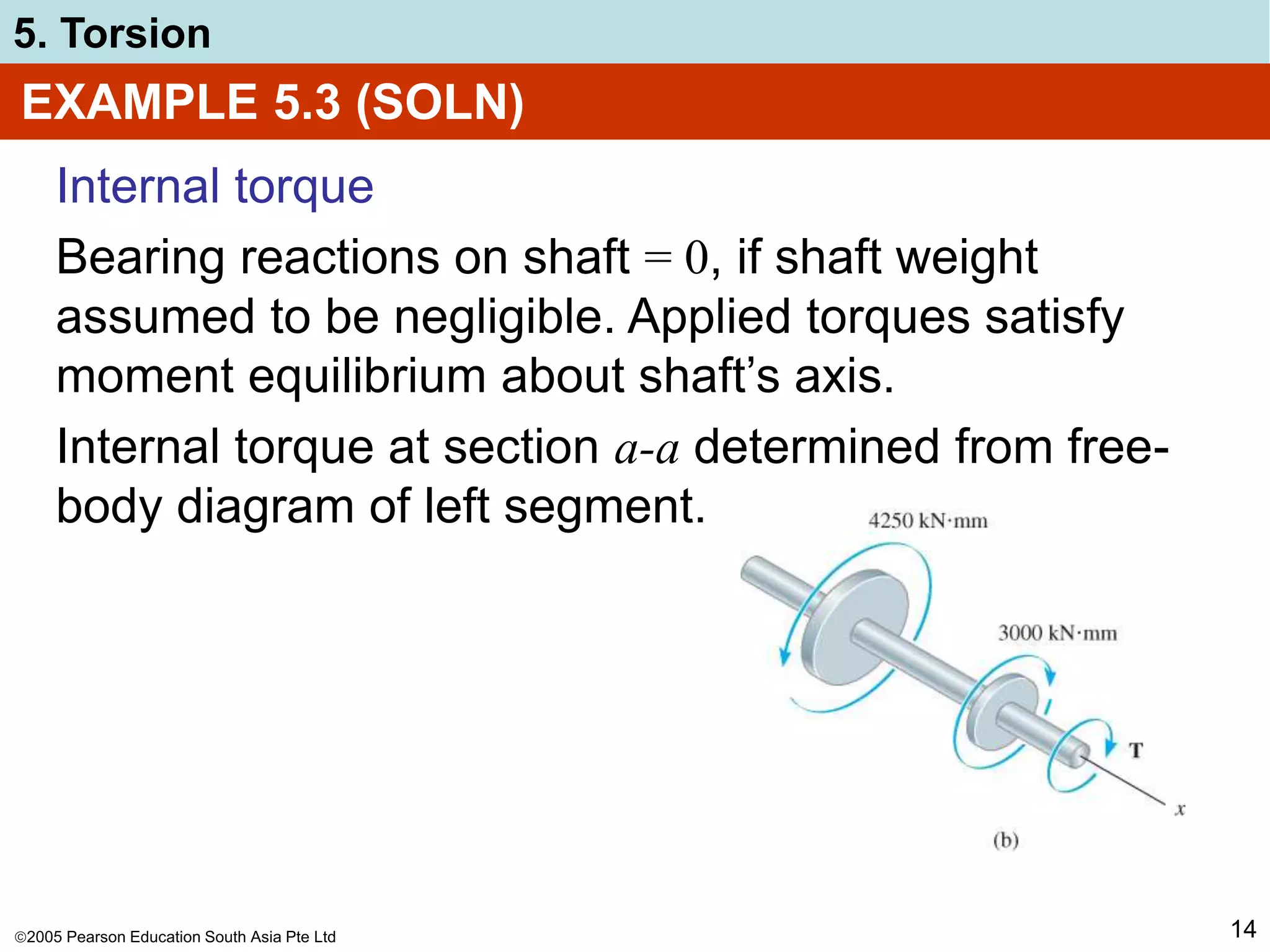
Internal torque
Bearing reactions on shaft = 0, if shaft weight
assumed to be negligible. Applied torques satisfy
moment equilibrium about shaft’s axis.
Internal torque at section a-a determined from free-
body diagram of left segment.
2005 Pearson Education South Asia Pte Ltd
5. Torsion
15
EXAMPLE 5.3 (SOLN)
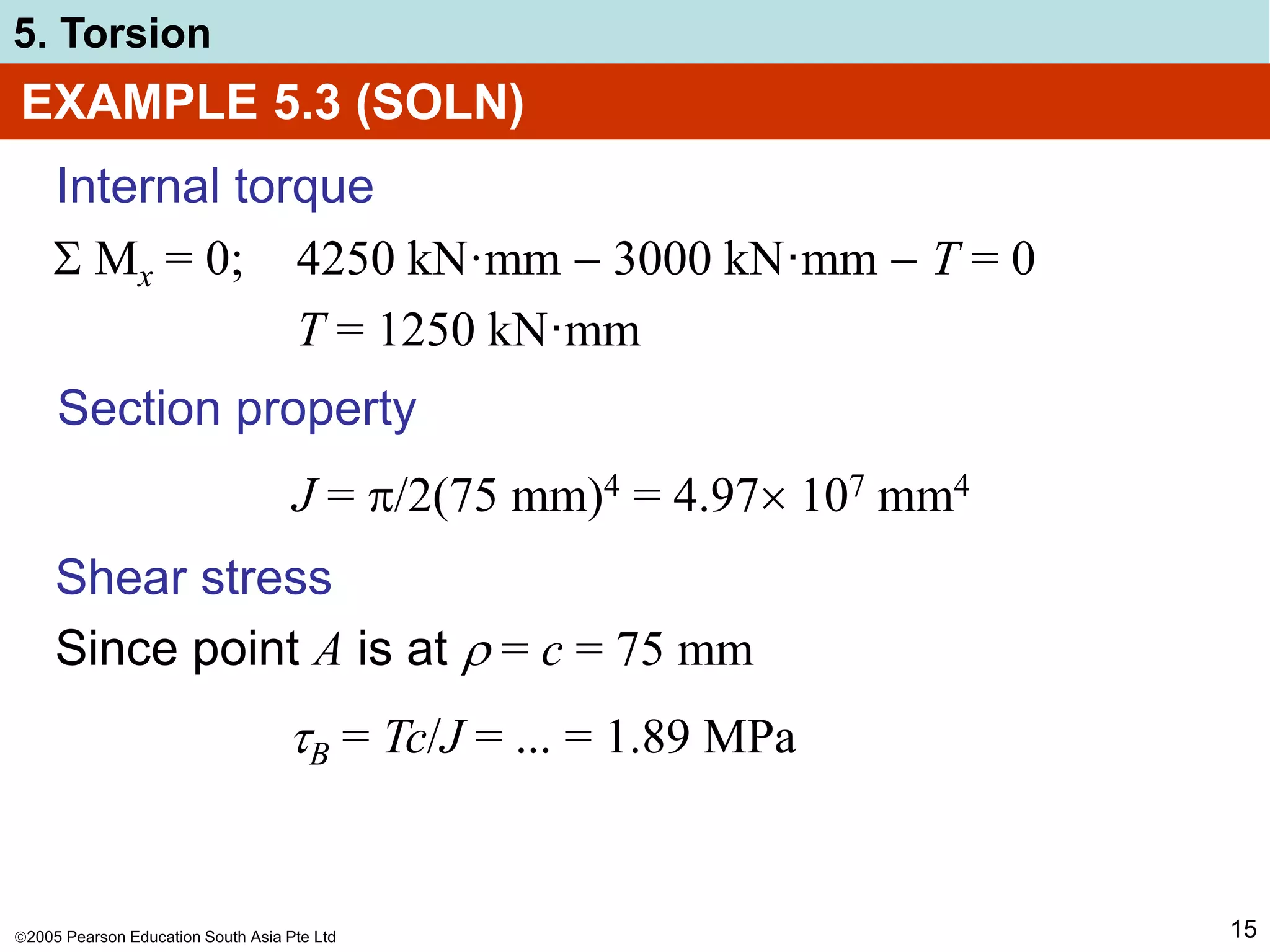
Internal torque
 Mx = 0; 4250 kN·mm  3000 kN·mm  T = 0
T = 1250 kN·mm
Section property
J = /2(75 mm)4 = 4.97 107 mm4
Shear stress
Since point A is at  = c = 75 mm
B = Tc/J = ... = 1.89 MPa
2005 Pearson Education South Asia Pte Ltd
5. Torsion
16
EXAMPLE 5.3 (SOLN)
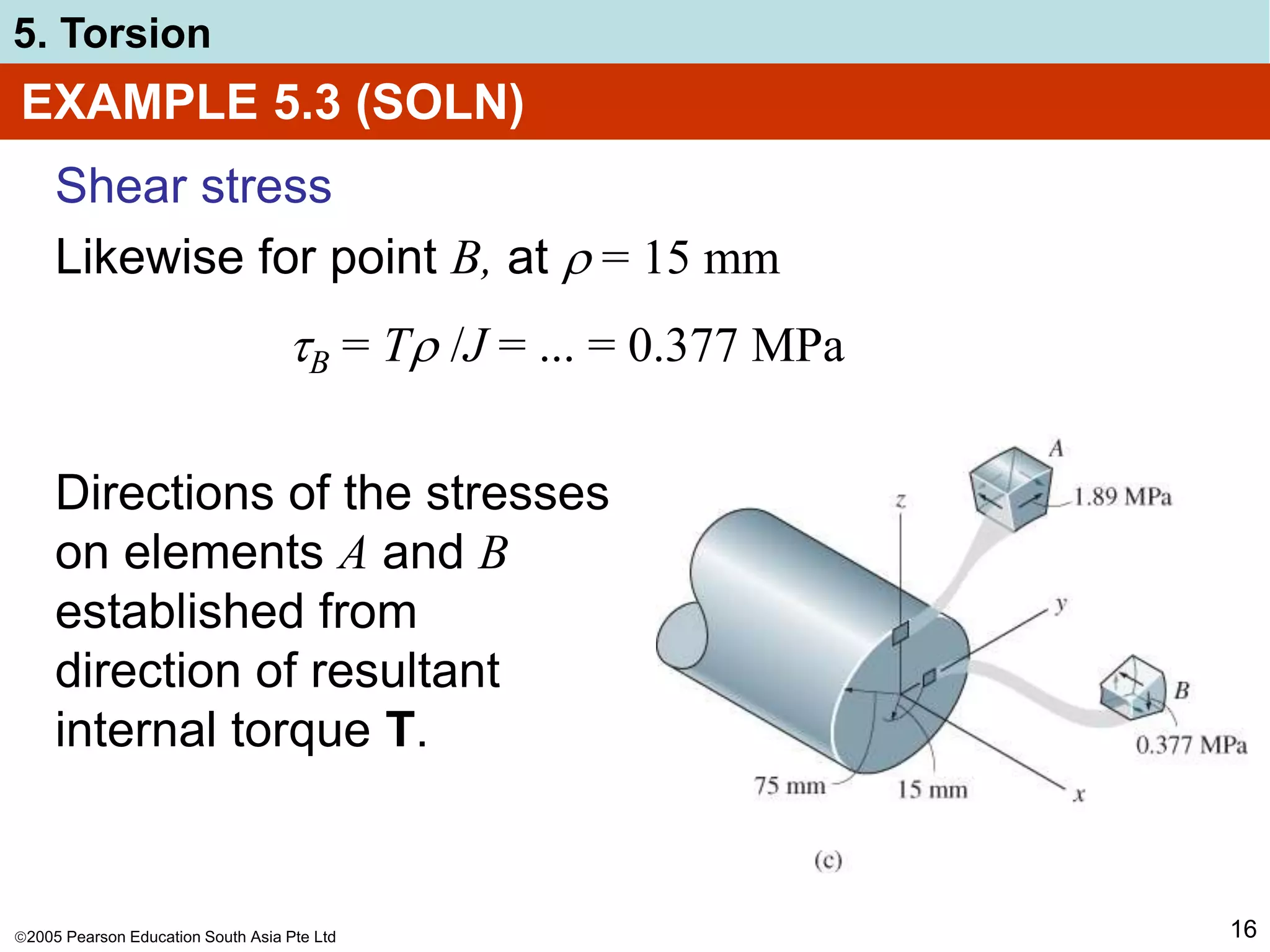
Shear stress
Likewise for point B, at  = 15 mm
B = T /J = ... = 0.377 MPa
Directions of the stresses
on elements A and B
established from
direction of resultant
internal torque T.
2005 Pearson Education South Asia Pte Ltd
5. Torsion
17
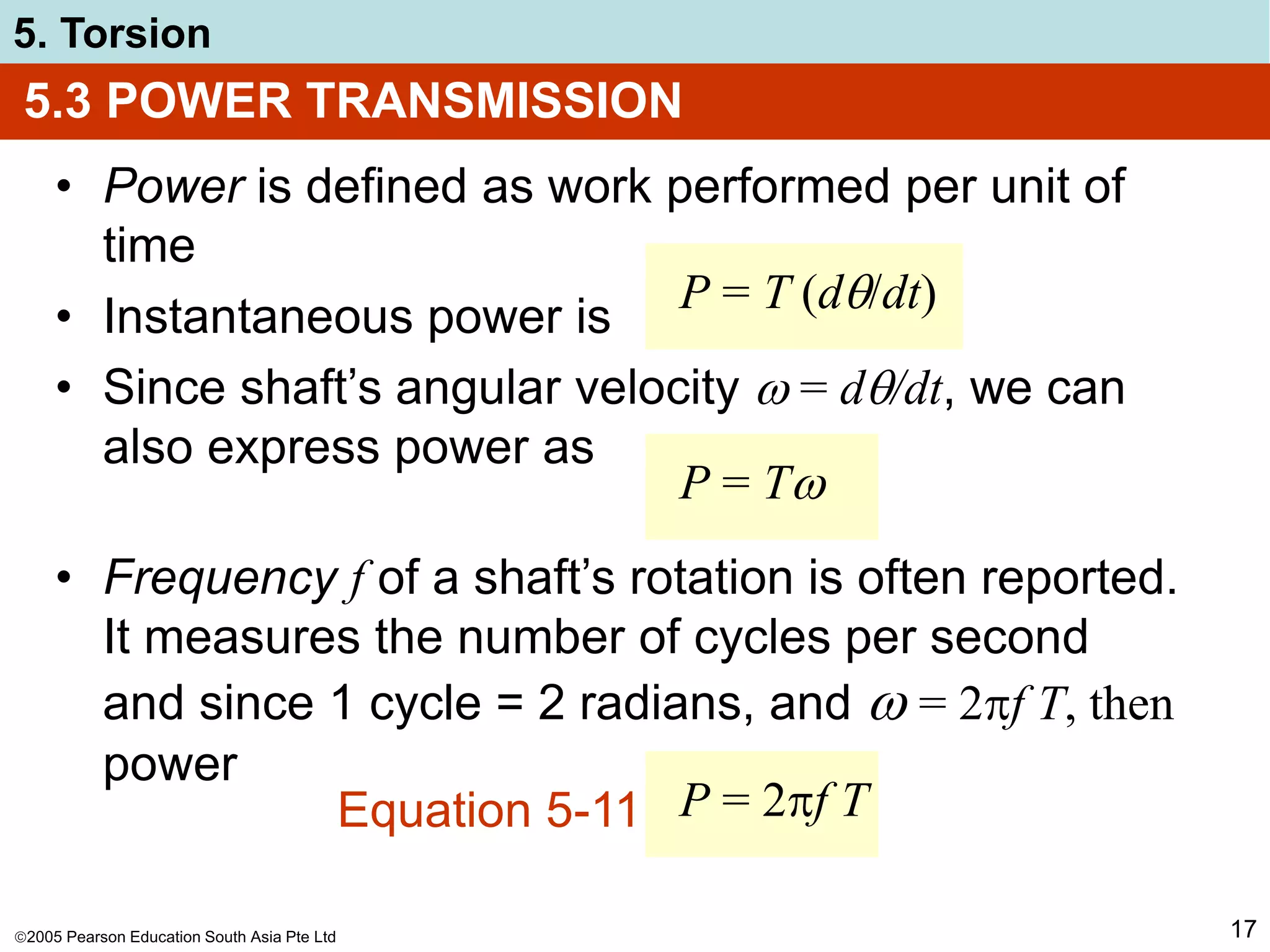
• Power is defined as work performed per unit of
time
• Instantaneous power is
• Since shaft’s angular velocity  = d/dt, we can
also express power as
5.3 POWER TRANSMISSION
P = T (d/dt)
P = T
• Frequency f of a shaft’s rotation is often reported.
It measures the number of cycles per second
and since 1 cycle = 2 radians, and  = 2f T, then
power
P = 2f T
Equation 5-11
2005 Pearson Education South Asia Pte Ltd
5. Torsion
18
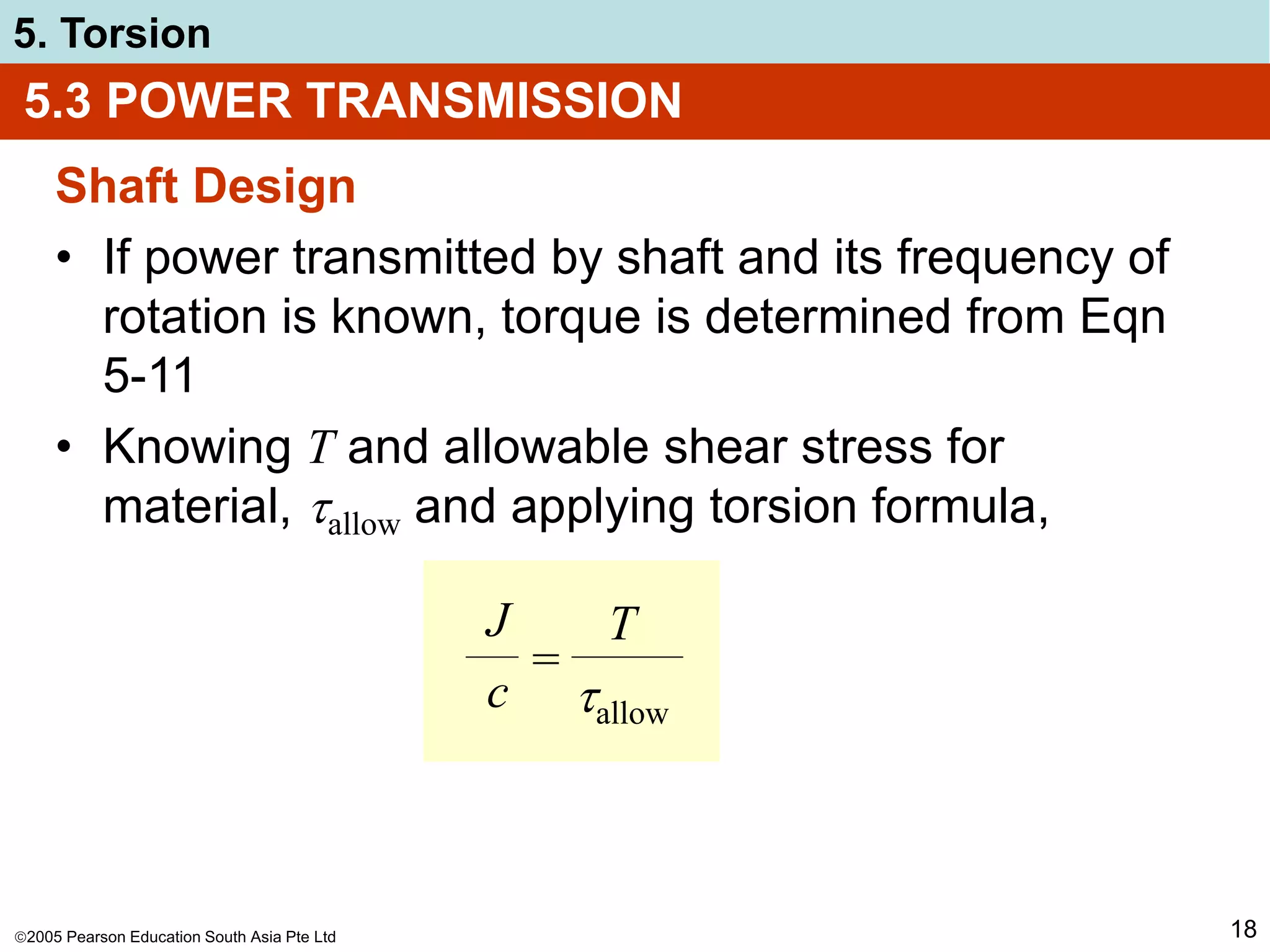
Shaft Design
• If power transmitted by shaft and its frequency of
rotation is known, torque is determined from Eqn
5-11
• Knowing T and allowable shear stress for
material, allow and applying torsion formula,
5.3 POWER TRANSMISSION
J
c
T
allow
=
2005 Pearson Education South Asia Pte Ltd
5. Torsion
19
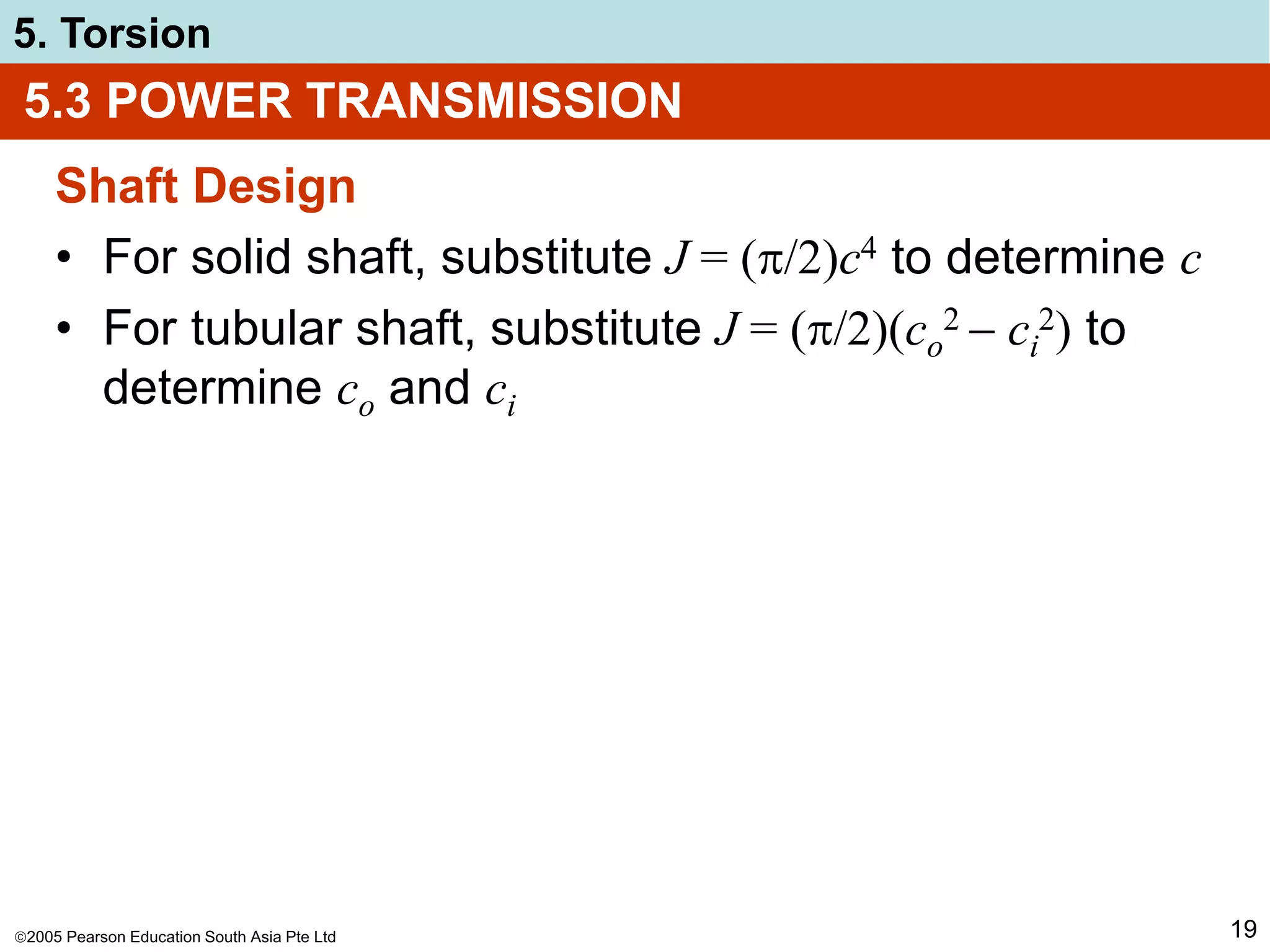
Shaft Design
• For solid shaft, substitute J = (/2)c4 to determine c
• For tubular shaft, substitute J = (/2)(co
2  ci
2) to
determine co and ci
5.3 POWER TRANSMISSION
2005 Pearson Education South Asia Pte Ltd
5. Torsion
20
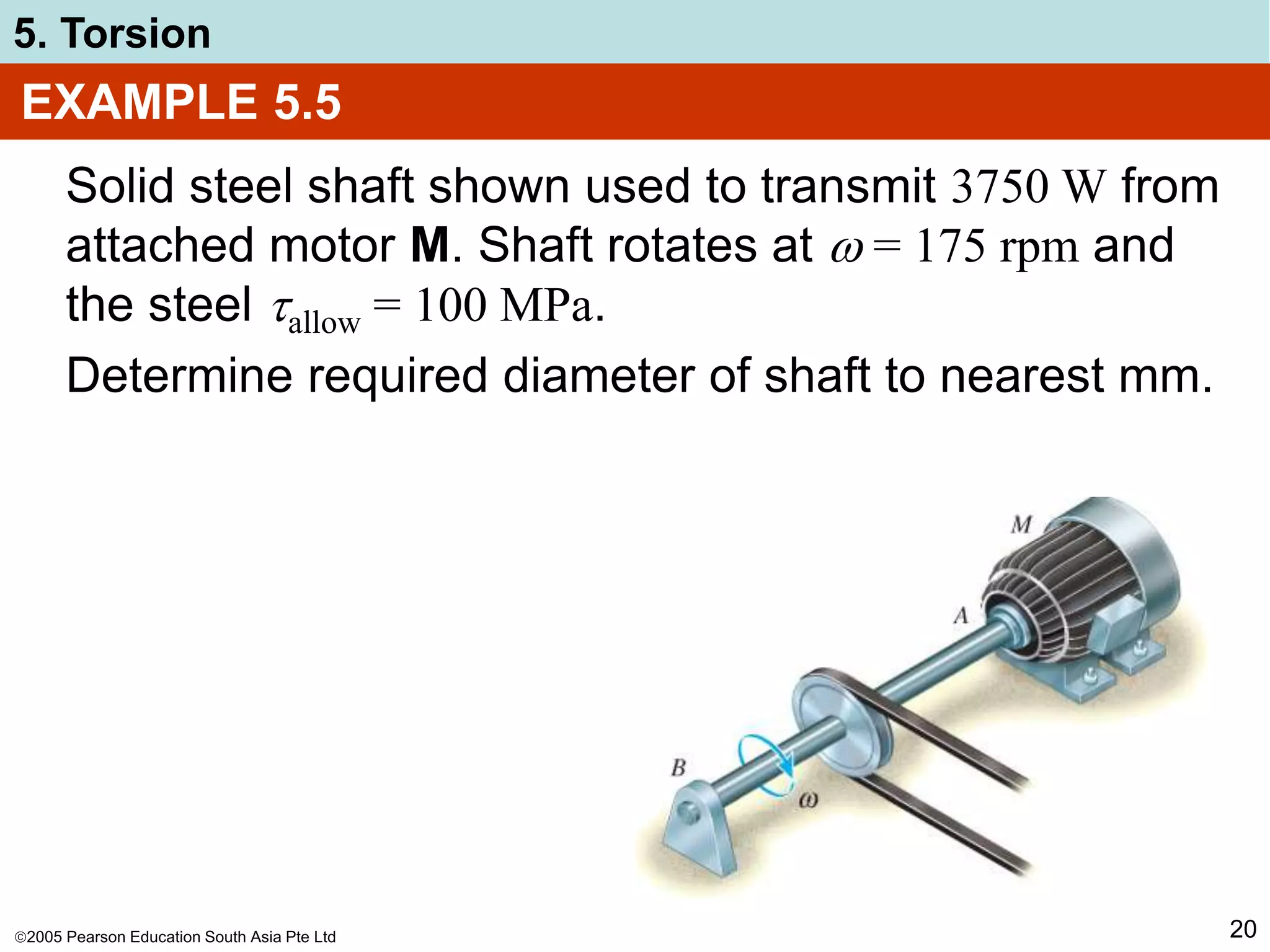
EXAMPLE 5.5
Solid steel shaft shown used to transmit 3750 W from
attached motor M. Shaft rotates at  = 175 rpm and
the steel allow = 100 MPa.
Determine required diameter of shaft to nearest mm.
2005 Pearson Education South Asia Pte Ltd
5. Torsion
21
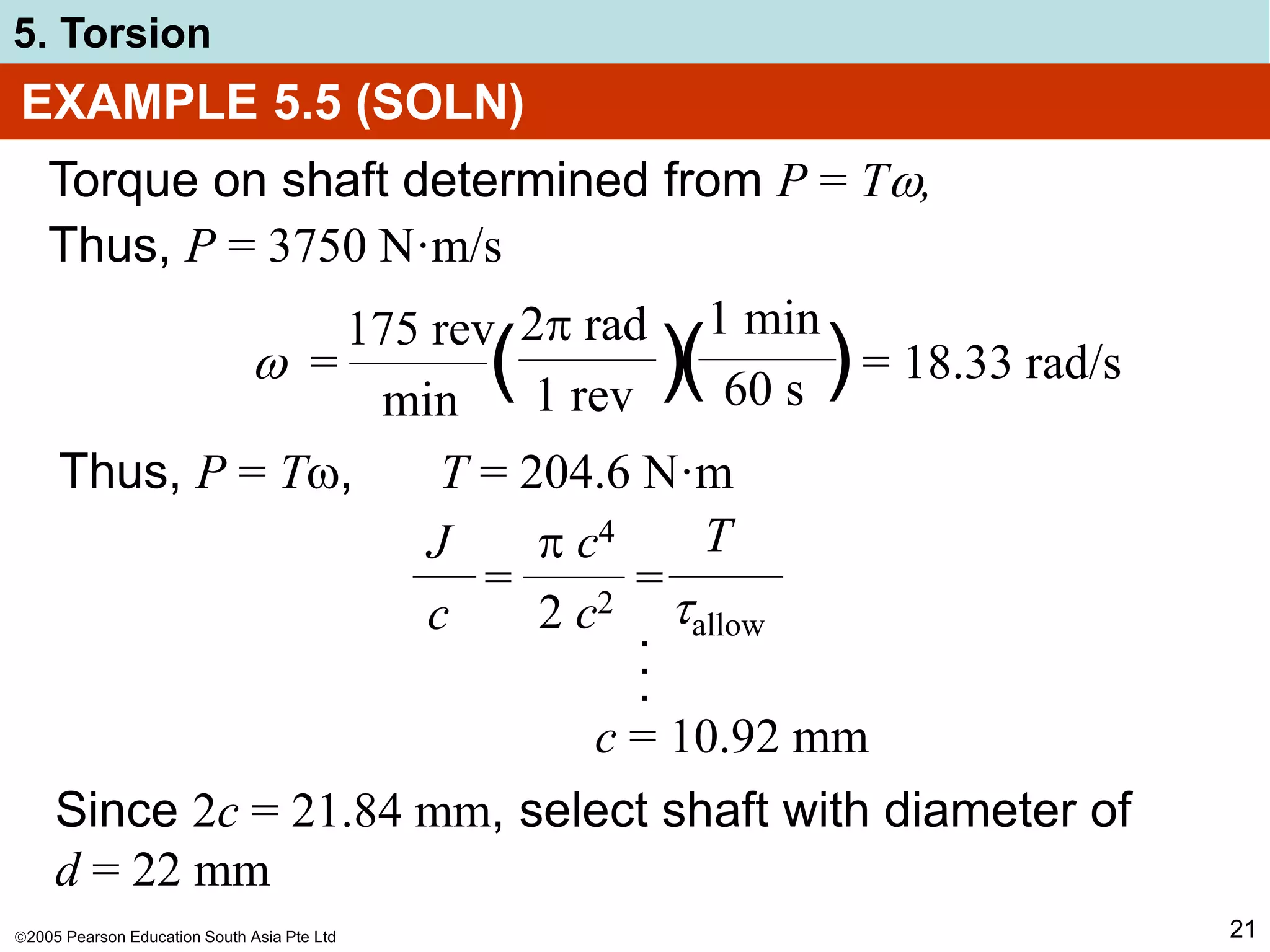
EXAMPLE 5.5 (SOLN)
Torque on shaft determined from P = T,
Thus, P = 3750 N·m/s
Thus, P = T, T = 204.6 N·m
( )
 = = 18.33 rad/s
175 rev
min
2 rad
1 rev
1 min
60 s
( )
= =
J
c
 c4
2 c2
T
allow
.
.
.
c = 10.92 mm
Since 2c = 21.84 mm, select shaft with diameter of
d = 22 mm
2005 Pearson Education South Asia Pte Ltd
5. Torsion
22
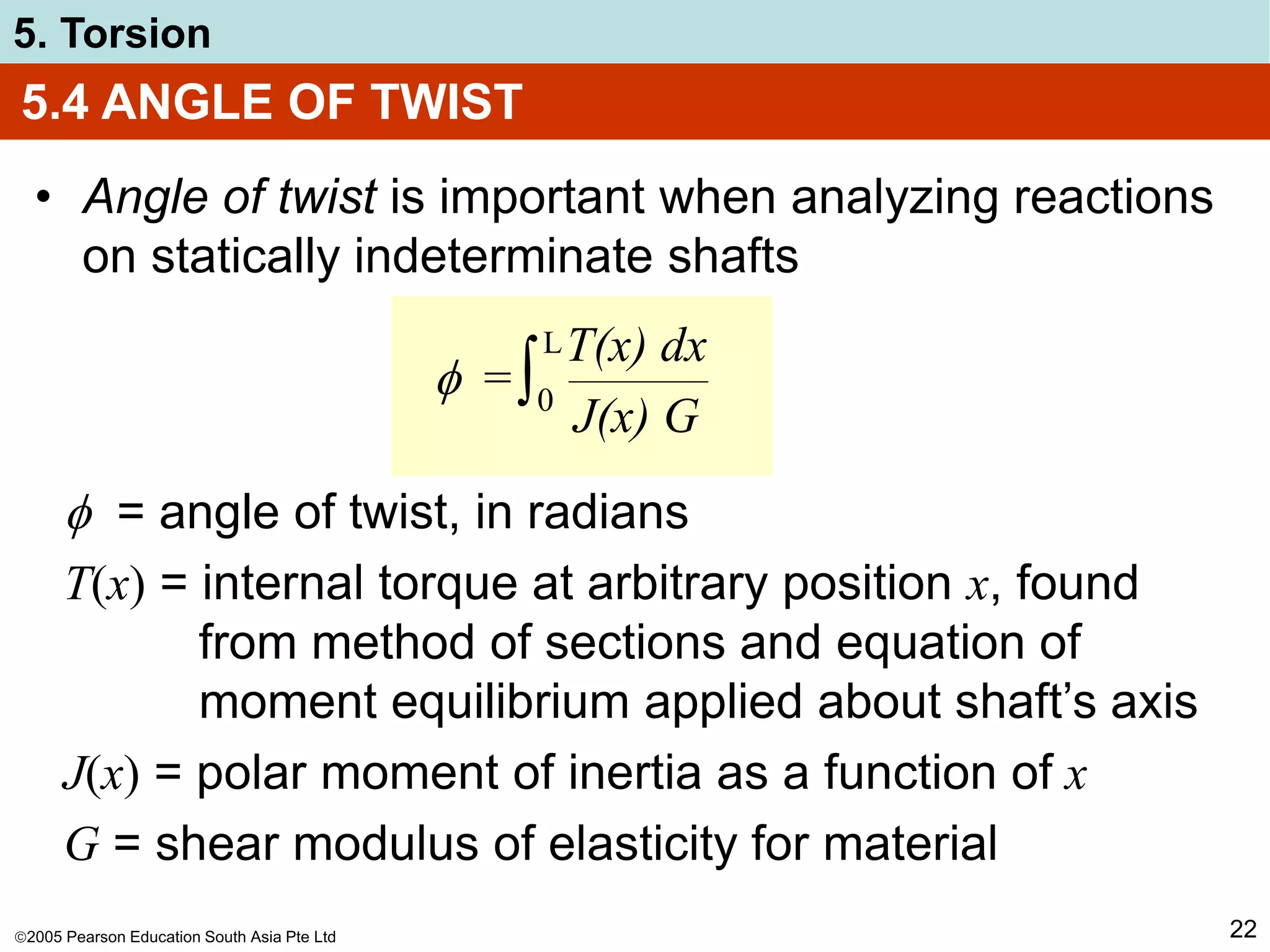
5.4 ANGLE OF TWIST
• Angle of twist is important when analyzing reactions
on statically indeterminate shafts
 =
T(x) dx
J(x) G
∫0
L
 = angle of twist, in radians
T(x) = internal torque at arbitrary position x, found
from method of sections and equation of
moment equilibrium applied about shaft’s axis
J(x) = polar moment of inertia as a function of x
G = shear modulus of elasticity for material
2005 Pearson Education South Asia Pte Ltd
5. Torsion
23
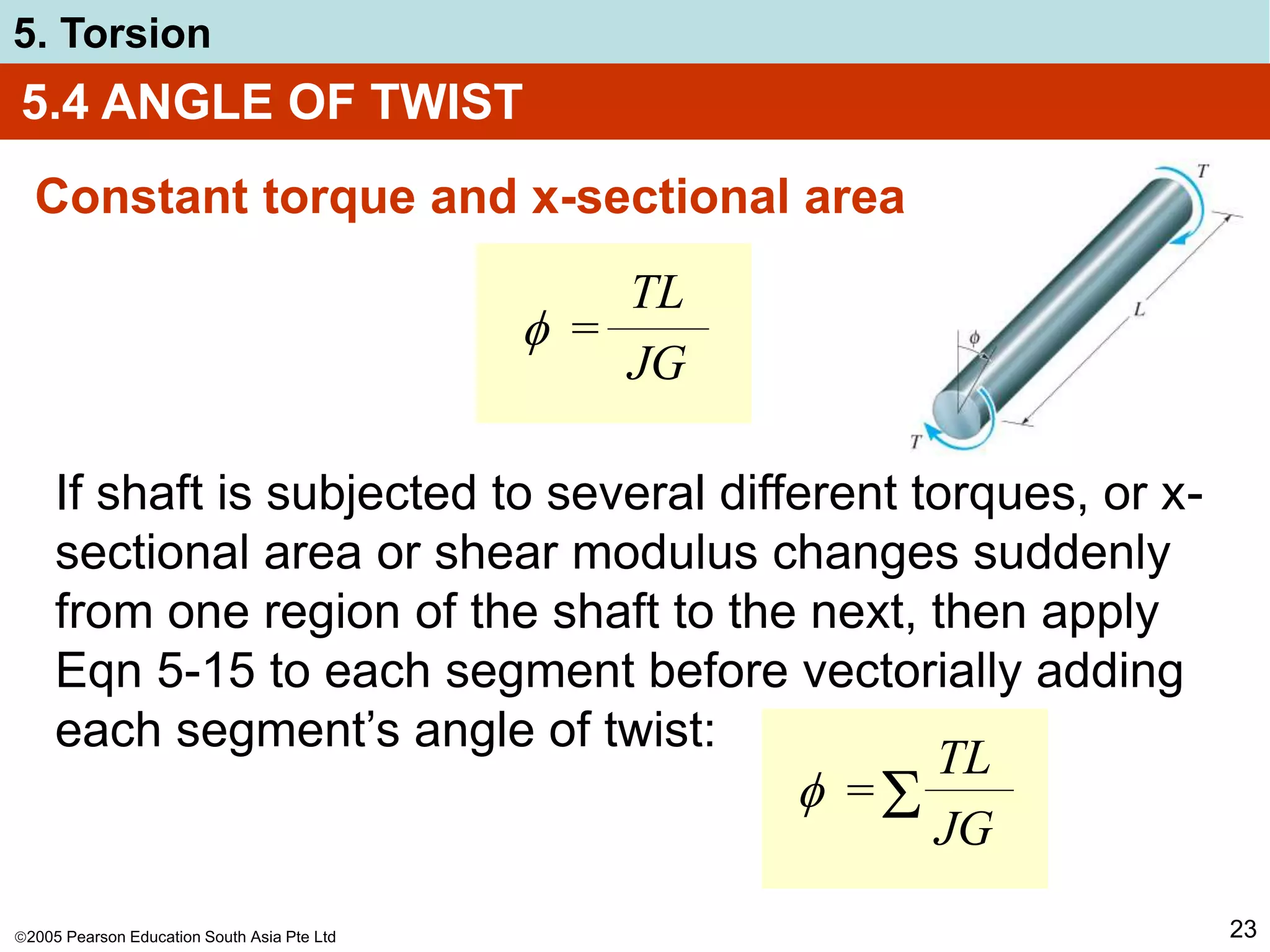
5.4 ANGLE OF TWIST
Constant torque and x-sectional area
 =
TL
JG
If shaft is subjected to several different torques, or x-
sectional area or shear modulus changes suddenly
from one region of the shaft to the next, then apply
Eqn 5-15 to each segment before vectorially adding
each segment’s angle of twist:
 =
TL
JG

2005 Pearson Education South Asia Pte Ltd
5. Torsion
24
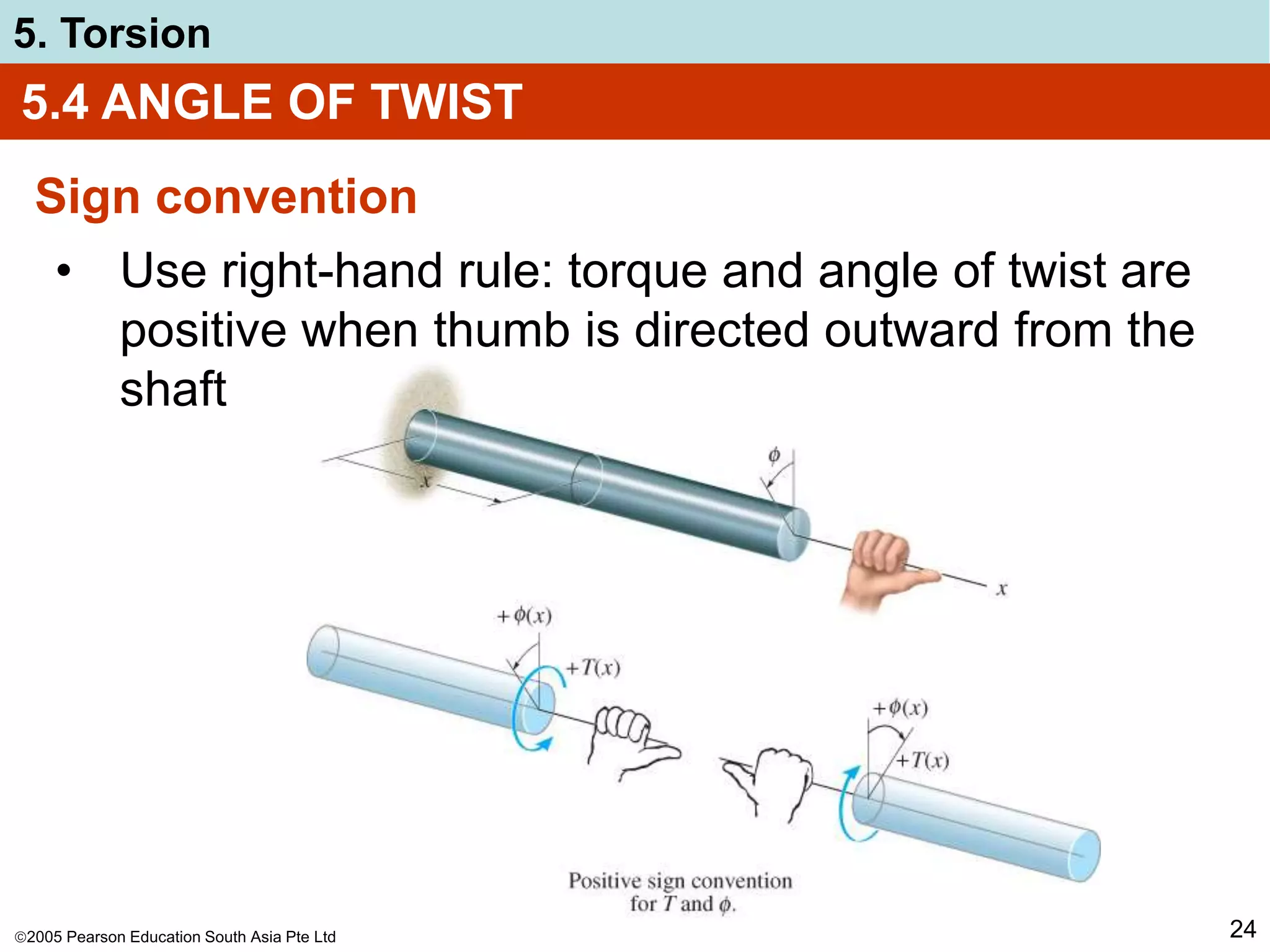
5.4 ANGLE OF TWIST
Sign convention
• Use right-hand rule: torque and angle of twist are
positive when thumb is directed outward from the
shaft
2005 Pearson Education South Asia Pte Ltd
5. Torsion
25
5.4 ANGLE OF TWIST
Procedure for analysis
Internal torque
• Use method of sections and equation of moment
equilibrium applied along shaft’s axis
• If torque varies along shaft’s length, section made
at arbitrary position x along shaft is represented
as T(x)
• If several constant external torques act on shaft
between its ends, internal torque in each segment
must be determined and shown as a torque
diagram
2005 Pearson Education South Asia Pte Ltd
5. Torsion
26
5.4 ANGLE OF TWIST
Procedure for analysis
Angle of twist
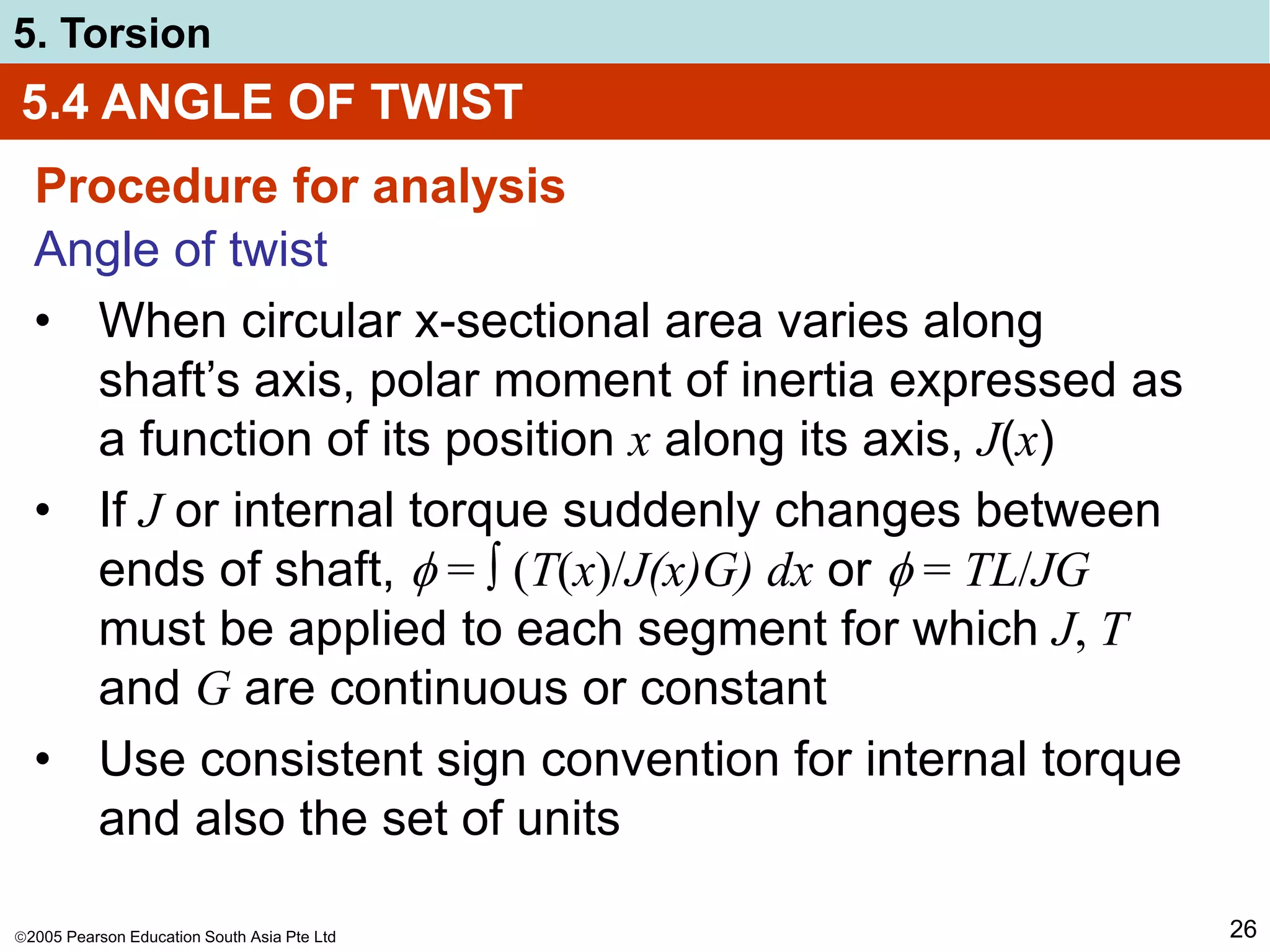
• When circular x-sectional area varies along
shaft’s axis, polar moment of inertia expressed as
a function of its position x along its axis, J(x)
• If J or internal torque suddenly changes between
ends of shaft,  = ∫ (T(x)/J(x)G) dx or  = TL/JG
must be applied to each segment for which J, T
and G are continuous or constant
• Use consistent sign convention for internal torque
and also the set of units
2005 Pearson Education South Asia Pte Ltd
5. Torsion
27
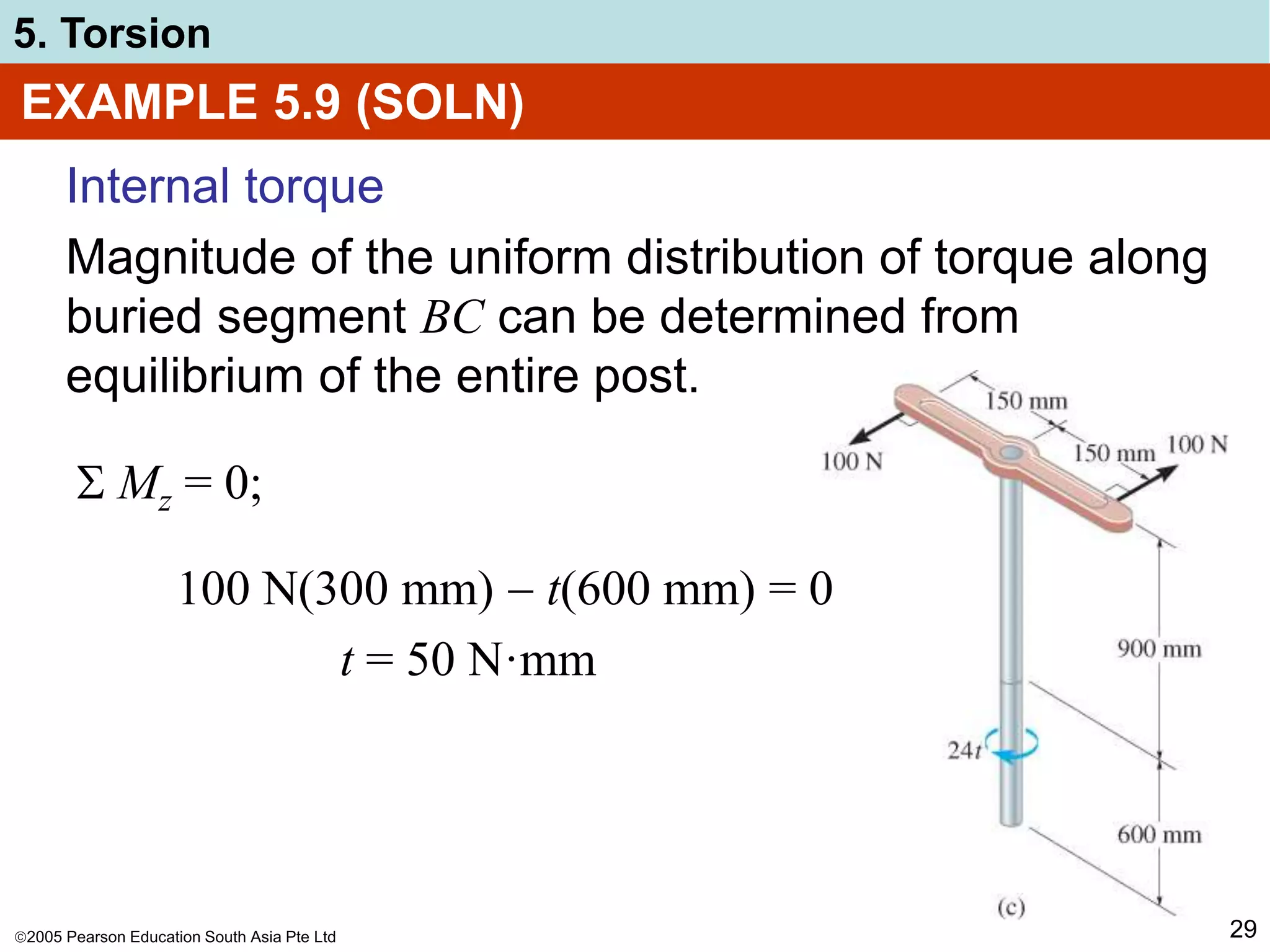
EXAMPLE 5.9
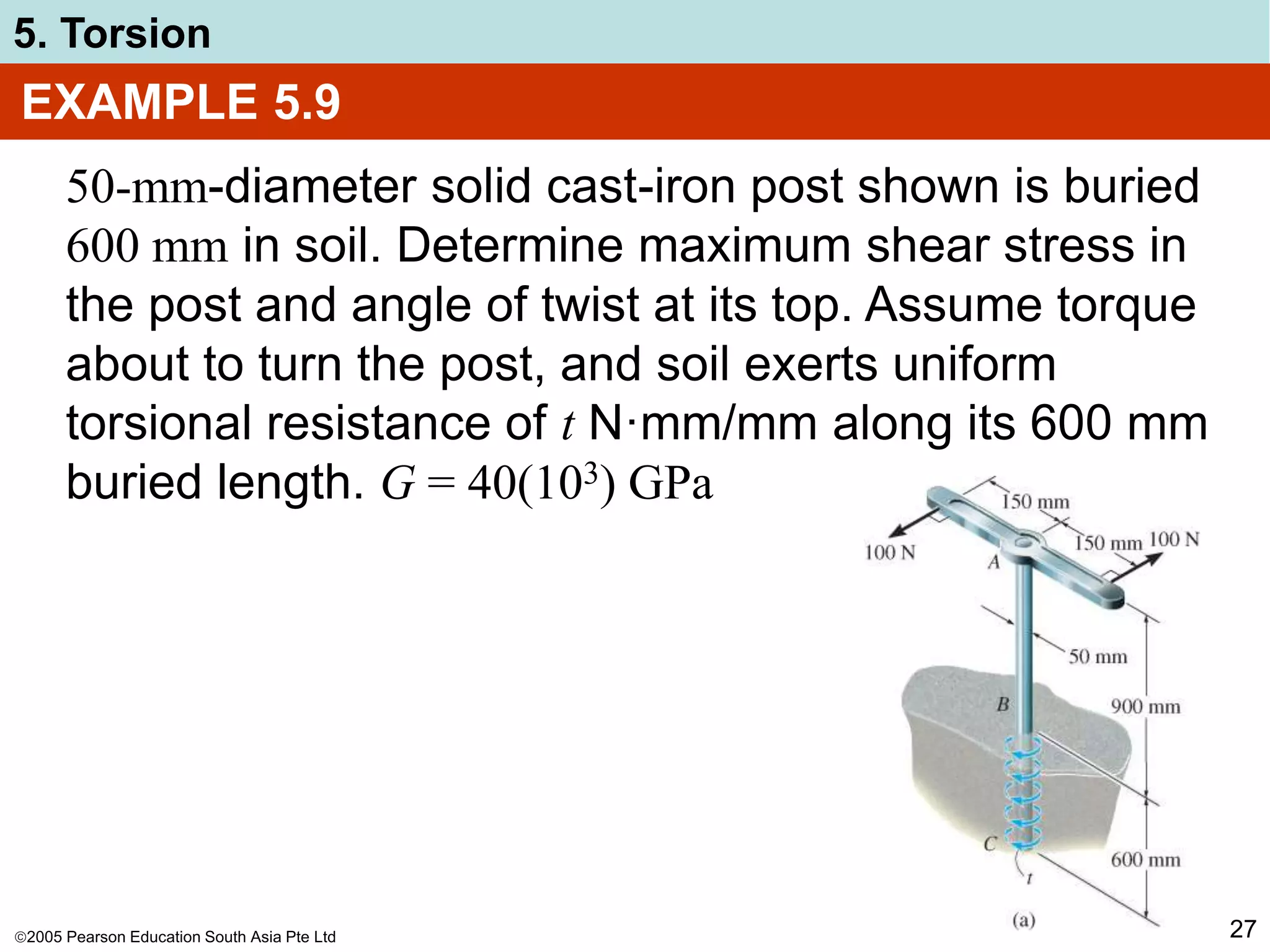
50-mm-diameter solid cast-iron post shown is buried
600 mm in soil. Determine maximum shear stress in
the post and angle of twist at its top. Assume torque
about to turn the post, and soil exerts uniform
torsional resistance of t N·mm/mm along its 600 mm
buried length. G = 40(103) GPa
2005 Pearson Education South Asia Pte Ltd
5. Torsion
28
EXAMPLE 5.9 (SOLN)
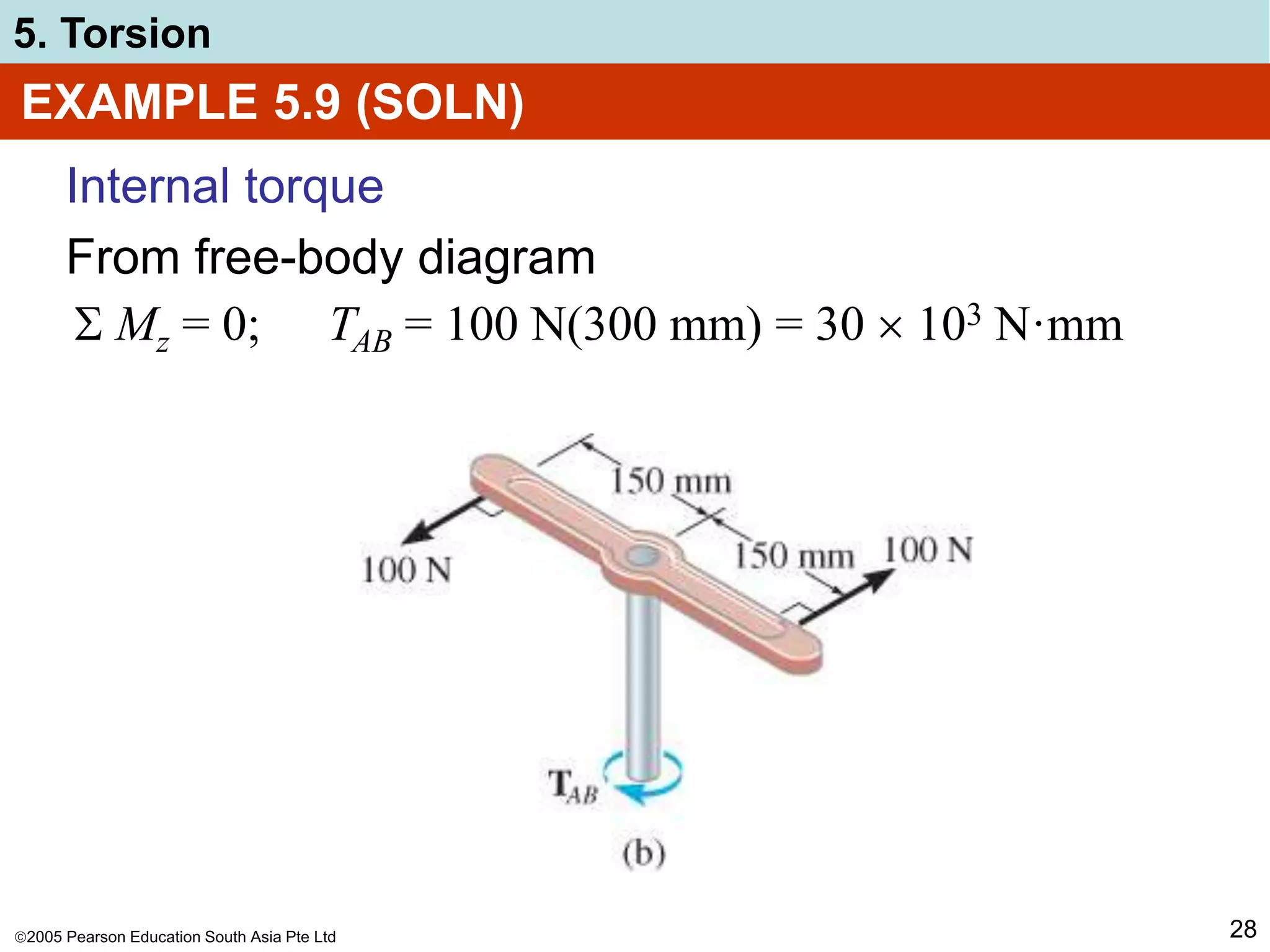
Internal torque
From free-body diagram
 Mz = 0; TAB = 100 N(300 mm) = 30  103 N·mm
2005 Pearson Education South Asia Pte Ltd
5. Torsion
29
EXAMPLE 5.9 (SOLN)
Internal torque
Magnitude of the uniform distribution of torque along
buried segment BC can be determined from
equilibrium of the entire post.
 Mz = 0;
100 N(300 mm)  t(600 mm) = 0
t = 50 N·mm
2005 Pearson Education South Asia Pte Ltd
5. Torsion
30
EXAMPLE 5.9 (SOLN)
Internal torque
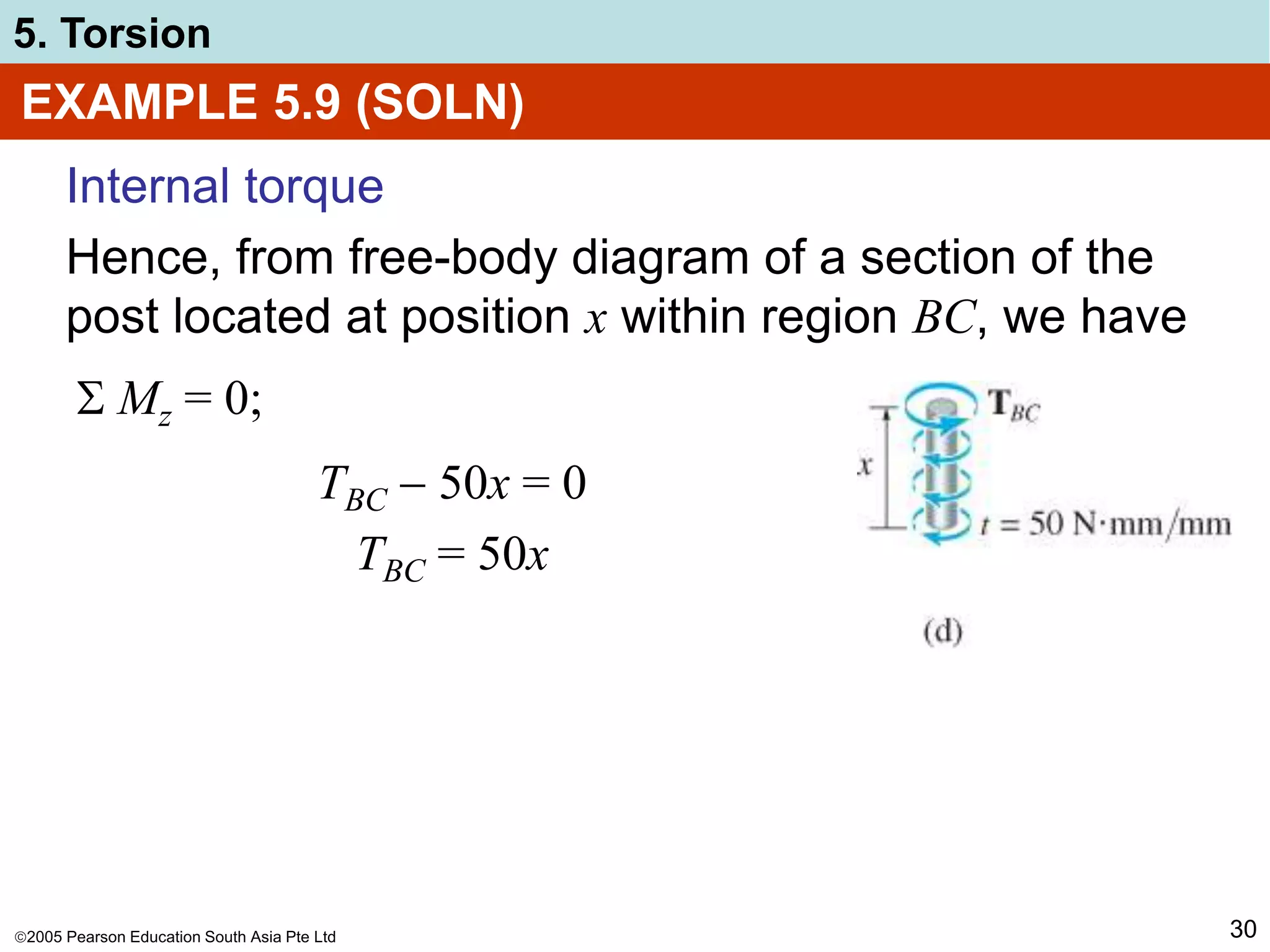
Hence, from free-body diagram of a section of the
post located at position x within region BC, we have
 Mz = 0;
TBC  50x = 0
TBC = 50x
2005 Pearson Education South Asia Pte Ltd
5. Torsion
31
EXAMPLE 5.9 (SOLN)
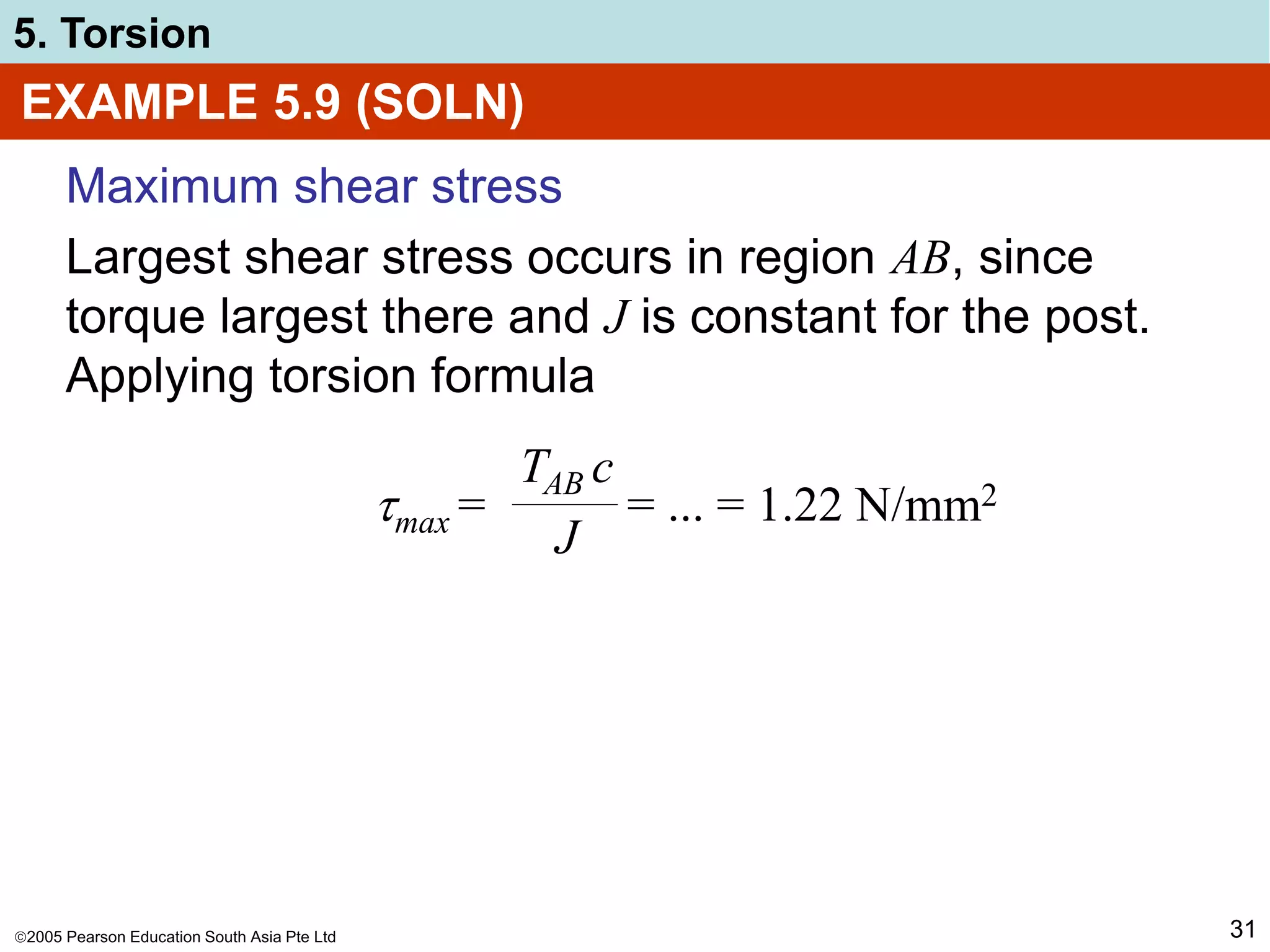
Maximum shear stress
Largest shear stress occurs in region AB, since
torque largest there and J is constant for the post.
Applying torsion formula
max = = ... = 1.22 N/mm2
TAB c
J
2005 Pearson Education South Asia Pte Ltd
5. Torsion
32
EXAMPLE 5.9 (SOLN)
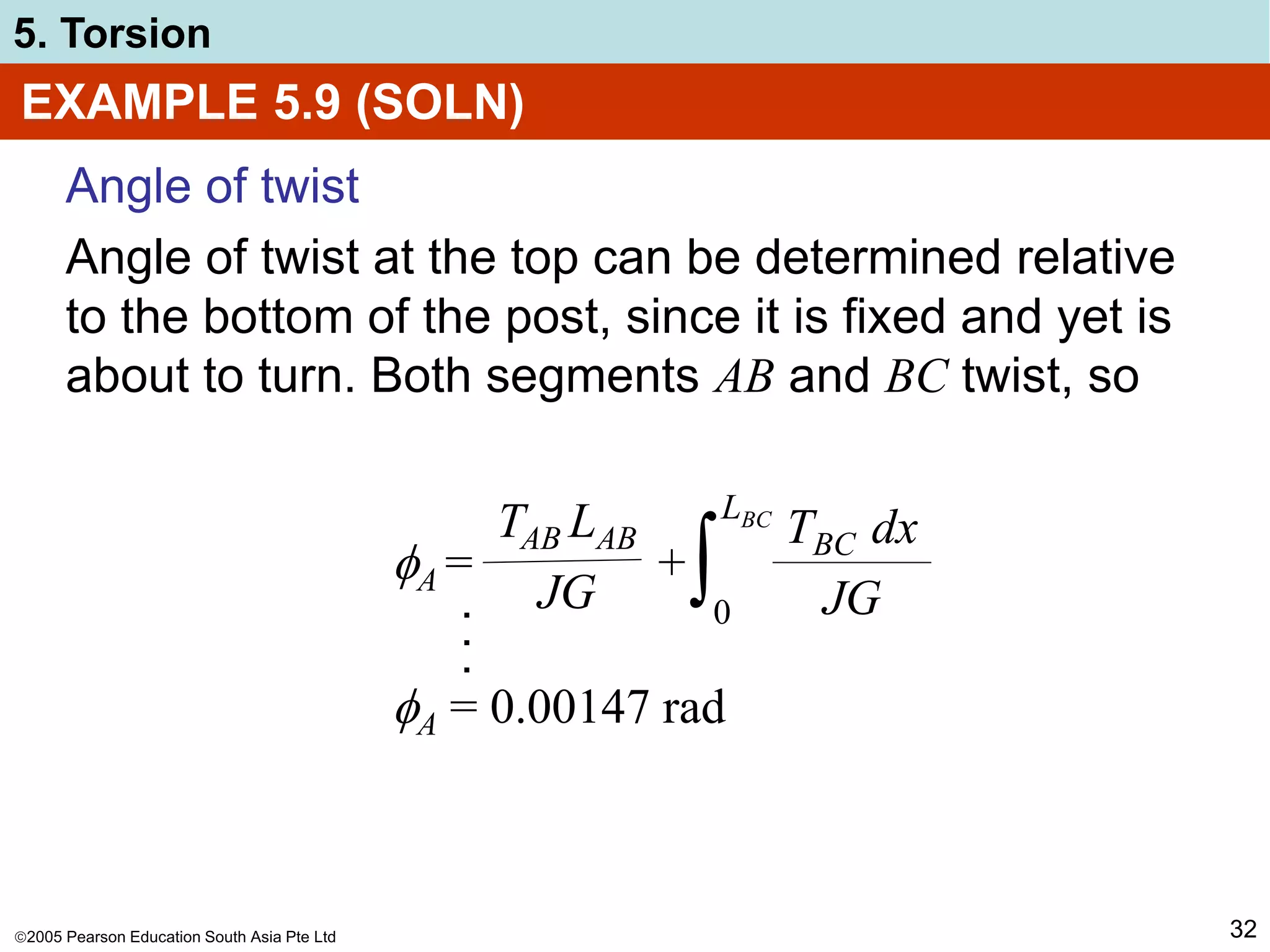
Angle of twist
Angle of twist at the top can be determined relative
to the bottom of the post, since it is fixed and yet is
about to turn. Both segments AB and BC twist, so
A = +
TAB LAB
JG
TBC dx
JG
∫0
LBC
.
.
.
A = 0.00147 rad
2005 Pearson Education South Asia Pte Ltd
5. Torsion
33
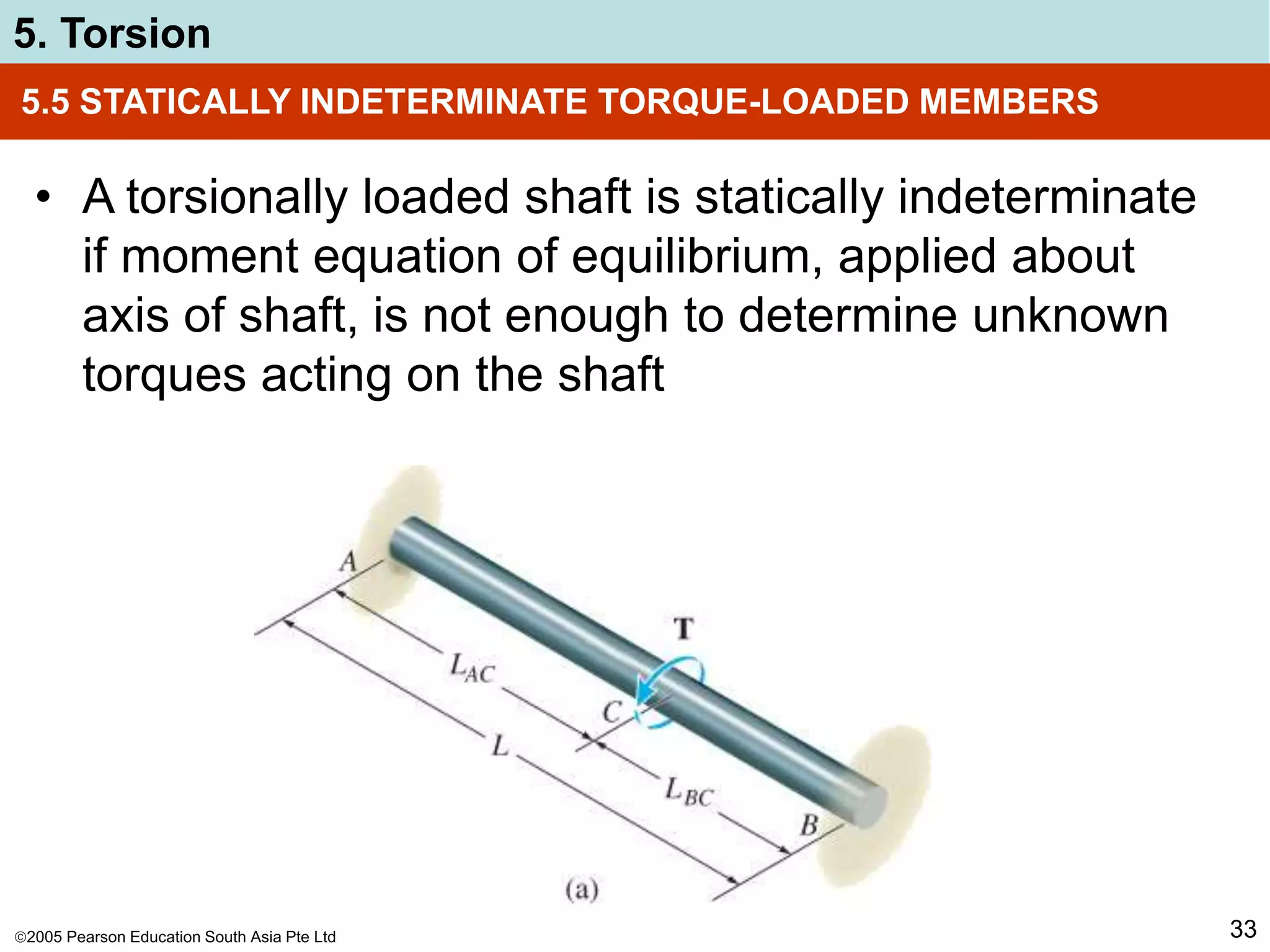
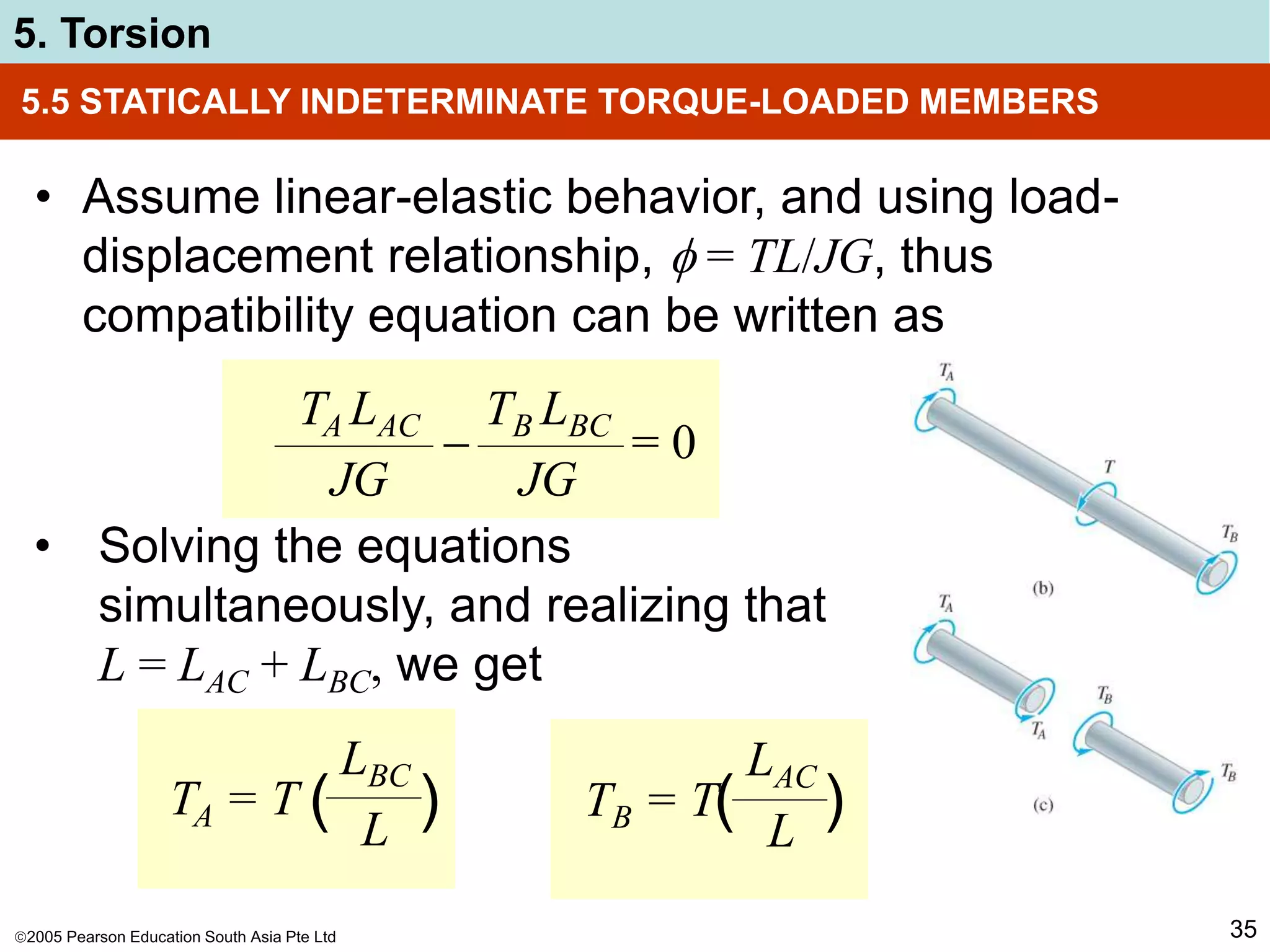
5.5 STATICALLY INDETERMINATE TORQUE-LOADED MEMBERS
• A torsionally loaded shaft is statically indeterminate
if moment equation of equilibrium, applied about
axis of shaft, is not enough to determine unknown
torques acting on the shaft
2005 Pearson Education South Asia Pte Ltd
5. Torsion
34
5.5 STATICALLY INDETERMINATE TORQUE-LOADED MEMBERS
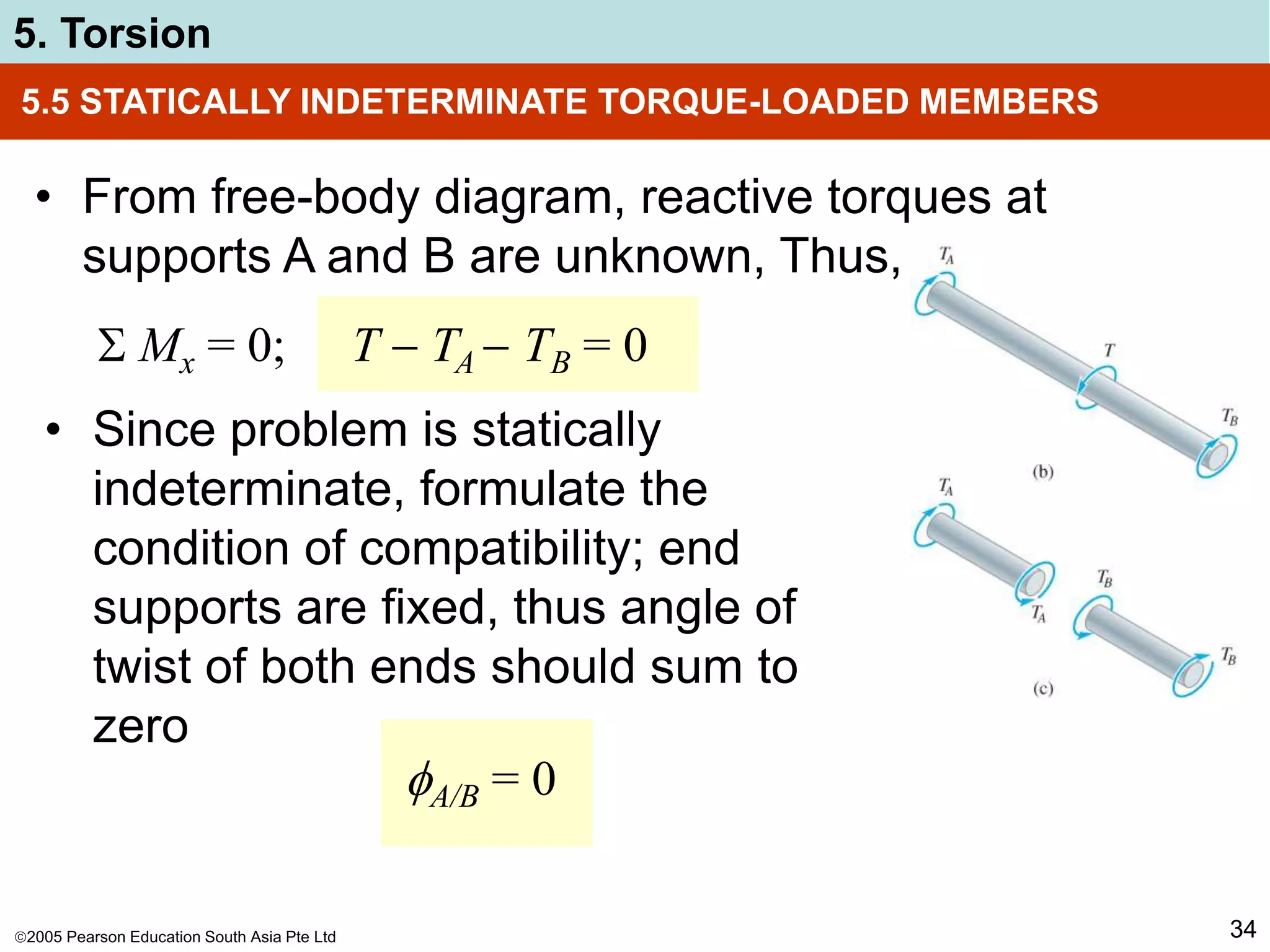
• From free-body diagram, reactive torques at
supports A and B are unknown, Thus,
 Mx = 0; T  TA  TB = 0
• Since problem is statically
indeterminate, formulate the
condition of compatibility; end
supports are fixed, thus angle of
twist of both ends should sum to
zero
A/B = 0
2005 Pearson Education South Asia Pte Ltd
5. Torsion
35
5.5 STATICALLY INDETERMINATE TORQUE-LOADED MEMBERS
• Assume linear-elastic behavior, and using load-
displacement relationship,  = TL/JG, thus
compatibility equation can be written as
TA LAC
JG
TB LBC
JG
 = 0
• Solving the equations
simultaneously, and realizing that
L = LAC + LBC, we get
TA = T
LBC
L
( ) TB = T
LAC
L
( )
2005 Pearson Education South Asia Pte Ltd
5. Torsion
36
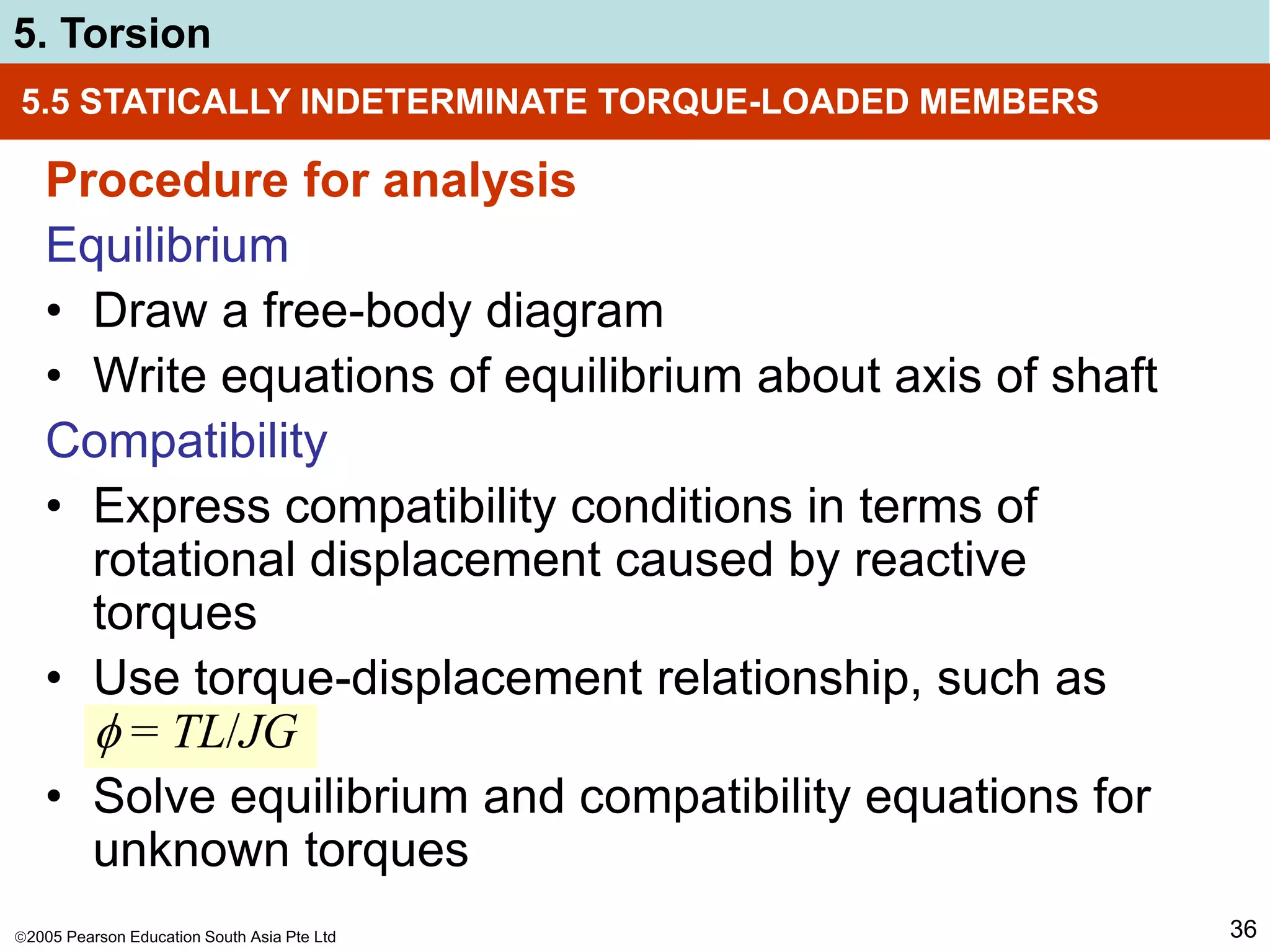
5.5 STATICALLY INDETERMINATE TORQUE-LOADED MEMBERS
Procedure for analysis
Equilibrium
• Draw a free-body diagram
• Write equations of equilibrium about axis of shaft
Compatibility
• Express compatibility conditions in terms of
rotational displacement caused by reactive
torques
• Use torque-displacement relationship, such as
 = TL/JG
• Solve equilibrium and compatibility equations for
unknown torques
2005 Pearson Education South Asia Pte Ltd
5. Torsion
37
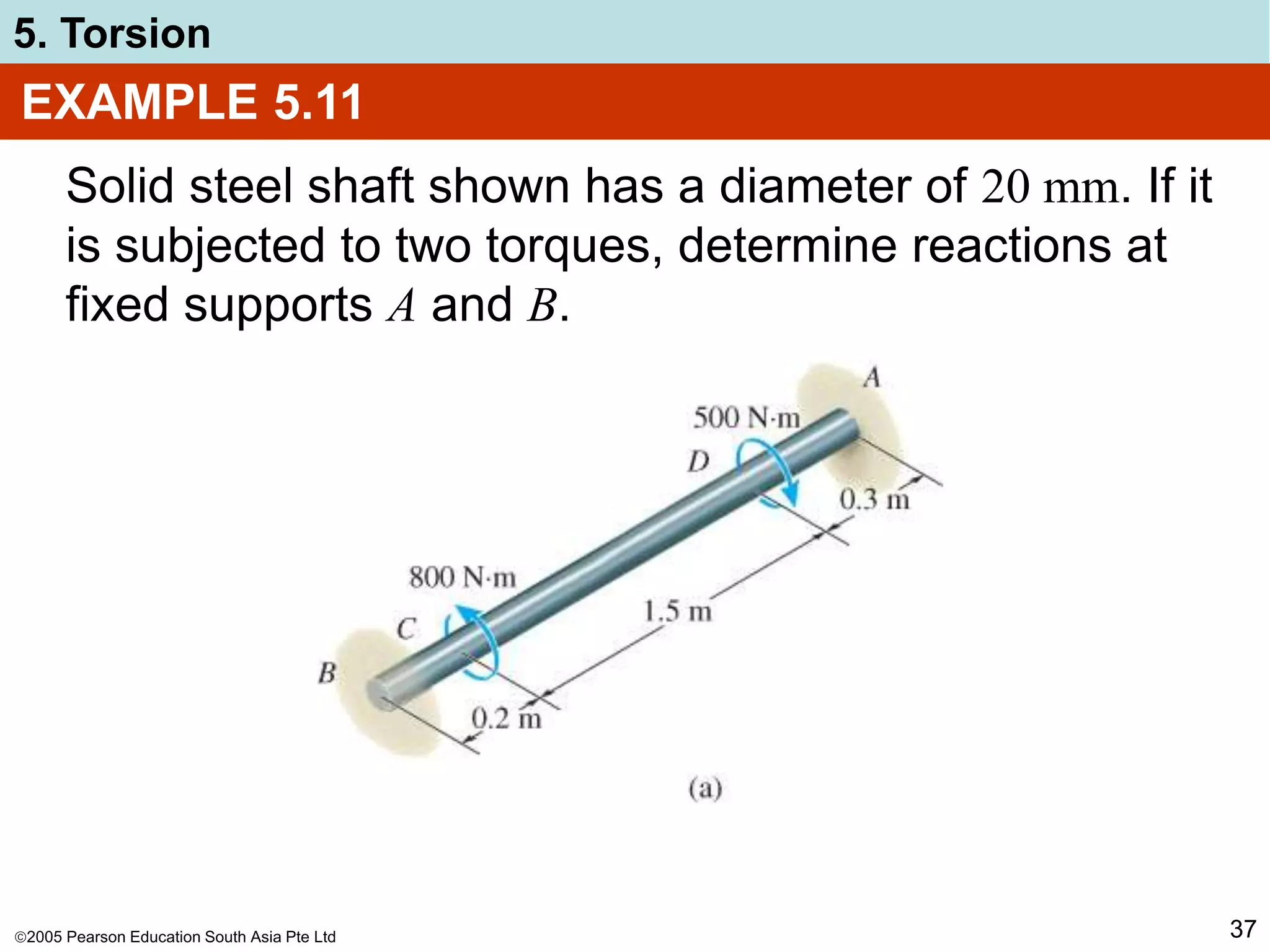
EXAMPLE 5.11
Solid steel shaft shown has a diameter of 20 mm. If it
is subjected to two torques, determine reactions at
fixed supports A and B.
2005 Pearson Education South Asia Pte Ltd
5. Torsion
38
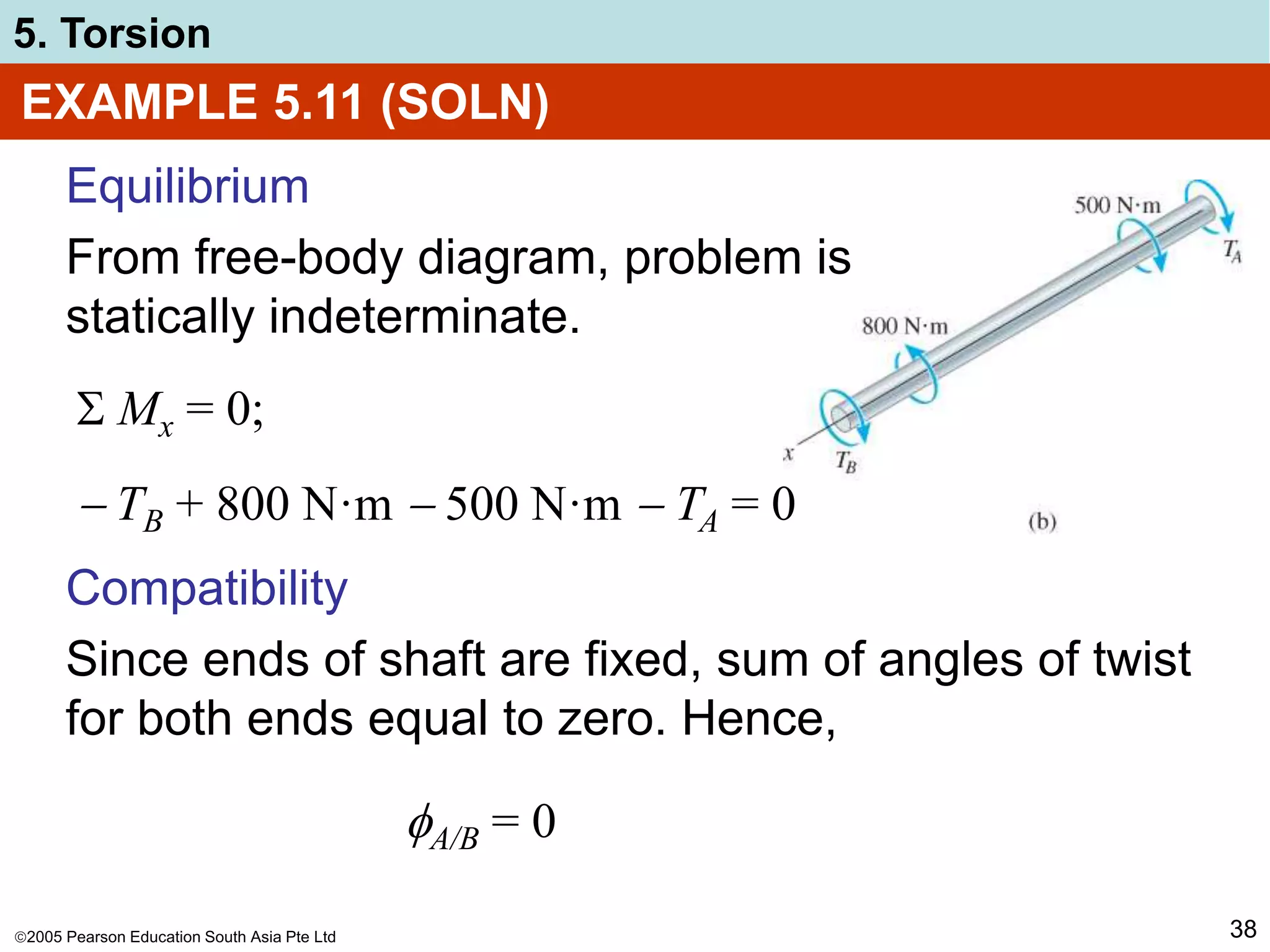
EXAMPLE 5.11 (SOLN)
Equilibrium
From free-body diagram, problem is
statically indeterminate.
 Mx = 0;
 TB + 800 N·m  500 N·m  TA = 0
Compatibility
Since ends of shaft are fixed, sum of angles of twist
for both ends equal to zero. Hence,
A/B = 0
2005 Pearson Education South Asia Pte Ltd
5. Torsion
39
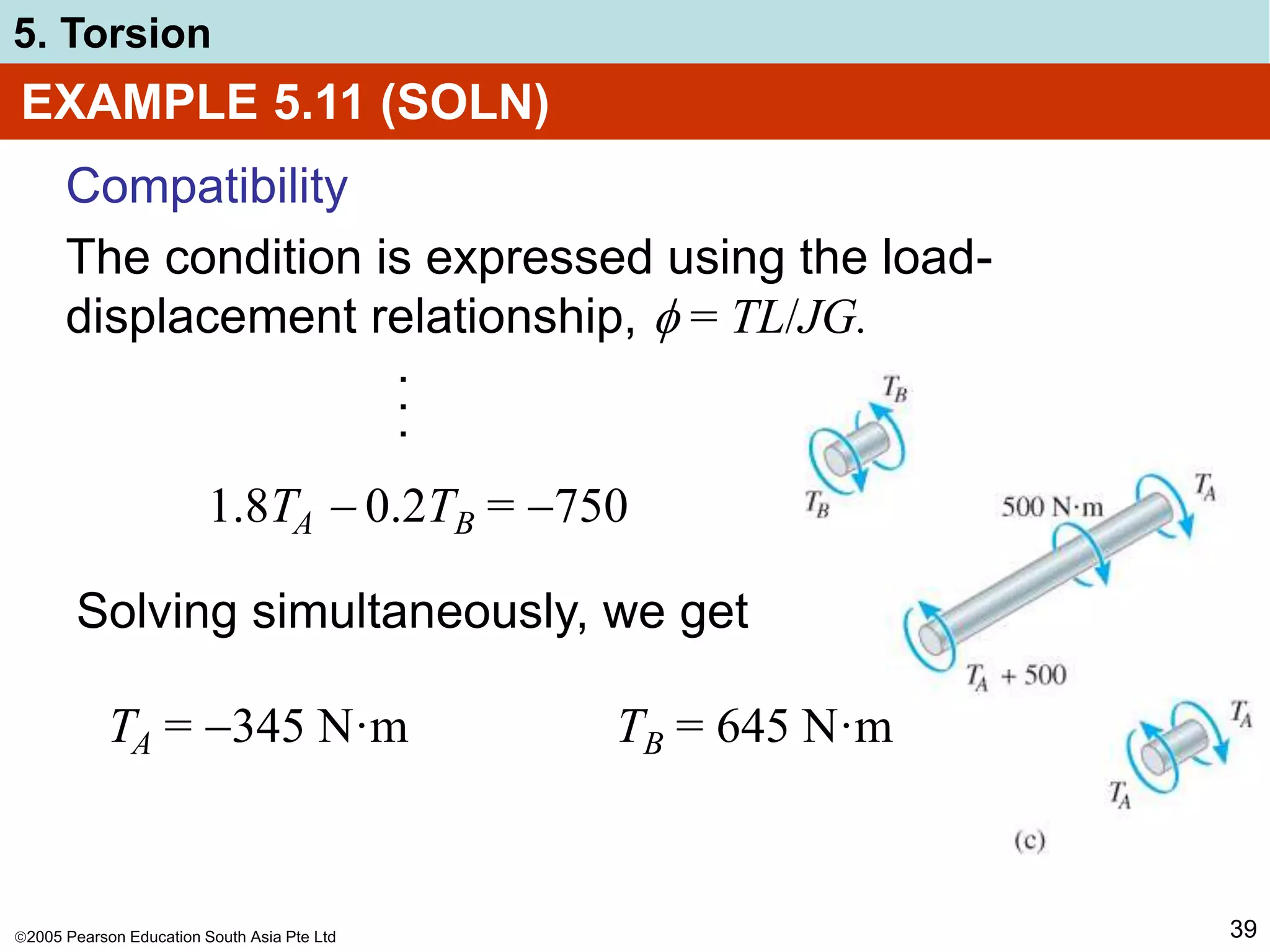
EXAMPLE 5.11 (SOLN)
1.8TA  0.2TB = 750
Compatibility
The condition is expressed using the load-
displacement relationship,  = TL/JG.
.
.
.
Solving simultaneously, we get
TA = 345 N·m TB = 645 N·m
2005 Pearson Education South Asia Pte Ltd
5. Torsion
40
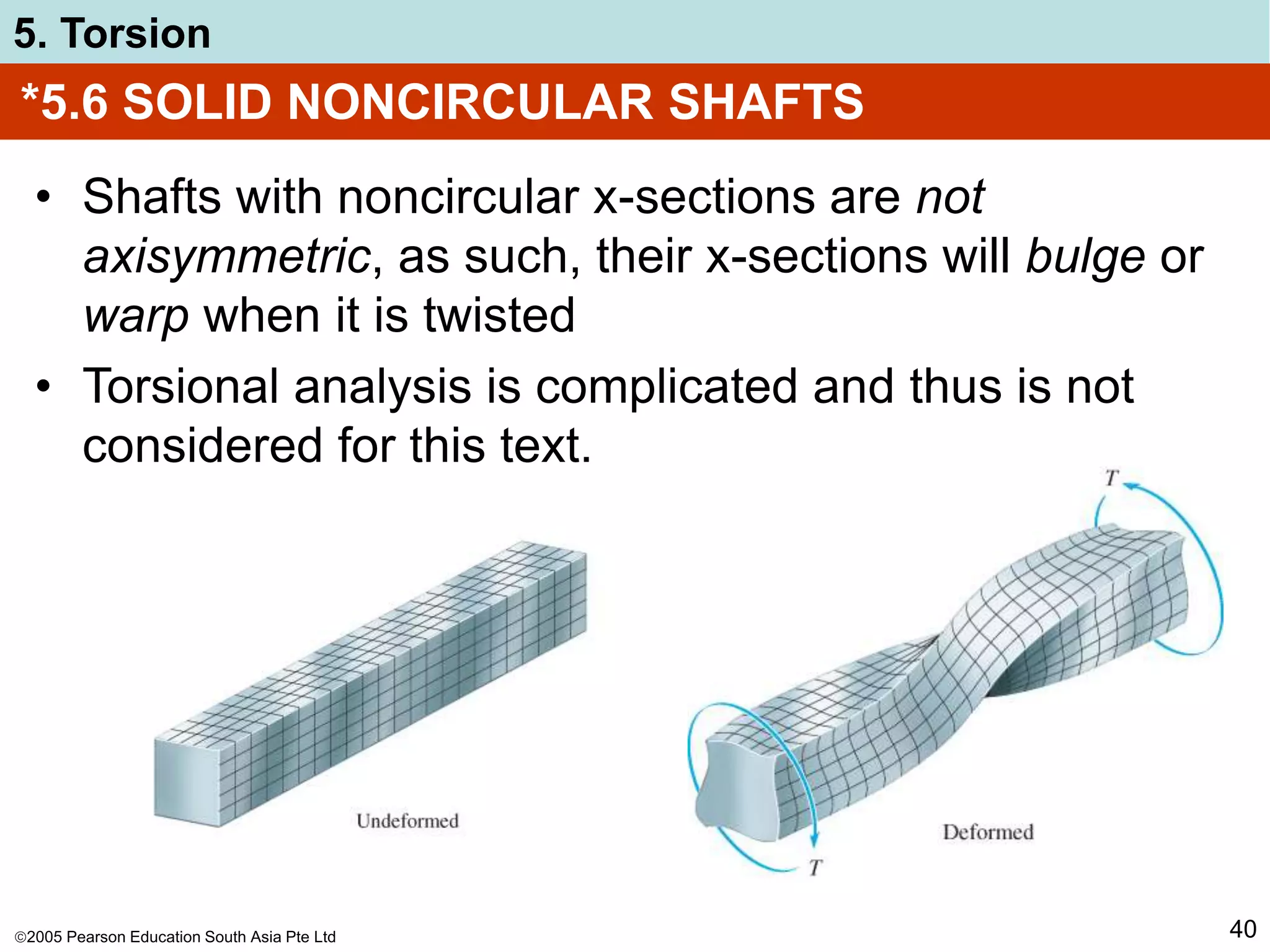
*5.6 SOLID NONCIRCULAR SHAFTS
• Shafts with noncircular x-sections are not
axisymmetric, as such, their x-sections will bulge or
warp when it is twisted
• Torsional analysis is complicated and thus is not
considered for this text.
2005 Pearson Education South Asia Pte Ltd
5. Torsion
41
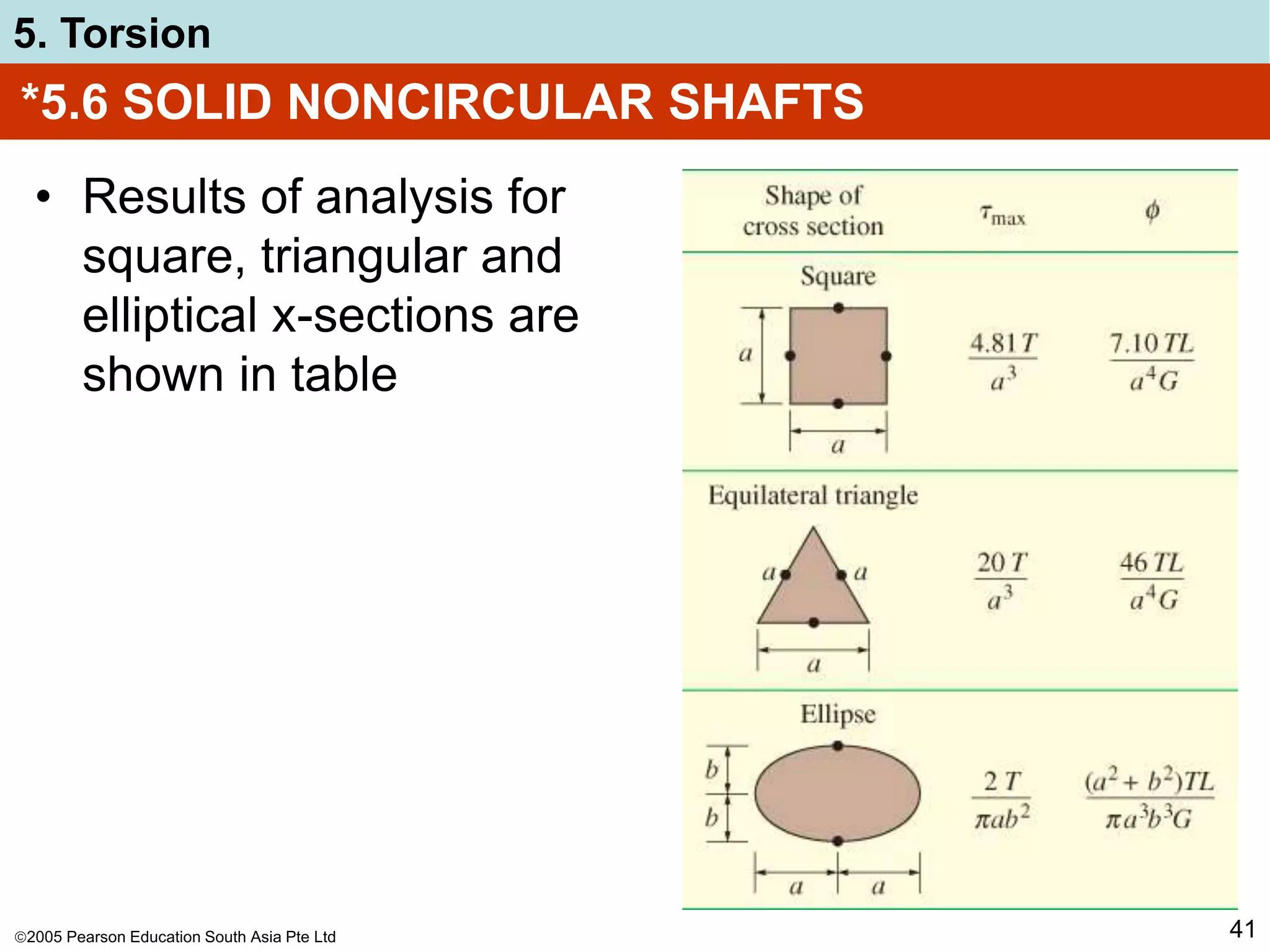
*5.6 SOLID NONCIRCULAR SHAFTS
• Results of analysis for
square, triangular and
elliptical x-sections are
shown in table
2005 Pearson Education South Asia Pte Ltd
5. Torsion
42
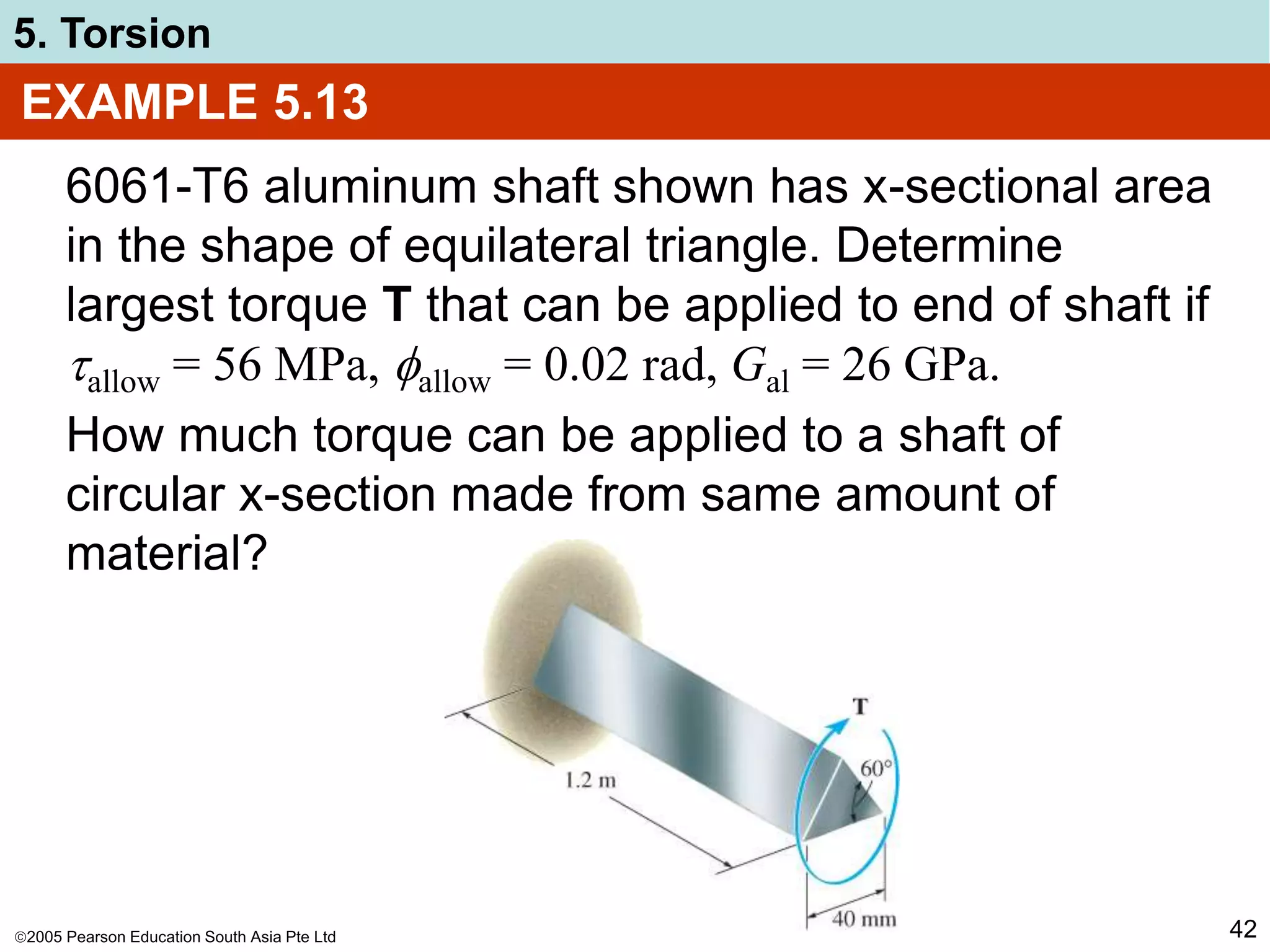
EXAMPLE 5.13
6061-T6 aluminum shaft shown has x-sectional area
in the shape of equilateral triangle. Determine
largest torque T that can be applied to end of shaft if
allow = 56 MPa, allow = 0.02 rad, Gal = 26 GPa.
How much torque can be applied to a shaft of
circular x-section made from same amount of
material?
2005 Pearson Education South Asia Pte Ltd
5. Torsion
43
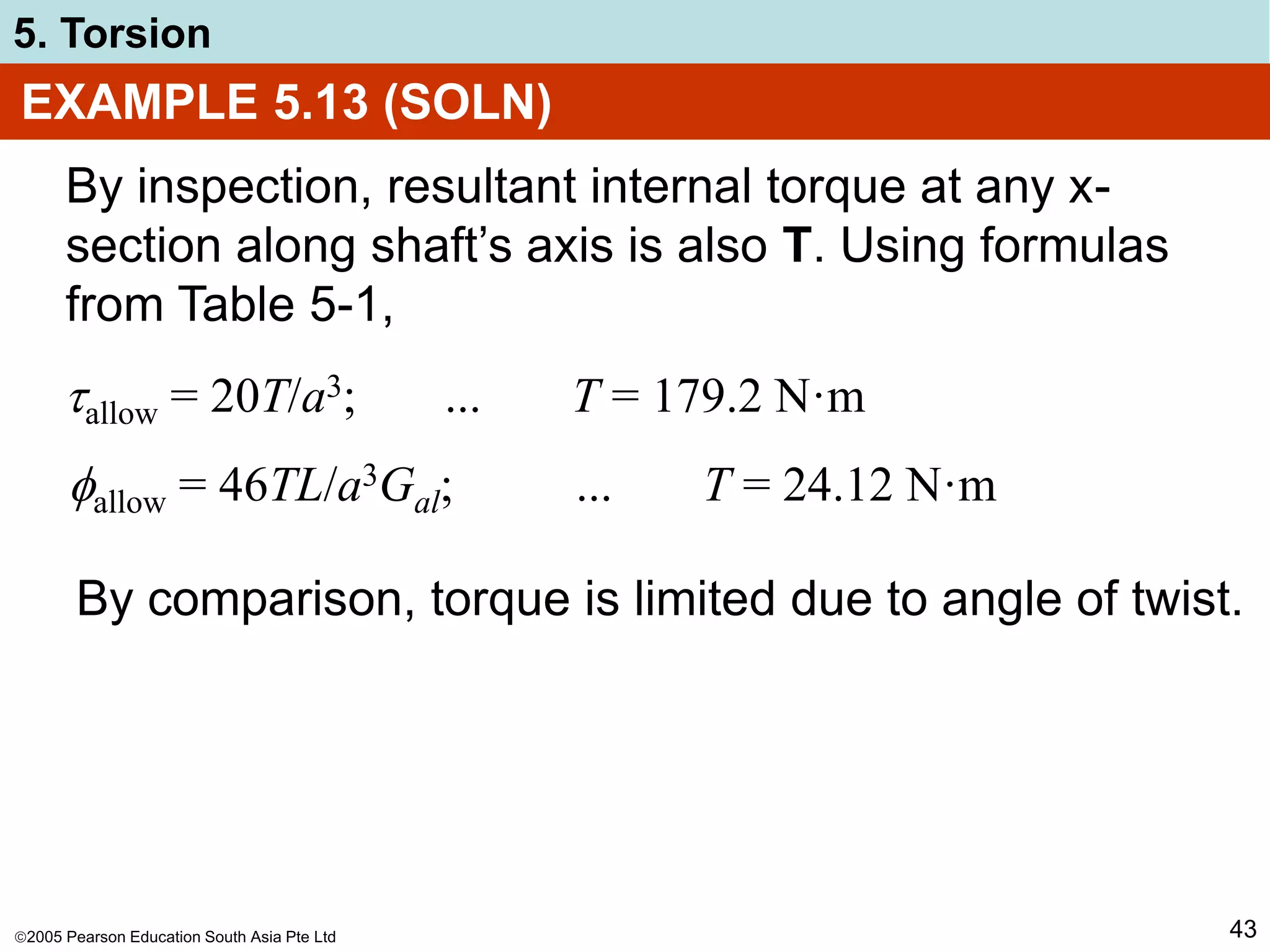
EXAMPLE 5.13 (SOLN)
By inspection, resultant internal torque at any x-
section along shaft’s axis is also T. Using formulas
from Table 5-1,
allow = 20T/a3; ... T = 179.2 N·m
allow = 46TL/a3Gal; ... T = 24.12 N·m
By comparison, torque is limited due to angle of twist.
2005 Pearson Education South Asia Pte Ltd
5. Torsion
44
EXAMPLE 5.13 (SOLN)
Circular x-section
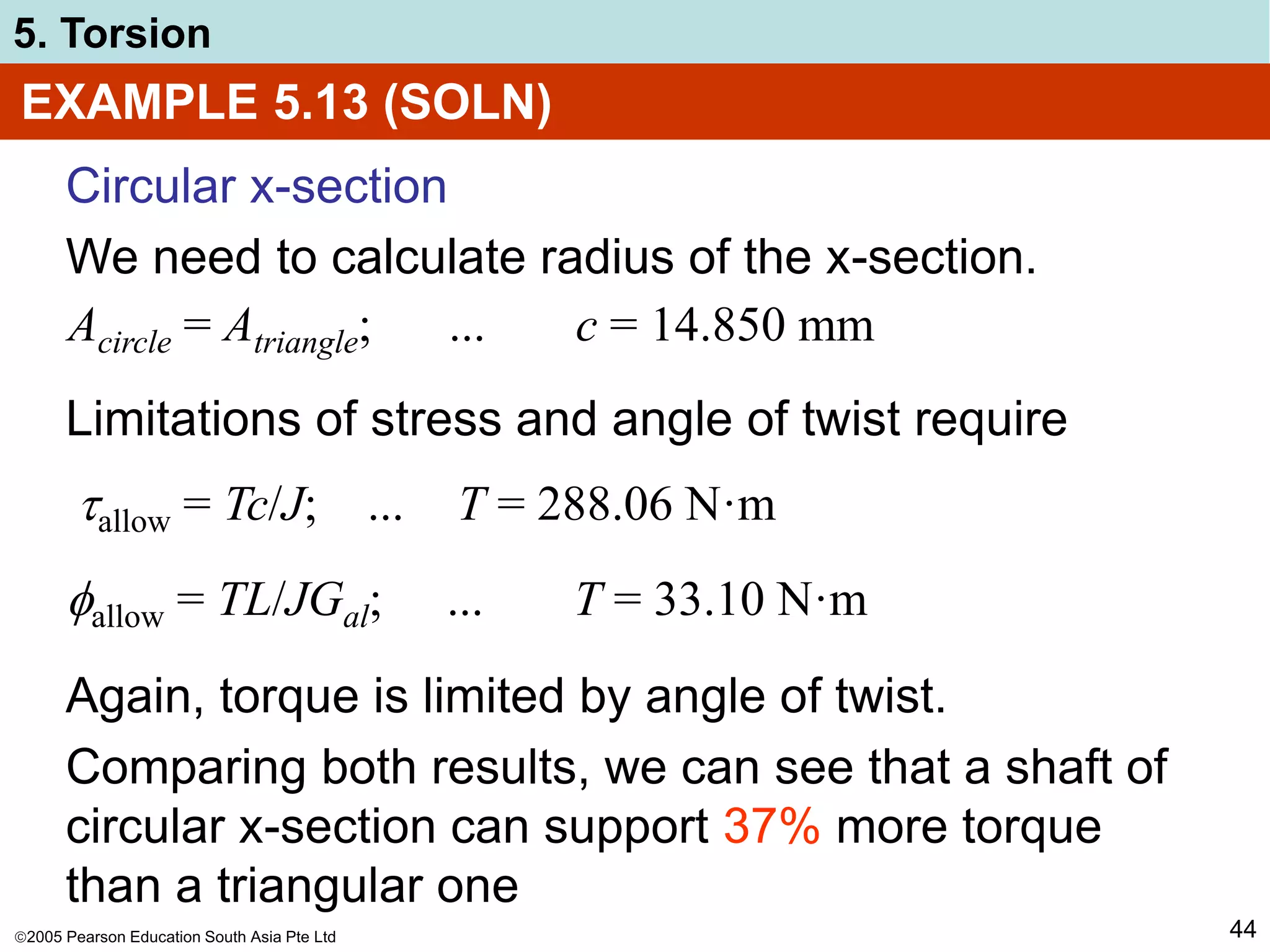
We need to calculate radius of the x-section.
Acircle = Atriangle; ... c = 14.850 mm
Limitations of stress and angle of twist require
allow = Tc/J; ... T = 288.06 N·m
allow = TL/JGal; ... T = 33.10 N·m
Again, torque is limited by angle of twist.
Comparing both results, we can see that a shaft of
circular x-section can support 37% more torque
than a triangular one
2005 Pearson Education South Asia Pte Ltd
5. Torsion
45
*5.7 THIN-WALLED TUBES HAVING CLOSED CROSS SECTIONS
• Thin-walled tubes of noncircular shape are used to
construct lightweight frameworks such as those in
aircraft
• This section will analyze such shafts with a closed
x-section
• As walls are thin, we assume stress is uniformly
distributed across the thickness of the tube
2005 Pearson Education South Asia Pte Ltd
5. Torsion
46
*5.7 THIN-WALLED TUBES HAVING CLOSED CROSS SECTIONS
Shear flow
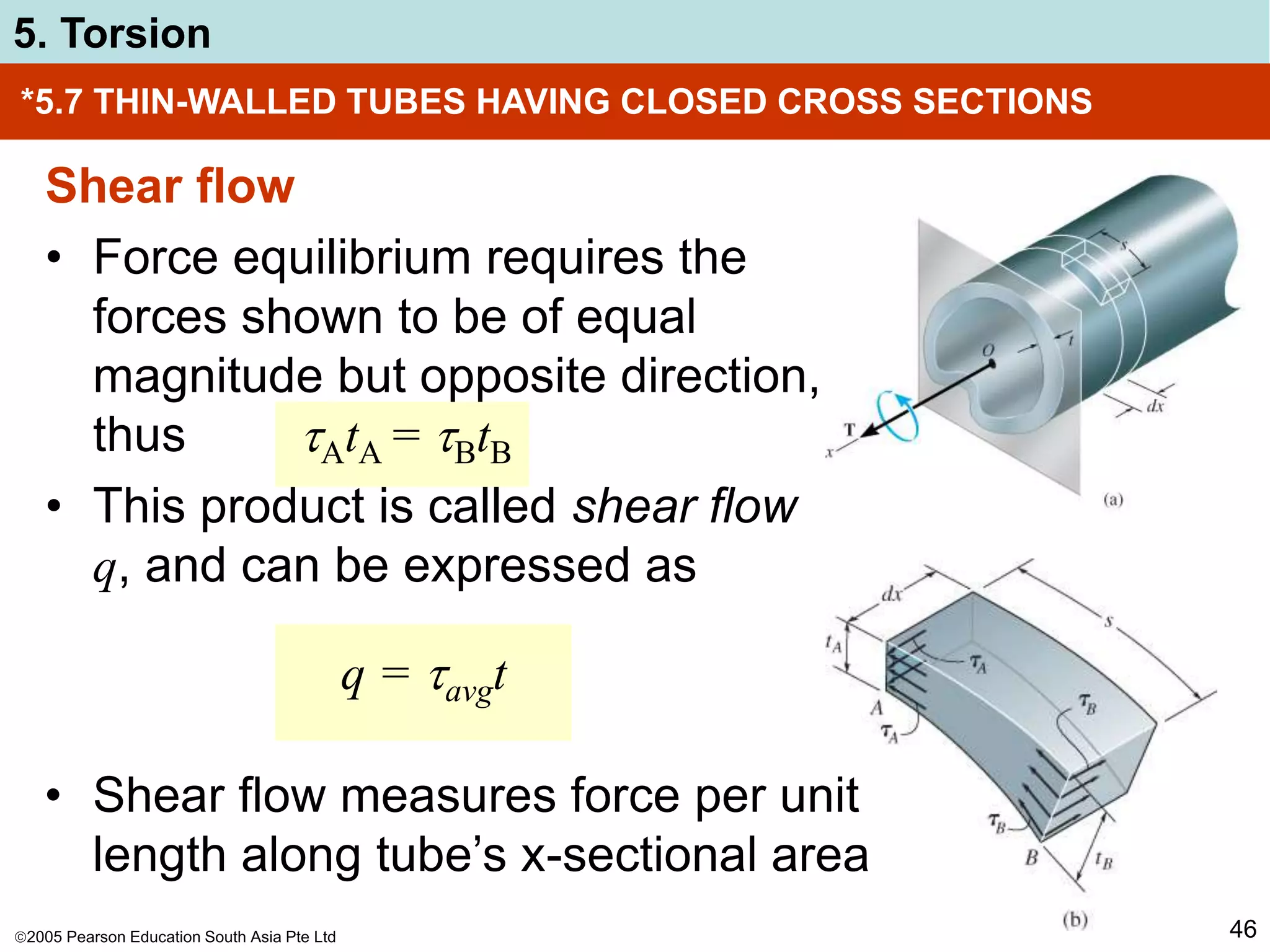
• Force equilibrium requires the
forces shown to be of equal
magnitude but opposite direction,
thus AtA = BtB
• This product is called shear flow
q, and can be expressed as
q = avgt
• Shear flow measures force per unit
length along tube’s x-sectional area
2005 Pearson Education South Asia Pte Ltd
5. Torsion
47
*5.7 THIN-WALLED TUBES HAVING CLOSED CROSS SECTIONS
Average shear stress
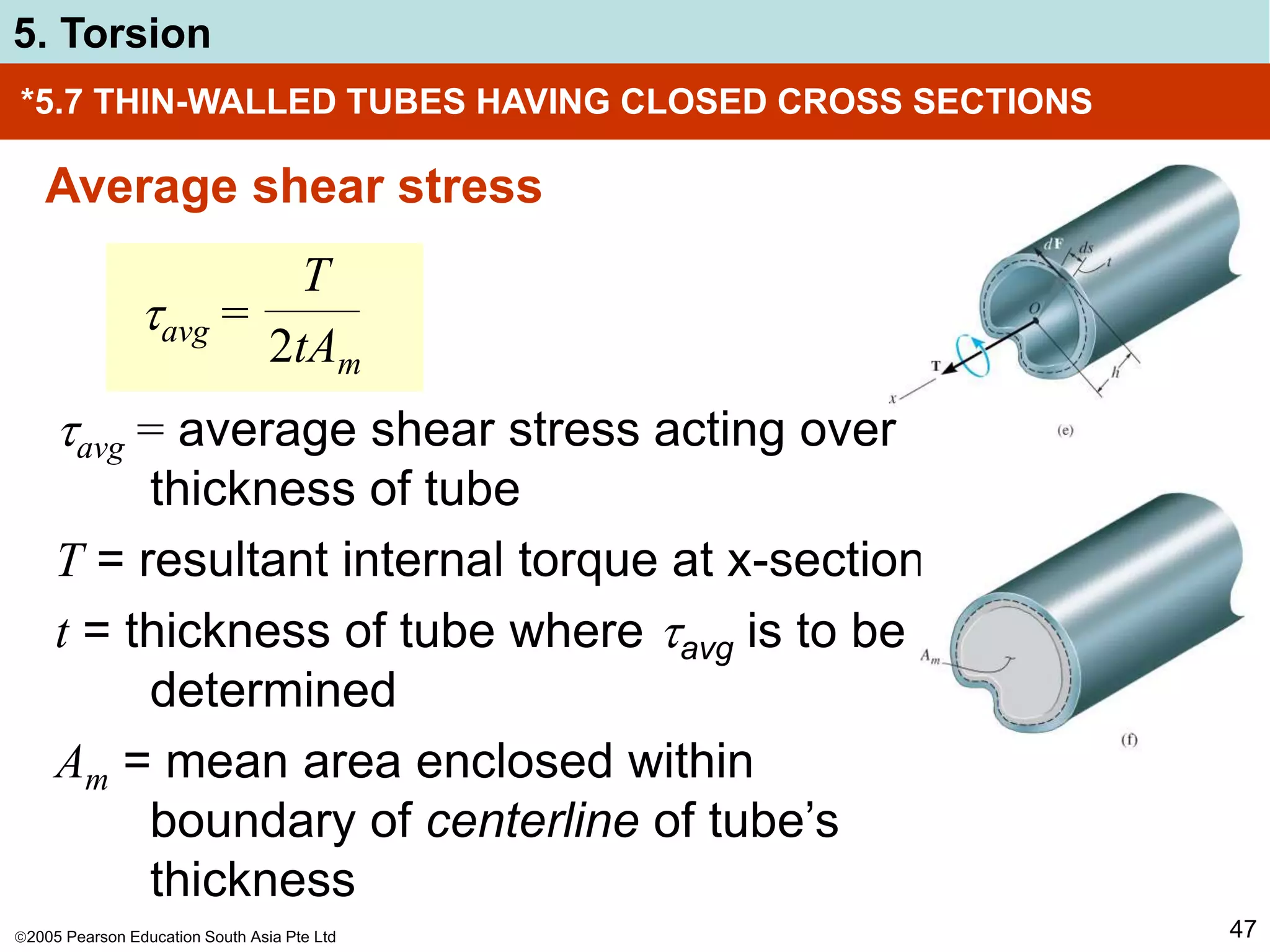
avg = average shear stress acting over
thickness of tube
T = resultant internal torque at x-section
t = thickness of tube where avg is to be
determined
Am = mean area enclosed within
boundary of centerline of tube’s
thickness
avg =
T
2tAm
2005 Pearson Education South Asia Pte Ltd
5. Torsion
48
*5.7 THIN-WALLED TUBES HAVING CLOSED CROSS SECTIONS
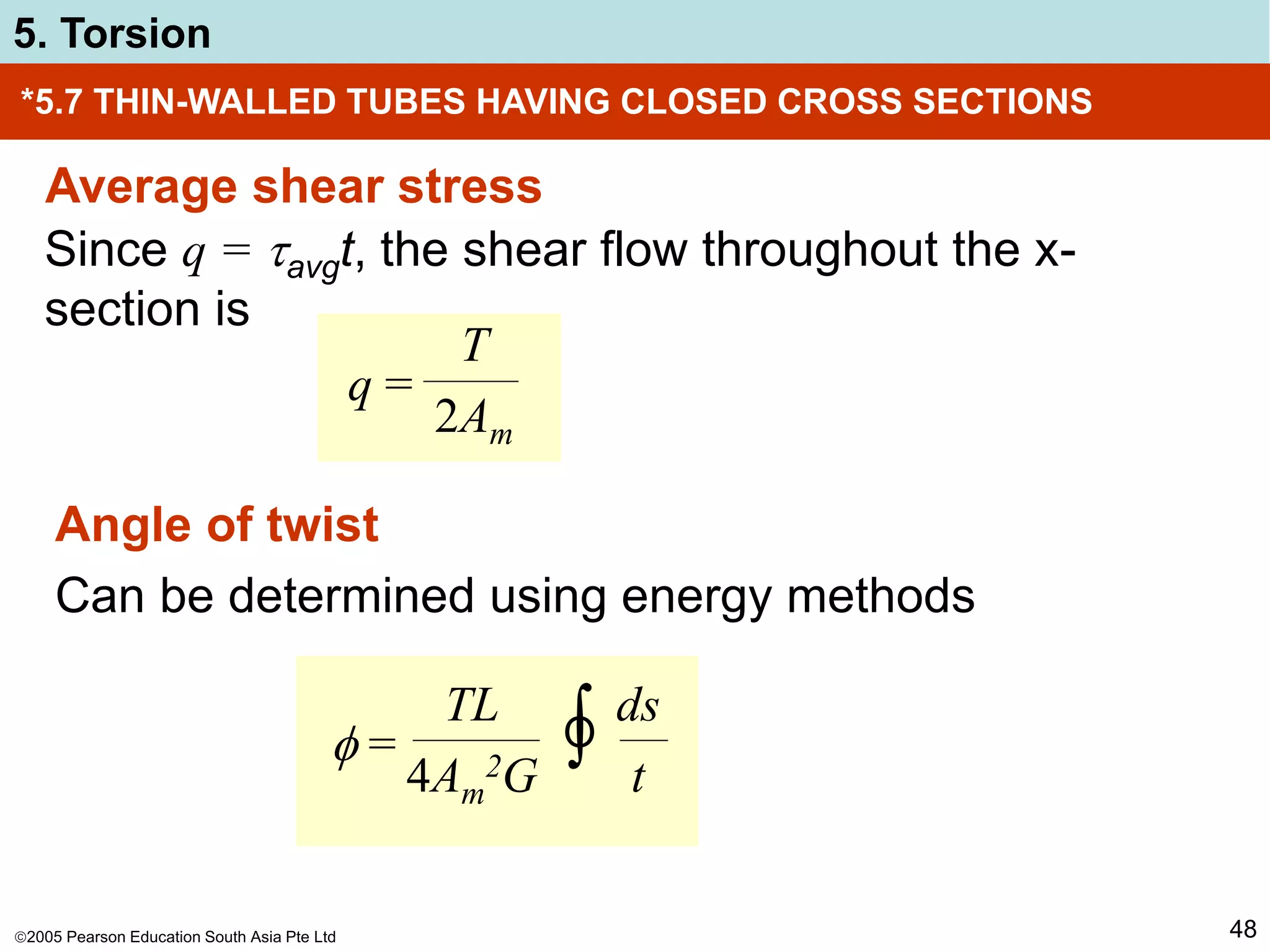
Average shear stress
Since q = avgt, the shear flow throughout the x-
section is
q =
T
2Am
Angle of twist
Can be determined using energy methods
 = ∫
TL
4Am
2G
ds
t
O
2005 Pearson Education South Asia Pte Ltd
5. Torsion
49
*5.7 THIN-WALLED TUBES HAVING CLOSED CROSS SECTIONS
IMPORTANT
• Shear flow q is a product of tube’s thickness and
average shear stress. This value is constant at all
points along tube’s x-section. Thus, largest
average shear stress occurs where tube’s
thickness is smallest
• Both shear flow and average shear stress act
tangent to wall of tube at all points in a direction to
contribute to resultant torque
2005 Pearson Education South Asia Pte Ltd
5. Torsion
50
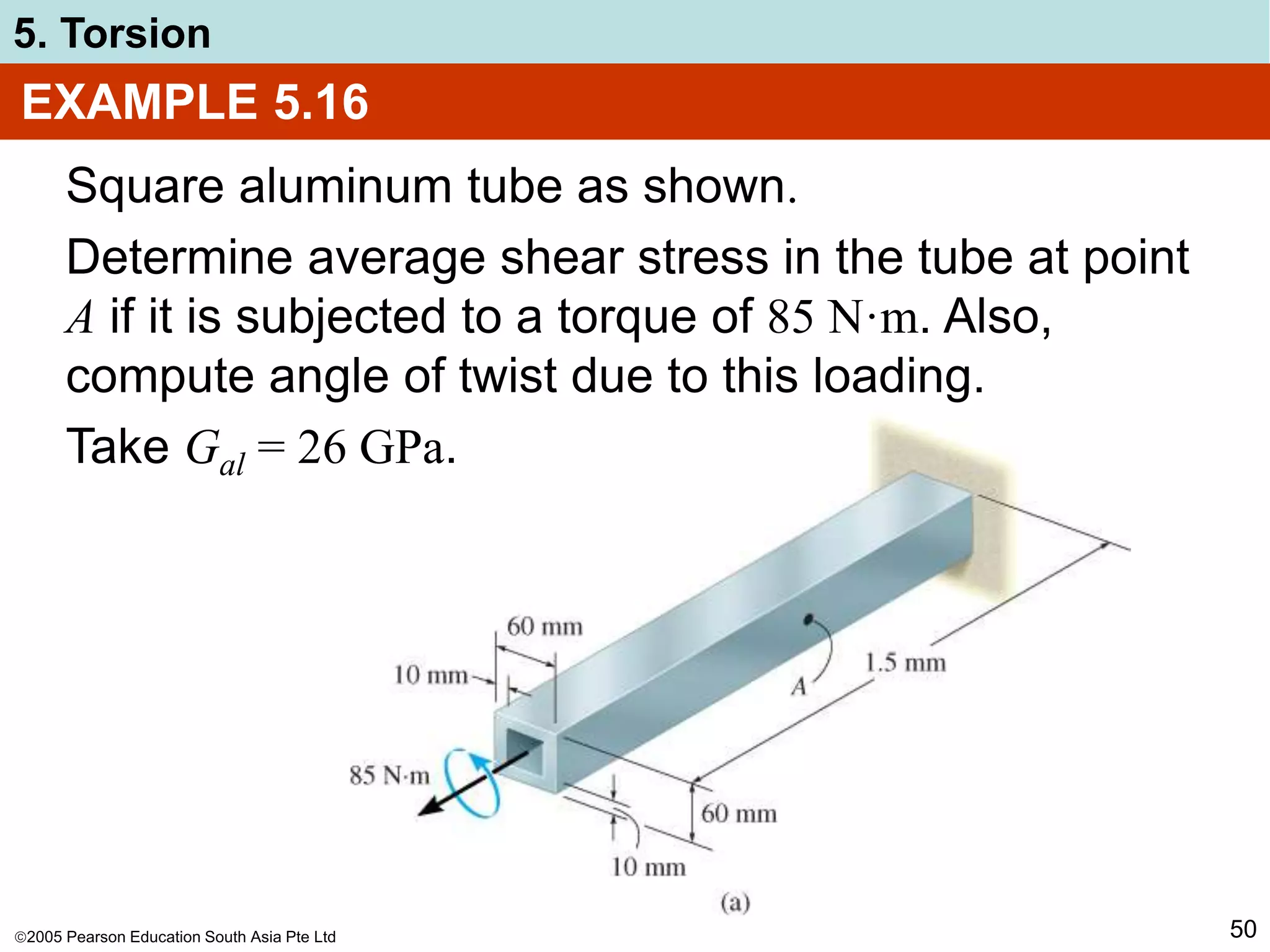
EXAMPLE 5.16
Square aluminum tube as shown.
Determine average shear stress in the tube at point
A if it is subjected to a torque of 85 N·m. Also,
compute angle of twist due to this loading.
Take Gal = 26 GPa.
2005 Pearson Education South Asia Pte Ltd
5. Torsion
51
EXAMPLE 5.16 (SOLN)
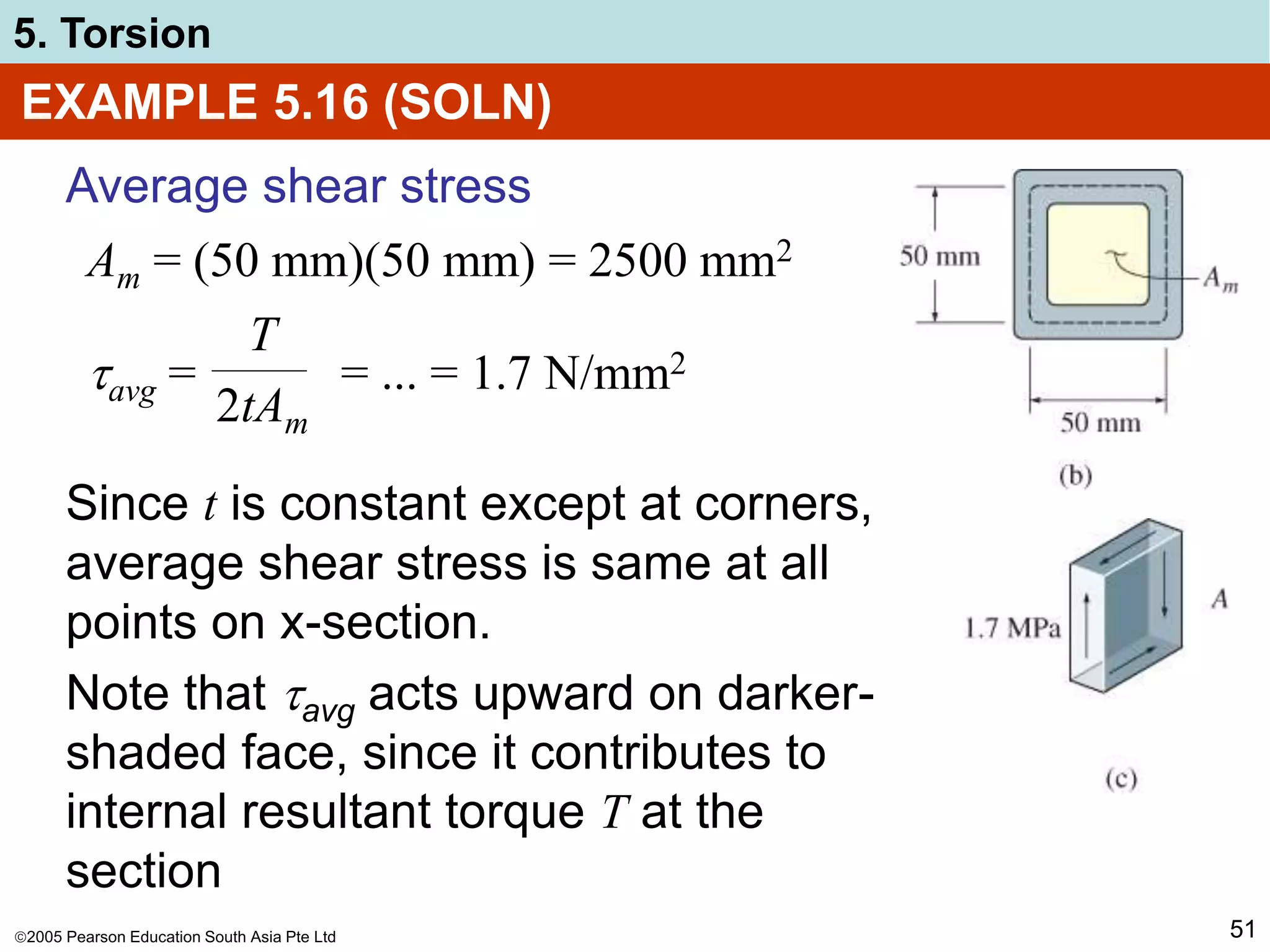
Average shear stress
Am = (50 mm)(50 mm) = 2500 mm2
avg = = ... = 1.7 N/mm2
T
2tAm
Since t is constant except at corners,
average shear stress is same at all
points on x-section.
Note that avg acts upward on darker-
shaded face, since it contributes to
internal resultant torque T at the
section
2005 Pearson Education South Asia Pte Ltd
5. Torsion
52
EXAMPLE 5.16 (SOLN)
Angle of twist
Here, integral represents length around
centerline boundary of tube, thus
 = ∫
TL
4Am
2G
ds
t
O = ... = 0.196(10-4) mm-1 ∫ ds
O
 = 0.196(10-4) mm-1[4(50 mm)] = 3.92 (10-3) rad
2005 Pearson Education South Asia Pte Ltd
5. Torsion
53
5.8 STRESS CONCENTRATION
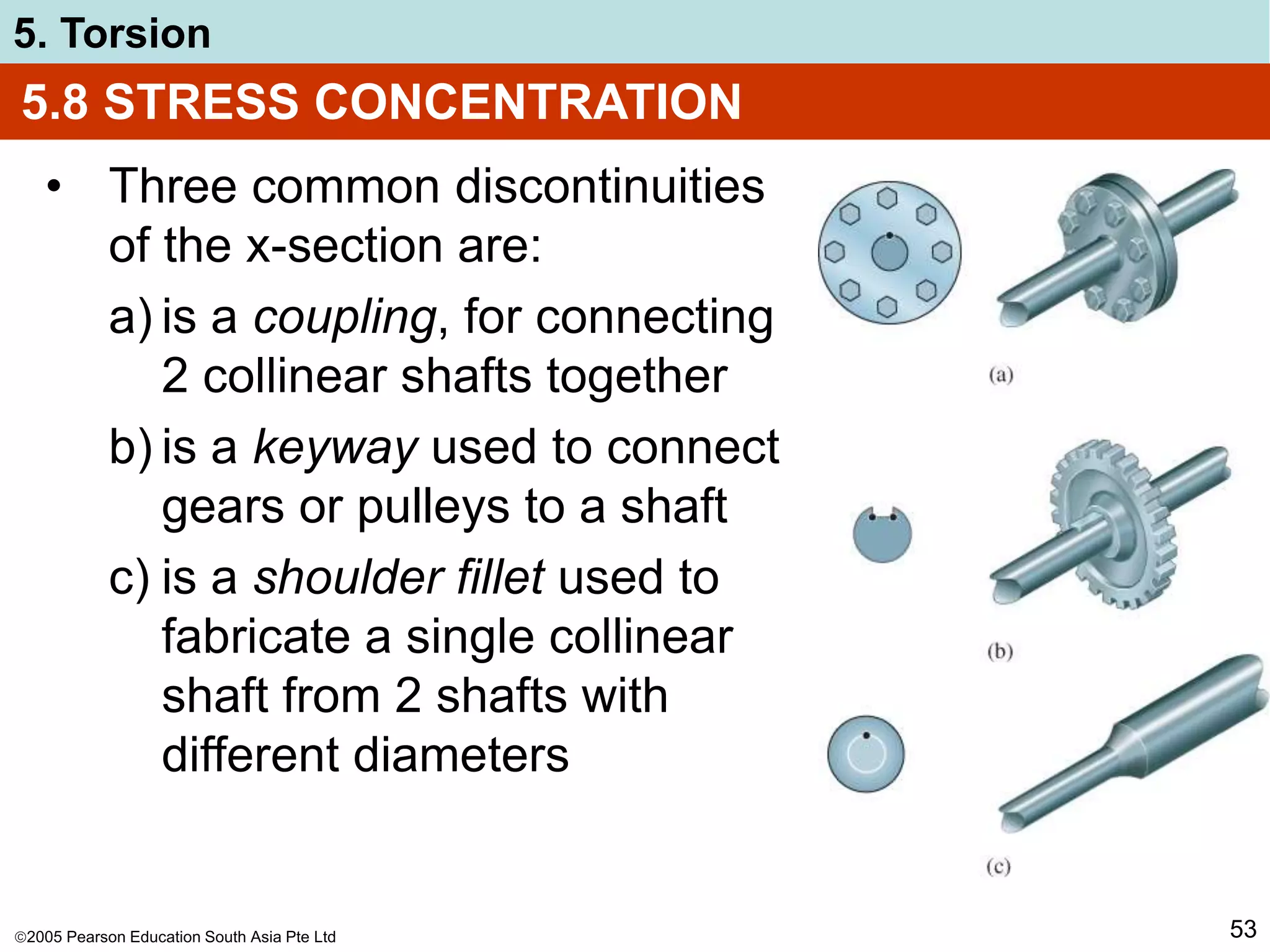
• Three common discontinuities
of the x-section are:
a) is a coupling, for connecting
2 collinear shafts together
b) is a keyway used to connect
gears or pulleys to a shaft
c) is a shoulder fillet used to
fabricate a single collinear
shaft from 2 shafts with
different diameters
2005 Pearson Education South Asia Pte Ltd
5. Torsion
54
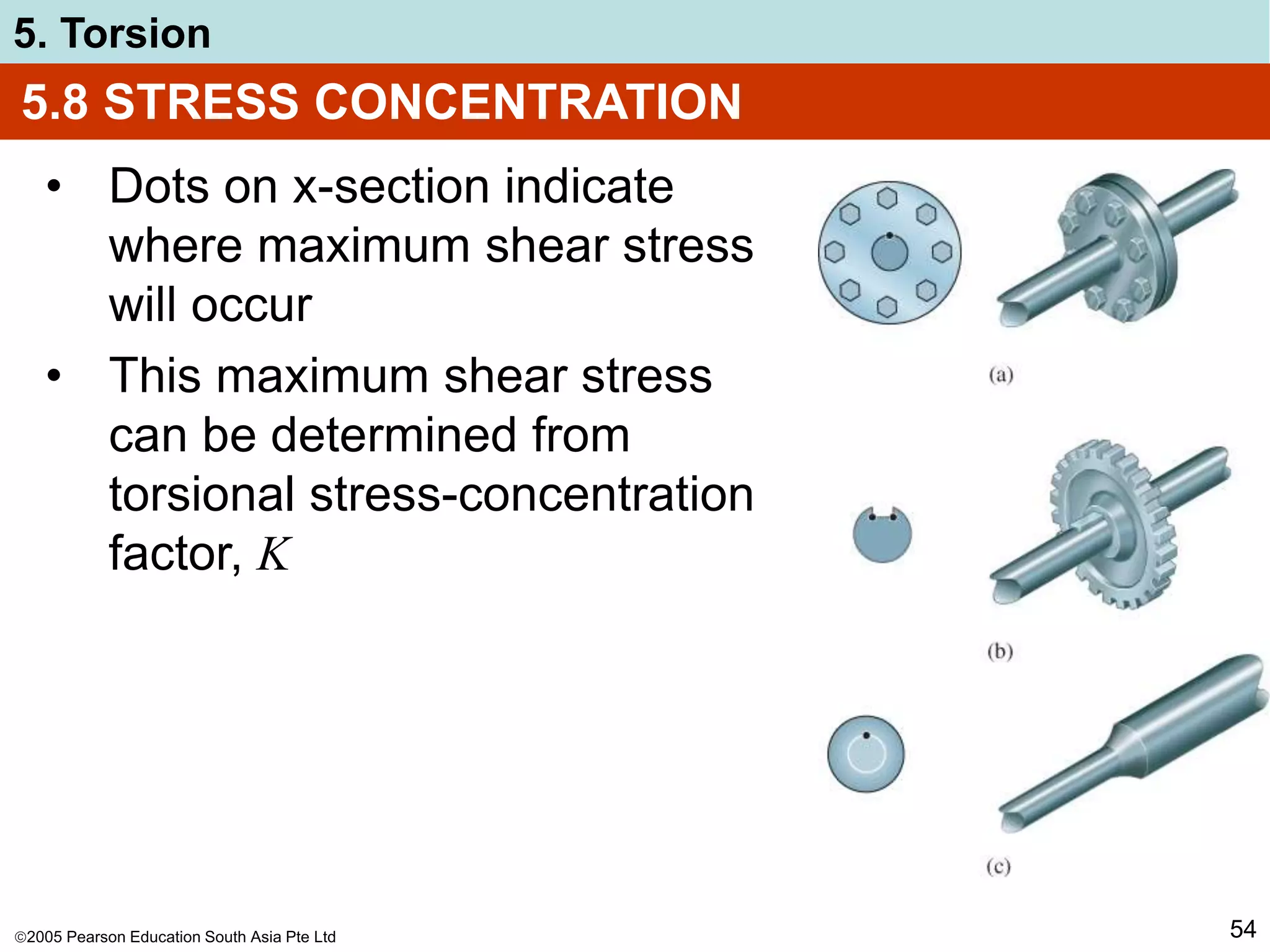
5.8 STRESS CONCENTRATION
• Dots on x-section indicate
where maximum shear stress
will occur
• This maximum shear stress
can be determined from
torsional stress-concentration
factor, K
2005 Pearson Education South Asia Pte Ltd
5. Torsion
55
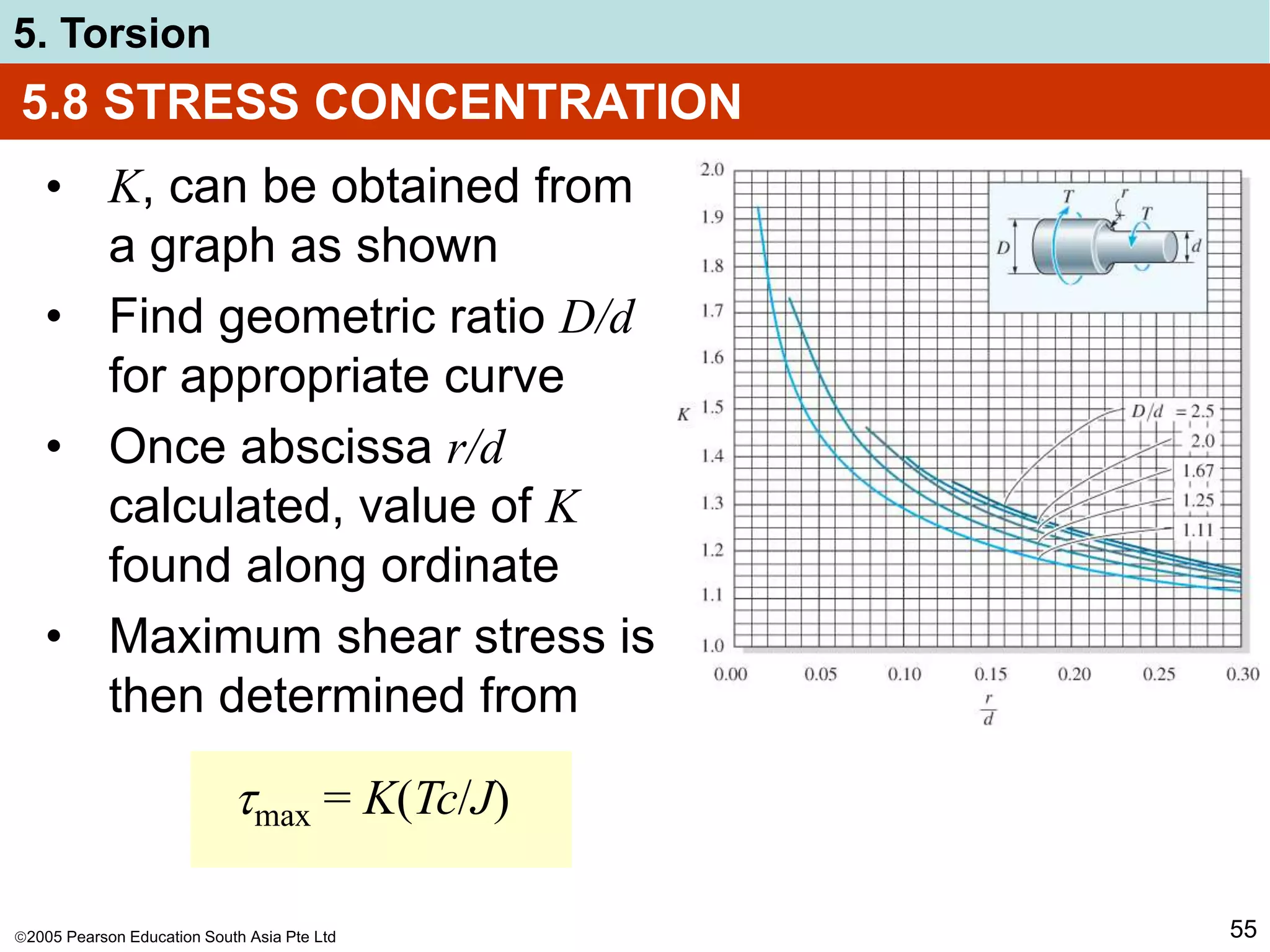
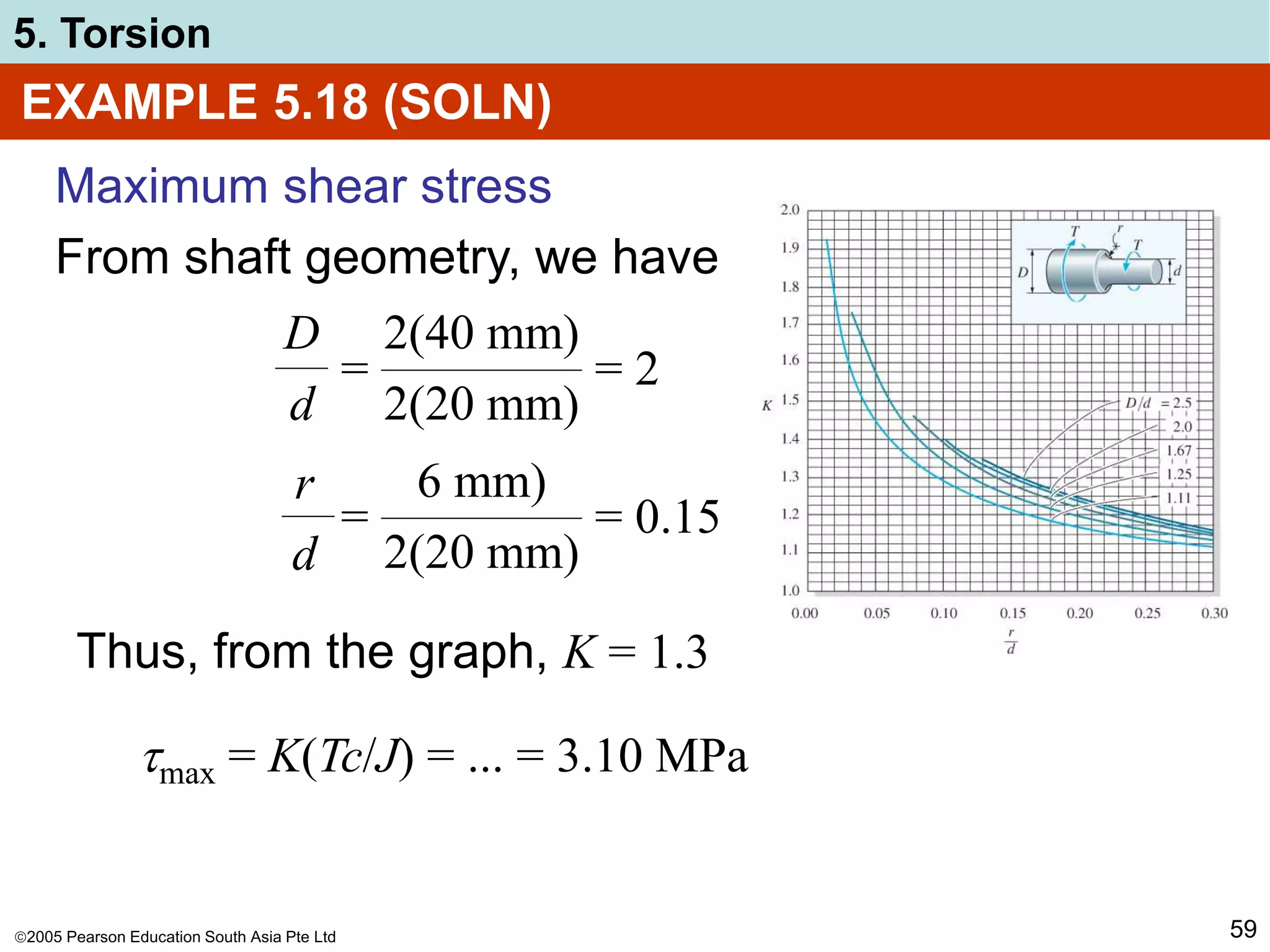
5.8 STRESS CONCENTRATION
• K, can be obtained from
a graph as shown
• Find geometric ratio D/d
for appropriate curve
• Once abscissa r/d
calculated, value of K
found along ordinate
• Maximum shear stress is
then determined from
max = K(Tc/J)
2005 Pearson Education South Asia Pte Ltd
5. Torsion
56
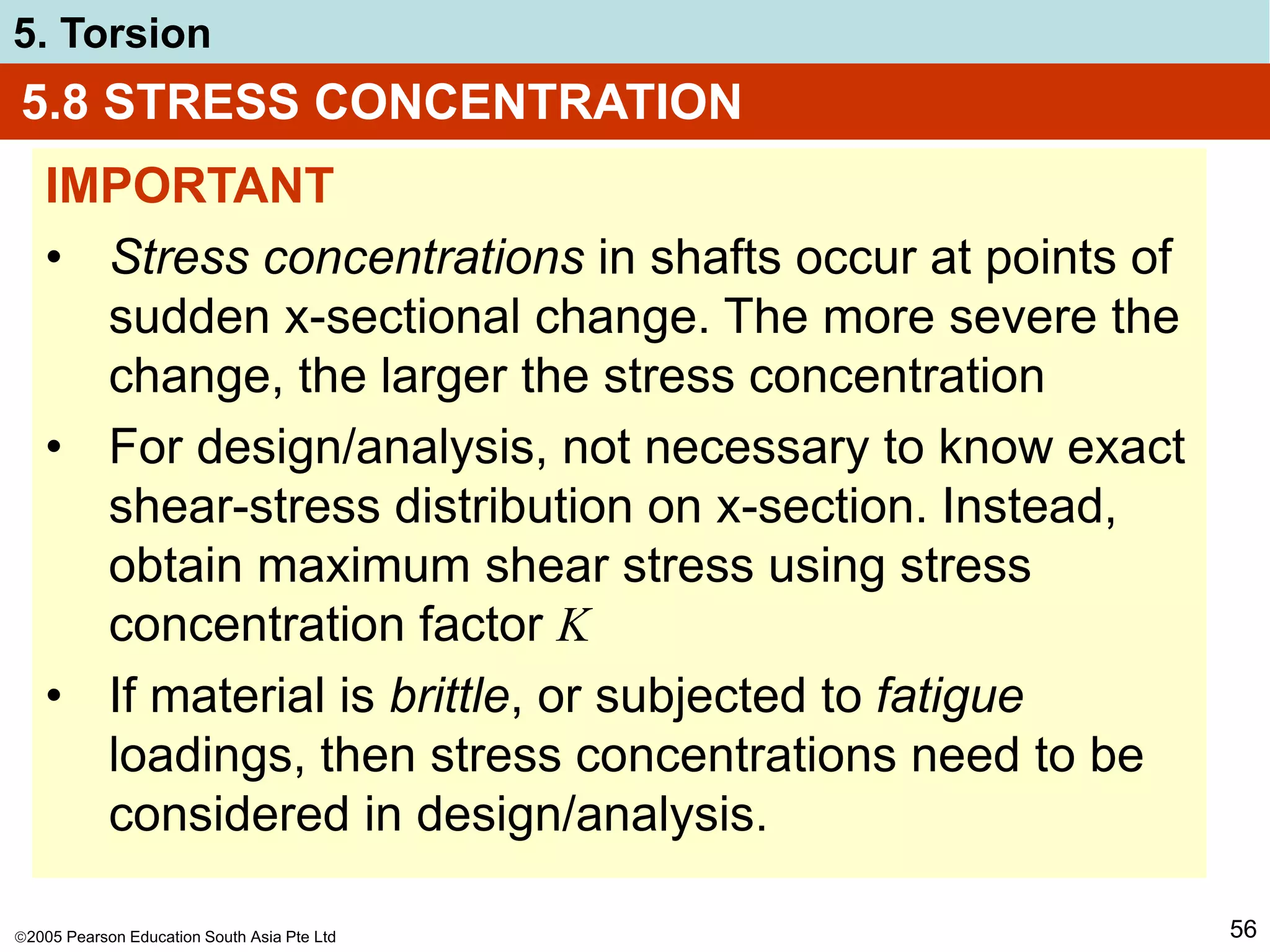
5.8 STRESS CONCENTRATION
IMPORTANT
• Stress concentrations in shafts occur at points of
sudden x-sectional change. The more severe the
change, the larger the stress concentration
• For design/analysis, not necessary to know exact
shear-stress distribution on x-section. Instead,
obtain maximum shear stress using stress
concentration factor K
• If material is brittle, or subjected to fatigue
loadings, then stress concentrations need to be
considered in design/analysis.
2005 Pearson Education South Asia Pte Ltd
5. Torsion
57
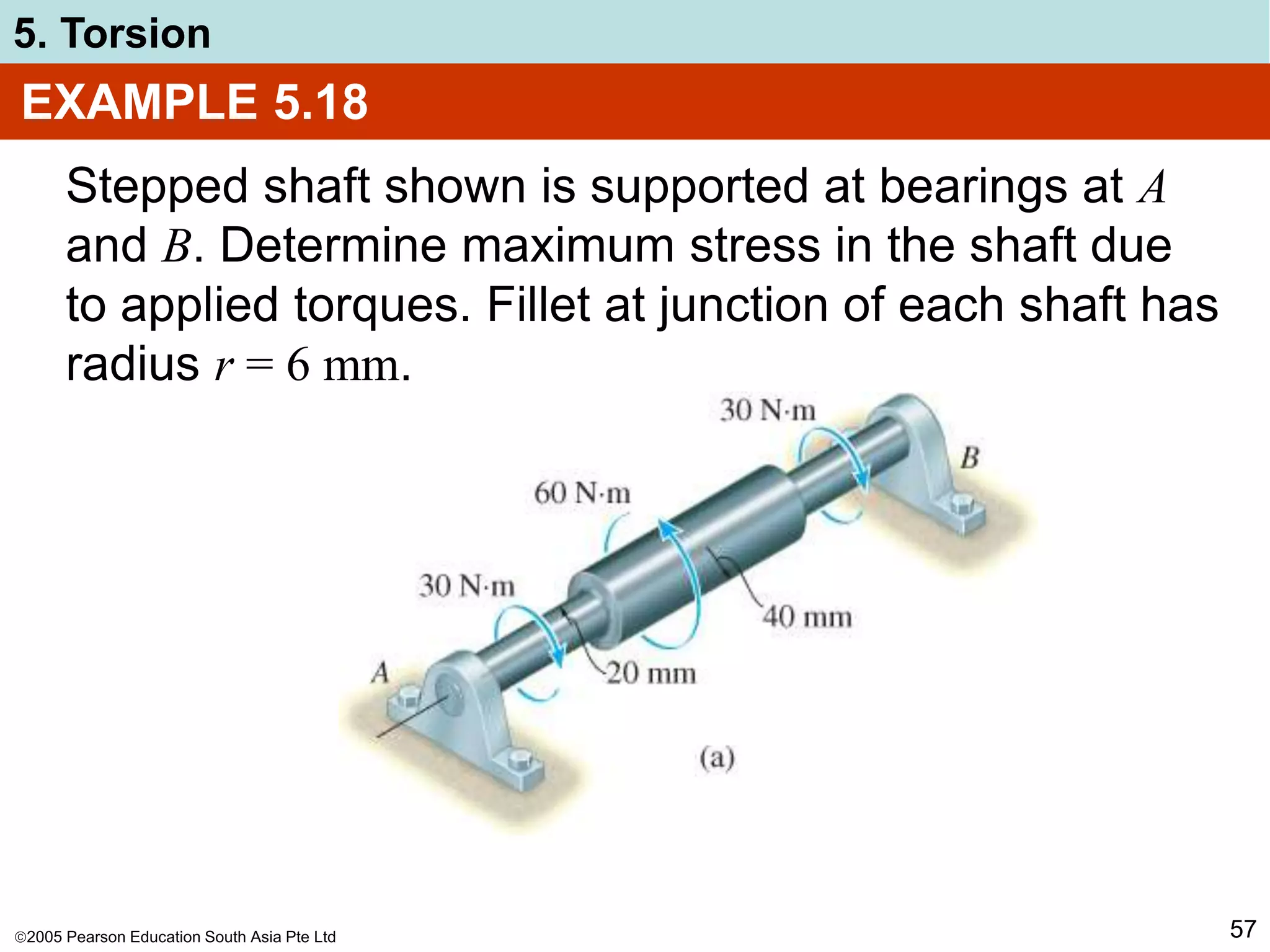
EXAMPLE 5.18
Stepped shaft shown is supported at bearings at A
and B. Determine maximum stress in the shaft due
to applied torques. Fillet at junction of each shaft has
radius r = 6 mm.
2005 Pearson Education South Asia Pte Ltd
5. Torsion
58
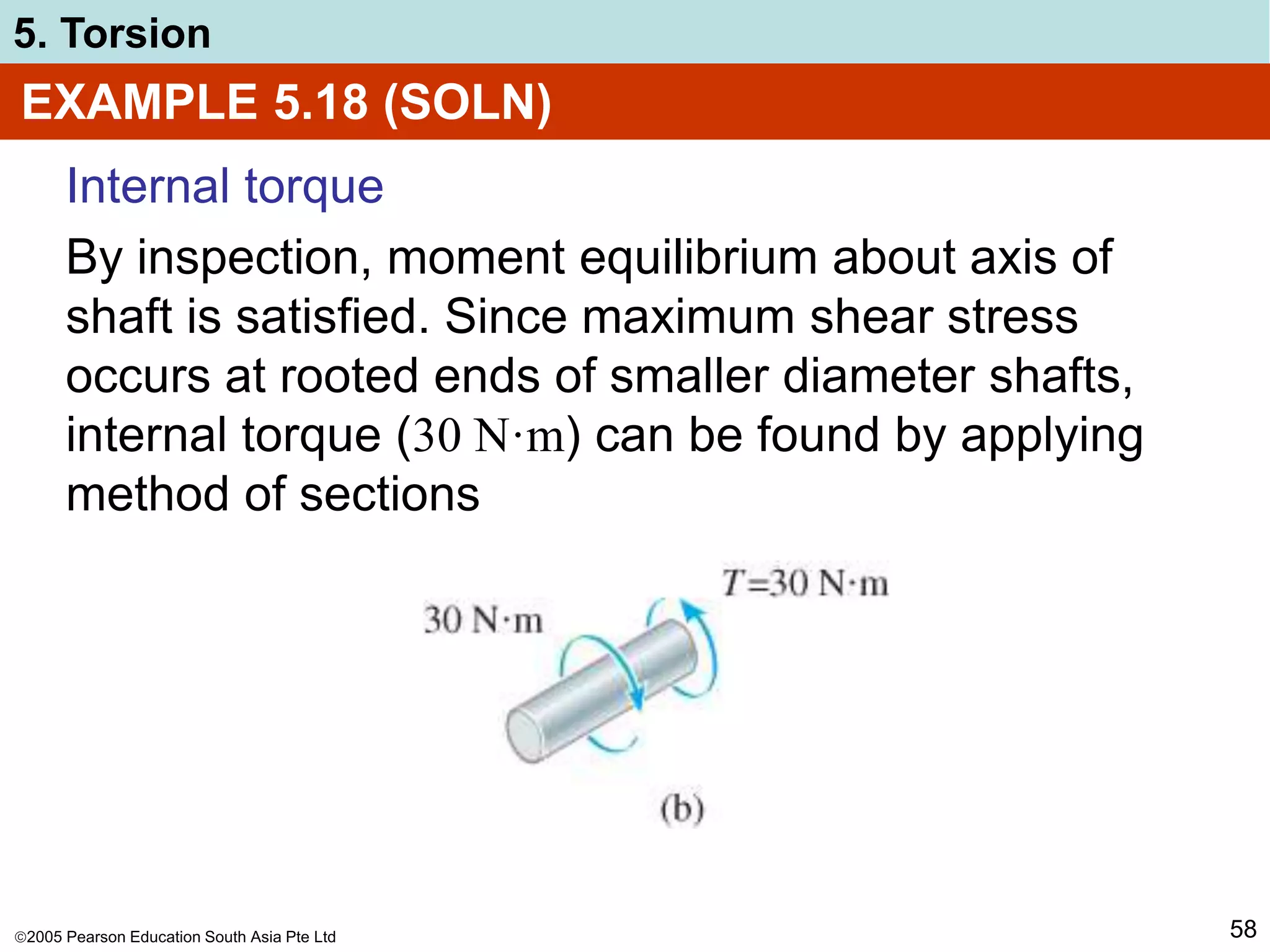
EXAMPLE 5.18 (SOLN)
Internal torque
By inspection, moment equilibrium about axis of
shaft is satisfied. Since maximum shear stress
occurs at rooted ends of smaller diameter shafts,
internal torque (30 N·m) can be found by applying
method of sections
2005 Pearson Education South Asia Pte Ltd
5. Torsion
59
EXAMPLE 5.18 (SOLN)
Maximum shear stress
From shaft geometry, we have
D
d
r
d
2(40 mm)
2(20 mm)
6 mm)
2(20 mm)
= = 2
= = 0.15
Thus, from the graph, K = 1.3
max = K(Tc/J) = ... = 3.10 MPa
2005 Pearson Education South Asia Pte Ltd
5. Torsion
60
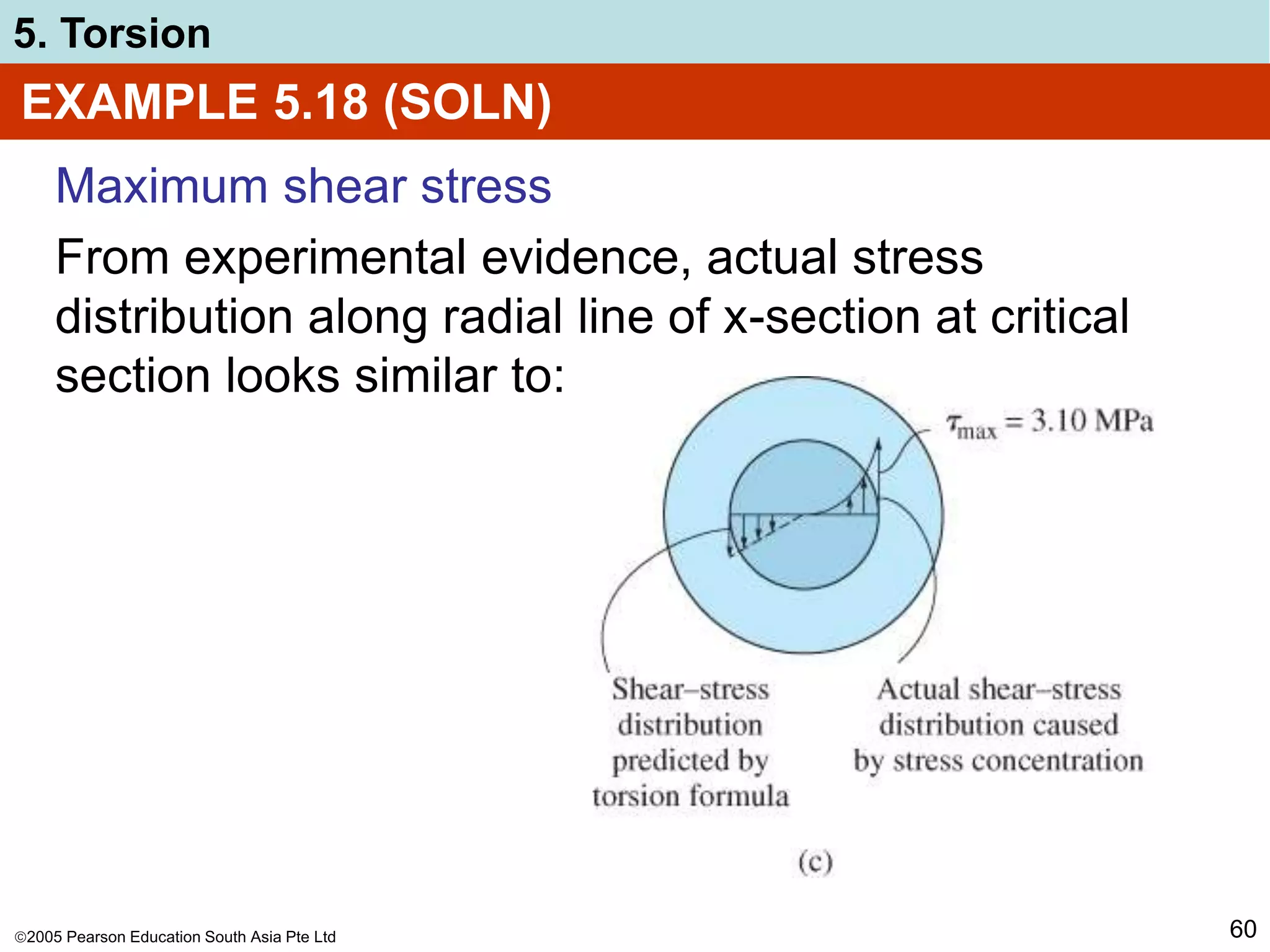
EXAMPLE 5.18 (SOLN)
Maximum shear stress
From experimental evidence, actual stress
distribution along radial line of x-section at critical
section looks similar to:
2005 Pearson Education South Asia Pte Ltd
5. Torsion
61
*5.9 INELASTIC TORSION
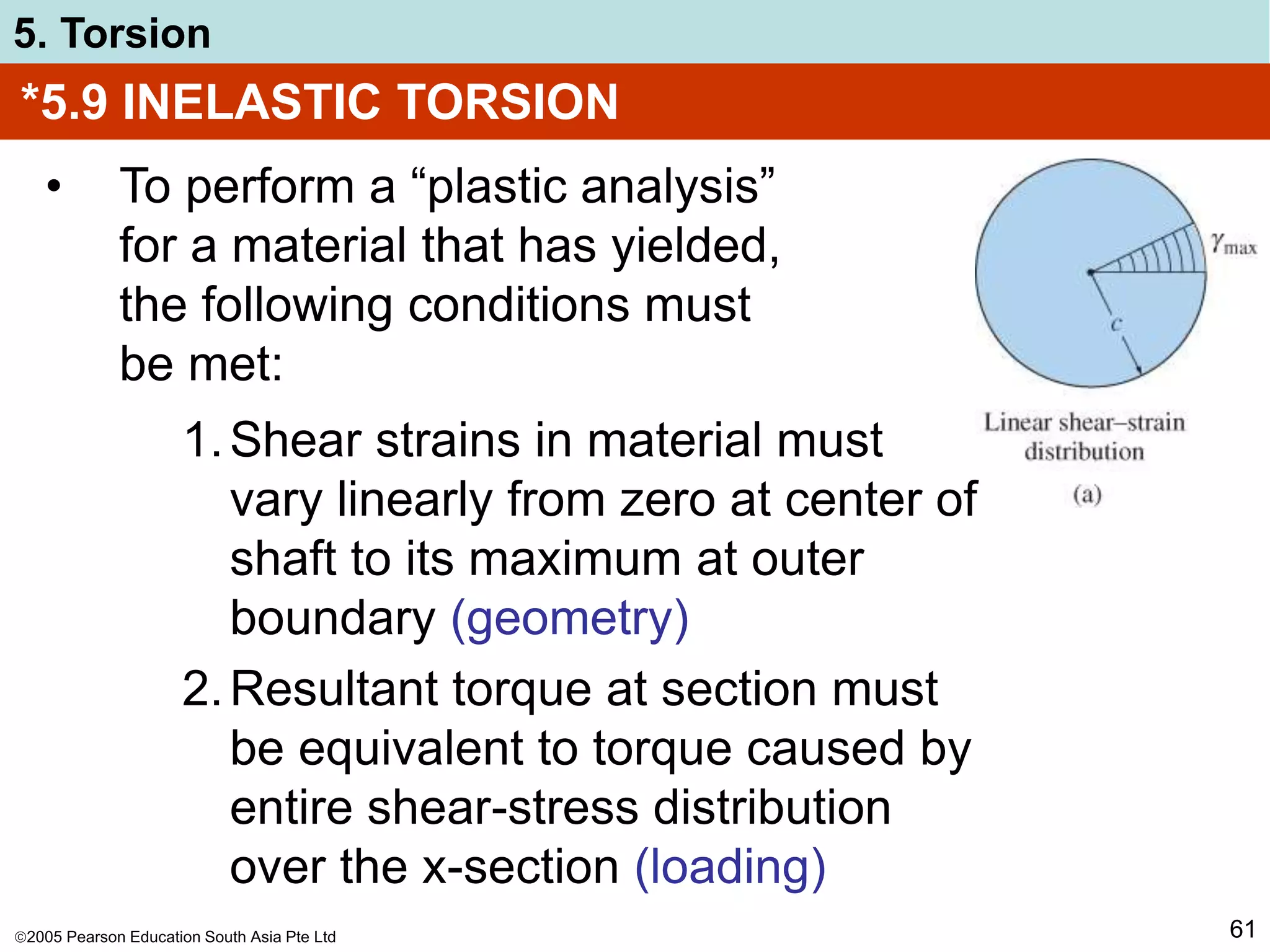
• To perform a “plastic analysis”
for a material that has yielded,
the following conditions must
be met:
1.Shear strains in material must
vary linearly from zero at center of
shaft to its maximum at outer
boundary (geometry)
2.Resultant torque at section must
be equivalent to torque caused by
entire shear-stress distribution
over the x-section (loading)
2005 Pearson Education South Asia Pte Ltd
5. Torsion
62
*5.9 INELASTIC TORSION
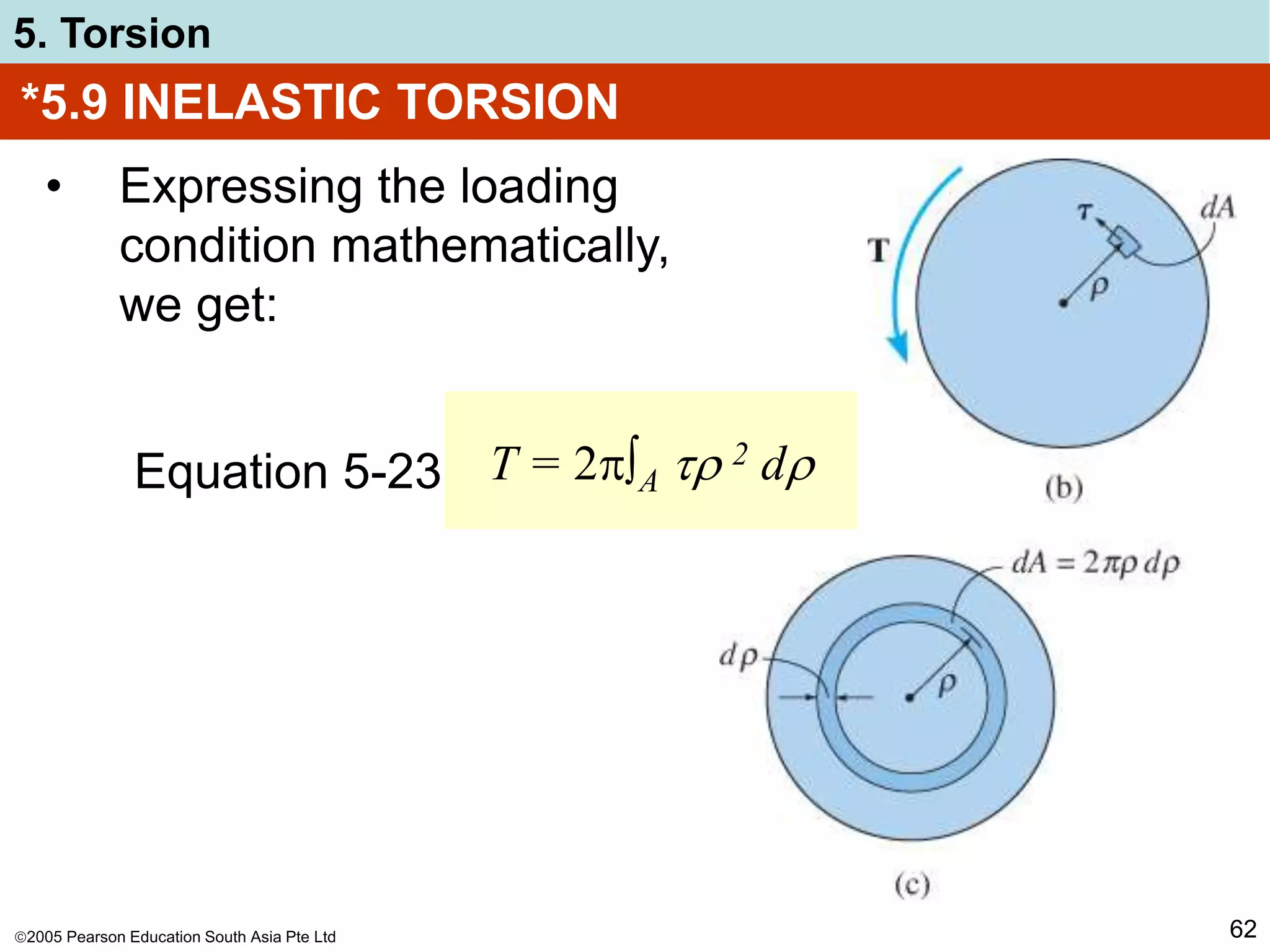
• Expressing the loading
condition mathematically,
we get:
T = 2∫A  2 d
Equation 5-23
2005 Pearson Education South Asia Pte Ltd
5. Torsion
63
*5.9 INELASTIC TORSION
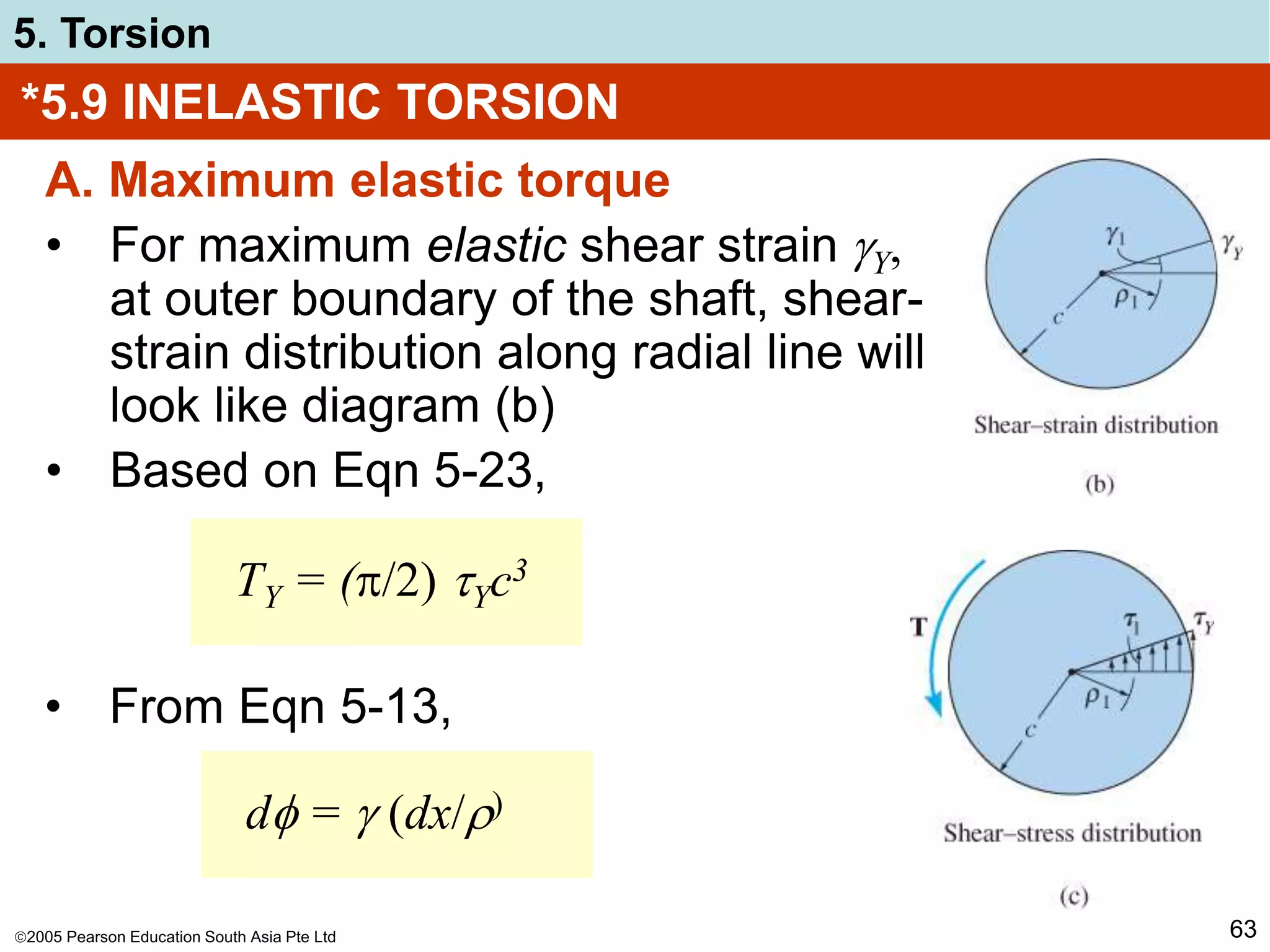
A. Maximum elastic torque
• For maximum elastic shear strain Y,
at outer boundary of the shaft, shear-
strain distribution along radial line will
look like diagram (b)
• Based on Eqn 5-23,
TY = (/2) Yc3
• From Eqn 5-13,
d =  (dx/)
2005 Pearson Education South Asia Pte Ltd
5. Torsion
64
*5.9 INELASTIC TORSION
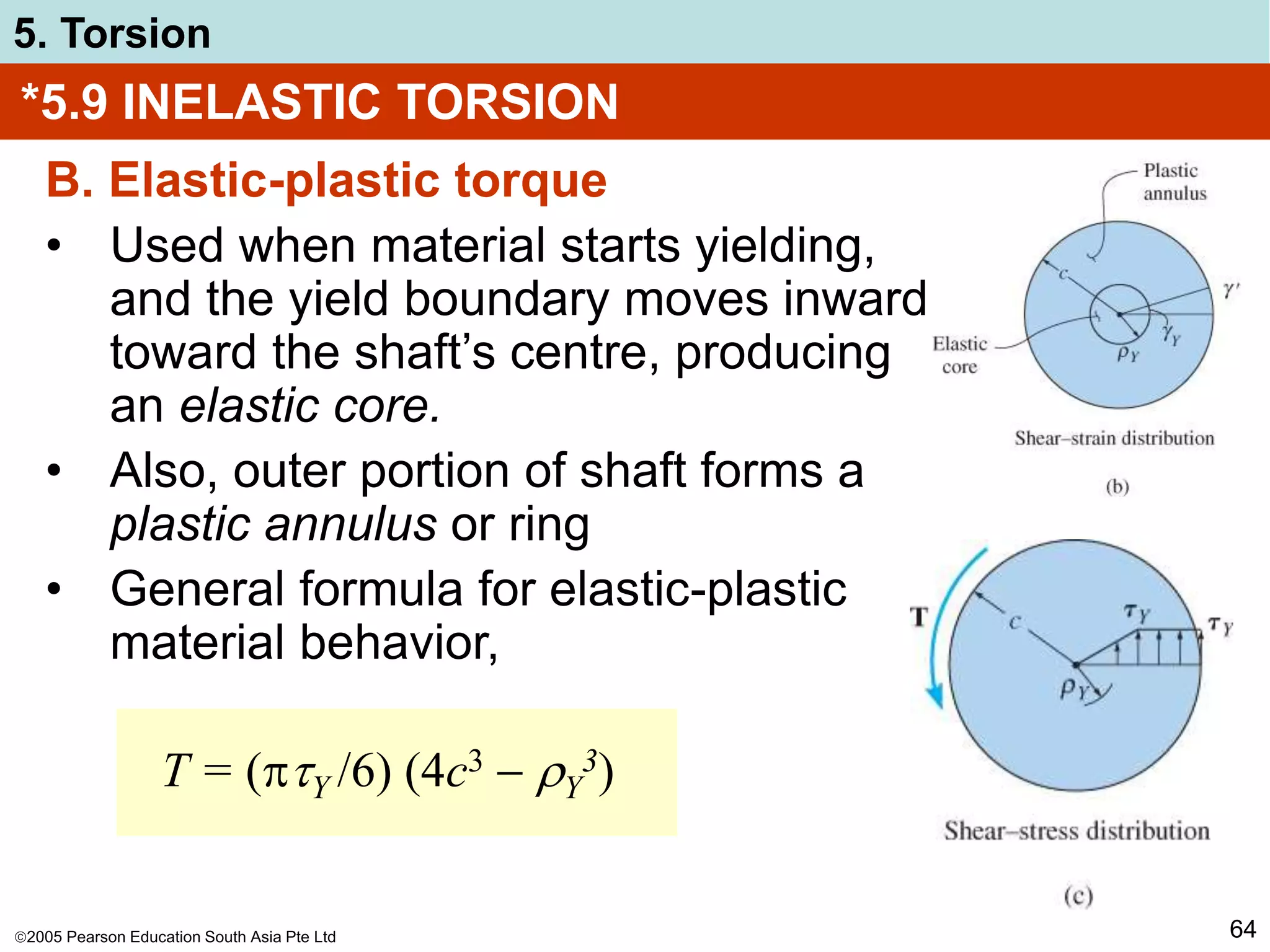
B. Elastic-plastic torque
• Used when material starts yielding,
and the yield boundary moves inward
toward the shaft’s centre, producing
an elastic core.
• Also, outer portion of shaft forms a
plastic annulus or ring
• General formula for elastic-plastic
material behavior,
T = (Y /6) (4c3  Y
3)
2005 Pearson Education South Asia Pte Ltd
5. Torsion
65
*5.9 INELASTIC TORSION
B. Elastic-plastic torque
Plastic torque
• Further increases in T will shrink the radius of
elastic core till all the material has yielded
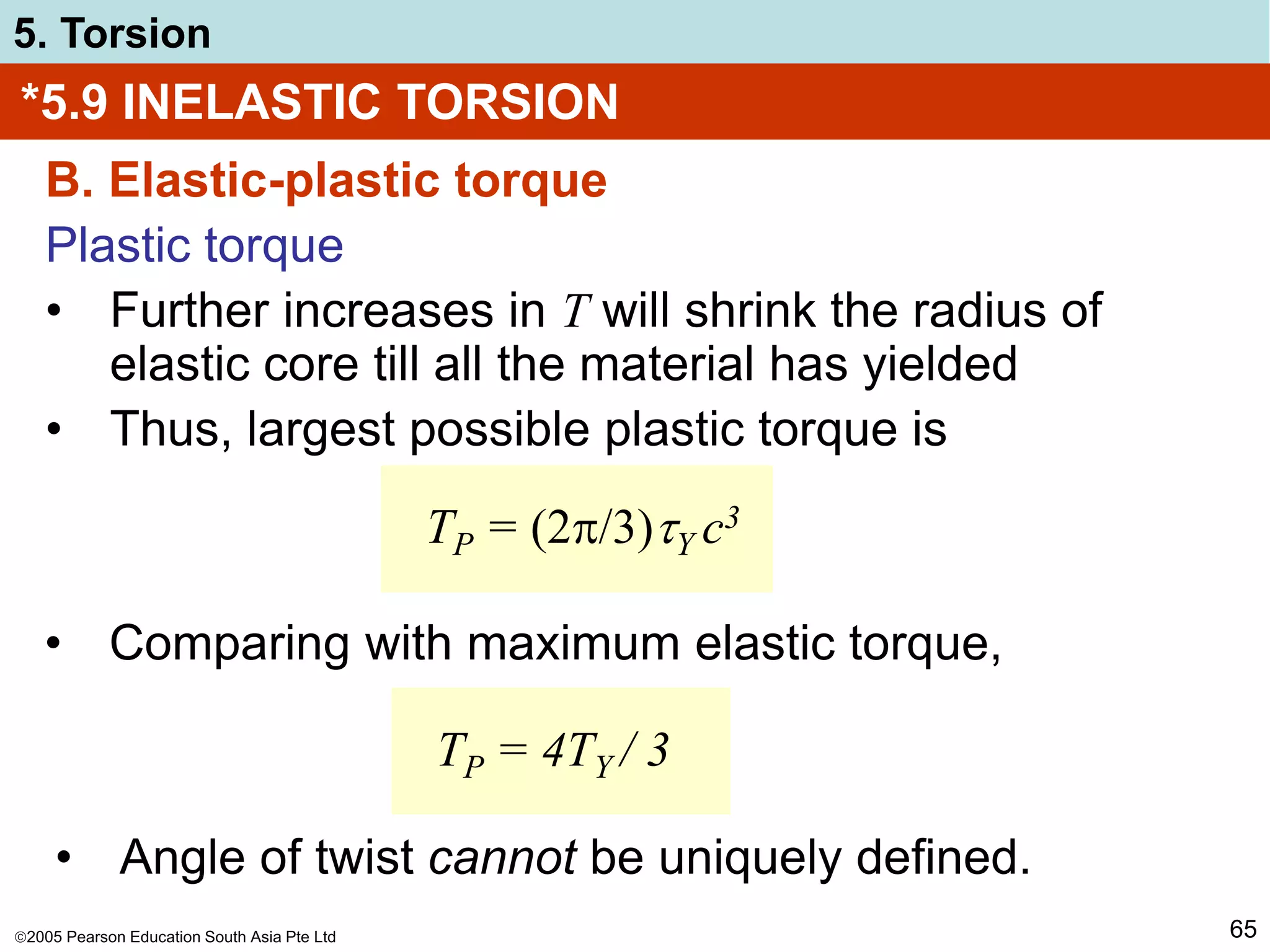
• Thus, largest possible plastic torque is
TP = (2/3)Y c3
• Comparing with maximum elastic torque,
TP = 4TY / 3
• Angle of twist cannot be uniquely defined.
2005 Pearson Education South Asia Pte Ltd
5. Torsion
66
*5.9 INELASTIC TORSION
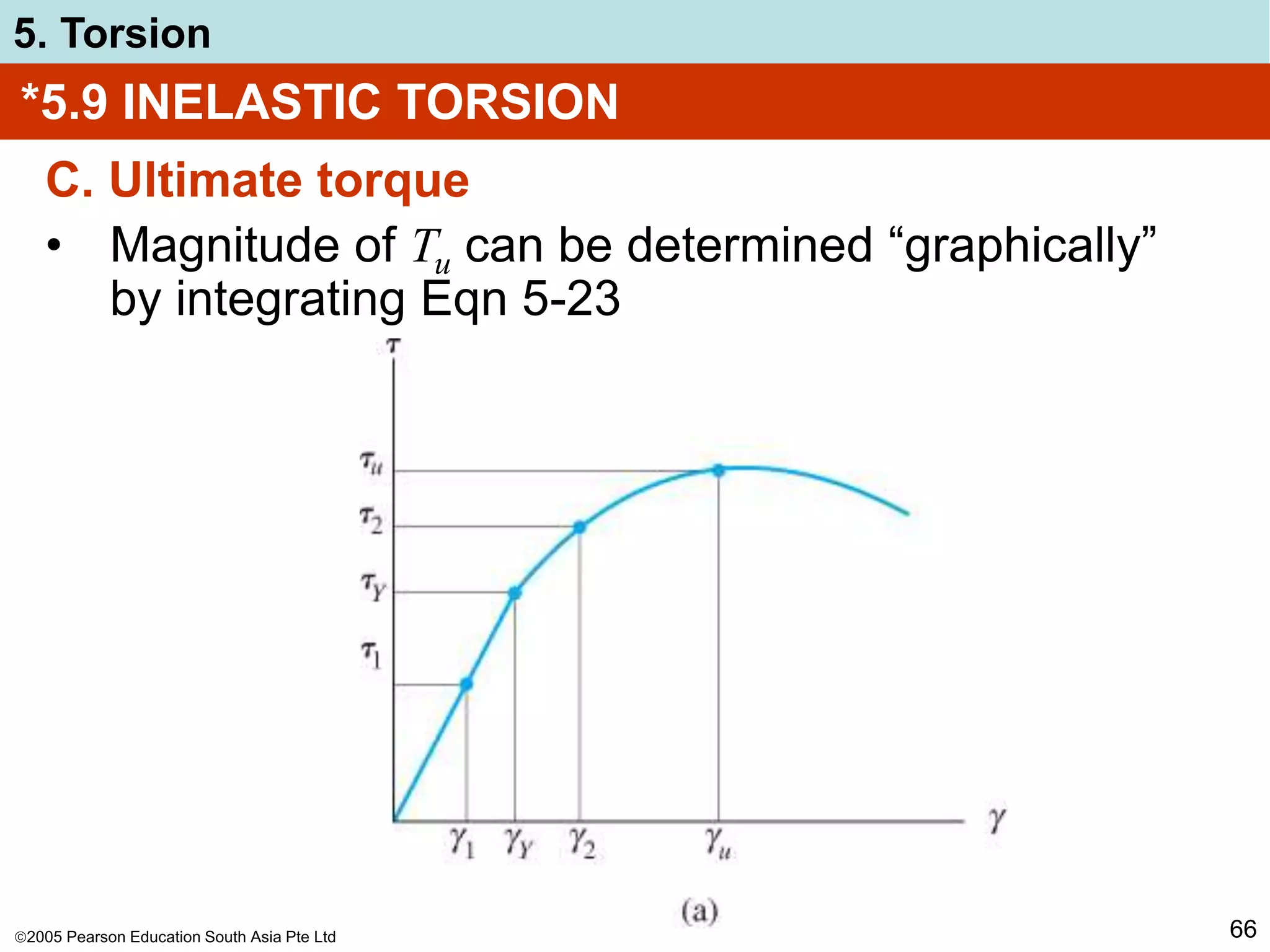
C. Ultimate torque
• Magnitude of Tu can be determined “graphically”
by integrating Eqn 5-23
2005 Pearson Education South Asia Pte Ltd
5. Torsion
67
*5.9 INELASTIC TORSION
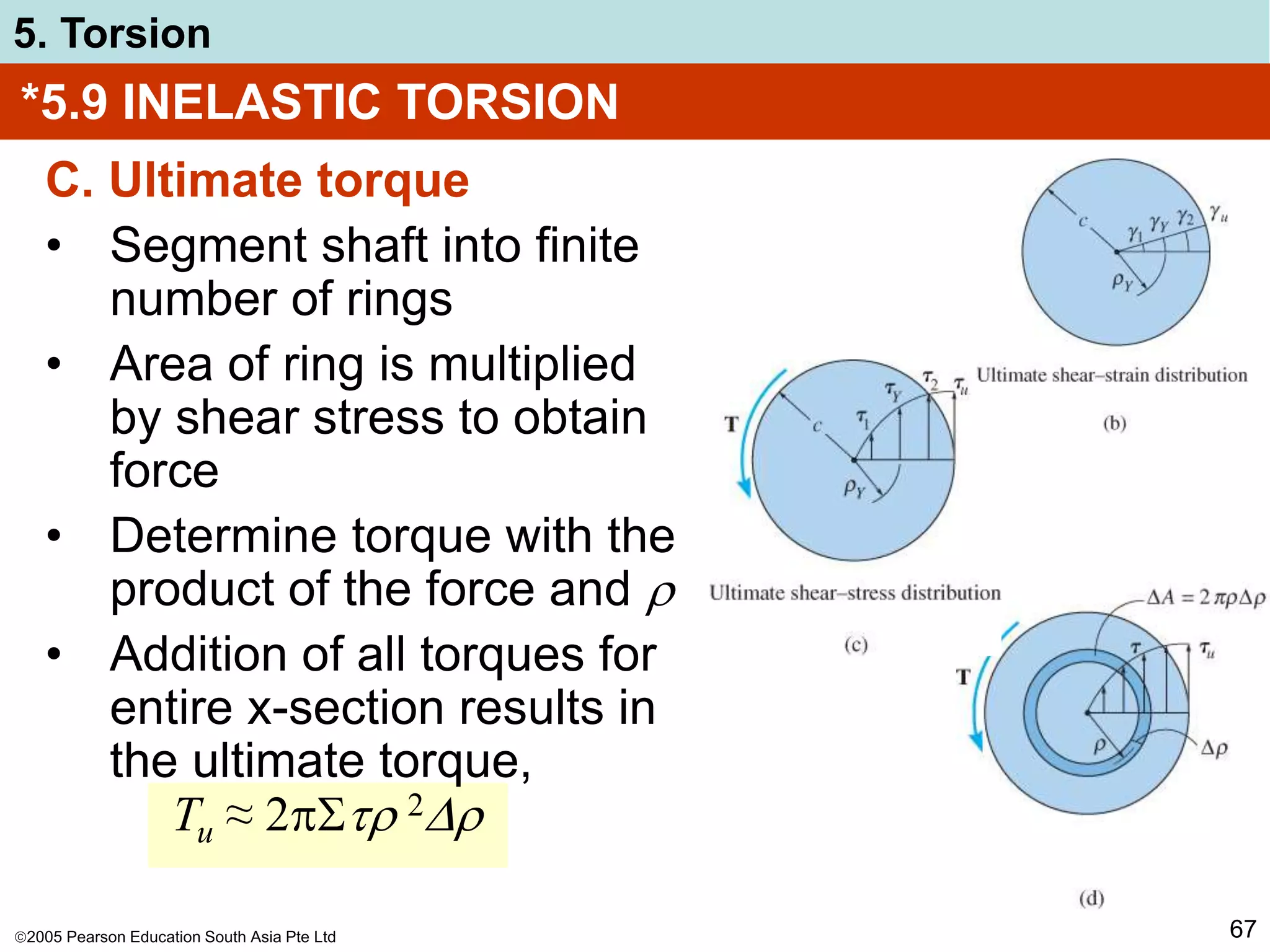
C. Ultimate torque
• Segment shaft into finite
number of rings
• Area of ring is multiplied
by shear stress to obtain
force
• Determine torque with the
product of the force and 
• Addition of all torques for
entire x-section results in
the ultimate torque,
Tu ≈ 2 2
2005 Pearson Education South Asia Pte Ltd
5. Torsion
68
*5.9 INELASTIC TORSION
IMPORTANT
• Shear-strain distribution over radial line on shaft
based on geometric considerations and is
always remain linear
• Shear-stress distribution must be determined
from material behavior or shear stress-strain
diagram
• Once shear-stress distribution established, the
torque about the axis is equivalent to resultant
torque acting on x-section
• Perfectly plastic behavior assumes shear-stress
distribution is constant and the torque is called
plastic torque
2005 Pearson Education South Asia Pte Ltd
5. Torsion
69
EXAMPLE 5.19
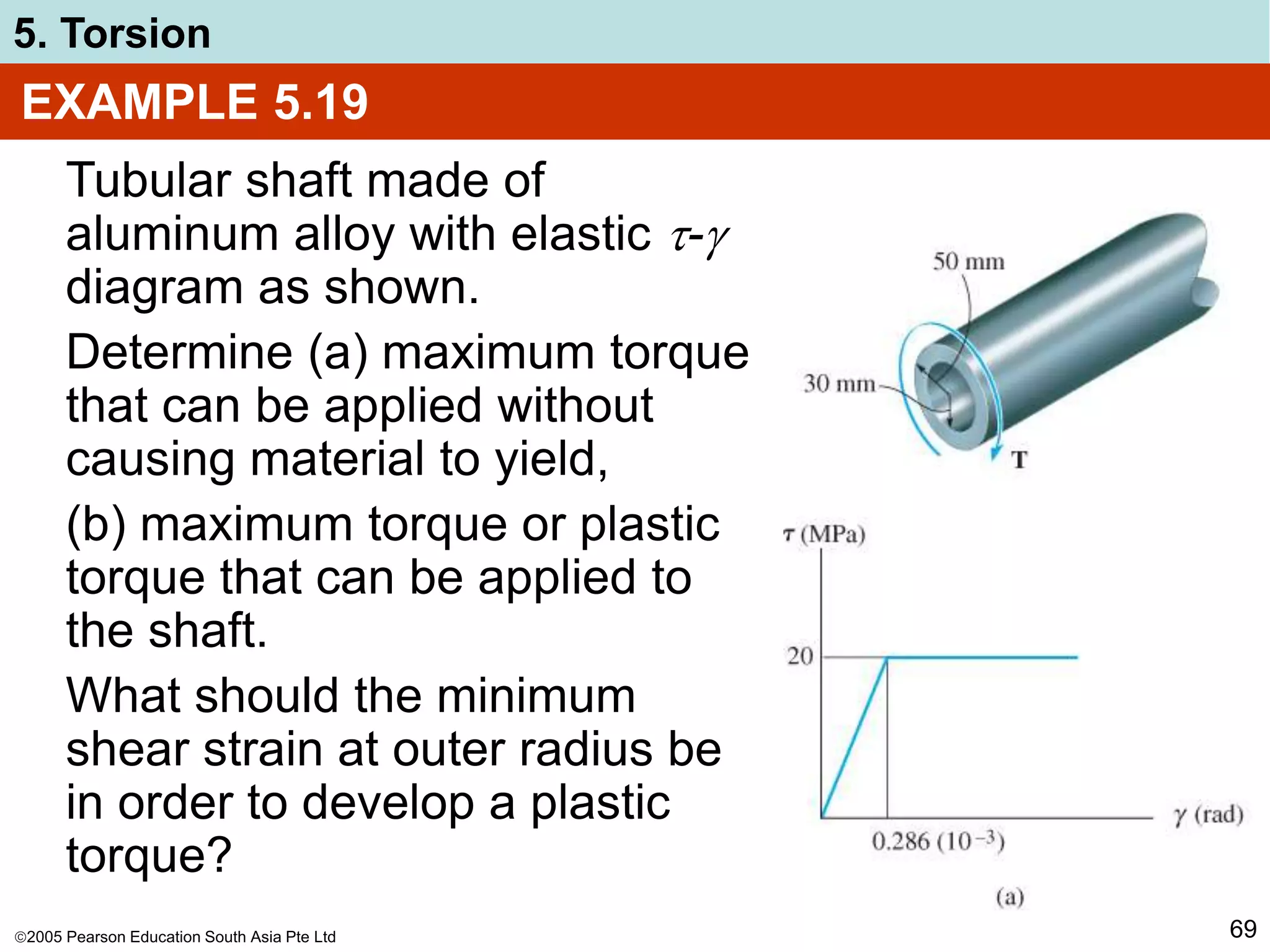
Tubular shaft made of
aluminum alloy with elastic -
diagram as shown.
Determine (a) maximum torque
that can be applied without
causing material to yield,
(b) maximum torque or plastic
torque that can be applied to
the shaft.
What should the minimum
shear strain at outer radius be
in order to develop a plastic
torque?
2005 Pearson Education South Asia Pte Ltd
5. Torsion
70
EXAMPLE 5.19 (SOLN)
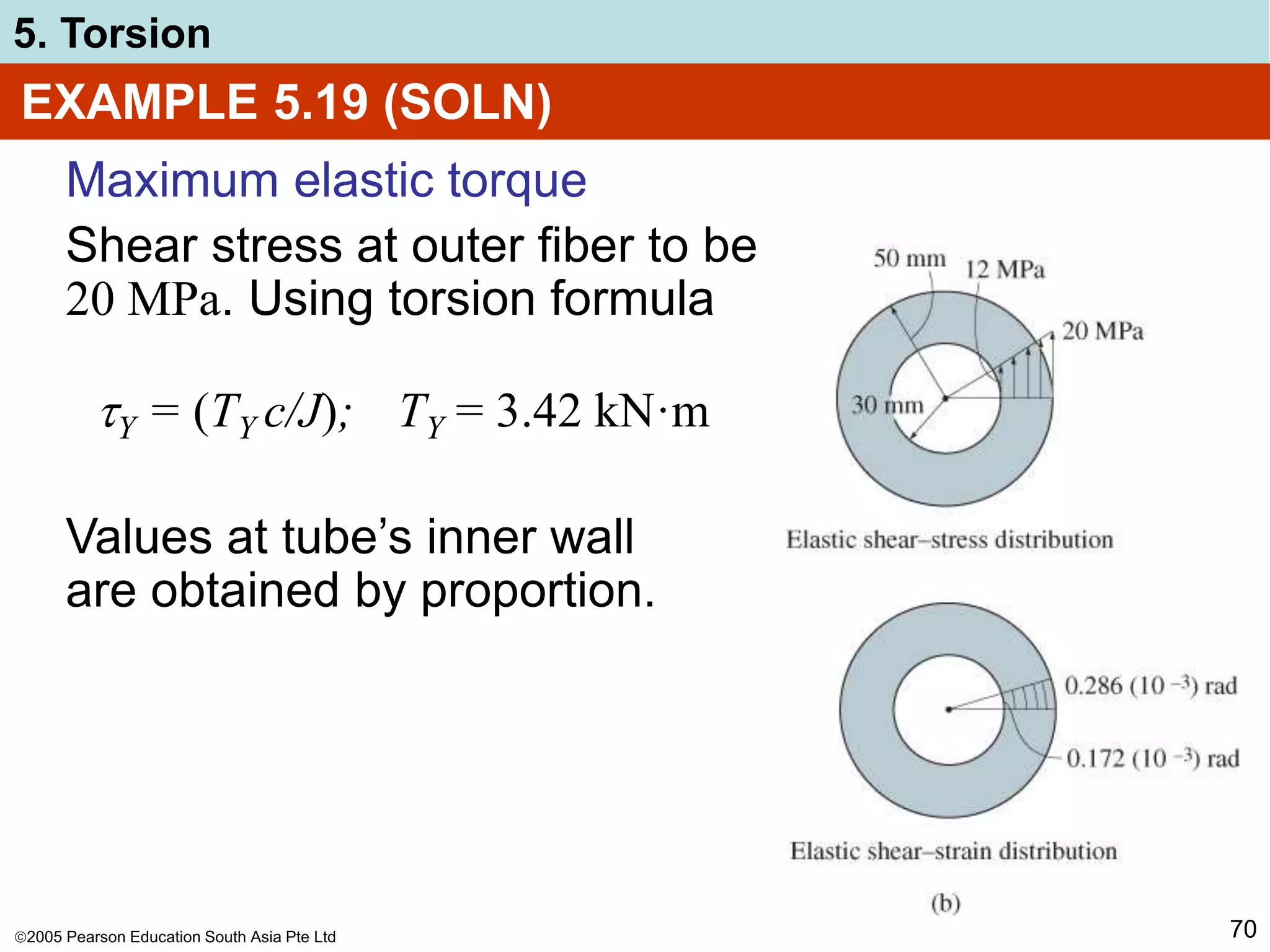
Maximum elastic torque
Shear stress at outer fiber to be
20 MPa. Using torsion formula
Y = (TY c/J); TY = 3.42 kN·m
Values at tube’s inner wall
are obtained by proportion.
2005 Pearson Education South Asia Pte Ltd
5. Torsion
71
EXAMPLE 5.19 (SOLN)
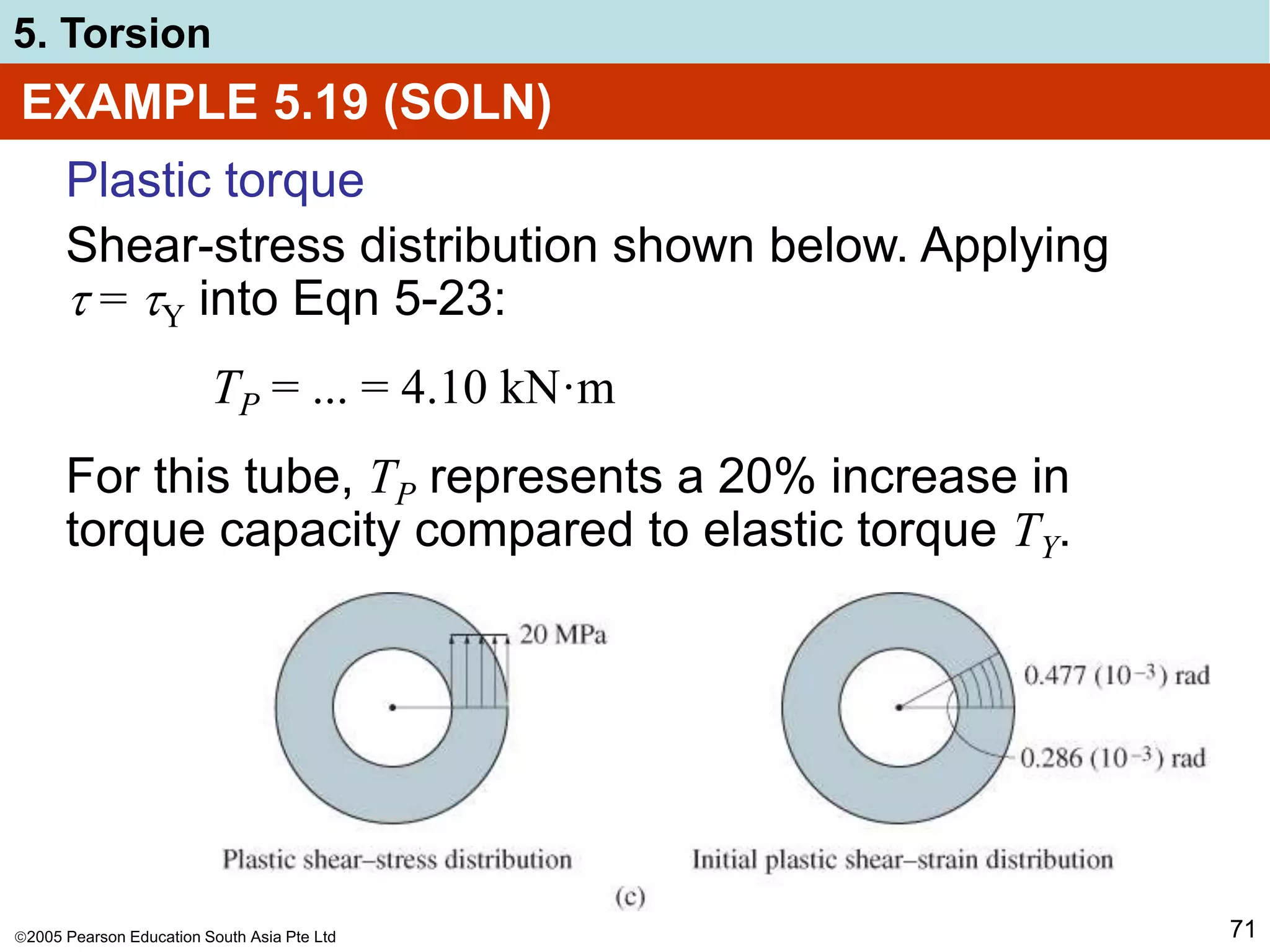
Plastic torque
Shear-stress distribution shown below. Applying
 = Y into Eqn 5-23:
TP = ... = 4.10 kN·m
For this tube, TP represents a 20% increase in
torque capacity compared to elastic torque TY.
2005 Pearson Education South Asia Pte Ltd
5. Torsion
72
EXAMPLE 5.19 (SOLN)
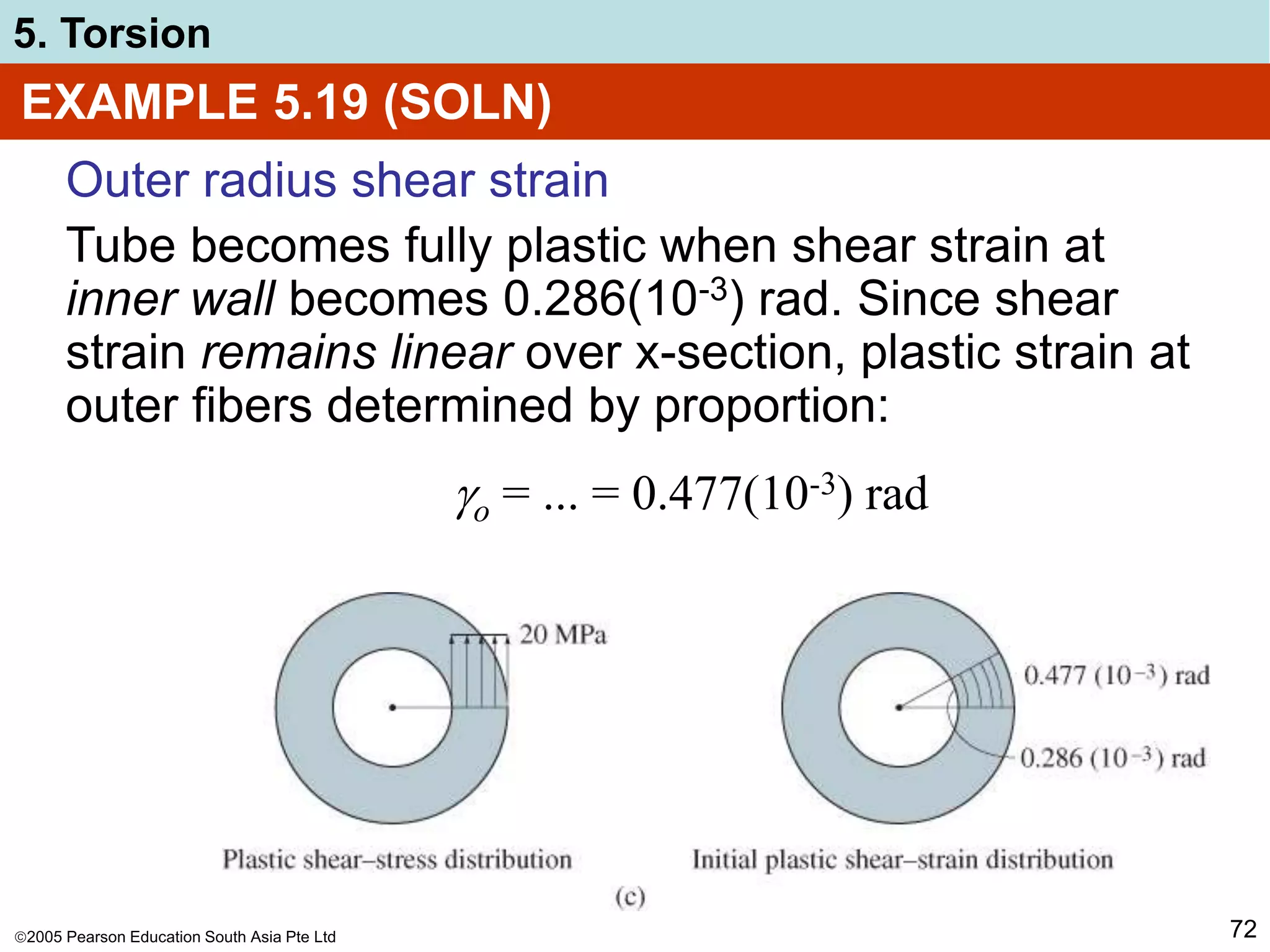
Outer radius shear strain
Tube becomes fully plastic when shear strain at
inner wall becomes 0.286(10-3) rad. Since shear
strain remains linear over x-section, plastic strain at
outer fibers determined by proportion:
o = ... = 0.477(10-3) rad
2005 Pearson Education South Asia Pte Ltd
5. Torsion
73
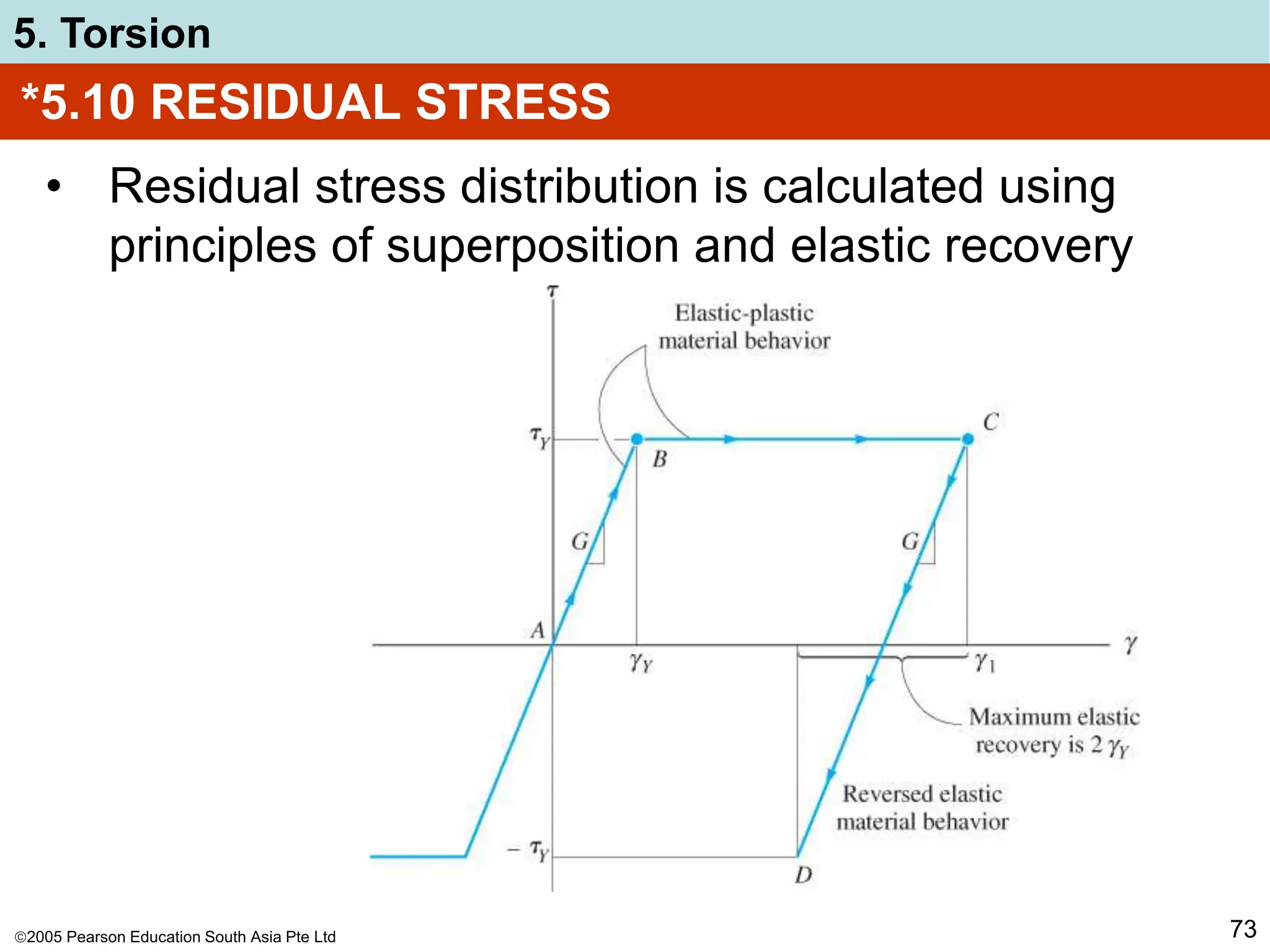
*5.10 RESIDUAL STRESS
• Residual stress distribution is calculated using
principles of superposition and elastic recovery
2005 Pearson Education South Asia Pte Ltd
5. Torsion
74
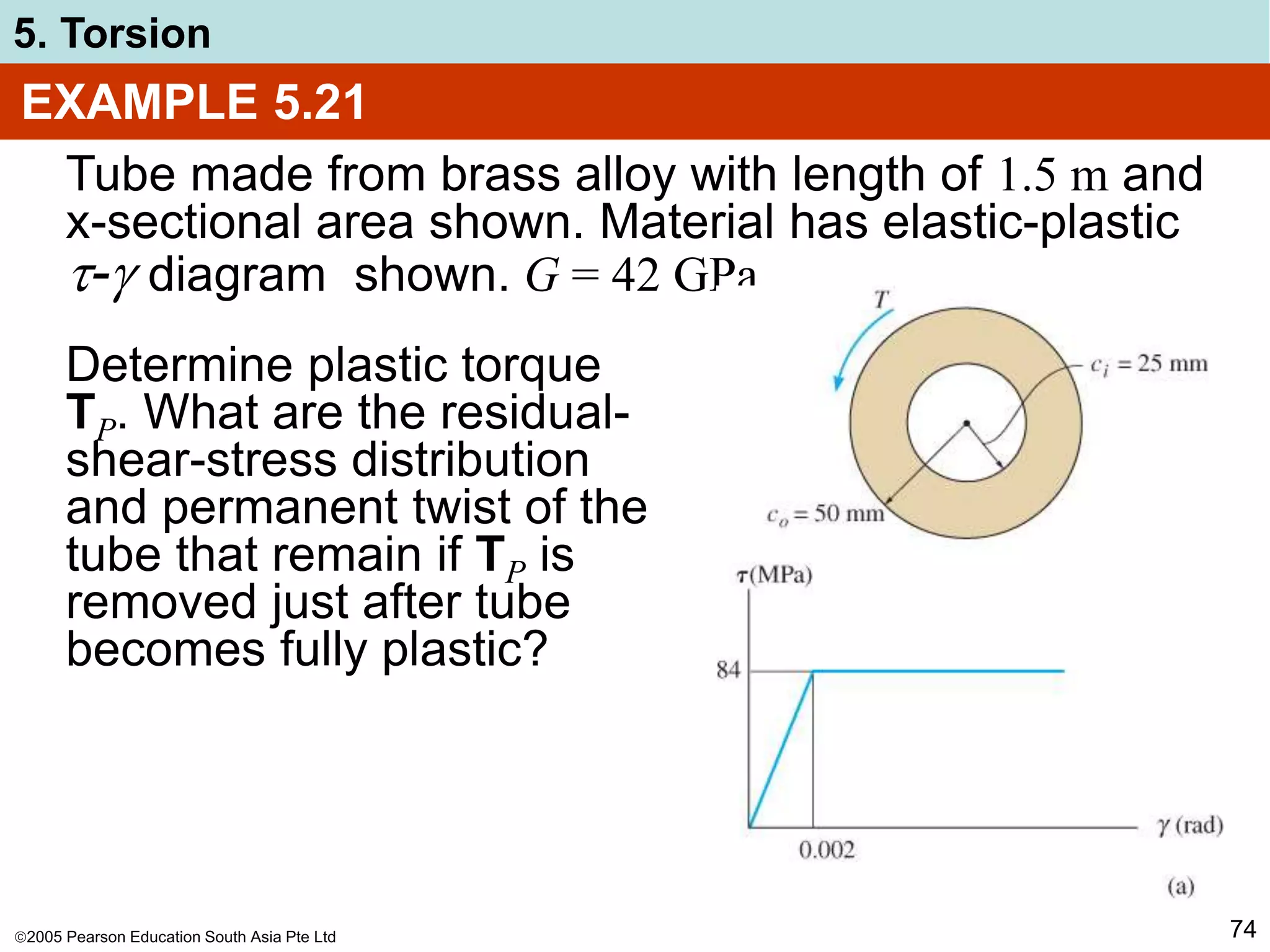
EXAMPLE 5.21
Tube made from brass alloy with length of 1.5 m and
x-sectional area shown. Material has elastic-plastic
- diagram shown. G = 42 GPa.
Determine plastic torque
TP. What are the residual-
shear-stress distribution
and permanent twist of the
tube that remain if TP is
removed just after tube
becomes fully plastic?
2005 Pearson Education South Asia Pte Ltd
5. Torsion
75
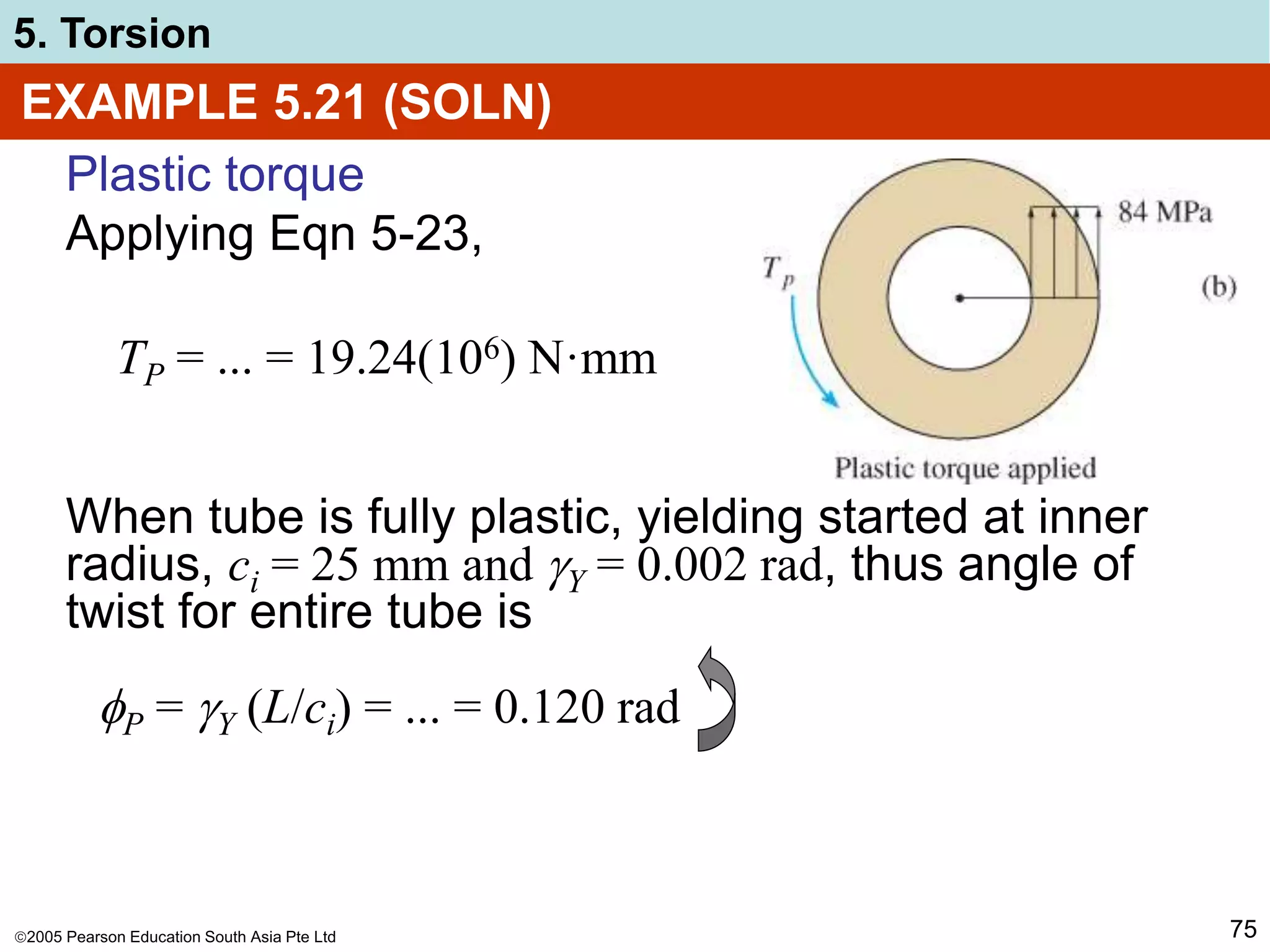
EXAMPLE 5.21 (SOLN)
Plastic torque
Applying Eqn 5-23,
When tube is fully plastic, yielding started at inner
radius, ci = 25 mm and Y = 0.002 rad, thus angle of
twist for entire tube is
TP = ... = 19.24(106) N·mm
P = Y (L/ci) = ... = 0.120 rad
2005 Pearson Education South Asia Pte Ltd
5. Torsion
76
EXAMPLE 5.21 (SOLN)
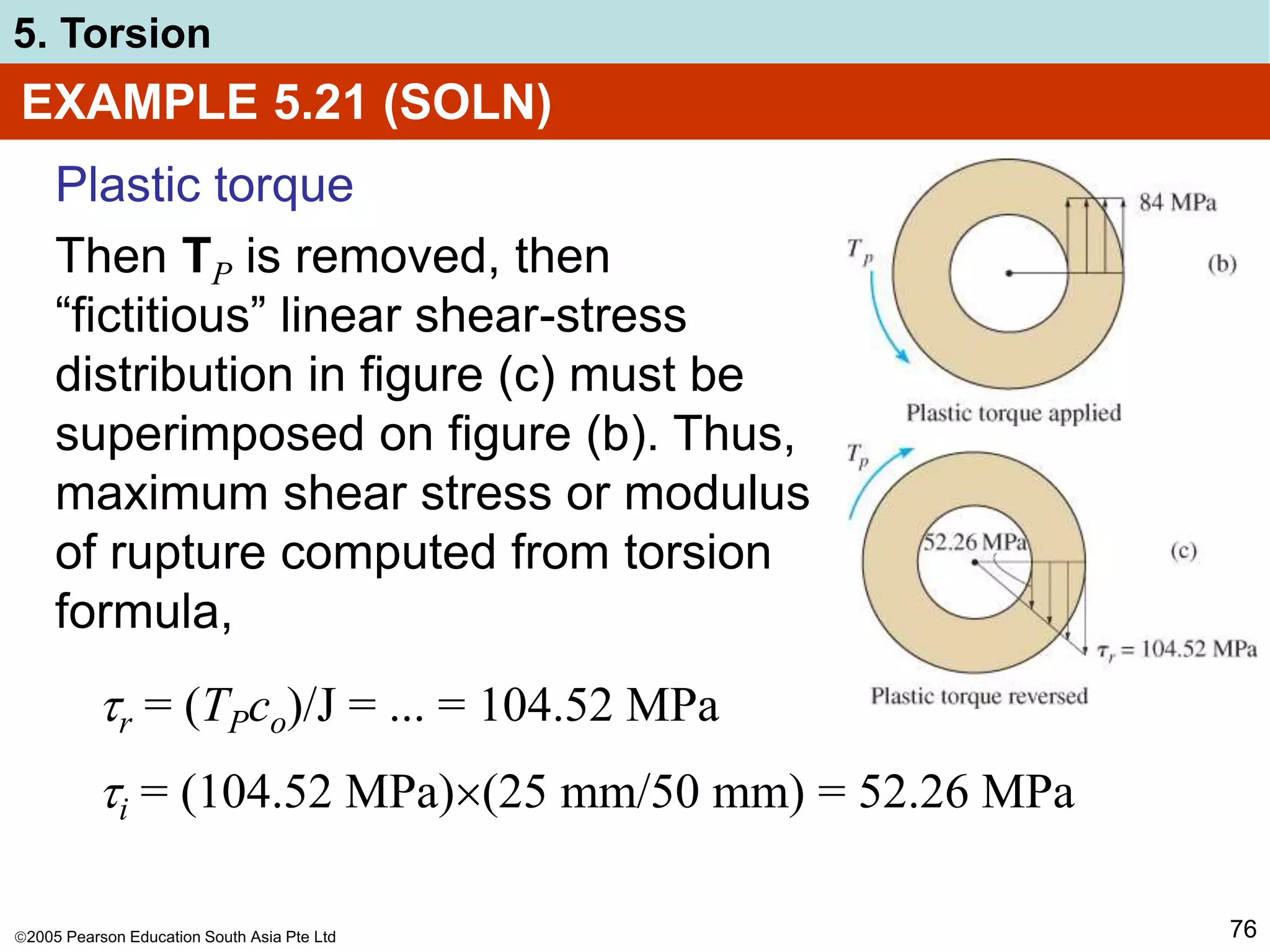
r = (TPco)/J = ... = 104.52 MPa
Plastic torque
Then TP is removed, then
“fictitious” linear shear-stress
distribution in figure (c) must be
superimposed on figure (b). Thus,
maximum shear stress or modulus
of rupture computed from torsion
formula,
i = (104.52 MPa)(25 mm/50 mm) = 52.26 MPa
2005 Pearson Education South Asia Pte Ltd
5. Torsion
77
EXAMPLE 5.21 (SOLN)
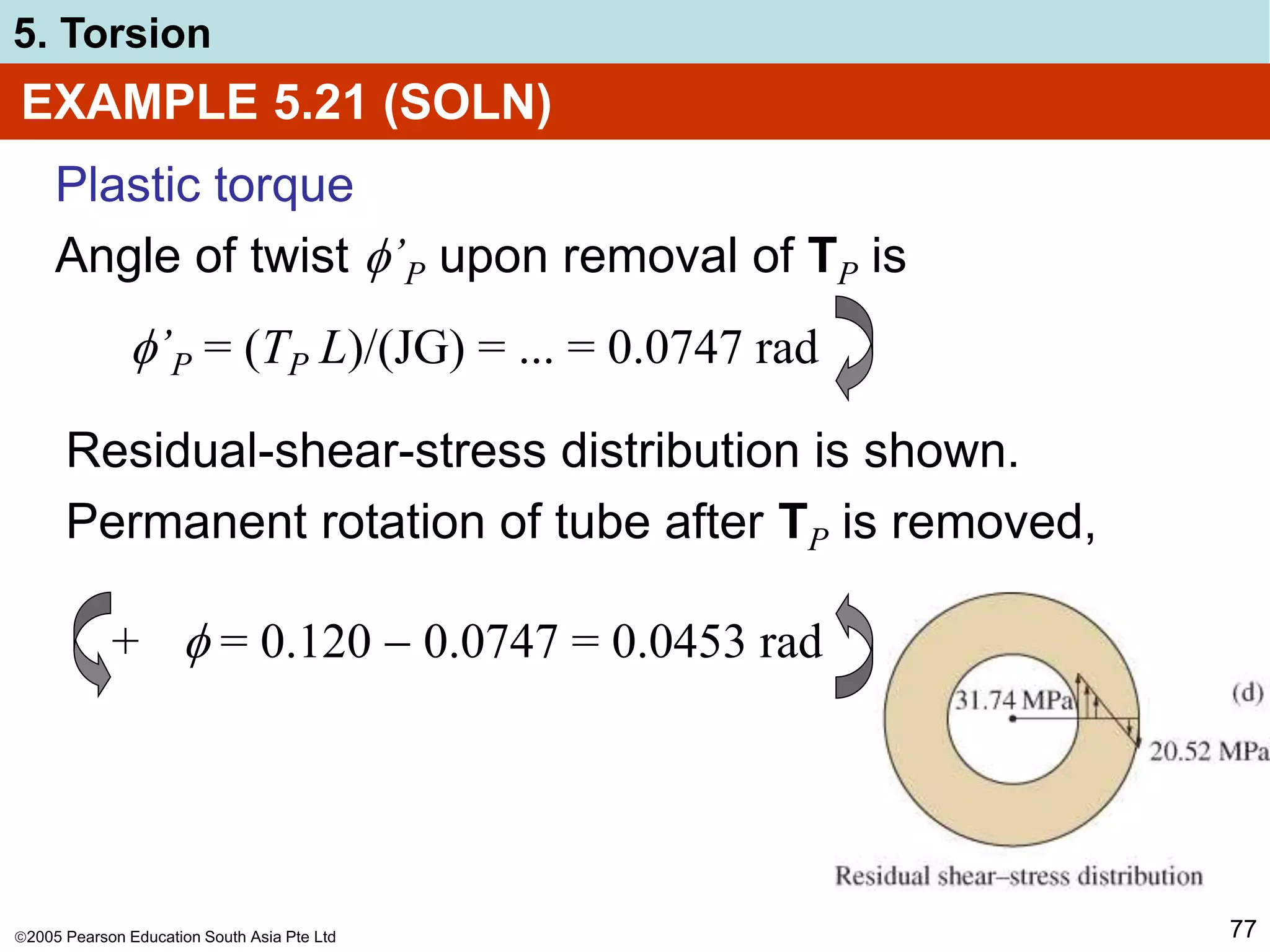
’P = (TP L)/(JG) = ... = 0.0747 rad
Plastic torque
Angle of twist ’P upon removal of TP is
+  = 0.120  0.0747 = 0.0453 rad
Residual-shear-stress distribution is shown.
Permanent rotation of tube after TP is removed,
2005 Pearson Education South Asia Pte Ltd
5. Torsion
78
CHAPTER REVIEW
• Torque causes a shaft with circular x-section to
twist, such that shear strain in shaft is
proportional to its radial distance from its centre
• Provided that material is homogeneous and
Hooke’s law applies, shear stress determined
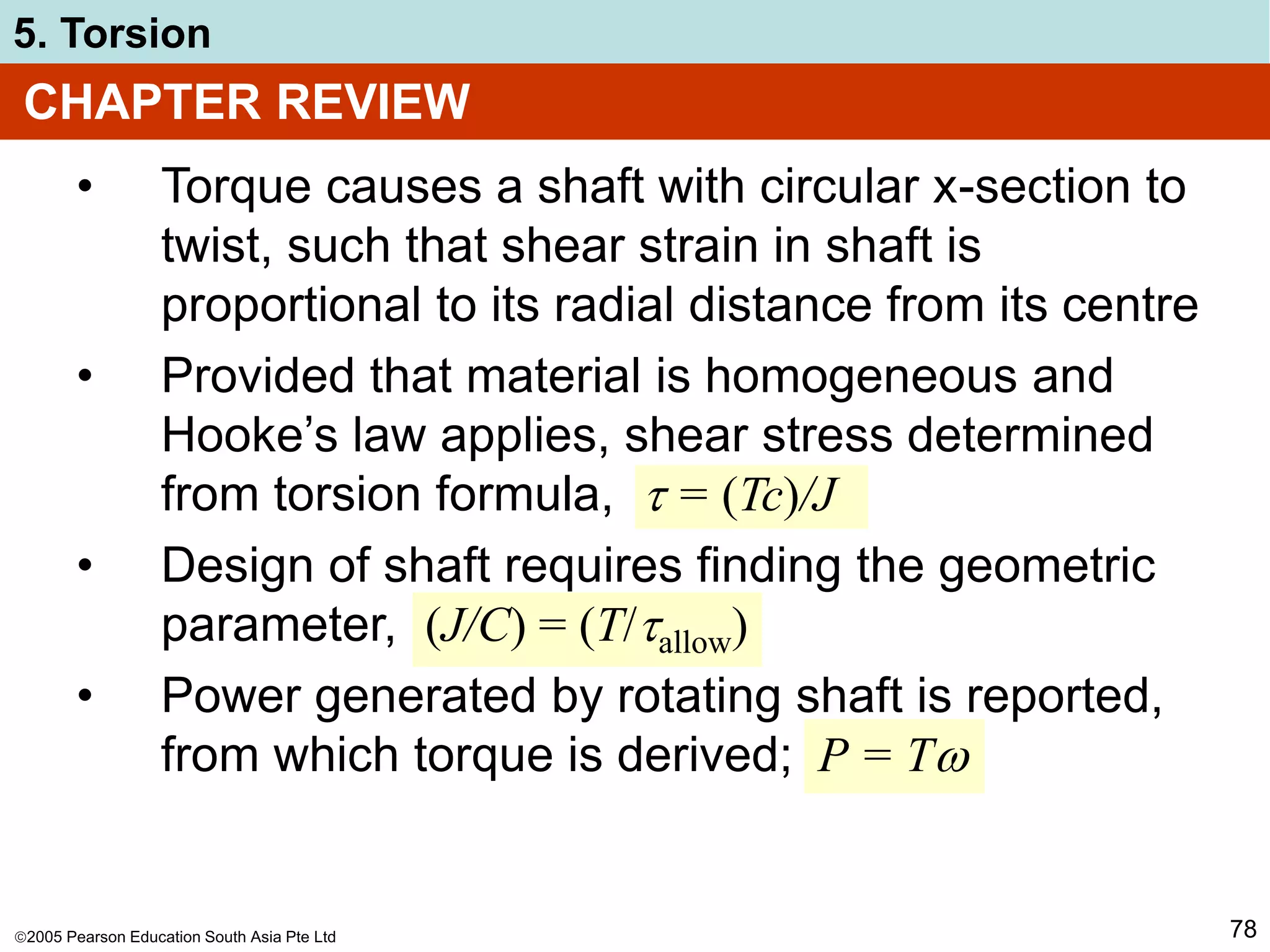
from torsion formula,  = (Tc)/J
• Design of shaft requires finding the geometric
parameter, (J/C) = (T/allow)
• Power generated by rotating shaft is reported,
from which torque is derived; P = T
2005 Pearson Education South Asia Pte Ltd
5. Torsion
79
CHAPTER REVIEW
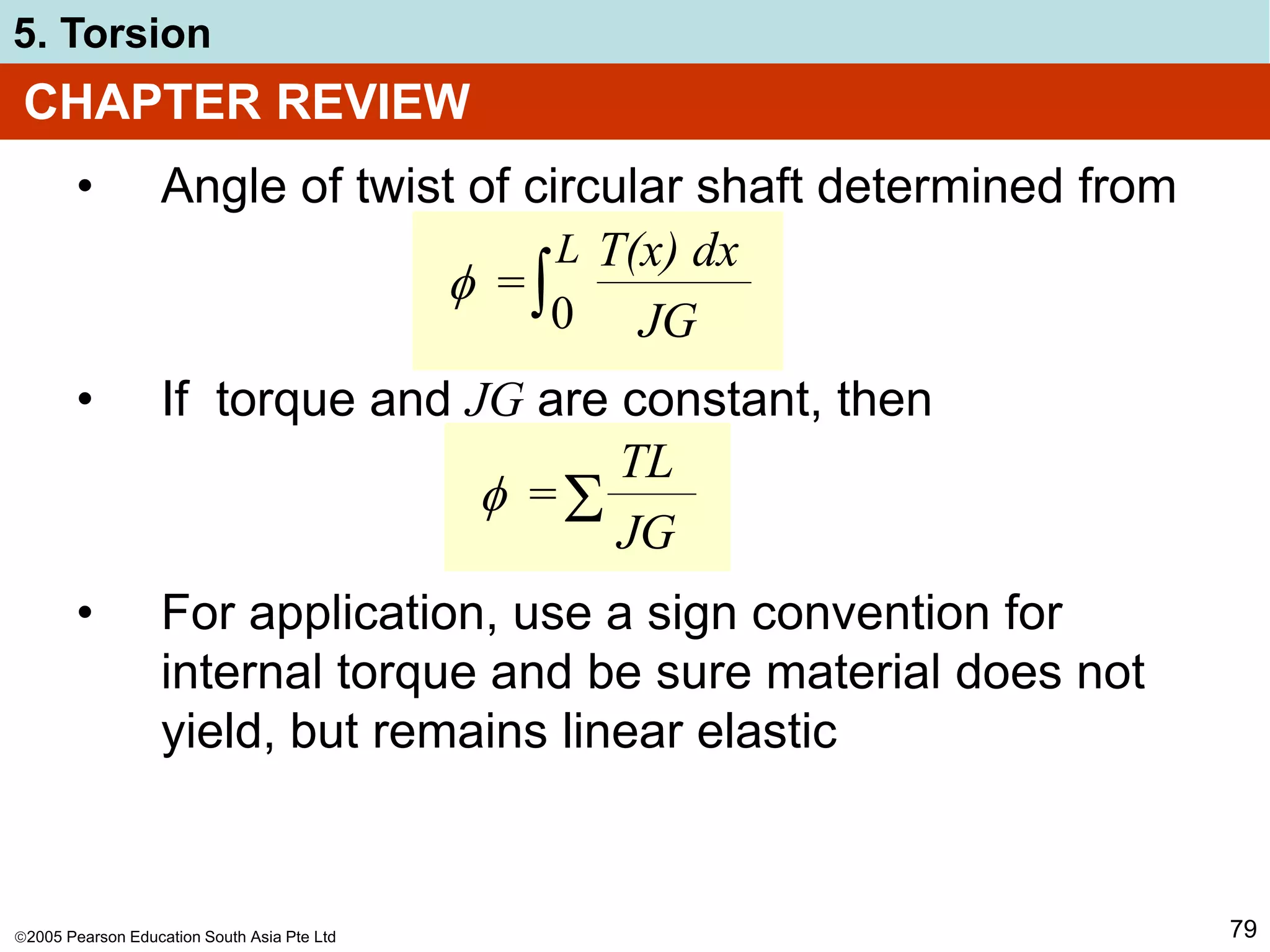
• Angle of twist of circular shaft determined from
• If torque and JG are constant, then
• For application, use a sign convention for
internal torque and be sure material does not
yield, but remains linear elastic
 =
TL
JG

 =
T(x) dx
JG
∫0
L
2005 Pearson Education South Asia Pte Ltd
5. Torsion
80
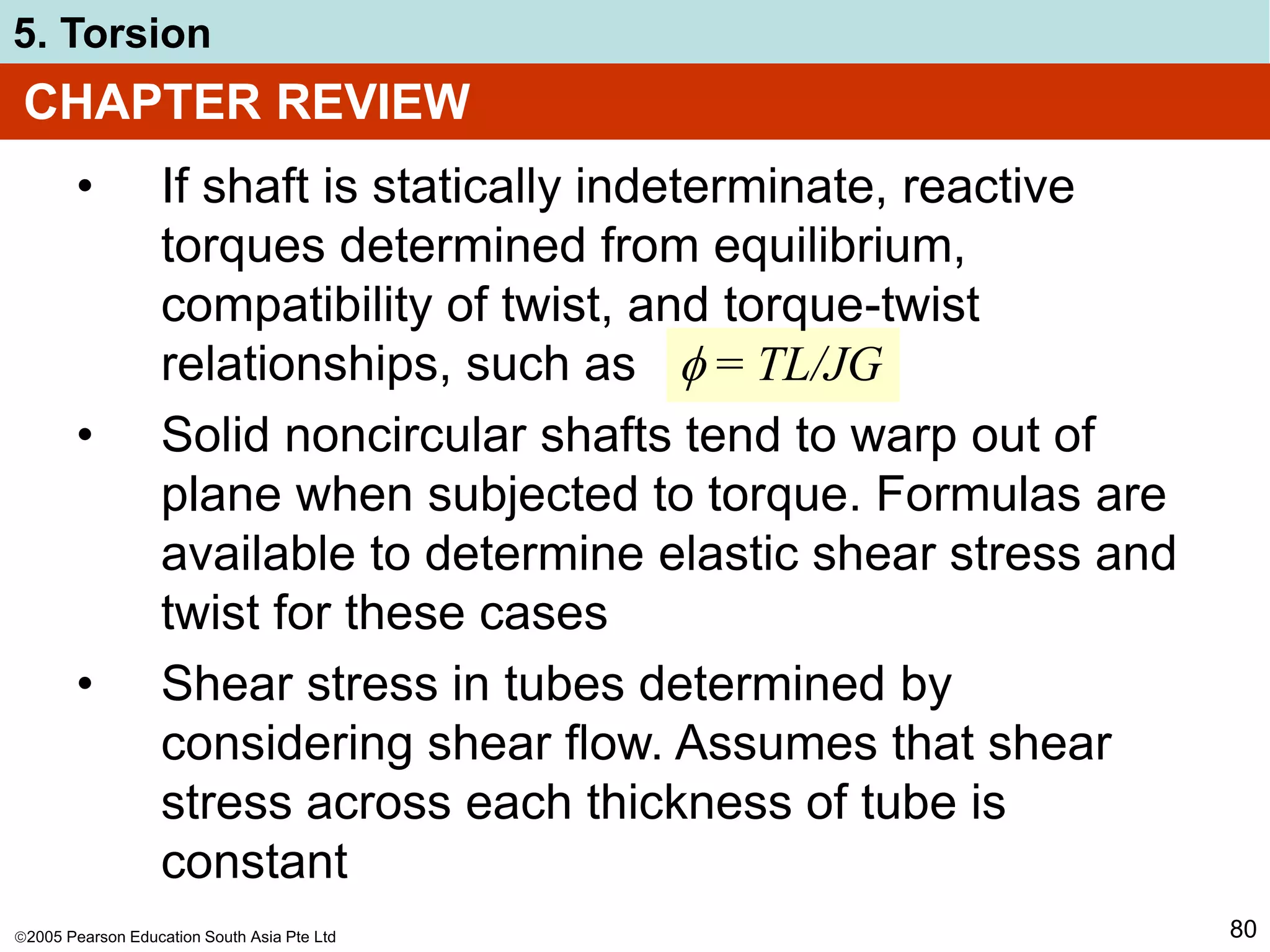
• If shaft is statically indeterminate, reactive
torques determined from equilibrium,
compatibility of twist, and torque-twist
relationships, such as  = TL/JG
• Solid noncircular shafts tend to warp out of
plane when subjected to torque. Formulas are
available to determine elastic shear stress and
twist for these cases
• Shear stress in tubes determined by
considering shear flow. Assumes that shear
stress across each thickness of tube is
constant
CHAPTER REVIEW
2005 Pearson Education South Asia Pte Ltd
5. Torsion
81
CHAPTER REVIEW
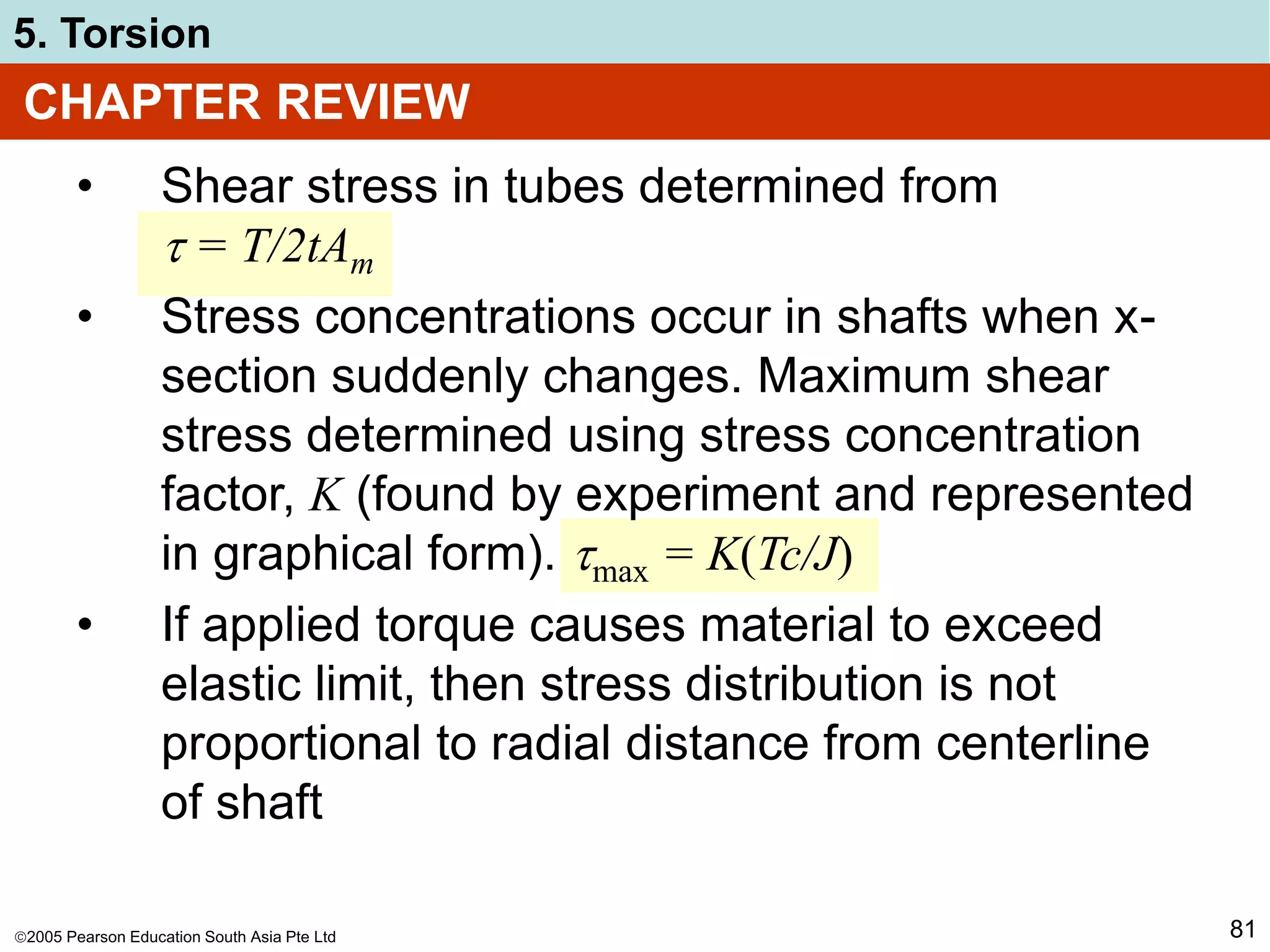
• Shear stress in tubes determined from
 = T/2tAm
• Stress concentrations occur in shafts when x-
section suddenly changes. Maximum shear
stress determined using stress concentration
factor, K (found by experiment and represented
in graphical form). max = K(Tc/J)
• If applied torque causes material to exceed
elastic limit, then stress distribution is not
proportional to radial distance from centerline
of shaft
2005 Pearson Education South Asia Pte Ltd
5. Torsion
82
CHAPTER REVIEW
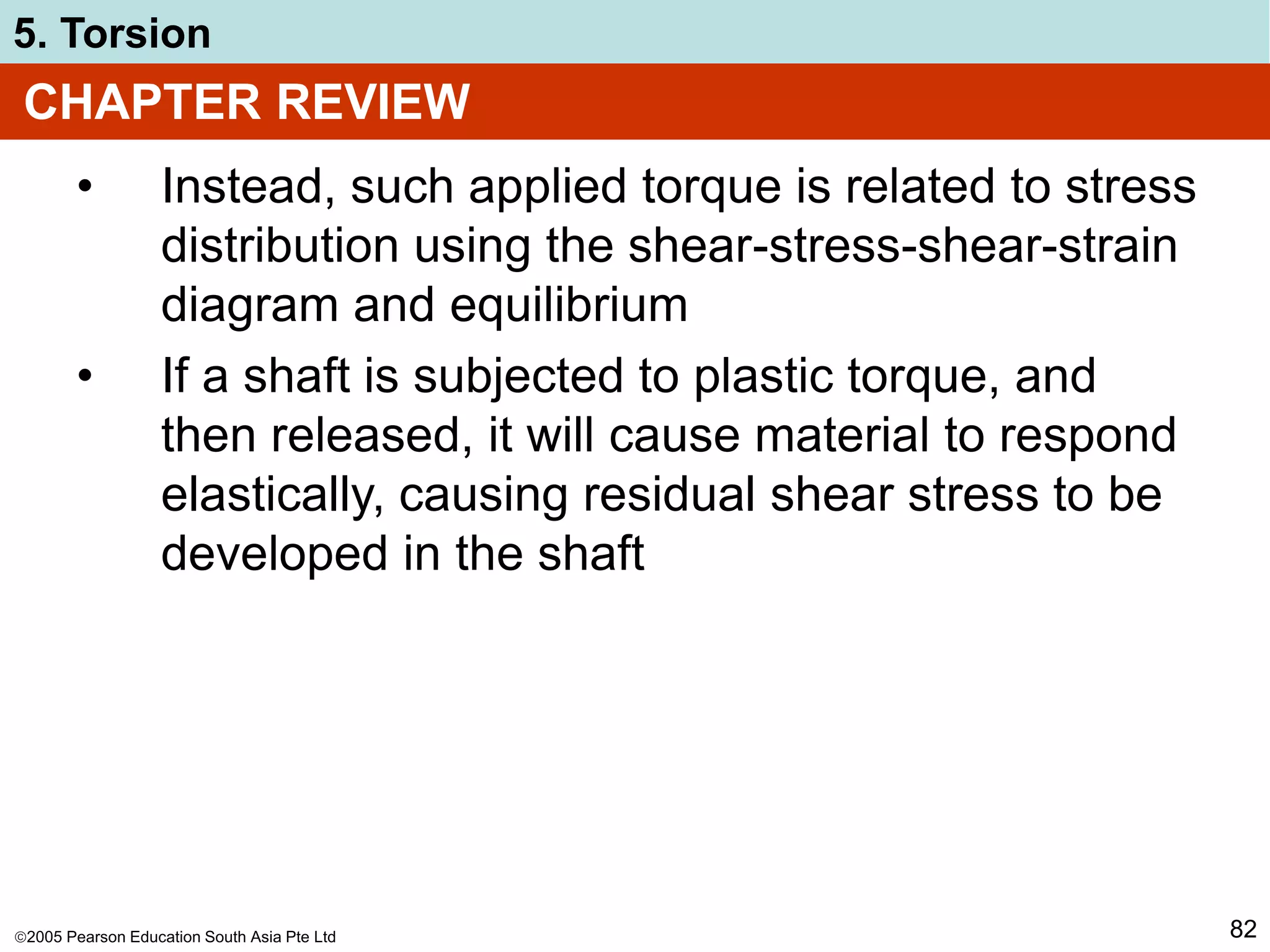
• Instead, such applied torque is related to stress
distribution using the shear-stress-shear-strain
diagram and equilibrium
• If a shaft is subjected to plastic torque, and
then released, it will cause material to respond
elastically, causing residual shear stress to be
developed in the shaft

MAK205_Chapter5.ppt

  • 1.
    2005 Pearson EducationSouth Asia Pte Ltd 5. Torsion 1 CHAPTER OBJECTIVES • Discuss effects of applying torsional loading to a long straight member • Determine stress distribution within the member under torsional load • Determine angle of twist when material behaves in a linear-elastic and inelastic manner • Discuss statically indeterminate analysis of shafts and tubes • Discuss stress distributions and residual stress caused by torsional loadings
  • 2.
    2005 Pearson EducationSouth Asia Pte Ltd 5. Torsion 2 CHAPTER OUTLINE 1. Torsional Deformation of a Circular Shaft 2. The Torsion Formula 3. Power Transmission 4. Angle of Twist 5. Statically Indeterminate Torque-Loaded Members 6. *Solid Noncircular Shafts 7. *Thin-Walled Tubes Having Closed Cross Sections 8. Stress Concentration 9. *Inelastic Torsion 10. *Residual Stress
  • 3.
    2005 Pearson EducationSouth Asia Pte Ltd 5. Torsion 3 • Torsion is a moment that twists/deforms a member about its longitudinal axis • By observation, if angle of rotation is small, length of shaft and its radius remain unchanged 5.1 TORSIONAL DEFORMATION OF A CIRCULAR SHAFT
  • 4.
    2005 Pearson EducationSouth Asia Pte Ltd 5. Torsion 4 5.1 TORSIONAL DEFORMATION OF A CIRCULAR SHAFT • By definition, shear strain is Let x  dx and   = d BD =  d = dx   = (/2)  lim ’ CA along CA BA along BA  =  d dx • Since d / dx =  / = max /c  = max  c ( ) Equation 5-2
  • 5.
    2005 Pearson EducationSouth Asia Pte Ltd 5. Torsion 5 5.2 THE TORSION FORMULA • For solid shaft, shear stress varies from zero at shaft’s longitudinal axis to maximum value at its outer surface. • Due to proportionality of triangles, or using Hooke’s law and Eqn 5-2,  =  max  c ( ) ...  =  max c ∫A 2 dA
  • 6.
    2005 Pearson EducationSouth Asia Pte Ltd 5. Torsion 6 5.2 THE TORSION FORMULA • The integral in the equation can be represented as the polar moment of inertia J, of shaft’s x-sectional area computed about its longitudinal axis  max = Tc J  max = max. shear stress in shaft, at the outer surface T = resultant internal torque acting at x-section, from method of sections & equation of moment equilibrium applied about longitudinal axis J = polar moment of inertia at x-sectional area c = outer radius pf the shaft
  • 7.
    2005 Pearson EducationSouth Asia Pte Ltd 5. Torsion 7 5.2 THE TORSION FORMULA • Shear stress at intermediate distance,   = T J • The above two equations are referred to as the torsion formula • Used only if shaft is circular, its material homogenous, and it behaves in an linear-elastic manner
  • 8.
    2005 Pearson EducationSouth Asia Pte Ltd 5. Torsion 8 5.2 THE TORSION FORMULA Solid shaft • J can be determined using area element in the form of a differential ring or annulus having thickness d and circumference 2 . • For this ring, dA = 2 d J = c4  2 • J is a geometric property of the circular area and is always positive. Common units used for its measurement are mm4 and m4.
  • 9.
    2005 Pearson EducationSouth Asia Pte Ltd 5. Torsion 9 5.2 THE TORSION FORMULA Tubular shaft J = (co 4  ci 4)  2
  • 10.
    2005 Pearson EducationSouth Asia Pte Ltd 5. Torsion 10 5.2 THE TORSION FORMULA Absolute maximum torsional stress • Need to find location where ratio Tc/J is maximum • Draw a torque diagram (internal torque  vs. x along shaft) • Sign Convention: T is positive, by right-hand rule, is directed outward from the shaft • Once internal torque throughout shaft is determined, maximum ratio of Tc/J can be identified
  • 11.
    2005 Pearson EducationSouth Asia Pte Ltd 5. Torsion 11 5.2 THE TORSION FORMULA Procedure for analysis Internal loading • Section shaft perpendicular to its axis at point where shear stress is to be determined • Use free-body diagram and equations of equilibrium to obtain internal torque at section Section property • Compute polar moment of inertia and x-sectional area • For solid section, J = c4/2 • For tube, J = (co 4  ci 2)/2
  • 12.
    2005 Pearson EducationSouth Asia Pte Ltd 5. Torsion 12 5.2 THE TORSION FORMULA Procedure for analysis Shear stress • Specify radial distance , measured from centre of x-section to point where shear stress is to be found • Apply torsion formula,  = T /J or max = Tc/J • Shear stress acts on x-section in direction that is always perpendicular to 
  • 13.
    2005 Pearson EducationSouth Asia Pte Ltd 5. Torsion 13 EXAMPLE 5.3 Shaft shown supported by two bearings and subjected to three torques. Determine shear stress developed at points A and B, located at section a-a of the shaft.
  • 14.
    2005 Pearson EducationSouth Asia Pte Ltd 5. Torsion 14 EXAMPLE 5.3 (SOLN) Internal torque Bearing reactions on shaft = 0, if shaft weight assumed to be negligible. Applied torques satisfy moment equilibrium about shaft’s axis. Internal torque at section a-a determined from free- body diagram of left segment.
  • 15.
    2005 Pearson EducationSouth Asia Pte Ltd 5. Torsion 15 EXAMPLE 5.3 (SOLN) Internal torque  Mx = 0; 4250 kN·mm  3000 kN·mm  T = 0 T = 1250 kN·mm Section property J = /2(75 mm)4 = 4.97 107 mm4 Shear stress Since point A is at  = c = 75 mm B = Tc/J = ... = 1.89 MPa
  • 16.
    2005 Pearson EducationSouth Asia Pte Ltd 5. Torsion 16 EXAMPLE 5.3 (SOLN) Shear stress Likewise for point B, at  = 15 mm B = T /J = ... = 0.377 MPa Directions of the stresses on elements A and B established from direction of resultant internal torque T.
  • 17.
    2005 Pearson EducationSouth Asia Pte Ltd 5. Torsion 17 • Power is defined as work performed per unit of time • Instantaneous power is • Since shaft’s angular velocity  = d/dt, we can also express power as 5.3 POWER TRANSMISSION P = T (d/dt) P = T • Frequency f of a shaft’s rotation is often reported. It measures the number of cycles per second and since 1 cycle = 2 radians, and  = 2f T, then power P = 2f T Equation 5-11
  • 18.
    2005 Pearson EducationSouth Asia Pte Ltd 5. Torsion 18 Shaft Design • If power transmitted by shaft and its frequency of rotation is known, torque is determined from Eqn 5-11 • Knowing T and allowable shear stress for material, allow and applying torsion formula, 5.3 POWER TRANSMISSION J c T allow =
  • 19.
    2005 Pearson EducationSouth Asia Pte Ltd 5. Torsion 19 Shaft Design • For solid shaft, substitute J = (/2)c4 to determine c • For tubular shaft, substitute J = (/2)(co 2  ci 2) to determine co and ci 5.3 POWER TRANSMISSION
  • 20.
    2005 Pearson EducationSouth Asia Pte Ltd 5. Torsion 20 EXAMPLE 5.5 Solid steel shaft shown used to transmit 3750 W from attached motor M. Shaft rotates at  = 175 rpm and the steel allow = 100 MPa. Determine required diameter of shaft to nearest mm.
  • 21.
    2005 Pearson EducationSouth Asia Pte Ltd 5. Torsion 21 EXAMPLE 5.5 (SOLN) Torque on shaft determined from P = T, Thus, P = 3750 N·m/s Thus, P = T, T = 204.6 N·m ( )  = = 18.33 rad/s 175 rev min 2 rad 1 rev 1 min 60 s ( ) = = J c  c4 2 c2 T allow . . . c = 10.92 mm Since 2c = 21.84 mm, select shaft with diameter of d = 22 mm
  • 22.
    2005 Pearson EducationSouth Asia Pte Ltd 5. Torsion 22 5.4 ANGLE OF TWIST • Angle of twist is important when analyzing reactions on statically indeterminate shafts  = T(x) dx J(x) G ∫0 L  = angle of twist, in radians T(x) = internal torque at arbitrary position x, found from method of sections and equation of moment equilibrium applied about shaft’s axis J(x) = polar moment of inertia as a function of x G = shear modulus of elasticity for material
  • 23.
    2005 Pearson EducationSouth Asia Pte Ltd 5. Torsion 23 5.4 ANGLE OF TWIST Constant torque and x-sectional area  = TL JG If shaft is subjected to several different torques, or x- sectional area or shear modulus changes suddenly from one region of the shaft to the next, then apply Eqn 5-15 to each segment before vectorially adding each segment’s angle of twist:  = TL JG 
  • 24.
    2005 Pearson EducationSouth Asia Pte Ltd 5. Torsion 24 5.4 ANGLE OF TWIST Sign convention • Use right-hand rule: torque and angle of twist are positive when thumb is directed outward from the shaft
  • 25.
    2005 Pearson EducationSouth Asia Pte Ltd 5. Torsion 25 5.4 ANGLE OF TWIST Procedure for analysis Internal torque • Use method of sections and equation of moment equilibrium applied along shaft’s axis • If torque varies along shaft’s length, section made at arbitrary position x along shaft is represented as T(x) • If several constant external torques act on shaft between its ends, internal torque in each segment must be determined and shown as a torque diagram
  • 26.
    2005 Pearson EducationSouth Asia Pte Ltd 5. Torsion 26 5.4 ANGLE OF TWIST Procedure for analysis Angle of twist • When circular x-sectional area varies along shaft’s axis, polar moment of inertia expressed as a function of its position x along its axis, J(x) • If J or internal torque suddenly changes between ends of shaft,  = ∫ (T(x)/J(x)G) dx or  = TL/JG must be applied to each segment for which J, T and G are continuous or constant • Use consistent sign convention for internal torque and also the set of units
  • 27.
    2005 Pearson EducationSouth Asia Pte Ltd 5. Torsion 27 EXAMPLE 5.9 50-mm-diameter solid cast-iron post shown is buried 600 mm in soil. Determine maximum shear stress in the post and angle of twist at its top. Assume torque about to turn the post, and soil exerts uniform torsional resistance of t N·mm/mm along its 600 mm buried length. G = 40(103) GPa
  • 28.
    2005 Pearson EducationSouth Asia Pte Ltd 5. Torsion 28 EXAMPLE 5.9 (SOLN) Internal torque From free-body diagram  Mz = 0; TAB = 100 N(300 mm) = 30  103 N·mm
  • 29.
    2005 Pearson EducationSouth Asia Pte Ltd 5. Torsion 29 EXAMPLE 5.9 (SOLN) Internal torque Magnitude of the uniform distribution of torque along buried segment BC can be determined from equilibrium of the entire post.  Mz = 0; 100 N(300 mm)  t(600 mm) = 0 t = 50 N·mm
  • 30.
    2005 Pearson EducationSouth Asia Pte Ltd 5. Torsion 30 EXAMPLE 5.9 (SOLN) Internal torque Hence, from free-body diagram of a section of the post located at position x within region BC, we have  Mz = 0; TBC  50x = 0 TBC = 50x
  • 31.
    2005 Pearson EducationSouth Asia Pte Ltd 5. Torsion 31 EXAMPLE 5.9 (SOLN) Maximum shear stress Largest shear stress occurs in region AB, since torque largest there and J is constant for the post. Applying torsion formula max = = ... = 1.22 N/mm2 TAB c J
  • 32.
    2005 Pearson EducationSouth Asia Pte Ltd 5. Torsion 32 EXAMPLE 5.9 (SOLN) Angle of twist Angle of twist at the top can be determined relative to the bottom of the post, since it is fixed and yet is about to turn. Both segments AB and BC twist, so A = + TAB LAB JG TBC dx JG ∫0 LBC . . . A = 0.00147 rad
  • 33.
    2005 Pearson EducationSouth Asia Pte Ltd 5. Torsion 33 5.5 STATICALLY INDETERMINATE TORQUE-LOADED MEMBERS • A torsionally loaded shaft is statically indeterminate if moment equation of equilibrium, applied about axis of shaft, is not enough to determine unknown torques acting on the shaft
  • 34.
    2005 Pearson EducationSouth Asia Pte Ltd 5. Torsion 34 5.5 STATICALLY INDETERMINATE TORQUE-LOADED MEMBERS • From free-body diagram, reactive torques at supports A and B are unknown, Thus,  Mx = 0; T  TA  TB = 0 • Since problem is statically indeterminate, formulate the condition of compatibility; end supports are fixed, thus angle of twist of both ends should sum to zero A/B = 0
  • 35.
    2005 Pearson EducationSouth Asia Pte Ltd 5. Torsion 35 5.5 STATICALLY INDETERMINATE TORQUE-LOADED MEMBERS • Assume linear-elastic behavior, and using load- displacement relationship,  = TL/JG, thus compatibility equation can be written as TA LAC JG TB LBC JG  = 0 • Solving the equations simultaneously, and realizing that L = LAC + LBC, we get TA = T LBC L ( ) TB = T LAC L ( )
  • 36.
    2005 Pearson EducationSouth Asia Pte Ltd 5. Torsion 36 5.5 STATICALLY INDETERMINATE TORQUE-LOADED MEMBERS Procedure for analysis Equilibrium • Draw a free-body diagram • Write equations of equilibrium about axis of shaft Compatibility • Express compatibility conditions in terms of rotational displacement caused by reactive torques • Use torque-displacement relationship, such as  = TL/JG • Solve equilibrium and compatibility equations for unknown torques
  • 37.
    2005 Pearson EducationSouth Asia Pte Ltd 5. Torsion 37 EXAMPLE 5.11 Solid steel shaft shown has a diameter of 20 mm. If it is subjected to two torques, determine reactions at fixed supports A and B.
  • 38.
    2005 Pearson EducationSouth Asia Pte Ltd 5. Torsion 38 EXAMPLE 5.11 (SOLN) Equilibrium From free-body diagram, problem is statically indeterminate.  Mx = 0;  TB + 800 N·m  500 N·m  TA = 0 Compatibility Since ends of shaft are fixed, sum of angles of twist for both ends equal to zero. Hence, A/B = 0
  • 39.
    2005 Pearson EducationSouth Asia Pte Ltd 5. Torsion 39 EXAMPLE 5.11 (SOLN) 1.8TA  0.2TB = 750 Compatibility The condition is expressed using the load- displacement relationship,  = TL/JG. . . . Solving simultaneously, we get TA = 345 N·m TB = 645 N·m
  • 40.
    2005 Pearson EducationSouth Asia Pte Ltd 5. Torsion 40 *5.6 SOLID NONCIRCULAR SHAFTS • Shafts with noncircular x-sections are not axisymmetric, as such, their x-sections will bulge or warp when it is twisted • Torsional analysis is complicated and thus is not considered for this text.
  • 41.
    2005 Pearson EducationSouth Asia Pte Ltd 5. Torsion 41 *5.6 SOLID NONCIRCULAR SHAFTS • Results of analysis for square, triangular and elliptical x-sections are shown in table
  • 42.
    2005 Pearson EducationSouth Asia Pte Ltd 5. Torsion 42 EXAMPLE 5.13 6061-T6 aluminum shaft shown has x-sectional area in the shape of equilateral triangle. Determine largest torque T that can be applied to end of shaft if allow = 56 MPa, allow = 0.02 rad, Gal = 26 GPa. How much torque can be applied to a shaft of circular x-section made from same amount of material?
  • 43.
    2005 Pearson EducationSouth Asia Pte Ltd 5. Torsion 43 EXAMPLE 5.13 (SOLN) By inspection, resultant internal torque at any x- section along shaft’s axis is also T. Using formulas from Table 5-1, allow = 20T/a3; ... T = 179.2 N·m allow = 46TL/a3Gal; ... T = 24.12 N·m By comparison, torque is limited due to angle of twist.
  • 44.
    2005 Pearson EducationSouth Asia Pte Ltd 5. Torsion 44 EXAMPLE 5.13 (SOLN) Circular x-section We need to calculate radius of the x-section. Acircle = Atriangle; ... c = 14.850 mm Limitations of stress and angle of twist require allow = Tc/J; ... T = 288.06 N·m allow = TL/JGal; ... T = 33.10 N·m Again, torque is limited by angle of twist. Comparing both results, we can see that a shaft of circular x-section can support 37% more torque than a triangular one
  • 45.
    2005 Pearson EducationSouth Asia Pte Ltd 5. Torsion 45 *5.7 THIN-WALLED TUBES HAVING CLOSED CROSS SECTIONS • Thin-walled tubes of noncircular shape are used to construct lightweight frameworks such as those in aircraft • This section will analyze such shafts with a closed x-section • As walls are thin, we assume stress is uniformly distributed across the thickness of the tube
  • 46.
    2005 Pearson EducationSouth Asia Pte Ltd 5. Torsion 46 *5.7 THIN-WALLED TUBES HAVING CLOSED CROSS SECTIONS Shear flow • Force equilibrium requires the forces shown to be of equal magnitude but opposite direction, thus AtA = BtB • This product is called shear flow q, and can be expressed as q = avgt • Shear flow measures force per unit length along tube’s x-sectional area
  • 47.
    2005 Pearson EducationSouth Asia Pte Ltd 5. Torsion 47 *5.7 THIN-WALLED TUBES HAVING CLOSED CROSS SECTIONS Average shear stress avg = average shear stress acting over thickness of tube T = resultant internal torque at x-section t = thickness of tube where avg is to be determined Am = mean area enclosed within boundary of centerline of tube’s thickness avg = T 2tAm
  • 48.
    2005 Pearson EducationSouth Asia Pte Ltd 5. Torsion 48 *5.7 THIN-WALLED TUBES HAVING CLOSED CROSS SECTIONS Average shear stress Since q = avgt, the shear flow throughout the x- section is q = T 2Am Angle of twist Can be determined using energy methods  = ∫ TL 4Am 2G ds t O
  • 49.
    2005 Pearson EducationSouth Asia Pte Ltd 5. Torsion 49 *5.7 THIN-WALLED TUBES HAVING CLOSED CROSS SECTIONS IMPORTANT • Shear flow q is a product of tube’s thickness and average shear stress. This value is constant at all points along tube’s x-section. Thus, largest average shear stress occurs where tube’s thickness is smallest • Both shear flow and average shear stress act tangent to wall of tube at all points in a direction to contribute to resultant torque
  • 50.
    2005 Pearson EducationSouth Asia Pte Ltd 5. Torsion 50 EXAMPLE 5.16 Square aluminum tube as shown. Determine average shear stress in the tube at point A if it is subjected to a torque of 85 N·m. Also, compute angle of twist due to this loading. Take Gal = 26 GPa.
  • 51.
    2005 Pearson EducationSouth Asia Pte Ltd 5. Torsion 51 EXAMPLE 5.16 (SOLN) Average shear stress Am = (50 mm)(50 mm) = 2500 mm2 avg = = ... = 1.7 N/mm2 T 2tAm Since t is constant except at corners, average shear stress is same at all points on x-section. Note that avg acts upward on darker- shaded face, since it contributes to internal resultant torque T at the section
  • 52.
    2005 Pearson EducationSouth Asia Pte Ltd 5. Torsion 52 EXAMPLE 5.16 (SOLN) Angle of twist Here, integral represents length around centerline boundary of tube, thus  = ∫ TL 4Am 2G ds t O = ... = 0.196(10-4) mm-1 ∫ ds O  = 0.196(10-4) mm-1[4(50 mm)] = 3.92 (10-3) rad
  • 53.
    2005 Pearson EducationSouth Asia Pte Ltd 5. Torsion 53 5.8 STRESS CONCENTRATION • Three common discontinuities of the x-section are: a) is a coupling, for connecting 2 collinear shafts together b) is a keyway used to connect gears or pulleys to a shaft c) is a shoulder fillet used to fabricate a single collinear shaft from 2 shafts with different diameters
  • 54.
    2005 Pearson EducationSouth Asia Pte Ltd 5. Torsion 54 5.8 STRESS CONCENTRATION • Dots on x-section indicate where maximum shear stress will occur • This maximum shear stress can be determined from torsional stress-concentration factor, K
  • 55.
    2005 Pearson EducationSouth Asia Pte Ltd 5. Torsion 55 5.8 STRESS CONCENTRATION • K, can be obtained from a graph as shown • Find geometric ratio D/d for appropriate curve • Once abscissa r/d calculated, value of K found along ordinate • Maximum shear stress is then determined from max = K(Tc/J)
  • 56.
    2005 Pearson EducationSouth Asia Pte Ltd 5. Torsion 56 5.8 STRESS CONCENTRATION IMPORTANT • Stress concentrations in shafts occur at points of sudden x-sectional change. The more severe the change, the larger the stress concentration • For design/analysis, not necessary to know exact shear-stress distribution on x-section. Instead, obtain maximum shear stress using stress concentration factor K • If material is brittle, or subjected to fatigue loadings, then stress concentrations need to be considered in design/analysis.
  • 57.
    2005 Pearson EducationSouth Asia Pte Ltd 5. Torsion 57 EXAMPLE 5.18 Stepped shaft shown is supported at bearings at A and B. Determine maximum stress in the shaft due to applied torques. Fillet at junction of each shaft has radius r = 6 mm.
  • 58.
    2005 Pearson EducationSouth Asia Pte Ltd 5. Torsion 58 EXAMPLE 5.18 (SOLN) Internal torque By inspection, moment equilibrium about axis of shaft is satisfied. Since maximum shear stress occurs at rooted ends of smaller diameter shafts, internal torque (30 N·m) can be found by applying method of sections
  • 59.
    2005 Pearson EducationSouth Asia Pte Ltd 5. Torsion 59 EXAMPLE 5.18 (SOLN) Maximum shear stress From shaft geometry, we have D d r d 2(40 mm) 2(20 mm) 6 mm) 2(20 mm) = = 2 = = 0.15 Thus, from the graph, K = 1.3 max = K(Tc/J) = ... = 3.10 MPa
  • 60.
    2005 Pearson EducationSouth Asia Pte Ltd 5. Torsion 60 EXAMPLE 5.18 (SOLN) Maximum shear stress From experimental evidence, actual stress distribution along radial line of x-section at critical section looks similar to:
  • 61.
    2005 Pearson EducationSouth Asia Pte Ltd 5. Torsion 61 *5.9 INELASTIC TORSION • To perform a “plastic analysis” for a material that has yielded, the following conditions must be met: 1.Shear strains in material must vary linearly from zero at center of shaft to its maximum at outer boundary (geometry) 2.Resultant torque at section must be equivalent to torque caused by entire shear-stress distribution over the x-section (loading)
  • 62.
    2005 Pearson EducationSouth Asia Pte Ltd 5. Torsion 62 *5.9 INELASTIC TORSION • Expressing the loading condition mathematically, we get: T = 2∫A  2 d Equation 5-23
  • 63.
    2005 Pearson EducationSouth Asia Pte Ltd 5. Torsion 63 *5.9 INELASTIC TORSION A. Maximum elastic torque • For maximum elastic shear strain Y, at outer boundary of the shaft, shear- strain distribution along radial line will look like diagram (b) • Based on Eqn 5-23, TY = (/2) Yc3 • From Eqn 5-13, d =  (dx/)
  • 64.
    2005 Pearson EducationSouth Asia Pte Ltd 5. Torsion 64 *5.9 INELASTIC TORSION B. Elastic-plastic torque • Used when material starts yielding, and the yield boundary moves inward toward the shaft’s centre, producing an elastic core. • Also, outer portion of shaft forms a plastic annulus or ring • General formula for elastic-plastic material behavior, T = (Y /6) (4c3  Y 3)
  • 65.
    2005 Pearson EducationSouth Asia Pte Ltd 5. Torsion 65 *5.9 INELASTIC TORSION B. Elastic-plastic torque Plastic torque • Further increases in T will shrink the radius of elastic core till all the material has yielded • Thus, largest possible plastic torque is TP = (2/3)Y c3 • Comparing with maximum elastic torque, TP = 4TY / 3 • Angle of twist cannot be uniquely defined.
  • 66.
    2005 Pearson EducationSouth Asia Pte Ltd 5. Torsion 66 *5.9 INELASTIC TORSION C. Ultimate torque • Magnitude of Tu can be determined “graphically” by integrating Eqn 5-23
  • 67.
    2005 Pearson EducationSouth Asia Pte Ltd 5. Torsion 67 *5.9 INELASTIC TORSION C. Ultimate torque • Segment shaft into finite number of rings • Area of ring is multiplied by shear stress to obtain force • Determine torque with the product of the force and  • Addition of all torques for entire x-section results in the ultimate torque, Tu ≈ 2 2
  • 68.
    2005 Pearson EducationSouth Asia Pte Ltd 5. Torsion 68 *5.9 INELASTIC TORSION IMPORTANT • Shear-strain distribution over radial line on shaft based on geometric considerations and is always remain linear • Shear-stress distribution must be determined from material behavior or shear stress-strain diagram • Once shear-stress distribution established, the torque about the axis is equivalent to resultant torque acting on x-section • Perfectly plastic behavior assumes shear-stress distribution is constant and the torque is called plastic torque
  • 69.
    2005 Pearson EducationSouth Asia Pte Ltd 5. Torsion 69 EXAMPLE 5.19 Tubular shaft made of aluminum alloy with elastic - diagram as shown. Determine (a) maximum torque that can be applied without causing material to yield, (b) maximum torque or plastic torque that can be applied to the shaft. What should the minimum shear strain at outer radius be in order to develop a plastic torque?
  • 70.
    2005 Pearson EducationSouth Asia Pte Ltd 5. Torsion 70 EXAMPLE 5.19 (SOLN) Maximum elastic torque Shear stress at outer fiber to be 20 MPa. Using torsion formula Y = (TY c/J); TY = 3.42 kN·m Values at tube’s inner wall are obtained by proportion.
  • 71.
    2005 Pearson EducationSouth Asia Pte Ltd 5. Torsion 71 EXAMPLE 5.19 (SOLN) Plastic torque Shear-stress distribution shown below. Applying  = Y into Eqn 5-23: TP = ... = 4.10 kN·m For this tube, TP represents a 20% increase in torque capacity compared to elastic torque TY.
  • 72.
    2005 Pearson EducationSouth Asia Pte Ltd 5. Torsion 72 EXAMPLE 5.19 (SOLN) Outer radius shear strain Tube becomes fully plastic when shear strain at inner wall becomes 0.286(10-3) rad. Since shear strain remains linear over x-section, plastic strain at outer fibers determined by proportion: o = ... = 0.477(10-3) rad
  • 73.
    2005 Pearson EducationSouth Asia Pte Ltd 5. Torsion 73 *5.10 RESIDUAL STRESS • Residual stress distribution is calculated using principles of superposition and elastic recovery
  • 74.
    2005 Pearson EducationSouth Asia Pte Ltd 5. Torsion 74 EXAMPLE 5.21 Tube made from brass alloy with length of 1.5 m and x-sectional area shown. Material has elastic-plastic - diagram shown. G = 42 GPa. Determine plastic torque TP. What are the residual- shear-stress distribution and permanent twist of the tube that remain if TP is removed just after tube becomes fully plastic?
  • 75.
    2005 Pearson EducationSouth Asia Pte Ltd 5. Torsion 75 EXAMPLE 5.21 (SOLN) Plastic torque Applying Eqn 5-23, When tube is fully plastic, yielding started at inner radius, ci = 25 mm and Y = 0.002 rad, thus angle of twist for entire tube is TP = ... = 19.24(106) N·mm P = Y (L/ci) = ... = 0.120 rad
  • 76.
    2005 Pearson EducationSouth Asia Pte Ltd 5. Torsion 76 EXAMPLE 5.21 (SOLN) r = (TPco)/J = ... = 104.52 MPa Plastic torque Then TP is removed, then “fictitious” linear shear-stress distribution in figure (c) must be superimposed on figure (b). Thus, maximum shear stress or modulus of rupture computed from torsion formula, i = (104.52 MPa)(25 mm/50 mm) = 52.26 MPa
  • 77.
    2005 Pearson EducationSouth Asia Pte Ltd 5. Torsion 77 EXAMPLE 5.21 (SOLN) ’P = (TP L)/(JG) = ... = 0.0747 rad Plastic torque Angle of twist ’P upon removal of TP is +  = 0.120  0.0747 = 0.0453 rad Residual-shear-stress distribution is shown. Permanent rotation of tube after TP is removed,
  • 78.
    2005 Pearson EducationSouth Asia Pte Ltd 5. Torsion 78 CHAPTER REVIEW • Torque causes a shaft with circular x-section to twist, such that shear strain in shaft is proportional to its radial distance from its centre • Provided that material is homogeneous and Hooke’s law applies, shear stress determined from torsion formula,  = (Tc)/J • Design of shaft requires finding the geometric parameter, (J/C) = (T/allow) • Power generated by rotating shaft is reported, from which torque is derived; P = T
  • 79.
    2005 Pearson EducationSouth Asia Pte Ltd 5. Torsion 79 CHAPTER REVIEW • Angle of twist of circular shaft determined from • If torque and JG are constant, then • For application, use a sign convention for internal torque and be sure material does not yield, but remains linear elastic  = TL JG   = T(x) dx JG ∫0 L
  • 80.
    2005 Pearson EducationSouth Asia Pte Ltd 5. Torsion 80 • If shaft is statically indeterminate, reactive torques determined from equilibrium, compatibility of twist, and torque-twist relationships, such as  = TL/JG • Solid noncircular shafts tend to warp out of plane when subjected to torque. Formulas are available to determine elastic shear stress and twist for these cases • Shear stress in tubes determined by considering shear flow. Assumes that shear stress across each thickness of tube is constant CHAPTER REVIEW
  • 81.
    2005 Pearson EducationSouth Asia Pte Ltd 5. Torsion 81 CHAPTER REVIEW • Shear stress in tubes determined from  = T/2tAm • Stress concentrations occur in shafts when x- section suddenly changes. Maximum shear stress determined using stress concentration factor, K (found by experiment and represented in graphical form). max = K(Tc/J) • If applied torque causes material to exceed elastic limit, then stress distribution is not proportional to radial distance from centerline of shaft
  • 82.
    2005 Pearson EducationSouth Asia Pte Ltd 5. Torsion 82 CHAPTER REVIEW • Instead, such applied torque is related to stress distribution using the shear-stress-shear-strain diagram and equilibrium • If a shaft is subjected to plastic torque, and then released, it will cause material to respond elastically, causing residual shear stress to be developed in the shaft