ENGINEERING MECHANICS
K Chaitanya Mummareddy
M.Tech, IITG
Associate Professor and
HOD of Mechanical Engineering
Malineni Perumallu Educational
Society’s group of Institutions
Guntur
Copyright 2014 M K Chaitanya

1
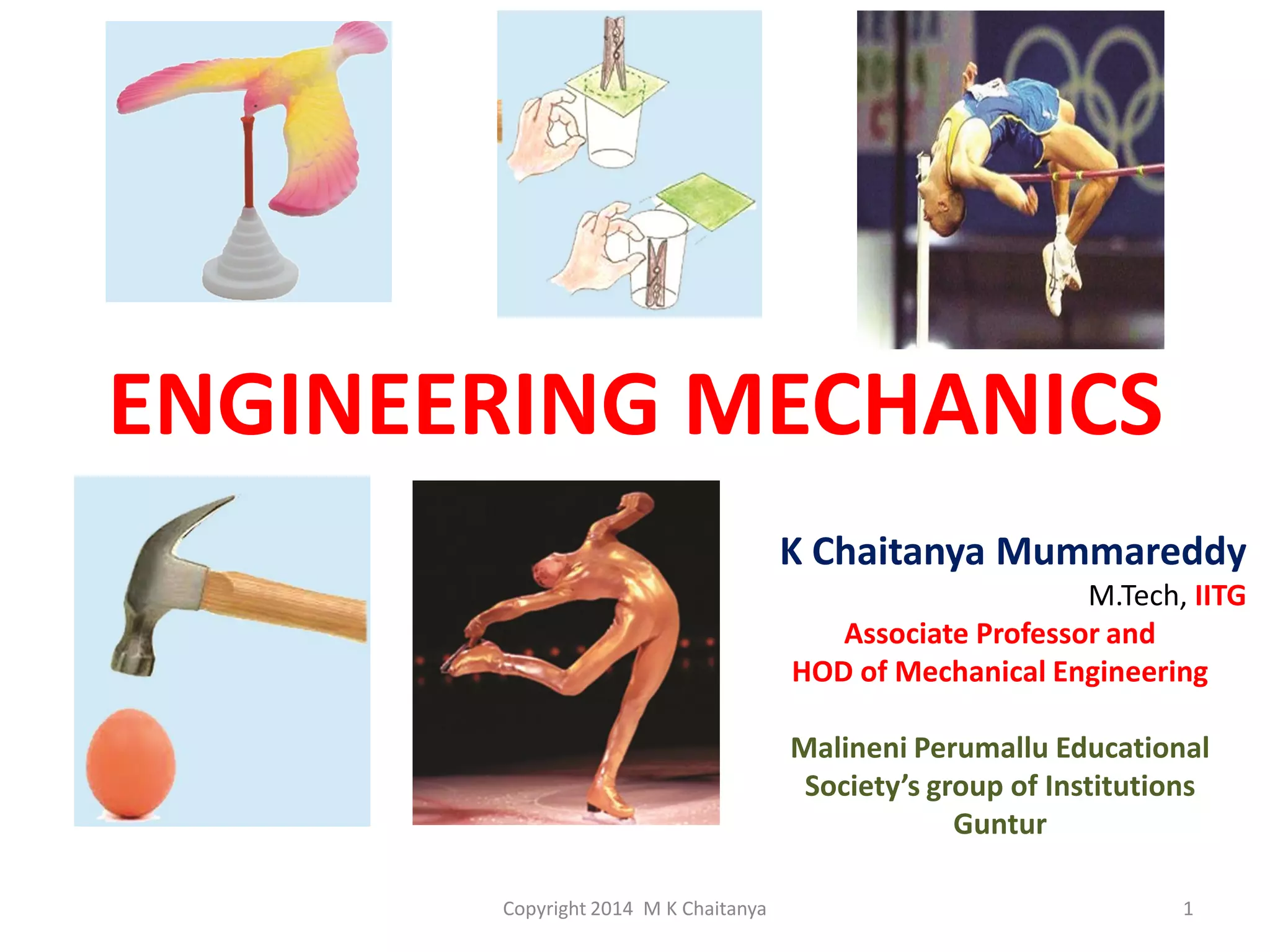
System of Forces: Several forces acting simultaneously upon a body
System of
Forces
Noncoplanar

Coplanar
2D

Concurrent

Parallel

3D

Nonconcurrent

Concurrent

General

Copyright 2014 M K Chaitanya

Parallel

Nonconcurrent

General

2
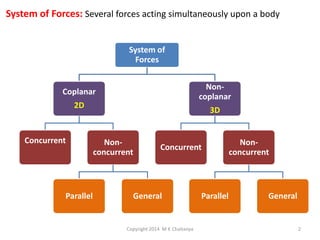
Coplanar System of Forces 2D

Copyright 2014 M K Chaitanya

3
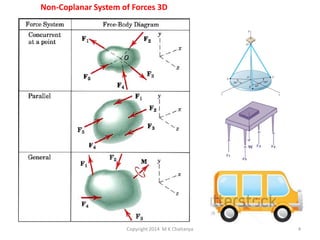
Non-Coplanar System of Forces 3D

Copyright 2014 M K Chaitanya

4
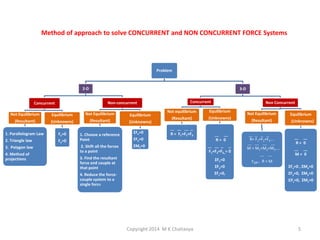
Method of approach to solve CONCURRENT and NON CONCURRENT FORCE Systems

Problem

2-D

3-D
Non-concurrent

Concurrent
Equilibrium

Not Equilibrium

(Resultant)

(Unknowns)

(Resultant)

1. Parallelogram Law

Fx=0

2. Triangle law

Fy=0

1. Choose a reference
Point

Not Equilibrium

3. Polygon law
4. Method of
projections

2. Shift all the forces
to a point

Equilibrium
(Unknowns)
ΣFx=0

Concurrent

Non Concurrent

Not equilibrium

Equilibrium

(Resultant)

(Unknowns)

--- --- --- -R = F1+F2+F3

ΣFy=0
ΣMz=0

3. Find the resultant
force and couple at
that point

--- --R= 0
--- --- -- -F1+F2+F3,,= 0
ΣFx=0
ΣFy=0
ΣFz=0,

4. Reduce the forcecouple system to a
single force

Not Equilibrium
(Resultant)

--- -- -- -R= F1+F2+F3….
--- --- --- --M = M1+M2+M3....
--- --rOPͯ R = M

Equilibrium
(Unknowns)

--- --R= 0
--- --M= 0

ΣFx=0 , ΣMx=0
ΣFy=0, ΣMy=0
ΣFz=0, ΣMz=0

Copyright 2014 M K Chaitanya

5
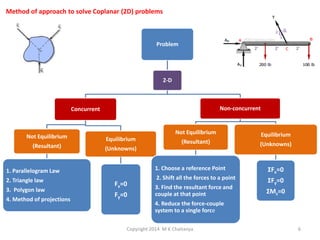
Method of approach to solve Coplanar (2D) problems

Problem

2-D

Non-concurrent

Concurrent

Not Equilibrium

Not Equilibrium

Equilibrium

(Resultant)

Equilibrium

(Resultant)

(Unknowns)

(Unknowns)
1. Choose a reference Point

1. Parallelogram Law
2. Triangle law
3. Polygon law
4. Method of projections

Fx=0
Fy=0

ΣFx=0

2. Shift all the forces to a point

ΣFy=0

3. Find the resultant force and
couple at that point

ΣMz=0

4. Reduce the force-couple
system to a single force
Copyright 2014 M K Chaitanya

6
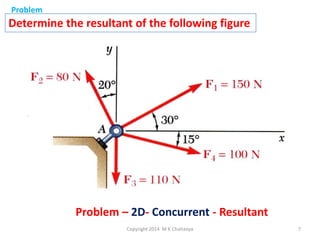
Problem

Determine the resultant of the following figure

Problem – 2D- Concurrent - Resultant
Copyright 2014 M K Chaitanya

7
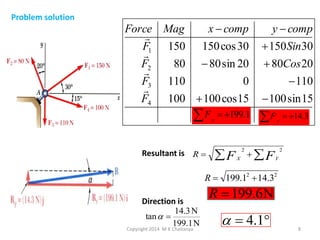
Problem solution

Force Mag
x  comp

F1 150 150 cos 30

F2
80  80 sin 20

F3 110
0

F4 100  100 cos 15

F

Resultant is R 

x

 199.1

F

2
X
y  comp
 150 Sin30
 80Cos 20
 110
 100 sin 15

F

y

  FY

 14.3

2

R  199.12  14.32
Direction is
14.3 N
tan  
199.1 N

Copyright 2014 M K Chaitanya

R  199.6N

  4.1

8
Problem

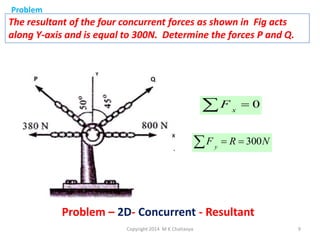
The resultant of the four concurrent forces as shown in Fig acts
along Y-axis and is equal to 300N. Determine the forces P and Q.

F
F

y

x

0

 R  300 N

Problem – 2D- Concurrent - Resultant
Copyright 2014 M K Chaitanya

9
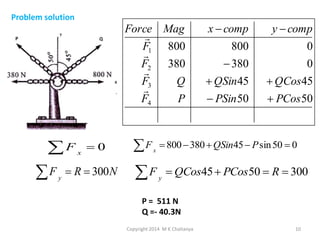
Problem solution

Force Mag

F1 800

F2 380

F3
Q

F4
P

F

F

y

x

0

 R  300 N

F

x

F

x  comp
800
 380
 QSin45
 PSin 50

y  comp
0
0
 QCos45
 PCos 50

 800  380  QSin45  P sin 50  0

y

 QCos45  PCos 50  R  300

P = 511 N
Q =- 40.3N
Copyright 2014 M K Chaitanya

10
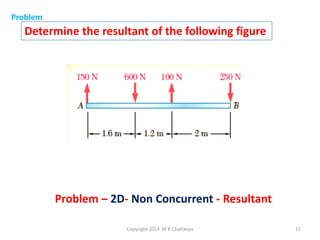
Problem

Determine the resultant of the following figure

Problem – 2D- Non Concurrent - Resultant
Copyright 2014 M K Chaitanya

11
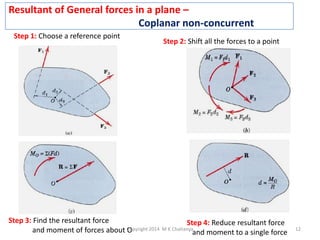
Resultant of General forces in a plane –
Coplanar non-concurrent
Step 1: Choose a reference point

Step 3: Find the resultant force
and moment of forces about Copyright 2014
O

Step 2: Shift all the forces to a point

Step 4: Reduce resultant force
and moment to a single force

M K Chaitanya

12
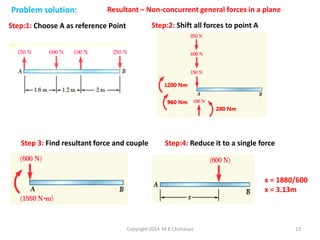
Problem solution:

Resultant – Non-concurrent general forces in a plane

Step:2: Shift all forces to point A

Step:1: Choose A as reference Point

Step 3: Find resultant force and couple

Step:4: Reduce it to a single force

x = 1880/600
x = 3.13m

Copyright 2014 M K Chaitanya

13
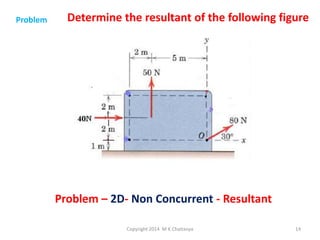
Problem

Determine the resultant of the following figure

Problem – 2D- Non Concurrent - Resultant
Copyright 2014 M K Chaitanya

14
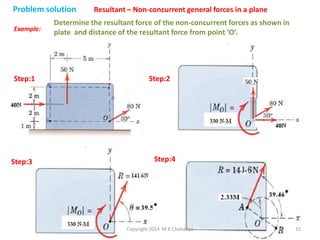
Problem solution
Example:

Step:1

Step:3

Resultant – Non-concurrent general forces in a plane

Determine the resultant force of the non-concurrent forces as shown in
plate and distance of the resultant force from point ‘O’.

Step:2

Step:4

Copyright 2014 M K Chaitanya

15
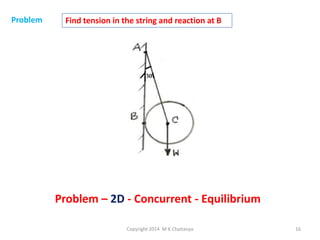
Problem

Find tension in the string and reaction at B

Problem – 2D - Concurrent - Equilibrium
Copyright 2014 M K Chaitanya

16
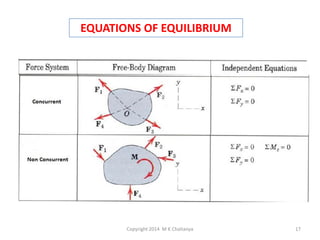
EQUATIONS OF EQUILIBRIUM

Copyright 2014 M K Chaitanya

17
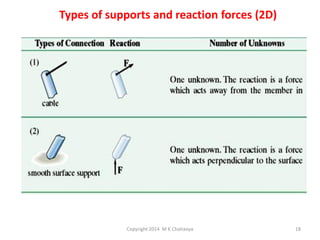
Types of supports and reaction forces (2D)

Copyright 2014 M K Chaitanya

18
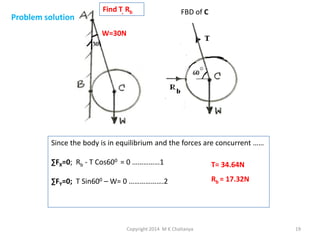
Problem solution

Find T, Rb

FBD of C

W=30N

Since the body is in equilibrium and the forces are concurrent ……
∑FX=0; Rb - T Cos600 = 0 ……………1

T= 34.64N

∑FY=0; T Sin600 – W= 0 ……………….2

Rb = 17.32N

Copyright 2014 M K Chaitanya

19
Problem

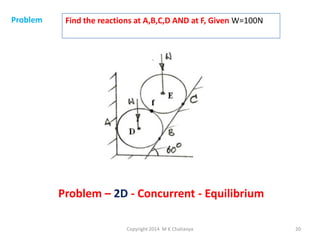
Find the reactions at A,B,C,D AND at F, Given W=100N

Problem – 2D - Concurrent - Equilibrium
Copyright 2014 M K Chaitanya

20
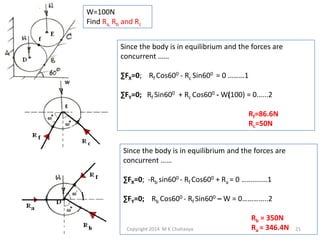
W=100N
Find Ra, Rb and Rc
Since the body is in equilibrium and the forces are
concurrent ……
∑FX=0; Rf Cos600 - Rc Sin600 = 0 ………1
∑FY=0; Rf Sin600 + Rc Cos600 - W(100) = 0…...2
Rf=86.6N
Rc=50N

Since the body is in equilibrium and the forces are
concurrent ……
∑FX=0; -Rb sin600 - Rf Cos600 + Ra = 0 ………..…1

∑FY=0; Rb Cos600 - Rf Sin600 – W = 0…………..2

Copyright 2014 M K Chaitanya

Rb = 350N
Ra = 346.4N

21
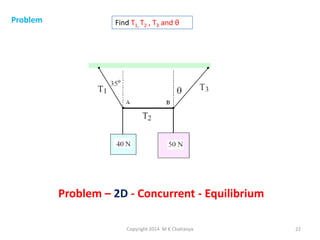
Problem

Find T1, T2 , T3 and θ

Problem – 2D - Concurrent - Equilibrium
Copyright 2014 M K Chaitanya

22
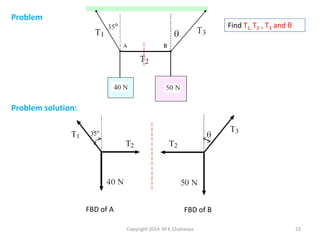
Problem

Find T1, T2 , T3 and θ

Problem solution:

FBD of A

FBD of B
Copyright 2014 M K Chaitanya

23
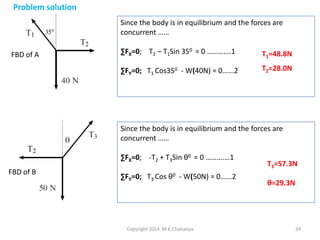
Problem solution
Since the body is in equilibrium and the forces are
concurrent ……
T1=48.8N

∑FY=0; T1 Cos350 - W(40N) = 0…...2

FBD of A

∑FX=0; T2 – T1Sin 350 = 0 ……….…1

T2=28.0N

Since the body is in equilibrium and the forces are
concurrent ……
∑FX=0; -T2 + T3Sin θ0 = 0 ……….…1
FBD of B

∑FY=0; T3 Cos θ0 - W(50N) = 0…...2

Copyright 2014 M K Chaitanya

T3=57.3N
θ=29.3N

24
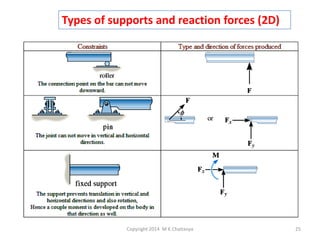
Types of supports and reaction forces (2D)

Copyright 2014 M K Chaitanya

25
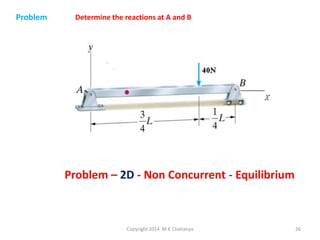
Problem

Determine the reactions at A and B

Problem – 2D - Non Concurrent - Equilibrium

Copyright 2014 M K Chaitanya

26
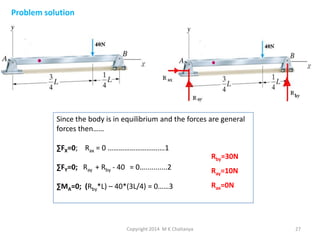
Problem solution

Since the body is in equilibrium and the forces are general
forces then……
∑FX=0; Rax = 0 ……………………….…1

Rby=30N

∑FY=0; Ray + Rby - 40 = 0…...........2

Ray=10N

∑MA=0; (Rby*L) – 40*(3L/4) = 0……3

Rax=0N

Copyright 2014 M K Chaitanya

27
Problem

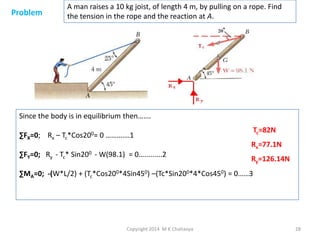
A man raises a 10 kg joist, of length 4 m, by pulling on a rope. Find
the tension in the rope and the reaction at A.

Since the body is in equilibrium then…….
∑FX=0; Rx – Tc*Cos200= 0 ……….…1

∑FY=0; Ry - Tc* Sin200 - W(98.1) = 0….........2

Tc=82N
Rx=77.1N
Ry=126.14N

∑MA=0; -(W*L/2) + (Tc*Cos200*4Sin450) –(Tc*Sin200*4*Cos450) = 0……3

Copyright 2014 M K Chaitanya

28
Problem

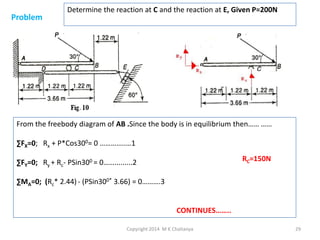
Determine the reaction at C and the reaction at E, Given P=200N

From the freebody diagram of AB .Since the body is in equilibrium then…… ……
∑FX=0; Rx + P*Cos300= 0 …………..…1
RC=150N

∑FY=0; Ry + Rc- PSin300 = 0…….........2
∑MA=0; (Rc* 2.44) - (PSin300* 3.66) = 0……….3
CONTINUES……..
Copyright 2014 M K Chaitanya

29
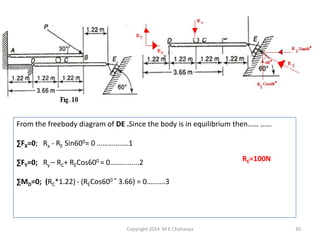
From the freebody diagram of DE .Since the body is in equilibrium then…… ……
∑FX=0; Rx - RE Sin600= 0 …………..…1
∑FY=0; Ry – RC+ RECos600 = 0…….........2

RE=100N

∑MD=0; (RC*1.22) - (RECos600 * 3.66) = 0……….3

Copyright 2014 M K Chaitanya

30
Problem

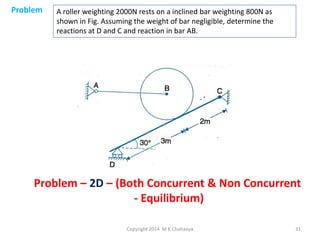
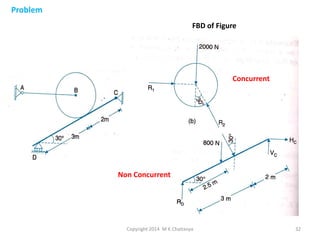
A roller weighting 2000N rests on a inclined bar weighting 800N as
shown in Fig. Assuming the weight of bar negligible, determine the
reactions at D and C and reaction in bar AB.

Problem – 2D – (Both Concurrent & Non Concurrent
- Equilibrium)
Copyright 2014 M K Chaitanya

31
Problem
FBD of Figure

Concurrent

Non Concurrent

Copyright 2014 M K Chaitanya

32
Problem

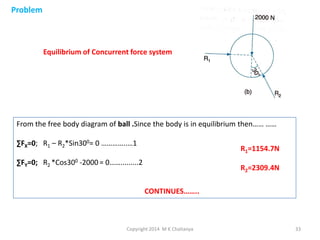
Equilibrium of Concurrent force system

From the free body diagram of ball .Since the body is in equilibrium then…… ……
∑FX=0; R1 – R2*Sin300= 0 …………..…1

R1=1154.7N

∑FY=0; R2 *Cos300 -2000 = 0…….........2

R2=2309.4N
CONTINUES……..

Copyright 2014 M K Chaitanya

33
Problem

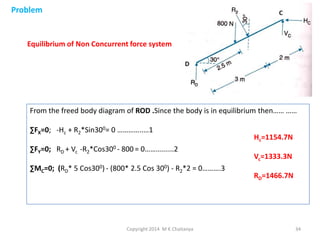
Equilibrium of Non Concurrent force system

From the freed body diagram of ROD .Since the body is in equilibrium then…… ……
∑FX=0; -Hc + R2*Sin300= 0 …………..…1
∑FY=0; RD + Vc -R2*Cos300 - 800 = 0…….........2
∑MC=0; (RD* 5 Cos300) - (800* 2.5 Cos 300) - R2*2 = 0……….3

Copyright 2014 M K Chaitanya

Hc=1154.7N
Vc=1333.3N
RD=1466.7N

34
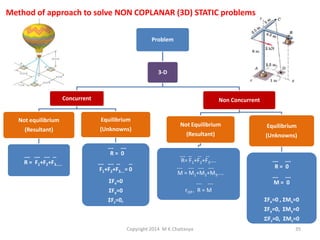
Method of approach to solve NON COPLANAR (3D) STATIC problems
Problem

3-D

Concurrent

Non Concurrent

Not equilibrium

Equilibrium

(Resultant)

(Unknowns)

--- --- --- -R = F1+F2+F3……

--- --R= 0
--- --- -- -F1+F2+F3….= 0
ΣFx=0
ΣFy=0

Not Equilibrium

Equilibrium

(Resultant)

(Unknowns)

--- -- -- -R= F1+F2+F3….
--- --- --- --M = M1+M2+M3....

--- --R= 0

--- --rOPͯ R = M

--- --M= 0
ΣFx=0 , ΣMx=0

ΣFz=0,

ΣFy=0, ΣMy=0
ΣFz=0, ΣMz=0
Copyright 2014 M K Chaitanya

35
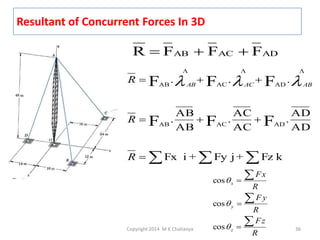
Resultant of Concurrent Forces In 3D

R  FAB  FAC  FAD




R  FAB .



R  FAB .

AB
AC
AD
 FAC .
 FAD .
AB
AC
AD

AB

 FAC .





AC

 FAD .



R   Fx i +  Fy j +  Fz k
cos  x 
cos  y 
Copyright 2014 M K Chaitanya

cos  z 

 Fx
R
Fy
R
 Fz
R

36

AB
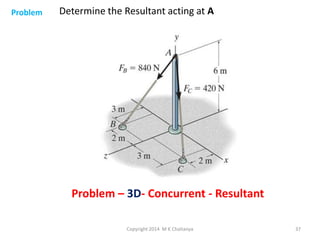
Problem

Determine the Resultant acting at A

Problem – 3D- Concurrent - Resultant
Copyright 2014 M K Chaitanya

37
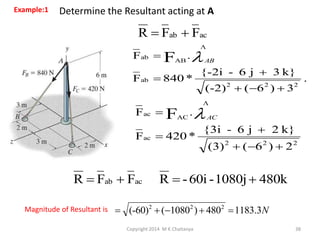
Example:1

Determine the Resultant acting at A

R  Fab  Fac
Fab  FAB .





{-2i - 6 j  3 k}

Fab  840 *

Fac  FAC .

(-2)  ( 6 )  3
2

Magnitude of Resultant is

2

2





Fac  420 *

R  Fab  Fac

AB

AC

{3i - 6 j  2 k}
(3) 2  ( 6 2 )  2 2

R  - 60i - 1080j  480k

 (-60)2  (10802 )  4802  1183.3N
Copyright 2014 M K Chaitanya

38

.
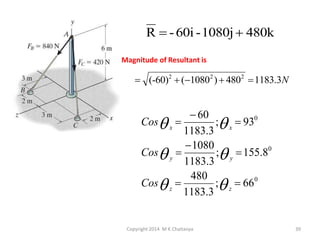
R  - 60i - 1080j  480k
Magnitude of Resultant is

 (-60)2  (10802 )  4802  1183.3N

 60
Cos x 
; x  930
1183.3
 1080
Cos y 
; y  155.80
1183.3
480
Cos z 
; z  660
1183.3

Copyright 2014 M K Chaitanya

39
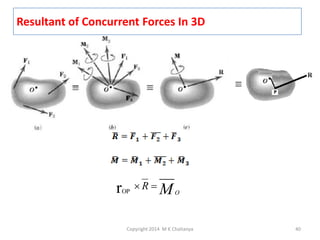
Resultant of Concurrent Forces In 3D

r

OP

RMO

Copyright 2014 M K Chaitanya

40
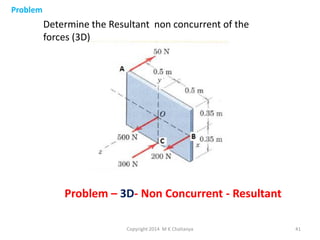
Problem

Determine the Resultant non concurrent of the
forces (3D)

Problem – 3D- Non Concurrent - Resultant
Copyright 2014 M K Chaitanya

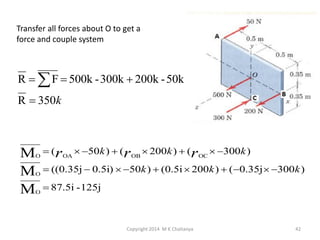
41
Transfer all forces about O to get a
force and couple system

R   F  500k - 300k  200k - 50k
R  350k

M
M
M

O

 (r OA  50k )  (r OB  200k )  (r OC  300k )

O

 ((0.35j  0.5i)  50k )  (0.5i  200k )  ( 0.35j  300k )

O

 87.5i - 125j

Copyright 2014 M K Chaitanya

42
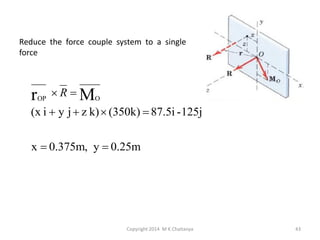
Reduce the force couple system to a single
force

r

OP

 R  MO

(x i  y j  z k)  (350k)  87.5i - 125j
x  0.375m, y  0.25m

Copyright 2014 M K Chaitanya

43
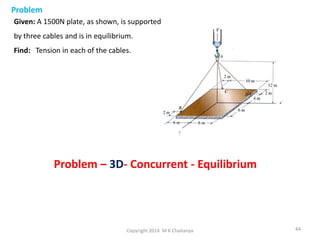
Problem
Given: A 1500N plate, as shown, is supported
by three cables and is in equilibrium.
Find: Tension in each of the cables.

Problem – 3D- Concurrent - Equilibrium

Copyright 2014 M K Chaitanya

44
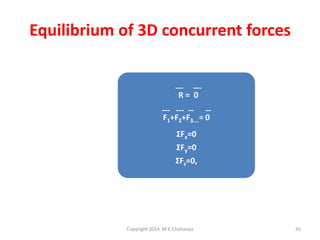
Equilibrium of 3D concurrent forces
--- --R= 0
--- --- -- -F1+F2+F3….= 0
ΣFx=0
ΣFy=0
ΣFz=0,

Copyright 2014 M K Chaitanya

45
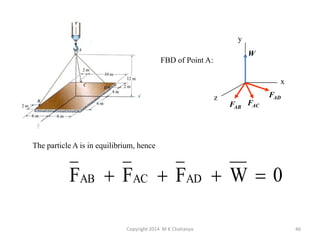
y
W

FBD of Point A:

x
z

FAB FAC

FAD

The particle A is in equilibrium, hence

FAB  FAC  FAD  W  0
Copyright 2014 M K Chaitanya

46
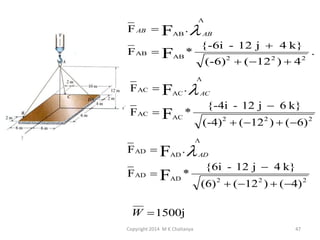
F AB  FAB .





F AB  FAB *

FAC  FAC .

(-6)  (12 )  4
2

.

AC

{-4i - 12 j  6 k}
(-4)2  (12 2 )  (6) 2





AD

{6i - 12 j  4 k}
(6) 2  (12 2 )  (4) 2

W  1500j
Copyright 2014 M K Chaitanya

2





FAD  FAD *

{-6i - 12 j  4 k}
2

FAC  FAC *
FAD  FAD .

AB

47
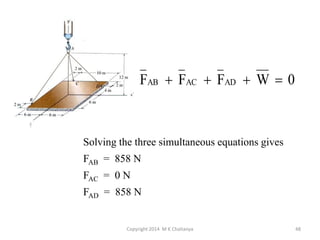
FAB  FAC  FAD  W  0

Solving the three simultaneous equations gives
FAB = 858 N

FAC = 0 N
FAD = 858 N

Copyright 2014 M K Chaitanya

48
Problem

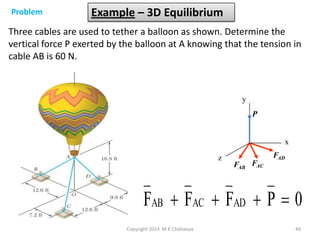
Example – 3D Equilibrium

Three cables are used to tether a balloon as shown. Determine the
vertical force P exerted by the balloon at A knowing that the tension in
cable AB is 60 N.

y
P

x

z

FAB FAC

FAD

FAB  FAC  FAD  P  0
Copyright 2014 M K Chaitanya

49
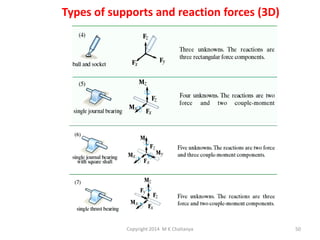
Types of supports and reaction forces (3D)

Copyright 2014 M K Chaitanya

50
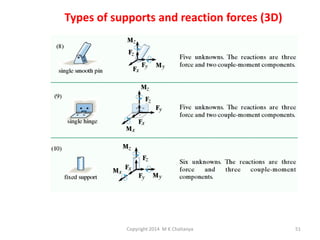
Types of supports and reaction forces (3D)

Copyright 2014 M K Chaitanya

51
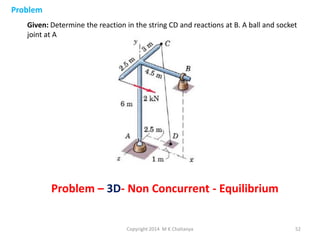
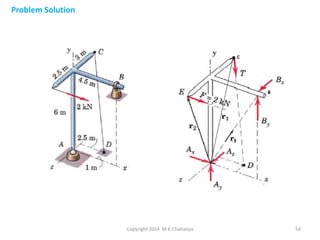
Problem
Given: Determine the reaction in the string CD and reactions at B. A ball and socket
joint at A

Problem – 3D- Non Concurrent - Equilibrium

Copyright 2014 M K Chaitanya

52
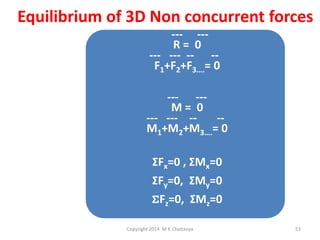
Equilibrium of 3D Non concurrent forces
--- --R= 0
--- --- -- -F1+F2+F3….= 0
--------R=0 =
M

--0
--- -- ----- ------ -F1+F2+F3….= 0
M1+M2+M3….= 0
ΣFx=0
ΣFy=0
ΣFx=0 ,
ΣFz=0,

ΣMx=0

ΣFy=0, ΣMy=0
ΣFz=0, ΣMz=0
Copyright 2014 M K Chaitanya

53
Problem Solution

Copyright 2014 M K Chaitanya

54
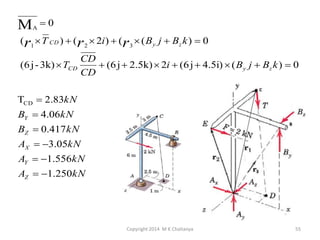
M 0
(r  T
A

1

CD

)  (r 2  2i )  (r 3  ( B y j  Bz k )  0

(6 j - 3k)  TCD

CD
 (6 j  2.5k)  2i  (6 j  4.5i)  ( B y j  Bz k )  0
CD

TCD  2.83kN
BY  4.06kN
BZ  0.417 kN
AX  3.05kN
AY  1.556kN
AZ  1.250kN

Copyright 2014 M K Chaitanya

55
References
•
•
•
•
•
•
•
•
•

•
•
•

Engg. Mechanics ,Timoshenko & Young.
2.Engg. Mechanics, R.K. Bansal , Laxmi publications
3.Engineering Mechanics,Fedinand.L.Singer , Harper – Collins.
4. Engineering Mechanics statics and dynamics, A Nelson, Mc Gra Hill publications
5. Engg. Mechanics Umesh Regl, Tayal.
6. Engineering Mechanics by N H Dubey
7. Engineering Mechanics , statics – J.L.Meriam, 6th Edn – Wiley India Pvt Ltd.
8. Engineering Mechanics , dynamics – J.L.Meriam, 6th Edn – Wiley India Pvt Ltd.
9. Mechanics For Engineers , statics - F.P.Beer & E.R.Johnston 5th Edn Mc Graw Hill
Publ.
10.Mechanics For Engineers, dynamics - F.P.Beer & E.R.Johnston – 5th Edn Mc
Graw Hill Publ.
11. www.google.com
12. http://nptel.iitm.ac.in/

Copyright 2014 M K Chaitanya

56
THANK YOU
Copyright 2014 M K Chaitanya

57

Engineering Mechanics

  • 1.
    ENGINEERING MECHANICS K ChaitanyaMummareddy M.Tech, IITG Associate Professor and HOD of Mechanical Engineering Malineni Perumallu Educational Society’s group of Institutions Guntur Copyright 2014 M K Chaitanya 1
  • 2.
    System of Forces:Several forces acting simultaneously upon a body System of Forces Noncoplanar Coplanar 2D Concurrent Parallel 3D Nonconcurrent Concurrent General Copyright 2014 M K Chaitanya Parallel Nonconcurrent General 2
  • 3.
    Coplanar System ofForces 2D Copyright 2014 M K Chaitanya 3
  • 4.
    Non-Coplanar System ofForces 3D Copyright 2014 M K Chaitanya 4
  • 5.
    Method of approachto solve CONCURRENT and NON CONCURRENT FORCE Systems Problem 2-D 3-D Non-concurrent Concurrent Equilibrium Not Equilibrium (Resultant) (Unknowns) (Resultant) 1. Parallelogram Law Fx=0 2. Triangle law Fy=0 1. Choose a reference Point Not Equilibrium 3. Polygon law 4. Method of projections 2. Shift all the forces to a point Equilibrium (Unknowns) ΣFx=0 Concurrent Non Concurrent Not equilibrium Equilibrium (Resultant) (Unknowns) --- --- --- -R = F1+F2+F3 ΣFy=0 ΣMz=0 3. Find the resultant force and couple at that point --- --R= 0 --- --- -- -F1+F2+F3,,= 0 ΣFx=0 ΣFy=0 ΣFz=0, 4. Reduce the forcecouple system to a single force Not Equilibrium (Resultant) --- -- -- -R= F1+F2+F3…. --- --- --- --M = M1+M2+M3.... --- --rOPͯ R = M Equilibrium (Unknowns) --- --R= 0 --- --M= 0 ΣFx=0 , ΣMx=0 ΣFy=0, ΣMy=0 ΣFz=0, ΣMz=0 Copyright 2014 M K Chaitanya 5
  • 6.
    Method of approachto solve Coplanar (2D) problems Problem 2-D Non-concurrent Concurrent Not Equilibrium Not Equilibrium Equilibrium (Resultant) Equilibrium (Resultant) (Unknowns) (Unknowns) 1. Choose a reference Point 1. Parallelogram Law 2. Triangle law 3. Polygon law 4. Method of projections Fx=0 Fy=0 ΣFx=0 2. Shift all the forces to a point ΣFy=0 3. Find the resultant force and couple at that point ΣMz=0 4. Reduce the force-couple system to a single force Copyright 2014 M K Chaitanya 6
  • 7.
    Problem Determine the resultantof the following figure Problem – 2D- Concurrent - Resultant Copyright 2014 M K Chaitanya 7
  • 8.
    Problem solution Force Mag x comp  F1 150 150 cos 30  F2 80  80 sin 20  F3 110 0  F4 100  100 cos 15 F Resultant is R  x  199.1 F 2 X y  comp  150 Sin30  80Cos 20  110  100 sin 15 F y   FY  14.3 2 R  199.12  14.32 Direction is 14.3 N tan   199.1 N Copyright 2014 M K Chaitanya R  199.6N   4.1 8
  • 9.
    Problem The resultant ofthe four concurrent forces as shown in Fig acts along Y-axis and is equal to 300N. Determine the forces P and Q. F F y x 0  R  300 N Problem – 2D- Concurrent - Resultant Copyright 2014 M K Chaitanya 9
  • 10.
    Problem solution Force Mag  F1800  F2 380  F3 Q  F4 P F F y x 0  R  300 N F x F x  comp 800  380  QSin45  PSin 50 y  comp 0 0  QCos45  PCos 50  800  380  QSin45  P sin 50  0 y  QCos45  PCos 50  R  300 P = 511 N Q =- 40.3N Copyright 2014 M K Chaitanya 10
  • 11.
    Problem Determine the resultantof the following figure Problem – 2D- Non Concurrent - Resultant Copyright 2014 M K Chaitanya 11
  • 12.
    Resultant of Generalforces in a plane – Coplanar non-concurrent Step 1: Choose a reference point Step 3: Find the resultant force and moment of forces about Copyright 2014 O Step 2: Shift all the forces to a point Step 4: Reduce resultant force and moment to a single force M K Chaitanya 12
  • 13.
    Problem solution: Resultant –Non-concurrent general forces in a plane Step:2: Shift all forces to point A Step:1: Choose A as reference Point Step 3: Find resultant force and couple Step:4: Reduce it to a single force x = 1880/600 x = 3.13m Copyright 2014 M K Chaitanya 13
  • 14.
    Problem Determine the resultantof the following figure Problem – 2D- Non Concurrent - Resultant Copyright 2014 M K Chaitanya 14
  • 15.
    Problem solution Example: Step:1 Step:3 Resultant –Non-concurrent general forces in a plane Determine the resultant force of the non-concurrent forces as shown in plate and distance of the resultant force from point ‘O’. Step:2 Step:4 Copyright 2014 M K Chaitanya 15
  • 16.
    Problem Find tension inthe string and reaction at B Problem – 2D - Concurrent - Equilibrium Copyright 2014 M K Chaitanya 16
  • 17.
  • 18.
    Types of supportsand reaction forces (2D) Copyright 2014 M K Chaitanya 18
  • 19.
    Problem solution Find T,Rb FBD of C W=30N Since the body is in equilibrium and the forces are concurrent …… ∑FX=0; Rb - T Cos600 = 0 ……………1 T= 34.64N ∑FY=0; T Sin600 – W= 0 ……………….2 Rb = 17.32N Copyright 2014 M K Chaitanya 19
  • 20.
    Problem Find the reactionsat A,B,C,D AND at F, Given W=100N Problem – 2D - Concurrent - Equilibrium Copyright 2014 M K Chaitanya 20
  • 21.
    W=100N Find Ra, Rband Rc Since the body is in equilibrium and the forces are concurrent …… ∑FX=0; Rf Cos600 - Rc Sin600 = 0 ………1 ∑FY=0; Rf Sin600 + Rc Cos600 - W(100) = 0…...2 Rf=86.6N Rc=50N Since the body is in equilibrium and the forces are concurrent …… ∑FX=0; -Rb sin600 - Rf Cos600 + Ra = 0 ………..…1 ∑FY=0; Rb Cos600 - Rf Sin600 – W = 0…………..2 Copyright 2014 M K Chaitanya Rb = 350N Ra = 346.4N 21
  • 22.
    Problem Find T1, T2, T3 and θ Problem – 2D - Concurrent - Equilibrium Copyright 2014 M K Chaitanya 22
  • 23.
    Problem Find T1, T2, T3 and θ Problem solution: FBD of A FBD of B Copyright 2014 M K Chaitanya 23
  • 24.
    Problem solution Since thebody is in equilibrium and the forces are concurrent …… T1=48.8N ∑FY=0; T1 Cos350 - W(40N) = 0…...2 FBD of A ∑FX=0; T2 – T1Sin 350 = 0 ……….…1 T2=28.0N Since the body is in equilibrium and the forces are concurrent …… ∑FX=0; -T2 + T3Sin θ0 = 0 ……….…1 FBD of B ∑FY=0; T3 Cos θ0 - W(50N) = 0…...2 Copyright 2014 M K Chaitanya T3=57.3N θ=29.3N 24
  • 25.
    Types of supportsand reaction forces (2D) Copyright 2014 M K Chaitanya 25
  • 26.
    Problem Determine the reactionsat A and B Problem – 2D - Non Concurrent - Equilibrium Copyright 2014 M K Chaitanya 26
  • 27.
    Problem solution Since thebody is in equilibrium and the forces are general forces then…… ∑FX=0; Rax = 0 ……………………….…1 Rby=30N ∑FY=0; Ray + Rby - 40 = 0…...........2 Ray=10N ∑MA=0; (Rby*L) – 40*(3L/4) = 0……3 Rax=0N Copyright 2014 M K Chaitanya 27
  • 28.
    Problem A man raisesa 10 kg joist, of length 4 m, by pulling on a rope. Find the tension in the rope and the reaction at A. Since the body is in equilibrium then……. ∑FX=0; Rx – Tc*Cos200= 0 ……….…1 ∑FY=0; Ry - Tc* Sin200 - W(98.1) = 0….........2 Tc=82N Rx=77.1N Ry=126.14N ∑MA=0; -(W*L/2) + (Tc*Cos200*4Sin450) –(Tc*Sin200*4*Cos450) = 0……3 Copyright 2014 M K Chaitanya 28
  • 29.
    Problem Determine the reactionat C and the reaction at E, Given P=200N From the freebody diagram of AB .Since the body is in equilibrium then…… …… ∑FX=0; Rx + P*Cos300= 0 …………..…1 RC=150N ∑FY=0; Ry + Rc- PSin300 = 0…….........2 ∑MA=0; (Rc* 2.44) - (PSin300* 3.66) = 0……….3 CONTINUES…….. Copyright 2014 M K Chaitanya 29
  • 30.
    From the freebodydiagram of DE .Since the body is in equilibrium then…… …… ∑FX=0; Rx - RE Sin600= 0 …………..…1 ∑FY=0; Ry – RC+ RECos600 = 0…….........2 RE=100N ∑MD=0; (RC*1.22) - (RECos600 * 3.66) = 0……….3 Copyright 2014 M K Chaitanya 30
  • 31.
    Problem A roller weighting2000N rests on a inclined bar weighting 800N as shown in Fig. Assuming the weight of bar negligible, determine the reactions at D and C and reaction in bar AB. Problem – 2D – (Both Concurrent & Non Concurrent - Equilibrium) Copyright 2014 M K Chaitanya 31
  • 32.
    Problem FBD of Figure Concurrent NonConcurrent Copyright 2014 M K Chaitanya 32
  • 33.
    Problem Equilibrium of Concurrentforce system From the free body diagram of ball .Since the body is in equilibrium then…… …… ∑FX=0; R1 – R2*Sin300= 0 …………..…1 R1=1154.7N ∑FY=0; R2 *Cos300 -2000 = 0…….........2 R2=2309.4N CONTINUES…….. Copyright 2014 M K Chaitanya 33
  • 34.
    Problem Equilibrium of NonConcurrent force system From the freed body diagram of ROD .Since the body is in equilibrium then…… …… ∑FX=0; -Hc + R2*Sin300= 0 …………..…1 ∑FY=0; RD + Vc -R2*Cos300 - 800 = 0…….........2 ∑MC=0; (RD* 5 Cos300) - (800* 2.5 Cos 300) - R2*2 = 0……….3 Copyright 2014 M K Chaitanya Hc=1154.7N Vc=1333.3N RD=1466.7N 34
  • 35.
    Method of approachto solve NON COPLANAR (3D) STATIC problems Problem 3-D Concurrent Non Concurrent Not equilibrium Equilibrium (Resultant) (Unknowns) --- --- --- -R = F1+F2+F3…… --- --R= 0 --- --- -- -F1+F2+F3….= 0 ΣFx=0 ΣFy=0 Not Equilibrium Equilibrium (Resultant) (Unknowns) --- -- -- -R= F1+F2+F3…. --- --- --- --M = M1+M2+M3.... --- --R= 0 --- --rOPͯ R = M --- --M= 0 ΣFx=0 , ΣMx=0 ΣFz=0, ΣFy=0, ΣMy=0 ΣFz=0, ΣMz=0 Copyright 2014 M K Chaitanya 35
  • 36.
    Resultant of ConcurrentForces In 3D R  FAB  FAC  FAD   R  FAB .  R  FAB . AB AC AD  FAC .  FAD . AB AC AD AB  FAC .   AC  FAD .  R   Fx i +  Fy j +  Fz k cos  x  cos  y  Copyright 2014 M K Chaitanya cos  z   Fx R Fy R  Fz R 36 AB
  • 37.
    Problem Determine the Resultantacting at A Problem – 3D- Concurrent - Resultant Copyright 2014 M K Chaitanya 37
  • 38.
    Example:1 Determine the Resultantacting at A R  Fab  Fac Fab  FAB .   {-2i - 6 j  3 k} Fab  840 * Fac  FAC . (-2)  ( 6 )  3 2 Magnitude of Resultant is 2 2   Fac  420 * R  Fab  Fac AB AC {3i - 6 j  2 k} (3) 2  ( 6 2 )  2 2 R  - 60i - 1080j  480k  (-60)2  (10802 )  4802  1183.3N Copyright 2014 M K Chaitanya 38 .
  • 39.
    R  -60i - 1080j  480k Magnitude of Resultant is  (-60)2  (10802 )  4802  1183.3N  60 Cos x  ; x  930 1183.3  1080 Cos y  ; y  155.80 1183.3 480 Cos z  ; z  660 1183.3 Copyright 2014 M K Chaitanya 39
  • 40.
    Resultant of ConcurrentForces In 3D r OP RMO Copyright 2014 M K Chaitanya 40
  • 41.
    Problem Determine the Resultantnon concurrent of the forces (3D) Problem – 3D- Non Concurrent - Resultant Copyright 2014 M K Chaitanya 41
  • 42.
    Transfer all forcesabout O to get a force and couple system R   F  500k - 300k  200k - 50k R  350k M M M O  (r OA  50k )  (r OB  200k )  (r OC  300k ) O  ((0.35j  0.5i)  50k )  (0.5i  200k )  ( 0.35j  300k ) O  87.5i - 125j Copyright 2014 M K Chaitanya 42
  • 43.
    Reduce the forcecouple system to a single force r OP  R  MO (x i  y j  z k)  (350k)  87.5i - 125j x  0.375m, y  0.25m Copyright 2014 M K Chaitanya 43
  • 44.
    Problem Given: A 1500Nplate, as shown, is supported by three cables and is in equilibrium. Find: Tension in each of the cables. Problem – 3D- Concurrent - Equilibrium Copyright 2014 M K Chaitanya 44
  • 45.
    Equilibrium of 3Dconcurrent forces --- --R= 0 --- --- -- -F1+F2+F3….= 0 ΣFx=0 ΣFy=0 ΣFz=0, Copyright 2014 M K Chaitanya 45
  • 46.
    y W FBD of PointA: x z FAB FAC FAD The particle A is in equilibrium, hence FAB  FAC  FAD  W  0 Copyright 2014 M K Chaitanya 46
  • 47.
    F AB FAB .   F AB  FAB * FAC  FAC . (-6)  (12 )  4 2 . AC {-4i - 12 j  6 k} (-4)2  (12 2 )  (6) 2   AD {6i - 12 j  4 k} (6) 2  (12 2 )  (4) 2 W  1500j Copyright 2014 M K Chaitanya 2   FAD  FAD * {-6i - 12 j  4 k} 2 FAC  FAC * FAD  FAD . AB 47
  • 48.
    FAB  FAC FAD  W  0 Solving the three simultaneous equations gives FAB = 858 N FAC = 0 N FAD = 858 N Copyright 2014 M K Chaitanya 48
  • 49.
    Problem Example – 3DEquilibrium Three cables are used to tether a balloon as shown. Determine the vertical force P exerted by the balloon at A knowing that the tension in cable AB is 60 N. y P x z FAB FAC FAD FAB  FAC  FAD  P  0 Copyright 2014 M K Chaitanya 49
  • 50.
    Types of supportsand reaction forces (3D) Copyright 2014 M K Chaitanya 50
  • 51.
    Types of supportsand reaction forces (3D) Copyright 2014 M K Chaitanya 51
  • 52.
    Problem Given: Determine thereaction in the string CD and reactions at B. A ball and socket joint at A Problem – 3D- Non Concurrent - Equilibrium Copyright 2014 M K Chaitanya 52
  • 53.
    Equilibrium of 3DNon concurrent forces --- --R= 0 --- --- -- -F1+F2+F3….= 0 --------R=0 = M --0 --- -- ----- ------ -F1+F2+F3….= 0 M1+M2+M3….= 0 ΣFx=0 ΣFy=0 ΣFx=0 , ΣFz=0, ΣMx=0 ΣFy=0, ΣMy=0 ΣFz=0, ΣMz=0 Copyright 2014 M K Chaitanya 53
  • 54.
  • 55.
    M 0 (r T A 1 CD )  (r 2  2i )  (r 3  ( B y j  Bz k )  0 (6 j - 3k)  TCD CD  (6 j  2.5k)  2i  (6 j  4.5i)  ( B y j  Bz k )  0 CD TCD  2.83kN BY  4.06kN BZ  0.417 kN AX  3.05kN AY  1.556kN AZ  1.250kN Copyright 2014 M K Chaitanya 55
  • 56.
    References • • • • • • • • • • • • Engg. Mechanics ,Timoshenko& Young. 2.Engg. Mechanics, R.K. Bansal , Laxmi publications 3.Engineering Mechanics,Fedinand.L.Singer , Harper – Collins. 4. Engineering Mechanics statics and dynamics, A Nelson, Mc Gra Hill publications 5. Engg. Mechanics Umesh Regl, Tayal. 6. Engineering Mechanics by N H Dubey 7. Engineering Mechanics , statics – J.L.Meriam, 6th Edn – Wiley India Pvt Ltd. 8. Engineering Mechanics , dynamics – J.L.Meriam, 6th Edn – Wiley India Pvt Ltd. 9. Mechanics For Engineers , statics - F.P.Beer & E.R.Johnston 5th Edn Mc Graw Hill Publ. 10.Mechanics For Engineers, dynamics - F.P.Beer & E.R.Johnston – 5th Edn Mc Graw Hill Publ. 11. www.google.com 12. http://nptel.iitm.ac.in/ Copyright 2014 M K Chaitanya 56
  • 57.
    THANK YOU Copyright 2014M K Chaitanya 57