ENGINEERING MECHANICS
Unit – V
Friction
by
S.Thanga Kasi Rajan
Assistant Professor
Department of Mechanical Engineering
Kamaraj College of Engineering & Technology,
Virudhunagar – 626001.
Tamil Nadu, India
Email : stkrajan@gmail.com
• Friction is a force between two surfaces that are
sliding, or trying to slide across one another, for
example when you try to push a toy car along the
floor.
• Friction always works in the direction opposite from
the direction of the motion of the object. It always
parallel to the plane of contact.
Moving
Friction
Friction
13/12/2014 S. ThangaKasiRajan, stkrajan@gmail.com 2
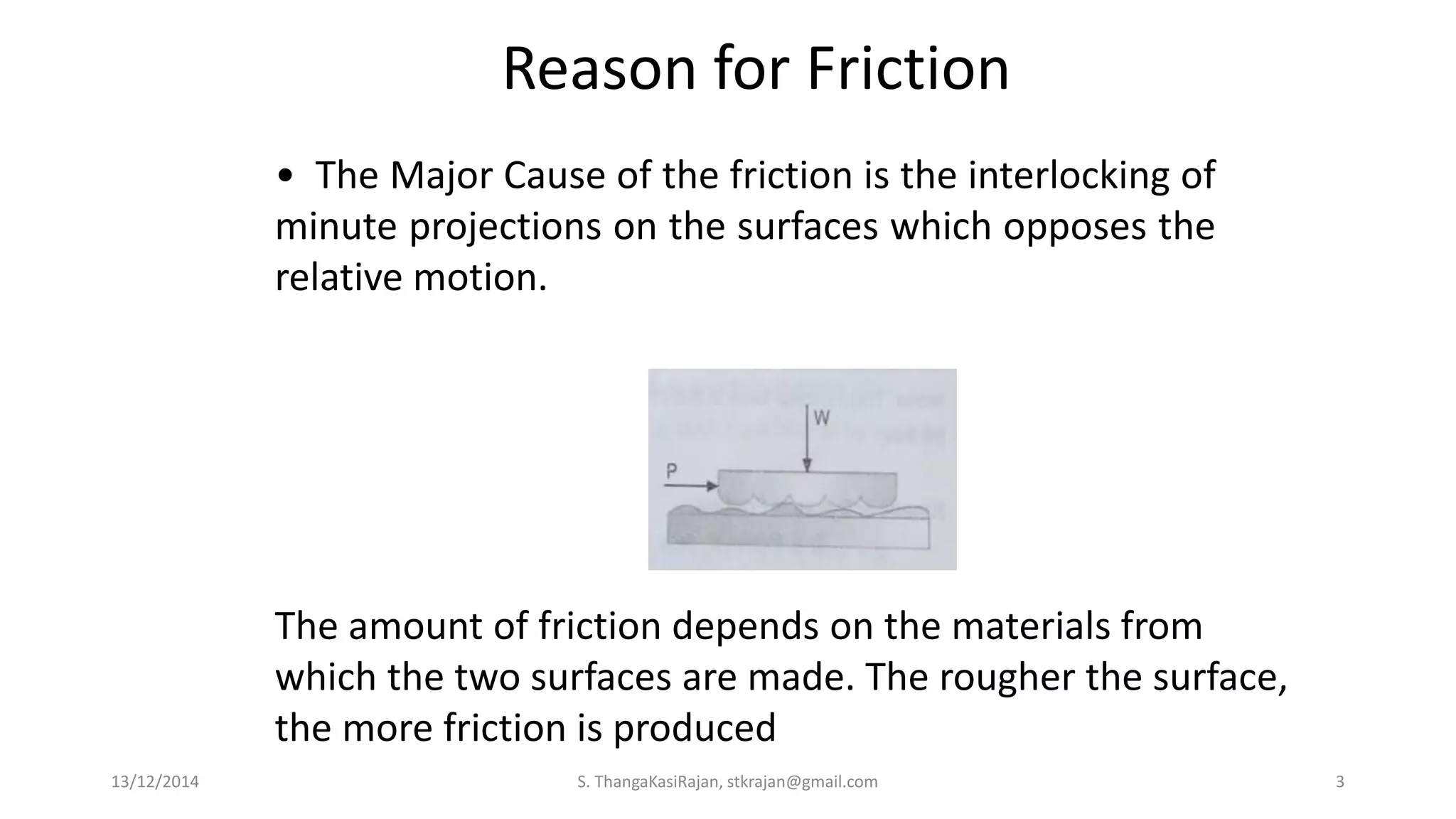
• The Major Cause of the friction is the interlocking of
minute projections on the surfaces which opposes the
relative motion.
Reason for Friction
The amount of friction depends on the materials from
which the two surfaces are made. The rougher the surface,
the more friction is produced
13/12/2014 S. ThangaKasiRajan, stkrajan@gmail.com 3
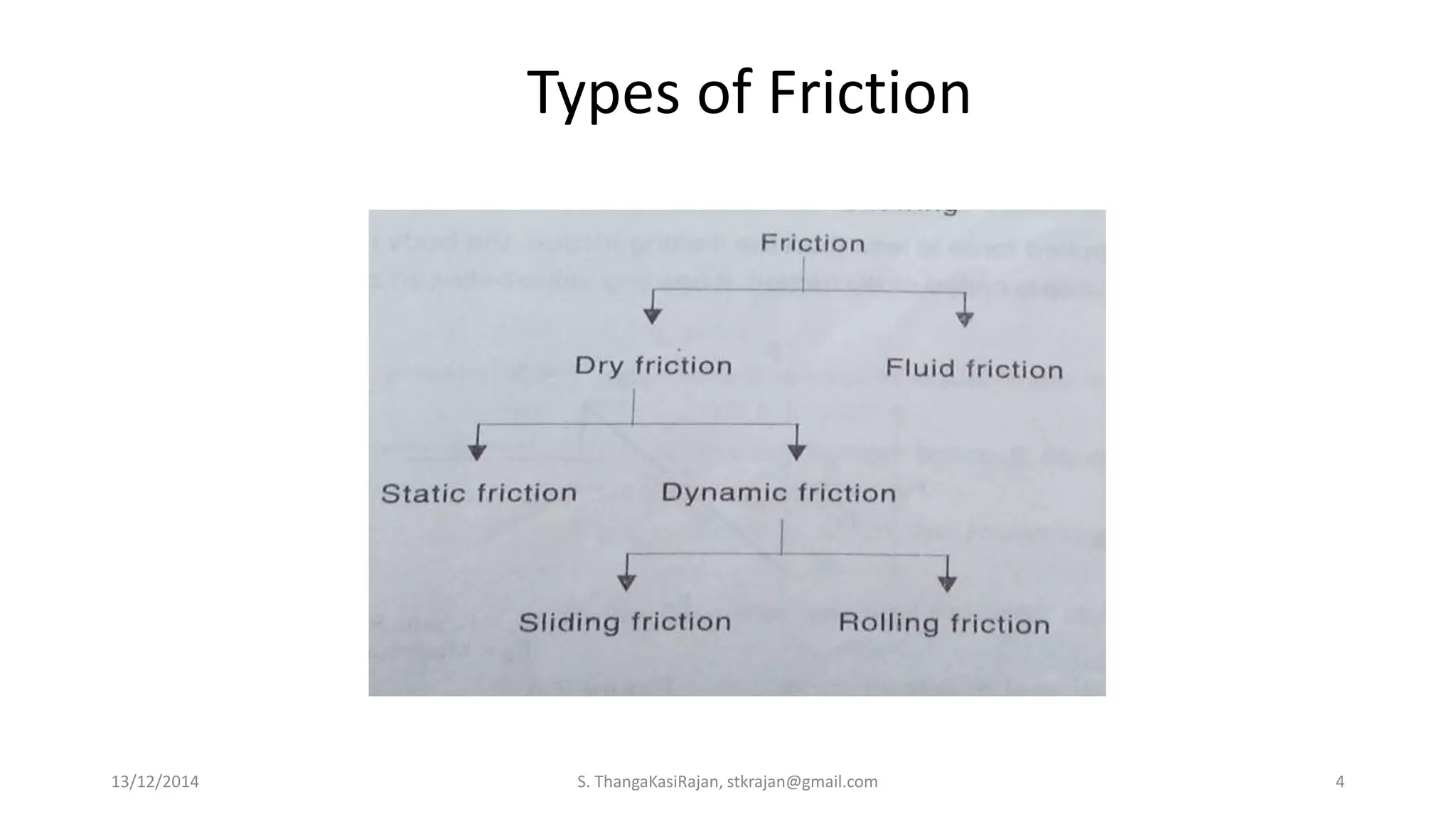
Types of Friction
13/12/2014 S. ThangaKasiRajan, stkrajan@gmail.com 4
FRICTION
The Resistance offered by the surface (due to ir-regularities) against motion of a
body by the system to moving the system.
In fluid mechanics, resistance offered by the fluid (within the system layer to
layer) itself is known as Viscosity.
Due to the frictional force our effort to do particular work is being increased.
Friction is must for the operation of Belt, Clutch, Screw Jack, Brake, Automobile
etc.,
Friction is undesirable in the case of Bearing.
Power lost due to friction is converted in to heat.
13/12/2014 S. ThangaKasiRajan, stkrajan@gmail.com 5
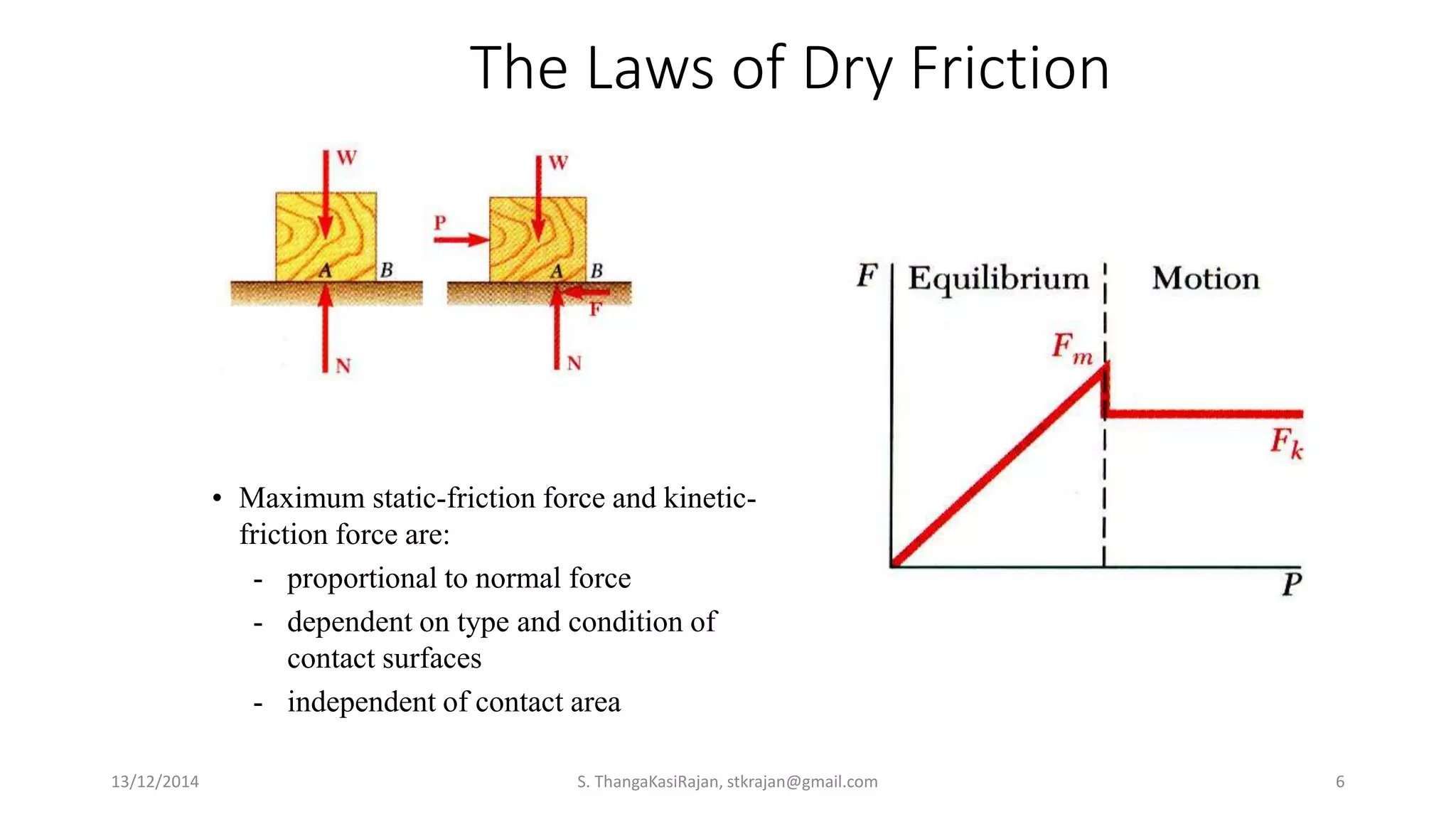
The Laws of Dry Friction
• Maximum static-friction force and kinetic-
friction force are:
- proportional to normal force
- dependent on type and condition of
contact surfaces
- independent of contact area
13/12/2014 S. ThangaKasiRajan, stkrajan@gmail.com 6
Coefficients of Friction
• Maximum static-friction force:
NF sm 
• Kinetic-friction force:
sk
kk NF


75.0

13/12/2014 S. ThangaKasiRajan, stkrajan@gmail.com 7
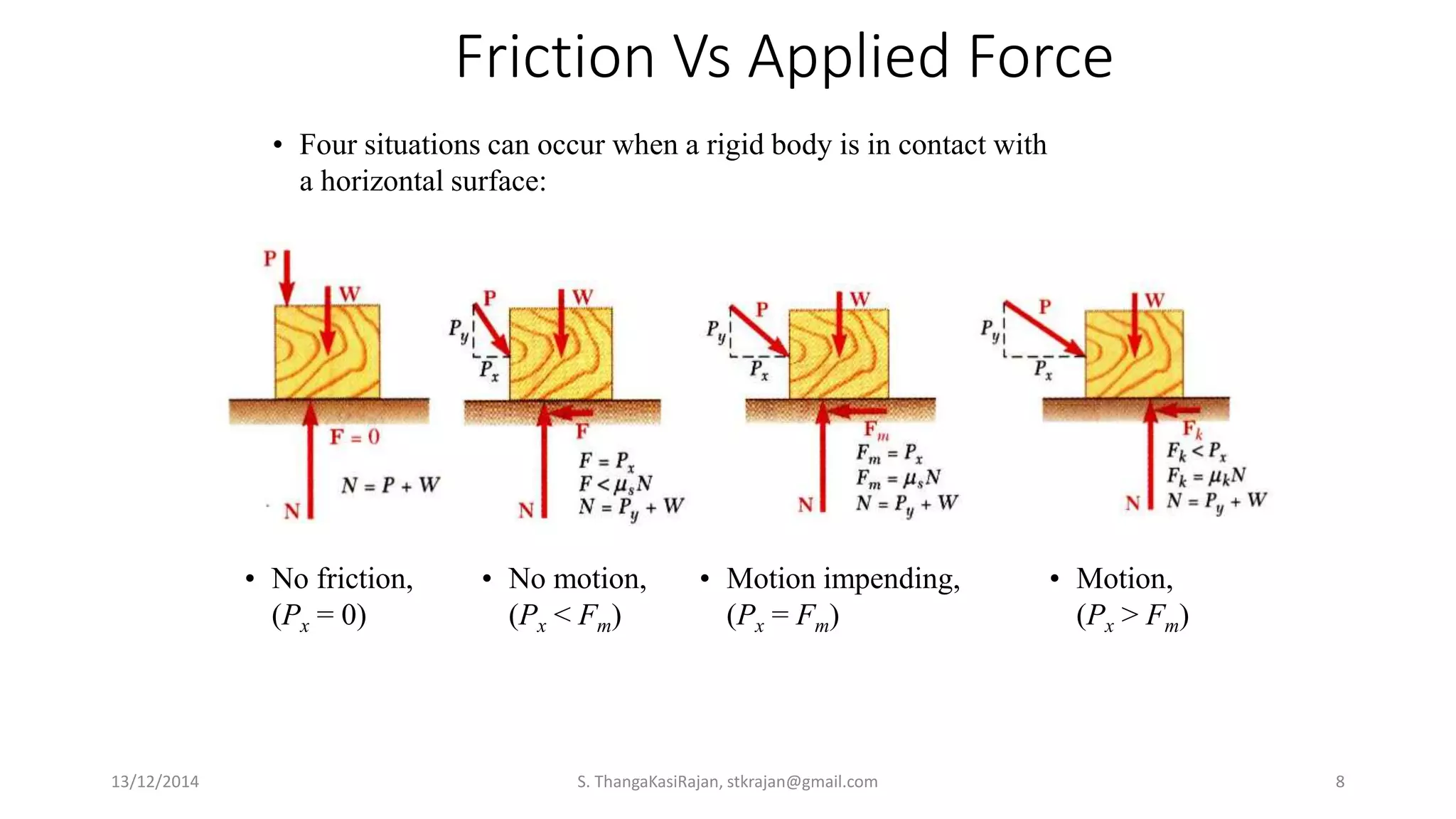
Friction Vs Applied Force
• Four situations can occur when a rigid body is in contact with
a horizontal surface:
• No friction,
(Px = 0)
• No motion,
(Px < Fm)
• Motion impending,
(Px = Fm)
• Motion,
(Px > Fm)
13/12/2014 S. ThangaKasiRajan, stkrajan@gmail.com 8
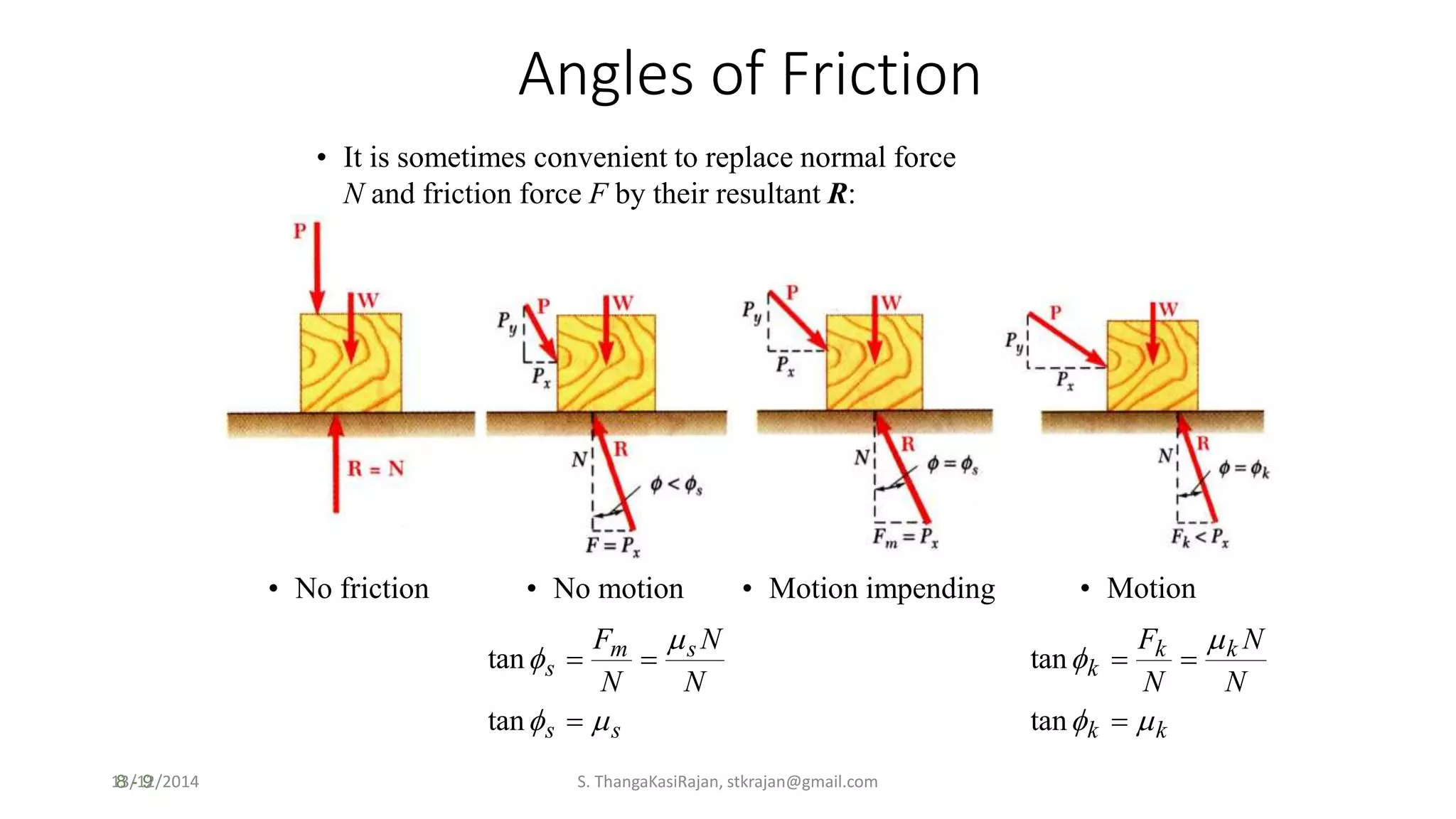
Angles of Friction
8 - 9
• It is sometimes convenient to replace normal force
N and friction force F by their resultant R:
• No friction • Motion impending• No motion
ss
sm
s
N
N
N
F





tan
tan
• Motion
kk
kk
k
N
N
N
F





tan
tan
13/12/2014 S. ThangaKasiRajan, stkrajan@gmail.com
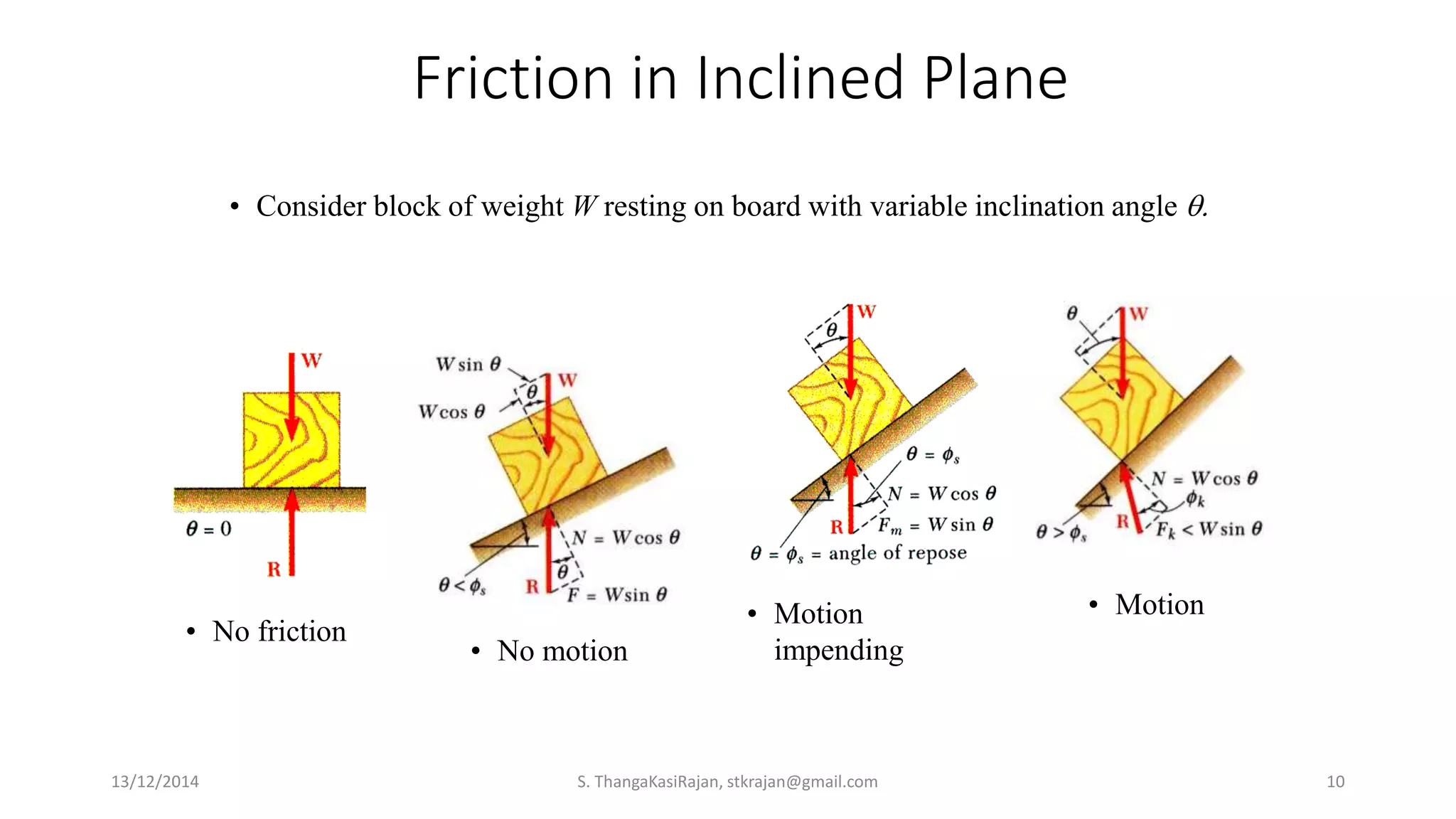
Friction in Inclined Plane
• Consider block of weight W resting on board with variable inclination angle q.
• No friction
• No motion
• Motion
impending
• Motion
13/12/2014 S. ThangaKasiRajan, stkrajan@gmail.com 10
Problems Involving Dry Friction
• All applied forces known
• Coefficient of static friction
is known
• Determine whether body
will remain at rest or slide
• All applied forces known
• Motion is impending
• Determine value of coefficient
of static friction.
• Coefficient of static
friction is known
• Motion is impending
• Determine magnitude or
direction of one of the
applied forces13/12/2014 S. ThangaKasiRajan, stkrajan@gmail.com 11
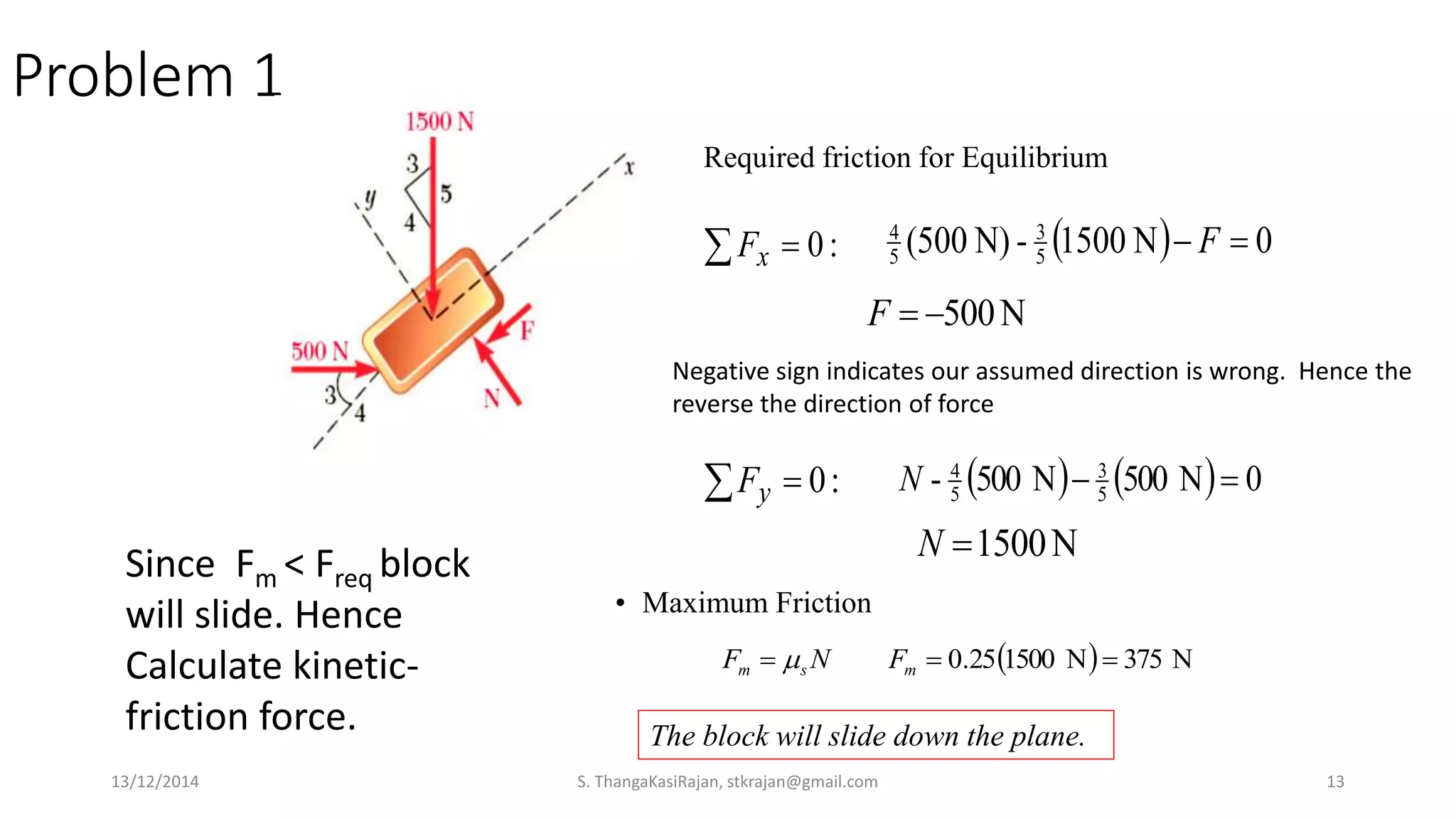
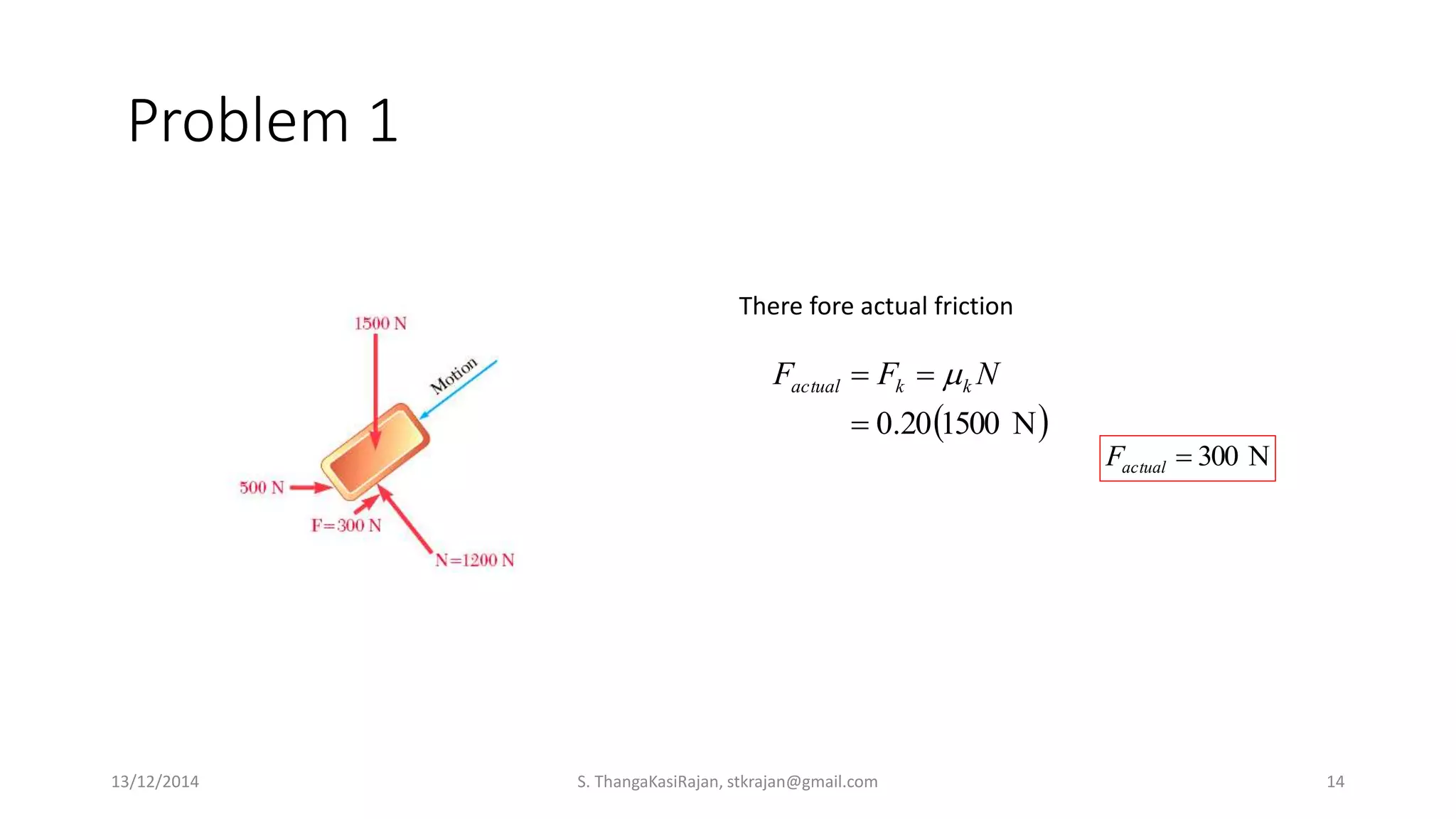
Problem 1
A 500-N force acts as shown on a 1.5 kN
block placed on an inclined plane. The
coefficients of friction between the block
and plane are s = 0.25 and k = 0.20.
Determine whether the block is in
equilibrium and find the value of the
friction force.
• Calculate maximum friction
force and compare with
friction force required for
equilibrium. If it is greater,
block will not slide.
• If maximum friction force is
less than friction force
required for equilibrium,
block will slide. Calculate
kinetic-friction force.
13/12/2014 S. ThangaKasiRajan, stkrajan@gmail.com
Problem 1
• Maximum Friction
  N375N150025.0  msm FNF 
The block will slide down the plane.
Required friction for Equilibrium
:0 xF   0N1500-N)500( 5
3
5
4
 F
N500F
:0 yF     0N500N500- 5
3
5
4
N
N1500N
Since Fm < Freq block
will slide. Hence
Calculate kinetic-
friction force.
Negative sign indicates our assumed direction is wrong. Hence the
reverse the direction of force
13/12/2014 S. ThangaKasiRajan, stkrajan@gmail.com 13
Problem 1
 N150020.0
 NFF kkactual 
N300actualF
There fore actual friction
13/12/2014 S. ThangaKasiRajan, stkrajan@gmail.com 14
Problem 2
Two Blocks of Weight W and 1200N, rests on
two identical inclined planes AB and BC
inclined at 60º and 30º to the horizontal
meeting at the point B, respectively. They
are connected by a rope passing over a
smooth pulley at B. If the coefficient of
friction between the block and the plane AB
is 0.23 and that between the block and the
plane BC is 0.25, find the least and greatest
value of W for the system to be in
equilibrium.
13/12/2014 S. ThangaKasiRajan, stkrajan@gmail.com 15
Problem 2
13/12/2014 S. ThangaKasiRajan, stkrajan@gmail.com 16
Problem 2
13/12/2014 S. ThangaKasiRajan, stkrajan@gmail.com 17
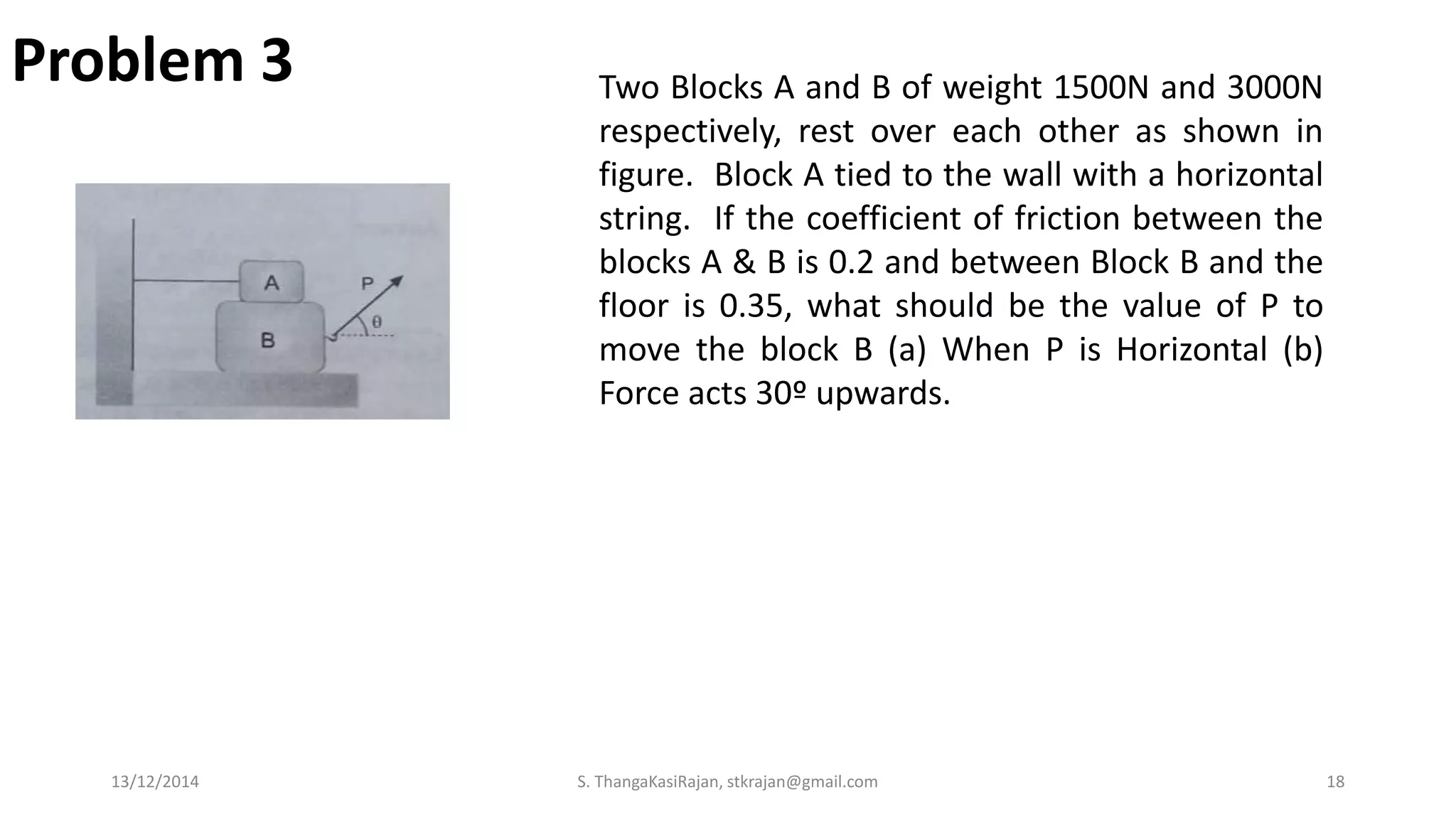
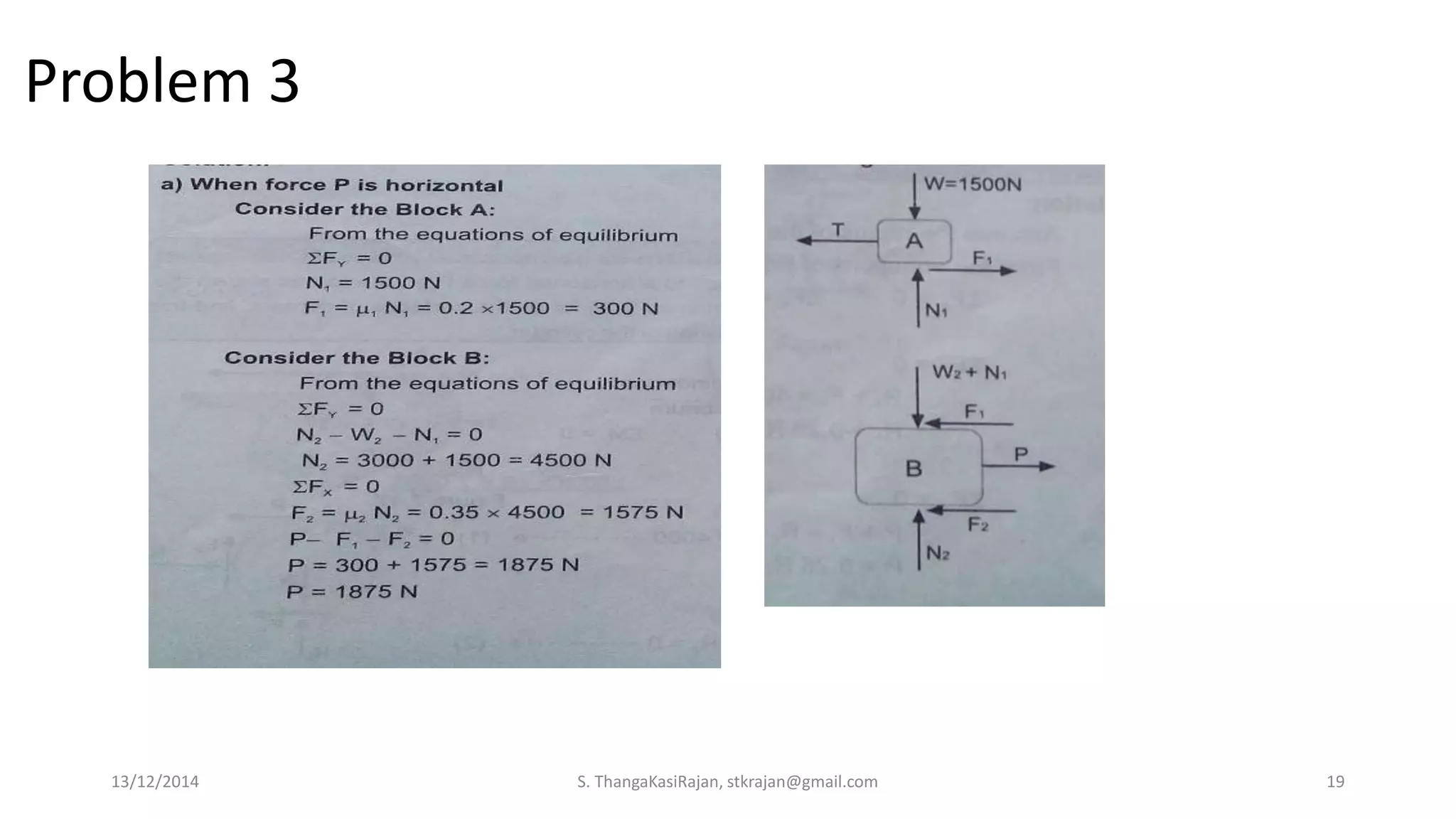
Problem 3 Two Blocks A and B of weight 1500N and 3000N
respectively, rest over each other as shown in
figure. Block A tied to the wall with a horizontal
string. If the coefficient of friction between the
blocks A & B is 0.2 and between Block B and the
floor is 0.35, what should be the value of P to
move the block B (a) When P is Horizontal (b)
Force acts 30º upwards.
13/12/2014 S. ThangaKasiRajan, stkrajan@gmail.com 18
Problem 3
13/12/2014 S. ThangaKasiRajan, stkrajan@gmail.com 19
Problem 3
13/12/2014 S. ThangaKasiRajan, stkrajan@gmail.com 20
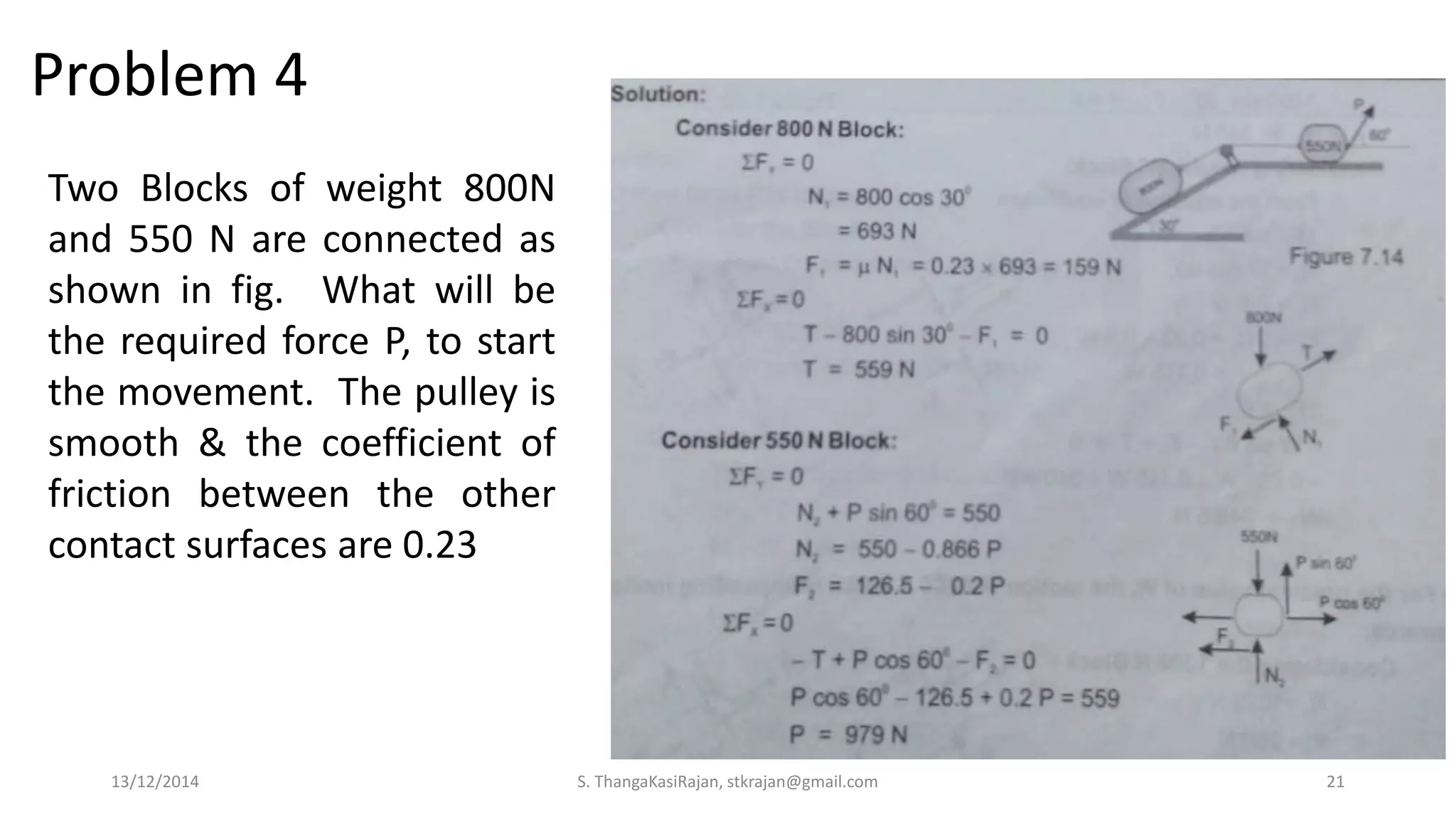
Problem 4
Two Blocks of weight 800N
and 550 N are connected as
shown in fig. What will be
the required force P, to start
the movement. The pulley is
smooth & the coefficient of
friction between the other
contact surfaces are 0.23
13/12/2014 S. ThangaKasiRajan, stkrajan@gmail.com 21
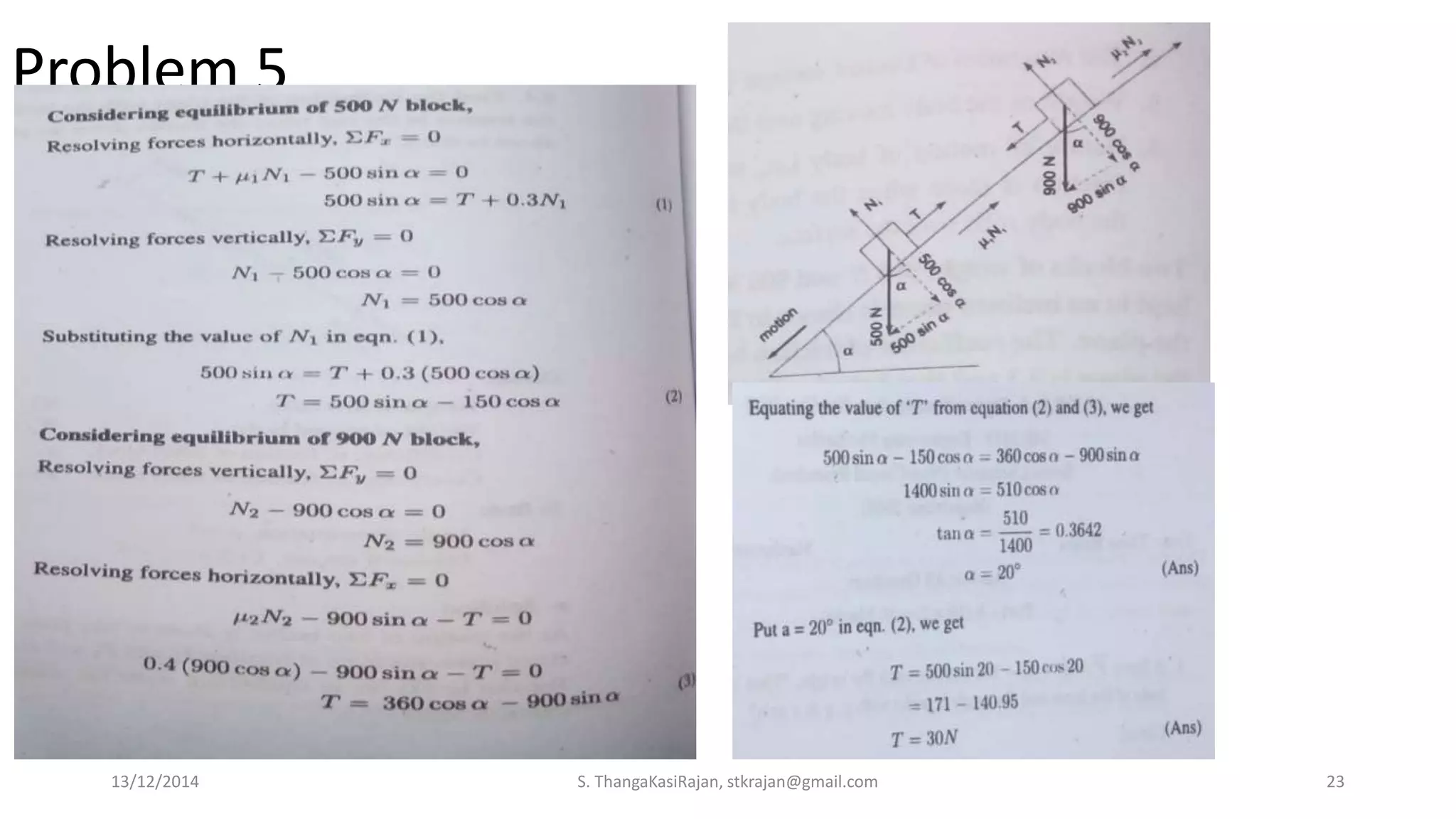
Problem 5
Two blocks of weight 500 N and 900N
connected by a rod are kept in an
inclined plane shown in the figure. The
rod is parallel to the plane. The
coefficient of friction between 500 N
blocks and the plane is 0.3 and that
between 900 N blocks and the plane is
0.4. find the inclination of the plane
with the horizontal and the tension in
the rod when the motion down the
plane is just about to start.
13/12/2014 S. ThangaKasiRajan, stkrajan@gmail.com 22
Problem 5
13/12/2014 S. ThangaKasiRajan, stkrajan@gmail.com 23
Two blocks of A & B of mass 50 kg and 100 kg respectively are
connected by a string C which passes through a frictionless
pulley connected with the fixed wall by another string D as
shown in the figure. Find the force P required to pull the block
B. Also find the tension in the string D. Take coefficient of
friction at all contact surfaces as 0.3
Problems for practice
Block A weighing 1000 N rests on a rough inclined
plane whose inclination to the horizontal is 45°. It
is connected to another block B, weighing 3000 N
rests on a rough horizontal plane by a weightless
rigid bar inclined at an angle of 30° to the
horizontal as shown in fig. Find the horizontal
force required to be applied to the block B just to
move the block A in upward direction. Assume
angle of friction as 15° at all surfaces where there
is sliding.
13/12/2014 S. ThangaKasiRajan, stkrajan@gmail.com 24
References
1. Ferdinand P Beer & E.Russell Johnston “VECTOR MECHANICS FOR
ENGINEERS STATICS & Dynamics”, (Ninth Edition) Tata McGraw Hill
Education Private Limited, New Delhi.
2. Engineering Mechanics – Statics & Dynamics by S.Nagan,
M.S.Palanichamy, Tata McGraw-Hill (2001).
02/01/2017 S.ThangaKasiRajan, stkrajan@gmail.com 25
Thank you
Any Queries contact
S.Thanga Kasi Rajan
Assistant Professor
Department of Mechanical Engineering
Kamaraj College of Engineering & Technology,
Virudhunagar – 626001.
Tamil Nadu, India
Email : stkrajan@gmail.com
02/01/2017 S.ThangaKasiRajan, stkrajan@gmail.com 26

Unit 5 Friction

  • 1.
    ENGINEERING MECHANICS Unit –V Friction by S.Thanga Kasi Rajan Assistant Professor Department of Mechanical Engineering Kamaraj College of Engineering & Technology, Virudhunagar – 626001. Tamil Nadu, India Email : stkrajan@gmail.com
  • 2.
    • Friction isa force between two surfaces that are sliding, or trying to slide across one another, for example when you try to push a toy car along the floor. • Friction always works in the direction opposite from the direction of the motion of the object. It always parallel to the plane of contact. Moving Friction Friction 13/12/2014 S. ThangaKasiRajan, stkrajan@gmail.com 2
  • 3.
    • The MajorCause of the friction is the interlocking of minute projections on the surfaces which opposes the relative motion. Reason for Friction The amount of friction depends on the materials from which the two surfaces are made. The rougher the surface, the more friction is produced 13/12/2014 S. ThangaKasiRajan, stkrajan@gmail.com 3
  • 4.
    Types of Friction 13/12/2014S. ThangaKasiRajan, stkrajan@gmail.com 4
  • 5.
    FRICTION The Resistance offeredby the surface (due to ir-regularities) against motion of a body by the system to moving the system. In fluid mechanics, resistance offered by the fluid (within the system layer to layer) itself is known as Viscosity. Due to the frictional force our effort to do particular work is being increased. Friction is must for the operation of Belt, Clutch, Screw Jack, Brake, Automobile etc., Friction is undesirable in the case of Bearing. Power lost due to friction is converted in to heat. 13/12/2014 S. ThangaKasiRajan, stkrajan@gmail.com 5
  • 6.
    The Laws ofDry Friction • Maximum static-friction force and kinetic- friction force are: - proportional to normal force - dependent on type and condition of contact surfaces - independent of contact area 13/12/2014 S. ThangaKasiRajan, stkrajan@gmail.com 6
  • 7.
    Coefficients of Friction •Maximum static-friction force: NF sm  • Kinetic-friction force: sk kk NF   75.0  13/12/2014 S. ThangaKasiRajan, stkrajan@gmail.com 7
  • 8.
    Friction Vs AppliedForce • Four situations can occur when a rigid body is in contact with a horizontal surface: • No friction, (Px = 0) • No motion, (Px < Fm) • Motion impending, (Px = Fm) • Motion, (Px > Fm) 13/12/2014 S. ThangaKasiRajan, stkrajan@gmail.com 8
  • 9.
    Angles of Friction 8- 9 • It is sometimes convenient to replace normal force N and friction force F by their resultant R: • No friction • Motion impending• No motion ss sm s N N N F      tan tan • Motion kk kk k N N N F      tan tan 13/12/2014 S. ThangaKasiRajan, stkrajan@gmail.com
  • 10.
    Friction in InclinedPlane • Consider block of weight W resting on board with variable inclination angle q. • No friction • No motion • Motion impending • Motion 13/12/2014 S. ThangaKasiRajan, stkrajan@gmail.com 10
  • 11.
    Problems Involving DryFriction • All applied forces known • Coefficient of static friction is known • Determine whether body will remain at rest or slide • All applied forces known • Motion is impending • Determine value of coefficient of static friction. • Coefficient of static friction is known • Motion is impending • Determine magnitude or direction of one of the applied forces13/12/2014 S. ThangaKasiRajan, stkrajan@gmail.com 11
  • 12.
    Problem 1 A 500-Nforce acts as shown on a 1.5 kN block placed on an inclined plane. The coefficients of friction between the block and plane are s = 0.25 and k = 0.20. Determine whether the block is in equilibrium and find the value of the friction force. • Calculate maximum friction force and compare with friction force required for equilibrium. If it is greater, block will not slide. • If maximum friction force is less than friction force required for equilibrium, block will slide. Calculate kinetic-friction force. 13/12/2014 S. ThangaKasiRajan, stkrajan@gmail.com
  • 13.
    Problem 1 • MaximumFriction   N375N150025.0  msm FNF  The block will slide down the plane. Required friction for Equilibrium :0 xF   0N1500-N)500( 5 3 5 4  F N500F :0 yF     0N500N500- 5 3 5 4 N N1500N Since Fm < Freq block will slide. Hence Calculate kinetic- friction force. Negative sign indicates our assumed direction is wrong. Hence the reverse the direction of force 13/12/2014 S. ThangaKasiRajan, stkrajan@gmail.com 13
  • 14.
    Problem 1  N150020.0 NFF kkactual  N300actualF There fore actual friction 13/12/2014 S. ThangaKasiRajan, stkrajan@gmail.com 14
  • 15.
    Problem 2 Two Blocksof Weight W and 1200N, rests on two identical inclined planes AB and BC inclined at 60º and 30º to the horizontal meeting at the point B, respectively. They are connected by a rope passing over a smooth pulley at B. If the coefficient of friction between the block and the plane AB is 0.23 and that between the block and the plane BC is 0.25, find the least and greatest value of W for the system to be in equilibrium. 13/12/2014 S. ThangaKasiRajan, stkrajan@gmail.com 15
  • 16.
    Problem 2 13/12/2014 S.ThangaKasiRajan, stkrajan@gmail.com 16
  • 17.
    Problem 2 13/12/2014 S.ThangaKasiRajan, stkrajan@gmail.com 17
  • 18.
    Problem 3 TwoBlocks A and B of weight 1500N and 3000N respectively, rest over each other as shown in figure. Block A tied to the wall with a horizontal string. If the coefficient of friction between the blocks A & B is 0.2 and between Block B and the floor is 0.35, what should be the value of P to move the block B (a) When P is Horizontal (b) Force acts 30º upwards. 13/12/2014 S. ThangaKasiRajan, stkrajan@gmail.com 18
  • 19.
    Problem 3 13/12/2014 S.ThangaKasiRajan, stkrajan@gmail.com 19
  • 20.
    Problem 3 13/12/2014 S.ThangaKasiRajan, stkrajan@gmail.com 20
  • 21.
    Problem 4 Two Blocksof weight 800N and 550 N are connected as shown in fig. What will be the required force P, to start the movement. The pulley is smooth & the coefficient of friction between the other contact surfaces are 0.23 13/12/2014 S. ThangaKasiRajan, stkrajan@gmail.com 21
  • 22.
    Problem 5 Two blocksof weight 500 N and 900N connected by a rod are kept in an inclined plane shown in the figure. The rod is parallel to the plane. The coefficient of friction between 500 N blocks and the plane is 0.3 and that between 900 N blocks and the plane is 0.4. find the inclination of the plane with the horizontal and the tension in the rod when the motion down the plane is just about to start. 13/12/2014 S. ThangaKasiRajan, stkrajan@gmail.com 22
  • 23.
    Problem 5 13/12/2014 S.ThangaKasiRajan, stkrajan@gmail.com 23
  • 24.
    Two blocks ofA & B of mass 50 kg and 100 kg respectively are connected by a string C which passes through a frictionless pulley connected with the fixed wall by another string D as shown in the figure. Find the force P required to pull the block B. Also find the tension in the string D. Take coefficient of friction at all contact surfaces as 0.3 Problems for practice Block A weighing 1000 N rests on a rough inclined plane whose inclination to the horizontal is 45°. It is connected to another block B, weighing 3000 N rests on a rough horizontal plane by a weightless rigid bar inclined at an angle of 30° to the horizontal as shown in fig. Find the horizontal force required to be applied to the block B just to move the block A in upward direction. Assume angle of friction as 15° at all surfaces where there is sliding. 13/12/2014 S. ThangaKasiRajan, stkrajan@gmail.com 24
  • 25.
    References 1. Ferdinand PBeer & E.Russell Johnston “VECTOR MECHANICS FOR ENGINEERS STATICS & Dynamics”, (Ninth Edition) Tata McGraw Hill Education Private Limited, New Delhi. 2. Engineering Mechanics – Statics & Dynamics by S.Nagan, M.S.Palanichamy, Tata McGraw-Hill (2001). 02/01/2017 S.ThangaKasiRajan, stkrajan@gmail.com 25
  • 26.
    Thank you Any Queriescontact S.Thanga Kasi Rajan Assistant Professor Department of Mechanical Engineering Kamaraj College of Engineering & Technology, Virudhunagar – 626001. Tamil Nadu, India Email : stkrajan@gmail.com 02/01/2017 S.ThangaKasiRajan, stkrajan@gmail.com 26