A shaft is said to be in torsion, when equal and opposite
torques are applied at the two ends of the shaft. Due to
the application of the torques at the two ends, the shaft
is subjected to a twisting moment. This causes the shear
stresses and shear strains in the material of the shaft.
 The torque is equal to the product of the force applied
(tangentially to the ends of a shaft) and radius of the
shaft.
When subjected to torsion, every cross-section of
circular (solid or hollow) shaft remains plane and
undistorted. This is due to axisymmetry of cross section.
 Cross-sections of noncircular shafts are distorted when
subjected to torsion – since no axisymmetry.
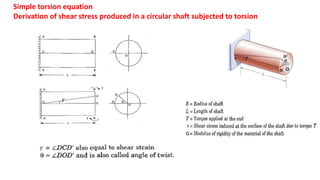
Simple torsion equation
Derivation of shear stress produced in a circular shaft subjected to torsion
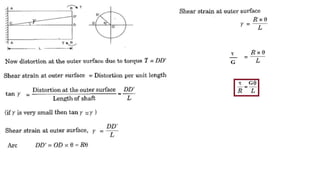
The shear stress is maximum at the outer surface and shear
stress is zero at the axis of the shaft.
𝜏 =
𝑮𝜽
𝑳
R
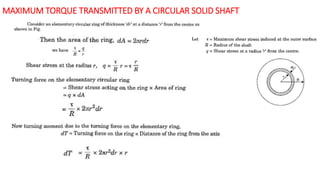
MAXIMUM TORQUE TRANSMITTED BY A CIRCULAR SOLID SHAFT
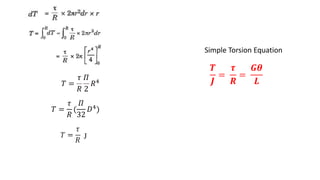
𝑇 =
𝜏
𝑅
𝛱
2
𝑅4
𝑇 =
𝜏
𝑅
(
𝛱
32
𝐷4)
𝑻
𝑱
=
𝝉
𝑹
=
𝑮𝜽
𝑳
Simple Torsion Equation
POLAR MODULUS
Polar modulus is defined as the ratio of the polar moment of inertia to the
radius of the shaft. It is also called torsional section modulus. It is denoted by
Zp
Zp =
J
𝐑
Polar section modulus for a solid shaft
Polar section modulus for a hollow shaft
STRENGTH OF A SHAFT AND TORSIONAL RIGIDITY
The strength of a shaft means the maximum torque or maximum
power the shaft can transmit.
Torsional rigidity or stiffness of the shaft is defined as the product of
modulus of Rigidity (G) and polar moment of inertia of the shaft(J).
Torsional Rigidity = G. J
Torsional rigidity is also defined as the torque required to produce a twist of one radian per unit length
of the shaft.
Torsional stiffness
The resistance offered by the loaded member to torsional deflection or
twisting is referred to as torsional stiffness.
Q2. A solid shaft of 150 mm diameter is used to transmit torque. Find the
maximum torque transmitted by the shaft if the maximum shear stress induced to
the shaft is 45N/mm2
𝑇 = 𝑧 𝑝 𝜏
Q2. The shearing stress in a solid shaft is not to exceed 40 N/mm2 when the torque
transmitted is 20000 N-m. Determine the minimum diameter of the shaft.
Q3. In a hollow circular shaft of outer and inner diameters of 20 cm and 10 cm
respectively, the shear stress is not to exceed 40 N/mm2 . Find the maximum
torque which the shaft can safely transmit.
Assumptions in simple torsion equation:
1.The material of the shaft is uniform throughout.
2. The twist along the shaft is uniform.
3. The shaft is of uniform circular section throughout.
4. Cross-sections of the shaft, which are plane before twist remain
plane after twist.
5. All radii which are straight before twist remain straight after twist.

Simple torsion equation

  • 2.
    A shaft issaid to be in torsion, when equal and opposite torques are applied at the two ends of the shaft. Due to the application of the torques at the two ends, the shaft is subjected to a twisting moment. This causes the shear stresses and shear strains in the material of the shaft.  The torque is equal to the product of the force applied (tangentially to the ends of a shaft) and radius of the shaft.
  • 3.
    When subjected totorsion, every cross-section of circular (solid or hollow) shaft remains plane and undistorted. This is due to axisymmetry of cross section.  Cross-sections of noncircular shafts are distorted when subjected to torsion – since no axisymmetry.
  • 4.
    Simple torsion equation Derivationof shear stress produced in a circular shaft subjected to torsion
  • 6.
    The shear stressis maximum at the outer surface and shear stress is zero at the axis of the shaft. 𝜏 = 𝑮𝜽 𝑳 R
  • 7.
    MAXIMUM TORQUE TRANSMITTEDBY A CIRCULAR SOLID SHAFT
  • 8.
  • 9.
    POLAR MODULUS Polar modulusis defined as the ratio of the polar moment of inertia to the radius of the shaft. It is also called torsional section modulus. It is denoted by Zp Zp = J 𝐑
  • 10.
    Polar section modulusfor a solid shaft Polar section modulus for a hollow shaft
  • 11.
    STRENGTH OF ASHAFT AND TORSIONAL RIGIDITY The strength of a shaft means the maximum torque or maximum power the shaft can transmit. Torsional rigidity or stiffness of the shaft is defined as the product of modulus of Rigidity (G) and polar moment of inertia of the shaft(J). Torsional Rigidity = G. J Torsional rigidity is also defined as the torque required to produce a twist of one radian per unit length of the shaft.
  • 12.
    Torsional stiffness The resistanceoffered by the loaded member to torsional deflection or twisting is referred to as torsional stiffness.
  • 13.
    Q2. A solidshaft of 150 mm diameter is used to transmit torque. Find the maximum torque transmitted by the shaft if the maximum shear stress induced to the shaft is 45N/mm2 𝑇 = 𝑧 𝑝 𝜏
  • 14.
    Q2. The shearingstress in a solid shaft is not to exceed 40 N/mm2 when the torque transmitted is 20000 N-m. Determine the minimum diameter of the shaft.
  • 15.
    Q3. In ahollow circular shaft of outer and inner diameters of 20 cm and 10 cm respectively, the shear stress is not to exceed 40 N/mm2 . Find the maximum torque which the shaft can safely transmit.
  • 16.
    Assumptions in simpletorsion equation: 1.The material of the shaft is uniform throughout. 2. The twist along the shaft is uniform. 3. The shaft is of uniform circular section throughout. 4. Cross-sections of the shaft, which are plane before twist remain plane after twist. 5. All radii which are straight before twist remain straight after twist.