ENGINEERING MECHANICS
Unit – I
Basics and Statics of Particles
by
S.Thanga Kasi Rajan
Assistant Professor
Department of Mechanical Engineering
Kamaraj College of Engineering & Technology,
Virudhunagar – 626001.
Tamil Nadu, India
Email : stkrajan@gmail.com
INTRODUCTION
02/01/2017 S.ThangaKasiRajan, stkrajan@gmail.com 2
INTRODUCTION
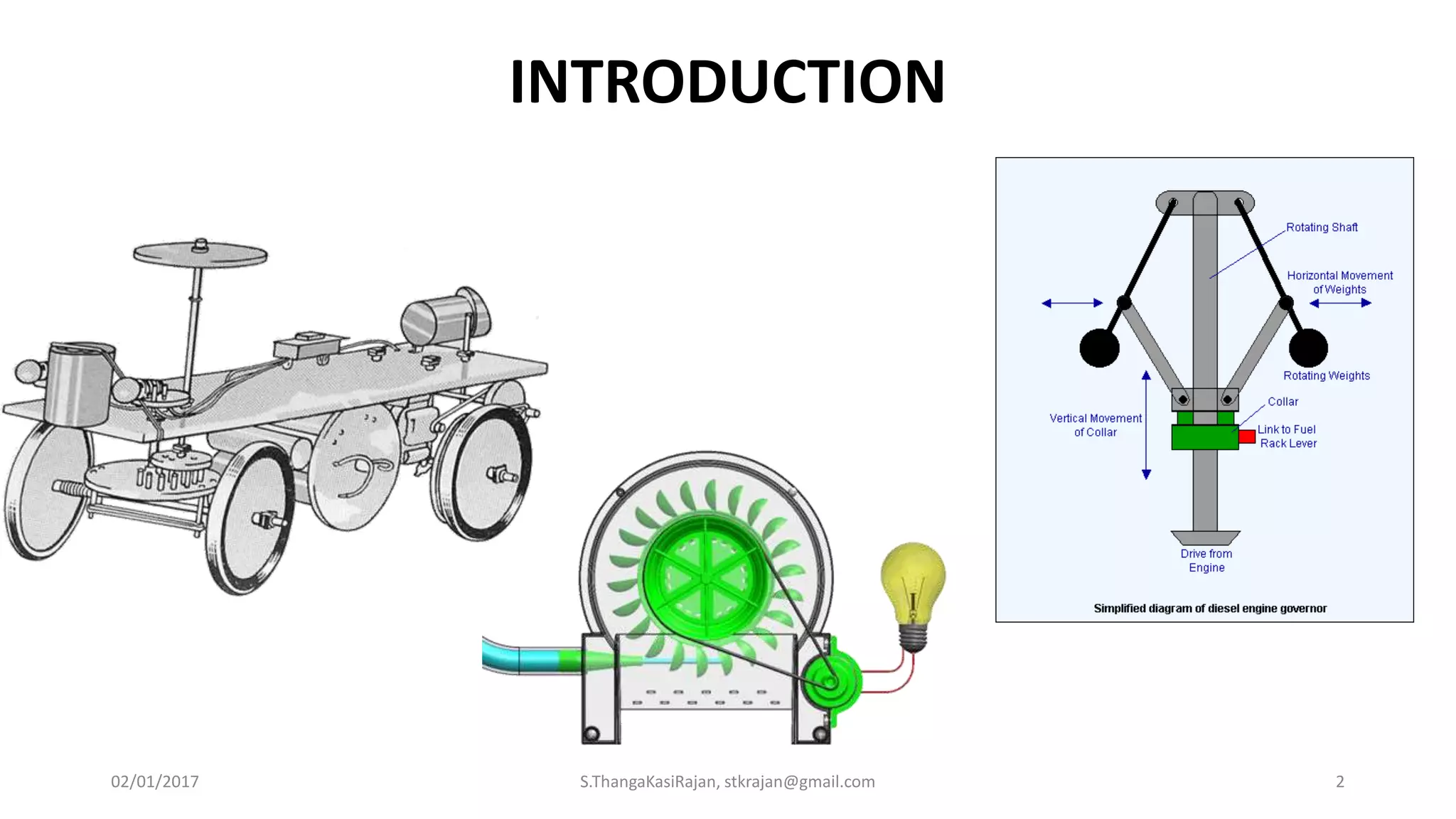
To deal with the above situations, we need to know about
engineering mechanics
Mechanics is the foundation of most engineering
sciences and is an indispensable prerequisite to their study.
Mechanics is the science which describes and predicts the
conditions of rest or motion of bodies under the action of forces.
02/01/2017 S.ThangaKasiRajan, stkrajan@gmail.com 3
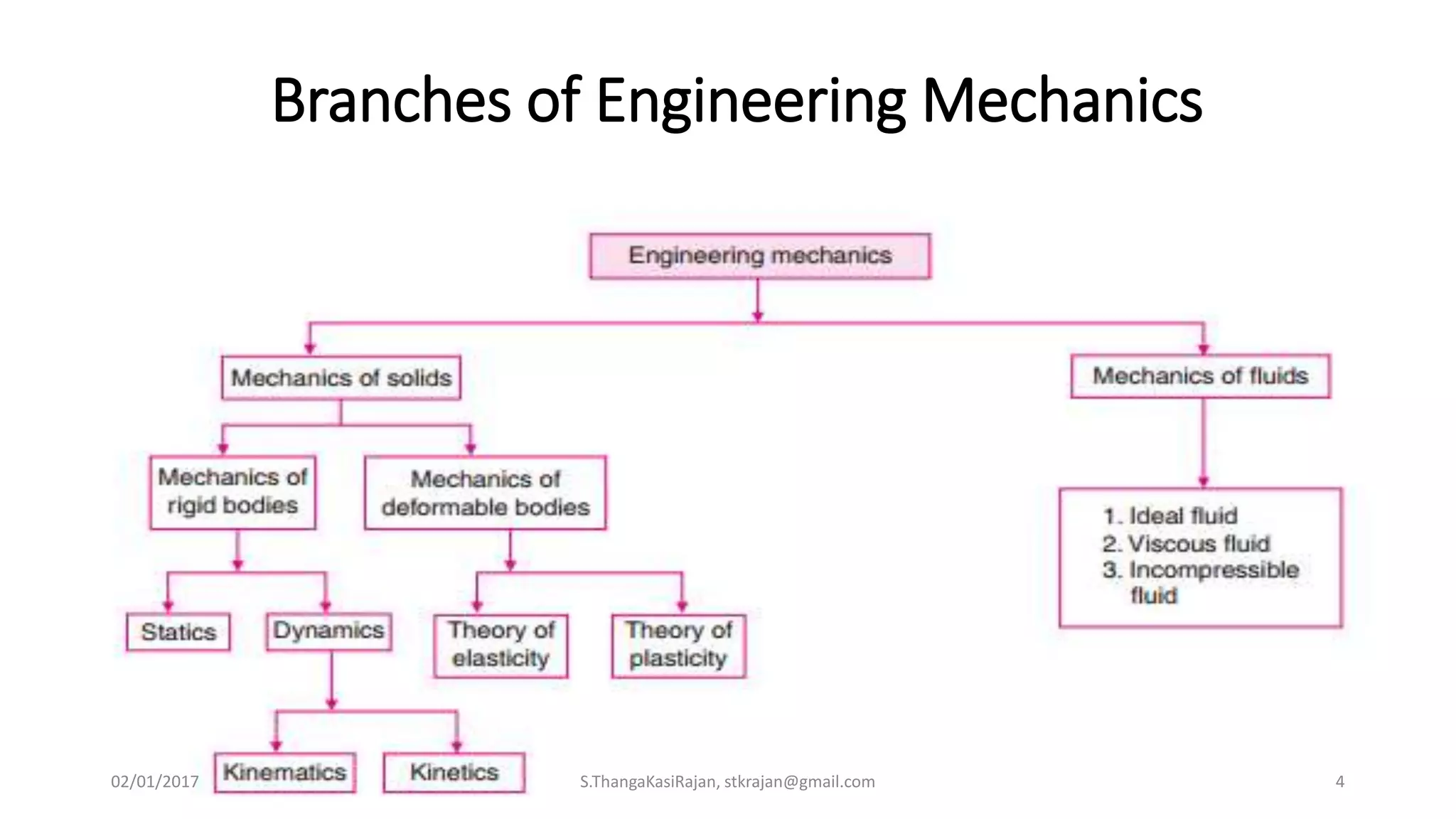
Branches of Engineering Mechanics
02/01/2017 S.ThangaKasiRajan, stkrajan@gmail.com 4
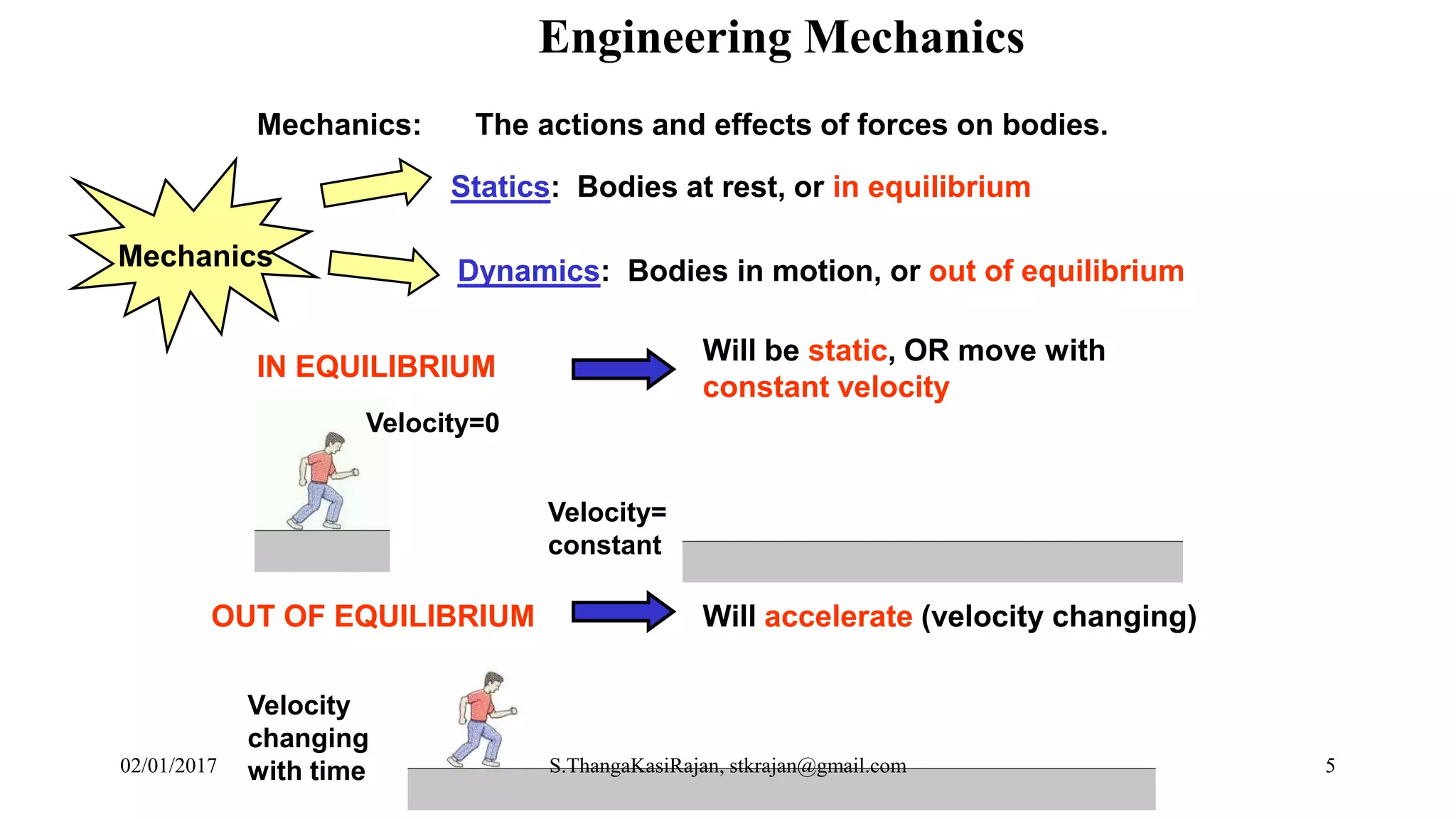
Mechanics: The actions and effects of forces on bodies.
Mechanics
Statics: Bodies at rest, or in equilibrium
Dynamics: Bodies in motion, or out of equilibrium
IN EQUILIBRIUM
Will be static, OR move with
constant velocity
OUT OF EQUILIBRIUM Will accelerate (velocity changing)
Velocity=0
Velocity=
constant
Velocity
changing
with time
Engineering Mechanics
02/01/2017 S.ThangaKasiRajan, stkrajan@gmail.com 5
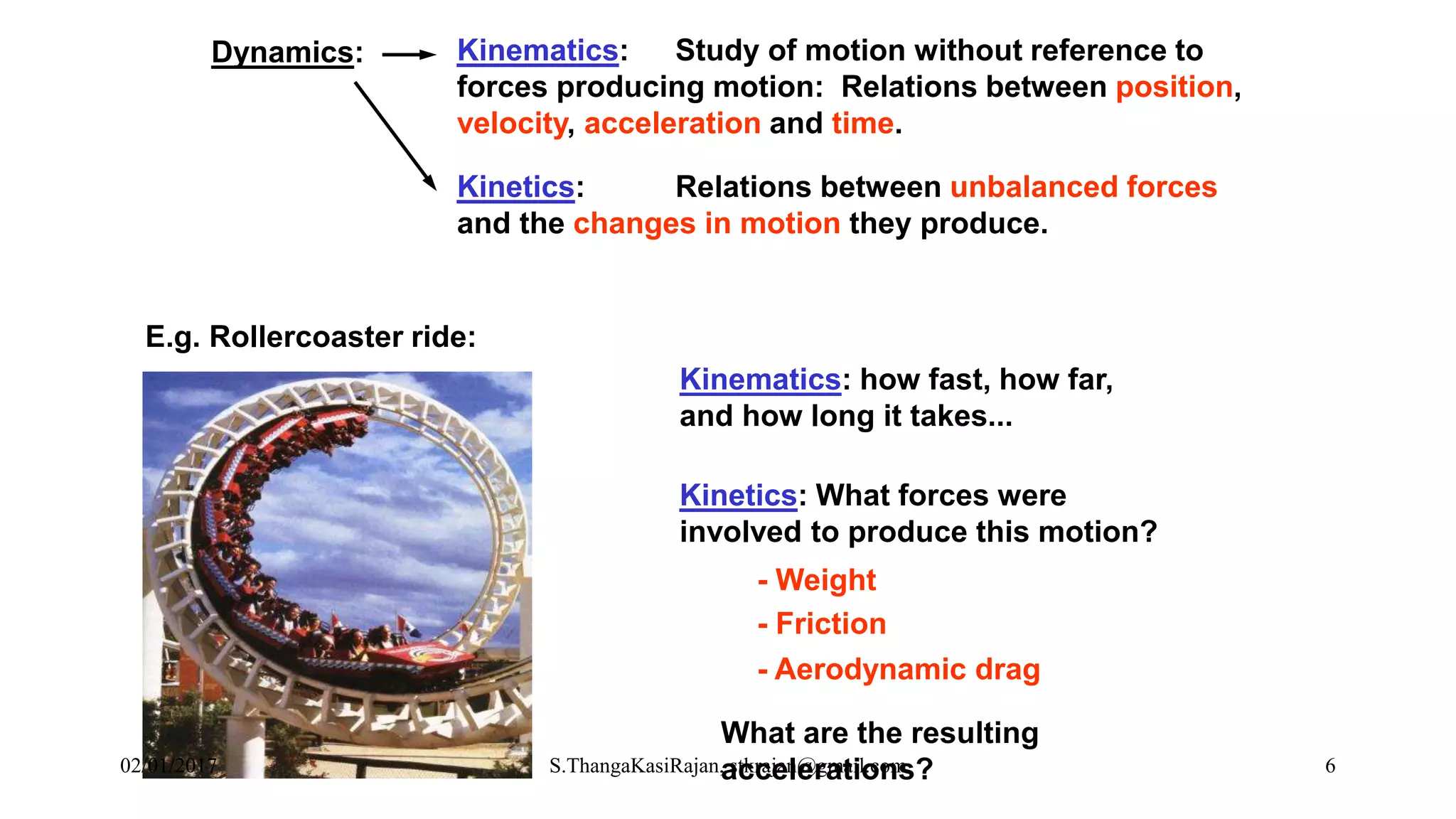
Kinematics: how fast, how far,
and how long it takes...
Kinetics: What forces were
involved to produce this motion?
Dynamics: Kinematics: Study of motion without reference to
forces producing motion: Relations between position,
velocity, acceleration and time.
Kinetics: Relations between unbalanced forces
and the changes in motion they produce.
E.g. Rollercoaster ride:
- Weight
- Friction
- Aerodynamic drag
What are the resulting
accelerations?02/01/2017 S.ThangaKasiRajan, stkrajan@gmail.com 6
Six Fundamental Concept of Mechanics
• Space - associated with the motion or the position of a point P given
in terms of three coordinates measured from a reference point or
origin.
• Time - definition of an event requires specification of the time and
position at which it occurred.
• Mass - used to characterize and compare bodies, e.g., response to
earth’s gravitational attraction and resistance to change in
translational motion.02/01/2017 S.ThangaKasiRajan, stkrajan@gmail.com 7
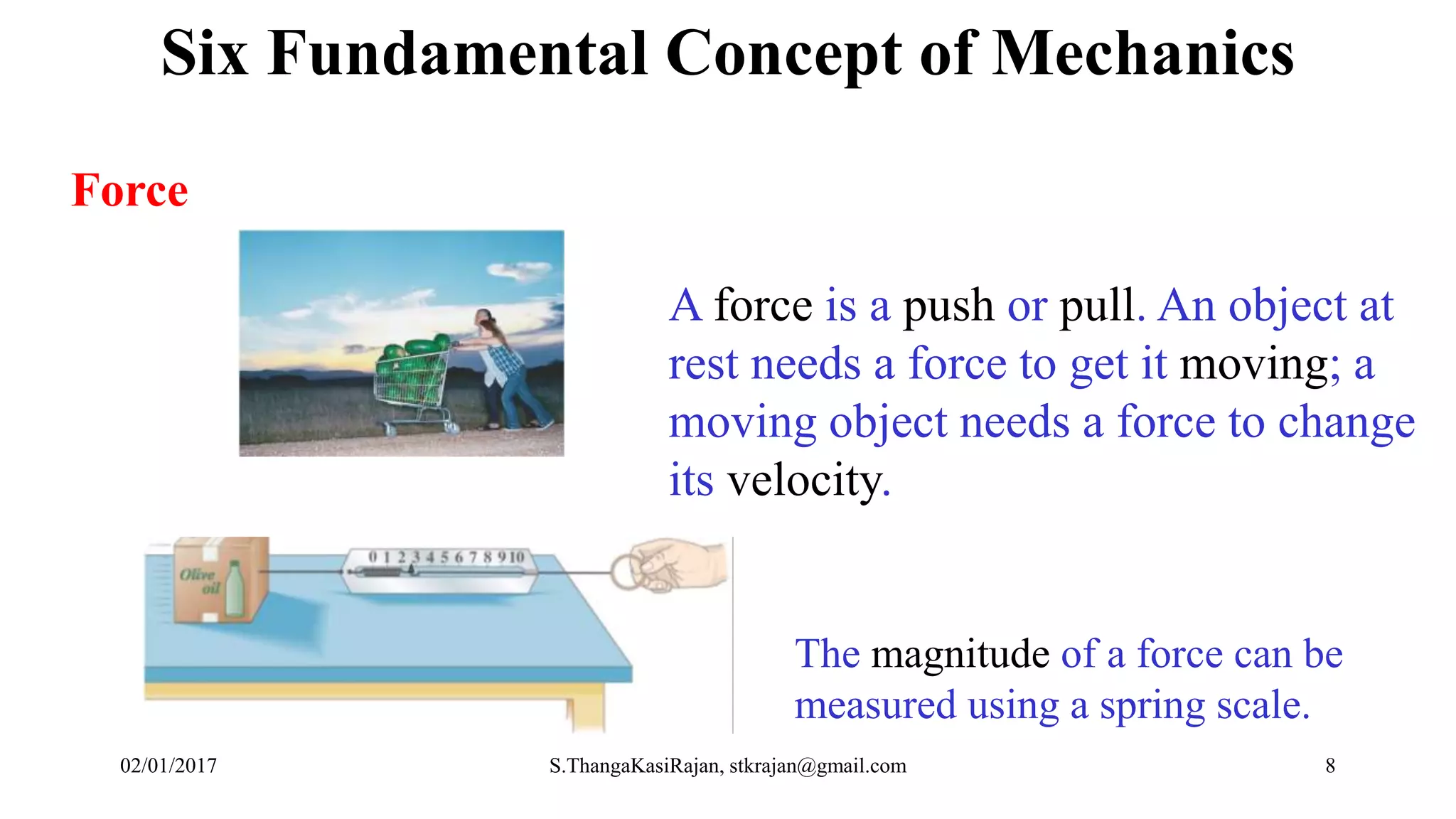
Force
A force is a push or pull. An object at
rest needs a force to get it moving; a
moving object needs a force to change
its velocity.
The magnitude of a force can be
measured using a spring scale.
Six Fundamental Concept of Mechanics
02/01/2017 S.ThangaKasiRajan, stkrajan@gmail.com 8
Six Fundamental Concept of Mechanics
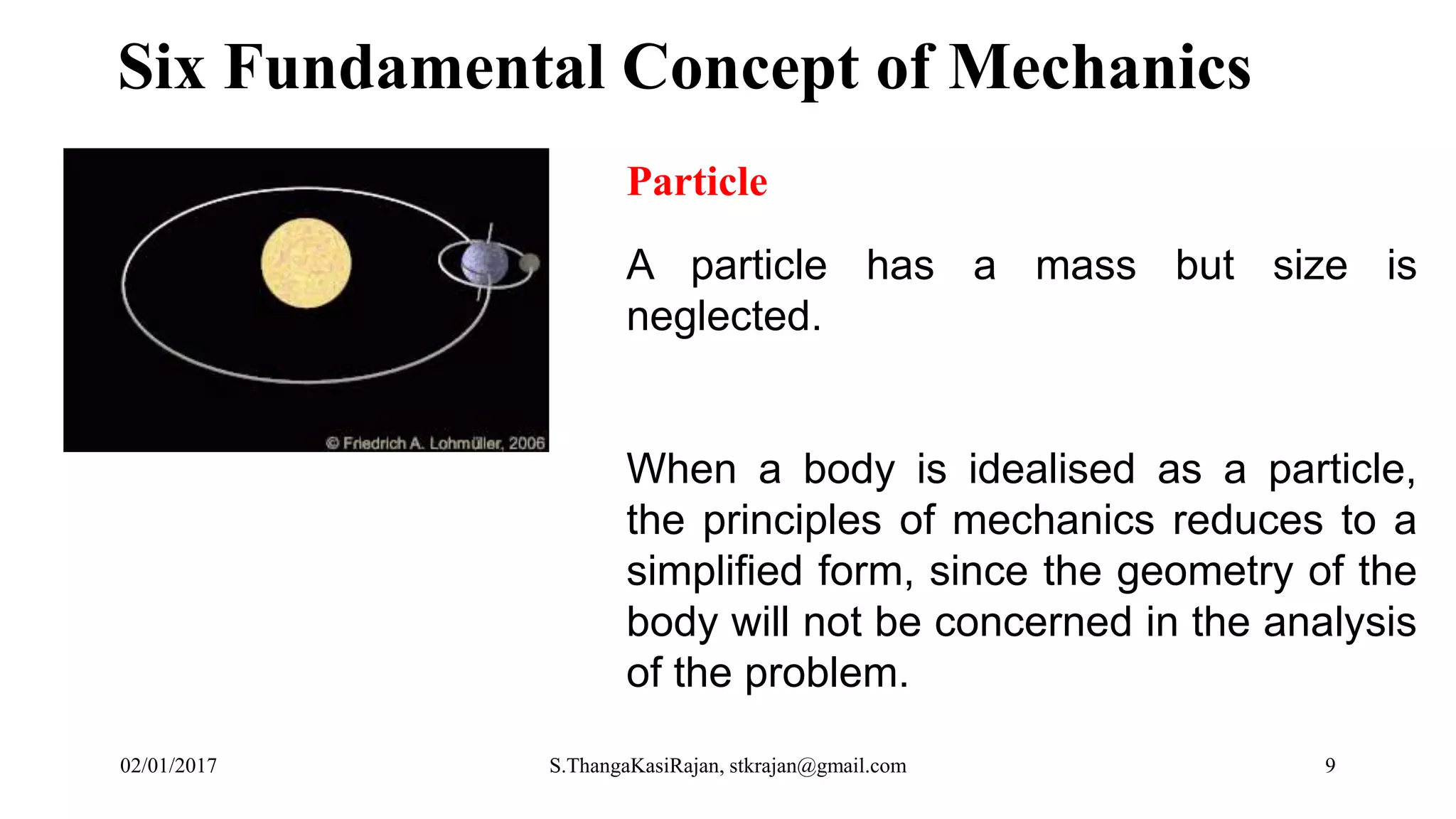
Particle
A particle has a mass but size is
neglected.
When a body is idealised as a particle,
the principles of mechanics reduces to a
simplified form, since the geometry of the
body will not be concerned in the analysis
of the problem.
02/01/2017 S.ThangaKasiRajan, stkrajan@gmail.com 9
Six Fundamental Concept of Mechanics
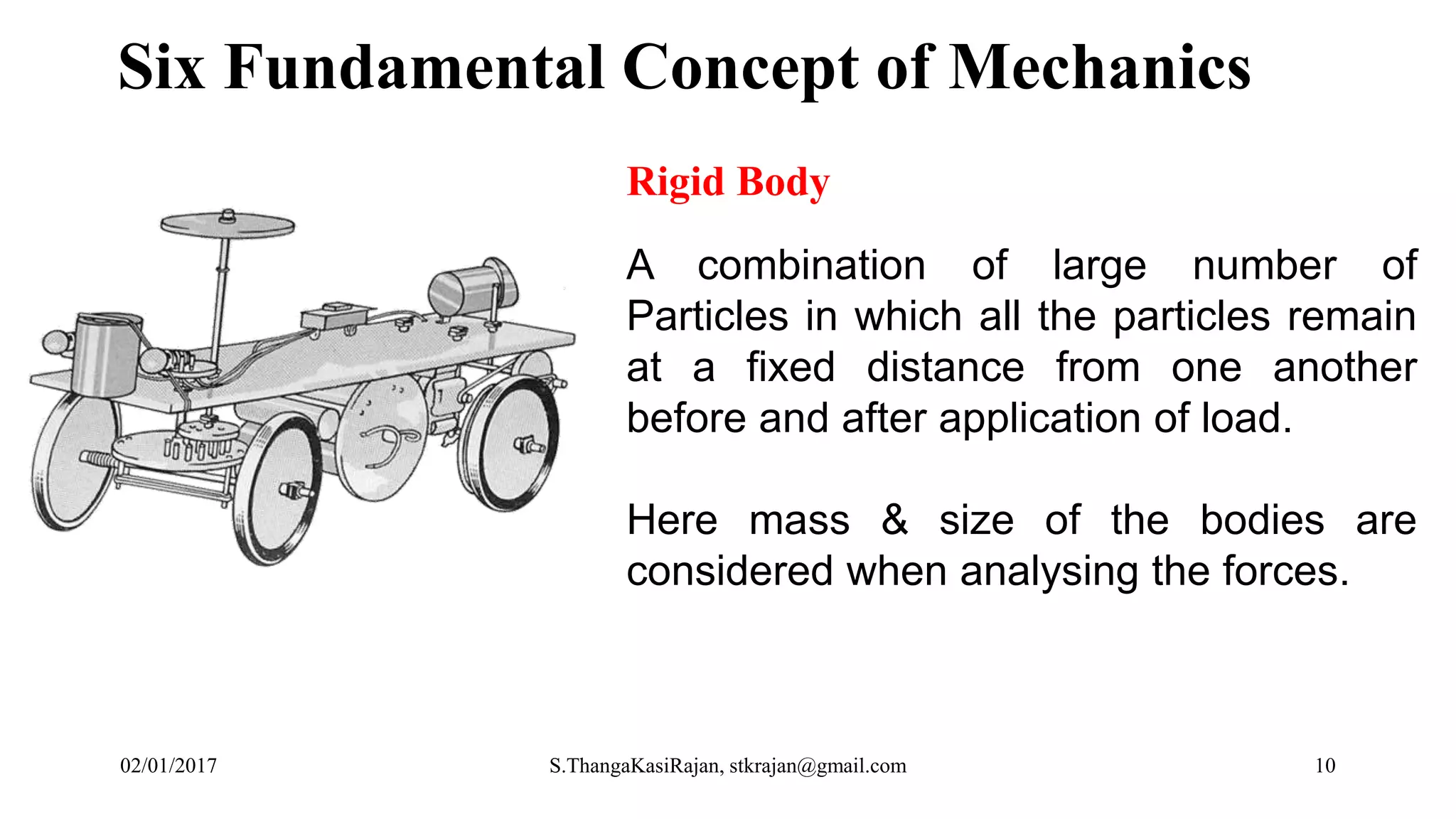
Rigid Body
A combination of large number of
Particles in which all the particles remain
at a fixed distance from one another
before and after application of load.
Here mass & size of the bodies are
considered when analysing the forces.
02/01/2017 S.ThangaKasiRajan, stkrajan@gmail.com 10
Basic Laws of Mechanics
1. Newton’s Law
2. Newton’s Law of Gravitation
3. Triangle Law
4. Parallellogram Law
5. Lami’s Theorem
6. Principle of Transmissibility
02/01/2017 S.ThangaKasiRajan, stkrajan@gmail.com 11
Basic Laws of Mechanics
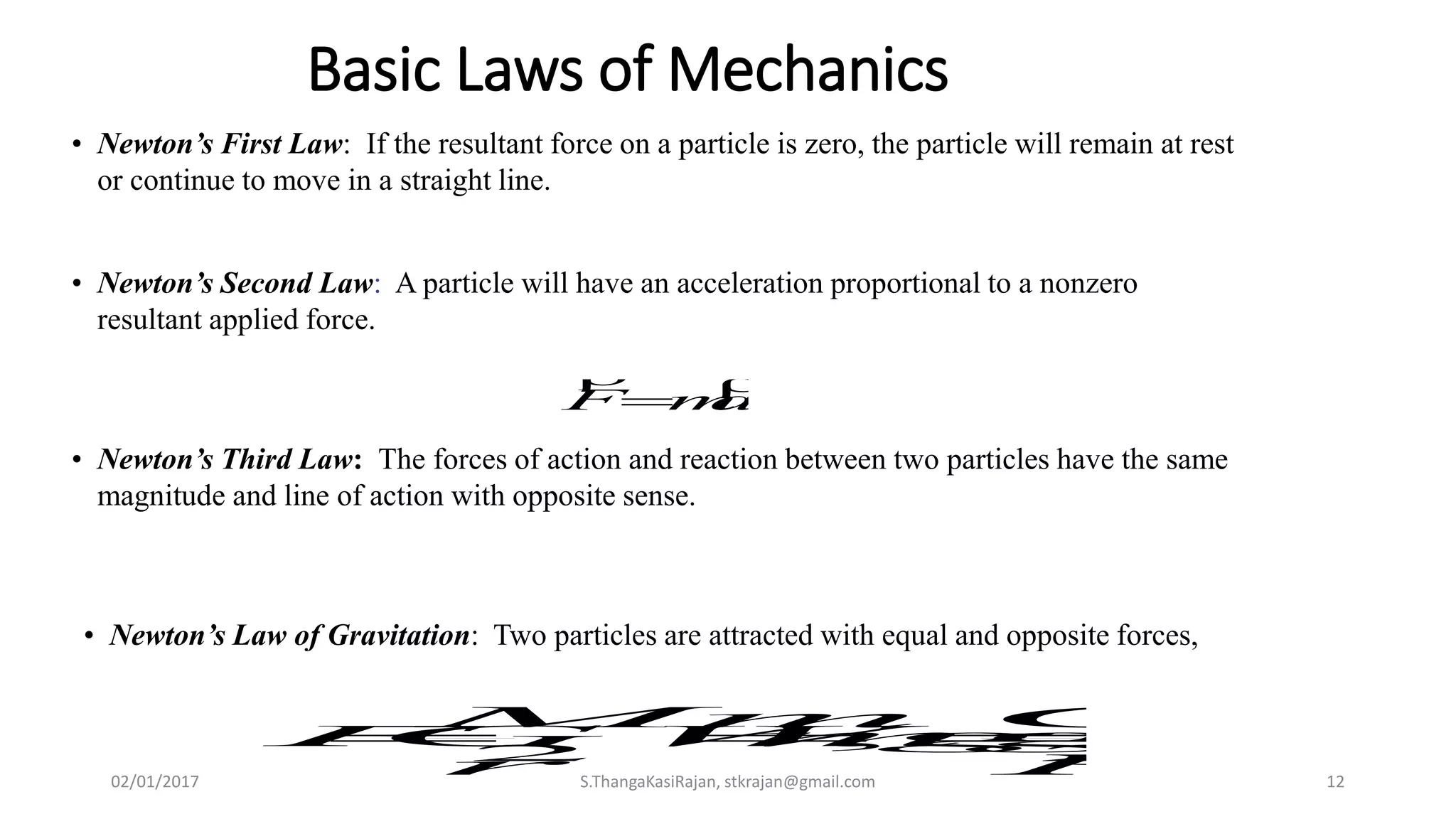
• Newton’s First Law: If the resultant force on a particle is zero, the particle will remain at rest
or continue to move in a straight line.
• Newton’s Third Law: The forces of action and reaction between two particles have the same
magnitude and line of action with opposite sense.
• Newton’s Second Law: A particle will have an acceleration proportional to a nonzero
resultant applied force.
amF


• Newton’s Law of Gravitation: Two particles are attracted with equal and opposite forces,
22
,
R
GM
gmgW
r
Mm
GF 
02/01/2017 S.ThangaKasiRajan, stkrajan@gmail.com 12
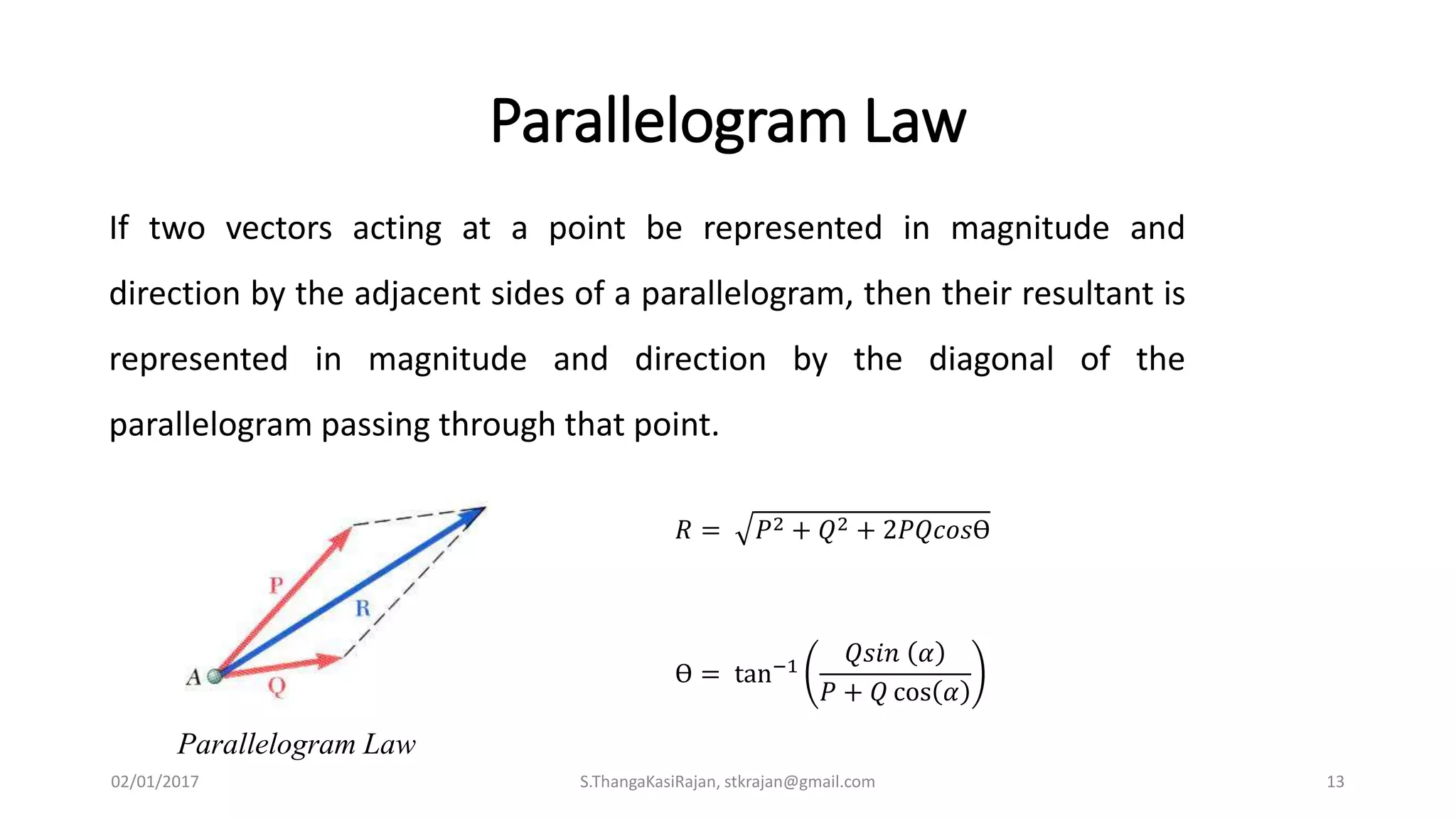
Parallelogram Law
Parallelogram Law
If two vectors acting at a point be represented in magnitude and
direction by the adjacent sides of a parallelogram, then their resultant is
represented in magnitude and direction by the diagonal of the
parallelogram passing through that point.
𝑅 = 𝑃2 + 𝑄2 + 2𝑃𝑄𝑐𝑜𝑠Ө
Ө = tan−1
𝑄𝑠𝑖𝑛 𝛼
𝑃 + 𝑄 cos 𝛼
02/01/2017 S.ThangaKasiRajan, stkrajan@gmail.com 13
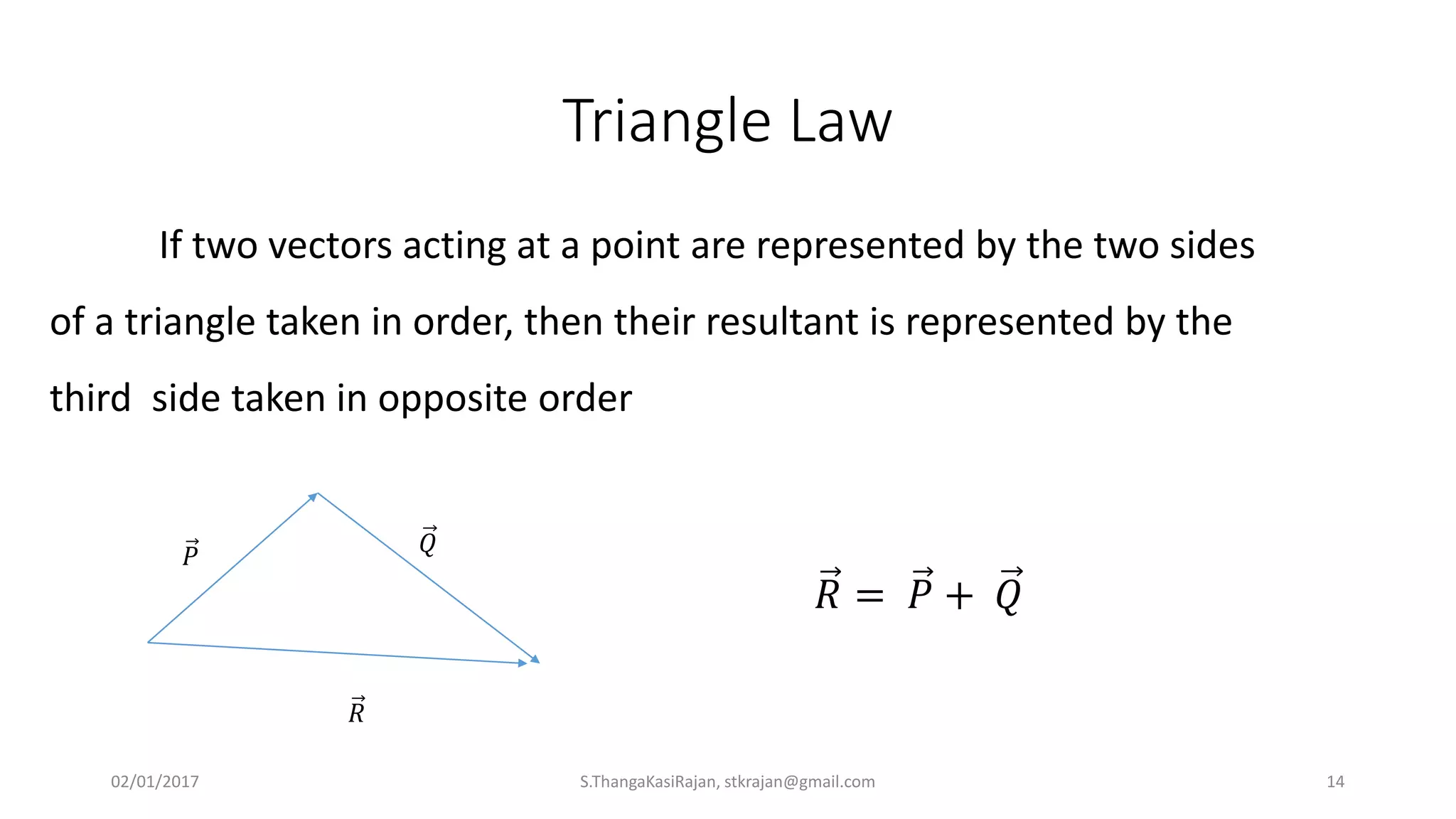
Triangle Law
If two vectors acting at a point are represented by the two sides
of a triangle taken in order, then their resultant is represented by the
third side taken in opposite order
𝑅 = 𝑃 + 𝑄
𝑃 𝑄
𝑅
02/01/2017 S.ThangaKasiRajan, stkrajan@gmail.com 14
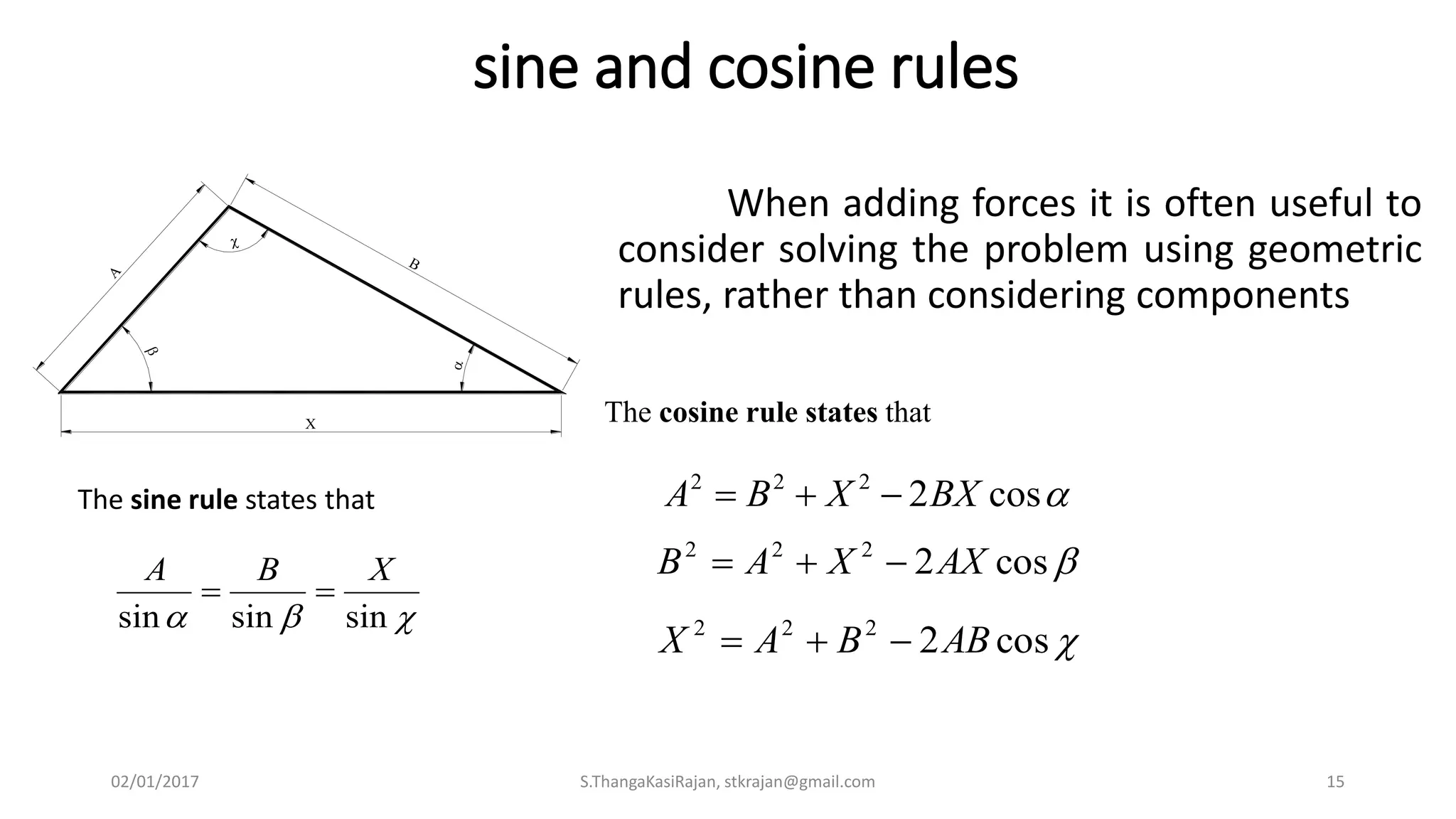
sine and cosine rules
When adding forces it is often useful to
consider solving the problem using geometric
rules, rather than considering components






The sine rule states that
 sinsinsin
XBA

The cosine rule states that
cos2222
BXXBA 
cos2222
AXXAB 
cos2222
ABBAX 
02/01/2017 S.ThangaKasiRajan, stkrajan@gmail.com 15
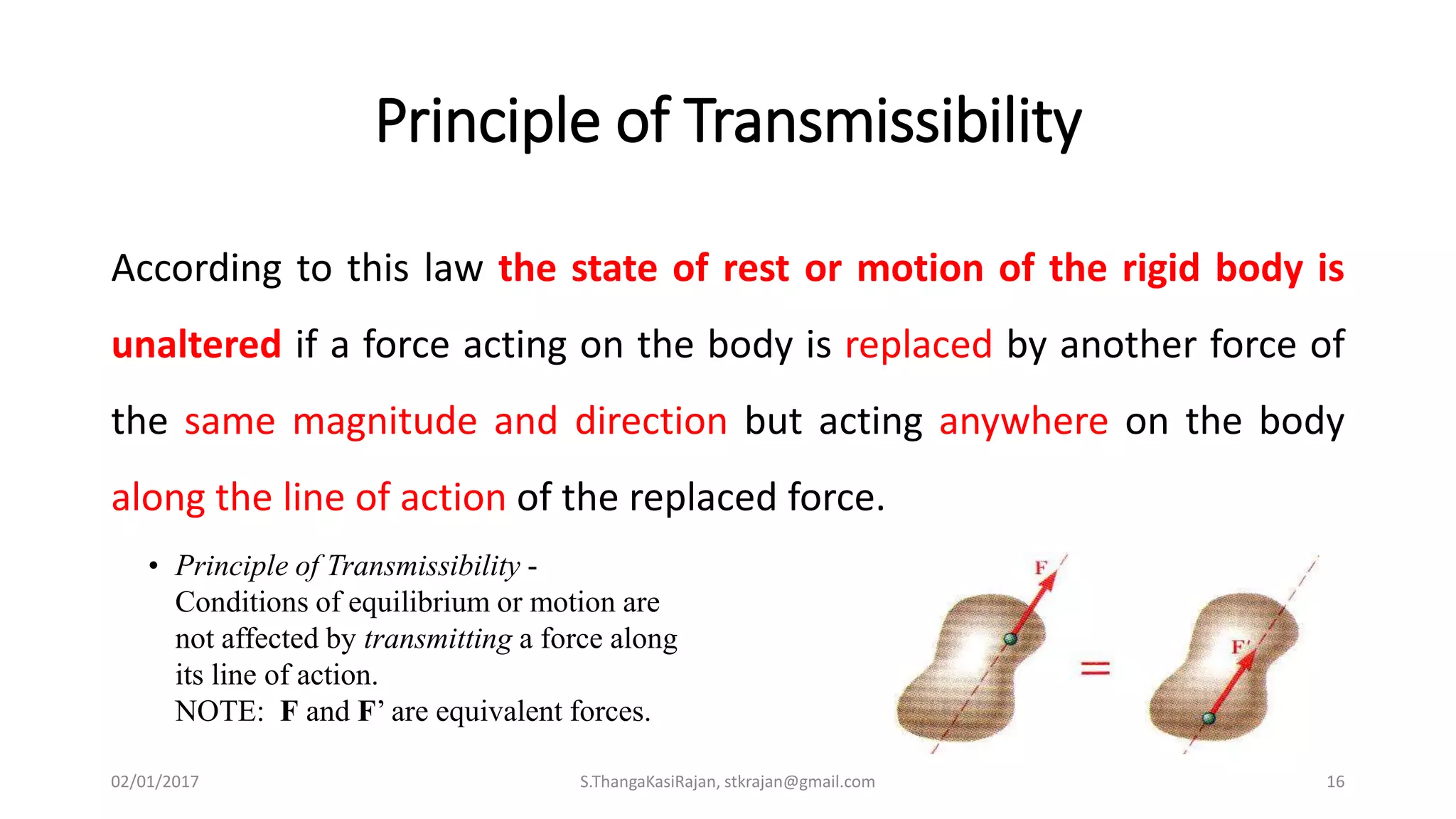
Principle of Transmissibility
According to this law the state of rest or motion of the rigid body is
unaltered if a force acting on the body is replaced by another force of
the same magnitude and direction but acting anywhere on the body
along the line of action of the replaced force.
• Principle of Transmissibility -
Conditions of equilibrium or motion are
not affected by transmitting a force along
its line of action.
NOTE: F and F’ are equivalent forces.
02/01/2017 S.ThangaKasiRajan, stkrajan@gmail.com 16
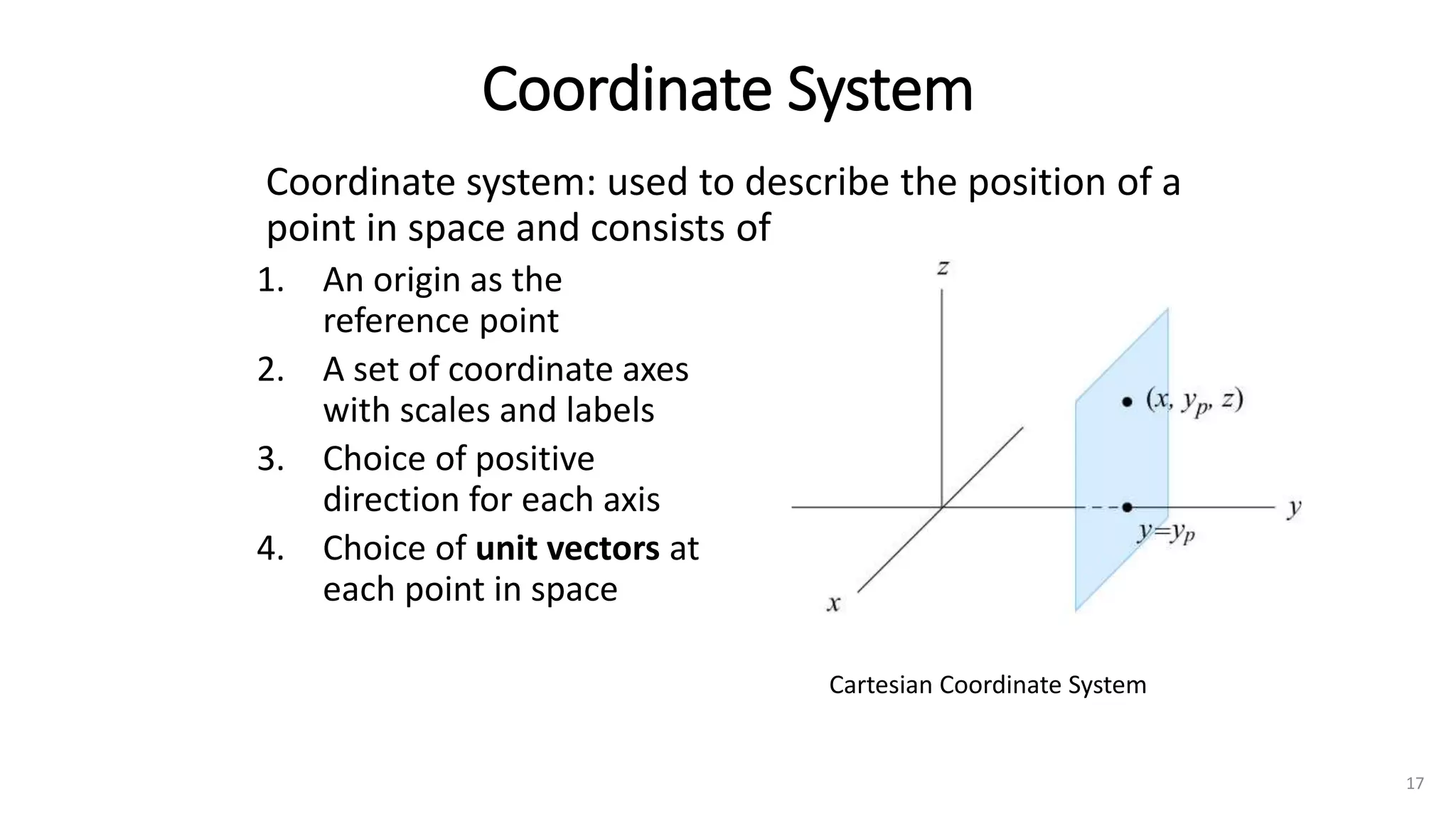
Coordinate System
1. An origin as the
reference point
2. A set of coordinate axes
with scales and labels
3. Choice of positive
direction for each axis
4. Choice of unit vectors at
each point in space
Coordinate system: used to describe the position of a
point in space and consists of
Cartesian Coordinate System
17
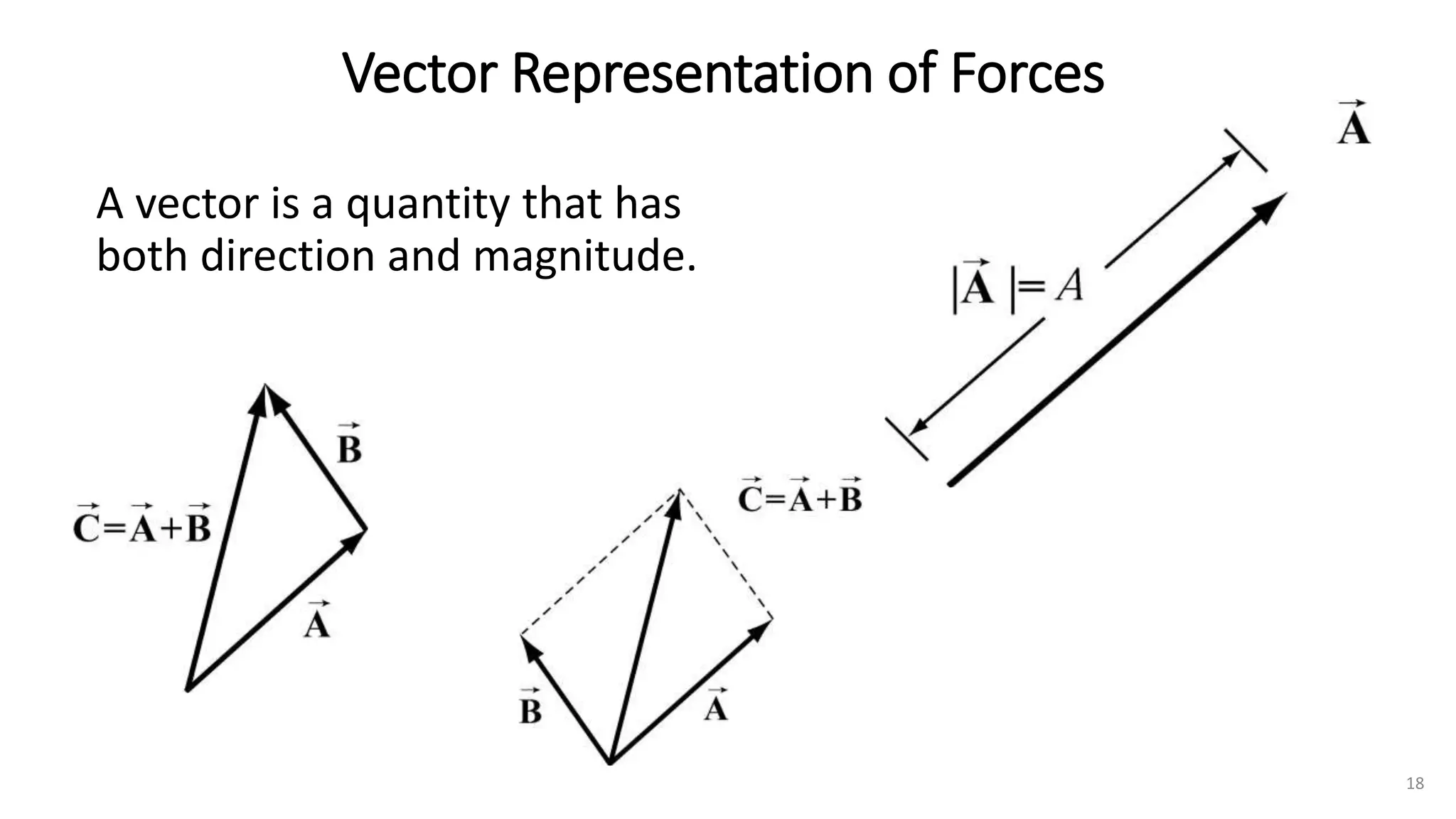
Vector Representation of Forces
A vector is a quantity that has
both direction and magnitude.
18
Application of Vectors
(1) Vectors can exist at any point P in space.
(2) Vectors have direction and magnitude.
(3) Vector Equality: Any two vectors that have the same
direction and magnitude, are equal no matter where in
space they are located.
19
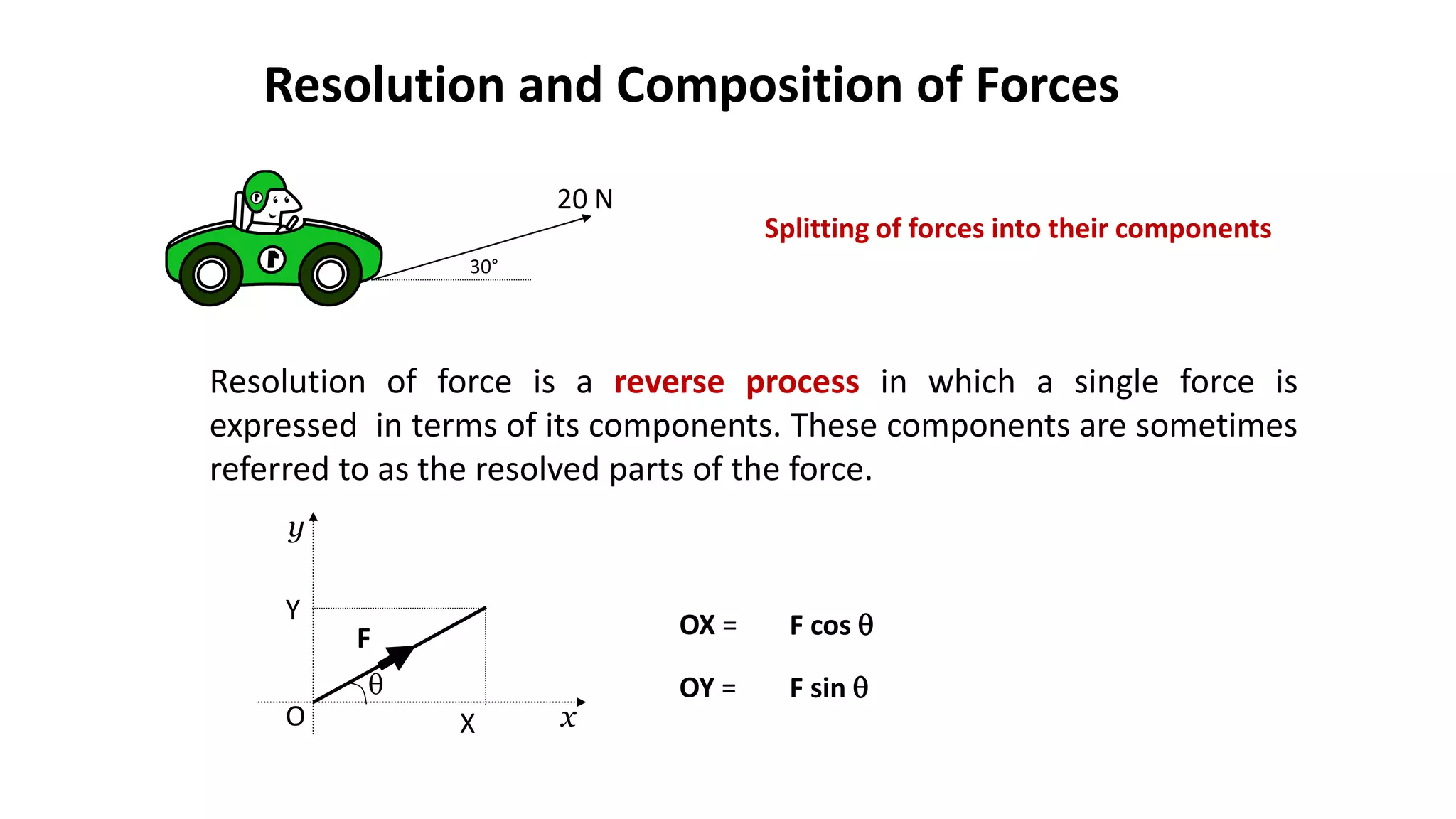
Resolution and Composition of Forces
Resolution of force is a reverse process in which a single force is
expressed in terms of its components. These components are sometimes
referred to as the resolved parts of the force.
F
x
y

O X
Y OX = F cos 
OY = F sin 
Splitting of forces into their components
30°
20 N
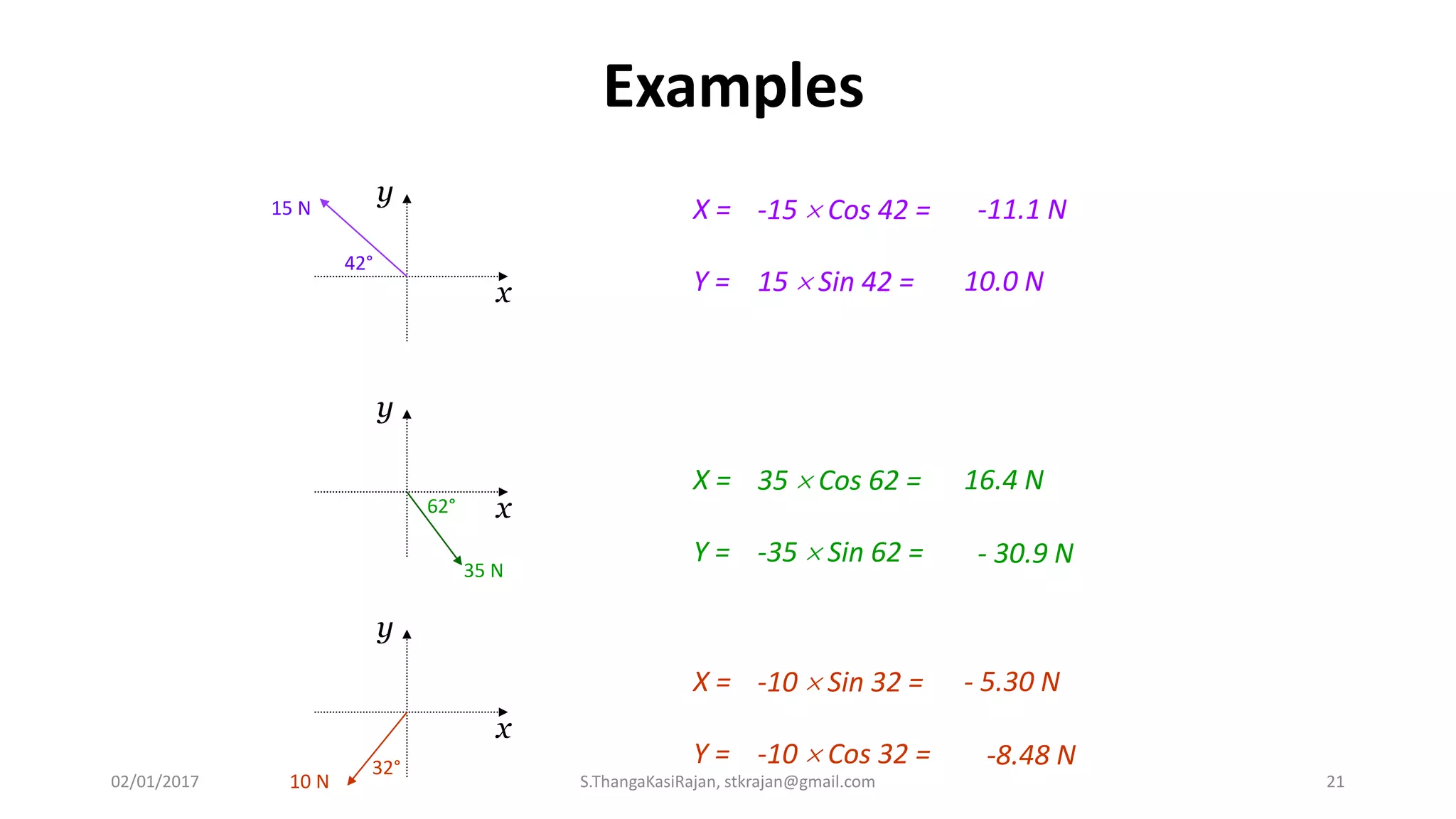
Examples
X = -15  Cos 42 = -11.1 N
Y = 15  Sin 42 = 10.0 N
X = 35  Cos 62 = 16.4 N
Y = -35  Sin 62 = - 30.9 N
x
y
42°
15 N
x
y
62°
35 N
x
y
32°
10 N
X = -10  Sin 32 = - 5.30 N
Y = -10  Cos 32 = -8.48 N
02/01/2017 S.ThangaKasiRajan, stkrajan@gmail.com 21
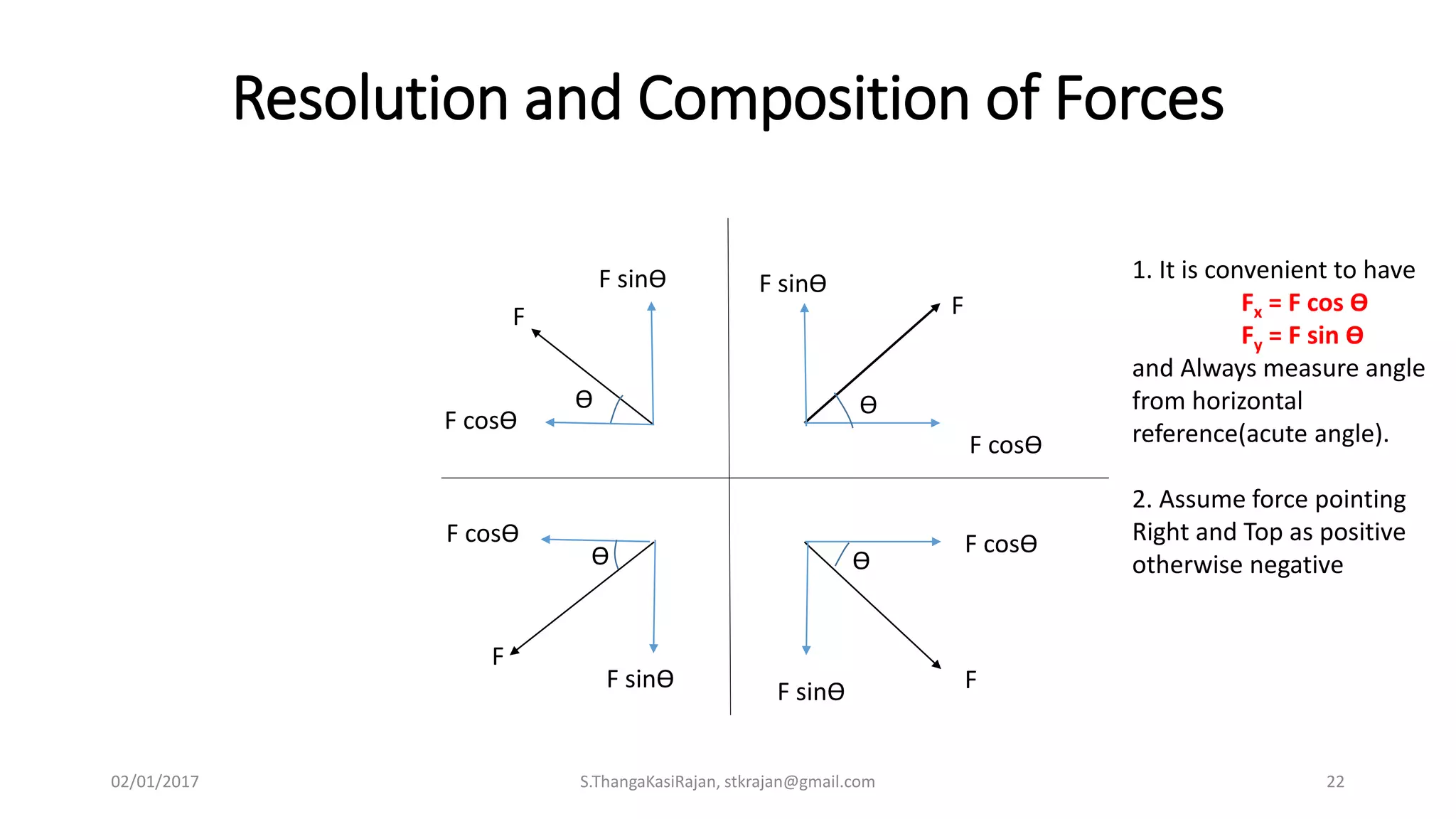
Resolution and Composition of Forces
F
F cosӨ
F sinӨ
F cosӨF cosӨ
F sinӨ F sinӨ
Ө
Ө Ө
F sinӨ
F cosӨ
Ө
F
F
F
1. It is convenient to have
Fx = F cos Ө
Fy = F sin Ө
and Always measure angle
from horizontal
reference(acute angle).
2. Assume force pointing
Right and Top as positive
otherwise negative
02/01/2017 S.ThangaKasiRajan, stkrajan@gmail.com 22
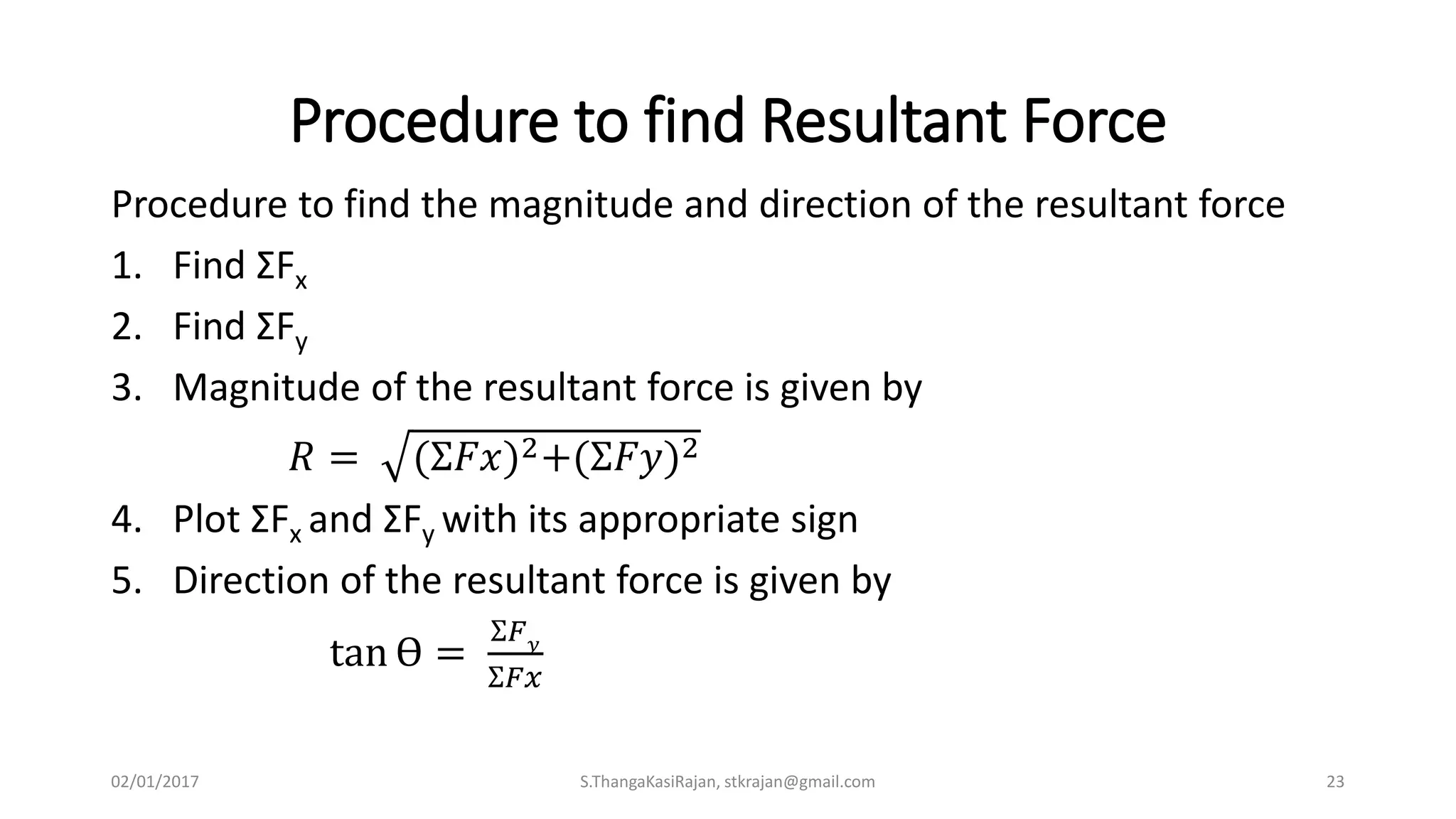
Procedure to find Resultant Force
Procedure to find the magnitude and direction of the resultant force
1. Find ƩFx
2. Find ƩFy
3. Magnitude of the resultant force is given by
𝑅 = (Ʃ𝐹𝑥)2+(Ʃ𝐹𝑦)2
4. Plot ƩFx and ƩFy with its appropriate sign
5. Direction of the resultant force is given by
tan Ө =
Ʃ𝐹 𝑦
Ʃ𝐹𝑥
02/01/2017 S.ThangaKasiRajan, stkrajan@gmail.com 23
Problems
02/01/2017 S.ThangaKasiRajan, stkrajan@gmail.com 24
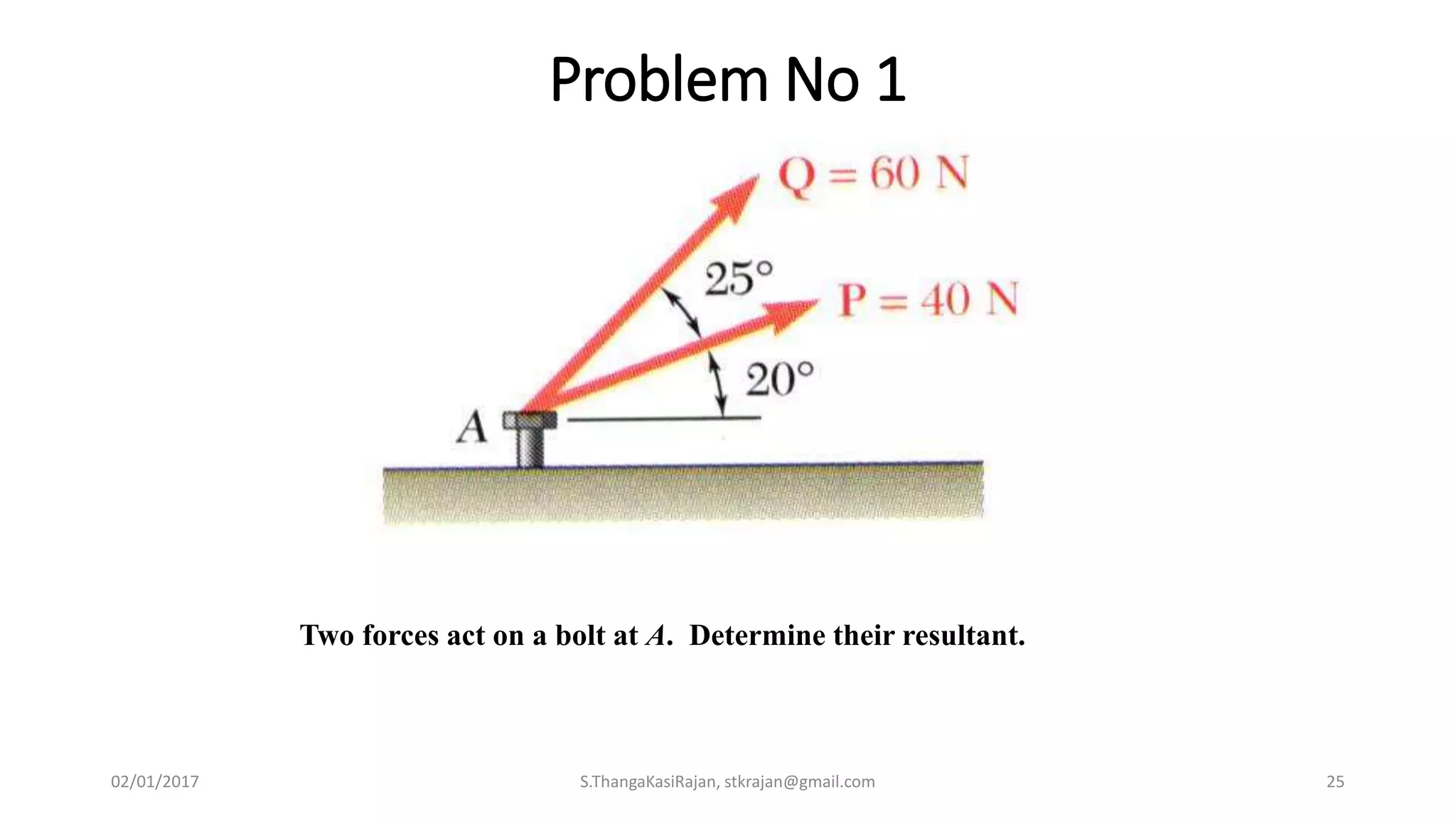
Problem No 1
Two forces act on a bolt at A. Determine their resultant.
02/01/2017 S.ThangaKasiRajan, stkrajan@gmail.com 25
Problem No 1 (contd…)
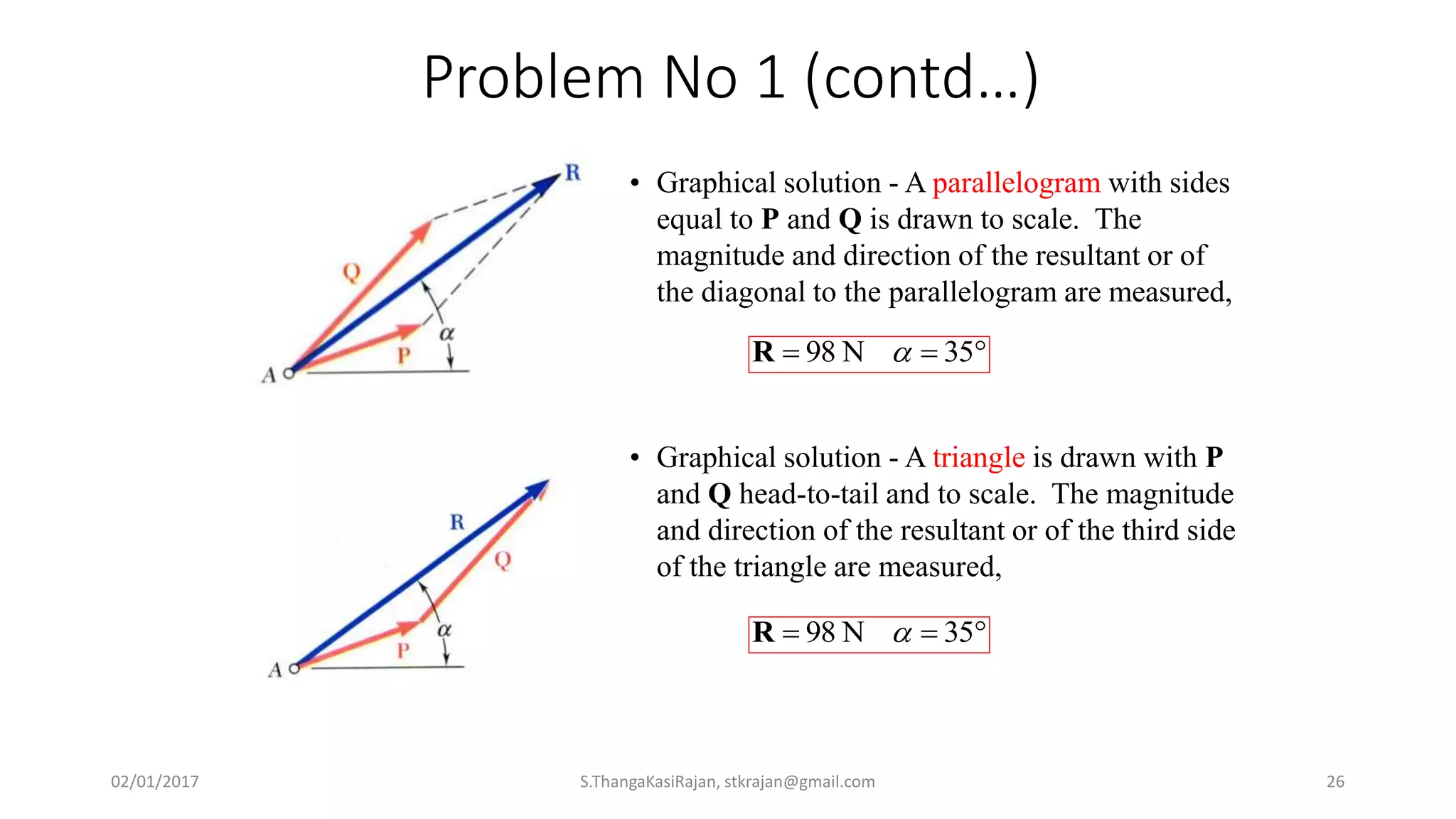
• Graphical solution - A parallelogram with sides
equal to P and Q is drawn to scale. The
magnitude and direction of the resultant or of
the diagonal to the parallelogram are measured,
 35N98 R
• Graphical solution - A triangle is drawn with P
and Q head-to-tail and to scale. The magnitude
and direction of the resultant or of the third side
of the triangle are measured,
 35N98 R
02/01/2017 S.ThangaKasiRajan, stkrajan@gmail.com 26
Problem No 1 (contd…)
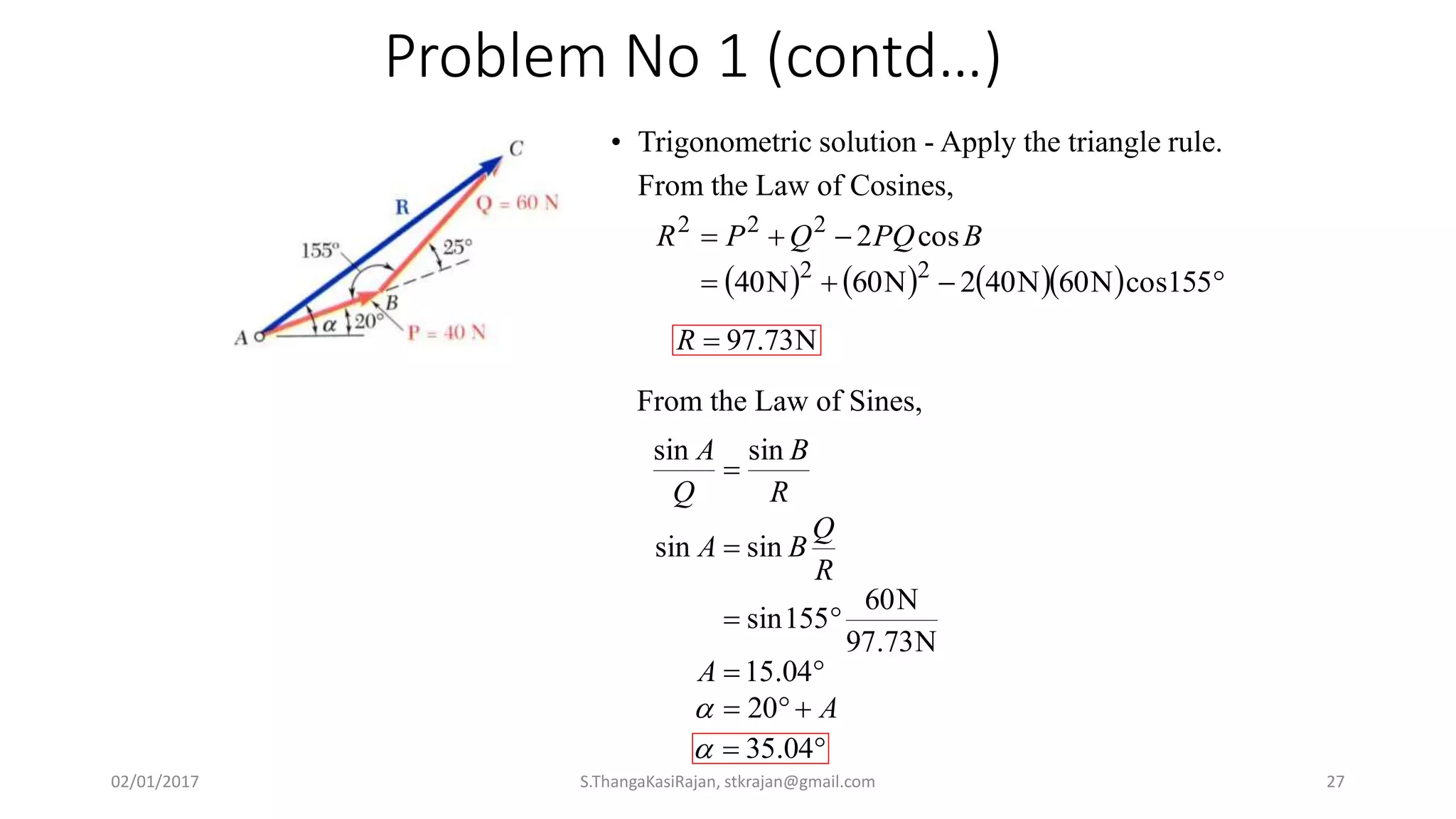
• Trigonometric solution - Apply the triangle rule.
From the Law of Cosines,
       

155cosN60N402N60N40
cos2
22
222
BPQQPR
A
A
R
Q
BA
R
B
Q
A





20
04.15
N73.97
N60
155sin
sinsin
sinsin

N73.97R
From the Law of Sines,
 04.35
02/01/2017 S.ThangaKasiRajan, stkrajan@gmail.com 27
Problem No 1 (contd…)
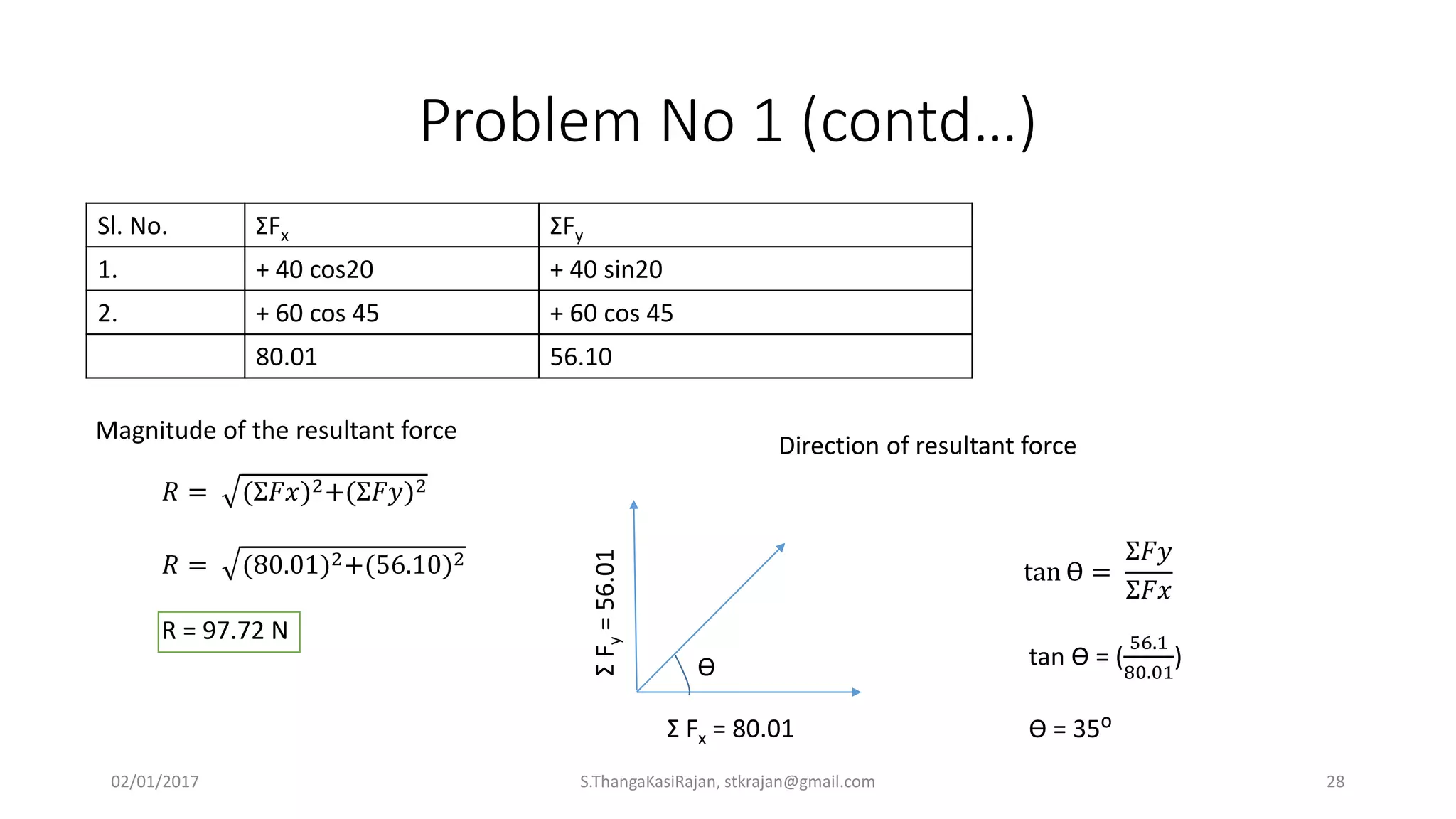
Sl. No. ƩFx ƩFy
1. + 40 cos20 + 40 sin20
2. + 60 cos 45 + 60 cos 45
80.01 56.10
𝑅 = (Ʃ𝐹𝑥)2+(Ʃ𝐹𝑦)2
𝑅 = (80.01)2+(56.10)2
R = 97.72 N
Magnitude of the resultant force
Direction of resultant force
Ʃ Fx = 80.01
ƩFy=56.01
Ө
tan Ө =
Ʃ𝐹𝑦
Ʃ𝐹𝑥
tan Ө = (
56.1
80.01
)
Ө = 35ᴼ
02/01/2017 S.ThangaKasiRajan, stkrajan@gmail.com 28
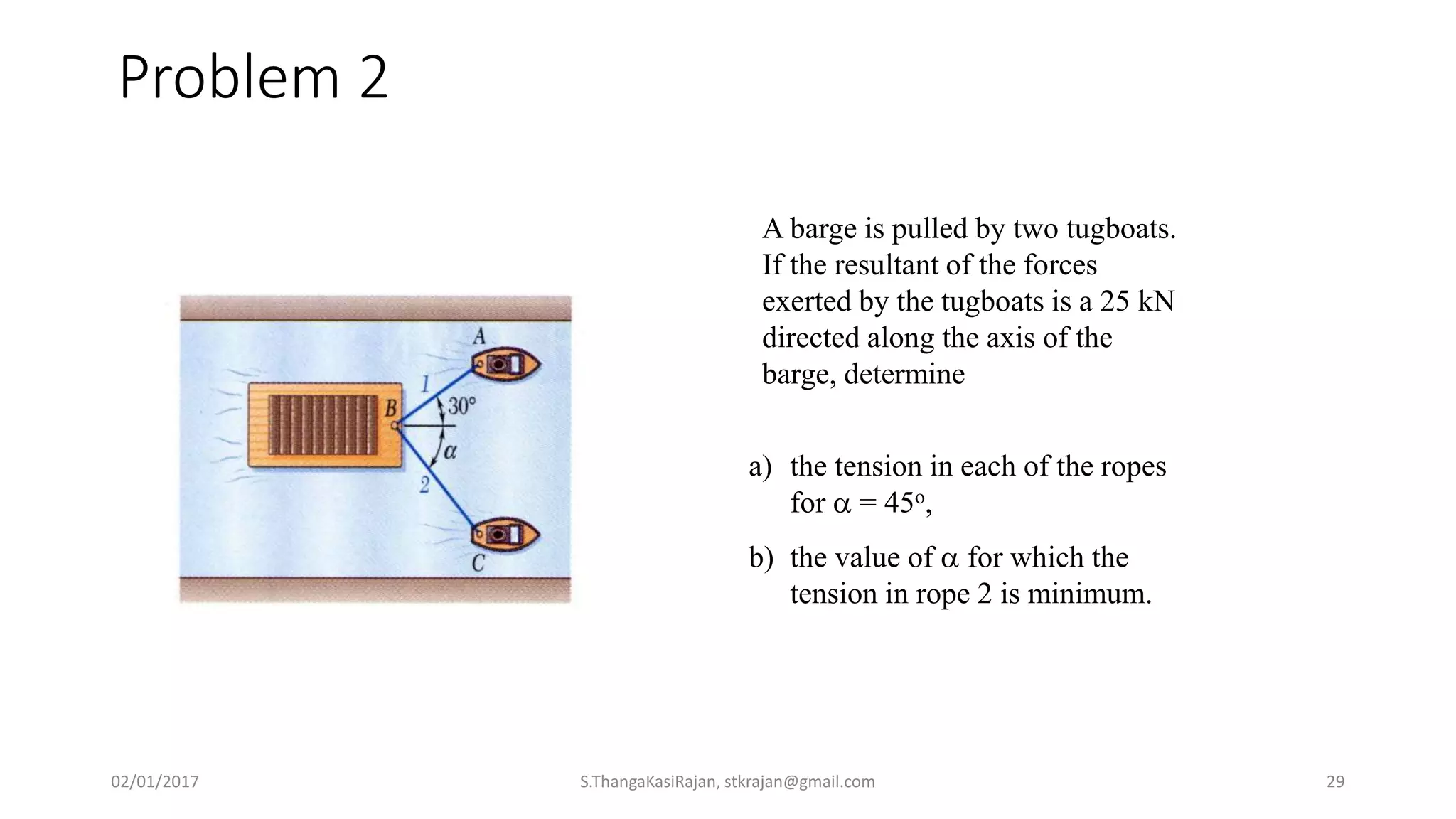
Problem 2
a) the tension in each of the ropes
for  = 45o,
b) the value of  for which the
tension in rope 2 is minimum.
A barge is pulled by two tugboats.
If the resultant of the forces
exerted by the tugboats is a 25 kN
directed along the axis of the
barge, determine
02/01/2017 S.ThangaKasiRajan, stkrajan@gmail.com 29
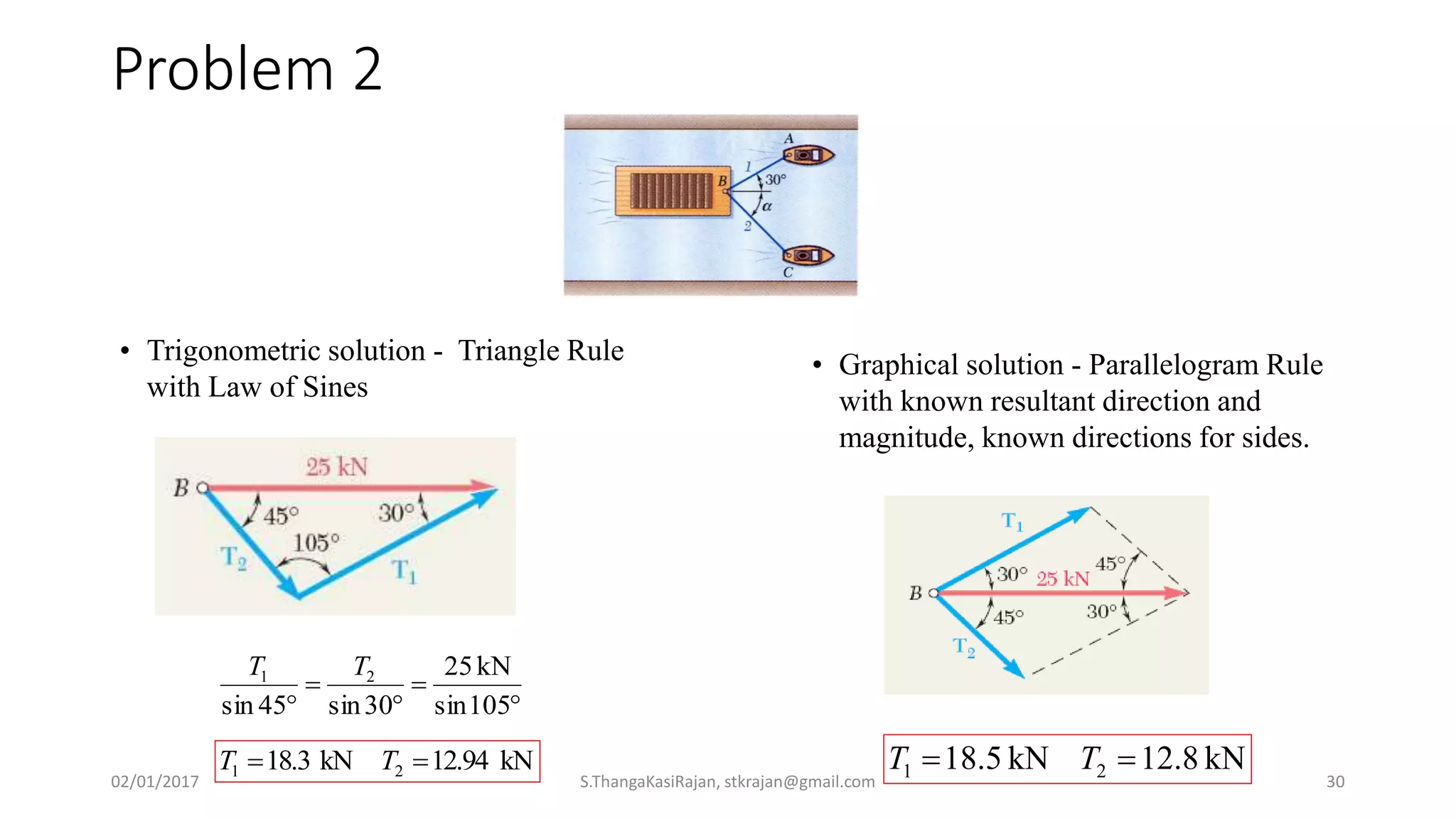
Problem 2
• Graphical solution - Parallelogram Rule
with known resultant direction and
magnitude, known directions for sides.
kN12.8kN18.5 21  TT
• Trigonometric solution - Triangle Rule
with Law of Sines




 105sin
kN25
30sin45sin
21 TT
kN12.94kN18.3 21  TT
02/01/2017 S.ThangaKasiRajan, stkrajan@gmail.com 30
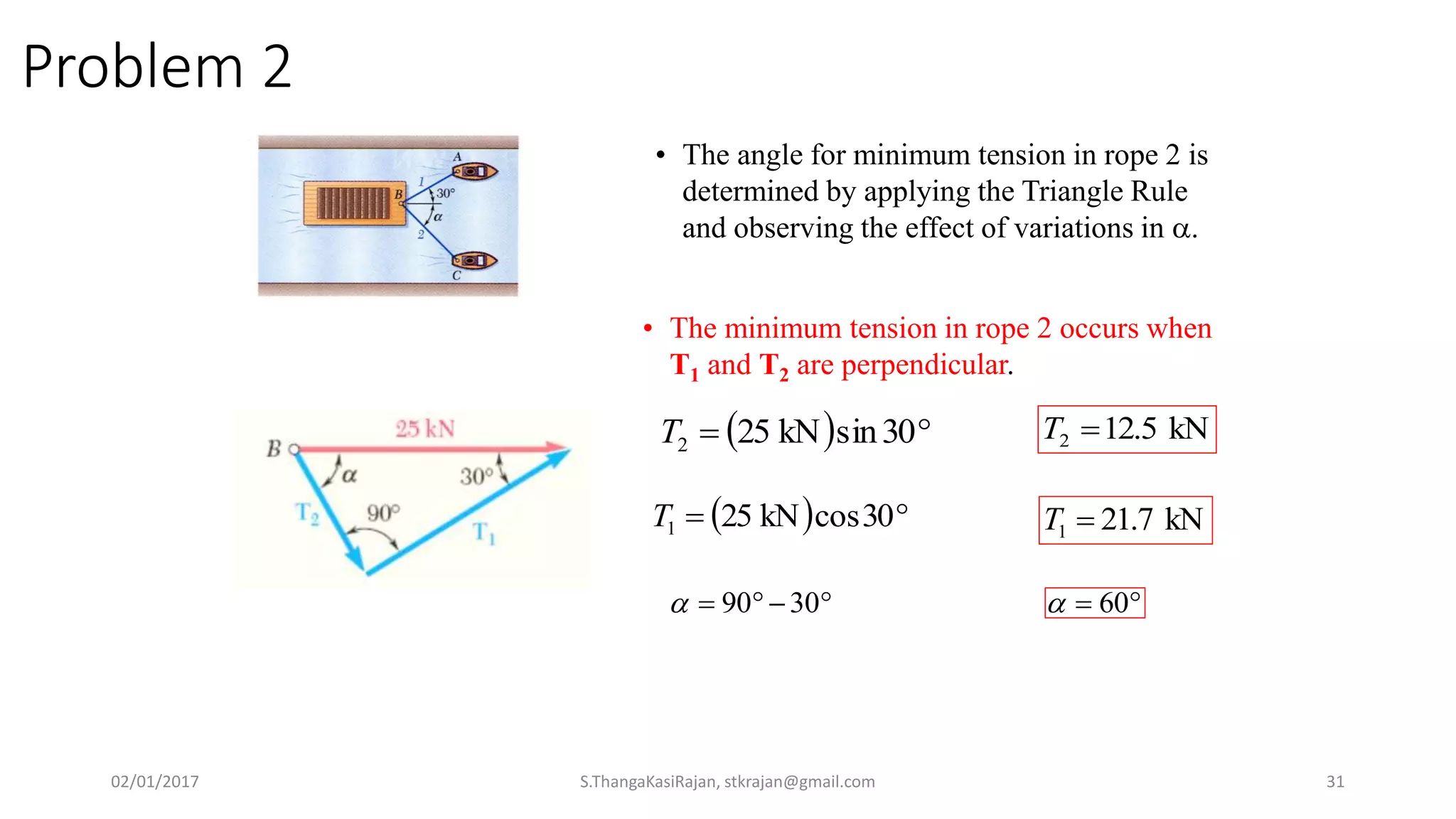
Problem 2
• The angle for minimum tension in rope 2 is
determined by applying the Triangle Rule
and observing the effect of variations in .
• The minimum tension in rope 2 occurs when
T1 and T2 are perpendicular.
   30sinkN252T kN12.52 T
   30coskN251T kN21.71 T
 3090  60
02/01/2017 S.ThangaKasiRajan, stkrajan@gmail.com 31
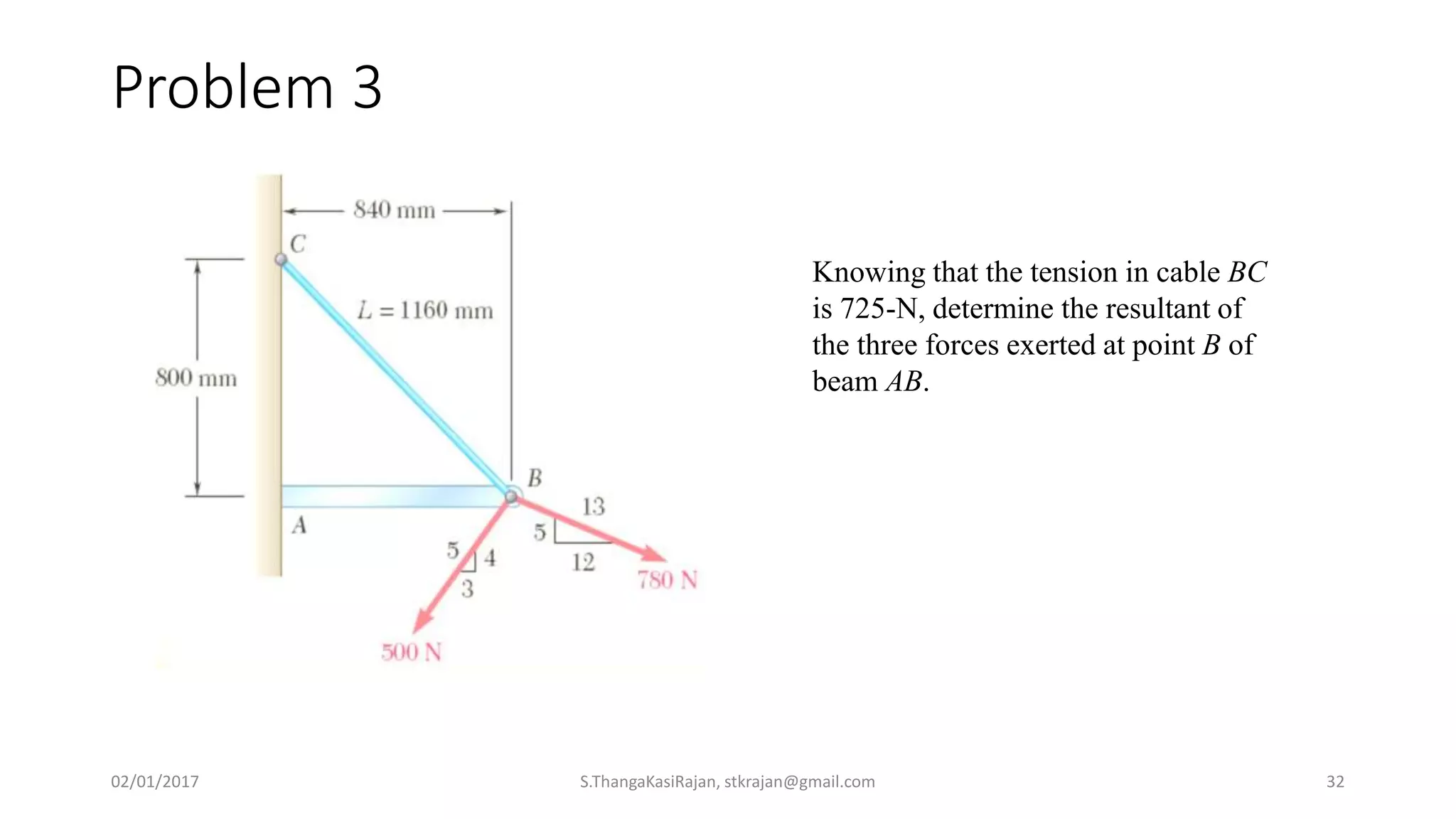
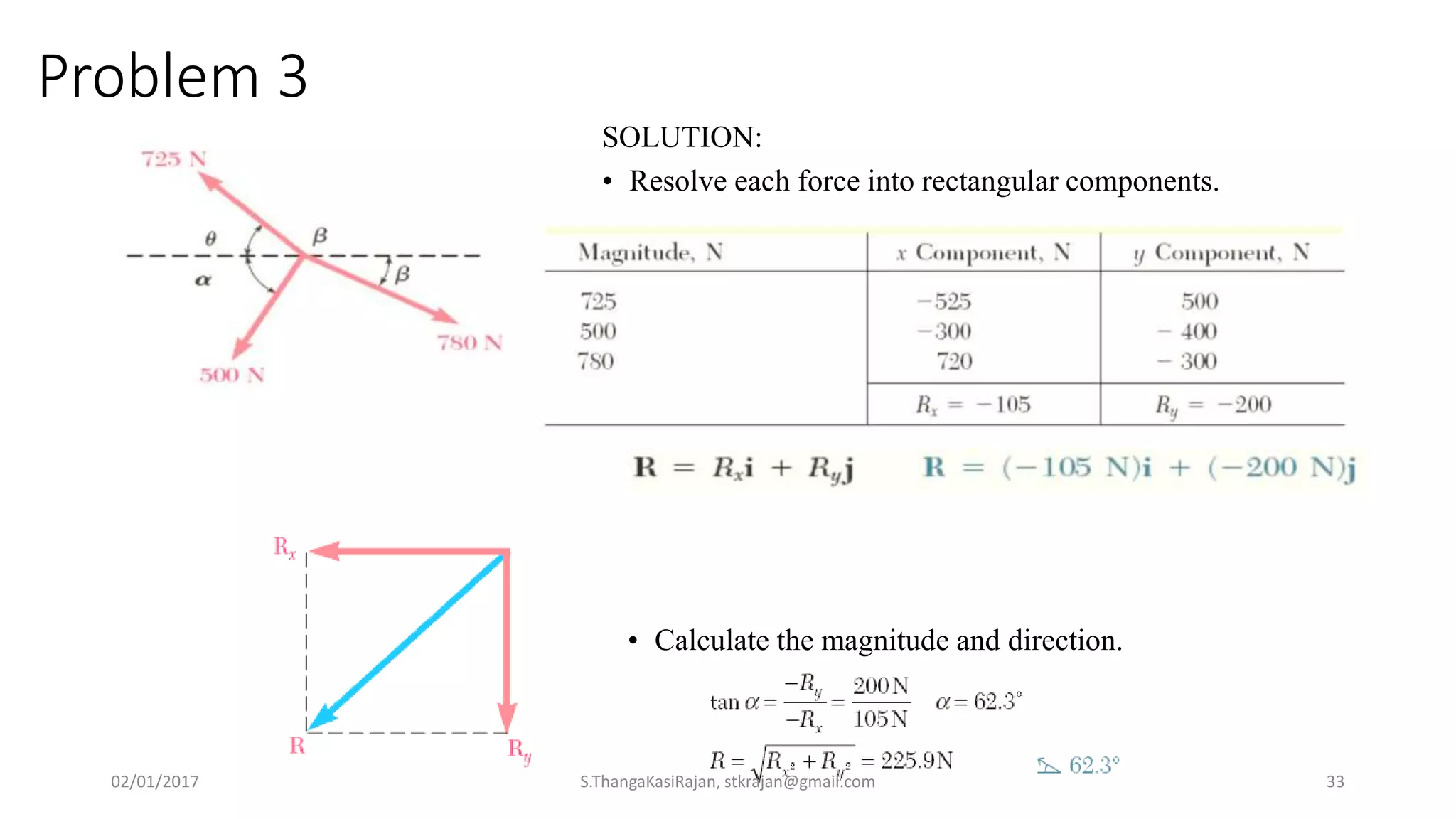
Problem 3
Knowing that the tension in cable BC
is 725-N, determine the resultant of
the three forces exerted at point B of
beam AB.
02/01/2017 S.ThangaKasiRajan, stkrajan@gmail.com 32
Problem 3
SOLUTION:
• Resolve each force into rectangular components.
• Calculate the magnitude and direction.
02/01/2017 S.ThangaKasiRajan, stkrajan@gmail.com 33
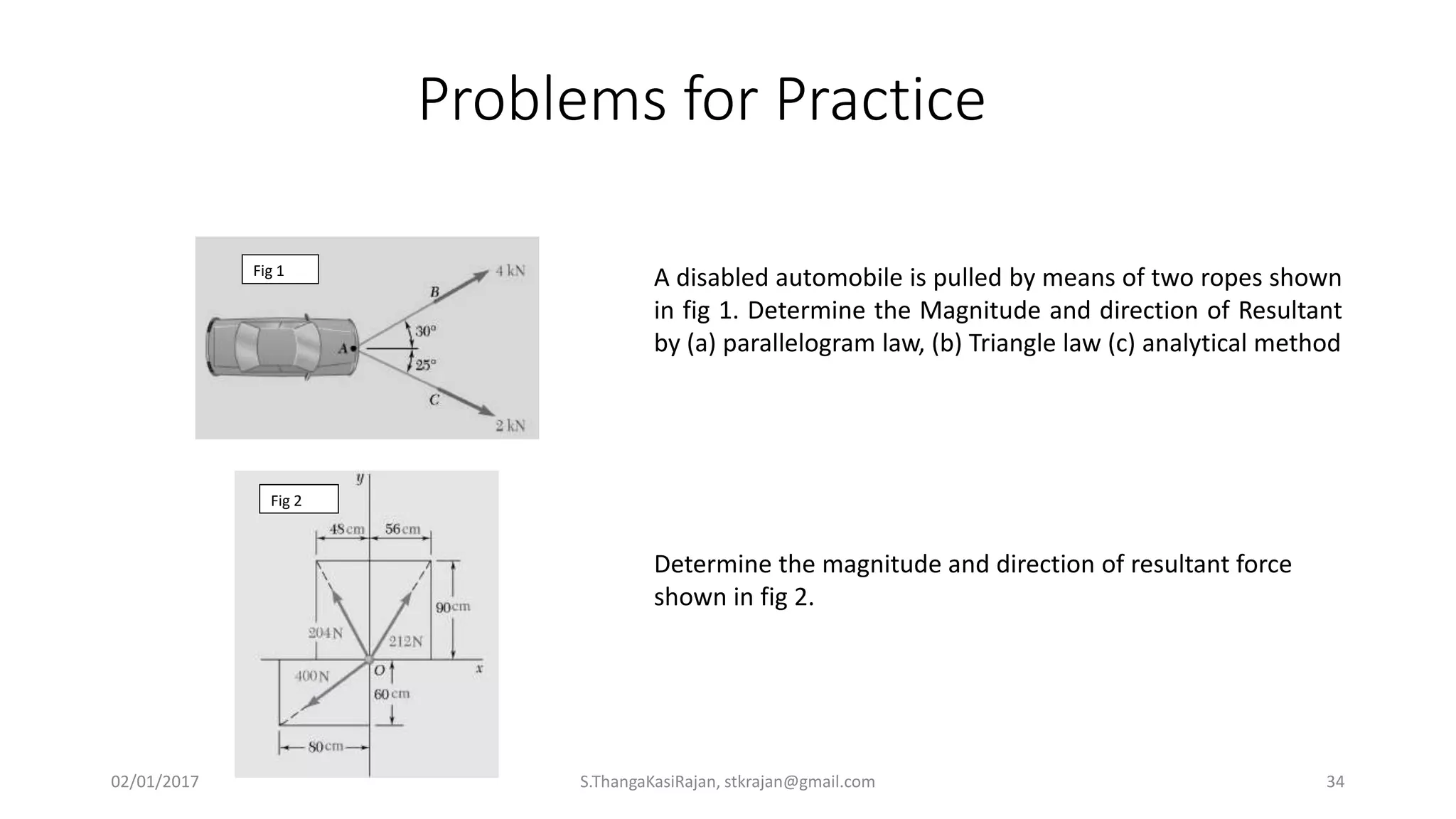
Problems for Practice
Fig 1
Fig 2
A disabled automobile is pulled by means of two ropes shown
in fig 1. Determine the Magnitude and direction of Resultant
by (a) parallelogram law, (b) Triangle law (c) analytical method
Determine the magnitude and direction of resultant force
shown in fig 2.
02/01/2017 S.ThangaKasiRajan, stkrajan@gmail.com 34
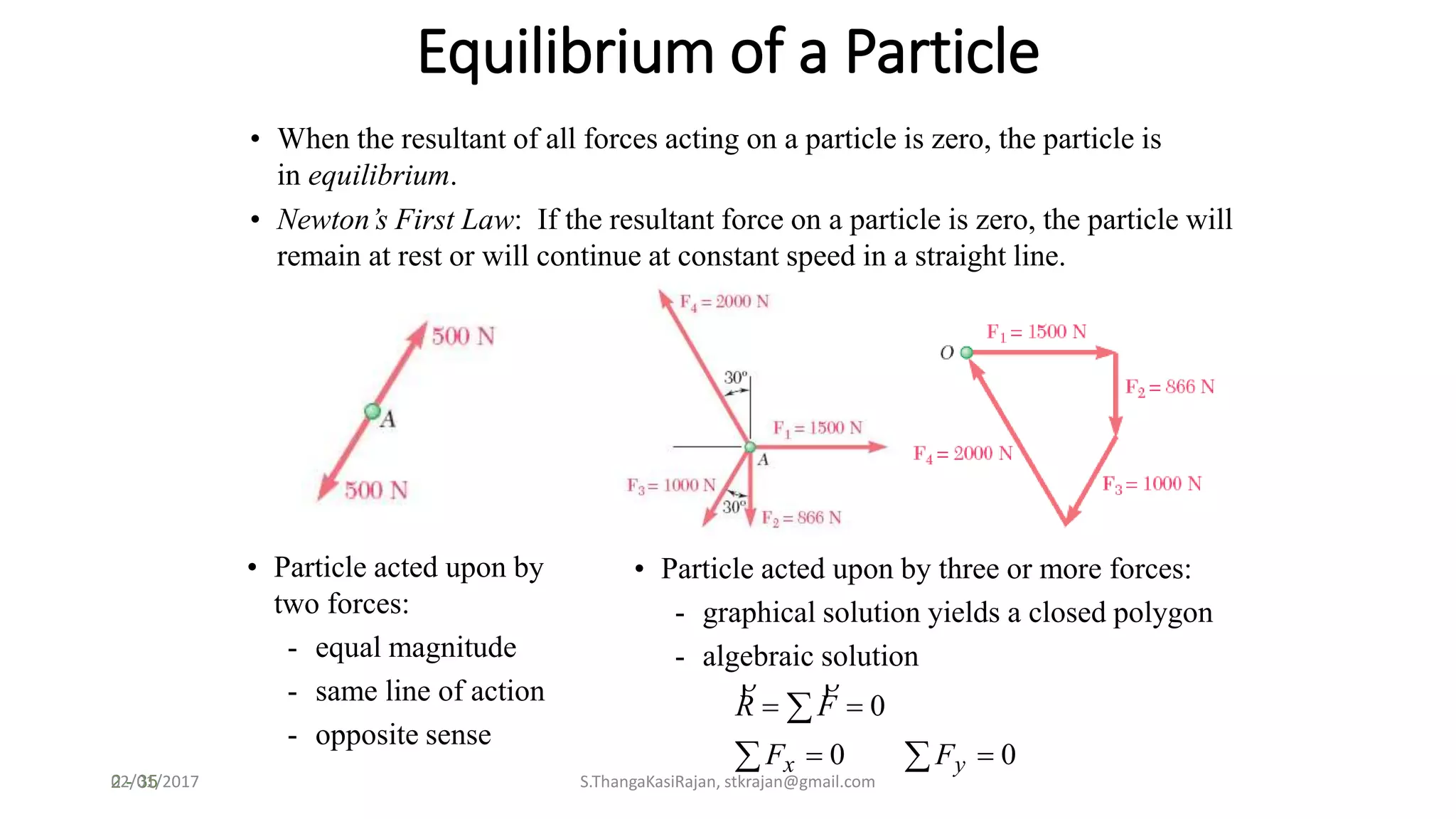
Equilibrium of a Particle
2 - 35
• When the resultant of all forces acting on a particle is zero, the particle is
in equilibrium.
• Newton’s First Law: If the resultant force on a particle is zero, the particle will
remain at rest or will continue at constant speed in a straight line.
• Particle acted upon by
two forces:
- equal magnitude
- same line of action
- opposite sense
• Particle acted upon by three or more forces:
- graphical solution yields a closed polygon
- algebraic solution
00
0




yx FF
FR

02/01/2017 S.ThangaKasiRajan, stkrajan@gmail.com
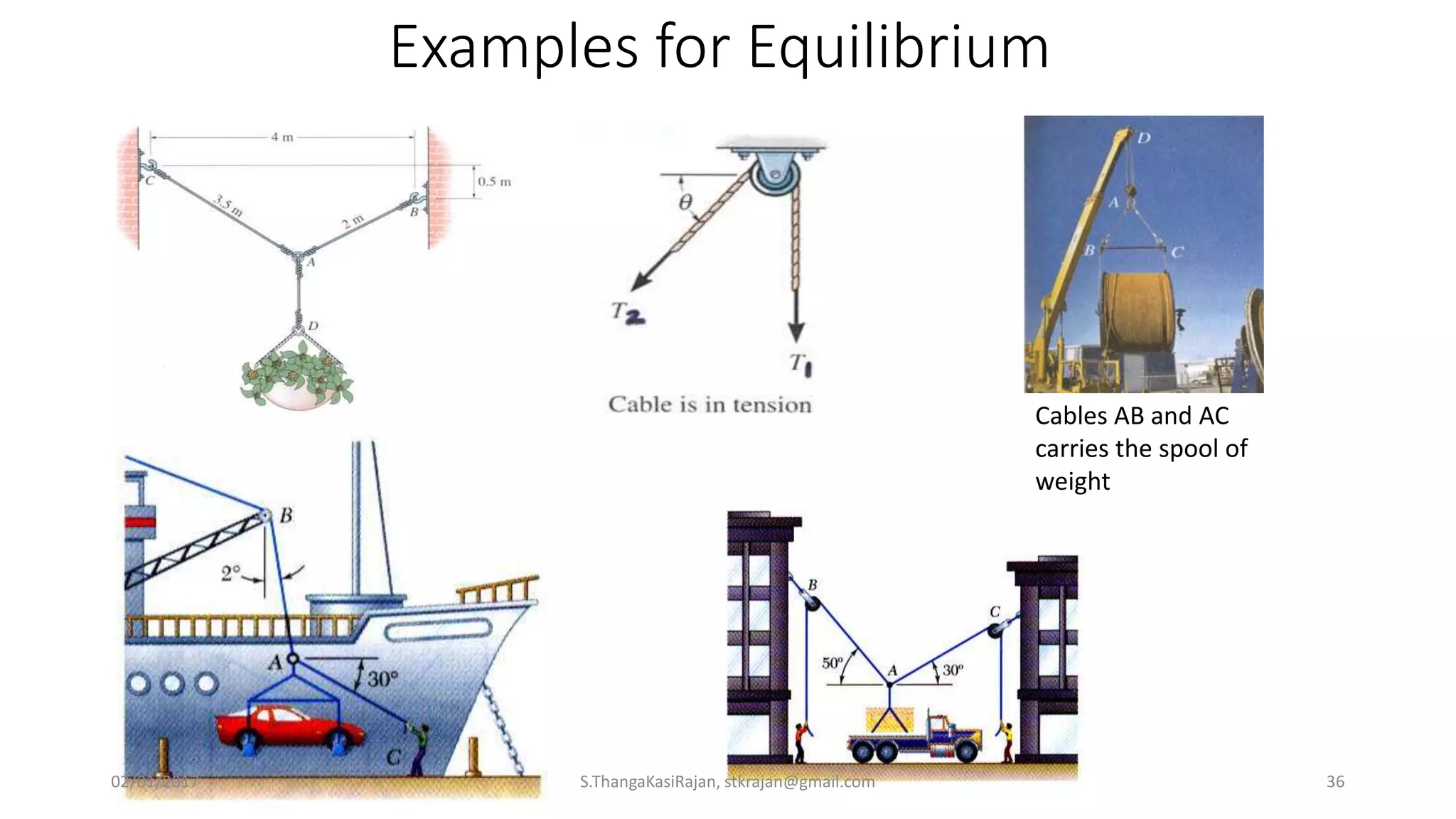
Examples for Equilibrium
Cables AB and AC
carries the spool of
weight
02/01/2017 S.ThangaKasiRajan, stkrajan@gmail.com 36
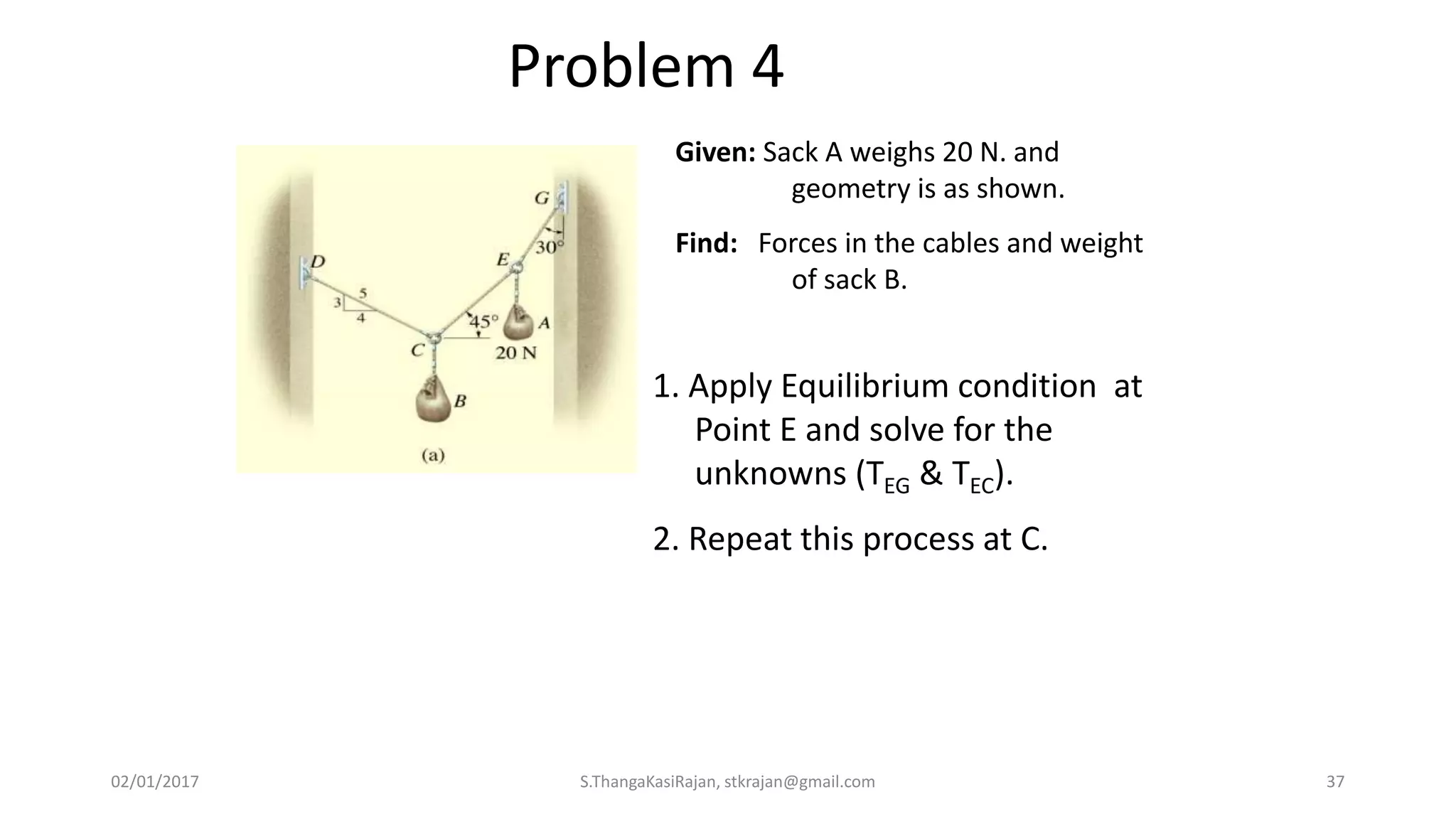
Problem 4
Given: Sack A weighs 20 N. and
geometry is as shown.
Find: Forces in the cables and weight
of sack B.
1. Apply Equilibrium condition at
Point E and solve for the
unknowns (TEG & TEC).
2. Repeat this process at C.
02/01/2017 S.ThangaKasiRajan, stkrajan@gmail.com 37
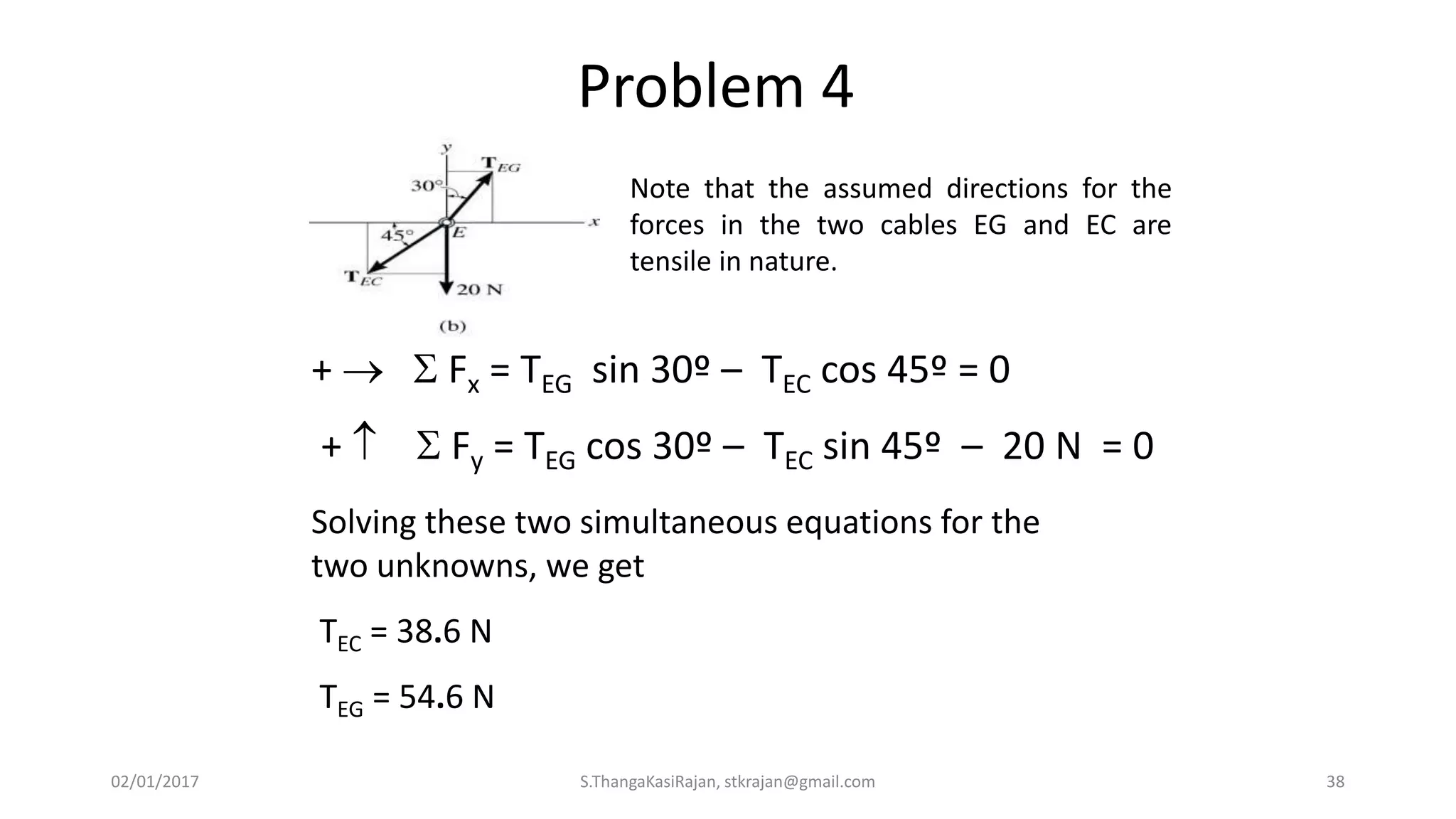
Problem 4
+   Fx = TEG sin 30º – TEC cos 45º = 0
+   Fy = TEG cos 30º – TEC sin 45º – 20 N = 0
Solving these two simultaneous equations for the
two unknowns, we get
TEC = 38.6 N
TEG = 54.6 N
Note that the assumed directions for the
forces in the two cables EG and EC are
tensile in nature.
02/01/2017 S.ThangaKasiRajan, stkrajan@gmail.com 38
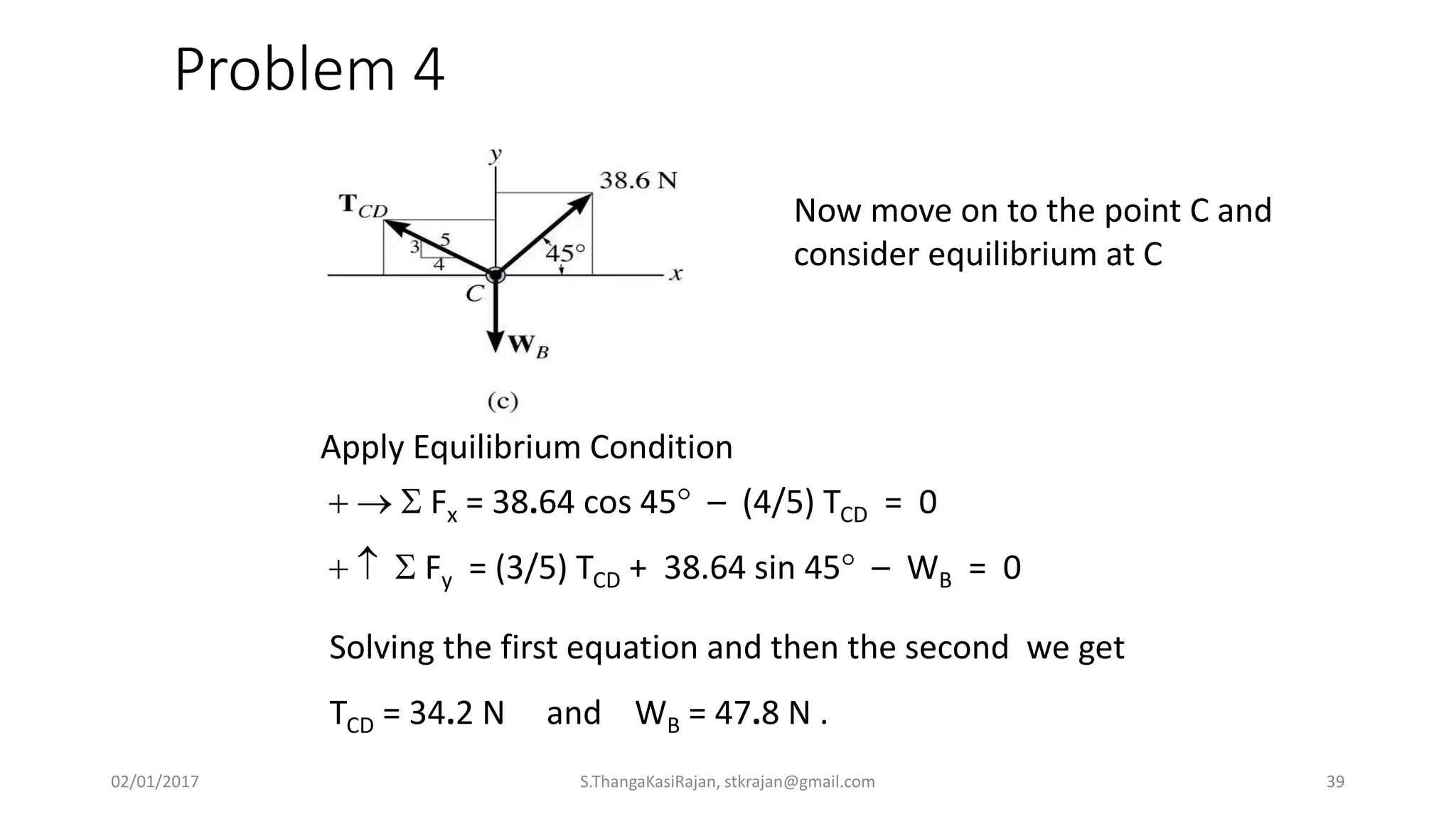
Problem 4
   Fx = 38.64 cos 45 – (4/5) TCD = 0
   Fy = (3/5) TCD + 38.64 sin 45 – WB = 0
Solving the first equation and then the second we get
TCD = 34.2 N and WB = 47.8 N .
Apply Equilibrium Condition
Now move on to the point C and
consider equilibrium at C
02/01/2017 S.ThangaKasiRajan, stkrajan@gmail.com 39
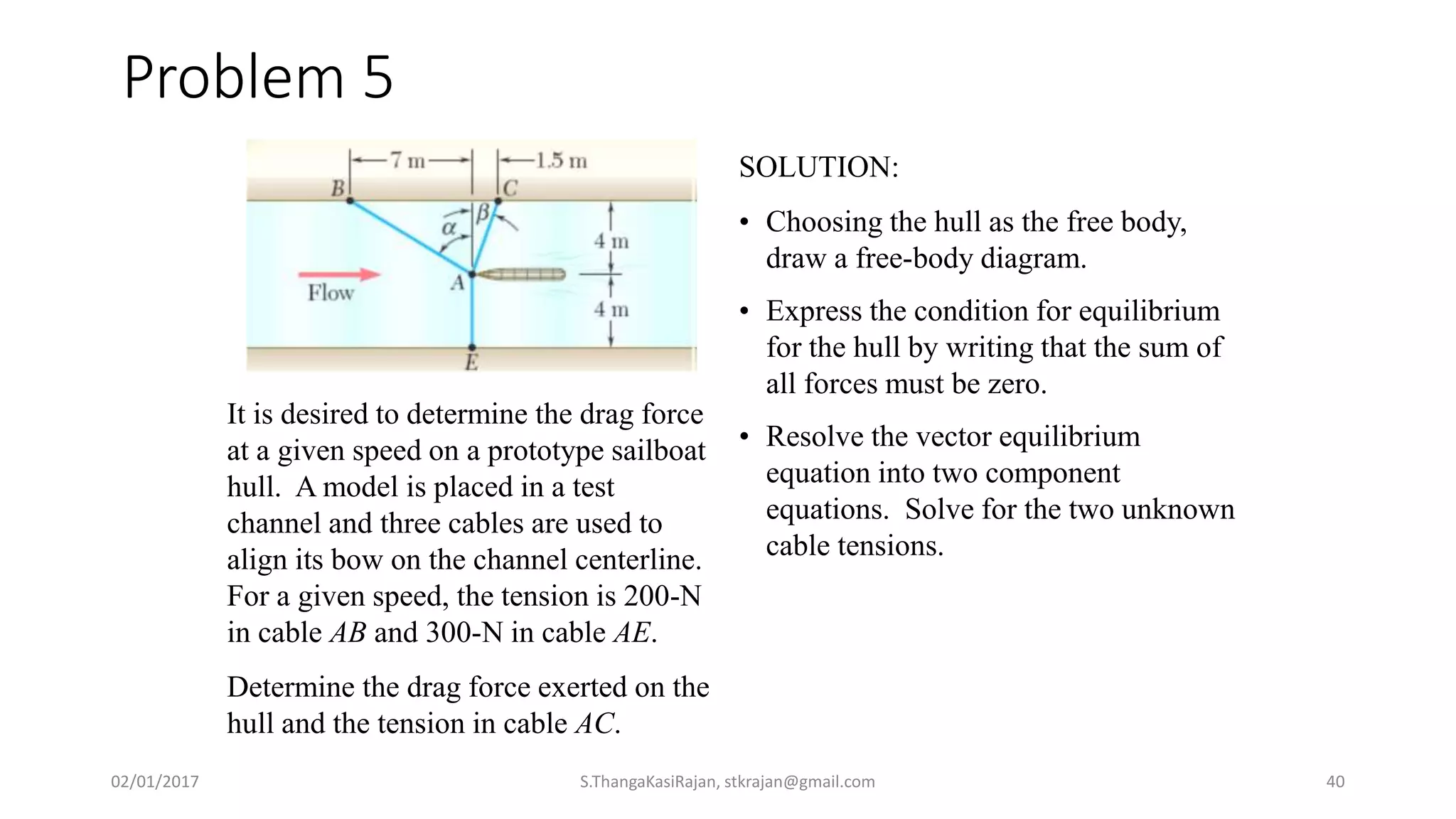
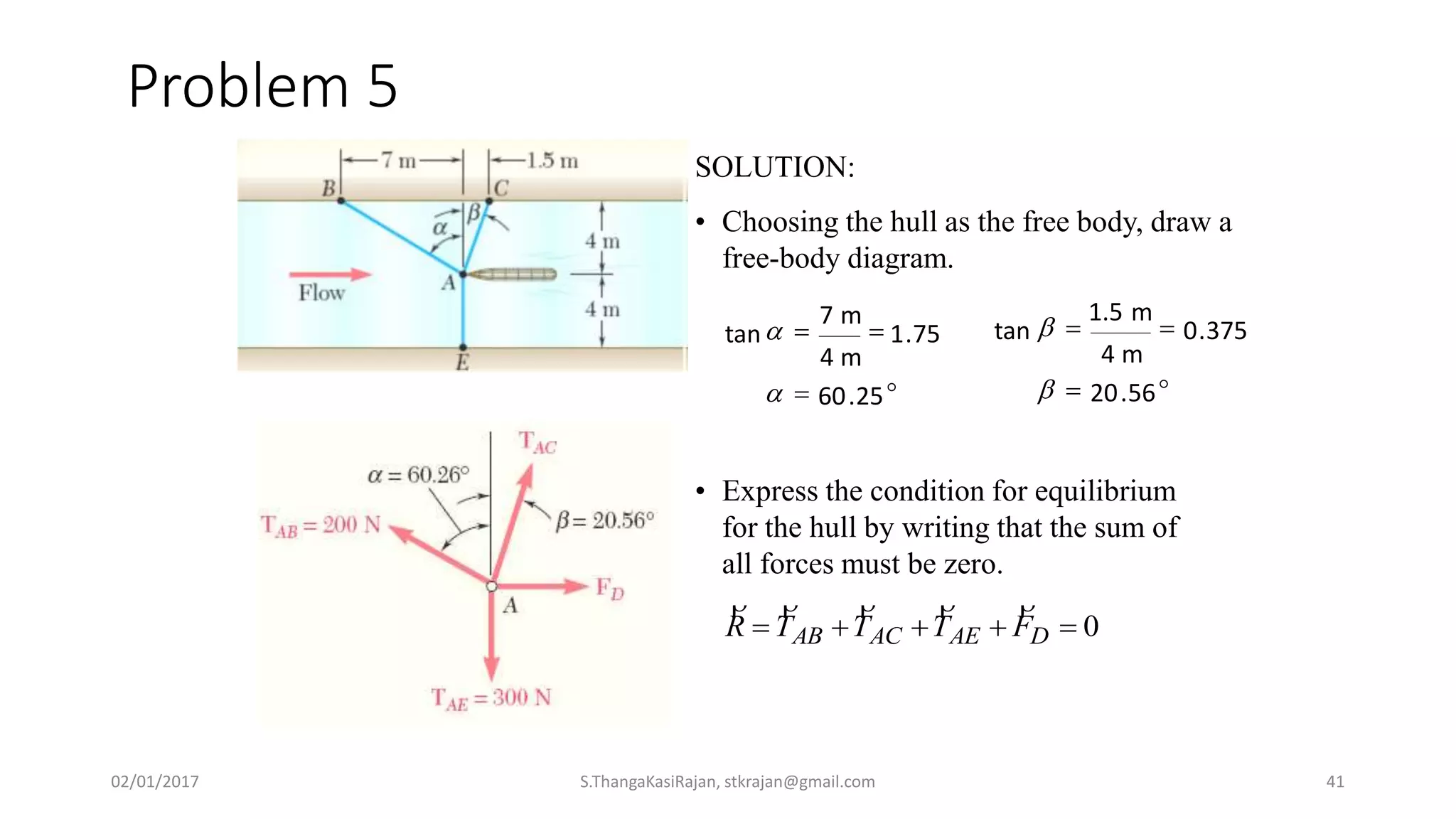
Problem 5
It is desired to determine the drag force
at a given speed on a prototype sailboat
hull. A model is placed in a test
channel and three cables are used to
align its bow on the channel centerline.
For a given speed, the tension is 200-N
in cable AB and 300-N in cable AE.
Determine the drag force exerted on the
hull and the tension in cable AC.
SOLUTION:
• Choosing the hull as the free body,
draw a free-body diagram.
• Express the condition for equilibrium
for the hull by writing that the sum of
all forces must be zero.
• Resolve the vector equilibrium
equation into two component
equations. Solve for the two unknown
cable tensions.
02/01/2017 S.ThangaKasiRajan, stkrajan@gmail.com 40
Problem 5
• Express the condition for equilibrium
for the hull by writing that the sum of
all forces must be zero.
0 DAEACAB FTTTR

SOLUTION:
• Choosing the hull as the free body, draw a
free-body diagram.


25.60
75.1
m4
m7
tan




56.20
375.0
m4
m1.5
tan


02/01/2017 S.ThangaKasiRajan, stkrajan@gmail.com 41
Problem 5
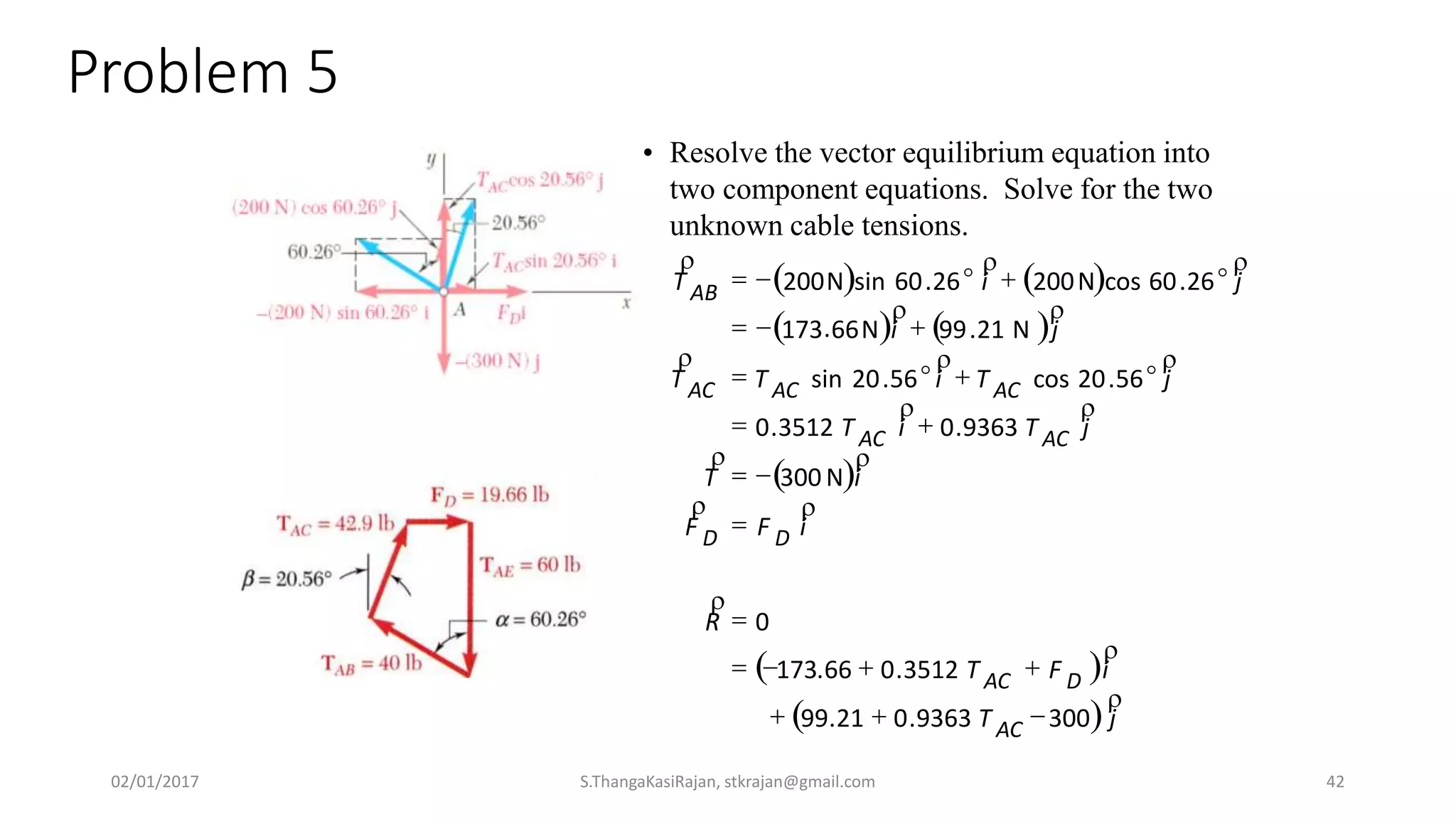
• Resolve the vector equilibrium equation into
two component equations. Solve for the two
unknown cable tensions.

   
   
 
 
  jT
iFT
R
iFF
iT
jTiT
jTiTT
ji
jiT
AC
DAC
DD
ACAC
ACACAC
AB









3009363.021.99
3512.066.173
0
N300
9363.03512.0
56.20cos56.20sin
N21.99N66.173
26.60cosN20026.60sinN200









02/01/2017 S.ThangaKasiRajan, stkrajan@gmail.com 42
Problem 5
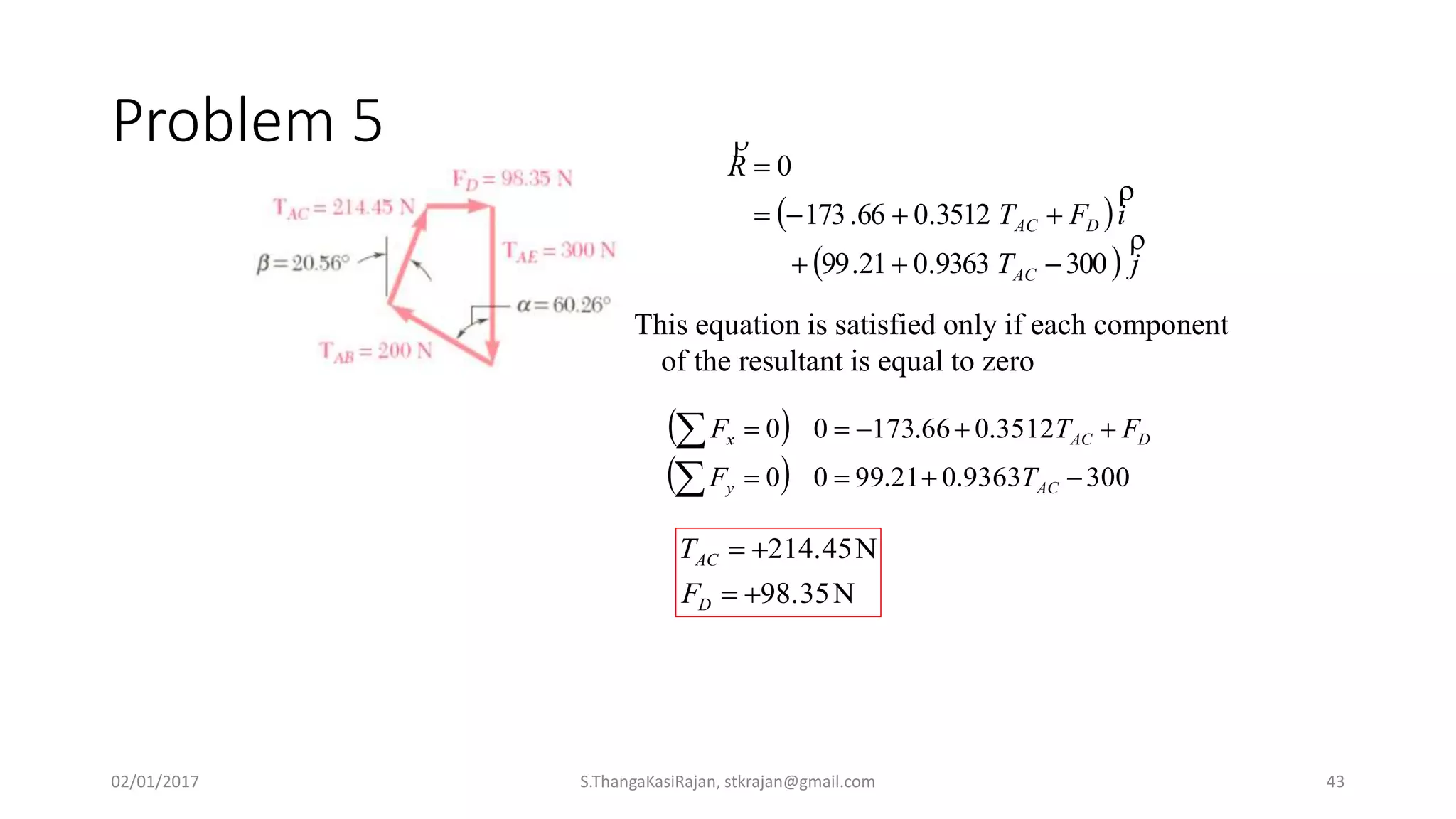
 
  3009363.021.9900
3512.066.17300




ACy
DACx
TF
FTF
N98.35
N214.45


D
AC
F
T
 
  jT
iFT
R
AC
DAC



3009363.021.99
3512.066.173
0



This equation is satisfied only if each component
of the resultant is equal to zero
02/01/2017 S.ThangaKasiRajan, stkrajan@gmail.com 43
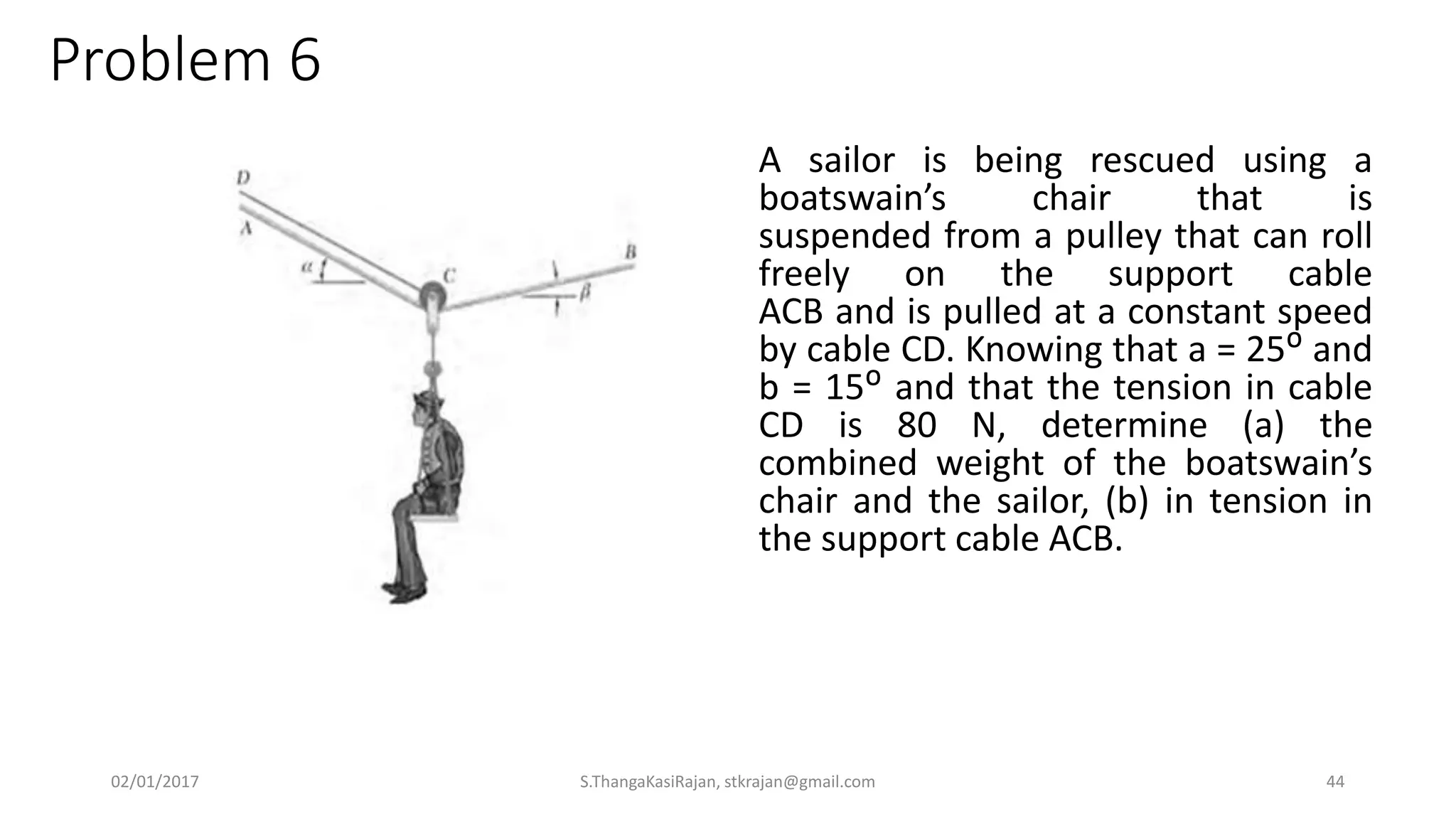
Problem 6
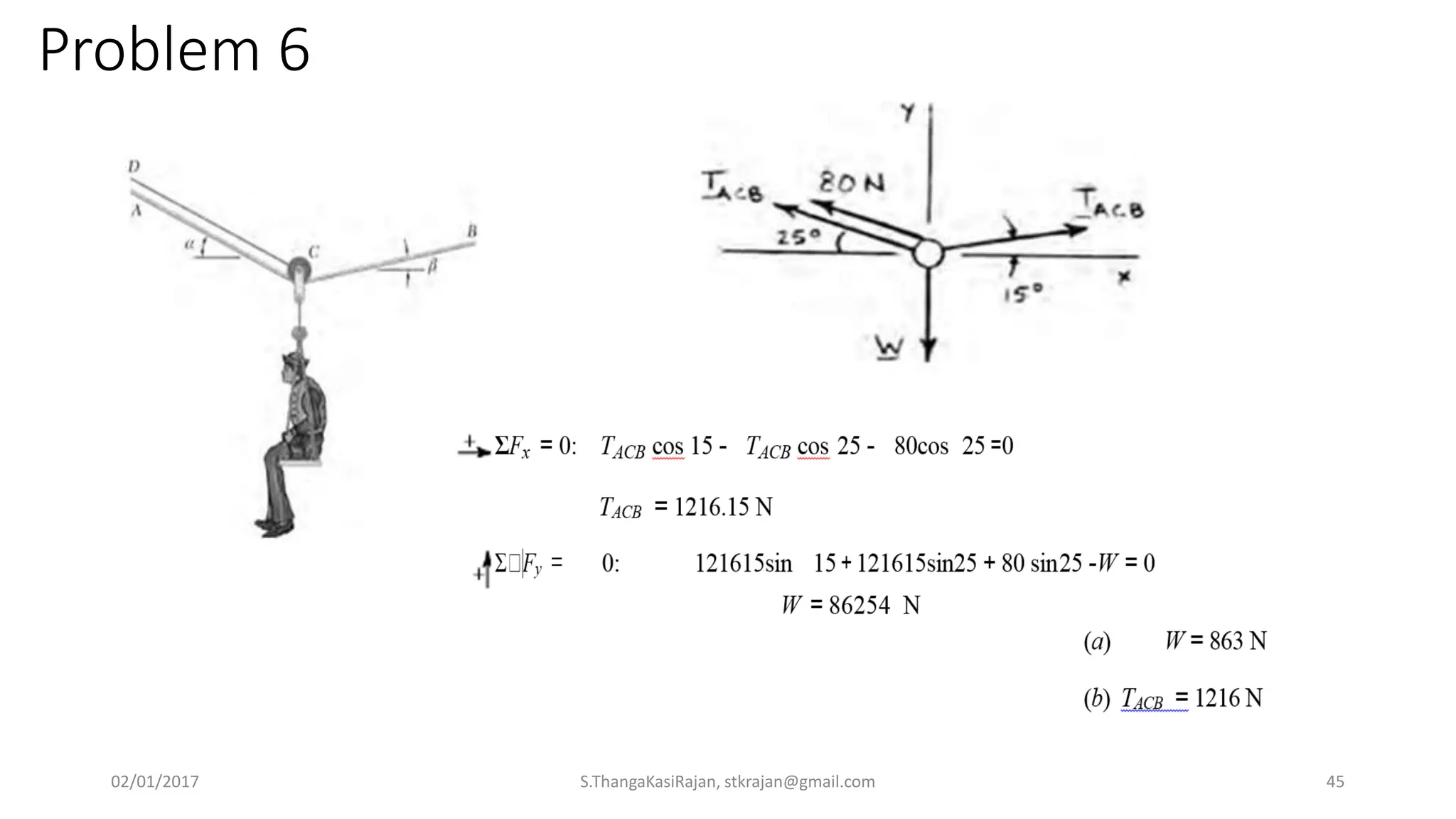
A sailor is being rescued using a
boatswain’s chair that is
suspended from a pulley that can roll
freely on the support cable
ACB and is pulled at a constant speed
by cable CD. Knowing that a = 25ᴼ and
b = 15ᴼ and that the tension in cable
CD is 80 N, determine (a) the
combined weight of the boatswain’s
chair and the sailor, (b) in tension in
the support cable ACB.
02/01/2017 S.ThangaKasiRajan, stkrajan@gmail.com 44
Problem 6
02/01/2017 S.ThangaKasiRajan, stkrajan@gmail.com 45
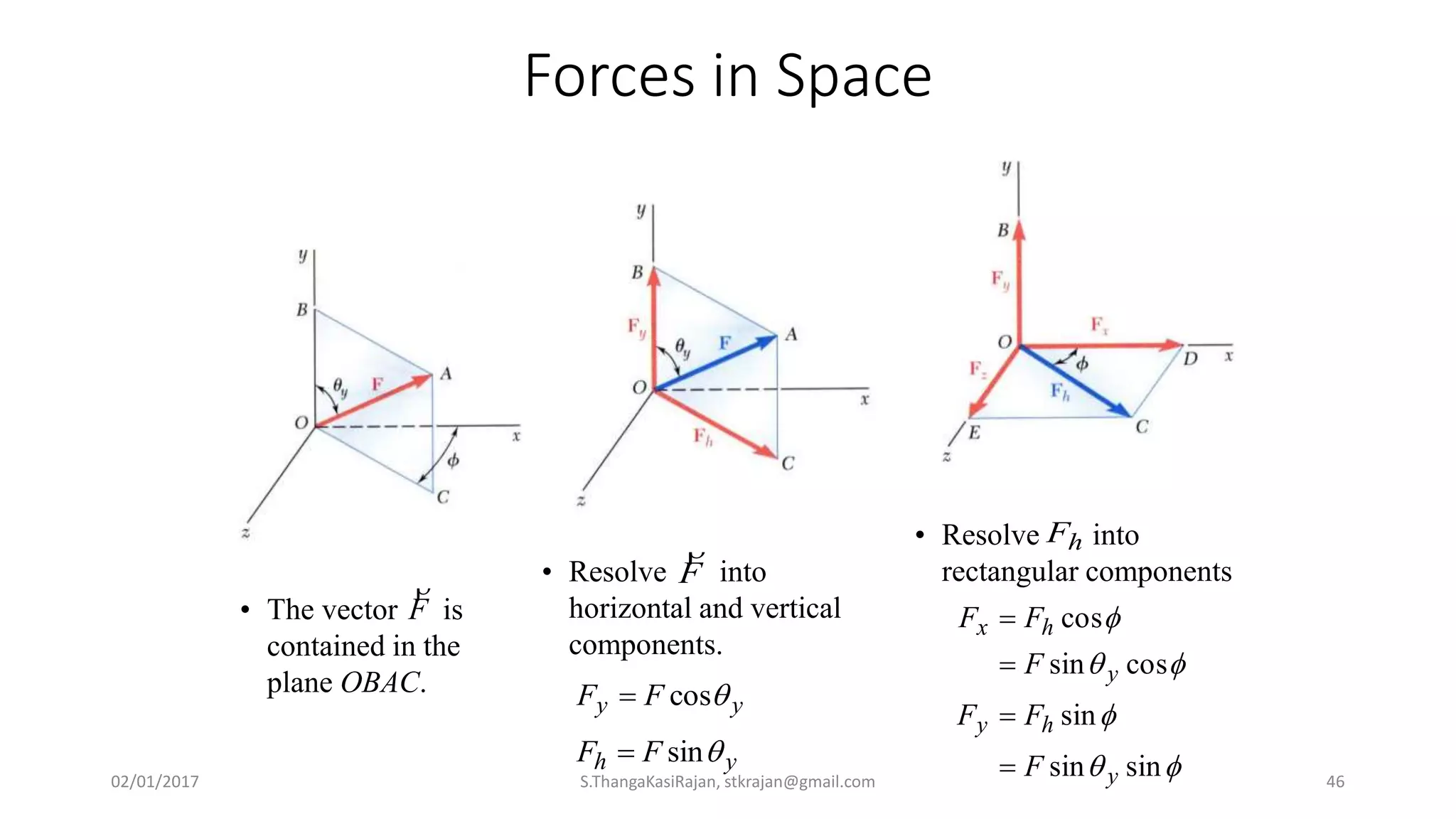
Forces in Space
• The vector is
contained in the
plane OBAC.
F
 • Resolve into
horizontal and vertical
components.
yh FF sin
F

yy FF cos
• Resolve into
rectangular components
hF




sinsin
sin
cossin
cos
y
hy
y
hx
F
FF
F
FF




02/01/2017 S.ThangaKasiRajan, stkrajan@gmail.com 46
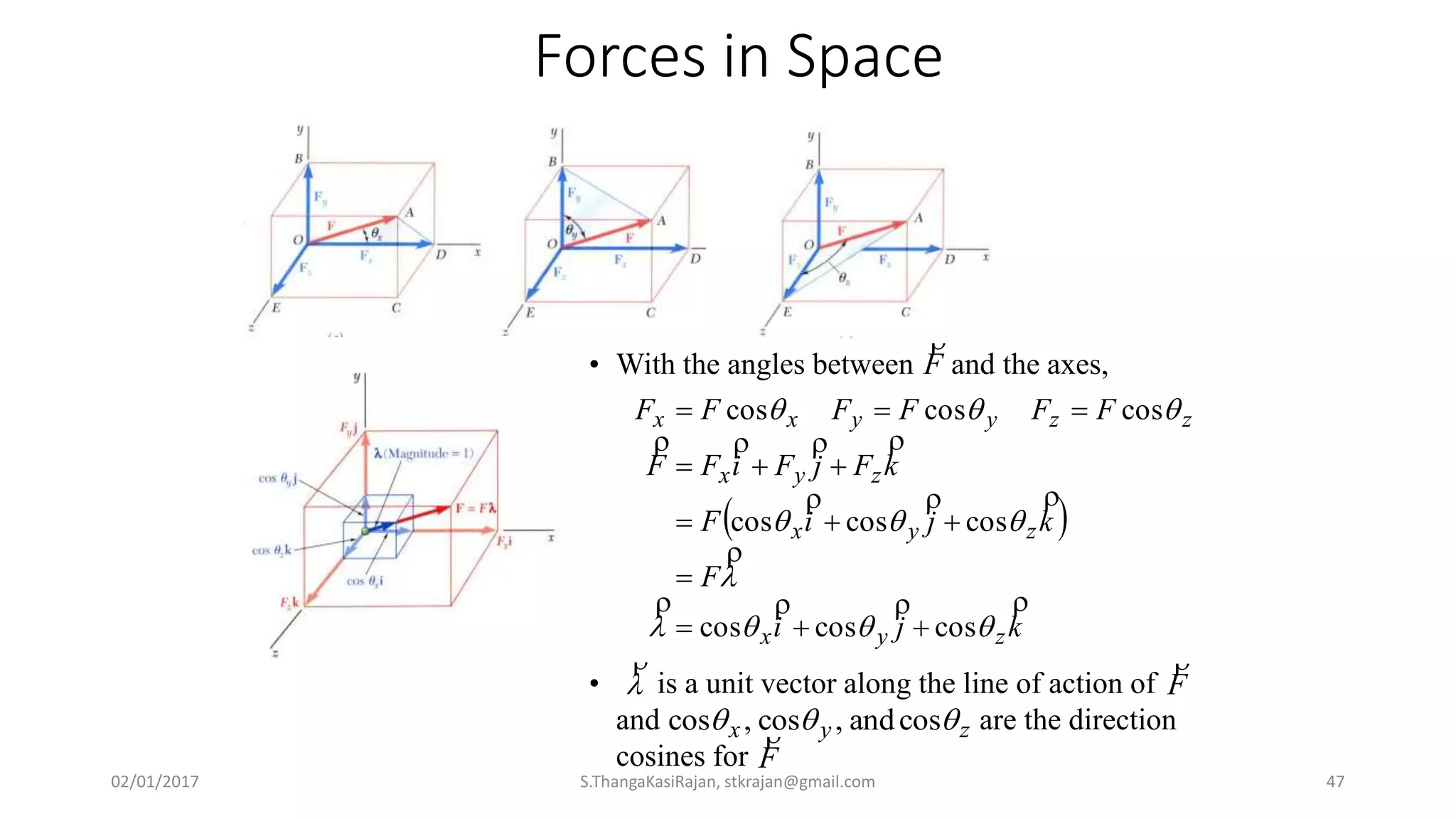
Forces in Space
• With the angles between and the axes,F

 
kji
F
kjiF
kFjFiFF
FFFFFF
zyx
zyx
zyx
zzyyxx








coscoscos
coscoscos
coscoscos





• is a unit vector along the line of action of
and are the direction
cosines for
F

F



zyx  cosand,cos,cos
02/01/2017 S.ThangaKasiRajan, stkrajan@gmail.com 47
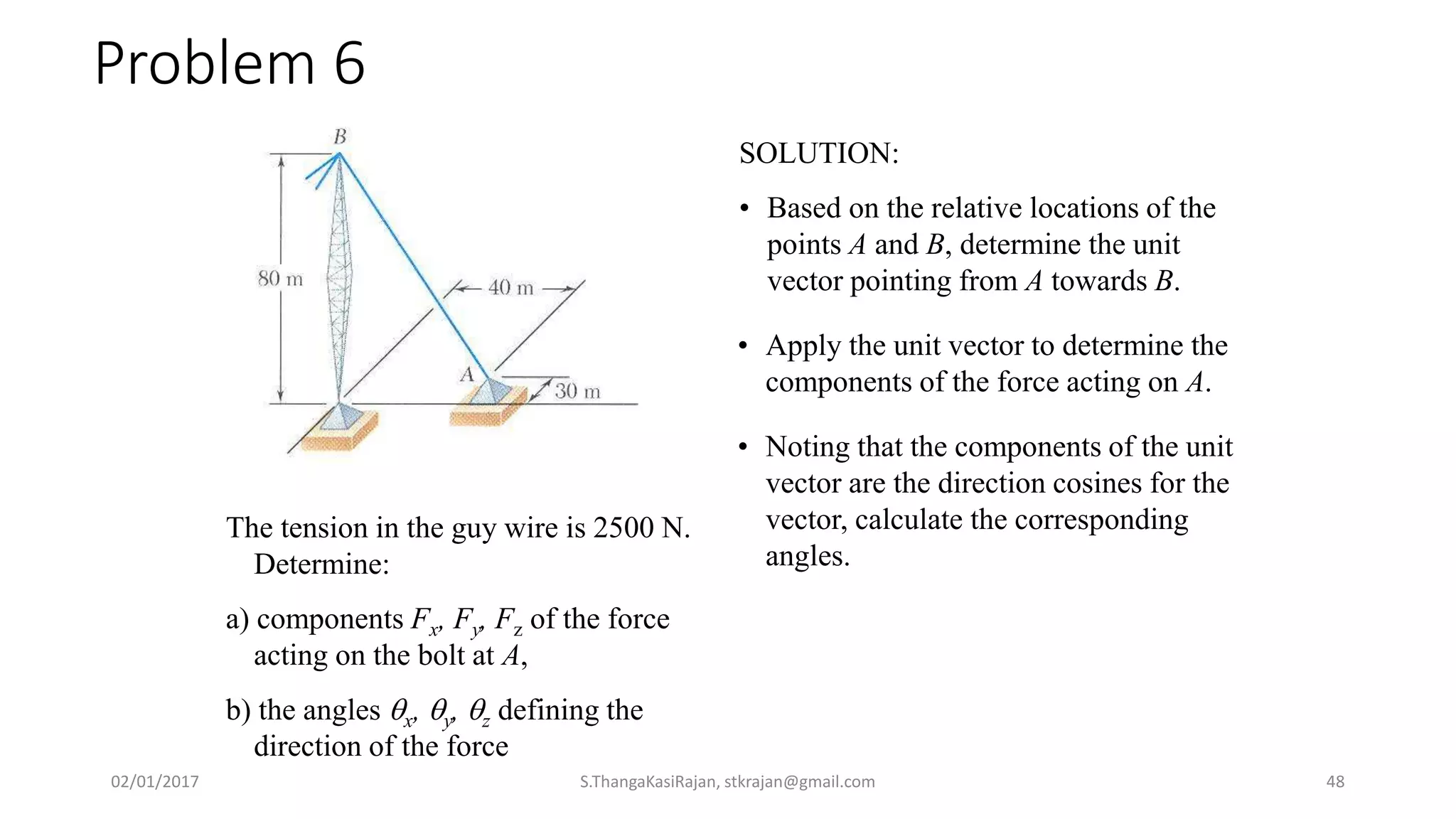
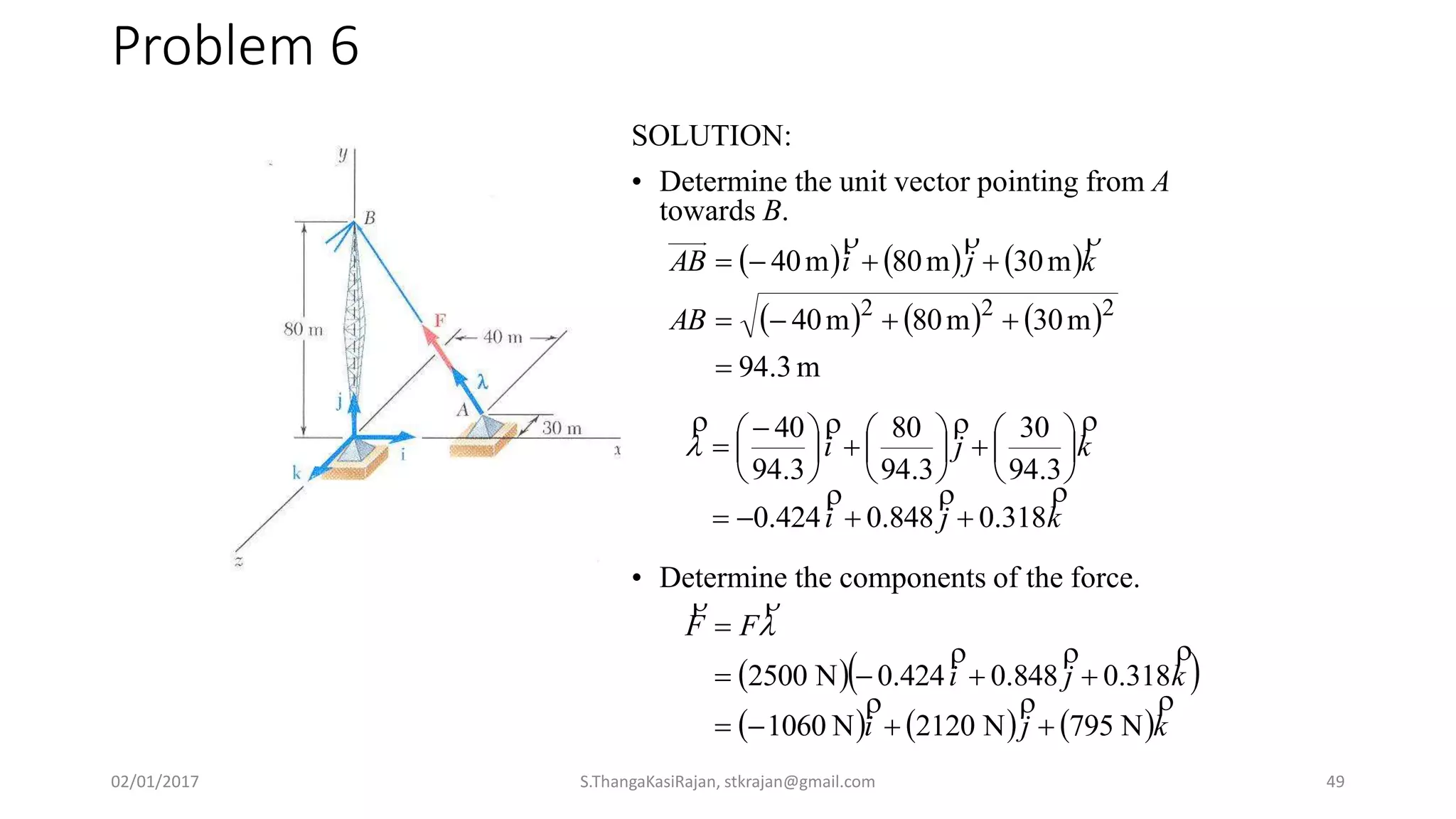
Problem 6
The tension in the guy wire is 2500 N.
Determine:
a) components Fx, Fy, Fz of the force
acting on the bolt at A,
b) the angles x, y, z defining the
direction of the force
SOLUTION:
• Based on the relative locations of the
points A and B, determine the unit
vector pointing from A towards B.
• Apply the unit vector to determine the
components of the force acting on A.
• Noting that the components of the unit
vector are the direction cosines for the
vector, calculate the corresponding
angles.
02/01/2017 S.ThangaKasiRajan, stkrajan@gmail.com 48
Problem 6
SOLUTION:
• Determine the unit vector pointing from A
towards B.
     
     
m3.94
m30m80m40
m30m80m40
222



AB
kjiAB

• Determine the components of the force.
  
     kji
kji
FF



N795N2120N1060
318.0848.0424.0N2500


 
kji
kji


318.0848.0424.0
3.94
30
3.94
80
3.94
40


















 

02/01/2017 S.ThangaKasiRajan, stkrajan@gmail.com 49
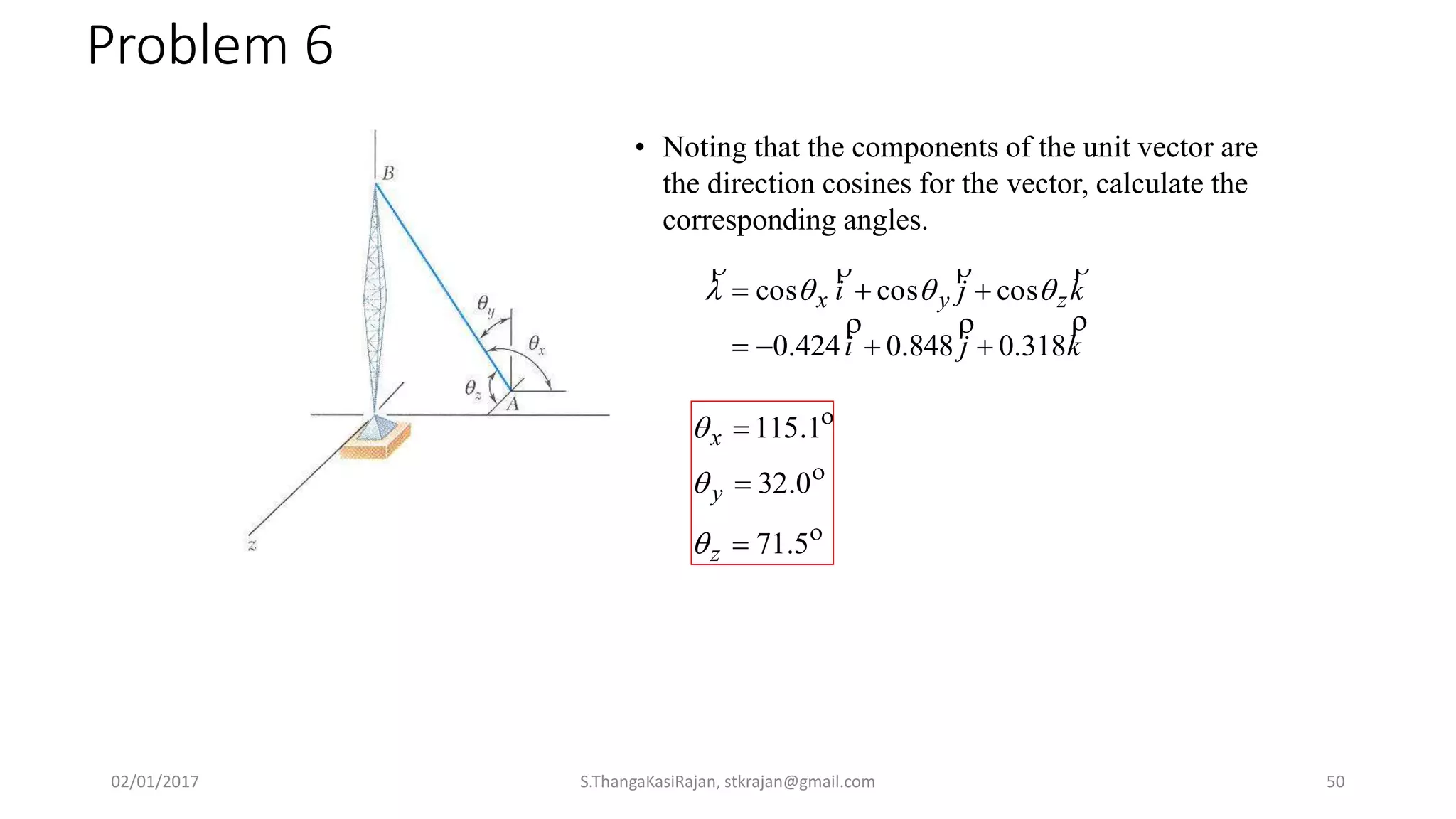
Problem 6
• Noting that the components of the unit vector are
the direction cosines for the vector, calculate the
corresponding angles.
kji
kji zyx


318.0848.0424.0
coscoscos

 



5.71
0.32
1.115



z
y
x



02/01/2017 S.ThangaKasiRajan, stkrajan@gmail.com 50
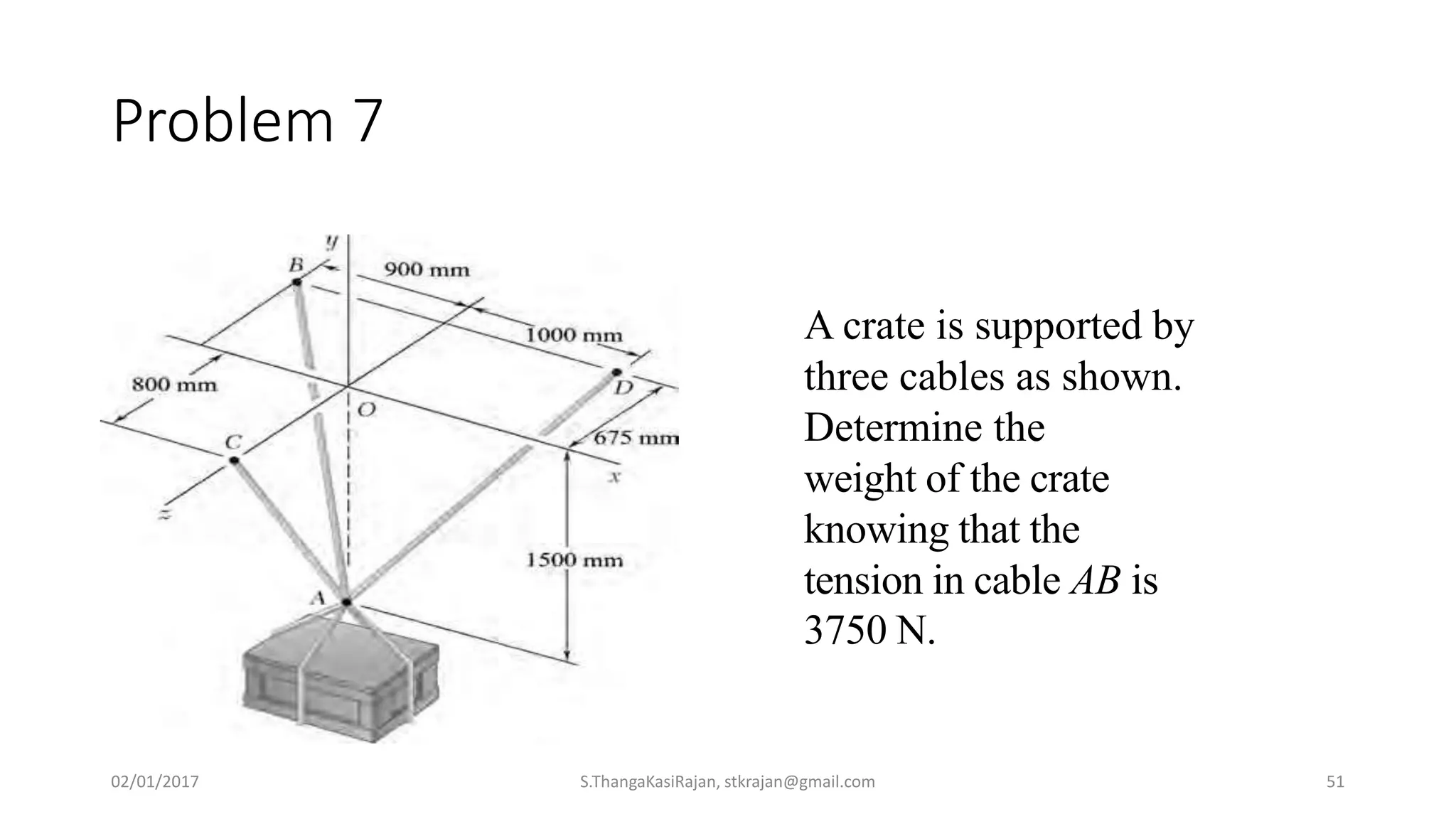
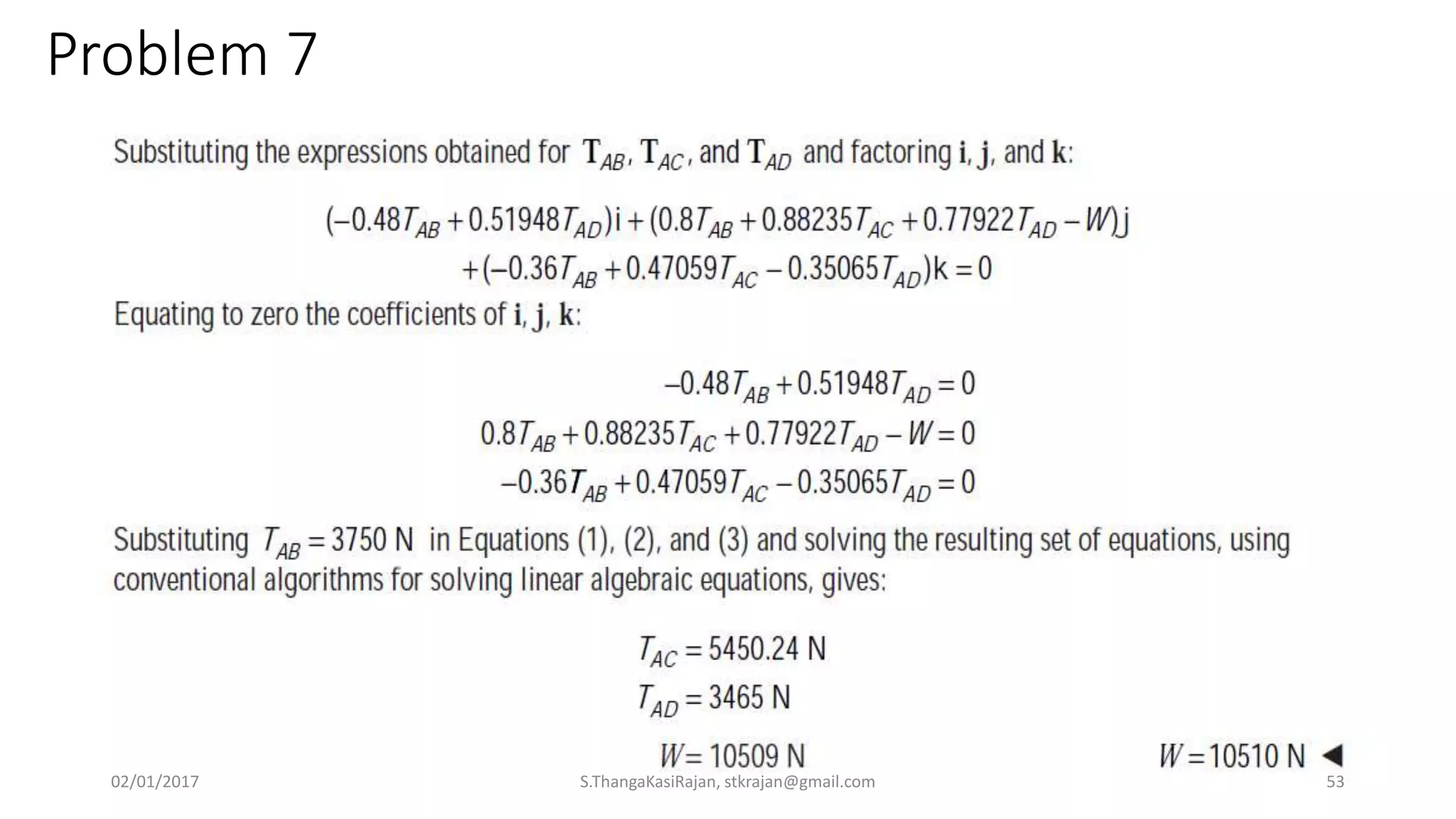
Problem 7
A crate is supported by
three cables as shown.
Determine the
weight of the crate
knowing that the
tension in cable AB is
3750 N.
02/01/2017 S.ThangaKasiRajan, stkrajan@gmail.com 51
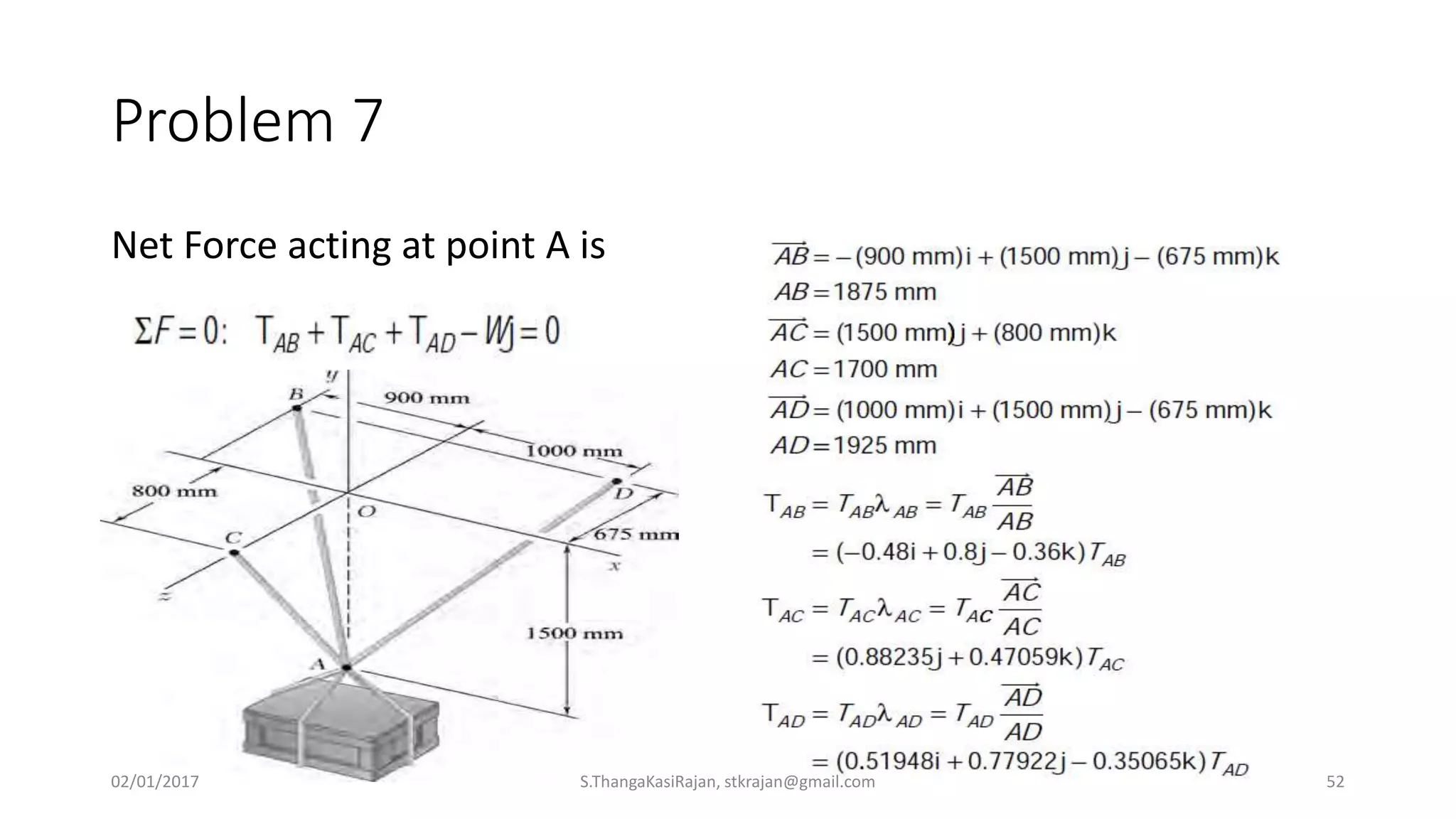
Problem 7
Net Force acting at point A is
02/01/2017 S.ThangaKasiRajan, stkrajan@gmail.com 52
Problem 7
02/01/2017 S.ThangaKasiRajan, stkrajan@gmail.com 53
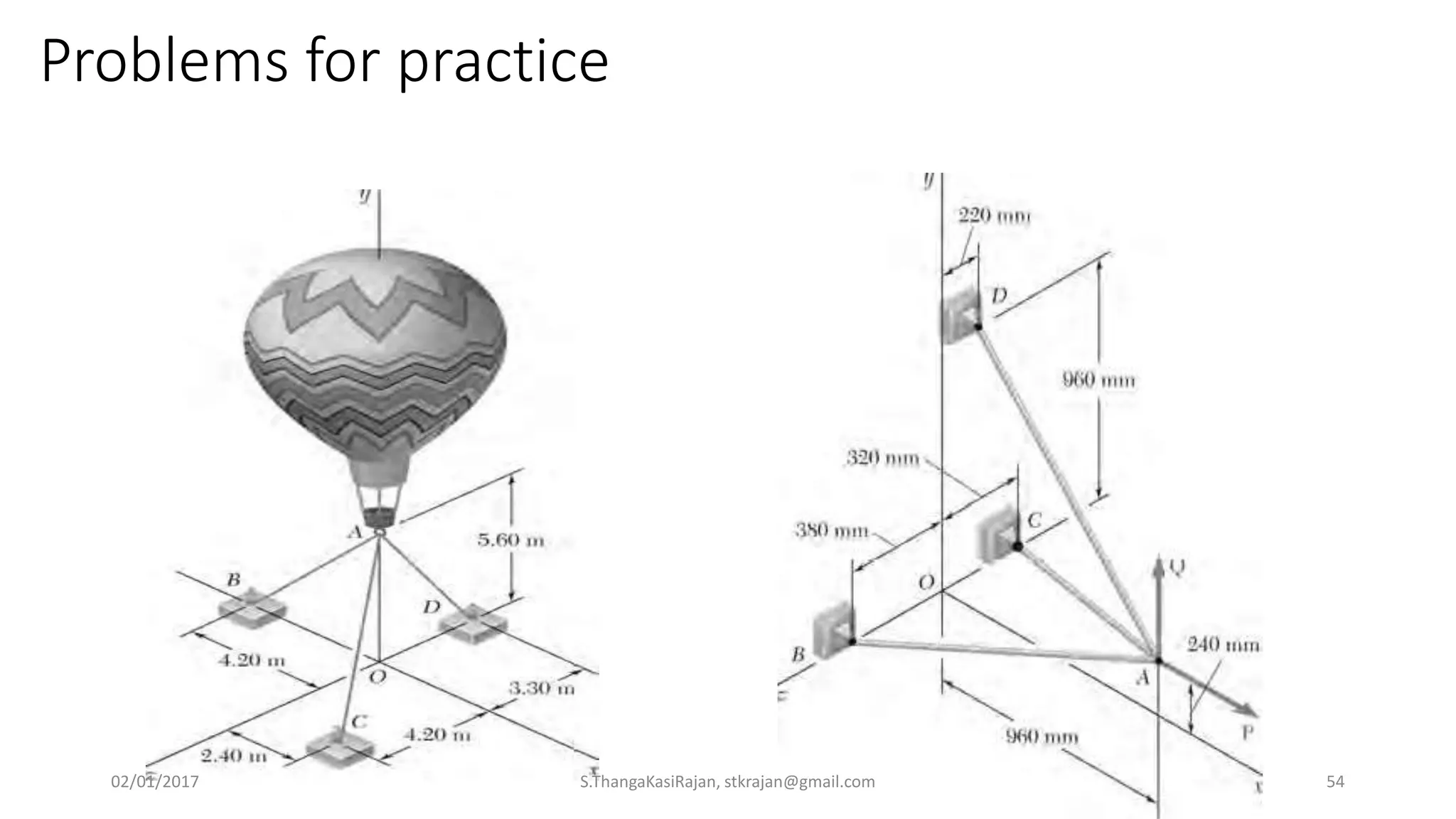
Problems for practice
02/01/2017 S.ThangaKasiRajan, stkrajan@gmail.com 54
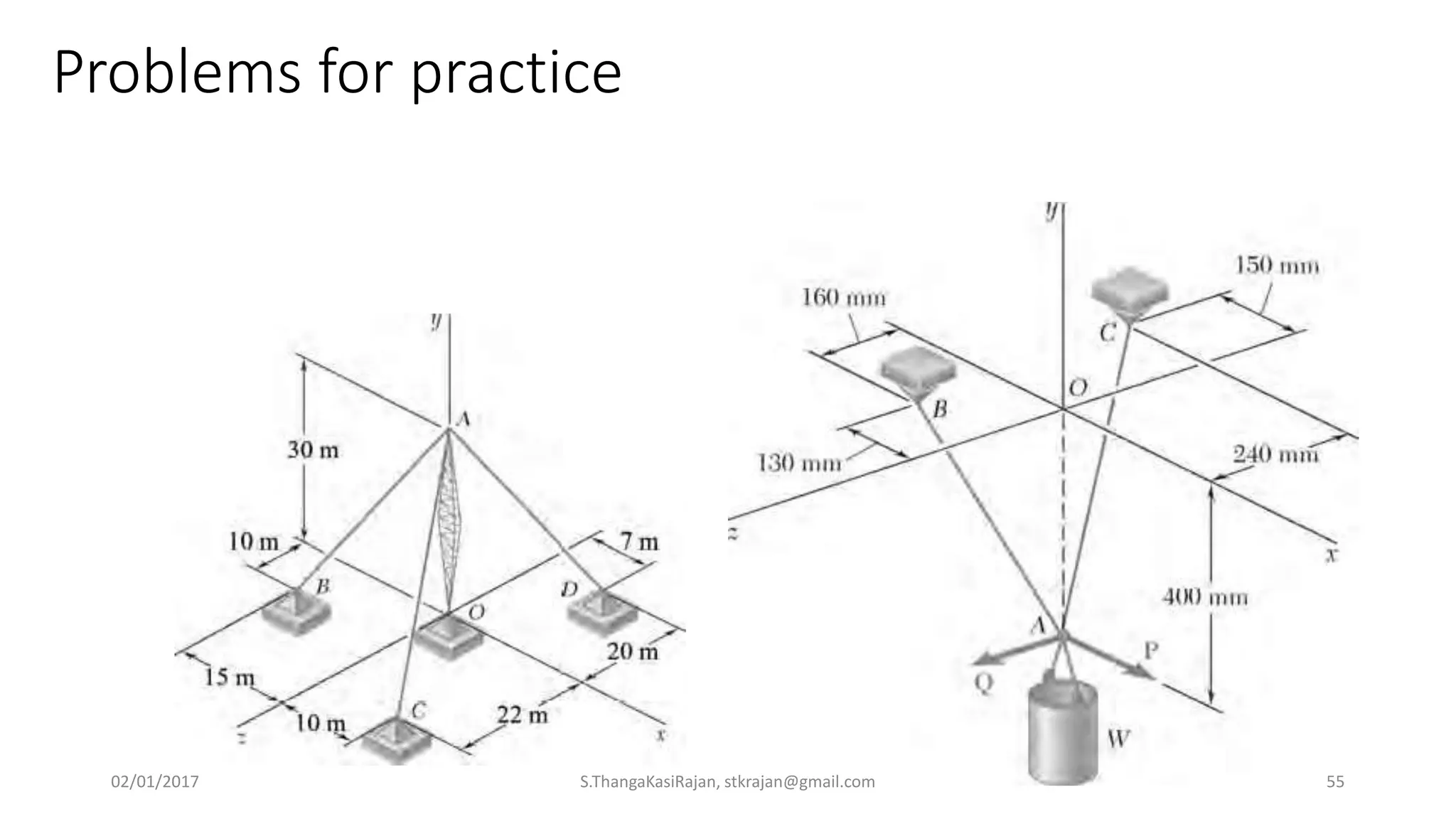
Problems for practice
02/01/2017 S.ThangaKasiRajan, stkrajan@gmail.com 55
References
1. Ferdinand P Beer & E.Russell Johnston “VECTOR MECHANICS FOR
ENGINEERS STATICS & Dynamics”, (Ninth Edition) Tata McGraw Hill
Education Private Limited, New Delhi.
2. Engineering Mechanics – Statics & Dynamics by S.Nagan,
M.S.Palanichamy, Tata McGraw-Hill (2001).
02/01/2017 S.ThangaKasiRajan, stkrajan@gmail.com 56
Thank you
Any Queries contact
S.Thanga Kasi Rajan
Assistant Professor
Department of Mechanical Engineering
Kamaraj College of Engineering & Technology,
Virudhunagar – 626001.
Tamil Nadu, India
Email : stkrajan@gmail.com
02/01/2017 S.ThangaKasiRajan, stkrajan@gmail.com 57

Basics and statics of particles unit i - GE6253 PPT

  • 1.
    ENGINEERING MECHANICS Unit –I Basics and Statics of Particles by S.Thanga Kasi Rajan Assistant Professor Department of Mechanical Engineering Kamaraj College of Engineering & Technology, Virudhunagar – 626001. Tamil Nadu, India Email : stkrajan@gmail.com
  • 2.
  • 3.
    INTRODUCTION To deal withthe above situations, we need to know about engineering mechanics Mechanics is the foundation of most engineering sciences and is an indispensable prerequisite to their study. Mechanics is the science which describes and predicts the conditions of rest or motion of bodies under the action of forces. 02/01/2017 S.ThangaKasiRajan, stkrajan@gmail.com 3
  • 4.
    Branches of EngineeringMechanics 02/01/2017 S.ThangaKasiRajan, stkrajan@gmail.com 4
  • 5.
    Mechanics: The actionsand effects of forces on bodies. Mechanics Statics: Bodies at rest, or in equilibrium Dynamics: Bodies in motion, or out of equilibrium IN EQUILIBRIUM Will be static, OR move with constant velocity OUT OF EQUILIBRIUM Will accelerate (velocity changing) Velocity=0 Velocity= constant Velocity changing with time Engineering Mechanics 02/01/2017 S.ThangaKasiRajan, stkrajan@gmail.com 5
  • 6.
    Kinematics: how fast,how far, and how long it takes... Kinetics: What forces were involved to produce this motion? Dynamics: Kinematics: Study of motion without reference to forces producing motion: Relations between position, velocity, acceleration and time. Kinetics: Relations between unbalanced forces and the changes in motion they produce. E.g. Rollercoaster ride: - Weight - Friction - Aerodynamic drag What are the resulting accelerations?02/01/2017 S.ThangaKasiRajan, stkrajan@gmail.com 6
  • 7.
    Six Fundamental Conceptof Mechanics • Space - associated with the motion or the position of a point P given in terms of three coordinates measured from a reference point or origin. • Time - definition of an event requires specification of the time and position at which it occurred. • Mass - used to characterize and compare bodies, e.g., response to earth’s gravitational attraction and resistance to change in translational motion.02/01/2017 S.ThangaKasiRajan, stkrajan@gmail.com 7
  • 8.
    Force A force isa push or pull. An object at rest needs a force to get it moving; a moving object needs a force to change its velocity. The magnitude of a force can be measured using a spring scale. Six Fundamental Concept of Mechanics 02/01/2017 S.ThangaKasiRajan, stkrajan@gmail.com 8
  • 9.
    Six Fundamental Conceptof Mechanics Particle A particle has a mass but size is neglected. When a body is idealised as a particle, the principles of mechanics reduces to a simplified form, since the geometry of the body will not be concerned in the analysis of the problem. 02/01/2017 S.ThangaKasiRajan, stkrajan@gmail.com 9
  • 10.
    Six Fundamental Conceptof Mechanics Rigid Body A combination of large number of Particles in which all the particles remain at a fixed distance from one another before and after application of load. Here mass & size of the bodies are considered when analysing the forces. 02/01/2017 S.ThangaKasiRajan, stkrajan@gmail.com 10
  • 11.
    Basic Laws ofMechanics 1. Newton’s Law 2. Newton’s Law of Gravitation 3. Triangle Law 4. Parallellogram Law 5. Lami’s Theorem 6. Principle of Transmissibility 02/01/2017 S.ThangaKasiRajan, stkrajan@gmail.com 11
  • 12.
    Basic Laws ofMechanics • Newton’s First Law: If the resultant force on a particle is zero, the particle will remain at rest or continue to move in a straight line. • Newton’s Third Law: The forces of action and reaction between two particles have the same magnitude and line of action with opposite sense. • Newton’s Second Law: A particle will have an acceleration proportional to a nonzero resultant applied force. amF   • Newton’s Law of Gravitation: Two particles are attracted with equal and opposite forces, 22 , R GM gmgW r Mm GF  02/01/2017 S.ThangaKasiRajan, stkrajan@gmail.com 12
  • 13.
    Parallelogram Law Parallelogram Law Iftwo vectors acting at a point be represented in magnitude and direction by the adjacent sides of a parallelogram, then their resultant is represented in magnitude and direction by the diagonal of the parallelogram passing through that point. 𝑅 = 𝑃2 + 𝑄2 + 2𝑃𝑄𝑐𝑜𝑠Ө Ө = tan−1 𝑄𝑠𝑖𝑛 𝛼 𝑃 + 𝑄 cos 𝛼 02/01/2017 S.ThangaKasiRajan, stkrajan@gmail.com 13
  • 14.
    Triangle Law If twovectors acting at a point are represented by the two sides of a triangle taken in order, then their resultant is represented by the third side taken in opposite order 𝑅 = 𝑃 + 𝑄 𝑃 𝑄 𝑅 02/01/2017 S.ThangaKasiRajan, stkrajan@gmail.com 14
  • 15.
    sine and cosinerules When adding forces it is often useful to consider solving the problem using geometric rules, rather than considering components       The sine rule states that  sinsinsin XBA  The cosine rule states that cos2222 BXXBA  cos2222 AXXAB  cos2222 ABBAX  02/01/2017 S.ThangaKasiRajan, stkrajan@gmail.com 15
  • 16.
    Principle of Transmissibility Accordingto this law the state of rest or motion of the rigid body is unaltered if a force acting on the body is replaced by another force of the same magnitude and direction but acting anywhere on the body along the line of action of the replaced force. • Principle of Transmissibility - Conditions of equilibrium or motion are not affected by transmitting a force along its line of action. NOTE: F and F’ are equivalent forces. 02/01/2017 S.ThangaKasiRajan, stkrajan@gmail.com 16
  • 17.
    Coordinate System 1. Anorigin as the reference point 2. A set of coordinate axes with scales and labels 3. Choice of positive direction for each axis 4. Choice of unit vectors at each point in space Coordinate system: used to describe the position of a point in space and consists of Cartesian Coordinate System 17
  • 18.
    Vector Representation ofForces A vector is a quantity that has both direction and magnitude. 18
  • 19.
    Application of Vectors (1)Vectors can exist at any point P in space. (2) Vectors have direction and magnitude. (3) Vector Equality: Any two vectors that have the same direction and magnitude, are equal no matter where in space they are located. 19
  • 20.
    Resolution and Compositionof Forces Resolution of force is a reverse process in which a single force is expressed in terms of its components. These components are sometimes referred to as the resolved parts of the force. F x y  O X Y OX = F cos  OY = F sin  Splitting of forces into their components 30° 20 N
  • 21.
    Examples X = -15 Cos 42 = -11.1 N Y = 15  Sin 42 = 10.0 N X = 35  Cos 62 = 16.4 N Y = -35  Sin 62 = - 30.9 N x y 42° 15 N x y 62° 35 N x y 32° 10 N X = -10  Sin 32 = - 5.30 N Y = -10  Cos 32 = -8.48 N 02/01/2017 S.ThangaKasiRajan, stkrajan@gmail.com 21
  • 22.
    Resolution and Compositionof Forces F F cosӨ F sinӨ F cosӨF cosӨ F sinӨ F sinӨ Ө Ө Ө F sinӨ F cosӨ Ө F F F 1. It is convenient to have Fx = F cos Ө Fy = F sin Ө and Always measure angle from horizontal reference(acute angle). 2. Assume force pointing Right and Top as positive otherwise negative 02/01/2017 S.ThangaKasiRajan, stkrajan@gmail.com 22
  • 23.
    Procedure to findResultant Force Procedure to find the magnitude and direction of the resultant force 1. Find ƩFx 2. Find ƩFy 3. Magnitude of the resultant force is given by 𝑅 = (Ʃ𝐹𝑥)2+(Ʃ𝐹𝑦)2 4. Plot ƩFx and ƩFy with its appropriate sign 5. Direction of the resultant force is given by tan Ө = Ʃ𝐹 𝑦 Ʃ𝐹𝑥 02/01/2017 S.ThangaKasiRajan, stkrajan@gmail.com 23
  • 24.
  • 25.
    Problem No 1 Twoforces act on a bolt at A. Determine their resultant. 02/01/2017 S.ThangaKasiRajan, stkrajan@gmail.com 25
  • 26.
    Problem No 1(contd…) • Graphical solution - A parallelogram with sides equal to P and Q is drawn to scale. The magnitude and direction of the resultant or of the diagonal to the parallelogram are measured,  35N98 R • Graphical solution - A triangle is drawn with P and Q head-to-tail and to scale. The magnitude and direction of the resultant or of the third side of the triangle are measured,  35N98 R 02/01/2017 S.ThangaKasiRajan, stkrajan@gmail.com 26
  • 27.
    Problem No 1(contd…) • Trigonometric solution - Apply the triangle rule. From the Law of Cosines,          155cosN60N402N60N40 cos2 22 222 BPQQPR A A R Q BA R B Q A      20 04.15 N73.97 N60 155sin sinsin sinsin  N73.97R From the Law of Sines,  04.35 02/01/2017 S.ThangaKasiRajan, stkrajan@gmail.com 27
  • 28.
    Problem No 1(contd…) Sl. No. ƩFx ƩFy 1. + 40 cos20 + 40 sin20 2. + 60 cos 45 + 60 cos 45 80.01 56.10 𝑅 = (Ʃ𝐹𝑥)2+(Ʃ𝐹𝑦)2 𝑅 = (80.01)2+(56.10)2 R = 97.72 N Magnitude of the resultant force Direction of resultant force Ʃ Fx = 80.01 ƩFy=56.01 Ө tan Ө = Ʃ𝐹𝑦 Ʃ𝐹𝑥 tan Ө = ( 56.1 80.01 ) Ө = 35ᴼ 02/01/2017 S.ThangaKasiRajan, stkrajan@gmail.com 28
  • 29.
    Problem 2 a) thetension in each of the ropes for  = 45o, b) the value of  for which the tension in rope 2 is minimum. A barge is pulled by two tugboats. If the resultant of the forces exerted by the tugboats is a 25 kN directed along the axis of the barge, determine 02/01/2017 S.ThangaKasiRajan, stkrajan@gmail.com 29
  • 30.
    Problem 2 • Graphicalsolution - Parallelogram Rule with known resultant direction and magnitude, known directions for sides. kN12.8kN18.5 21  TT • Trigonometric solution - Triangle Rule with Law of Sines      105sin kN25 30sin45sin 21 TT kN12.94kN18.3 21  TT 02/01/2017 S.ThangaKasiRajan, stkrajan@gmail.com 30
  • 31.
    Problem 2 • Theangle for minimum tension in rope 2 is determined by applying the Triangle Rule and observing the effect of variations in . • The minimum tension in rope 2 occurs when T1 and T2 are perpendicular.    30sinkN252T kN12.52 T    30coskN251T kN21.71 T  3090  60 02/01/2017 S.ThangaKasiRajan, stkrajan@gmail.com 31
  • 32.
    Problem 3 Knowing thatthe tension in cable BC is 725-N, determine the resultant of the three forces exerted at point B of beam AB. 02/01/2017 S.ThangaKasiRajan, stkrajan@gmail.com 32
  • 33.
    Problem 3 SOLUTION: • Resolveeach force into rectangular components. • Calculate the magnitude and direction. 02/01/2017 S.ThangaKasiRajan, stkrajan@gmail.com 33
  • 34.
    Problems for Practice Fig1 Fig 2 A disabled automobile is pulled by means of two ropes shown in fig 1. Determine the Magnitude and direction of Resultant by (a) parallelogram law, (b) Triangle law (c) analytical method Determine the magnitude and direction of resultant force shown in fig 2. 02/01/2017 S.ThangaKasiRajan, stkrajan@gmail.com 34
  • 35.
    Equilibrium of aParticle 2 - 35 • When the resultant of all forces acting on a particle is zero, the particle is in equilibrium. • Newton’s First Law: If the resultant force on a particle is zero, the particle will remain at rest or will continue at constant speed in a straight line. • Particle acted upon by two forces: - equal magnitude - same line of action - opposite sense • Particle acted upon by three or more forces: - graphical solution yields a closed polygon - algebraic solution 00 0     yx FF FR  02/01/2017 S.ThangaKasiRajan, stkrajan@gmail.com
  • 36.
    Examples for Equilibrium CablesAB and AC carries the spool of weight 02/01/2017 S.ThangaKasiRajan, stkrajan@gmail.com 36
  • 37.
    Problem 4 Given: SackA weighs 20 N. and geometry is as shown. Find: Forces in the cables and weight of sack B. 1. Apply Equilibrium condition at Point E and solve for the unknowns (TEG & TEC). 2. Repeat this process at C. 02/01/2017 S.ThangaKasiRajan, stkrajan@gmail.com 37
  • 38.
    Problem 4 +  Fx = TEG sin 30º – TEC cos 45º = 0 +   Fy = TEG cos 30º – TEC sin 45º – 20 N = 0 Solving these two simultaneous equations for the two unknowns, we get TEC = 38.6 N TEG = 54.6 N Note that the assumed directions for the forces in the two cables EG and EC are tensile in nature. 02/01/2017 S.ThangaKasiRajan, stkrajan@gmail.com 38
  • 39.
    Problem 4   Fx = 38.64 cos 45 – (4/5) TCD = 0    Fy = (3/5) TCD + 38.64 sin 45 – WB = 0 Solving the first equation and then the second we get TCD = 34.2 N and WB = 47.8 N . Apply Equilibrium Condition Now move on to the point C and consider equilibrium at C 02/01/2017 S.ThangaKasiRajan, stkrajan@gmail.com 39
  • 40.
    Problem 5 It isdesired to determine the drag force at a given speed on a prototype sailboat hull. A model is placed in a test channel and three cables are used to align its bow on the channel centerline. For a given speed, the tension is 200-N in cable AB and 300-N in cable AE. Determine the drag force exerted on the hull and the tension in cable AC. SOLUTION: • Choosing the hull as the free body, draw a free-body diagram. • Express the condition for equilibrium for the hull by writing that the sum of all forces must be zero. • Resolve the vector equilibrium equation into two component equations. Solve for the two unknown cable tensions. 02/01/2017 S.ThangaKasiRajan, stkrajan@gmail.com 40
  • 41.
    Problem 5 • Expressthe condition for equilibrium for the hull by writing that the sum of all forces must be zero. 0 DAEACAB FTTTR  SOLUTION: • Choosing the hull as the free body, draw a free-body diagram.   25.60 75.1 m4 m7 tan     56.20 375.0 m4 m1.5 tan   02/01/2017 S.ThangaKasiRajan, stkrajan@gmail.com 41
  • 42.
    Problem 5 • Resolvethe vector equilibrium equation into two component equations. Solve for the two unknown cable tensions.                jT iFT R iFF iT jTiT jTiTT ji jiT AC DAC DD ACAC ACACAC AB          3009363.021.99 3512.066.173 0 N300 9363.03512.0 56.20cos56.20sin N21.99N66.173 26.60cosN20026.60sinN200          02/01/2017 S.ThangaKasiRajan, stkrajan@gmail.com 42
  • 43.
    Problem 5    3009363.021.9900 3512.066.17300     ACy DACx TF FTF N98.35 N214.45   D AC F T     jT iFT R AC DAC    3009363.021.99 3512.066.173 0    This equation is satisfied only if each component of the resultant is equal to zero 02/01/2017 S.ThangaKasiRajan, stkrajan@gmail.com 43
  • 44.
    Problem 6 A sailoris being rescued using a boatswain’s chair that is suspended from a pulley that can roll freely on the support cable ACB and is pulled at a constant speed by cable CD. Knowing that a = 25ᴼ and b = 15ᴼ and that the tension in cable CD is 80 N, determine (a) the combined weight of the boatswain’s chair and the sailor, (b) in tension in the support cable ACB. 02/01/2017 S.ThangaKasiRajan, stkrajan@gmail.com 44
  • 45.
  • 46.
    Forces in Space •The vector is contained in the plane OBAC. F  • Resolve into horizontal and vertical components. yh FF sin F  yy FF cos • Resolve into rectangular components hF     sinsin sin cossin cos y hy y hx F FF F FF     02/01/2017 S.ThangaKasiRajan, stkrajan@gmail.com 46
  • 47.
    Forces in Space •With the angles between and the axes,F    kji F kjiF kFjFiFF FFFFFF zyx zyx zyx zzyyxx         coscoscos coscoscos coscoscos      • is a unit vector along the line of action of and are the direction cosines for F  F    zyx  cosand,cos,cos 02/01/2017 S.ThangaKasiRajan, stkrajan@gmail.com 47
  • 48.
    Problem 6 The tensionin the guy wire is 2500 N. Determine: a) components Fx, Fy, Fz of the force acting on the bolt at A, b) the angles x, y, z defining the direction of the force SOLUTION: • Based on the relative locations of the points A and B, determine the unit vector pointing from A towards B. • Apply the unit vector to determine the components of the force acting on A. • Noting that the components of the unit vector are the direction cosines for the vector, calculate the corresponding angles. 02/01/2017 S.ThangaKasiRajan, stkrajan@gmail.com 48
  • 49.
    Problem 6 SOLUTION: • Determinethe unit vector pointing from A towards B.             m3.94 m30m80m40 m30m80m40 222    AB kjiAB  • Determine the components of the force.         kji kji FF    N795N2120N1060 318.0848.0424.0N2500     kji kji   318.0848.0424.0 3.94 30 3.94 80 3.94 40                      02/01/2017 S.ThangaKasiRajan, stkrajan@gmail.com 49
  • 50.
    Problem 6 • Notingthat the components of the unit vector are the direction cosines for the vector, calculate the corresponding angles. kji kji zyx   318.0848.0424.0 coscoscos       5.71 0.32 1.115    z y x    02/01/2017 S.ThangaKasiRajan, stkrajan@gmail.com 50
  • 51.
    Problem 7 A crateis supported by three cables as shown. Determine the weight of the crate knowing that the tension in cable AB is 3750 N. 02/01/2017 S.ThangaKasiRajan, stkrajan@gmail.com 51
  • 52.
    Problem 7 Net Forceacting at point A is 02/01/2017 S.ThangaKasiRajan, stkrajan@gmail.com 52
  • 53.
  • 54.
    Problems for practice 02/01/2017S.ThangaKasiRajan, stkrajan@gmail.com 54
  • 55.
    Problems for practice 02/01/2017S.ThangaKasiRajan, stkrajan@gmail.com 55
  • 56.
    References 1. Ferdinand PBeer & E.Russell Johnston “VECTOR MECHANICS FOR ENGINEERS STATICS & Dynamics”, (Ninth Edition) Tata McGraw Hill Education Private Limited, New Delhi. 2. Engineering Mechanics – Statics & Dynamics by S.Nagan, M.S.Palanichamy, Tata McGraw-Hill (2001). 02/01/2017 S.ThangaKasiRajan, stkrajan@gmail.com 56
  • 57.
    Thank you Any Queriescontact S.Thanga Kasi Rajan Assistant Professor Department of Mechanical Engineering Kamaraj College of Engineering & Technology, Virudhunagar – 626001. Tamil Nadu, India Email : stkrajan@gmail.com 02/01/2017 S.ThangaKasiRajan, stkrajan@gmail.com 57