Bacteriophages
DR. KAVEH HARATIAN
MASTER EDUCATION SERIES - AUMS - 2014 1
What do you think about them
?
MASTER EDUCATION SERIES - AUMS - 2014 2
Some interesting facts
Viruses that infect bacteria.
Viruses of dsDNA(tailed dsDNA phages).easily in environmental samples
107 /mL in coastal sea-water
1031 individual tailed phage virion on planet Earth.
End to end : 200 million light years into intergalactic space
Most bacterial genomes contain 1 to 24 phage genome as prophage
Turn over every 4-5 years: 1024 productive infections/sec
MASTER EDUCATION SERIES - AUMS - 2014 3
What are Bacteriophages ?
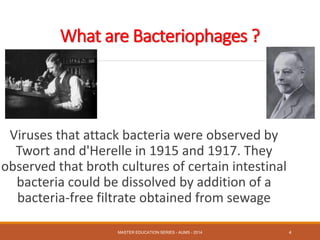
Viruses that attack bacteria were observed by
Twort and d'Herelle in 1915 and 1917. They
observed that broth cultures of certain intestinal
bacteria could be dissolved by addition of a
bacteria-free filtrate obtained from sewage
MASTER EDUCATION SERIES - AUMS - 2014 4
MASTER EDUCATION SERIES - AUMS - 2014 5
Brief history
Discovered in 1915/1917. basis on :
◦ Clearing(cell lysis) in bacterial lawn.
◦ Propagation as infectious agents
Ideas:
◦ Nature of viruses
◦ Phage therapy: using phages as an agent to combat bacterial infections
Modern era of phage research, 1940:
◦ Nature of gene
◦ Using phages as experimental model system
Extra results:
◦ Nature of gene
◦ Expression of genes and expression regulation
◦ Development of methods of recombinant DNA.
MASTER EDUCATION SERIES - AUMS - 2014 6
Bacteriophages under Electron
Microscope
MASTER EDUCATION SERIES - AUMS - 2014 7
Bacteriophage (Phage)
Definition - Obligate intracellular parasites that
multiply inside bacteria by making use of some or
all of the host biosynthetic machinery
Significance
◦ Models for animal cell viruses
◦ Gene transfer in bacteria
◦ Medical applications
◦ Identification of bacteria - phage typing
◦ Treatment and prophylaxsis???
MASTER EDUCATION SERIES - AUMS - 2014 8
Bacteriophages as therapeutic
agents
1919: successful treatment of typhoid in chickens , dysentery in humans.
1921: using against staphylococcus in skin disease.
1920s: large-scale experiments in many countries, like india.
1939 upward:
◦ Against diseases with no bacterial component: herpes, urticaria
◦ Although high specific, were used against inappropriate bacterial targets
◦ Inappropriate growth condition or preservatives could limit/prevented the inclusion of
infectious Bacteriophages.
◦ No good evidence that they actually worked in the therapeutic uses.
◦ But it continued through WW2(German and soviet armies) notably against dysentery.
Antibiotic age
Renewal of interest
MASTER EDUCATION SERIES - AUMS - 2014 9
Bacteriophages:
Definition & History
Bacteriophages are viruses that can
infect and destroy bacteria.
They have been referred to as bacterial
parasites, with each phage type
depending on a single strain of bacteria
to act as host.
MASTER EDUCATION SERIES - AUMS - 2014 10
BACTRIOPHAGES
Like most viruses, bacteriophages typically
carry only the genetic information needed
for replication of their nucleic acid and
synthesis of their protein coats.. They
require precursors, energy generation and
ribosomes supplied by their bacterial host
cell.
MASTER EDUCATION SERIES - AUMS - 2014 11
Bacteriophages:
Classification
At present, over 5000
bacteriophages have
been studied by
electron microscopy
and can be divided
into 13 virus families.
MASTER EDUCATION SERIES - AUMS - 2014 12
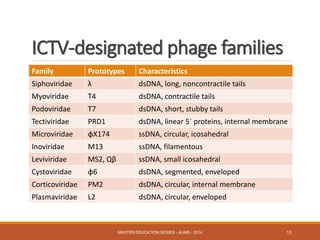
ICTV-designated phage families
Family Prototypes Characteristics
Siphoviridae λ dsDNA, long, noncontractile tails
Myoviridae T4 dsDNA, contractile tails
Podoviridae T7 dsDNA, short, stubby tails
Tectiviridae PRD1 dsDNA, linear 5` proteins, internal membrane
Microviridae φX174 ssDNA, circular, icosahedral
Inoviridae M13 ssDNA, filamentous
Leviviridae MS2, Qβ ssDNA, small icosahedral
Cystoviridae φ6 dsDNA, segmented, enveloped
Corticoviridae PM2 dsDNA, circular, internal membrane
Plasmaviridae L2 dsDNA, circular, enveloped
MASTER EDUCATION SERIES - AUMS - 2014 13
Bacteriophage
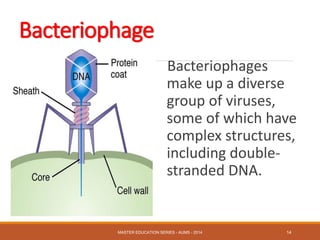
Bacteriophages
make up a diverse
group of viruses,
some of which have
complex structures,
including double-
stranded DNA.
MASTER EDUCATION SERIES - AUMS - 2014 14
Bacteriophage
MASTER EDUCATION SERIES - AUMS - 2014 15
Bacteriophage
Also known simply as a
phage; a virus that attacks
and infects bacteria. The
infection may or may not lead
to the death of the
bacterium, depending on the
phage and sometimes on
conditions. Each
bacteriophage is specific to
one form of bacteria.
MASTER EDUCATION SERIES - AUMS - 2014 16
Composition and Structure
Composition
◦Nucleic acid
◦Genome size
◦Modified bases
◦Protein
◦Protection
◦Infection
• Structure (T4)
– Size
– Head or capsid
– Tail
Tail
Tail Fibers
Base Plate
Head/Capsid
Contractile
Sheath
MASTER EDUCATION SERIES - AUMS - 2014 17
MASTER EDUCATION SERIES - AUMS - 2014 18
Phage entering a bacterial cell
MASTER EDUCATION SERIES - AUMS - 2014 19
MASTER EDUCATION SERIES - AUMS - 2014 20
Virulent vs. temperate phages
• Virulent phages do not integrate their genetic
material into the host cell chromosome and
usually kill the host cells (lytic infection)
(e.g. T-phages of E.coli).
• Temperate phages may integrate into the host
DNA, causing LYSOGENY.
MASTER EDUCATION SERIES - AUMS - 2014 21
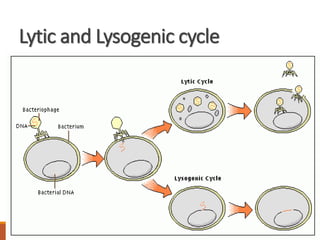
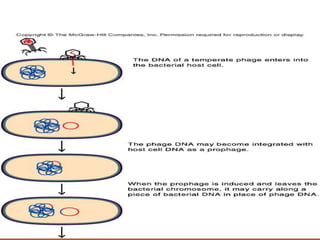
Bacteriophage showing Lytic and
lysogenic cycle
MASTER EDUCATION SERIES - AUMS - 2014 22
Bacteriophages:
Virulence Factors Carried On Phage
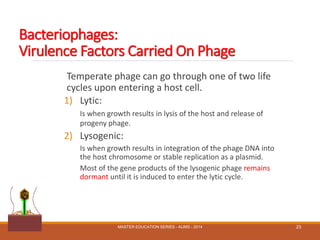
Temperate phage can go through one of two life
cycles upon entering a host cell.
1) Lytic:
Is when growth results in lysis of the host and release of
progeny phage.
2) Lysogenic:
Is when growth results in integration of the phage DNA into
the host chromosome or stable replication as a plasmid.
Most of the gene products of the lysogenic phage remains
dormant until it is induced to enter the lytic cycle.
MASTER EDUCATION SERIES - AUMS - 2014 23
Bacteriophages:
Lysogenic Conversion
Some lysogenic phage carry genes that can
enhance the virulence of the bacterial host.
 For example, some phage carry genes that encode toxins.
These genes, once integrated into the
bacterial chromosome, can cause the once
harmless bacteria to release potent toxins
that can cause disease.
MASTER EDUCATION SERIES - AUMS - 2014 24
Bacteriophages
• Used for cloning foreign
genes among other
applications
• Proteins and peptides are
fused to the
Capsid(surface) of the
phage
• The combination of the
phage and peptide is
known as a Fusion Protein
MASTER EDUCATION SERIES - AUMS - 2014 25
Lytic and Lysogenic cycle
MASTER EDUCATION SERIES - AUMS - 2014 26
MASTER EDUCATION SERIES - AUMS - 2014 27
MASTER EDUCATION SERIES - AUMS - 2014 28
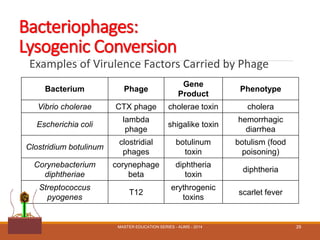
Bacteriophages:
Lysogenic Conversion
Bacterium Phage
Gene
Product
Phenotype
Vibrio cholerae CTX phage cholerae toxin cholera
Escherichia coli
lambda
phage
shigalike toxin
hemorrhagic
diarrhea
Clostridium botulinum
clostridial
phages
botulinum
toxin
botulism (food
poisoning)
Corynebacterium
diphtheriae
corynephage
beta
diphtheria
toxin
diphtheria
Streptococcus
pyogenes
T12
erythrogenic
toxins
scarlet fever
Examples of Virulence Factors Carried by Phage
MASTER EDUCATION SERIES - AUMS - 2014 29
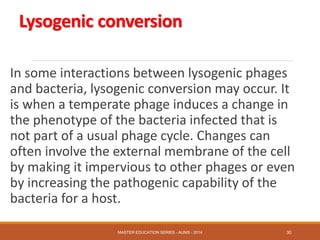
Lysogenic conversion
In some interactions between lysogenic phages
and bacteria, lysogenic conversion may occur. It
is when a temperate phage induces a change in
the phenotype of the bacteria infected that is
not part of a usual phage cycle. Changes can
often involve the external membrane of the cell
by making it impervious to other phages or even
by increasing the pathogenic capability of the
bacteria for a host.
MASTER EDUCATION SERIES - AUMS - 2014 30
Assay for Lytic Phage
• Plaque assay
– Method
– Plaque forming unit
(pfu)
– Measures infectious
particles
Bacteria
Phage
+
Phage
Plaque assay
Method
Plaque forming
unit (pfu)
Measures
infectious particles
MASTER EDUCATION SERIES - AUMS - 2014 31
Lytic
vs
Lysogenic
Cycle
MASTER EDUCATION SERIES - AUMS - 2014 32
Transduction
MASTER EDUCATION SERIES - AUMS - 2014 33
Transduction
MASTER EDUCATION SERIES - AUMS - 2014 34
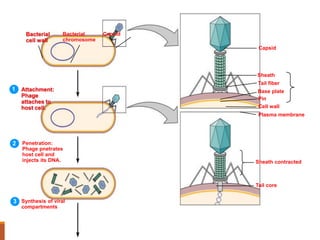
Figure 13.10.1
Attachment:
Phage
attaches to
host cell.
Penetration:
Phage pnetrates
host cell and
injects its DNA.
Synthesis of viral
compartments
1
2
3
Bacterial
cell wall
Bacterial
chromosome
Capsid DNA
Capsid
Sheath
Tail fiber
Base plate
Pin
Cell wall
Tail
Plasma membrane
Sheath contracted
Tail core
MASTER EDUCATION SERIES - AUMS - 2014 35
Figure 13.10.2
4 Maturation:
Viral components
are assembled
into virions.
Tail
5 Release:
Host cell lyses
and new virions
are released.
DNA
Capsid
Tail fibers
MASTER EDUCATION SERIES - AUMS - 2014 36
Examples:
* Corynebacterium diphtheria produces the toxin of diphtheria only when it
is infected by the phage β. In this case, the gene that codes for the toxin is
carried by the phage, not the bacteria.
* Vibrio cholerae is a non-toxic strain that can become toxic, producing
cholera toxin, when it is infected with the phage CTXφ.
* Clostridium botulinum causes botulism.
* Streptococcus pyogenes causes scarlet fever.
* Shiga toxin
* Tetanus
MASTER EDUCATION SERIES - AUMS - 2014 37
Medical Applications of Phages
“I strongly believe phage could become an
effective antibacterial tool” - Carl Merril, Chief of
the Laboratory of Biochemical Genetics, National Institute
of Mental Health, NIH.
“It might be another string on the bow, such
that when (conventional antibiotics) fail,
here’s something that has a chance of
working. But it’s not going to be a panacea” -
Joshua Lederberg, Sackler Foundation Scholar at The
Rockefeller University
MASTER EDUCATION SERIES - AUMS - 2014 38
Model Organisms
MASTER EDUCATION SERIES - AUMS - 2014 39
Model Organisms
Fundamental problems are solved in
the simplest and most accessible system
in which the problem can be addressed.
These organisms are called model
organisms.
MASTER EDUCATION SERIES - AUMS - 2014 40
Some Important Model
Organisms
Escherichia coli and its phage (the T phage and phage λ)
Baker’s yeast Saccharomyces cerevisiae
The nematode Caenorhabditis elegans
The fruit fly Drosophila melanogaster
The house mouse Mus musculus
MASTER EDUCATION SERIES - AUMS - 2014 41
Features of Model Systems
The availability of powerful tools of
traditional and molecular genetics.
The study of each model system
attracted a critical mass of investigators.
(Ideas,methods, tools and strains could
be shared)
MASTER EDUCATION SERIES - AUMS - 2014 42
HOW to choose a model
organism?
It depends on what question is being asked.
When studying fundamental issues of
molecular biology, simpler unicellular
organisms or viruses are convenient. For
developmental questions, more complicated
organisms should be used.
MASTER EDUCATION SERIES - AUMS - 2014 43
Model 1:
BACTERIOPHAGE
MASTER EDUCATION SERIES - AUMS - 2014 44
Bacteriophage (Viruses)
The simplest system
Their genomes are replicated only
after being injected into a host cell.
The genomes can recombine during
these infections.
MASTER EDUCATION SERIES - AUMS - 2014 45
Figure BacteriophageMASTER EDUCATION SERIES - AUMS - 2014 46
Each phage attaches to a specific cell
surface molecule (usually a protein)
and so only cells bearing that
“receptor” can be infected by a given
phage.
MASTER EDUCATION SERIES - AUMS - 2014 47
Two Basic Types
1. Lytic phage: eg. T phage
infect a bacterial cell
DNA replication
coat proteins expression
host cell lysed to release the new
phage
MASTER EDUCATION SERIES - AUMS - 2014 48
Figure 21-1
The lytic growth cycle
MASTER EDUCATION SERIES - AUMS - 2014 49
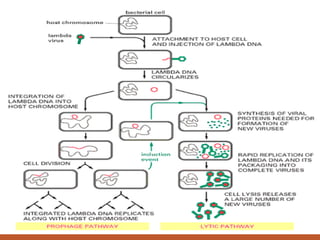
2. Temperate phage:
eg. Phage λ
Lysogeny—the phage genome integrated into
the bacterial genome and replicated passively
as part of the host chromosome, coat protein
genes not expressed.
•The phage is called a prophage.
•Daughter cells are lysogens.
MASTER EDUCATION SERIES - AUMS - 2014 50
Figure 21-2
The lysogenic
cycle of a
bacteriophage
MASTER EDUCATION SERIES - AUMS - 2014 51
The lysogenic state can switch to lytic
growth, called induction.
Excision of the prophage DNA
DNA replication
Coat proteins expression
Lytic growth
MASTER EDUCATION SERIES - AUMS - 2014 52
Figure 16-24
Growth and
induction of λ
lysogen
MASTER EDUCATION SERIES - AUMS - 2014 53
Assays of Phage Growth
Progagate phage:
by growth on a suitable
bacterial host in liquid
culture.
Quantify phage:
plaque assay
Bacteriophage
MASTER EDUCATION SERIES - AUMS - 2014 54
Progagate phage
Find a suitable
host cell that
supports the
growth of the virus.
The mixture of
viruses and
bacteria are filtered
through a bacterial-
proof filter.
MASTER EDUCATION SERIES - AUMS - 2014 55
Quantify phage
Phage are mixed with and adsorb to
bacterial cells.
Dilute the mix.
Add dilutions to “soft agar” (contain many
uninfected bacterial cells).
Poured onto a hard agar base.
Incubated to allow bacterial growth and
phage infection.
MASTER EDUCATION SERIES - AUMS - 2014 56
Soft
agar
Hard agar
a petri dish
MASTER EDUCATION SERIES - AUMS - 2014 57
This circle-of-death produces a hole or
PLAQUE in a lawn of living cells. These
plaques can be easily seen and counted so
that the numbers of virus can be quantitated.
As the viruses
replicate and
are released,
they spread
and infect the
nearby cells.
MASTER EDUCATION SERIES - AUMS - 2014 58
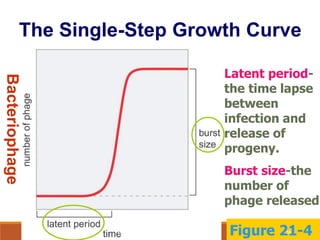
The Single-Step Growth Curve
Bacteriophage
Figure 21-4
Latent period-
the time lapse
between
infection and
release of
progeny.
Burst size-the
number of
phage released
MASTER EDUCATION SERIES - AUMS - 2014 59
The Single-Step Growth Curve
It reveals the life cycle of a typical lytic
phage.
It reveals the length of time it takes a
phage to undergo one round of lytic growth,
and also the number of progeny phage
produced per infected cell.
MASTER EDUCATION SERIES - AUMS - 2014 60
Method
1. Phage were mixed with bacterial cells for
10 minutes. (Long enough for adsorption
but too short for further infection
progress.)
2. The mixture is diluted by 10,000. (Only
those cells that bound phage in the initial
incubation will contribute to the infected
population; progeny phage produced from
those infections will not find host cells to
infect.)
MASTER EDUCATION SERIES - AUMS - 2014 61
3. Incubate the dilution. At intervals, a sample can
be removed from the mixture and the number of
free phage counted using a plaque assay.
MASTER EDUCATION SERIES - AUMS - 2014 62
Phage Crosses and
Complementation Tests
Bacteriophage
Mixed infection: a single
cell is infected with two
phage particles at once.
MASTER EDUCATION SERIES - AUMS - 2014 63
Mixed infection (co-infection)
1. It allows one to perform phage crosses.
If two different mutants of the
same phage co-infect a cell,
recombination can occur between
the genomes. The frequency of
this genetic exchange can be used
to order genes on the genome.
MASTER EDUCATION SERIES - AUMS - 2014 64
2. It allows one to assign
mutations to complementation
groups.
If two different mutant phage co-infect
the same cell and as a result each
provides the function that the other
was lacking, the two mutations must be
in different genes (complementation
groups). If not, the two mutations are
likely located in the same gene.
MASTER EDUCATION SERIES - AUMS - 2014 65
Transduction and
Recombinant DNA
Bacteriophage
During infection, a phage might pick
up a piece of bacterial DNA (mostly
happens when a prophage excises form
the bacterial chromosome).
The resulting recombinant phage can
transfer the bacterial DNA from one
host to another, known as specialized
transduction.
eg. Phage λMASTER EDUCATION SERIES - AUMS - 2014 66
This series Created by Dr.Kaveh Haratian Ph.D. for Medical and Master
learning.
Email
astrokaveh@gmail.com
MASTER EDUCATION SERIES - AUMS - 2014 67

Bacteriophages

  • 1.
    Bacteriophages DR. KAVEH HARATIAN MASTEREDUCATION SERIES - AUMS - 2014 1
  • 2.
    What do youthink about them ? MASTER EDUCATION SERIES - AUMS - 2014 2
  • 3.
    Some interesting facts Virusesthat infect bacteria. Viruses of dsDNA(tailed dsDNA phages).easily in environmental samples 107 /mL in coastal sea-water 1031 individual tailed phage virion on planet Earth. End to end : 200 million light years into intergalactic space Most bacterial genomes contain 1 to 24 phage genome as prophage Turn over every 4-5 years: 1024 productive infections/sec MASTER EDUCATION SERIES - AUMS - 2014 3
  • 4.
    What are Bacteriophages? Viruses that attack bacteria were observed by Twort and d'Herelle in 1915 and 1917. They observed that broth cultures of certain intestinal bacteria could be dissolved by addition of a bacteria-free filtrate obtained from sewage MASTER EDUCATION SERIES - AUMS - 2014 4
  • 5.
    MASTER EDUCATION SERIES- AUMS - 2014 5
  • 6.
    Brief history Discovered in1915/1917. basis on : ◦ Clearing(cell lysis) in bacterial lawn. ◦ Propagation as infectious agents Ideas: ◦ Nature of viruses ◦ Phage therapy: using phages as an agent to combat bacterial infections Modern era of phage research, 1940: ◦ Nature of gene ◦ Using phages as experimental model system Extra results: ◦ Nature of gene ◦ Expression of genes and expression regulation ◦ Development of methods of recombinant DNA. MASTER EDUCATION SERIES - AUMS - 2014 6
  • 7.
    Bacteriophages under Electron Microscope MASTEREDUCATION SERIES - AUMS - 2014 7
  • 8.
    Bacteriophage (Phage) Definition -Obligate intracellular parasites that multiply inside bacteria by making use of some or all of the host biosynthetic machinery Significance ◦ Models for animal cell viruses ◦ Gene transfer in bacteria ◦ Medical applications ◦ Identification of bacteria - phage typing ◦ Treatment and prophylaxsis??? MASTER EDUCATION SERIES - AUMS - 2014 8
  • 9.
    Bacteriophages as therapeutic agents 1919:successful treatment of typhoid in chickens , dysentery in humans. 1921: using against staphylococcus in skin disease. 1920s: large-scale experiments in many countries, like india. 1939 upward: ◦ Against diseases with no bacterial component: herpes, urticaria ◦ Although high specific, were used against inappropriate bacterial targets ◦ Inappropriate growth condition or preservatives could limit/prevented the inclusion of infectious Bacteriophages. ◦ No good evidence that they actually worked in the therapeutic uses. ◦ But it continued through WW2(German and soviet armies) notably against dysentery. Antibiotic age Renewal of interest MASTER EDUCATION SERIES - AUMS - 2014 9
  • 10.
    Bacteriophages: Definition & History Bacteriophagesare viruses that can infect and destroy bacteria. They have been referred to as bacterial parasites, with each phage type depending on a single strain of bacteria to act as host. MASTER EDUCATION SERIES - AUMS - 2014 10
  • 11.
    BACTRIOPHAGES Like most viruses,bacteriophages typically carry only the genetic information needed for replication of their nucleic acid and synthesis of their protein coats.. They require precursors, energy generation and ribosomes supplied by their bacterial host cell. MASTER EDUCATION SERIES - AUMS - 2014 11
  • 12.
    Bacteriophages: Classification At present, over5000 bacteriophages have been studied by electron microscopy and can be divided into 13 virus families. MASTER EDUCATION SERIES - AUMS - 2014 12
  • 13.
    ICTV-designated phage families FamilyPrototypes Characteristics Siphoviridae λ dsDNA, long, noncontractile tails Myoviridae T4 dsDNA, contractile tails Podoviridae T7 dsDNA, short, stubby tails Tectiviridae PRD1 dsDNA, linear 5` proteins, internal membrane Microviridae φX174 ssDNA, circular, icosahedral Inoviridae M13 ssDNA, filamentous Leviviridae MS2, Qβ ssDNA, small icosahedral Cystoviridae φ6 dsDNA, segmented, enveloped Corticoviridae PM2 dsDNA, circular, internal membrane Plasmaviridae L2 dsDNA, circular, enveloped MASTER EDUCATION SERIES - AUMS - 2014 13
  • 14.
    Bacteriophage Bacteriophages make up adiverse group of viruses, some of which have complex structures, including double- stranded DNA. MASTER EDUCATION SERIES - AUMS - 2014 14
  • 15.
  • 16.
    Bacteriophage Also known simplyas a phage; a virus that attacks and infects bacteria. The infection may or may not lead to the death of the bacterium, depending on the phage and sometimes on conditions. Each bacteriophage is specific to one form of bacteria. MASTER EDUCATION SERIES - AUMS - 2014 16
  • 17.
    Composition and Structure Composition ◦Nucleicacid ◦Genome size ◦Modified bases ◦Protein ◦Protection ◦Infection • Structure (T4) – Size – Head or capsid – Tail Tail Tail Fibers Base Plate Head/Capsid Contractile Sheath MASTER EDUCATION SERIES - AUMS - 2014 17
  • 18.
    MASTER EDUCATION SERIES- AUMS - 2014 18
  • 19.
    Phage entering abacterial cell MASTER EDUCATION SERIES - AUMS - 2014 19
  • 20.
    MASTER EDUCATION SERIES- AUMS - 2014 20
  • 21.
    Virulent vs. temperatephages • Virulent phages do not integrate their genetic material into the host cell chromosome and usually kill the host cells (lytic infection) (e.g. T-phages of E.coli). • Temperate phages may integrate into the host DNA, causing LYSOGENY. MASTER EDUCATION SERIES - AUMS - 2014 21
  • 22.
    Bacteriophage showing Lyticand lysogenic cycle MASTER EDUCATION SERIES - AUMS - 2014 22
  • 23.
    Bacteriophages: Virulence Factors CarriedOn Phage Temperate phage can go through one of two life cycles upon entering a host cell. 1) Lytic: Is when growth results in lysis of the host and release of progeny phage. 2) Lysogenic: Is when growth results in integration of the phage DNA into the host chromosome or stable replication as a plasmid. Most of the gene products of the lysogenic phage remains dormant until it is induced to enter the lytic cycle. MASTER EDUCATION SERIES - AUMS - 2014 23
  • 24.
    Bacteriophages: Lysogenic Conversion Some lysogenicphage carry genes that can enhance the virulence of the bacterial host.  For example, some phage carry genes that encode toxins. These genes, once integrated into the bacterial chromosome, can cause the once harmless bacteria to release potent toxins that can cause disease. MASTER EDUCATION SERIES - AUMS - 2014 24
  • 25.
    Bacteriophages • Used forcloning foreign genes among other applications • Proteins and peptides are fused to the Capsid(surface) of the phage • The combination of the phage and peptide is known as a Fusion Protein MASTER EDUCATION SERIES - AUMS - 2014 25
  • 26.
    Lytic and Lysogeniccycle MASTER EDUCATION SERIES - AUMS - 2014 26
  • 27.
    MASTER EDUCATION SERIES- AUMS - 2014 27
  • 28.
    MASTER EDUCATION SERIES- AUMS - 2014 28
  • 29.
    Bacteriophages: Lysogenic Conversion Bacterium Phage Gene Product Phenotype Vibriocholerae CTX phage cholerae toxin cholera Escherichia coli lambda phage shigalike toxin hemorrhagic diarrhea Clostridium botulinum clostridial phages botulinum toxin botulism (food poisoning) Corynebacterium diphtheriae corynephage beta diphtheria toxin diphtheria Streptococcus pyogenes T12 erythrogenic toxins scarlet fever Examples of Virulence Factors Carried by Phage MASTER EDUCATION SERIES - AUMS - 2014 29
  • 30.
    Lysogenic conversion In someinteractions between lysogenic phages and bacteria, lysogenic conversion may occur. It is when a temperate phage induces a change in the phenotype of the bacteria infected that is not part of a usual phage cycle. Changes can often involve the external membrane of the cell by making it impervious to other phages or even by increasing the pathogenic capability of the bacteria for a host. MASTER EDUCATION SERIES - AUMS - 2014 30
  • 31.
    Assay for LyticPhage • Plaque assay – Method – Plaque forming unit (pfu) – Measures infectious particles Bacteria Phage + Phage Plaque assay Method Plaque forming unit (pfu) Measures infectious particles MASTER EDUCATION SERIES - AUMS - 2014 31
  • 32.
  • 33.
  • 34.
  • 35.
    Figure 13.10.1 Attachment: Phage attaches to hostcell. Penetration: Phage pnetrates host cell and injects its DNA. Synthesis of viral compartments 1 2 3 Bacterial cell wall Bacterial chromosome Capsid DNA Capsid Sheath Tail fiber Base plate Pin Cell wall Tail Plasma membrane Sheath contracted Tail core MASTER EDUCATION SERIES - AUMS - 2014 35
  • 36.
    Figure 13.10.2 4 Maturation: Viralcomponents are assembled into virions. Tail 5 Release: Host cell lyses and new virions are released. DNA Capsid Tail fibers MASTER EDUCATION SERIES - AUMS - 2014 36
  • 37.
    Examples: * Corynebacterium diphtheriaproduces the toxin of diphtheria only when it is infected by the phage β. In this case, the gene that codes for the toxin is carried by the phage, not the bacteria. * Vibrio cholerae is a non-toxic strain that can become toxic, producing cholera toxin, when it is infected with the phage CTXφ. * Clostridium botulinum causes botulism. * Streptococcus pyogenes causes scarlet fever. * Shiga toxin * Tetanus MASTER EDUCATION SERIES - AUMS - 2014 37
  • 38.
    Medical Applications ofPhages “I strongly believe phage could become an effective antibacterial tool” - Carl Merril, Chief of the Laboratory of Biochemical Genetics, National Institute of Mental Health, NIH. “It might be another string on the bow, such that when (conventional antibiotics) fail, here’s something that has a chance of working. But it’s not going to be a panacea” - Joshua Lederberg, Sackler Foundation Scholar at The Rockefeller University MASTER EDUCATION SERIES - AUMS - 2014 38
  • 39.
    Model Organisms MASTER EDUCATIONSERIES - AUMS - 2014 39
  • 40.
    Model Organisms Fundamental problemsare solved in the simplest and most accessible system in which the problem can be addressed. These organisms are called model organisms. MASTER EDUCATION SERIES - AUMS - 2014 40
  • 41.
    Some Important Model Organisms Escherichiacoli and its phage (the T phage and phage λ) Baker’s yeast Saccharomyces cerevisiae The nematode Caenorhabditis elegans The fruit fly Drosophila melanogaster The house mouse Mus musculus MASTER EDUCATION SERIES - AUMS - 2014 41
  • 42.
    Features of ModelSystems The availability of powerful tools of traditional and molecular genetics. The study of each model system attracted a critical mass of investigators. (Ideas,methods, tools and strains could be shared) MASTER EDUCATION SERIES - AUMS - 2014 42
  • 43.
    HOW to choosea model organism? It depends on what question is being asked. When studying fundamental issues of molecular biology, simpler unicellular organisms or viruses are convenient. For developmental questions, more complicated organisms should be used. MASTER EDUCATION SERIES - AUMS - 2014 43
  • 44.
  • 45.
    Bacteriophage (Viruses) The simplestsystem Their genomes are replicated only after being injected into a host cell. The genomes can recombine during these infections. MASTER EDUCATION SERIES - AUMS - 2014 45
  • 46.
    Figure BacteriophageMASTER EDUCATIONSERIES - AUMS - 2014 46
  • 47.
    Each phage attachesto a specific cell surface molecule (usually a protein) and so only cells bearing that “receptor” can be infected by a given phage. MASTER EDUCATION SERIES - AUMS - 2014 47
  • 48.
    Two Basic Types 1.Lytic phage: eg. T phage infect a bacterial cell DNA replication coat proteins expression host cell lysed to release the new phage MASTER EDUCATION SERIES - AUMS - 2014 48
  • 49.
    Figure 21-1 The lyticgrowth cycle MASTER EDUCATION SERIES - AUMS - 2014 49
  • 50.
    2. Temperate phage: eg.Phage λ Lysogeny—the phage genome integrated into the bacterial genome and replicated passively as part of the host chromosome, coat protein genes not expressed. •The phage is called a prophage. •Daughter cells are lysogens. MASTER EDUCATION SERIES - AUMS - 2014 50
  • 51.
    Figure 21-2 The lysogenic cycleof a bacteriophage MASTER EDUCATION SERIES - AUMS - 2014 51
  • 52.
    The lysogenic statecan switch to lytic growth, called induction. Excision of the prophage DNA DNA replication Coat proteins expression Lytic growth MASTER EDUCATION SERIES - AUMS - 2014 52
  • 53.
    Figure 16-24 Growth and inductionof λ lysogen MASTER EDUCATION SERIES - AUMS - 2014 53
  • 54.
    Assays of PhageGrowth Progagate phage: by growth on a suitable bacterial host in liquid culture. Quantify phage: plaque assay Bacteriophage MASTER EDUCATION SERIES - AUMS - 2014 54
  • 55.
    Progagate phage Find asuitable host cell that supports the growth of the virus. The mixture of viruses and bacteria are filtered through a bacterial- proof filter. MASTER EDUCATION SERIES - AUMS - 2014 55
  • 56.
    Quantify phage Phage aremixed with and adsorb to bacterial cells. Dilute the mix. Add dilutions to “soft agar” (contain many uninfected bacterial cells). Poured onto a hard agar base. Incubated to allow bacterial growth and phage infection. MASTER EDUCATION SERIES - AUMS - 2014 56
  • 57.
    Soft agar Hard agar a petridish MASTER EDUCATION SERIES - AUMS - 2014 57
  • 58.
    This circle-of-death producesa hole or PLAQUE in a lawn of living cells. These plaques can be easily seen and counted so that the numbers of virus can be quantitated. As the viruses replicate and are released, they spread and infect the nearby cells. MASTER EDUCATION SERIES - AUMS - 2014 58
  • 59.
    The Single-Step GrowthCurve Bacteriophage Figure 21-4 Latent period- the time lapse between infection and release of progeny. Burst size-the number of phage released MASTER EDUCATION SERIES - AUMS - 2014 59
  • 60.
    The Single-Step GrowthCurve It reveals the life cycle of a typical lytic phage. It reveals the length of time it takes a phage to undergo one round of lytic growth, and also the number of progeny phage produced per infected cell. MASTER EDUCATION SERIES - AUMS - 2014 60
  • 61.
    Method 1. Phage weremixed with bacterial cells for 10 minutes. (Long enough for adsorption but too short for further infection progress.) 2. The mixture is diluted by 10,000. (Only those cells that bound phage in the initial incubation will contribute to the infected population; progeny phage produced from those infections will not find host cells to infect.) MASTER EDUCATION SERIES - AUMS - 2014 61
  • 62.
    3. Incubate thedilution. At intervals, a sample can be removed from the mixture and the number of free phage counted using a plaque assay. MASTER EDUCATION SERIES - AUMS - 2014 62
  • 63.
    Phage Crosses and ComplementationTests Bacteriophage Mixed infection: a single cell is infected with two phage particles at once. MASTER EDUCATION SERIES - AUMS - 2014 63
  • 64.
    Mixed infection (co-infection) 1.It allows one to perform phage crosses. If two different mutants of the same phage co-infect a cell, recombination can occur between the genomes. The frequency of this genetic exchange can be used to order genes on the genome. MASTER EDUCATION SERIES - AUMS - 2014 64
  • 65.
    2. It allowsone to assign mutations to complementation groups. If two different mutant phage co-infect the same cell and as a result each provides the function that the other was lacking, the two mutations must be in different genes (complementation groups). If not, the two mutations are likely located in the same gene. MASTER EDUCATION SERIES - AUMS - 2014 65
  • 66.
    Transduction and Recombinant DNA Bacteriophage Duringinfection, a phage might pick up a piece of bacterial DNA (mostly happens when a prophage excises form the bacterial chromosome). The resulting recombinant phage can transfer the bacterial DNA from one host to another, known as specialized transduction. eg. Phage λMASTER EDUCATION SERIES - AUMS - 2014 66
  • 67.
    This series Createdby Dr.Kaveh Haratian Ph.D. for Medical and Master learning. Email astrokaveh@gmail.com MASTER EDUCATION SERIES - AUMS - 2014 67