BACTERIOPHAGE
Viruses thatinfect and parsitized
bacteria is known as bacteriophage.
It was discovered by Frederick.W.Twort
in Great Britian (1915) and Felix d’ Herelle
in France(1917).
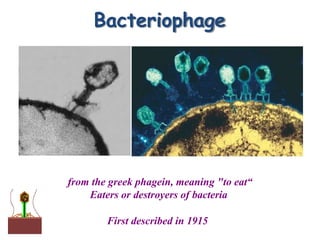
D’ Herelle coined the term
bacteriophage meaning ‘bacterial eater’ to
describe the agent’s bacteriocidal activity.
He observed lysis of a broth culture of a
dysentry bacillus.
6.
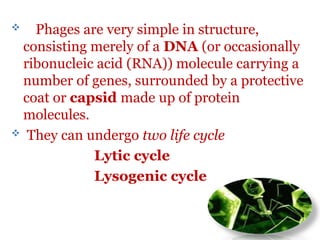
Phages arevery simple in structure,
consisting merely of a DNA (or occasionally
ribonucleic acid (RNA)) molecule carrying a
number of genes, surrounded by a protective
coat or capsid made up of protein
molecules.
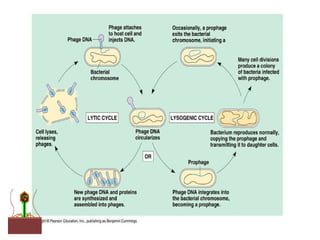
They can undergo two life cycle
Lytic cycle
Lysogenic cycle
7.
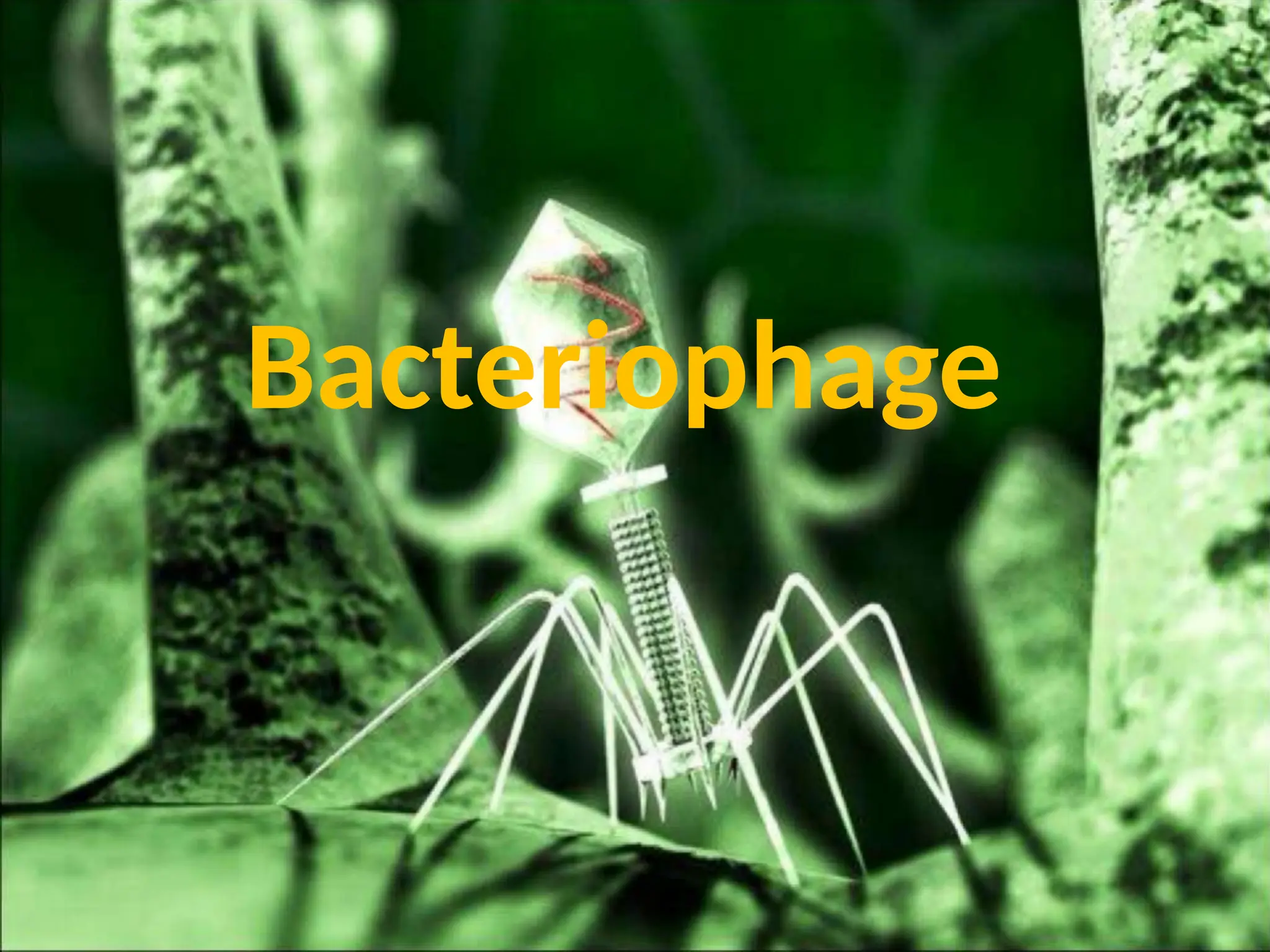
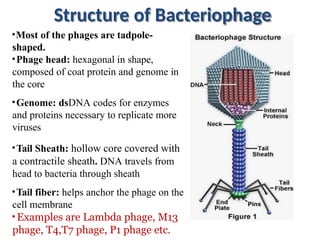
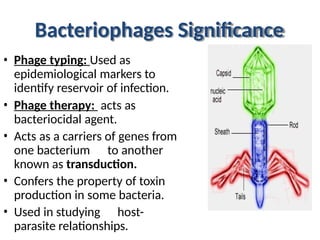
Structure of Bacteriophage
•Mostof the phages are tadpole-
shaped.
•Phage head: hexagonal in shape,
composed of coat protein and genome in
the core
•Genome: dsDNA codes for enzymes
and proteins necessary to replicate more
viruses
•Tail Sheath: hollow core covered with
a contractile sheath. DNA travels from
head to bacteria through sheath
•Tail fiber: helps anchor the phage on the
cell membrane
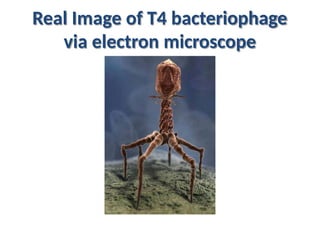
• Examples are Lambda phage, M13
phage, T4,T7 phage, P1 phage etc.
8.
CHARECTERSTICS OF BACTERIOPHAGES
•Host specificity: they have
high specificity.
• They are filterable through filters.
• Lytic phage causes lysis of bacteria.
• They are sensitive to heat.
host
• Their commonest habital is
intestinal bacterial flora of man and
animal.
9.
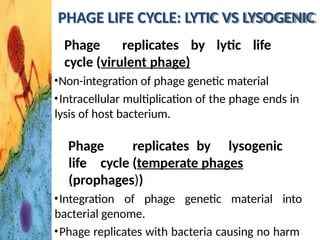
PHAGE LIFE CYCLE:LYTIC VS LYSOGENIC
Phage replicates by lytic life
cycle (virulent phage)
•Non-integration of phage genetic material
•Intracellular multiplication of the phage ends in
lysis of host bacterium.
Phage replicates by lysogenic
life cycle (temperate phages
(prophages))
•Integration of phage genetic material into
bacterial genome.
•Phage replicates with bacteria causing no harm
10.
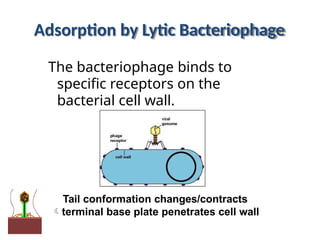
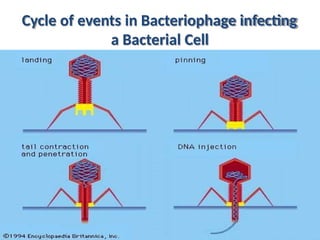
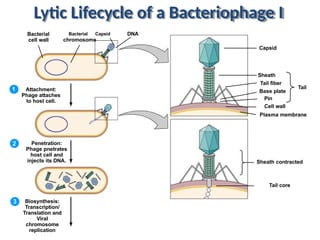
Adsorption by LyticBacteriophage
The bacteriophage binds to
specific receptors on the
bacterial cell wall.
Tail conformation changes/contracts
terminal base plate penetrates cell wall
11.
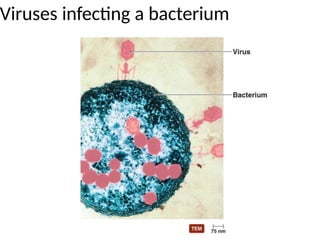
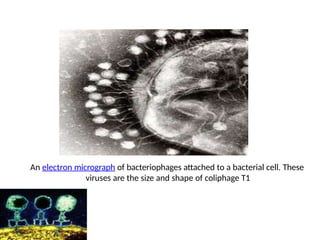
An electron micrographof bacteriophages attached to a bacterial cell. These
viruses are the size and shape of coliphage T1
Synthesis of phagecomponent
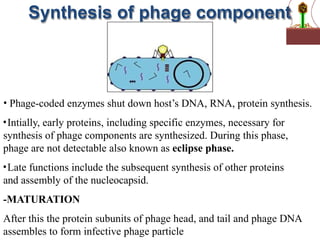
• Phage-coded enzymes shut down host’s DNA, RNA, protein synthesis.
•Intially, early proteins, including specific enzymes, necessary for
synthesis of phage components are synthesized. During this phase,
phage are not detectable also known as eclipse phase.
•Late functions include the subsequent synthesis of other proteins
and assembly of the nucleocapsid.
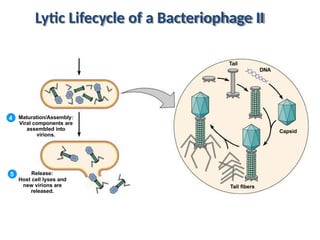
-MATURATION
After this the protein subunits of phage head, and tail and phage DNA
assembles to form infective phage particle
16.
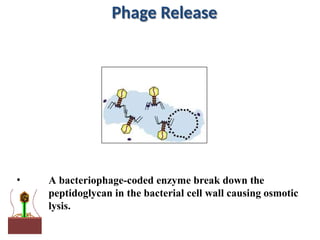
Phage Release
• Abacteriophage-coded enzyme break down the
peptidoglycan in the bacterial cell wall causing osmotic
lysis.
18.
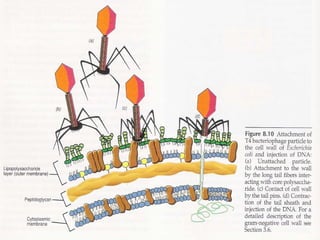
Attachment:
Phage attaches
to hostcell.
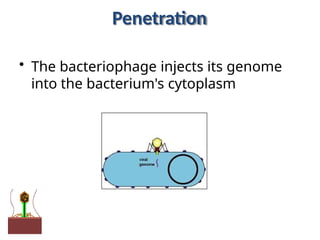
Penetration:
Phage pnetrates
host cell and
injects its DNA.
Biosynthesis:
Transcription/
Translation and
Viral
chromosome
replication
1
2
3
Bacterial
cell wall
Bacterial Capsid DNA
chromosome
Capsid
Sheath
Tail fiber
Base plate
Pin
Cell wall
Tail
Plasma membrane
Sheath contracted
Tail core
Lytic Lifecycle of a Bacteriophage I
19.
4 Maturation/Assembly:
Viral componentsare
assembled into
virions.
5 Release:
Host cell lyses and
new virions are
released.
Tail
DNA
Capsid
Tail fibers
Lytic Lifecycle of a Bacteriophage II
20.
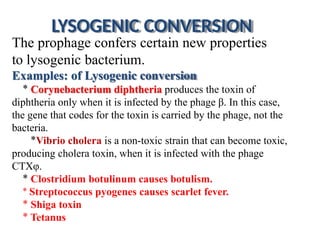
LYSOGENIC CONVERSION
The prophageconfers certain new properties
to lysogenic bacterium.
Examples: of Lysogenic conversion
* Corynebacterium diphtheria produces the toxin of
diphtheria only when it is infected by the phage β. In this case,
the gene that codes for the toxin is carried by the phage, not the
bacteria.
*Vibrio cholera is a non-toxic strain that can become toxic,
producing cholera toxin, when it is infected with the phage
CTXφ.
* Clostridium botulinum causes botulism.
* Streptococcus pyogenes causes scarlet fever.
* Shiga toxin
* Tetanus
21.
Bacteriophages Significance
• Phagetyping: Used as
epidemiological markers to
identify reservoir of infection.
• Phage therapy: acts as
bacteriocidal agent.
• Acts as a carriers of genes from
one bacterium to another
known as transduction.
• Confers the property of toxin
production in some bacteria.
• Used in studying host-
parasite relationships.
22.
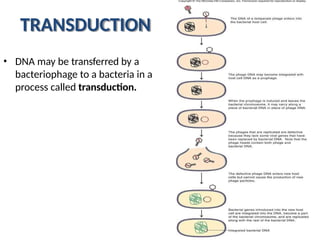
TRANSDUCTION
• DNA maybe transferred by a
bacteriophage to a bacteria in a
process called transduction.
23.
• Phage typingis used as epidemiological marker to
biochemically serologically identical
identify different bacterial strains that are
and
indistinguishable from each other.
• Such bacterial strains are differentiated by using
type specific bacteriophage.
• The technique has most extensively been
used for the detection of Mycobacterium
tuberculosis, E.coli, Pseudomonas, Salmonella,
Listeria, and Campylobacter species
24.
Bacteriophages in Medicine
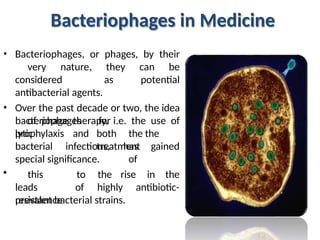
•Bacteriophages, or phages, by their
very nature, they can be
considered as potential
antibacterial agents.
• Over the past decade or two, the idea
of phage therapy, i.e. the use of
lytic
bacteriophages for
both the the
treatment
of
prophylaxis and
bacterial infections, has gained
special significance.
rise in the
• this
leads
prevalence
to the
of highly antibiotic-
resistant bacterial strains.
25.
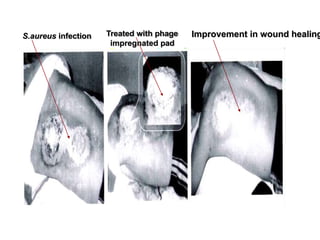
Phage Therapy
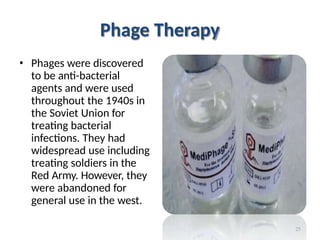
• Phageswere discovered
to be anti-bacterial
agents and were used
throughout the 1940s in
the Soviet Union for
treating bacterial
infections. They had
widespread use including
treating soldiers in the
Red Army. However, they
were abandoned for
general use in the west.
25
Limitations of phagetherapy
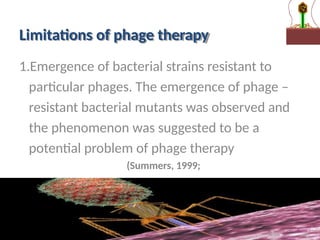
1.Emergence of bacterial strains resistant to
particular phages. The emergence of phage –
resistant bacterial mutants was observed and
the phenomenon was suggested to be a
potential problem of phage therapy
(Summers, 1999;
d’Herelle,1930)