Bacteriophage
Bacteriophage (Phage) Definition - Obligate intracellular parasites that multiply inside bacteria by making use of some or all of the host biosynthetic machinery Significance Models for animal cell viruses Gene transfer in bacteria Medical applications Identification of bacteria - phage typing Treatment and prophylaxsis???
Medical Applications of Phage “ I strongly believe phage could become an effective antibacterial tool” -  Carl Merril, Chief of the Laboratory of Biochemical Genetics, National Institute of Mental Health, NIH. “ It might be another string on the bow, such that when (conventional antibiotics) fail, here’s something that has a chance of working.  But it’s not going to be a panacea” -  Joshua Lederberg, Sackler Foundation Scholar at The Rockefeller University Reassessment of Medicinal Phage Spurs Companies to Study Therapeutic Uses American Society for Microbiology News 64:620-623, 1998
Medical Applications of Phage Exponential Biotherapies (Rockville, MD) Vancomycin resistant  Enterococcus facium  and  Streptococcus pneumoniae Phage Therapeutics (Bothell, WA) Staphylococcus aureus  and  Staphylococcus epidermidis Intralytix, Inc. (Baltimore, MD) Salmonella  in meat and poultry Biopharm Ltd. (Tblisi, Georgia) Infections associated with burns   University of Idaho Escherichia coli  O157:H7 in cattle Reassessment of Medicinal Phage Spurs Companies to Study Therapeutic Uses.  American Society for Microbiology News 64:620-623, 1998. Phages eyed as agents to protect against harmful  E. coli.  American Society for Microbiology News 65:666-667, 1999.
Bacteriophage T 4 Lambda (  )
Composition and Structure Composition Nucleic acid Genome size Modified bases Protein Protection Infection Structure (T 4 ) Size Head or capsid Tail Tail Tail Fibers Base Plate Head/Capsid Contractile Sheath
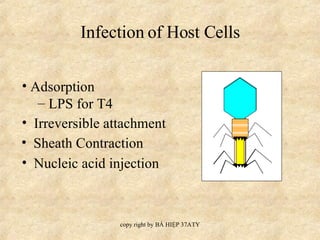
Infection of Host Cells Irreversible attachment Adsorption LPS for T4 Nucleic acid injection Sheath Contraction
Types of Bacteriophage Lytic or virulent phage: Phage that can only multiply within bacteria and kill the cell by lysis. ( e.g.,  T 4 )
Lytic Phage Multiplication Cycle Eclipse Early genes Phage DNA synthesis Late genes Intracellular accumulation Lysis and Release Total Phage Extracellular Phage Eclipse Intracellular accumulation phase Time after Infection Number of Infectious Particles  Lysis
Assay for Lytic Phage Plaque assay Method Plaque forming unit (pfu) Measures infectious particles Bacteria Phage + Phage
Types of Bacteriophage Lysogenic or temperate phage:  Phage that can either multiply via the lytic cycle or enter a quiescent state in the bacterial cell. ( e.g.,    ) Expression of most phage genes repressed  Prophage Lysogen
Events Leading to Lysogeny Circularization of the phage chromosome Cohesive ends Lygase Closed Circle Cohesive Ends Linear Double Stranded Opened Circle
Events Leading to Lysogeny Site-specific recombination Phage coded enzyme Repression of the phage genome Repressor protein Specific Immunity to superinfection gal bio gal bio gal bio
Termination of Lysogeny Induction Adverse conditions Role of proteases recA protein Destruction of repressor Excision Lytic growth Gene expression gal bio gal bio gal bio gal bio
Lytic vs Lysogenic Cycle? Role of repressor Role of  cro  gene product Role of proteases
Significance of Lysogeny Model for animal virus transformation Lysogenic or phage conversion Definition: A change in the phenotype of a bacterial cell as a consequence of lysogeny Modification of  Salmonella  O antigen Toxin production by  Corynebacterium diphtheriae

vsv7

  • 1.
  • 2.
    Bacteriophage (Phage) Definition- Obligate intracellular parasites that multiply inside bacteria by making use of some or all of the host biosynthetic machinery Significance Models for animal cell viruses Gene transfer in bacteria Medical applications Identification of bacteria - phage typing Treatment and prophylaxsis???
  • 3.
    Medical Applications ofPhage “ I strongly believe phage could become an effective antibacterial tool” - Carl Merril, Chief of the Laboratory of Biochemical Genetics, National Institute of Mental Health, NIH. “ It might be another string on the bow, such that when (conventional antibiotics) fail, here’s something that has a chance of working. But it’s not going to be a panacea” - Joshua Lederberg, Sackler Foundation Scholar at The Rockefeller University Reassessment of Medicinal Phage Spurs Companies to Study Therapeutic Uses American Society for Microbiology News 64:620-623, 1998
  • 4.
    Medical Applications ofPhage Exponential Biotherapies (Rockville, MD) Vancomycin resistant Enterococcus facium and Streptococcus pneumoniae Phage Therapeutics (Bothell, WA) Staphylococcus aureus and Staphylococcus epidermidis Intralytix, Inc. (Baltimore, MD) Salmonella in meat and poultry Biopharm Ltd. (Tblisi, Georgia) Infections associated with burns University of Idaho Escherichia coli O157:H7 in cattle Reassessment of Medicinal Phage Spurs Companies to Study Therapeutic Uses. American Society for Microbiology News 64:620-623, 1998. Phages eyed as agents to protect against harmful E. coli. American Society for Microbiology News 65:666-667, 1999.
  • 5.
    Bacteriophage T 4Lambda (  )
  • 6.
    Composition and StructureComposition Nucleic acid Genome size Modified bases Protein Protection Infection Structure (T 4 ) Size Head or capsid Tail Tail Tail Fibers Base Plate Head/Capsid Contractile Sheath
  • 7.
    Infection of HostCells Irreversible attachment Adsorption LPS for T4 Nucleic acid injection Sheath Contraction
  • 8.
    Types of BacteriophageLytic or virulent phage: Phage that can only multiply within bacteria and kill the cell by lysis. ( e.g., T 4 )
  • 9.
    Lytic Phage MultiplicationCycle Eclipse Early genes Phage DNA synthesis Late genes Intracellular accumulation Lysis and Release Total Phage Extracellular Phage Eclipse Intracellular accumulation phase Time after Infection Number of Infectious Particles Lysis
  • 10.
    Assay for LyticPhage Plaque assay Method Plaque forming unit (pfu) Measures infectious particles Bacteria Phage + Phage
  • 11.
    Types of BacteriophageLysogenic or temperate phage: Phage that can either multiply via the lytic cycle or enter a quiescent state in the bacterial cell. ( e.g.,  ) Expression of most phage genes repressed Prophage Lysogen
  • 12.
    Events Leading toLysogeny Circularization of the phage chromosome Cohesive ends Lygase Closed Circle Cohesive Ends Linear Double Stranded Opened Circle
  • 13.
    Events Leading toLysogeny Site-specific recombination Phage coded enzyme Repression of the phage genome Repressor protein Specific Immunity to superinfection gal bio gal bio gal bio
  • 14.
    Termination of LysogenyInduction Adverse conditions Role of proteases recA protein Destruction of repressor Excision Lytic growth Gene expression gal bio gal bio gal bio gal bio
  • 15.
    Lytic vs LysogenicCycle? Role of repressor Role of cro gene product Role of proteases
  • 16.
    Significance of LysogenyModel for animal virus transformation Lysogenic or phage conversion Definition: A change in the phenotype of a bacterial cell as a consequence of lysogeny Modification of Salmonella O antigen Toxin production by Corynebacterium diphtheriae