CAULIFLOWER
MOSAIC VIRUS
By
SATHYA.T,
MSC Microbiology(2017-2019)
Tirupur Kumaran College For Women, Tirupur
Tamil Nadu.
INTRODUCTION:
• The first plant virus shown to have a DNA genome and the first
shown to replicate by reverse transcription.
• Worldwide but only causes significantly losses locally.
• It is transmitted by aphids .
• Type member of the Caulimovirus genus, contains 11 species and 6
possible members.
• significantly impact on plant virology and plant molecular biology.
• The virus is an important source of gene regulatory elements, used
exclusively in the genetic manipulation of plants.
• CaMV infects mostly plants of the Brassicaceae family but some
CaMV strains are also able to infect Solanaceae species of the genera
Datura and Nicotiana.
• symptoms such as mosaic, necrotic lesions , stunted growth,
deformation of the overall plant structures.
• Symtoms vary depending on the viral strain, host ecotype,
environmental conditions.
• once introduced into the plant cells , Virions migrate to the Nuclear
Envelope of the plant cells.
• Group: Group VII ds DNA
• FAMILY : caulimoviridae
• Genus: caulimovirus
• Species: cauliflower mosaic virus
STRUCTURE:
• Icosachedral with a diameter of 52Â nm built from 420 capsid
protein subunits.
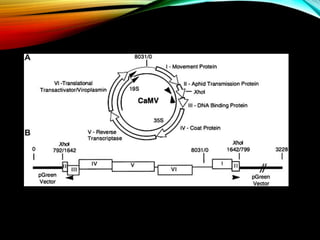
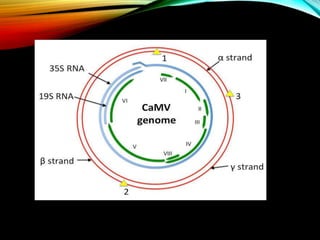
• It contains a circular double-stranded DNA molecule of about
8.0 kB .
• Dna is interrupted by sitespecific discontinuties resulting from
its replication by reverse transcription.
• After entering the host, the single stranded nicks in the viral
DNA are repaired, forming a supercoiled molecule that binds to
histones.
• DNA is transcriped into a full length .
• the virus particle have been crystallized , x-ray
crystallography did not yield any detailed information .
• The structure has been shown by cryoelectron
microscopy and three dimensional image
reconstruction to comprise three concentric layers of
solvent-excluded density.
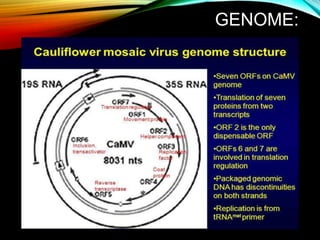
GENOME:
REPLICATION:
The virus particle enter into a plant cells
1) - ve strand ( )
2) + VE strand (β, γ) circular genome with three
gaps or discontinuities (D1, D2, and D3)
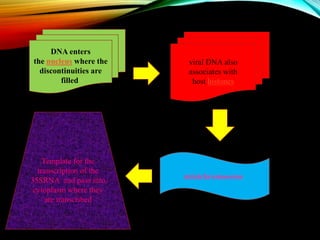
DNA enters
the nucleus where the
discontinuities are
filled
viral DNA also
associates with
host histones
minichromosome
Template for the
transcription of the
35SRNA and pass into
cytoplasm where they
are transcribed
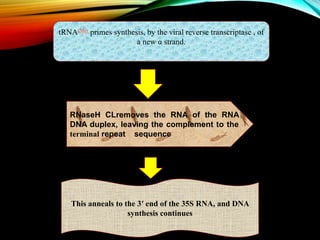
tRNAfMet primes synthesis, by the viral reverse transcriptase , of
a new α strand.
RNaseH CLremoves the RNA of the RNA
DNA duplex, leaving the complement to the
terminal repeat sequence
This anneals to the 3′ end of the 35S RNA, and DNA
synthesis continues
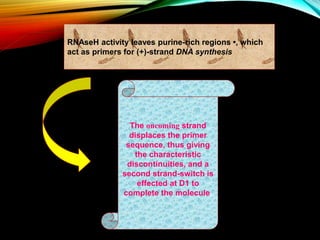
RNAseH activity leaves purine-rich regions •, which
act as primers for (+)-strand DNA synthesis
The oncoming strand
displaces the primer
sequence, thus giving
the characteristic
discontinuities, and a
second strand-switch is
effected at D1 to
complete the molecule.
RISK FACTORS:
• The Cauliflower mosaic virus promoter (CaMV 35S) is used in
most transgenic crops to activate foreign genes which have
been artificially inserted into the host plant. It is inserted into
transgenic plants in a form which is different from that found
when it is present in its natural Brassica plant hosts. This
enables it to operate in a wide range of host-organism
environments which would otherwise not be possible.
35 S PROMOTER:
• used in almost all GM crops currently grown or tested,
• especially GM maize.
• It is the promoter of choice for plant genetic engineering, as it is a strong
and constitutive promoter.
• Failure to recognise or to ignore its capacity to be universally active in
almost any organism is irresponsible and careless and shows a serious lack
of scientific rigour and commitment to safety.
• Any safety assessment can be expected to be flawed that does not resort to
actual laboratory test of the capacity of bacteria and fungi to utilise the
particular genes and their promoters.
Cauliflower mosaic virus ppt

Cauliflower mosaic virus ppt

  • 1.
  • 2.
    INTRODUCTION: • The firstplant virus shown to have a DNA genome and the first shown to replicate by reverse transcription. • Worldwide but only causes significantly losses locally. • It is transmitted by aphids . • Type member of the Caulimovirus genus, contains 11 species and 6 possible members. • significantly impact on plant virology and plant molecular biology. • The virus is an important source of gene regulatory elements, used exclusively in the genetic manipulation of plants.
  • 4.
    • CaMV infectsmostly plants of the Brassicaceae family but some CaMV strains are also able to infect Solanaceae species of the genera Datura and Nicotiana. • symptoms such as mosaic, necrotic lesions , stunted growth, deformation of the overall plant structures. • Symtoms vary depending on the viral strain, host ecotype, environmental conditions. • once introduced into the plant cells , Virions migrate to the Nuclear Envelope of the plant cells. • Group: Group VII ds DNA • FAMILY : caulimoviridae • Genus: caulimovirus • Species: cauliflower mosaic virus
  • 5.
    STRUCTURE: • Icosachedral witha diameter of 52Â nm built from 420 capsid protein subunits. • It contains a circular double-stranded DNA molecule of about 8.0 kB . • Dna is interrupted by sitespecific discontinuties resulting from its replication by reverse transcription. • After entering the host, the single stranded nicks in the viral DNA are repaired, forming a supercoiled molecule that binds to histones. • DNA is transcriped into a full length .
  • 6.
    • the virusparticle have been crystallized , x-ray crystallography did not yield any detailed information . • The structure has been shown by cryoelectron microscopy and three dimensional image reconstruction to comprise three concentric layers of solvent-excluded density.
  • 8.
  • 9.
    REPLICATION: The virus particleenter into a plant cells 1) - ve strand ( ) 2) + VE strand (β, γ) circular genome with three gaps or discontinuities (D1, D2, and D3)
  • 10.
    DNA enters the nucleuswhere the discontinuities are filled viral DNA also associates with host histones minichromosome Template for the transcription of the 35SRNA and pass into cytoplasm where they are transcribed
  • 11.
    tRNAfMet primes synthesis,by the viral reverse transcriptase , of a new α strand. RNaseH CLremoves the RNA of the RNA DNA duplex, leaving the complement to the terminal repeat sequence This anneals to the 3′ end of the 35S RNA, and DNA synthesis continues
  • 12.
    RNAseH activity leavespurine-rich regions •, which act as primers for (+)-strand DNA synthesis The oncoming strand displaces the primer sequence, thus giving the characteristic discontinuities, and a second strand-switch is effected at D1 to complete the molecule.
  • 14.
    RISK FACTORS: • TheCauliflower mosaic virus promoter (CaMV 35S) is used in most transgenic crops to activate foreign genes which have been artificially inserted into the host plant. It is inserted into transgenic plants in a form which is different from that found when it is present in its natural Brassica plant hosts. This enables it to operate in a wide range of host-organism environments which would otherwise not be possible.
  • 15.
    35 S PROMOTER: •used in almost all GM crops currently grown or tested, • especially GM maize. • It is the promoter of choice for plant genetic engineering, as it is a strong and constitutive promoter. • Failure to recognise or to ignore its capacity to be universally active in almost any organism is irresponsible and careless and shows a serious lack of scientific rigour and commitment to safety. • Any safety assessment can be expected to be flawed that does not resort to actual laboratory test of the capacity of bacteria and fungi to utilise the particular genes and their promoters.