Bacteriophages
Dr.T.V.Rao MD
11/20/12 Dr.T.V.Rao MD's Undergraduate Series 1
What are Bacteriophages
Viruses that attack bacteria were
observed by Twort and d'Herelle in
1915 and 1917. They observed that
broth cultures of certain intestinal
bacteria could be dissolved by addition
of a bacteria-free filtrate obtained from
sewage
11/20/12 Dr.T.V.Rao MD's Undergraduate Series 2
11/20/12 Dr.T.V.Rao MD's Undergraduate Series 3
Bacteriophages under Electron
Microscope
11/20/12 Dr.T.V.Rao MD's Undergraduate Series 4
Bacteriophage (Phage)

Definition - Obligate intracellular parasites
that multiply inside bacteria by making use of
some or all of the host biosynthetic
machinery

Significance
− Models for animal cell viruses
− Gene transfer in bacteria
− Medical applications

Identification of bacteria - phage typing

Treatment and prophylaxsis???
11/20/12 Dr.T.V.Rao MD's Undergraduate Series 5
Bacteriophages:
Definition & History

Bacteriophages are
viruses that can infect
and destroy bacteria.

They have been
referred to as bacterial
parasites, with each
phage type depending
on a single strain of
bacteria to act as host.
11/20/12 Dr.T.V.Rao MD's Undergraduate Series 6
BACTRIOPHAGES
Like most viruses, bacteriophages
typically carry only the genetic
information needed for replication of
their nucleic acid and synthesis of their
protein coats.. They require precursors,
energy generation and ribosomes
supplied by their bacterial host cell.
11/20/12 Dr.T.V.Rao MD's Undergraduate Series 7
Bacteriophages:
Classification
 At present, over
5000
bacteriophages
have been studied
by electron
microscopy and
can be divided
into 13 virus
families.
11/20/12 Dr.T.V.Rao MD's Undergraduate Series 8
Bacteriophage
 Bacteriophages
make up a
diverse group of
viruses, some of
which have
complex
structures,
including double-
stranded DNA.
11/20/12 Dr.T.V.Rao MD's Undergraduate Series 9
Bacteriophage
Bacteriophage
11/20/12 Dr.T.V.Rao MD's Undergraduate Series 10
Bacteriophage
Bacteriophage
 Also known simply as a
phage; a virus that
attacks and infects
bacteria. The infection
may or may not lead to
the death of the
bacterium, depending on
the phage and
sometimes on
conditions. Each
bacteriophage is specific
to one form of bacteria.
11/20/12 Dr.T.V.Rao MD's Undergraduate Series 11
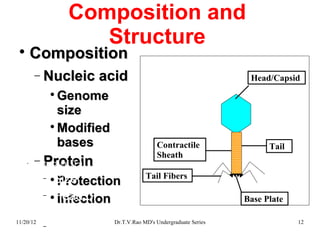
Composition and
Structure

Composition
Composition
− Nucleic acid
Nucleic acid

Genome
Genome
size
size

Modified
Modified
bases
bases
− Protein
Protein

Protection
Protection

Infection
Infection
• Structure (T4)
–
Size
–
Head or
capsid
–
Tail
Tail
Tail Fibers
Base Plate
Head/Capsid
Contractile
Sheath
11/20/12 Dr.T.V.Rao MD's Undergraduate Series 12
11/20/12 Dr.T.V.Rao MD's Undergraduate Series 13
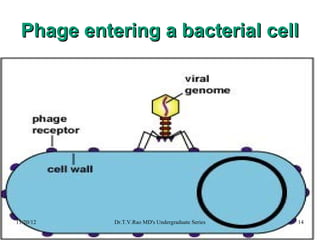
Phage entering a bacterial cell
11/20/12 Dr.T.V.Rao MD's Undergraduate Series 14
11/20/12 Dr.T.V.Rao MD's Undergraduate Series 15
Bacteriophage showing Lytic and
lysogenic cycle
11/20/12 Dr.T.V.Rao MD's Undergraduate Series 16
Bacteriophages:
Virulence Factors Carried On Phage

Temperate phage can go through one of two
life cycles upon entering a host cell.
1) Lytic:
Is when growth results in lysis of the host and release
of progeny phage.
2) Lysogenic:
Is when growth results in integration of the phage DNA
into the host chromosome or stable replication as a
plasmid.
Most of the gene products of the lysogenic phage
remains dormant until it is induced to enter the lytic
cycle.
11/20/12 Dr.T.V.Rao MD's Undergraduate Series 17
Bacteriophages:
Lysogenic Conversion

Some lysogenic phage carry genes that
can enhance the virulence of the
bacterial host.
 For example, some phage carry genes that
For example, some phage carry genes that
encode toxins.
encode toxins.

These genes, once integrated into the
bacterial chromosome, can cause the
once harmless bacteria to release
potent toxins that can cause disease.
11/20/12 Dr.T.V.Rao MD's Undergraduate Series 18
Bacteriophages
•
Used for cloning foreign
genes among other
applications
•
Proteins and peptides are
fused to the
Capsid(surface) of the
phage
•
The combination of the
phage and peptide is
known as a Fusion Protein
11/20/12 Dr.T.V.Rao MD's Undergraduate Series 19
Bacteriophages
•
Used for cloning foreign
genes among other
applications
•
Proteins and peptides are
fused to the
Capsid(surface) of the
phage
•
The combination of the
phage and peptide is
known as a Fusion Protein
11/20/12 Dr.T.V.Rao MD's Undergraduate Series 20
Bacteriophages
•
Once these Phages are isolated and
recovered they can be used to infect
bacteria which will create a particle similar
to a monoclonal antibody
11/20/12 Dr.T.V.Rao MD's Undergraduate Series 21
Lytic and Lysogenic cycle
11/20/12 Dr.T.V.Rao MD's Undergraduate Series 22
11/20/12 Dr.T.V.Rao MD's Undergraduate Series 23
11/20/12 Dr.T.V.Rao MD's Undergraduate Series 24
Bacteriophages:
Lysogenic Conversion
Examples of Virulence Factors Carried by Phage
Bacterium Phage
Gene
Product
Phenotype
Vibrio cholerae CTX phage cholerae toxin cholera
Escherichia coli
lambda
phage
shigalike toxin
hemorrhagic
diarrhea
Clostridium botulinum
clostridial
phages
botulinum
toxin
botulism (food
poisoning)
Corynebacterium
diphtheriae
corynephage
beta
diphtheria
toxin
diphtheria
Streptococcus
pyogenes
T12
erythrogenic
toxins
scarlet fever
11/20/12 Dr.T.V.Rao MD's Undergraduate Series 25
Lysogenic conversion
In some interactions between lysogenic
phages and bacteria, lysogenic conversion
may occur. It is when a temperate phage
induces a change in the phenotype of the
bacteria infected that is not part of a usual
phage cycle. Changes can often involve the
external membrane of the cell by making it
impervious to other phages or even by
increasing the pathogenic capability of the
bacteria for a host.
11/20/12 Dr.T.V.Rao MD's Undergraduate Series 26
Assay for Lytic Phage
•
Plaque assay
–
Method
–
Plaque forming unit
(pfu)
–
Measures infectious
particles
Bacteria
Phage
+
Phage

Plaque assay

Method

Plaque forming
unit (pfu)

Measures
infectious
particles
11/20/12 Dr.T.V.Rao MD's Undergraduate Series 27
Lytic
vs
Lysogenic
Cycle
11/20/12 Dr.T.V.Rao MD's Undergraduate Series 28
Transduction
11/20/12 Dr.T.V.Rao MD's Undergraduate Series 29
Transduction
11/20/12 Dr.T.V.Rao MD's Undergraduate Series 30
31
Figure 13.10.1
Attachment:
Attachment:
Phage
Phage
attaches to
attaches to
host cell.
host cell.
Penetration:
Phage pnetrates
host cell and
injects its DNA.
Merozoites released
into bloodsteam
from liver may infect
new red blood cells
1
2
3
Bacterial
Bacterial
cell wall
cell wall
Bacterial
chromosome
Capsid DNA
Capsid
Sheath
Tail fiber
Base plate
Pin
Cell wall
Tail
Plasma membrane
Sheath contracted
Tail core
11/20/12 Dr.T.V.Rao MD's Undergraduate Series
32
Figure 13.10.2
4 Maturation:
Maturation:
Viral components
Viral components
are assembled
are assembled
into virions.
into virions.
Tail
5 Release:
Release:
Host cell lyses
Host cell lyses
and new virions
and new virions
are released.
are released.
DNA
Capsid
Tail fibers
11/20/12 Dr.T.V.Rao MD's Undergraduate Series
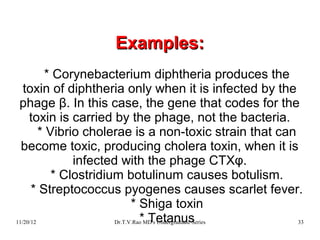
Examples:
Examples:
* Corynebacterium diphtheria produces the
toxin of diphtheria only when it is infected by the
phage β. In this case, the gene that codes for the
toxin is carried by the phage, not the bacteria.
* Vibrio cholerae is a non-toxic strain that can
become toxic, producing cholera toxin, when it is
infected with the phage CTXφ.
* Clostridium botulinum causes botulism.
* Streptococcus pyogenes causes scarlet fever.
* Shiga toxin
* Tetanus
11/20/12 Dr.T.V.Rao MD's Undergraduate Series 33
Medical Applications of Phages
“I strongly believe phage could become
an effective antibacterial tool” - Carl Merril,
Chief of the Laboratory of Biochemical Genetics,
National Institute of Mental Health, NIH.

“It might be another string on the bow,
such that when (conventional antibiotics)
fail, here’s something that has a chance
of working. But it’s not going to be a
panacea” - Joshua Lederberg, Sackler Foundation
Scholar at The Rockefeller University
11/20/12 Dr.T.V.Rao MD's Undergraduate Series 34

The Programme Created by Dr.T.V.Rao MD
for Undergraduate Learning in Developing
Countries

Email

doctortvrao@gmail.com
11/20/12 Dr.T.V.Rao MD's Undergraduate Series 35

bacteriophagenet-121119195318-phpapp01.pdf

  • 1.
  • 2.
    What are Bacteriophages Virusesthat attack bacteria were observed by Twort and d'Herelle in 1915 and 1917. They observed that broth cultures of certain intestinal bacteria could be dissolved by addition of a bacteria-free filtrate obtained from sewage 11/20/12 Dr.T.V.Rao MD's Undergraduate Series 2
  • 3.
    11/20/12 Dr.T.V.Rao MD'sUndergraduate Series 3
  • 4.
    Bacteriophages under Electron Microscope 11/20/12Dr.T.V.Rao MD's Undergraduate Series 4
  • 5.
    Bacteriophage (Phage)  Definition -Obligate intracellular parasites that multiply inside bacteria by making use of some or all of the host biosynthetic machinery  Significance − Models for animal cell viruses − Gene transfer in bacteria − Medical applications  Identification of bacteria - phage typing  Treatment and prophylaxsis??? 11/20/12 Dr.T.V.Rao MD's Undergraduate Series 5
  • 6.
    Bacteriophages: Definition & History  Bacteriophagesare viruses that can infect and destroy bacteria.  They have been referred to as bacterial parasites, with each phage type depending on a single strain of bacteria to act as host. 11/20/12 Dr.T.V.Rao MD's Undergraduate Series 6
  • 7.
    BACTRIOPHAGES Like most viruses,bacteriophages typically carry only the genetic information needed for replication of their nucleic acid and synthesis of their protein coats.. They require precursors, energy generation and ribosomes supplied by their bacterial host cell. 11/20/12 Dr.T.V.Rao MD's Undergraduate Series 7
  • 8.
    Bacteriophages: Classification  At present,over 5000 bacteriophages have been studied by electron microscopy and can be divided into 13 virus families. 11/20/12 Dr.T.V.Rao MD's Undergraduate Series 8
  • 9.
    Bacteriophage  Bacteriophages make upa diverse group of viruses, some of which have complex structures, including double- stranded DNA. 11/20/12 Dr.T.V.Rao MD's Undergraduate Series 9
  • 10.
  • 11.
    Bacteriophage Bacteriophage  Also knownsimply as a phage; a virus that attacks and infects bacteria. The infection may or may not lead to the death of the bacterium, depending on the phage and sometimes on conditions. Each bacteriophage is specific to one form of bacteria. 11/20/12 Dr.T.V.Rao MD's Undergraduate Series 11
  • 12.
    Composition and Structure  Composition Composition − Nucleicacid Nucleic acid  Genome Genome size size  Modified Modified bases bases − Protein Protein  Protection Protection  Infection Infection • Structure (T4) – Size – Head or capsid – Tail Tail Tail Fibers Base Plate Head/Capsid Contractile Sheath 11/20/12 Dr.T.V.Rao MD's Undergraduate Series 12
  • 13.
    11/20/12 Dr.T.V.Rao MD'sUndergraduate Series 13
  • 14.
    Phage entering abacterial cell Phage entering a bacterial cell 11/20/12 Dr.T.V.Rao MD's Undergraduate Series 14
  • 15.
    11/20/12 Dr.T.V.Rao MD'sUndergraduate Series 15
  • 16.
    Bacteriophage showing Lyticand lysogenic cycle 11/20/12 Dr.T.V.Rao MD's Undergraduate Series 16
  • 17.
    Bacteriophages: Virulence Factors CarriedOn Phage  Temperate phage can go through one of two life cycles upon entering a host cell. 1) Lytic: Is when growth results in lysis of the host and release of progeny phage. 2) Lysogenic: Is when growth results in integration of the phage DNA into the host chromosome or stable replication as a plasmid. Most of the gene products of the lysogenic phage remains dormant until it is induced to enter the lytic cycle. 11/20/12 Dr.T.V.Rao MD's Undergraduate Series 17
  • 18.
    Bacteriophages: Lysogenic Conversion  Some lysogenicphage carry genes that can enhance the virulence of the bacterial host.  For example, some phage carry genes that For example, some phage carry genes that encode toxins. encode toxins.  These genes, once integrated into the bacterial chromosome, can cause the once harmless bacteria to release potent toxins that can cause disease. 11/20/12 Dr.T.V.Rao MD's Undergraduate Series 18
  • 19.
    Bacteriophages • Used for cloningforeign genes among other applications • Proteins and peptides are fused to the Capsid(surface) of the phage • The combination of the phage and peptide is known as a Fusion Protein 11/20/12 Dr.T.V.Rao MD's Undergraduate Series 19
  • 20.
    Bacteriophages • Used for cloningforeign genes among other applications • Proteins and peptides are fused to the Capsid(surface) of the phage • The combination of the phage and peptide is known as a Fusion Protein 11/20/12 Dr.T.V.Rao MD's Undergraduate Series 20
  • 21.
    Bacteriophages • Once these Phagesare isolated and recovered they can be used to infect bacteria which will create a particle similar to a monoclonal antibody 11/20/12 Dr.T.V.Rao MD's Undergraduate Series 21
  • 22.
    Lytic and Lysogeniccycle 11/20/12 Dr.T.V.Rao MD's Undergraduate Series 22
  • 23.
    11/20/12 Dr.T.V.Rao MD'sUndergraduate Series 23
  • 24.
    11/20/12 Dr.T.V.Rao MD'sUndergraduate Series 24
  • 25.
    Bacteriophages: Lysogenic Conversion Examples ofVirulence Factors Carried by Phage Bacterium Phage Gene Product Phenotype Vibrio cholerae CTX phage cholerae toxin cholera Escherichia coli lambda phage shigalike toxin hemorrhagic diarrhea Clostridium botulinum clostridial phages botulinum toxin botulism (food poisoning) Corynebacterium diphtheriae corynephage beta diphtheria toxin diphtheria Streptococcus pyogenes T12 erythrogenic toxins scarlet fever 11/20/12 Dr.T.V.Rao MD's Undergraduate Series 25
  • 26.
    Lysogenic conversion In someinteractions between lysogenic phages and bacteria, lysogenic conversion may occur. It is when a temperate phage induces a change in the phenotype of the bacteria infected that is not part of a usual phage cycle. Changes can often involve the external membrane of the cell by making it impervious to other phages or even by increasing the pathogenic capability of the bacteria for a host. 11/20/12 Dr.T.V.Rao MD's Undergraduate Series 26
  • 27.
    Assay for LyticPhage • Plaque assay – Method – Plaque forming unit (pfu) – Measures infectious particles Bacteria Phage + Phage  Plaque assay  Method  Plaque forming unit (pfu)  Measures infectious particles 11/20/12 Dr.T.V.Rao MD's Undergraduate Series 27
  • 28.
  • 29.
  • 30.
  • 31.
    31 Figure 13.10.1 Attachment: Attachment: Phage Phage attaches to attachesto host cell. host cell. Penetration: Phage pnetrates host cell and injects its DNA. Merozoites released into bloodsteam from liver may infect new red blood cells 1 2 3 Bacterial Bacterial cell wall cell wall Bacterial chromosome Capsid DNA Capsid Sheath Tail fiber Base plate Pin Cell wall Tail Plasma membrane Sheath contracted Tail core 11/20/12 Dr.T.V.Rao MD's Undergraduate Series
  • 32.
    32 Figure 13.10.2 4 Maturation: Maturation: Viralcomponents Viral components are assembled are assembled into virions. into virions. Tail 5 Release: Release: Host cell lyses Host cell lyses and new virions and new virions are released. are released. DNA Capsid Tail fibers 11/20/12 Dr.T.V.Rao MD's Undergraduate Series
  • 33.
    Examples: Examples: * Corynebacterium diphtheriaproduces the toxin of diphtheria only when it is infected by the phage β. In this case, the gene that codes for the toxin is carried by the phage, not the bacteria. * Vibrio cholerae is a non-toxic strain that can become toxic, producing cholera toxin, when it is infected with the phage CTXφ. * Clostridium botulinum causes botulism. * Streptococcus pyogenes causes scarlet fever. * Shiga toxin * Tetanus 11/20/12 Dr.T.V.Rao MD's Undergraduate Series 33
  • 34.
    Medical Applications ofPhages “I strongly believe phage could become an effective antibacterial tool” - Carl Merril, Chief of the Laboratory of Biochemical Genetics, National Institute of Mental Health, NIH.  “It might be another string on the bow, such that when (conventional antibiotics) fail, here’s something that has a chance of working. But it’s not going to be a panacea” - Joshua Lederberg, Sackler Foundation Scholar at The Rockefeller University 11/20/12 Dr.T.V.Rao MD's Undergraduate Series 34
  • 35.
     The Programme Createdby Dr.T.V.Rao MD for Undergraduate Learning in Developing Countries  Email  doctortvrao@gmail.com 11/20/12 Dr.T.V.Rao MD's Undergraduate Series 35