JIT
Just in Time Production
1
Arunnima B S
July 2013
Contents
 JIT – Intro
 Origin of JIT
 JIT Concepts
 Kanban
 Benefits & Limitations
 Trends
2
Just-in-time Production
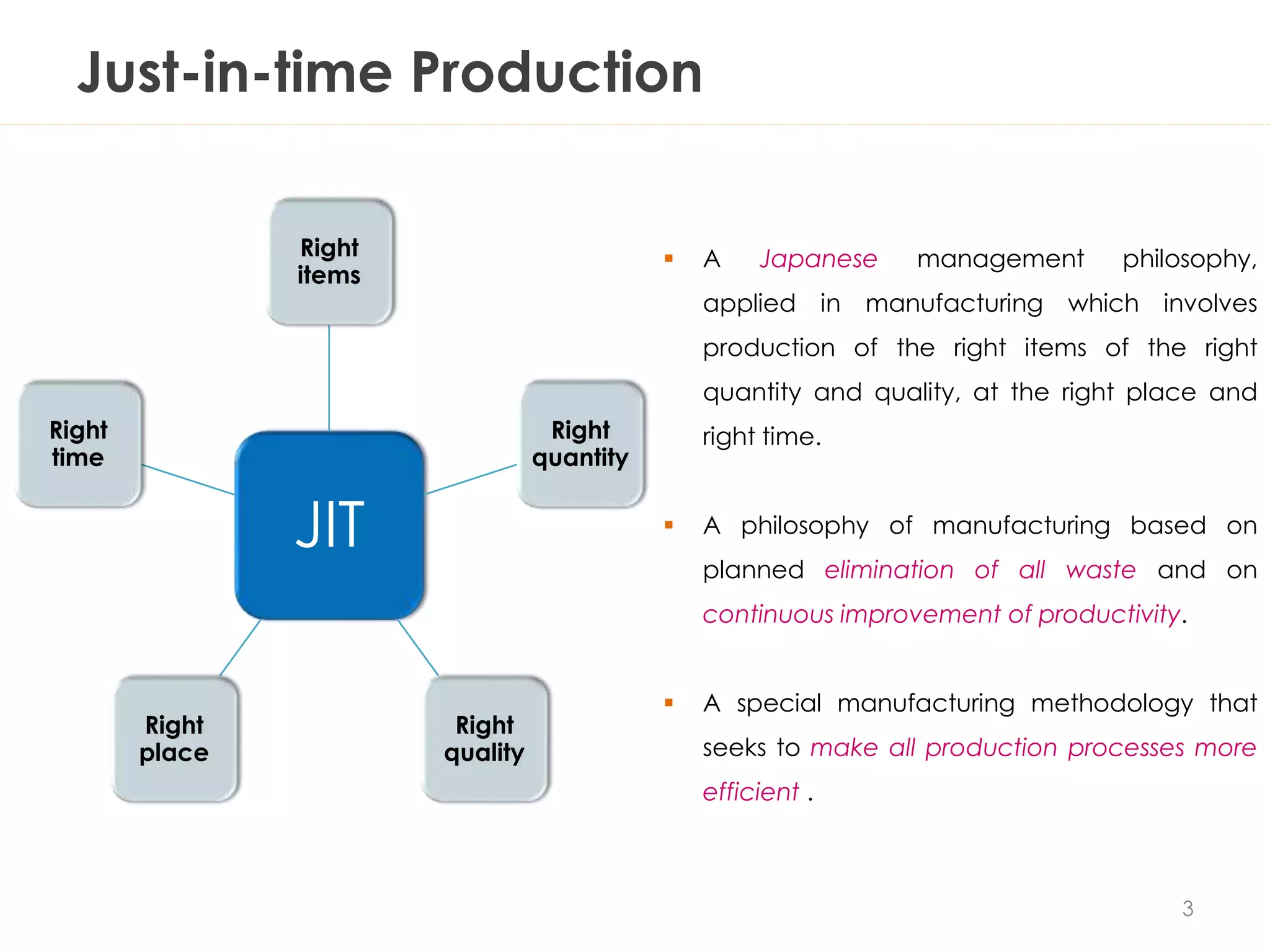
JIT
Right
items
Right
quantity
Right
quality
Right
place
Right
time
3
 A Japanese management philosophy,
applied in manufacturing which involves
production of the right items of the right
quantity and quality, at the right place and
right time.
 A philosophy of manufacturing based on
planned elimination of all waste and on
continuous improvement of productivity.
 A special manufacturing methodology that
seeks to make all production processes more
efficient .
Origin of JIT
 Initiated by Taiichi Ohno of Toyota shortly after World
War II
 Idea taken from American Supermarket operations
o Customers pulled items from shelf to their shopping carts
o Shelves became empty as customers pulled items
o Empty space signaled refilling of items in the shelf
o When item quantities became low, it signaled to order more from suppliers
 Applied the same logic to manufacturing
o Parts were pulled through the plant as per usage
o Machines were kept closer to reduce movement
o Usage of parts were determined by production rates
4
Two important concepts…
“Waste” & “Pull System”
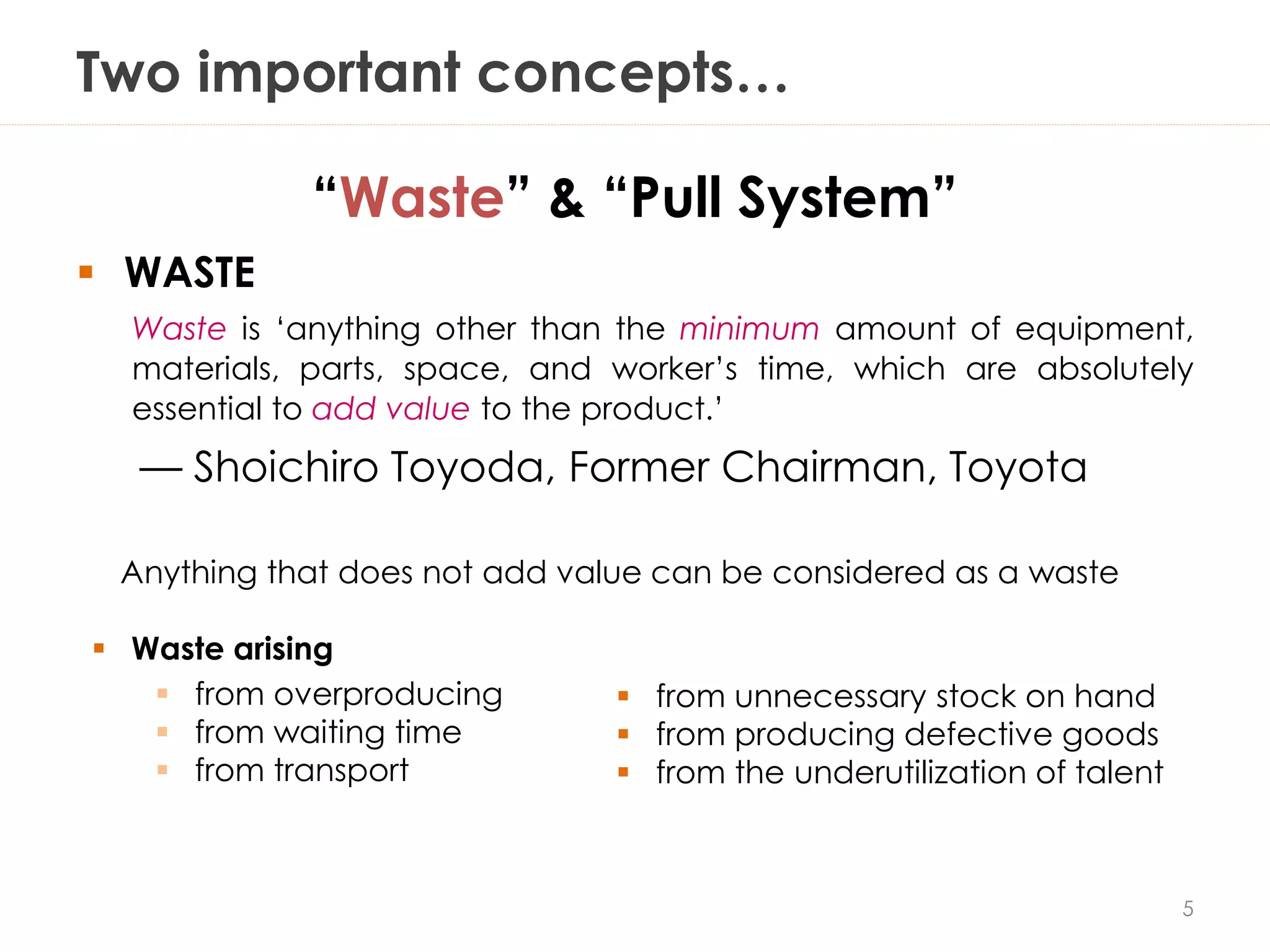
 WASTE
Waste is ‘anything other than the minimum amount of equipment,
materials, parts, space, and worker’s time, which are absolutely
essential to add value to the product.’
— Shoichiro Toyoda, Former Chairman, Toyota
Anything that does not add value can be considered as a waste
5
 Waste arising
 from overproducing
 from waiting time
 from transport
 from unnecessary stock on hand
 from producing defective goods
 from the underutilization of talent
Two important concepts…
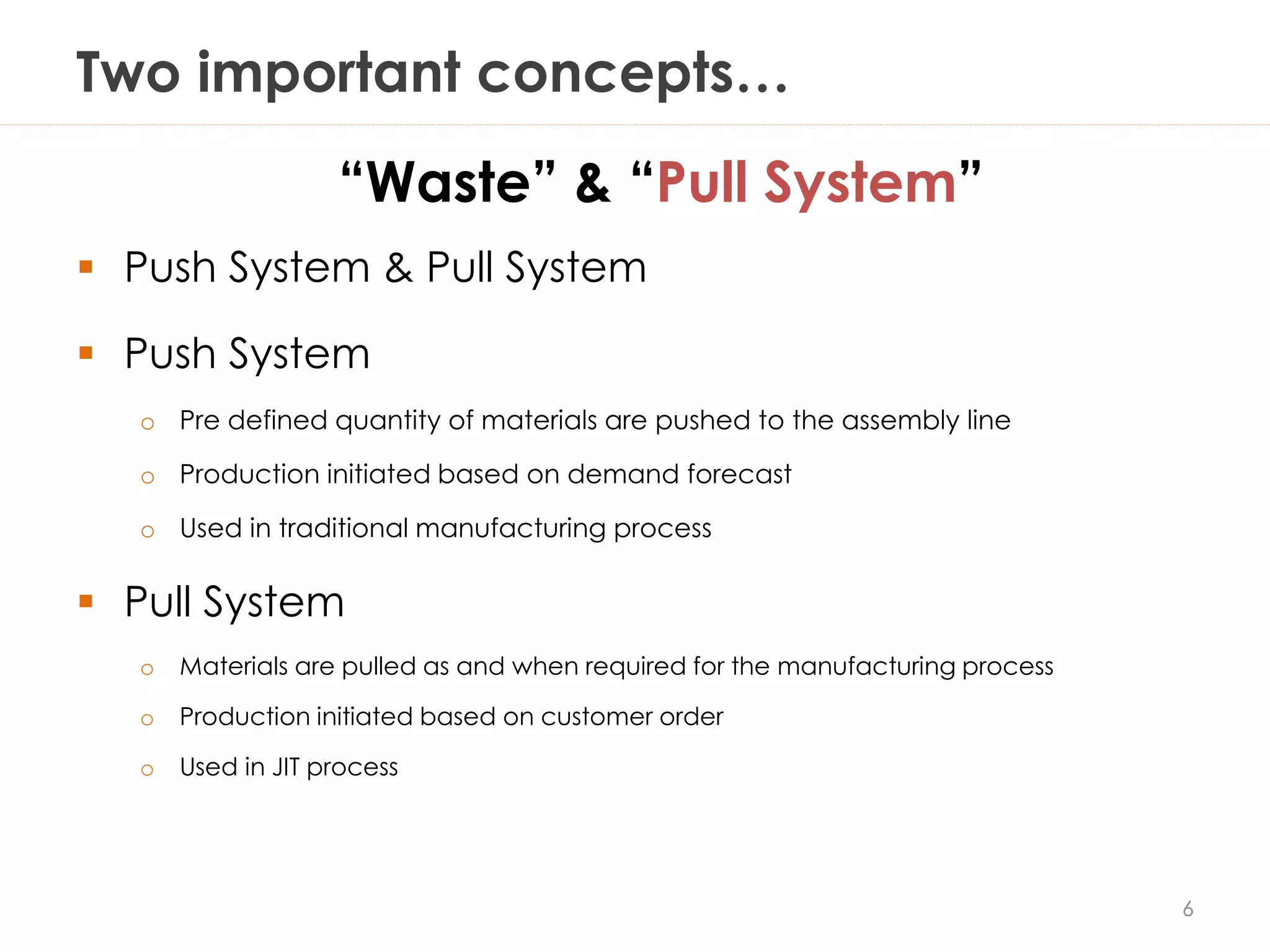
 Push System & Pull System
 Push System
o Pre defined quantity of materials are pushed to the assembly line
o Production initiated based on demand forecast
o Used in traditional manufacturing process
 Pull System
o Materials are pulled as and when required for the manufacturing process
o Production initiated based on customer order
o Used in JIT process
6
“Waste” & “Pull System”
Crux of JIT
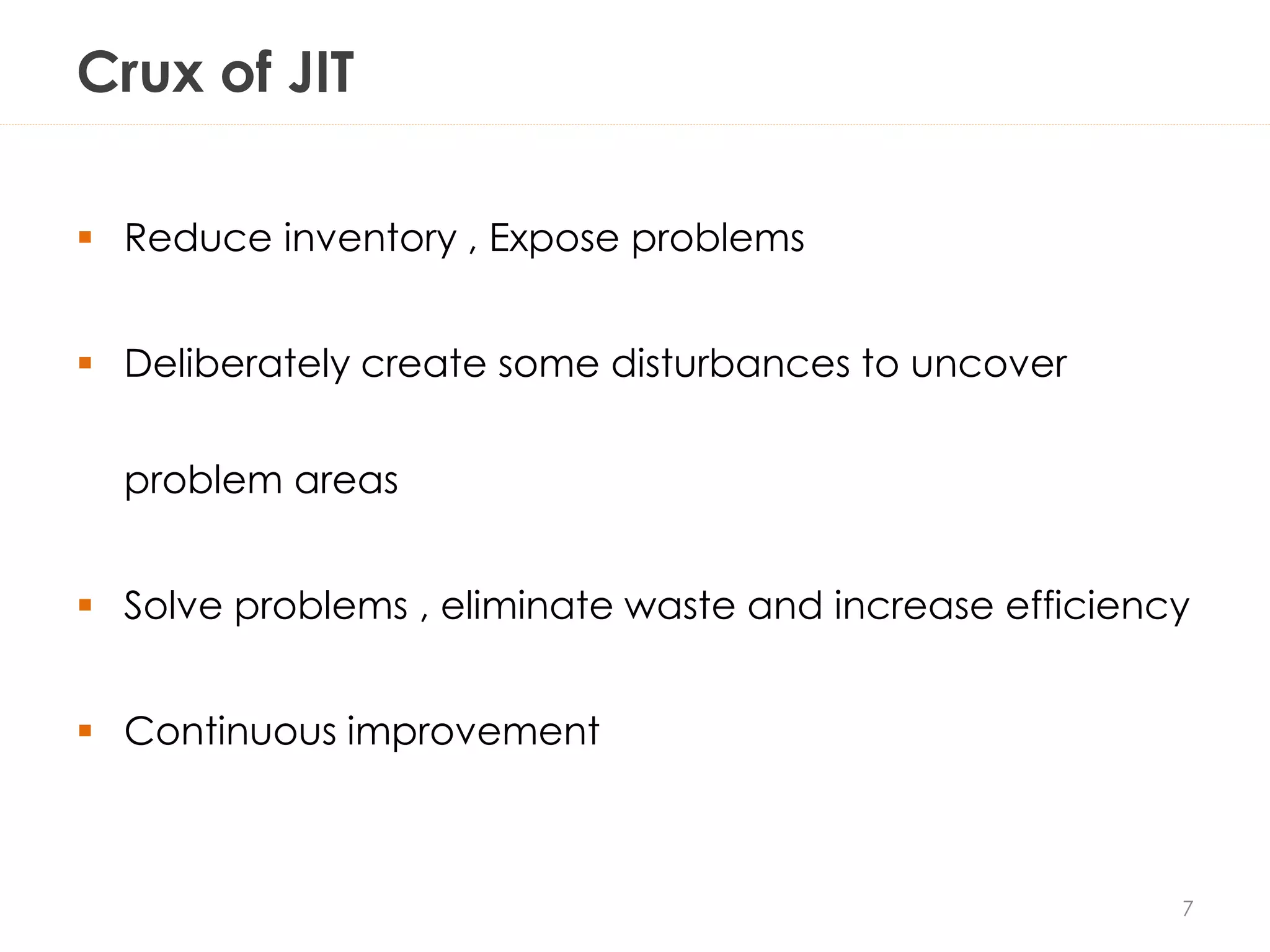
 Reduce inventory , Expose problems
 Deliberately create some disturbances to uncover
problem areas
 Solve problems , eliminate waste and increase efficiency
 Continuous improvement
7
8
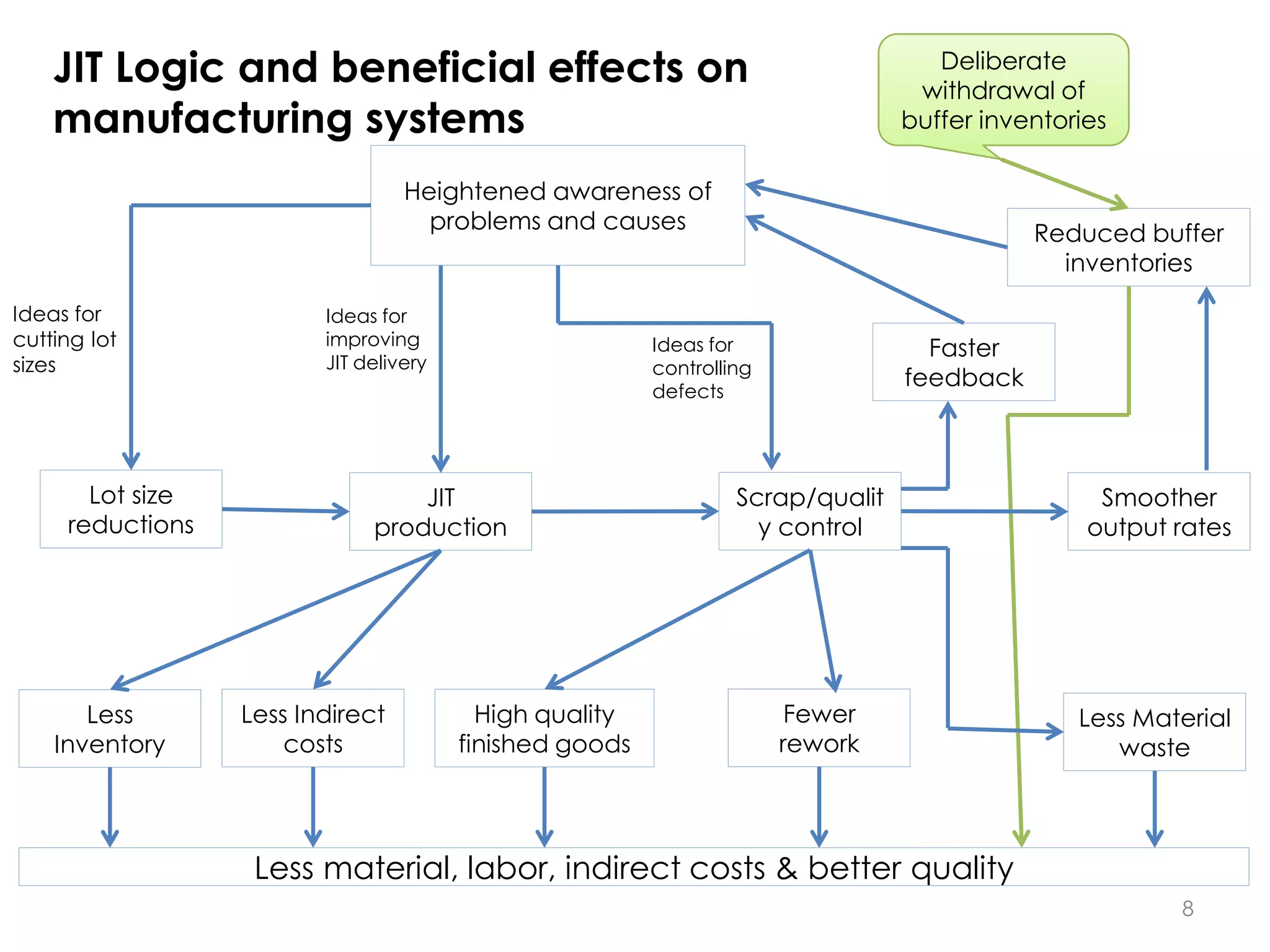
Less material, labor, indirect costs & better quality
Less
Inventory
Less Material
waste
Fewer
rework
High quality
finished goods
Less Indirect
costs
Lot size
reductions
Scrap/qualit
y control
JIT
production
Smoother
output rates
Heightened awareness of
problems and causes
Faster
feedback
Reduced buffer
inventories
Deliberate
withdrawal of
buffer inventories
Ideas for
cutting lot
sizes
Ideas for
improving
JIT delivery
Ideas for
controlling
defects
JIT Logic and beneficial effects on
manufacturing systems
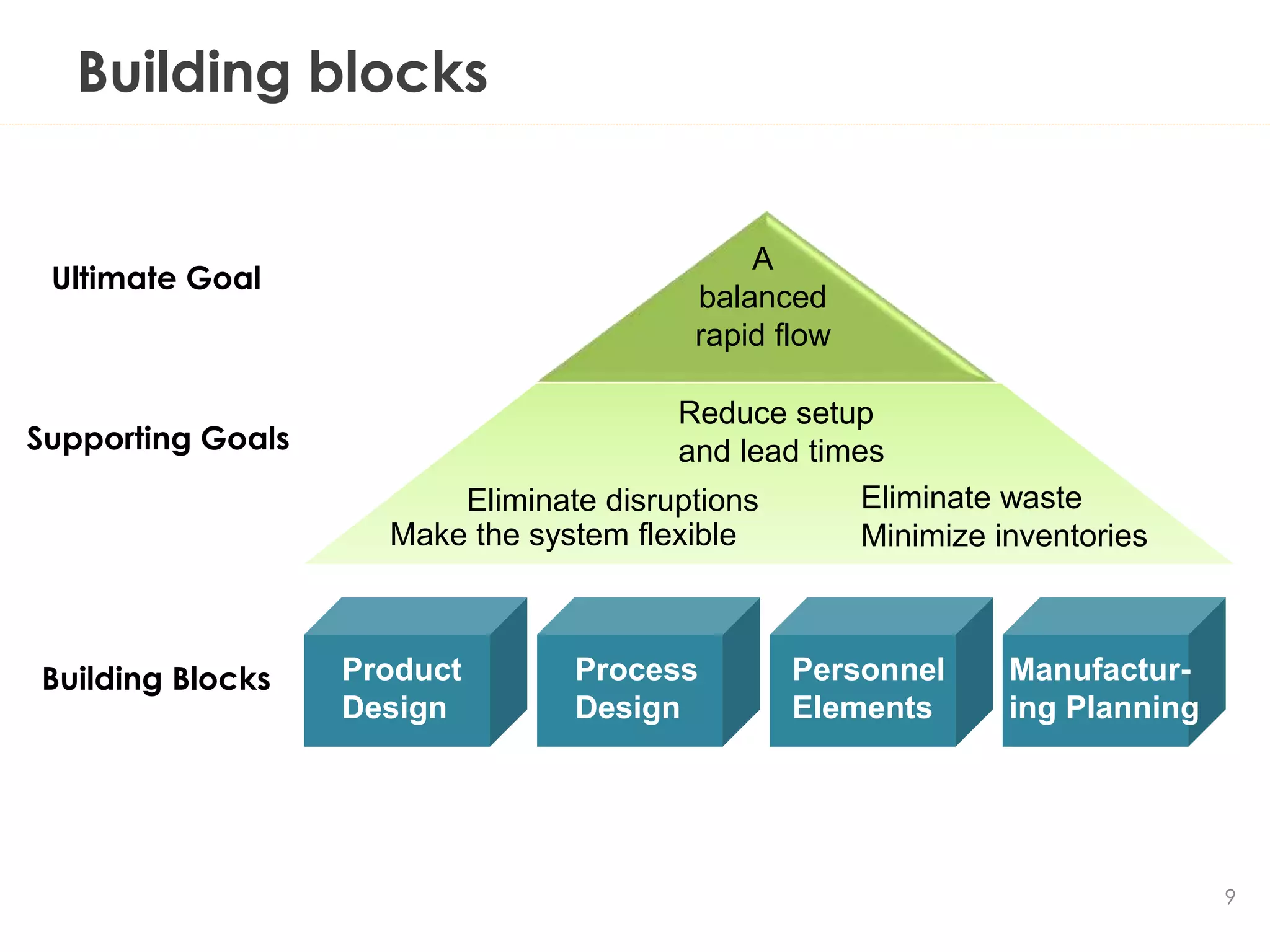
Building blocks
9
Product
Design
Process
Design
Personnel
Elements
Manufactur-
ing Planning
Eliminate disruptions
Make the system flexible
Reduce setup
and lead times
Eliminate waste
Minimize inventories
A
balanced
rapid flow
Ultimate Goal
Supporting Goals
Building Blocks
Characteristics of JIT
 Lower inventory levels
 Small Lot Size
 Reducing travel distance [Cellular Manufacturing]
 Eliminate waste & defects
 High quality levels
 Standardization
 Continuous improvement
 Applicable primarily for repetitive operations
10
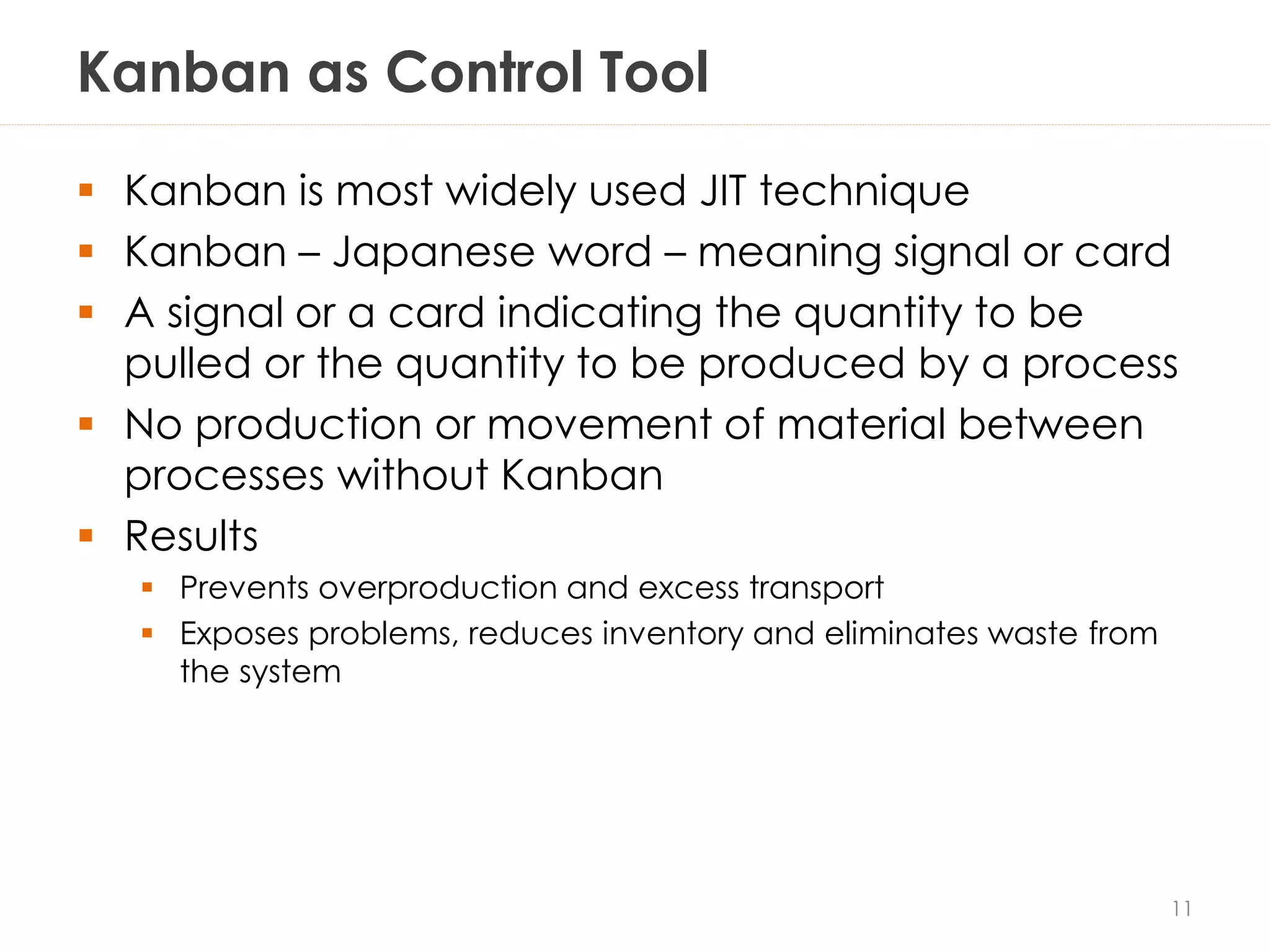
Kanban as Control Tool
 Kanban is most widely used JIT technique
 Kanban – Japanese word – meaning signal or card
 A signal or a card indicating the quantity to be
pulled or the quantity to be produced by a process
 No production or movement of material between
processes without Kanban
 Results
 Prevents overproduction and excess transport
 Exposes problems, reduces inventory and eliminates waste from
the system
11
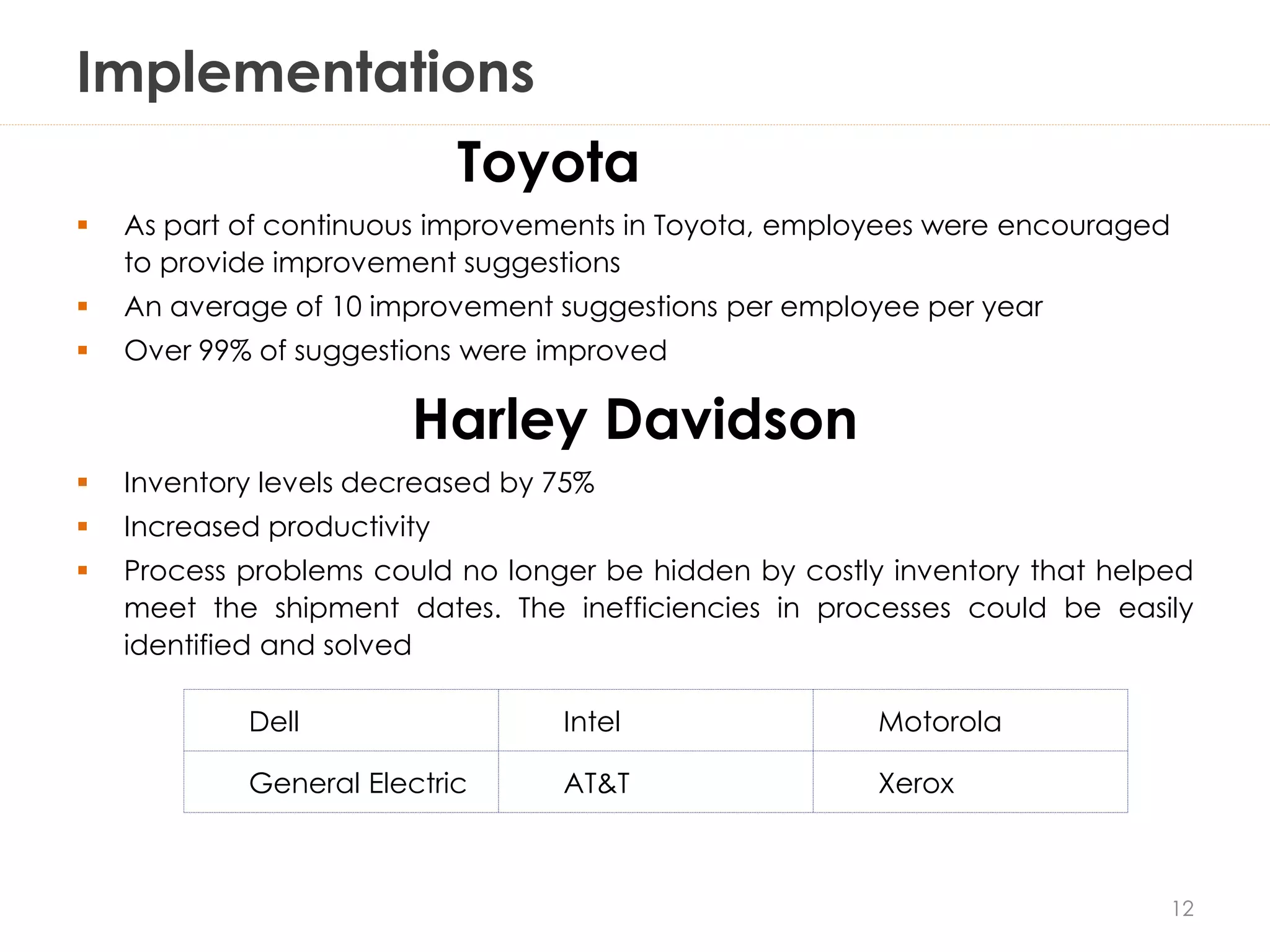
Implementations
Toyota
 As part of continuous improvements in Toyota, employees were encouraged
to provide improvement suggestions
 An average of 10 improvement suggestions per employee per year
 Over 99% of suggestions were improved
Harley Davidson
 Inventory levels decreased by 75%
 Increased productivity
 Process problems could no longer be hidden by costly inventory that helped
meet the shipment dates. The inefficiencies in processes could be easily
identified and solved
12
Dell Intel Motorola
General Electric AT&T Xerox
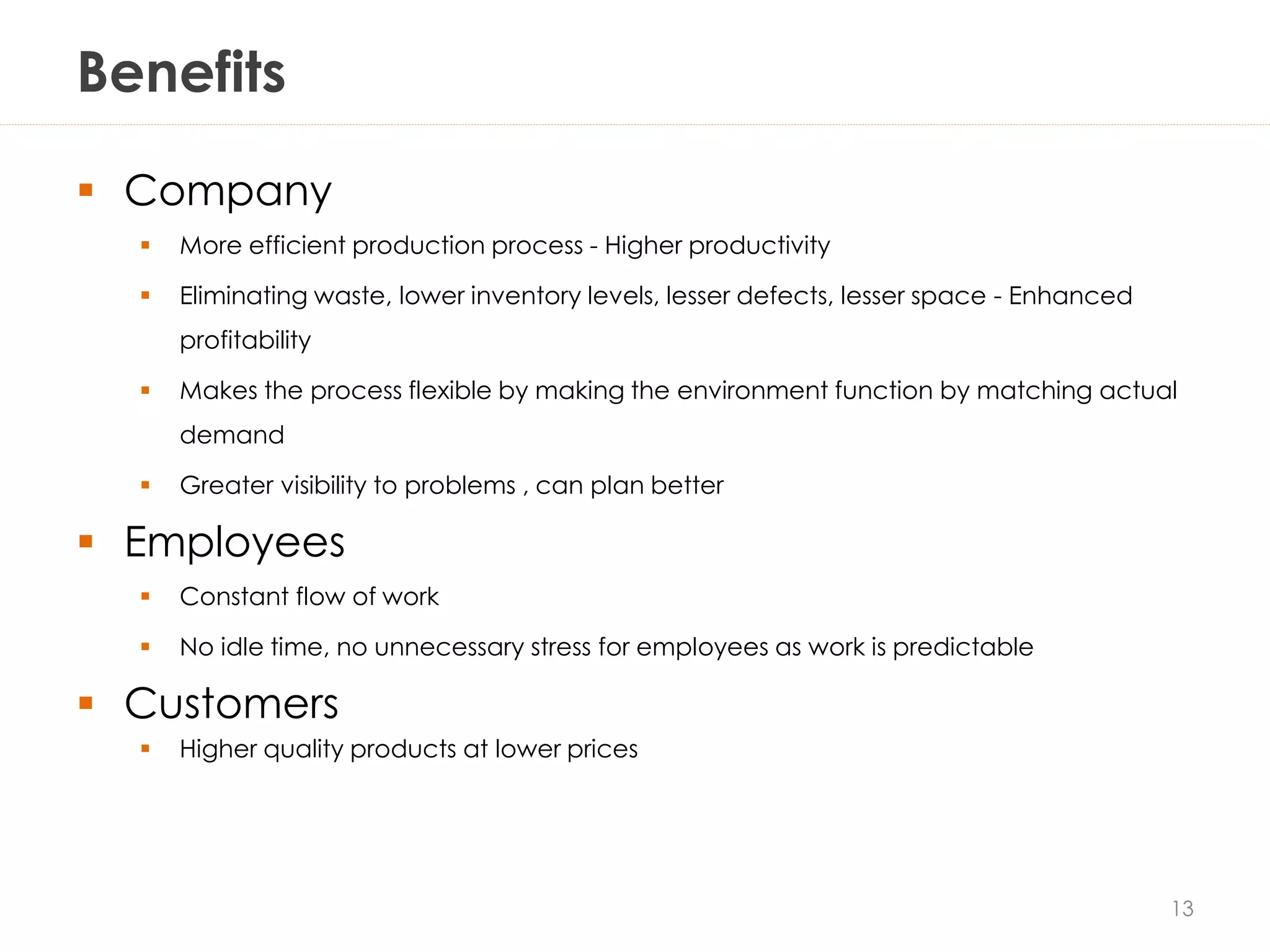
Benefits
 Company
 More efficient production process - Higher productivity
 Eliminating waste, lower inventory levels, lesser defects, lesser space - Enhanced
profitability
 Makes the process flexible by making the environment function by matching actual
demand
 Greater visibility to problems , can plan better
 Employees
 Constant flow of work
 No idle time, no unnecessary stress for employees as work is predictable
 Customers
 Higher quality products at lower prices
13
Limitations /Challenges
 Requires co-operation from employees
 Special training and reorganization of policies and
procedures
 Involves high setup costs
 Assumes that sources of supply are reliable and
dependable at all times, which may not be the
case
 Suppliers may resist to deliver as per JIT requirements
14
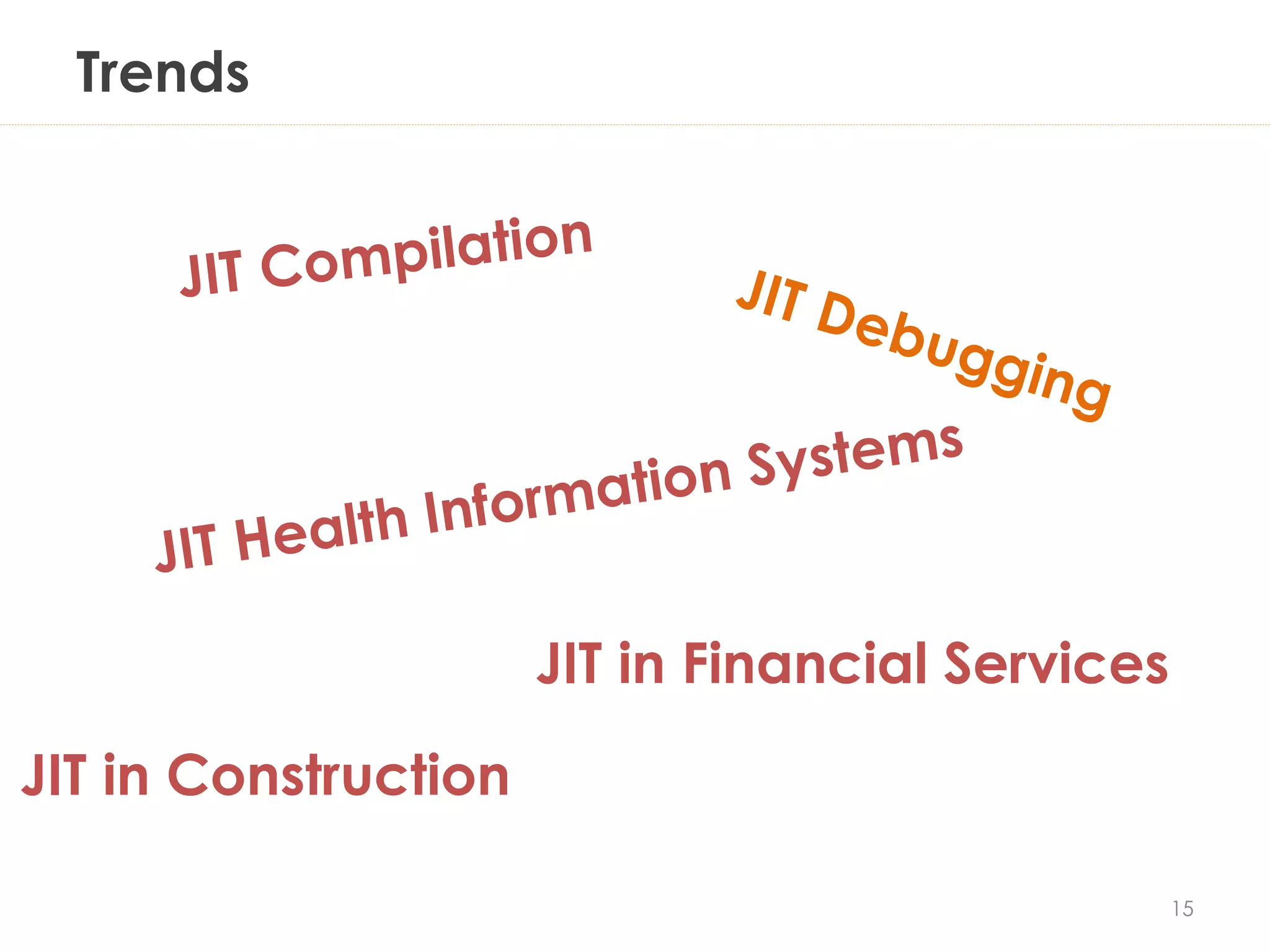
Trends
15
JIT in Construction
JIT in Financial Services
16
When is the best time to have an inventory
part ready for production?
Just in time.
When is the best time to have an item ready
for the next step in production?
Just in time.
When is the best time to have a product
ready for delivery to a customer?
Just in time.
Why do manufacturers build inventory of both
finished goods and raw materials?
Just in case!
17
References
 http://www.toyota-
global.com/company/vision_philosophy/toyota_production_system/just-in-
time.html
 http://www.tutorialspoint.com/management_concepts/just_in_time_manufac
turing.htm
 http://www.mindtools.com/pages/article/newSTR_78.htm
 JIT MANUFACTURING: WORKING TO DELIVER QUALITY AT THE RIGHT TIME, ALL
OF THE TIME, By Bryan Sparks, School of Technology , Eastern Illinois University
 Application of Just-In-Time Principles to Financial Services, By Olga Manou,
University of the Aegean
18

Just In Time Production (JIT)

  • 1.
    JIT Just in TimeProduction 1 Arunnima B S July 2013
  • 2.
    Contents  JIT –Intro  Origin of JIT  JIT Concepts  Kanban  Benefits & Limitations  Trends 2
  • 3.
    Just-in-time Production JIT Right items Right quantity Right quality Right place Right time 3  AJapanese management philosophy, applied in manufacturing which involves production of the right items of the right quantity and quality, at the right place and right time.  A philosophy of manufacturing based on planned elimination of all waste and on continuous improvement of productivity.  A special manufacturing methodology that seeks to make all production processes more efficient .
  • 4.
    Origin of JIT Initiated by Taiichi Ohno of Toyota shortly after World War II  Idea taken from American Supermarket operations o Customers pulled items from shelf to their shopping carts o Shelves became empty as customers pulled items o Empty space signaled refilling of items in the shelf o When item quantities became low, it signaled to order more from suppliers  Applied the same logic to manufacturing o Parts were pulled through the plant as per usage o Machines were kept closer to reduce movement o Usage of parts were determined by production rates 4
  • 5.
    Two important concepts… “Waste”& “Pull System”  WASTE Waste is ‘anything other than the minimum amount of equipment, materials, parts, space, and worker’s time, which are absolutely essential to add value to the product.’ — Shoichiro Toyoda, Former Chairman, Toyota Anything that does not add value can be considered as a waste 5  Waste arising  from overproducing  from waiting time  from transport  from unnecessary stock on hand  from producing defective goods  from the underutilization of talent
  • 6.
    Two important concepts… Push System & Pull System  Push System o Pre defined quantity of materials are pushed to the assembly line o Production initiated based on demand forecast o Used in traditional manufacturing process  Pull System o Materials are pulled as and when required for the manufacturing process o Production initiated based on customer order o Used in JIT process 6 “Waste” & “Pull System”
  • 7.
    Crux of JIT Reduce inventory , Expose problems  Deliberately create some disturbances to uncover problem areas  Solve problems , eliminate waste and increase efficiency  Continuous improvement 7
  • 8.
    8 Less material, labor,indirect costs & better quality Less Inventory Less Material waste Fewer rework High quality finished goods Less Indirect costs Lot size reductions Scrap/qualit y control JIT production Smoother output rates Heightened awareness of problems and causes Faster feedback Reduced buffer inventories Deliberate withdrawal of buffer inventories Ideas for cutting lot sizes Ideas for improving JIT delivery Ideas for controlling defects JIT Logic and beneficial effects on manufacturing systems
  • 9.
    Building blocks 9 Product Design Process Design Personnel Elements Manufactur- ing Planning Eliminatedisruptions Make the system flexible Reduce setup and lead times Eliminate waste Minimize inventories A balanced rapid flow Ultimate Goal Supporting Goals Building Blocks
  • 10.
    Characteristics of JIT Lower inventory levels  Small Lot Size  Reducing travel distance [Cellular Manufacturing]  Eliminate waste & defects  High quality levels  Standardization  Continuous improvement  Applicable primarily for repetitive operations 10
  • 11.
    Kanban as ControlTool  Kanban is most widely used JIT technique  Kanban – Japanese word – meaning signal or card  A signal or a card indicating the quantity to be pulled or the quantity to be produced by a process  No production or movement of material between processes without Kanban  Results  Prevents overproduction and excess transport  Exposes problems, reduces inventory and eliminates waste from the system 11
  • 12.
    Implementations Toyota  As partof continuous improvements in Toyota, employees were encouraged to provide improvement suggestions  An average of 10 improvement suggestions per employee per year  Over 99% of suggestions were improved Harley Davidson  Inventory levels decreased by 75%  Increased productivity  Process problems could no longer be hidden by costly inventory that helped meet the shipment dates. The inefficiencies in processes could be easily identified and solved 12 Dell Intel Motorola General Electric AT&T Xerox
  • 13.
    Benefits  Company  Moreefficient production process - Higher productivity  Eliminating waste, lower inventory levels, lesser defects, lesser space - Enhanced profitability  Makes the process flexible by making the environment function by matching actual demand  Greater visibility to problems , can plan better  Employees  Constant flow of work  No idle time, no unnecessary stress for employees as work is predictable  Customers  Higher quality products at lower prices 13
  • 14.
    Limitations /Challenges  Requiresco-operation from employees  Special training and reorganization of policies and procedures  Involves high setup costs  Assumes that sources of supply are reliable and dependable at all times, which may not be the case  Suppliers may resist to deliver as per JIT requirements 14
  • 15.
    Trends 15 JIT in Construction JITin Financial Services
  • 16.
    16 When is thebest time to have an inventory part ready for production? Just in time. When is the best time to have an item ready for the next step in production? Just in time. When is the best time to have a product ready for delivery to a customer? Just in time. Why do manufacturers build inventory of both finished goods and raw materials? Just in case!
  • 17.
  • 18.
    References  http://www.toyota- global.com/company/vision_philosophy/toyota_production_system/just-in- time.html  http://www.tutorialspoint.com/management_concepts/just_in_time_manufac turing.htm http://www.mindtools.com/pages/article/newSTR_78.htm  JIT MANUFACTURING: WORKING TO DELIVER QUALITY AT THE RIGHT TIME, ALL OF THE TIME, By Bryan Sparks, School of Technology , Eastern Illinois University  Application of Just-In-Time Principles to Financial Services, By Olga Manou, University of the Aegean 18

Editor's Notes

  • #2 27th July 2013
  • #12 As implemented in the Toyota Production System, a kanban is a card that is attached to a storage and transport container.  It identifies the part number and container capacity, along with other information, and is used to provide an easily understood, visual signal that a specific activity is required. In Toyota’s dual-card kanban system, there are two main types of kanban: 1. Production Kanban: signals the need to produce more parts 2. Withdrawal Kanban (also called a "move" or a "conveyance” kanban): signals the need to withdraw parts from one work center and deliver them to the next work center.
  • #16 JIT Health Information Systems – Personalized content delivery without search