
Presented By- 
Akshay Jain 
(2013004) 
Abhishek 
Jain 
(2013002) 
TOYOTA'S JIT 
REVOLUTION
WHY JIT?? 
“Toyota’s focus on JIT is a continual problem-solving process (not an 
inventory reduction plan) illustrates why the automaker is a JIT leader 
not only in its industry but all of industry.” 
“Toyota is the benchmark in manufacturing and product development” 
- General Motors Officials
INTRODUCTION 
The Toyota Production System (TPS) is an integrated socio-technical 
system, developed by Toyota, that comprises its management philosophy 
and practices. 
The TPS organizes manufacturing and logistics for the automobile 
manufacturer, including interaction with suppliers and customers. 
The system is a major precursor of the more generic "Lean manufacturing.
CONTD………… 
 1897:- Sakichi Toyoda diversified his business. 
 1926:-He formed Toyoda Automatic LoomWorks (TALW) to manufacturing 
Loom workers 
 1933:-Established an Automobile department within TALW. 
 1935:-First Passenger car prototype was developed. 
 1936:-Sakichi sold the patent rights of his Automatic loom to a UK based 
Company. 
 1947:-The passenger cars production began. 
 1950-1955:-Foundation of Kanban System.
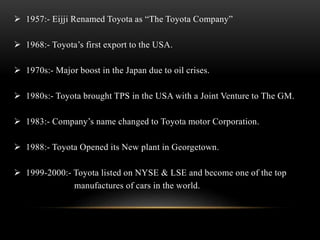
 1957:- Eijji Renamed Toyota as “The Toyota Company” 
 1968:- Toyota’s first export to the USA. 
 1970s:- Major boost in the Japan due to oil crises. 
 1980s:- Toyota brought TPS in the USA with a Joint Venture to The GM. 
 1983:- Company’s name changed to Toyota motor Corporation. 
 1988:- Toyota Opened its New plant in Georgetown. 
 1999-2000:- Toyota listed on NYSE & LSE and become one of the top 
manufactures of cars in the world.
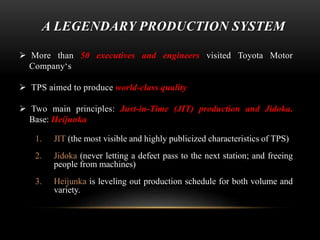
A LEGENDARY PRODUCTION SYSTEM 
 More than 50 executives and engineers visited Toyota Motor 
Company‘s 
 TPS aimed to produce world-class quality 
 Two main principles: Just-in-Time (JIT) production and Jidoka. 
Base: Heijunka 
1. JIT (the most visible and highly publicized characteristics of TPS) 
2. Jidoka (never letting a defect pass to the next station; and freeing 
people from machines) 
3. Heijunka is leveling out production schedule for both volume and 
variety.
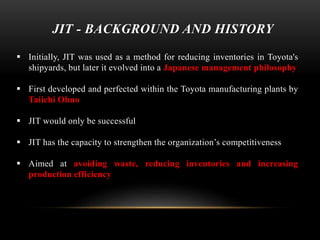
JIT - BACKGROUND AND HISTORY 
 Initially, JIT was used as a method for reducing inventories in Toyota's 
shipyards, but later it evolved into a Japanese management philosophy 
 First developed and perfected within the Toyota manufacturing plants by 
Taiichi Ohno 
 JIT would only be successful 
 JIT has the capacity to strengthen the organization’s competitiveness 
 Aimed at avoiding waste, reducing inventories and increasing 
production efficiency
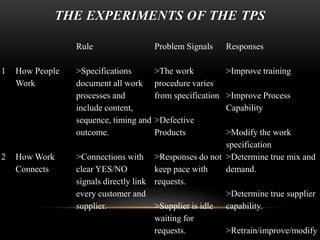
THE EXPERIMENTS OF THE TPS 
Rule Problem Signals Responses 
1 How People 
Work 
>Specifications 
document all work 
processes and 
include content, 
sequence, timing and 
outcome. 
>The work 
procedure varies 
from specification 
>Defective 
Products 
>Improve training 
>Improve Process 
Capability 
>Modify the work 
specification 
2 How Work 
Connects 
>Connections with 
clear YES/NO 
signals directly link 
every customer and 
supplier. 
>Responses do not 
keep pace with 
requests. 
>Supplier is idle 
waiting for 
requests. 
>Determine true mix and 
demand. 
>Determine true supplier 
capability. 
>Retrain/improve/modify
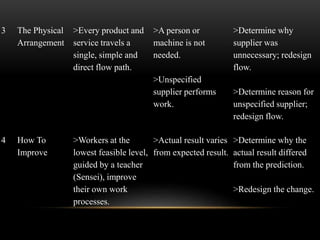
3 The Physical 
Arrangement 
>Every product and 
service travels a 
single, simple and 
direct flow path. 
>A person or 
machine is not 
needed. 
>Unspecified 
supplier performs 
work. 
>Determine why 
supplier was 
unnecessary; redesign 
flow. 
>Determine reason for 
unspecified supplier; 
redesign flow. 
4 How To 
Improve 
>Workers at the 
lowest feasible level, 
guided by a teacher 
(Sensei), improve 
their own work 
processes. 
>Actual result varies 
from expected result. 
>Determine why the 
actual result differed 
from the prediction. 
>Redesign the change.
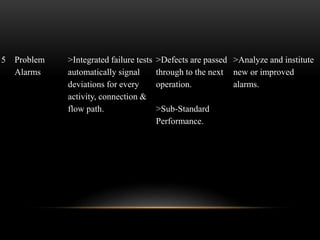
5 Problem 
Alarms 
>Integrated failure tests 
automatically signal 
deviations for every 
activity, connection & 
flow path. 
>Defects are passed 
through to the next 
operation. 
>Sub-Standard 
Performance. 
>Analyze and institute 
new or improved 
alarms.
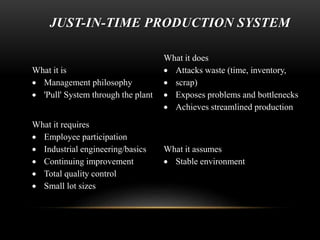
JUST-IN-TIME PRODUCTION SYSTEM 
What it is 
 Management philosophy 
 'Pull' System through the plant 
What it does 
 Attacks waste (time, inventory, 
 scrap) 
 Exposes problems and bottlenecks 
 Achieves streamlined production 
What it requires 
 Employee participation 
 Industrial engineering/basics 
 Continuing improvement 
 Total quality control 
 Small lot sizes 
What it assumes 
 Stable environment
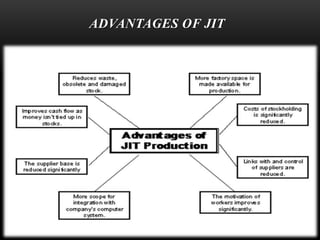
ADVANTAGES OF JIT 
 Price flexibility, 
 Reduction in product variation, 
 Quick response to customers' demands, 
 High quality products at low cost for consumers, 
 Customer satisfaction.
JIT IN SERVICES (EXAMPLES) 
• Organize Problem-Solving Groups 
• Upgrade Housekeeping 
• Upgrade Quality 
• Clarify Process Flows 
• Revise Equipment and Process 
Technologies 
• Level the Facility Load 
• Eliminate Unnecessary Activities 
• Reorganize Physical Configuration 
• Introduce Demand-Pull Scheduling 
• Develop Supplier Networks
SUPPLIER NETWORKS: 
TRENDS IN SUPPLIER POLICIES 
 Locate near to the customer 
 Consider establishing small warehouses near to the customer or 
consolidating warehouses with other suppliers 
 Use standardized containers and make deliveries according to a precise 
delivery schedule 
 Become a certified supplier and accept payment at regular intervals rather 
than upon delivery
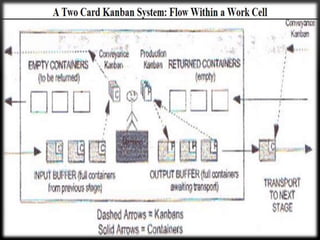
THE KANBAN 
 Essential component of Toyota's JIT concept. 
 Japanese referred to Kanban as a simple parts-movement system that 
depended on cards and boxes/containers to take parts from one 
workstation to another on a production line. 
 Ohno had developed the idea in 1956 from the super markets in the US. 
 Kanban developed into a sophisticated information system. 
 Ensured production in required quantities at the right time. 
 A chain process in which orders flowed from one process to another, the 
production or delivery of components was 'pulled' to the production 
line.
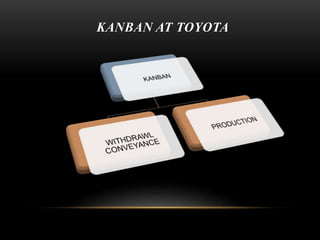
KANBAN AT TOYOTA
 Withdrawal Kanban is carried when going from one process to the 
preceding process. 
 Three types of information were exchanged using Kanban 
 Pick up information 
 Transfer information 
 Production information 
 To make the Kanban system effective, Ohno framed six rules: 
 Later process went to the earlier process to pick up products. 
 The earlier process produced only the amount withdrawn by the 
later process. 
 Should not pick or produce goods without a Kanban. 
 A Kanban should be attached to the goods. 
 100% defect free parts were required. 
 Reduce the number of Kanban.
ADVANTAGES OF KANBAN 
 A simple and understandable process 
 Provides quick and precise information 
 Low costs associated with the transfer of information 
 Provides quick response to changes 
 Limit of over-capacity in process 
 Avoids overproduction 
 Minimizes waste 
 Control can be maintained 
 Delegates' responsibility to workers
Problems with JIT 
• Based on the key assumption that sources and channels of supply were 
reliable and dependable at all times 
• Did not take into account the possibility of labor strikes at automotive 
plants. 
• JIT involved high set up costs 
• Special training and reorganization of policies and procedures were 
necessary 
• Increases the risk of inventory shortage. 
• Difficulty of removing the 'human element'
Successful Implementation 
Ʊ Did not make frequent changes in production planning 
Ʊ Forecasting procedures should be reliable 
Ʊ Depended on highly experienced, highly motivated managers. 
Ʊ A network of capable suppliers that operated in sync
Future of JIT 
o Being a philosophy, JIT does not restrict itself to high technology 
manufacturing environments 
o Valid in any manufacturing environments 
o Not limited to any specific type of industry nor does the size of the 
organization matter. 
o Service sector as growing very fast in developing countries like India but 
poorly managed, JIT can be very useful in improving the performance
Companies currently using JIT 
o Harley Davidson 
o Toyota Motor Company 
o General Motors 
o Ford Motor Company 
o Manufacturing Magic 
o Hawthorne Management Consulting 
o Strategy Manufacturing Inc.
Toyota's jit revolution ppt

Toyota's jit revolution ppt

  • 1.
    Presented By- AkshayJain (2013004) Abhishek Jain (2013002) TOYOTA'S JIT REVOLUTION
  • 2.
    WHY JIT?? “Toyota’sfocus on JIT is a continual problem-solving process (not an inventory reduction plan) illustrates why the automaker is a JIT leader not only in its industry but all of industry.” “Toyota is the benchmark in manufacturing and product development” - General Motors Officials
  • 3.
    INTRODUCTION The ToyotaProduction System (TPS) is an integrated socio-technical system, developed by Toyota, that comprises its management philosophy and practices. The TPS organizes manufacturing and logistics for the automobile manufacturer, including interaction with suppliers and customers. The system is a major precursor of the more generic "Lean manufacturing.
  • 4.
    CONTD…………  1897:-Sakichi Toyoda diversified his business.  1926:-He formed Toyoda Automatic LoomWorks (TALW) to manufacturing Loom workers  1933:-Established an Automobile department within TALW.  1935:-First Passenger car prototype was developed.  1936:-Sakichi sold the patent rights of his Automatic loom to a UK based Company.  1947:-The passenger cars production began.  1950-1955:-Foundation of Kanban System.
  • 5.
     1957:- EijjiRenamed Toyota as “The Toyota Company”  1968:- Toyota’s first export to the USA.  1970s:- Major boost in the Japan due to oil crises.  1980s:- Toyota brought TPS in the USA with a Joint Venture to The GM.  1983:- Company’s name changed to Toyota motor Corporation.  1988:- Toyota Opened its New plant in Georgetown.  1999-2000:- Toyota listed on NYSE & LSE and become one of the top manufactures of cars in the world.
  • 6.
    A LEGENDARY PRODUCTIONSYSTEM  More than 50 executives and engineers visited Toyota Motor Company‘s  TPS aimed to produce world-class quality  Two main principles: Just-in-Time (JIT) production and Jidoka. Base: Heijunka 1. JIT (the most visible and highly publicized characteristics of TPS) 2. Jidoka (never letting a defect pass to the next station; and freeing people from machines) 3. Heijunka is leveling out production schedule for both volume and variety.
  • 7.
    JIT - BACKGROUNDAND HISTORY  Initially, JIT was used as a method for reducing inventories in Toyota's shipyards, but later it evolved into a Japanese management philosophy  First developed and perfected within the Toyota manufacturing plants by Taiichi Ohno  JIT would only be successful  JIT has the capacity to strengthen the organization’s competitiveness  Aimed at avoiding waste, reducing inventories and increasing production efficiency
  • 8.
    THE EXPERIMENTS OFTHE TPS Rule Problem Signals Responses 1 How People Work >Specifications document all work processes and include content, sequence, timing and outcome. >The work procedure varies from specification >Defective Products >Improve training >Improve Process Capability >Modify the work specification 2 How Work Connects >Connections with clear YES/NO signals directly link every customer and supplier. >Responses do not keep pace with requests. >Supplier is idle waiting for requests. >Determine true mix and demand. >Determine true supplier capability. >Retrain/improve/modify
  • 9.
    3 The Physical Arrangement >Every product and service travels a single, simple and direct flow path. >A person or machine is not needed. >Unspecified supplier performs work. >Determine why supplier was unnecessary; redesign flow. >Determine reason for unspecified supplier; redesign flow. 4 How To Improve >Workers at the lowest feasible level, guided by a teacher (Sensei), improve their own work processes. >Actual result varies from expected result. >Determine why the actual result differed from the prediction. >Redesign the change.
  • 10.
    5 Problem Alarms >Integrated failure tests automatically signal deviations for every activity, connection & flow path. >Defects are passed through to the next operation. >Sub-Standard Performance. >Analyze and institute new or improved alarms.
  • 11.
    JUST-IN-TIME PRODUCTION SYSTEM What it is  Management philosophy  'Pull' System through the plant What it does  Attacks waste (time, inventory,  scrap)  Exposes problems and bottlenecks  Achieves streamlined production What it requires  Employee participation  Industrial engineering/basics  Continuing improvement  Total quality control  Small lot sizes What it assumes  Stable environment
  • 12.
    ADVANTAGES OF JIT  Price flexibility,  Reduction in product variation,  Quick response to customers' demands,  High quality products at low cost for consumers,  Customer satisfaction.
  • 13.
    JIT IN SERVICES(EXAMPLES) • Organize Problem-Solving Groups • Upgrade Housekeeping • Upgrade Quality • Clarify Process Flows • Revise Equipment and Process Technologies • Level the Facility Load • Eliminate Unnecessary Activities • Reorganize Physical Configuration • Introduce Demand-Pull Scheduling • Develop Supplier Networks
  • 14.
    SUPPLIER NETWORKS: TRENDSIN SUPPLIER POLICIES  Locate near to the customer  Consider establishing small warehouses near to the customer or consolidating warehouses with other suppliers  Use standardized containers and make deliveries according to a precise delivery schedule  Become a certified supplier and accept payment at regular intervals rather than upon delivery
  • 15.
    THE KANBAN Essential component of Toyota's JIT concept.  Japanese referred to Kanban as a simple parts-movement system that depended on cards and boxes/containers to take parts from one workstation to another on a production line.  Ohno had developed the idea in 1956 from the super markets in the US.  Kanban developed into a sophisticated information system.  Ensured production in required quantities at the right time.  A chain process in which orders flowed from one process to another, the production or delivery of components was 'pulled' to the production line.
  • 16.
  • 17.
     Withdrawal Kanbanis carried when going from one process to the preceding process.  Three types of information were exchanged using Kanban  Pick up information  Transfer information  Production information  To make the Kanban system effective, Ohno framed six rules:  Later process went to the earlier process to pick up products.  The earlier process produced only the amount withdrawn by the later process.  Should not pick or produce goods without a Kanban.  A Kanban should be attached to the goods.  100% defect free parts were required.  Reduce the number of Kanban.
  • 19.
    ADVANTAGES OF KANBAN  A simple and understandable process  Provides quick and precise information  Low costs associated with the transfer of information  Provides quick response to changes  Limit of over-capacity in process  Avoids overproduction  Minimizes waste  Control can be maintained  Delegates' responsibility to workers
  • 20.
    Problems with JIT • Based on the key assumption that sources and channels of supply were reliable and dependable at all times • Did not take into account the possibility of labor strikes at automotive plants. • JIT involved high set up costs • Special training and reorganization of policies and procedures were necessary • Increases the risk of inventory shortage. • Difficulty of removing the 'human element'
  • 21.
    Successful Implementation ƱDid not make frequent changes in production planning Ʊ Forecasting procedures should be reliable Ʊ Depended on highly experienced, highly motivated managers. Ʊ A network of capable suppliers that operated in sync
  • 22.
    Future of JIT o Being a philosophy, JIT does not restrict itself to high technology manufacturing environments o Valid in any manufacturing environments o Not limited to any specific type of industry nor does the size of the organization matter. o Service sector as growing very fast in developing countries like India but poorly managed, JIT can be very useful in improving the performance
  • 23.
    Companies currently usingJIT o Harley Davidson o Toyota Motor Company o General Motors o Ford Motor Company o Manufacturing Magic o Hawthorne Management Consulting o Strategy Manufacturing Inc.