Just in Time and Lean Production
Contents:
1) Objectives.
2) Introduction.
3) Definition of JIT and Lean Production.
4) Elements of JIT and Lean Production.
5) Continuous development by using JIT and Lean Production (Kaizen).
6) Kinds of wasting and lost.
7) Applications of 5S.
8) Advantages and Disadvantages of JIT and Lean Production.
1) Objectives…
 Understanding of JIT and Lean Production.
 Describing the elements of JIT and Lean Production.
 Clarification of using JIT and Lean Production in continuous development.
 Knowing the main resources of the wasting and lost.
 Describing the advantages and disadvantages of JIT and Lean Production.
2) Introduction…
 A lot of evolutions like short life cycle of products, increasing demands of
customers, globalization and increased number of competitors in diverse
markets caused high load over the Organizations which led them to be high
response.
 And one of the best solution for the Organizations to be higher response is to
have own inventory but the cost will be high, also what if the product get
expired and/or have some issue?
 For that the best solution for the organizations is to have Just In Time and
Lean Production process system to be smart and able to respond for the
market needs faster.
So what are Just In Time and Lean
Production Systems?
3) Concept of JIT and Lean Production.
First of all JIT and Lean Production systems assigned to Taiichi Ohno who is the
president of Toyota Co. but it is applied by James Womack and Daniel Jones to
describe Toyota Production System (TPS) which was one of the most efficient
system in that time.
 Lean Production: is a methodology that focuses on minimizing waste within
manufacturing systems while simultaneously maximizing productivity.
 Just In Time (JIT): is an inventory management method whereby materials,
and goods are scheduled to arrive exactly when needed in the production
process.
Produce what We need and don’t allow to transfer materials to the next
machine unless there is actual need. So there will be no space for making
mistake.
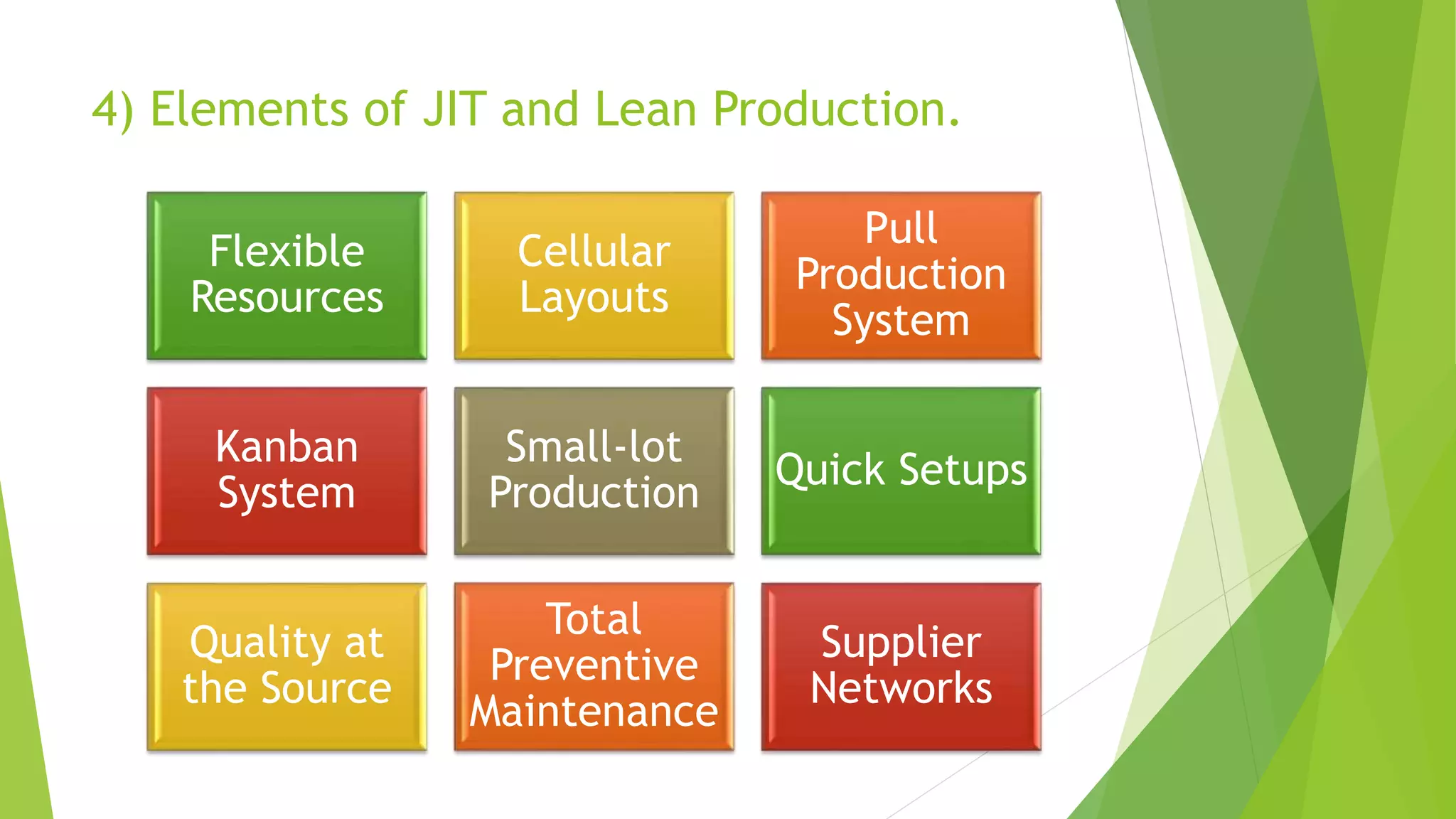
4) Elements of JIT and Lean Production.
Flexible
Resources
Cellular
Layouts
Pull
Production
System
Kanban
System
Small-lot
Production
Quick Setups
Quality at
the Source
Total
Preventive
Maintenance
Supplier
Networks
Flexible Resources:
 The Organization should have Multifunctional Employees to get benefits from
them in diverse fields. How? Suppose that the resources have been finished
from specific production line so We can transfer the employees to another
production line.
Quick Setups:
 Is set of necessary processes to re-prepare the machine and that is made
between the production batch and other.
Small Lot Production:
 In small-lot production, quality problems are easier to detect and workers
show less tendency to let poor quality pass. How? When We required small lot
production We can test them and if We have problem We can inform the
supplier spontaneously, but If We required large lot production from the
supplier and We found some problem on items after specific duration We
can’t refer it to the supplier again.
Kanban System:
 Kanban means card in Japanese. Kanban is a signal used in a drag system that
expresses a request for production or withdrawal of a specific standard
quantity for a given material or product. And aims to control the flow of
production and inventory levels under operation between cells and work
stations within the plant.
 The Kanban card includes information such as: part number, brief description
of the part, quantity of container, previous station and next station.
Kanban System: (Cont.)
 Rules for Managing Kanban System:
 Each Container should have Card to control specific part.
 Each container should have same quantity from good elements.
 Defects and incorrect amounts are never sent to the next process.
 Total production should not exceed the total amount on the Kanban cards.
 If Kanban System is not visual so We can use the Kanban Card but if it is so We can
use for example the flashing light to indicate the status of my system.
Kanban system(Cont.) How does it work?
Supplier Network:
 As We know in JIT We produced the product depending on the pull system, for
that We interested in having the materials that provided by suppliers in
determined time, so We have to make long term relation ship with the
supplier.
 And one of the most important point to be considered when choosing the
supplier is to be near by your Organization’s location.
Cellular Layouts:
 To make logical arrangement for the machine in the industry. For example if
Machine A produce the product 1 so the Machine B should be near by Machine
A to reduce the transfer actions for the product and the employees.
Total Preventive Maintenance:
 What if the production line has been interrupted? And there is 10 employees
working in this production line? For sure the production’s process will be
delayed also those employees will get rest till the maintenance process finish.
So the Organization should make a preventive maintenance before beginning
work to insure all machines working normally.
Quality at the Source:
 For a JIT system to work well, quality has to be extremely high. Due to
smaller lot sizes actually encouraged better quality. Workers can observe
quality problems more easily; when problems are detected, they can be
traced to their source and remedied without reworking too many units.
Pull System:
 The production process begin after knowing and receiving the customer’s
requirements, It prevents overproduction and underproduction; only
necessary quantities are produced.
5) Continuous Improvements by using JIT and
Lean Production (Kaizen).
 It is one of the most important principles of Total Quality Management as Edward Deming’s
Recommendation.
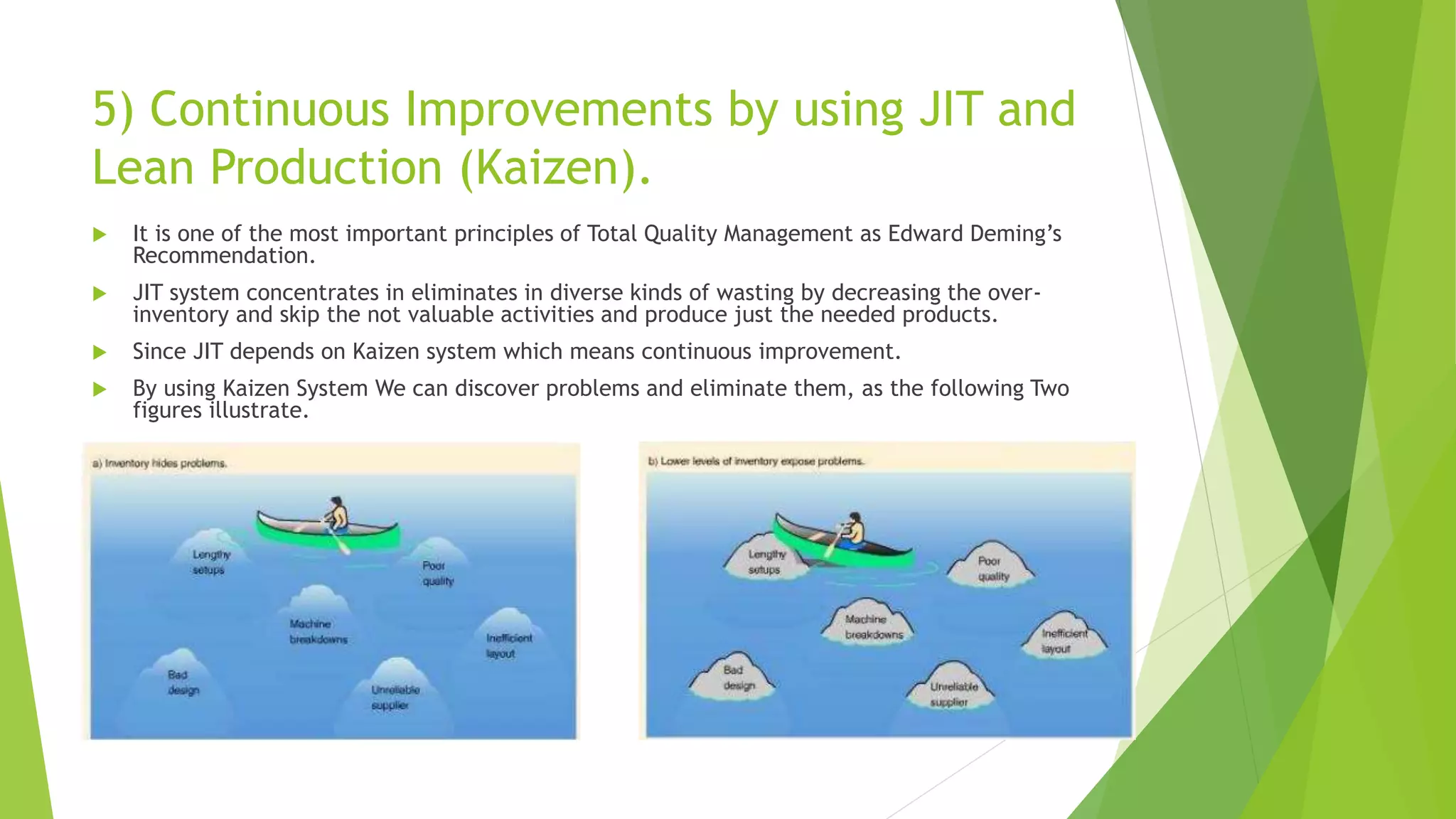
 JIT system concentrates in eliminates in diverse kinds of wasting by decreasing the over-
inventory and skip the not valuable activities and produce just the needed products.
 Since JIT depends on Kaizen system which means continuous improvement.
 By using Kaizen System We can discover problems and eliminate them, as the following Two
figures illustrate.
6) Kinds of wasting and lost.
6) Kinds of wasting and lost. (Cont.)
No Name Description
1 Over-Production Waste from making more product than customers demand.
2 Waiting Waste from time spent waiting for the next process step to occur
3 Defects Waste from product or service failure to meet customer expectations.
4 Unused-Talent Wastes due to underutilization of people’s talents, skills and knowledge.
5 Extra-Processing Wastes related to more work or higher quality than is required.
6 Motion Wasted time and effort related to unnecessary movements by people.
7 Transportation Wasted time, resources and costs when unnecessarily moving products.
8 Inventory Wastes resulting from excess products and material that aren’t proceed.
7) Applications and Practices of 5S.
5S Definition
Seiri (Sort) Throw away all rubbish and unrelated materials in the workplace.
Seiton (Set In Order) Set everything in proper place for quick retrieval and storage.
Seiso (Shine) Clean the workplace; everyone should be a janitor.
Seiketsu (Standardize) Maintain clean and improve 3S.
Shisuke (Self-Discipline) Make 5s practices a habit.
 5S method aims to arrange the workplace to be more productive and efficient.
 The following table contains the 5S with the definition of them:
8) Advantages and Disadvantages of JIT and
Lean Production.
1) Reduced Inventory.
2) Improved Quality.
3) Lower Costs.
4) Reduced Space Requirements.
5) Increased Productivity.
6) Better relations with suppliers.
7) Better use of Human Resource.
8) Greater flexibility.
9) More Product Variety.
Advantages Dis-advantages
1) The reputation of the
manufacturer is placed in the
hands of the supplier.
2) May be difficult to meet
unexpected major increases in
demand.
3) Production may be stopped if
supplier is delayed.
9) Case Study…
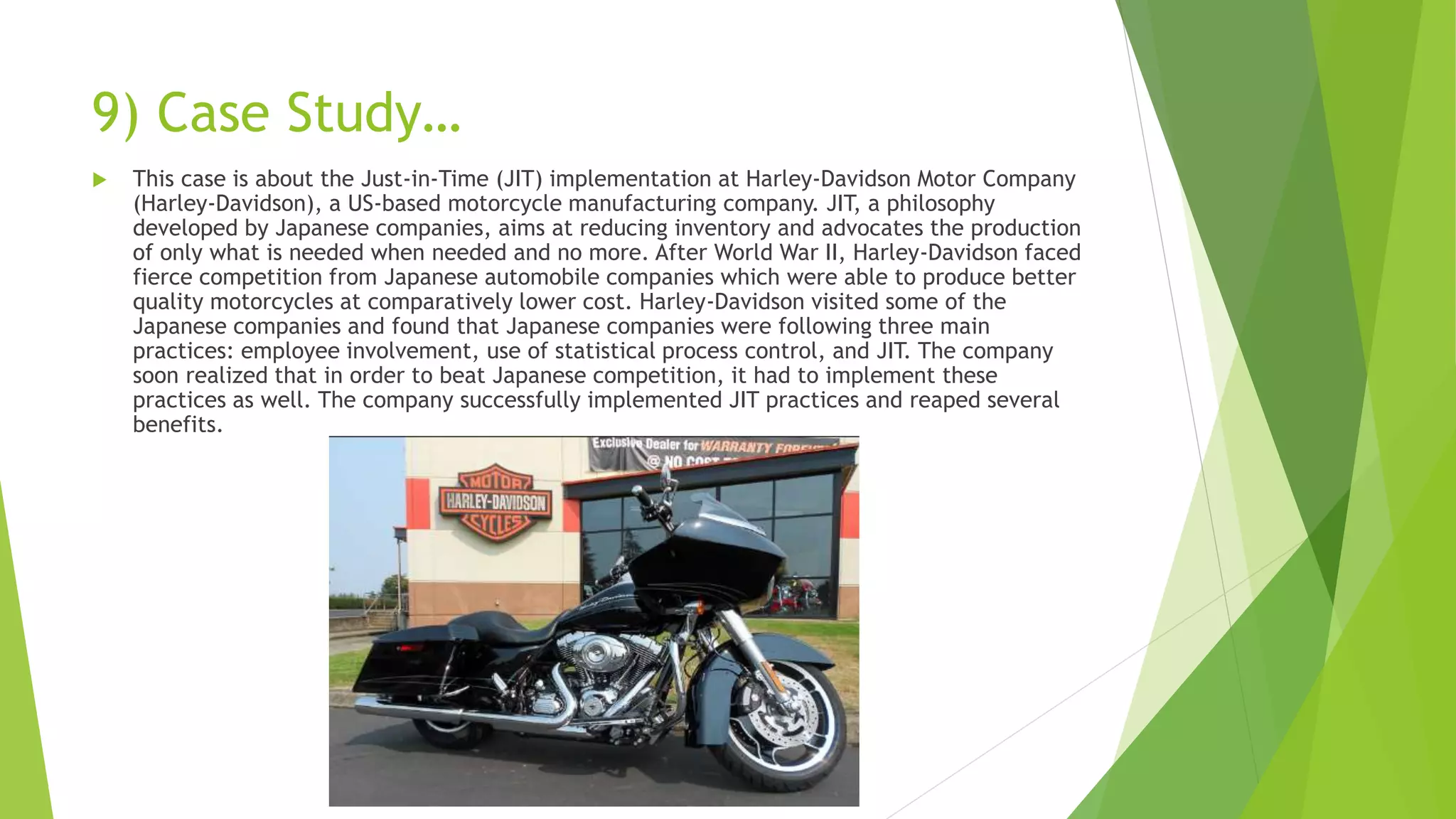
 This case is about the Just-in-Time (JIT) implementation at Harley-Davidson Motor Company
(Harley-Davidson), a US-based motorcycle manufacturing company. JIT, a philosophy
developed by Japanese companies, aims at reducing inventory and advocates the production
of only what is needed when needed and no more. After World War II, Harley-Davidson faced
fierce competition from Japanese automobile companies which were able to produce better
quality motorcycles at comparatively lower cost. Harley-Davidson visited some of the
Japanese companies and found that Japanese companies were following three main
practices: employee involvement, use of statistical process control, and JIT. The company
soon realized that in order to beat Japanese competition, it had to implement these
practices as well. The company successfully implemented JIT practices and reaped several
benefits.
The End.
 Done by: Hisham Jamleh.
 Transmission Enterprise Solutions
Engineer at Zain-Jo.
Thank You.

Just in time (jit) and lean production

  • 1.
    Just in Timeand Lean Production Contents: 1) Objectives. 2) Introduction. 3) Definition of JIT and Lean Production. 4) Elements of JIT and Lean Production. 5) Continuous development by using JIT and Lean Production (Kaizen). 6) Kinds of wasting and lost. 7) Applications of 5S. 8) Advantages and Disadvantages of JIT and Lean Production.
  • 2.
    1) Objectives…  Understandingof JIT and Lean Production.  Describing the elements of JIT and Lean Production.  Clarification of using JIT and Lean Production in continuous development.  Knowing the main resources of the wasting and lost.  Describing the advantages and disadvantages of JIT and Lean Production.
  • 3.
    2) Introduction…  Alot of evolutions like short life cycle of products, increasing demands of customers, globalization and increased number of competitors in diverse markets caused high load over the Organizations which led them to be high response.  And one of the best solution for the Organizations to be higher response is to have own inventory but the cost will be high, also what if the product get expired and/or have some issue?  For that the best solution for the organizations is to have Just In Time and Lean Production process system to be smart and able to respond for the market needs faster. So what are Just In Time and Lean Production Systems?
  • 4.
    3) Concept ofJIT and Lean Production. First of all JIT and Lean Production systems assigned to Taiichi Ohno who is the president of Toyota Co. but it is applied by James Womack and Daniel Jones to describe Toyota Production System (TPS) which was one of the most efficient system in that time.  Lean Production: is a methodology that focuses on minimizing waste within manufacturing systems while simultaneously maximizing productivity.  Just In Time (JIT): is an inventory management method whereby materials, and goods are scheduled to arrive exactly when needed in the production process. Produce what We need and don’t allow to transfer materials to the next machine unless there is actual need. So there will be no space for making mistake.
  • 5.
    4) Elements ofJIT and Lean Production. Flexible Resources Cellular Layouts Pull Production System Kanban System Small-lot Production Quick Setups Quality at the Source Total Preventive Maintenance Supplier Networks
  • 6.
    Flexible Resources:  TheOrganization should have Multifunctional Employees to get benefits from them in diverse fields. How? Suppose that the resources have been finished from specific production line so We can transfer the employees to another production line. Quick Setups:  Is set of necessary processes to re-prepare the machine and that is made between the production batch and other. Small Lot Production:  In small-lot production, quality problems are easier to detect and workers show less tendency to let poor quality pass. How? When We required small lot production We can test them and if We have problem We can inform the supplier spontaneously, but If We required large lot production from the supplier and We found some problem on items after specific duration We can’t refer it to the supplier again.
  • 7.
    Kanban System:  Kanbanmeans card in Japanese. Kanban is a signal used in a drag system that expresses a request for production or withdrawal of a specific standard quantity for a given material or product. And aims to control the flow of production and inventory levels under operation between cells and work stations within the plant.  The Kanban card includes information such as: part number, brief description of the part, quantity of container, previous station and next station.
  • 8.
    Kanban System: (Cont.) Rules for Managing Kanban System:  Each Container should have Card to control specific part.  Each container should have same quantity from good elements.  Defects and incorrect amounts are never sent to the next process.  Total production should not exceed the total amount on the Kanban cards.  If Kanban System is not visual so We can use the Kanban Card but if it is so We can use for example the flashing light to indicate the status of my system.
  • 9.
  • 10.
    Supplier Network:  AsWe know in JIT We produced the product depending on the pull system, for that We interested in having the materials that provided by suppliers in determined time, so We have to make long term relation ship with the supplier.  And one of the most important point to be considered when choosing the supplier is to be near by your Organization’s location. Cellular Layouts:  To make logical arrangement for the machine in the industry. For example if Machine A produce the product 1 so the Machine B should be near by Machine A to reduce the transfer actions for the product and the employees.
  • 11.
    Total Preventive Maintenance: What if the production line has been interrupted? And there is 10 employees working in this production line? For sure the production’s process will be delayed also those employees will get rest till the maintenance process finish. So the Organization should make a preventive maintenance before beginning work to insure all machines working normally. Quality at the Source:  For a JIT system to work well, quality has to be extremely high. Due to smaller lot sizes actually encouraged better quality. Workers can observe quality problems more easily; when problems are detected, they can be traced to their source and remedied without reworking too many units.
  • 12.
    Pull System:  Theproduction process begin after knowing and receiving the customer’s requirements, It prevents overproduction and underproduction; only necessary quantities are produced.
  • 13.
    5) Continuous Improvementsby using JIT and Lean Production (Kaizen).  It is one of the most important principles of Total Quality Management as Edward Deming’s Recommendation.  JIT system concentrates in eliminates in diverse kinds of wasting by decreasing the over- inventory and skip the not valuable activities and produce just the needed products.  Since JIT depends on Kaizen system which means continuous improvement.  By using Kaizen System We can discover problems and eliminate them, as the following Two figures illustrate.
  • 14.
    6) Kinds ofwasting and lost.
  • 15.
    6) Kinds ofwasting and lost. (Cont.) No Name Description 1 Over-Production Waste from making more product than customers demand. 2 Waiting Waste from time spent waiting for the next process step to occur 3 Defects Waste from product or service failure to meet customer expectations. 4 Unused-Talent Wastes due to underutilization of people’s talents, skills and knowledge. 5 Extra-Processing Wastes related to more work or higher quality than is required. 6 Motion Wasted time and effort related to unnecessary movements by people. 7 Transportation Wasted time, resources and costs when unnecessarily moving products. 8 Inventory Wastes resulting from excess products and material that aren’t proceed.
  • 16.
    7) Applications andPractices of 5S. 5S Definition Seiri (Sort) Throw away all rubbish and unrelated materials in the workplace. Seiton (Set In Order) Set everything in proper place for quick retrieval and storage. Seiso (Shine) Clean the workplace; everyone should be a janitor. Seiketsu (Standardize) Maintain clean and improve 3S. Shisuke (Self-Discipline) Make 5s practices a habit.  5S method aims to arrange the workplace to be more productive and efficient.  The following table contains the 5S with the definition of them:
  • 17.
    8) Advantages andDisadvantages of JIT and Lean Production. 1) Reduced Inventory. 2) Improved Quality. 3) Lower Costs. 4) Reduced Space Requirements. 5) Increased Productivity. 6) Better relations with suppliers. 7) Better use of Human Resource. 8) Greater flexibility. 9) More Product Variety. Advantages Dis-advantages 1) The reputation of the manufacturer is placed in the hands of the supplier. 2) May be difficult to meet unexpected major increases in demand. 3) Production may be stopped if supplier is delayed.
  • 18.
    9) Case Study… This case is about the Just-in-Time (JIT) implementation at Harley-Davidson Motor Company (Harley-Davidson), a US-based motorcycle manufacturing company. JIT, a philosophy developed by Japanese companies, aims at reducing inventory and advocates the production of only what is needed when needed and no more. After World War II, Harley-Davidson faced fierce competition from Japanese automobile companies which were able to produce better quality motorcycles at comparatively lower cost. Harley-Davidson visited some of the Japanese companies and found that Japanese companies were following three main practices: employee involvement, use of statistical process control, and JIT. The company soon realized that in order to beat Japanese competition, it had to implement these practices as well. The company successfully implemented JIT practices and reaped several benefits.
  • 19.
    The End.  Doneby: Hisham Jamleh.  Transmission Enterprise Solutions Engineer at Zain-Jo. Thank You.