Master Production ScheduleMaster Production Schedule
OverviewOverview
• DefineDefine MMasteraster PProductionroduction SSchedulechedule
• Explain MPSExplain MPS
• Discuss How MPS WorksDiscuss How MPS Works
• Example From “Real Life”Example From “Real Life”
• Brainstorm: How Can MPS Help YourBrainstorm: How Can MPS Help Your
Firm?Firm?
• Practice MPS LogicPractice MPS Logic
What is MPS?What is MPS?
• MMasteraster PProductionroduction SSchedule –chedule –
States the requirements forStates the requirements for
individual end items by date andindividual end items by date and
quantity. -quantity. -APICSAPICS
MPS ExplainedMPS Explained
• Breaks down, or disaggregates,Breaks down, or disaggregates,
the production plan into productthe production plan into product
familiesfamilies
• Promotes valid order promisesPromotes valid order promises
• Provides a communicationProvides a communication
medium betweenmedium between
Marketing/Sales and OperationsMarketing/Sales and Operations
Explanation ContinuedExplanation Continued
• Proactively control ability toProactively control ability to
deliver goods to customersdeliver goods to customers
• Resource availability controlResource availability control
• Proactively control inventoryProactively control inventory
levelslevels
Disaggregate the Sales andDisaggregate the Sales and
Operations PlanOperations Plan
• The production plan is brokenThe production plan is broken
into product familiesinto product families
Promotes Valid Order PromisesPromotes Valid Order Promises
• By validating the capacity forBy validating the capacity for
the MPS through rough cutthe MPS through rough cut
capacity planning, alterativecapacity planning, alterative
plans can be made when thereplans can be made when there
are more orders than productionare more orders than production
MarketingMarketing  OperationsOperations
• Marketing communicatesMarketing communicates
demand through customerdemand through customer
orders and forecastsorders and forecasts
• Operations communicatesOperations communicates
capacity through inventorycapacity through inventory
levels and constraintslevels and constraints
Resource AvailabilityResource Availability
ControlControl
• Production shortfalls will beProduction shortfalls will be
known ahead of time andknown ahead of time and
alternative plans can be made.alternative plans can be made.
Customer ServiceCustomer Service
• Proactively control ability toProactively control ability to
deliver goods to customersdeliver goods to customers
Inventory ControlInventory Control
• Proactive approach to inventoryProactive approach to inventory
controlcontrol
– Items are scheduled to arrive whenItems are scheduled to arrive when
neededneeded
– Safety stock has less importanceSafety stock has less importance
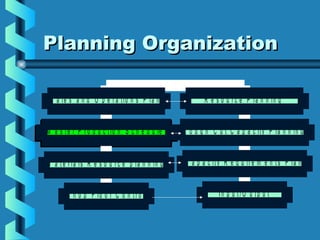
Planning OrganizationPlanning Organization
S h o p F lo o r C o n t r o l
M a t e r ia ls R e s o u r c e p la n n in g
M a s t e r P r o d u c t io n S c h e d u le
S a le s a n d O p e r a tio n s P la n
I n p u t / O u t p u t
C a p a c it y R e q u ir e m e n t s P la n
R o u g h C u t C a p a c ity P la n n in g
R e s o u r c e P la n n in g
How MPS WorksHow MPS Works
• Information needed for MPSInformation needed for MPS
logiclogic
– Lot SizeLot Size
– Lead TimeLead Time
– Product DemandProduct Demand
– Starting InventoryStarting Inventory
How MPS Works Cont.How MPS Works Cont.
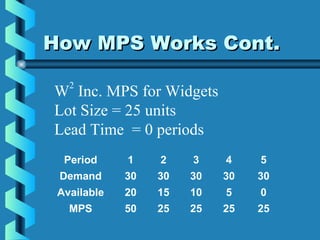
Period 1 2 3 4 5
Demand 30 30 30 30 30
Available 20 15 10 5 0
MPS 50 25 25 25 25
W
2
Inc. MPS for Widgets
Lot Size = 25 units
Lead Time = 0 periods
Jet Spray Corp. ExampleJet Spray Corp. Example
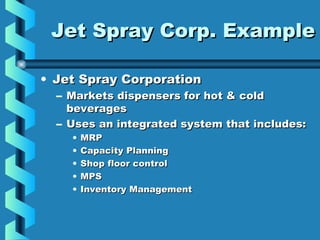
• Jet Spray CorporationJet Spray Corporation
– Markets dispensers for hot & coldMarkets dispensers for hot & cold
beveragesbeverages
– Uses an integrated system that includes:Uses an integrated system that includes:
• MRPMRP
• Capacity PlanningCapacity Planning
• Shop floor controlShop floor control
• MPSMPS
• Inventory ManagementInventory Management
Example ContinuedExample Continued
Brainstorming ExerciseBrainstorming Exercise
• How can an MPS system beHow can an MPS system be
used in your Firm?used in your Firm?
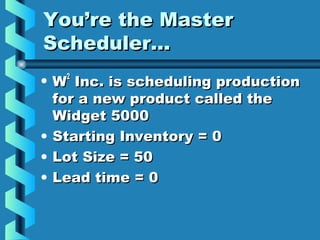
You’re the MasterYou’re the Master
Scheduler…Scheduler…
• WW22
Inc. is scheduling productionInc. is scheduling production
for a new product called thefor a new product called the
Widget 5000Widget 5000
• Starting Inventory = 0Starting Inventory = 0
• Lot Size = 50Lot Size = 50
• Lead time = 0Lead time = 0
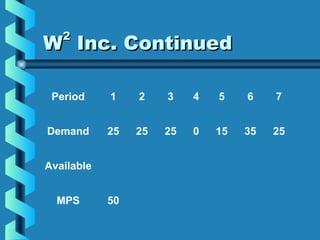
WW22
Inc. ContinuedInc. Continued
Period 1 2 3 4 5 6 7
Demand 25 25 25 0 15 35 25
Available              
MPS 50            
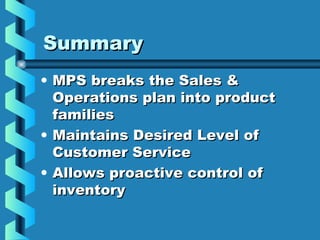
SummarySummary
• MPS breaks the Sales &MPS breaks the Sales &
Operations plan into productOperations plan into product
familiesfamilies
• Maintains Desired Level ofMaintains Desired Level of
Customer ServiceCustomer Service
• Allows proactive control ofAllows proactive control of
inventoryinventory
BibliographyBibliography
• Sources:Sources:
• Cox III, James F., and Blackstone Jr., JohnCox III, James F., and Blackstone Jr., John
H., eds.H., eds. APICS Dictionary.APICS Dictionary. 19981998
• Vollman, Thomas E., William L. Berry, D.Vollman, Thomas E., William L. Berry, D.
Clay Whybark, (1997)Clay Whybark, (1997) ManufacturingManufacturing
Planning and Control SystemsPlanning and Control Systems (4(4thth
ed.). Newed.). New
York McGraw-HillYork McGraw-Hill
• APICS. (2000).APICS. (2000). Basics of Supply ChainBasics of Supply Chain
Management.Management. Virginia.Virginia.

Master production schedule

  • 1.
  • 2.
    OverviewOverview • DefineDefine MMasterasterPProductionroduction SSchedulechedule • Explain MPSExplain MPS • Discuss How MPS WorksDiscuss How MPS Works • Example From “Real Life”Example From “Real Life” • Brainstorm: How Can MPS Help YourBrainstorm: How Can MPS Help Your Firm?Firm? • Practice MPS LogicPractice MPS Logic
  • 3.
    What is MPS?Whatis MPS? • MMasteraster PProductionroduction SSchedule –chedule – States the requirements forStates the requirements for individual end items by date andindividual end items by date and quantity. -quantity. -APICSAPICS
  • 4.
    MPS ExplainedMPS Explained •Breaks down, or disaggregates,Breaks down, or disaggregates, the production plan into productthe production plan into product familiesfamilies • Promotes valid order promisesPromotes valid order promises • Provides a communicationProvides a communication medium betweenmedium between Marketing/Sales and OperationsMarketing/Sales and Operations
  • 5.
    Explanation ContinuedExplanation Continued •Proactively control ability toProactively control ability to deliver goods to customersdeliver goods to customers • Resource availability controlResource availability control • Proactively control inventoryProactively control inventory levelslevels
  • 6.
    Disaggregate the SalesandDisaggregate the Sales and Operations PlanOperations Plan • The production plan is brokenThe production plan is broken into product familiesinto product families
  • 7.
    Promotes Valid OrderPromisesPromotes Valid Order Promises • By validating the capacity forBy validating the capacity for the MPS through rough cutthe MPS through rough cut capacity planning, alterativecapacity planning, alterative plans can be made when thereplans can be made when there are more orders than productionare more orders than production
  • 8.
    MarketingMarketing  OperationsOperations •Marketing communicatesMarketing communicates demand through customerdemand through customer orders and forecastsorders and forecasts • Operations communicatesOperations communicates capacity through inventorycapacity through inventory levels and constraintslevels and constraints
  • 9.
    Resource AvailabilityResource Availability ControlControl •Production shortfalls will beProduction shortfalls will be known ahead of time andknown ahead of time and alternative plans can be made.alternative plans can be made.
  • 10.
    Customer ServiceCustomer Service •Proactively control ability toProactively control ability to deliver goods to customersdeliver goods to customers
  • 11.
    Inventory ControlInventory Control •Proactive approach to inventoryProactive approach to inventory controlcontrol – Items are scheduled to arrive whenItems are scheduled to arrive when neededneeded – Safety stock has less importanceSafety stock has less importance
  • 12.
    Planning OrganizationPlanning Organization Sh o p F lo o r C o n t r o l M a t e r ia ls R e s o u r c e p la n n in g M a s t e r P r o d u c t io n S c h e d u le S a le s a n d O p e r a tio n s P la n I n p u t / O u t p u t C a p a c it y R e q u ir e m e n t s P la n R o u g h C u t C a p a c ity P la n n in g R e s o u r c e P la n n in g
  • 13.
    How MPS WorksHowMPS Works • Information needed for MPSInformation needed for MPS logiclogic – Lot SizeLot Size – Lead TimeLead Time – Product DemandProduct Demand – Starting InventoryStarting Inventory
  • 14.
    How MPS WorksCont.How MPS Works Cont. Period 1 2 3 4 5 Demand 30 30 30 30 30 Available 20 15 10 5 0 MPS 50 25 25 25 25 W 2 Inc. MPS for Widgets Lot Size = 25 units Lead Time = 0 periods
  • 15.
    Jet Spray Corp.ExampleJet Spray Corp. Example • Jet Spray CorporationJet Spray Corporation – Markets dispensers for hot & coldMarkets dispensers for hot & cold beveragesbeverages – Uses an integrated system that includes:Uses an integrated system that includes: • MRPMRP • Capacity PlanningCapacity Planning • Shop floor controlShop floor control • MPSMPS • Inventory ManagementInventory Management
  • 16.
  • 17.
    Brainstorming ExerciseBrainstorming Exercise •How can an MPS system beHow can an MPS system be used in your Firm?used in your Firm?
  • 18.
    You’re the MasterYou’rethe Master Scheduler…Scheduler… • WW22 Inc. is scheduling productionInc. is scheduling production for a new product called thefor a new product called the Widget 5000Widget 5000 • Starting Inventory = 0Starting Inventory = 0 • Lot Size = 50Lot Size = 50 • Lead time = 0Lead time = 0
  • 19.
    WW22 Inc. ContinuedInc. Continued Period1 2 3 4 5 6 7 Demand 25 25 25 0 15 35 25 Available               MPS 50            
  • 20.
    SummarySummary • MPS breaksthe Sales &MPS breaks the Sales & Operations plan into productOperations plan into product familiesfamilies • Maintains Desired Level ofMaintains Desired Level of Customer ServiceCustomer Service • Allows proactive control ofAllows proactive control of inventoryinventory
  • 21.
    BibliographyBibliography • Sources:Sources: • CoxIII, James F., and Blackstone Jr., JohnCox III, James F., and Blackstone Jr., John H., eds.H., eds. APICS Dictionary.APICS Dictionary. 19981998 • Vollman, Thomas E., William L. Berry, D.Vollman, Thomas E., William L. Berry, D. Clay Whybark, (1997)Clay Whybark, (1997) ManufacturingManufacturing Planning and Control SystemsPlanning and Control Systems (4(4thth ed.). Newed.). New York McGraw-HillYork McGraw-Hill • APICS. (2000).APICS. (2000). Basics of Supply ChainBasics of Supply Chain Management.Management. Virginia.Virginia.

Editor's Notes

  • #2 Master Production Schedule Training Slides By John Kash For Operations Management 345 Dr. Tom Foster
  • #3 Topics Covered in presentation.
  • #4 The APICS dictionary defines the Master Production Schedule as follows: 1) The anticipated build schedule for those items assigned to the master scheduler. The Master Scheduler maintains this schedule, and in turn, it becomes a set of planning numbers that drives Material Requirements Planning. It represents what the company plans to produce expressed in specific configurations, quantities, and Dates. The Master production Schedule is not a sales forecast that represents a statement of demand. The Master Production Schedule must take into account the forecast, the production plan, and other important considerations such as backlog, availability of material, availability of capacity, and management policies and goals. Syn. Master Schedule 2) The result of the master scheduling process. The master schedule is a presentation of demand, forecast, backlog, the MPS, the projected on hand inventory, the available-to-promise quantity.  
  • #5 Breaks down, or disaggregates, the production plan into product families: The production plan is broken into product families for the Master Production Schedule and Production is planned based on demand forecasts provided by marketing. Promotes valid order promises: Order promises can be made against planned production. This job falls to marketing and is referred to as “consuming” the Inventory. Provides a communication medium between Marketing/Sales and Operations. When more product has been promised than will be produced, marketing and operations must work together to develop a strategy to meet customer requirements. This can take the form of many options including; subcontract, allow overtime, increase capacity through equipment acquisition, expand facilities, increasing staffing levels, improve processes, etc…
  • #6 Proactively control ability to deliver goods to customers: The MPS allows for better understanding of capacity and gives visibility to capacity shortfalls. This allows action to be taken to meet demand or prioritize customer orders ahead of time. Resource availability control: Understanding future capacity shortfalls creates the ability to plan the best uses of resources or increase resources if needed. Proactively control inventory levels: MPS gives a firm the ability to not rely on safety stock or “reactive” EOQ models.
  • #7 The Sales and Operations Plan is broken into smaller product families. An example would be an auto maker breaking their automobile production down into small cars, sudans, trucks, etc…
  • #8 Promotes valid order promises: By validating the capacity for the MPS through rough cut capacity planning, alterative plans can be made when there are more orders than production. Management has several options and implement something before customer orders are late or missed.
  • #9 Marketing communicates demand through customer orders and forecasts: Marketing researches and monitors data to provide input on actual customer demand and forecasted customer demand to the Operations department Operations communicates capacity through inventory levels and constraints: Operations researches and monitors data tp provide input on capacity, inventory levels, and production constraints.
  • #10 Production shortfalls will be known ahead of time and alternative plans can be made: Based on the sales forecast and capacity review, a firm will know when they will not be able to meet forecasted demand and will be able to make alternative plans to wither increase capacity in some manner or subcontract.
  • #11 Proactively control ability to deliver goods to customers: Management will be able to proactively manage customer relations by deciding how to handle production shortfalls in advance.
  • #12 Proactive approach to inventory control: By planning out the production based on demand, inventory can be deliver as it is needed. This helps to lower the cost of carrying goods that are not currently needed.
  • #13 Explanation Continued: The chart displayed is based on the Planning and Control Hierarchy from Basics of Supply Chain Management. The sales and operations plan sets the direction for the markets that a firm will compete in based on that firms core competencies. This information is broken down or disaggregated into product families by the MPS. The MPS then sets dates for the completion of end items based on input from the sales forecast. In turn, this information is fed to the MRP system for further disaggregation. The MPS is checked through rough cut capacity planning. This is where the firm determines if they have the capacity to produce the necessary volume dictated by the sales forecast. If there is not enough capacity then other options should be explored.
  • #14 Lot size, Lead time, and product demand are the basic elements used to create a MPS.
  • #15 Fictitious example of how a MPS works: This is an over simplified MPS for the W2 Inc. Company’s Widget product. Please note that you will probably never see a constant demand as shown. This example also starts with no product available and a schedule receipt of 50 widgets. The Available units is calculated by subtracting the demand from the units scheduled to arrive in the MPS and the left over units from the previous period. For example, in period one, 30 units is subtracted from the 50 units arriving add to the beginning inventory level of zero units or (50+0)-30=20 units.
  • #16 Jet Spray Corporation Markets dispensers for hot & cold beverages Uses an integrated system that includes: MRP Capacity Planning Shop floor control MPS Inventory Management Manufacturing Planning and Control Systems pg 242-244
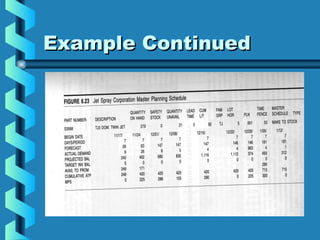
  • #17 This is an MPS for the “TJ3” product manufactured by Jet Spray. This MPS includes: Forecasted Demand Projected Inventory Balance Available-To-Promise (Finished goods that have not been ordered by customers) Note: For period 12/29, demand consumes the previous MPS receipts from December and the last 7 units from period 11/24. Manufacturing Planning and Control Systems pg 242-244
  • #18 Have everyone write down a few ideas individually. Once everyone has a few ideas, have someone write them all down on a board that everyone can see. The group can them discuss the merits of each idea and come to a consensus.
  • #19 Practice example: Each member of the audience is the Master Scheduler for W2 Inc. please complete and MPS for the following demand (next slide).
  • #20 Have audience complete MPS on this slide: Answer: Period1234567 Demand2525250153525 Available250252510250 MPS505050
  • #21 Thanks!
  • #22 Sources: Cox III, James F., and Blackstone Jr., John H., eds. APICS Dictionary. 1998 Vollman, Thomas E., William L. Berry, D. Clay Whybark, (1997) Manufacturing Planning and Control Systems (4th ed.). New York McGraw-Hill APICS. (2000). Basics of Supply Chain Management. Virginia.