AVINASH KUMAR GUPTA
CCW TRAINING INSTITUTE
15/07/2018
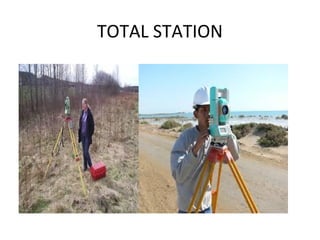
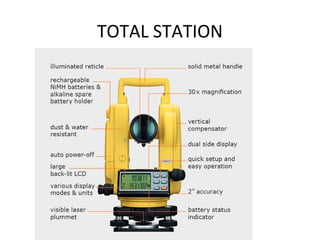
TOTAL STATION
TOTAL STATION
TOTAL STATION
• Total Station is integrated Electronic
instrument.
• Its basic component are electronic
theodolite ,EDM and a Computer /micro
processor.
• It can measure all parameters used in
reduction of survey data.
• It can measure, reduce, display and
store surveying data automatically in
Digital format,
• Least Count .1 second to 20 second
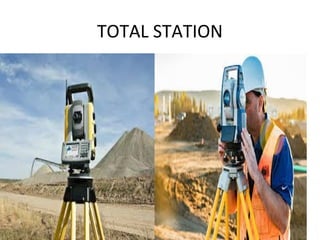
TOTAL STATION
TOTAL STATION
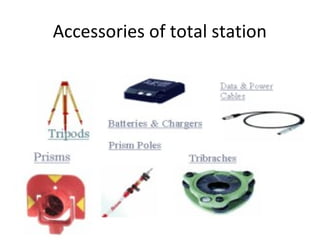
Accessories of total station
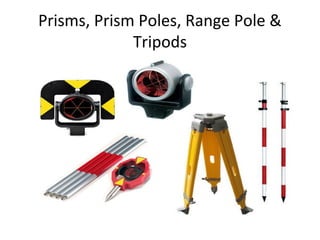
Prisms, Prism Poles, Range Pole &
Tripods
TRIPLE PRISM
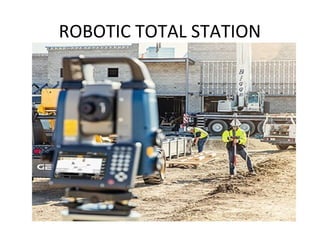
ROBOTIC TOTAL STATION
• Operator controls from distance
through remote.
• It contains jog-shuttle mechanism
which actuates an internal servo
motors to rotate telescope about both
horizontal and vertical axes allowing
TS to track and aim its target
automatically.
TOTAL STATION KEYS/SCREEN
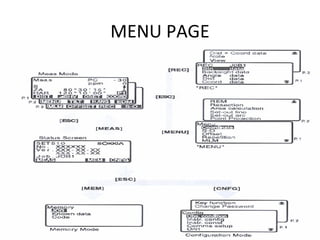
MENU PAGE
Leveling the Total Station
• Leveling the Total Station must be
accomplished to sufficient accuracy otherwise
the instrument will not report results
• Leveling the instrument takes 30 to 45
minutes
• Make sure you can see all targets from the
instrument station before going through the
process
TRIPOD SETUP
•Tripod legs
should be
equally spaced
•Tripod head
should be
approximately
level
•Head should
be directly
over survey
point
Mount Instrument on Tripod
•Place
Instrument
on Tripod
•Secure with
centering screw
while bracing the
instrument with
the other hand
•Insert battery in
instrument before
leveling
Focus on Survey Point
•Focus the
optical
plummet on the
survey point
Leveling the Instrument
•Adjust the leveling foot screws
to center the
survey point in the optical
plummet reticle
•Center the bubble in the
circular level by
adjusting the tripod legs
Leveling …
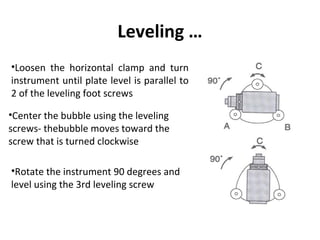
•Loosen the horizontal clamp and turn
instrument until plate level is parallel to
2 of the leveling foot screws
•Center the bubble using the leveling
screws- thebubble moves toward the
screw that is turned clockwise
•Rotate the instrument 90 degrees and
level using the 3rd leveling screw
Leveling …
• Observe the survey point in the optical
plummet and center the point by loosening
the entering screw and sliding the entire
instrument
• After re-tightening the centering screw check
to make sure the plate level bubble is level
in several directions
Electronically Verify
Leveling•Turn on the instrument by
pressing and holding the “on”
button (you should hear an
audible beep)
•The opening screen will be
the “MEAS” screen. Select
the
[Tilt] function
•Adjust the foot level screws
to exactly center the elctronic
“bubble
•Rotate the instrument 90
degrees and repeat
Adjust Image & Reticle
Focus
•Release the horizontal & vertical clamps
and point telescope to a featureless light
background
•Adjust the reticle (i.e. cross-hair) focus
adjustment until reticle image is sharply
focused
•Point telescope to target and
adjust the focus ring until target is
focused
•Move your head from side-to-side to
test for image shift (i.e. parallax).
Repeat the reticle focus step if parallax
is significant
•NOTE: When the instrument operator
changes the reticle, focus may need to
be adjusted
MEASURING The HEIGHT
Level the instrument at a site where the target can be viewed through the
telescope and the mirror target can be setup directly below the target
After powering on the instrument select “REM” from “MEAS” >
“Menu
Ht = h1 + h2
h2 = S (sin θz1) (cot θz2 ) – S (cos θz1)
Measurement of Target Height
•Set the Target Height from “MEAS” > “Menu” >
“Coordinate” > “Station Orientation” > “Station
Coordinate”
•Set the target height to the measured height of
the mirror target. You do not have to fill out the
other fields for a REM measurement
•Press “ESC” to return to the “MEAS” menu.
• Select the “MEAS” > “Menu” > “REM”, sight the
mirror target, press [OBS] to measure “S”, then
[STOP]
•Sight the object above the target for height
Measurement
• Select [REM] and then [STOP]
REM Screen Results
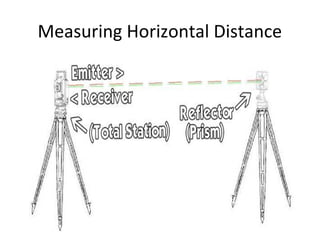
Measuring Horizontal Distance
HORIZONTAL DISTAND AND
ELEVATION
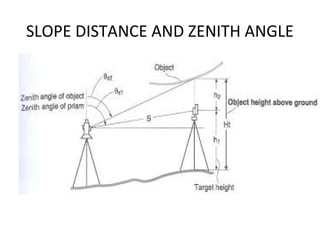
SLOPE DISTANCE AND ZENITH ANGLE
Distance Measurement
• TS measures the slope distance between the
instrument and the target.
• Slope distance gets converted to horizontal and
vertical distance.
• TS makes use of an EDMI for measurement of
distance.
• Thus,TS makes use of principle of EDMI for
measurement of its slope distance
EDM
• Require clear line of sight;
• Energy transmitted from one end of the line to
the other and returned back to the starting
point; thus it travels the measurement distance
twice.
• Measurement Techniques
• –PHASE SHIFT
• –Pulsed Laser System.
Phase Shift method
• Uses continuous e.m. waves;
• Measures lengths by indirectly determining the number of full and
partial cycles of transmitted e.m.e between the two ends of a line.
• •Modulated e.m. wave is transmitted to the target, placed at the
other end of the line. The target, acting as a reflector, reflects the
light beam back to the receiver, where the incoming light is
converted to an electrical signal. A phase comparison is made
between the projected and reflected signals.
• Then the amount by which the transmitted and received signals are
out of phase get measured electronically and registered in a meter
by getting converted to an equivalent distance
Phase Shift Method
Phase Shift Method
Thus, the distance(D) between the stations is D=(1/2)
[n+Δφ/360°]Xλ,where n is the integral number of
wavelength,λ in the double path.
Pulsed Laser System
• Makes use of pulses derived from an infra-
red or visible laser diode.
Velocity(v) o f pulses gets determined.
•Transit time(t) is measured using electronic signal
processing technique.
•Distance, D=0.5Xv.t
•Large number of pulses(~20,000/sec)get analysed
during measurements.
Distance Measurement using
Reflector
• Reflector Measurements Precise, Rapid &
Tracking modes.
• Use Single or Triple prism set as reflector
• Range 2-5km
Distance Measurement without
Reflector
• Telescope crosshairs aimed at the point whose
distance is to be measured
• Advantageous, if TS equipped with visible red laser
beam to locate the target.
• Applications:
–In accessible targets
–Targets in dangerous areas
–Construction surveys
–Etc.
Total station

Total station

  • 1.
    AVINASH KUMAR GUPTA CCWTRAINING INSTITUTE 15/07/2018 TOTAL STATION
  • 2.
  • 3.
    TOTAL STATION • TotalStation is integrated Electronic instrument. • Its basic component are electronic theodolite ,EDM and a Computer /micro processor. • It can measure all parameters used in reduction of survey data. • It can measure, reduce, display and store surveying data automatically in Digital format, • Least Count .1 second to 20 second
  • 4.
  • 7.
  • 8.
  • 9.
    Prisms, Prism Poles,Range Pole & Tripods
  • 10.
  • 11.
  • 12.
    ROBOTIC TOTAL STATION •Operator controls from distance through remote. • It contains jog-shuttle mechanism which actuates an internal servo motors to rotate telescope about both horizontal and vertical axes allowing TS to track and aim its target automatically.
  • 13.
  • 14.
  • 15.
    Leveling the TotalStation • Leveling the Total Station must be accomplished to sufficient accuracy otherwise the instrument will not report results • Leveling the instrument takes 30 to 45 minutes • Make sure you can see all targets from the instrument station before going through the process
  • 16.
    TRIPOD SETUP •Tripod legs shouldbe equally spaced •Tripod head should be approximately level •Head should be directly over survey point
  • 17.
    Mount Instrument onTripod •Place Instrument on Tripod •Secure with centering screw while bracing the instrument with the other hand •Insert battery in instrument before leveling
  • 18.
    Focus on SurveyPoint •Focus the optical plummet on the survey point
  • 19.
    Leveling the Instrument •Adjustthe leveling foot screws to center the survey point in the optical plummet reticle •Center the bubble in the circular level by adjusting the tripod legs
  • 20.
    Leveling … •Loosen thehorizontal clamp and turn instrument until plate level is parallel to 2 of the leveling foot screws •Center the bubble using the leveling screws- thebubble moves toward the screw that is turned clockwise •Rotate the instrument 90 degrees and level using the 3rd leveling screw
  • 21.
    Leveling … • Observethe survey point in the optical plummet and center the point by loosening the entering screw and sliding the entire instrument • After re-tightening the centering screw check to make sure the plate level bubble is level in several directions
  • 22.
    Electronically Verify Leveling•Turn onthe instrument by pressing and holding the “on” button (you should hear an audible beep) •The opening screen will be the “MEAS” screen. Select the [Tilt] function •Adjust the foot level screws to exactly center the elctronic “bubble •Rotate the instrument 90 degrees and repeat
  • 23.
    Adjust Image &Reticle Focus •Release the horizontal & vertical clamps and point telescope to a featureless light background •Adjust the reticle (i.e. cross-hair) focus adjustment until reticle image is sharply focused •Point telescope to target and adjust the focus ring until target is focused •Move your head from side-to-side to test for image shift (i.e. parallax). Repeat the reticle focus step if parallax is significant •NOTE: When the instrument operator changes the reticle, focus may need to be adjusted
  • 24.
    MEASURING The HEIGHT Levelthe instrument at a site where the target can be viewed through the telescope and the mirror target can be setup directly below the target After powering on the instrument select “REM” from “MEAS” > “Menu Ht = h1 + h2 h2 = S (sin θz1) (cot θz2 ) – S (cos θz1)
  • 25.
    Measurement of TargetHeight •Set the Target Height from “MEAS” > “Menu” > “Coordinate” > “Station Orientation” > “Station Coordinate” •Set the target height to the measured height of the mirror target. You do not have to fill out the other fields for a REM measurement •Press “ESC” to return to the “MEAS” menu. • Select the “MEAS” > “Menu” > “REM”, sight the mirror target, press [OBS] to measure “S”, then [STOP] •Sight the object above the target for height Measurement • Select [REM] and then [STOP]
  • 26.
  • 27.
  • 28.
  • 29.
    SLOPE DISTANCE ANDZENITH ANGLE
  • 30.
    Distance Measurement • TSmeasures the slope distance between the instrument and the target. • Slope distance gets converted to horizontal and vertical distance. • TS makes use of an EDMI for measurement of distance. • Thus,TS makes use of principle of EDMI for measurement of its slope distance
  • 31.
    EDM • Require clearline of sight; • Energy transmitted from one end of the line to the other and returned back to the starting point; thus it travels the measurement distance twice. • Measurement Techniques • –PHASE SHIFT • –Pulsed Laser System.
  • 32.
    Phase Shift method •Uses continuous e.m. waves; • Measures lengths by indirectly determining the number of full and partial cycles of transmitted e.m.e between the two ends of a line. • •Modulated e.m. wave is transmitted to the target, placed at the other end of the line. The target, acting as a reflector, reflects the light beam back to the receiver, where the incoming light is converted to an electrical signal. A phase comparison is made between the projected and reflected signals. • Then the amount by which the transmitted and received signals are out of phase get measured electronically and registered in a meter by getting converted to an equivalent distance
  • 33.
  • 34.
    Phase Shift Method Thus,the distance(D) between the stations is D=(1/2) [n+Δφ/360°]Xλ,where n is the integral number of wavelength,λ in the double path.
  • 35.
    Pulsed Laser System •Makes use of pulses derived from an infra- red or visible laser diode. Velocity(v) o f pulses gets determined. •Transit time(t) is measured using electronic signal processing technique. •Distance, D=0.5Xv.t •Large number of pulses(~20,000/sec)get analysed during measurements.
  • 36.
    Distance Measurement using Reflector •Reflector Measurements Precise, Rapid & Tracking modes. • Use Single or Triple prism set as reflector • Range 2-5km
  • 37.
    Distance Measurement without Reflector •Telescope crosshairs aimed at the point whose distance is to be measured • Advantageous, if TS equipped with visible red laser beam to locate the target. • Applications: –In accessible targets –Targets in dangerous areas –Construction surveys –Etc.