B Y :
R A K E S H K U M A R V E R M A
A S S T . P R O F E S S O R C I V I L E N G G . P . I . E . T .
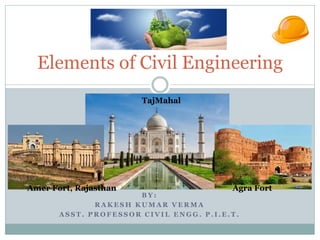
Elements of Civil Engineering
Amer Fort, Rajasthan Agra Fort
TajMahal
Civil Engineering
 One of the oldest of the engineering professions
 Includes the designing, planning, construction, and
maintenance of the infrastructure
 Works include roads, bridges, buildings, dams,
canals, water supply
 Concerned with determining the right design for
these structures and looking after the construction
process
 Egyptian pyramids and Roman road systems are
based on civil engineering principles
Design
Planning
Construct
Field Surveying Planning and Drawing
Estimation & Implementation
Maintenance
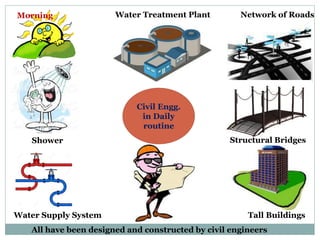
Civil Engg.
in Daily
routine
Water Treatment Plant
All have been designed and constructed by civil engineers
Morning
Shower
Water Supply System
Network of Roads
Structural Bridges
Tall Buildings
Importance and Applications of Civil Engineering
 building good quality transportation systems like
highways, airports, rail lines, sea ports, etc
 fire control systems and installing quick fire exit
points in the buildings
 minimizing the loss of life during fire accidents
 purify the contaminated air, water and soil
Continue……..
 Other principal works in which surveying is
primarily utilised are
1. to fix the national and state boundaries;
2. to chart coastlines, navigable streams and lakes;
3. to establish control points;
4. to execute hydrographic and oceanographic
charting and mapping; and
5. to prepare topographic map of land surface of the
earth.
Diamond Crossing Indian Railway
Delhi
Palais Royale Mumbai
China’s Dawang Mountain Resort
ITC Maurya Hotel in New Delhi
Signature tower, Abu Dhabi
Survey
Opinion Survey
Surveying
American Congress on Surveying and Mapping
(ACSM) defines as;
 Surveying is the science and art of making all
essential measurements to determine the relative
position of points or physical and cultural details
above, on, or beneath the surface of the Earth, and to
depict them in a usable form, or to establish the
position of points or details.
 This is being carried out by finding the spatial
location (relative / absolute) of points on or near
the surface of the earth.
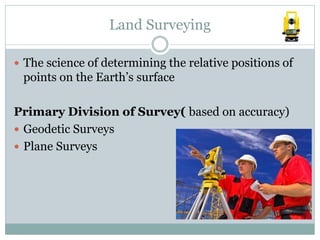
Land Surveying
 The science of determining the relative positions of
points on the Earth’s surface
Primary Division of Survey( based on accuracy)
 Geodetic Surveys
 Plane Surveys
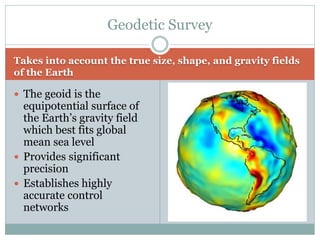
Takes into account the true size, shape, and gravity fields
of the Earth
 The geoid is the
equipotential surface of
the Earth’s gravity field
which best fits global
mean sea level
 Provides significant
precision
 Establishes highly
accurate control
networks
Geodetic Survey
Surveying aims
 to measure the Horizontal Distance between
points.
 to measure the Vertical elevation between points.
 to find out the Relative direction of lines by
measuring horizontal angles with reference to any
arbitrary direction and
 to find out Absolute direction by
measuring horizontal angles with reference to a fixed
direction.
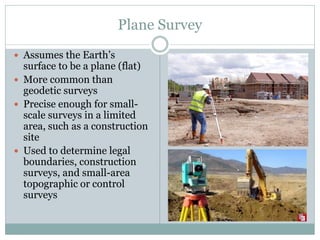
Plane Survey
 Assumes the Earth’s
surface to be a plane (flat)
 More common than
geodetic surveys
 Precise enough for small-
scale surveys in a limited
area, such as a construction
site
 Used to determine legal
boundaries, construction
surveys, and small-area
topographic or control
surveys
Plane Surveying
 When radius of curvature of the earth is not taken
into account.
 Small area and small distances are covered
 Degree of accuracy is comparatively low.
 American survey put 250 km2 for treating survey as
Plane, but controlling factor should be degree of
precision rather than extent of area.
Based upon Nature of
field
Based upon Method
Employed
 Land Survey
 Marine Survey
 Astronomical Survey
 Triangulation
 Traversing
Types of Surveying
Based upon Object of
Survey
Based upon Instrument
Used
 Geological Survey(Object
is to survey different
strata in the earth crust)
 Mine Survey (Mineral
wealth such as coal, gold)
 Military Survey(Points of
strategic importance)
 Surveying by Total Station
 Chain Survey
 Theodolite Survey
 Compass Survey
 Plane Tabling
 Photographic and Aerial
Surveys
Types of Surveying
Topographical Survey Cadastral Survey
 Determine natural
features of a country
such as hills, valleys,
lakes woods etc. and
also arterial features
such as roads,
buildings, canals,
towns etc.
 Details such
boundaries of houses,
town, fields and other
properties pathways
are determined.
1. City Survey
2. Engineering Survey
Land Survey
Engineering Survey
 Engineering Survey can be further divided into:
 Reconnaissance (To determine the feasibility and
rough cost of the scheme)
 Preliminary Survey (For collecting more precise
data)
 Location Survey(For setting out the work on the
ground)
Geodetic or Trigonometrical Surveying
 When the radius of curvature of earth is taken in to
account.
 Large area and large distances are covered.
 Object of geodetic survey is to determine precise
positions on the surface of earth.
 Refined Instruments and Methods are used.
 Conducted by Government agencies.
No. Plain Surveying Geodetic Surveying
1 The earth surface is considered as
plain Surface.
The earth surface is considered as Curved
Surface.
2. The Curvature of the earth is
ignored
The curvature of earth is taken into
account.
3 Line joining any two stations is
considered to be straight
The line joining any two stations is
considered as spherical.
4. The triangle formed by any three
points is considered as plain
The Triangle formed by any three points is
considered as spherical.
5. The angles of triangle are
considered as plain angles.
The angles of the triangle are considered as
spherical angles.
6. Carried out for a small area <
250 km2
Carried out for a small area > 250 km2
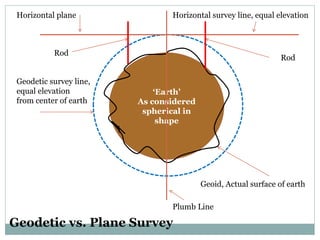
‘Earth’
As considered
spherical in
shape
Plumb Line
Geoid, Actual surface of earth
Geodetic survey line,
equal elevation
from center of earth
Horizontal survey line, equal elevationHorizontal plane
Rod
Rod
Geodetic vs. Plane Survey
Types of Surveys
 Control Survey
 Topographic Survey
 Property Survey
 Site Survey
 Construction Survey
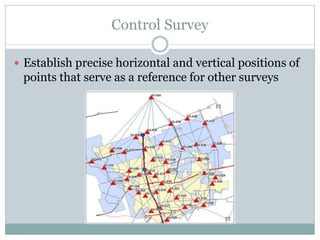
Control Survey
 Establish precise horizontal and vertical positions of
points that serve as a reference for other surveys
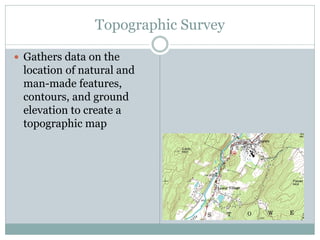
Topographic Survey
 Gathers data on the
location of natural and
man-made features,
contours, and ground
elevation to create a
topographic map
Property Survey
(or Boundary Survey)
 Establishes property
lines for a lot
 Used to create a plat
Site Survey
(Plot Survey or Lot Survey)
 Combination of a
property survey and
topographic survey
 May be required to
receive a construction
permit
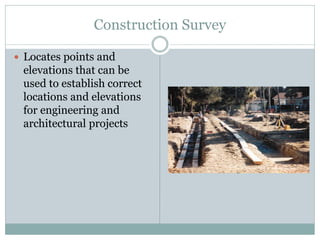
Construction Survey
 Locates points and
elevations that can be
used to establish correct
locations and elevations
for engineering and
architectural projects
National Spatial Reference System (NSRS)
 Common set of reference
points for all surveys
 Horizontal Datum =
Collection of points of
known latitude and
longitude
 Vertical Datum =
Collection of points of
known elevation
 Benchmark (BM) =
Permanent mark that
establishes a point of
known elevation
Optical Equipment
A theodolite measures
vertical and horizontal
angles
A total station is an
electronic/optical
surveying instrument
Optical Equipment
 Automatic (Auto) Level
 Commonly used on
building sites
 Internal compensator
can automatically level
the instrument
 Measures difference in
elevation between the
line of sight and a point
Auto Level
Bulls Eye
Level
Telescope
Leveling
Screws
Horizontal
Angle
Rotation Ring
Eyepiece
Horizontal
Tangent
Knob
Sight
Diopter
Adjustment
Ring
Mirror
Kennedy
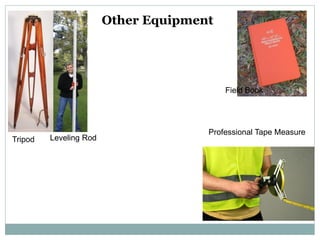
Professional Tape Measure
Field Book
Other Equipment
Tripod Leveling Rod
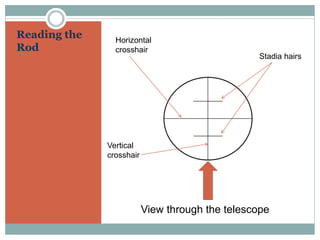
Reading the
Rod
Stadia hairs
Horizontal
crosshair
Vertical
crosshair
View through the telescope
Reading the
Rod
Upper Stadia Reading =
5.30 m
Rod Reading = 5.25 m
Lower Stadia Reading =
5.20 m
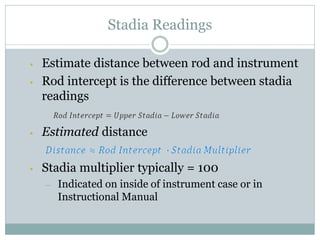
Stadia Readings
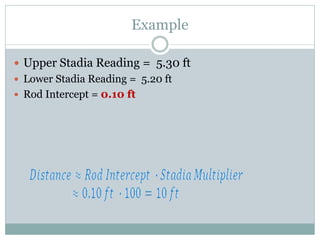
• Estimate distance between rod and instrument
• Rod intercept is the difference between stadia
readings
• Estimated distance
• Stadia multiplier typically = 100
– Indicated on inside of instrument case or in
Instructional Manual
Example
 Upper Stadia Reading = 5.30 ft
 Lower Stadia Reading = 5.20 ft
 Rod Intercept = 0.10 ft
Differential Leveling
 The establishment of differences in elevation
between two or more points with respect to a datum
Earth Surface
Datum line or plane
BM
BS FS
Staff
Staff
Instrument
Point of
unknown
elevation
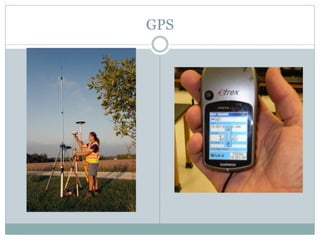
GPS Technology
 Global Positioning System
 A global navigation satellite
system
 Developed by the U.S.
Department of Defense
 A constellation of satellites
that broadcast radio signals
 Receivers intercept several
satellite signals in order to
determine precise location
GPS

Introduction to Surveying under ECE

  • 1.
    B Y : RA K E S H K U M A R V E R M A A S S T . P R O F E S S O R C I V I L E N G G . P . I . E . T . Elements of Civil Engineering Amer Fort, Rajasthan Agra Fort TajMahal
  • 2.
    Civil Engineering  Oneof the oldest of the engineering professions  Includes the designing, planning, construction, and maintenance of the infrastructure  Works include roads, bridges, buildings, dams, canals, water supply  Concerned with determining the right design for these structures and looking after the construction process  Egyptian pyramids and Roman road systems are based on civil engineering principles
  • 5.
    Design Planning Construct Field Surveying Planningand Drawing Estimation & Implementation Maintenance
  • 9.
    Civil Engg. in Daily routine WaterTreatment Plant All have been designed and constructed by civil engineers Morning Shower Water Supply System Network of Roads Structural Bridges Tall Buildings
  • 10.
    Importance and Applicationsof Civil Engineering  building good quality transportation systems like highways, airports, rail lines, sea ports, etc  fire control systems and installing quick fire exit points in the buildings  minimizing the loss of life during fire accidents  purify the contaminated air, water and soil
  • 11.
    Continue……..  Other principalworks in which surveying is primarily utilised are 1. to fix the national and state boundaries; 2. to chart coastlines, navigable streams and lakes; 3. to establish control points; 4. to execute hydrographic and oceanographic charting and mapping; and 5. to prepare topographic map of land surface of the earth.
  • 13.
  • 14.
    Palais Royale Mumbai China’sDawang Mountain Resort ITC Maurya Hotel in New Delhi Signature tower, Abu Dhabi
  • 15.
  • 16.
    Surveying American Congress onSurveying and Mapping (ACSM) defines as;  Surveying is the science and art of making all essential measurements to determine the relative position of points or physical and cultural details above, on, or beneath the surface of the Earth, and to depict them in a usable form, or to establish the position of points or details.  This is being carried out by finding the spatial location (relative / absolute) of points on or near the surface of the earth.
  • 17.
    Land Surveying  Thescience of determining the relative positions of points on the Earth’s surface Primary Division of Survey( based on accuracy)  Geodetic Surveys  Plane Surveys
  • 20.
    Takes into accountthe true size, shape, and gravity fields of the Earth  The geoid is the equipotential surface of the Earth’s gravity field which best fits global mean sea level  Provides significant precision  Establishes highly accurate control networks Geodetic Survey
  • 21.
    Surveying aims  tomeasure the Horizontal Distance between points.  to measure the Vertical elevation between points.  to find out the Relative direction of lines by measuring horizontal angles with reference to any arbitrary direction and  to find out Absolute direction by measuring horizontal angles with reference to a fixed direction.
  • 22.
    Plane Survey  Assumesthe Earth’s surface to be a plane (flat)  More common than geodetic surveys  Precise enough for small- scale surveys in a limited area, such as a construction site  Used to determine legal boundaries, construction surveys, and small-area topographic or control surveys
  • 23.
    Plane Surveying  Whenradius of curvature of the earth is not taken into account.  Small area and small distances are covered  Degree of accuracy is comparatively low.  American survey put 250 km2 for treating survey as Plane, but controlling factor should be degree of precision rather than extent of area.
  • 24.
    Based upon Natureof field Based upon Method Employed  Land Survey  Marine Survey  Astronomical Survey  Triangulation  Traversing Types of Surveying
  • 25.
    Based upon Objectof Survey Based upon Instrument Used  Geological Survey(Object is to survey different strata in the earth crust)  Mine Survey (Mineral wealth such as coal, gold)  Military Survey(Points of strategic importance)  Surveying by Total Station  Chain Survey  Theodolite Survey  Compass Survey  Plane Tabling  Photographic and Aerial Surveys Types of Surveying
  • 26.
    Topographical Survey CadastralSurvey  Determine natural features of a country such as hills, valleys, lakes woods etc. and also arterial features such as roads, buildings, canals, towns etc.  Details such boundaries of houses, town, fields and other properties pathways are determined. 1. City Survey 2. Engineering Survey Land Survey
  • 27.
    Engineering Survey  EngineeringSurvey can be further divided into:  Reconnaissance (To determine the feasibility and rough cost of the scheme)  Preliminary Survey (For collecting more precise data)  Location Survey(For setting out the work on the ground)
  • 28.
    Geodetic or TrigonometricalSurveying  When the radius of curvature of earth is taken in to account.  Large area and large distances are covered.  Object of geodetic survey is to determine precise positions on the surface of earth.  Refined Instruments and Methods are used.  Conducted by Government agencies.
  • 29.
    No. Plain SurveyingGeodetic Surveying 1 The earth surface is considered as plain Surface. The earth surface is considered as Curved Surface. 2. The Curvature of the earth is ignored The curvature of earth is taken into account. 3 Line joining any two stations is considered to be straight The line joining any two stations is considered as spherical. 4. The triangle formed by any three points is considered as plain The Triangle formed by any three points is considered as spherical. 5. The angles of triangle are considered as plain angles. The angles of the triangle are considered as spherical angles. 6. Carried out for a small area < 250 km2 Carried out for a small area > 250 km2
  • 30.
    ‘Earth’ As considered spherical in shape PlumbLine Geoid, Actual surface of earth Geodetic survey line, equal elevation from center of earth Horizontal survey line, equal elevationHorizontal plane Rod Rod Geodetic vs. Plane Survey
  • 31.
    Types of Surveys Control Survey  Topographic Survey  Property Survey  Site Survey  Construction Survey
  • 32.
    Control Survey  Establishprecise horizontal and vertical positions of points that serve as a reference for other surveys
  • 43.
    Topographic Survey  Gathersdata on the location of natural and man-made features, contours, and ground elevation to create a topographic map
  • 44.
    Property Survey (or BoundarySurvey)  Establishes property lines for a lot  Used to create a plat
  • 45.
    Site Survey (Plot Surveyor Lot Survey)  Combination of a property survey and topographic survey  May be required to receive a construction permit
  • 46.
    Construction Survey  Locatespoints and elevations that can be used to establish correct locations and elevations for engineering and architectural projects
  • 47.
    National Spatial ReferenceSystem (NSRS)  Common set of reference points for all surveys  Horizontal Datum = Collection of points of known latitude and longitude  Vertical Datum = Collection of points of known elevation  Benchmark (BM) = Permanent mark that establishes a point of known elevation
  • 48.
    Optical Equipment A theodolitemeasures vertical and horizontal angles A total station is an electronic/optical surveying instrument
  • 49.
    Optical Equipment  Automatic(Auto) Level  Commonly used on building sites  Internal compensator can automatically level the instrument  Measures difference in elevation between the line of sight and a point
  • 50.
    Auto Level Bulls Eye Level Telescope Leveling Screws Horizontal Angle RotationRing Eyepiece Horizontal Tangent Knob Sight Diopter Adjustment Ring Mirror Kennedy
  • 51.
    Professional Tape Measure FieldBook Other Equipment Tripod Leveling Rod
  • 52.
  • 53.
    Reading the Rod Upper StadiaReading = 5.30 m Rod Reading = 5.25 m Lower Stadia Reading = 5.20 m
  • 54.
    Stadia Readings • Estimatedistance between rod and instrument • Rod intercept is the difference between stadia readings • Estimated distance • Stadia multiplier typically = 100 – Indicated on inside of instrument case or in Instructional Manual
  • 55.
    Example  Upper StadiaReading = 5.30 ft  Lower Stadia Reading = 5.20 ft  Rod Intercept = 0.10 ft
  • 56.
    Differential Leveling  Theestablishment of differences in elevation between two or more points with respect to a datum Earth Surface Datum line or plane BM BS FS Staff Staff Instrument Point of unknown elevation
  • 57.
    GPS Technology  GlobalPositioning System  A global navigation satellite system  Developed by the U.S. Department of Defense  A constellation of satellites that broadcast radio signals  Receivers intercept several satellite signals in order to determine precise location
  • 58.